|
시장보고서
상품코드
2124261
소독 로봇 시장 : 시장 점유율 분석, 업계 동향 및 통계, 성장 예측(2026-2031년)Disinfectant Robot - Market Share Analysis, Industry Trends & Statistics, Growth Forecasts (2026 - 2031) |
||||||
 Mordor Intelligence
Mordor Intelligence에 의하면, 소독 로봇 시장 규모는 2025년에 16억 1,000만 달러로 평가되었고, 2026년 19억 7,000만 달러에서 2031년까지 53억 7,000만 달러에 이를 것으로 추정되며, 예측 기간(2026-2031년) CAGR은 22.27%를 나타낼 전망입니다.
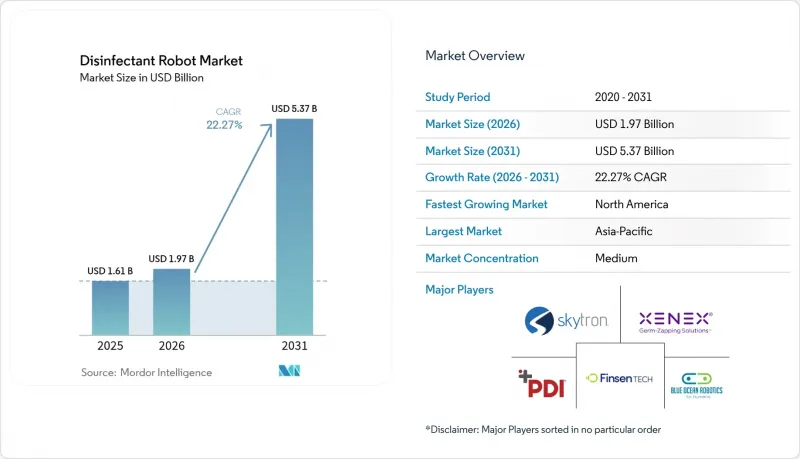
본 보고서는 소독 기술별(UV-C, 과산화수소 증기, 기타), 이동성 수준별(완전 자율형 이동 로봇, 반자율형/원격 조작형 로봇, 수동식 플랫폼), 최종 사용자별(병원 및 클리닉, 교통 거점·차량, 기타), 용도별(경질 표면 소독, 기타), 지역별로 분류되어 있습니다. 시장 예측은 금액(달러) 기준으로 제시되어 있습니다.
세계의 소독 로봇 시장 동향 및 인사이트
높은 병원 내 감염 발생률
미국에서는 입원 환자 31명 중 1명이 매일 병원 내 감염에 걸리고 있으며, 연간 총 68만 7,000건의 감염이 발생하여 280억-450억 달러의 비용이 소요되고 있습니다. 이와 유사한 경향은 전 세계적으로도 관찰됩니다. 표적화된 대책 프로그램으로 인해 MRSA 및 CLABSI의 발생률은 감소했으나, 포자 형성균인 클로스트리디오이데스 디피실(Clostridioides difficile)는 여전히 뿌리 깊게 남아 있어, 단단한 표면에서 10-30분 이내에 3-6 로그의 살균 효과를 재현성 있게 발휘하는 소독 로봇에 대한 도입 수요가 높아지고 있습니다. 질병 비용 추정에 따르면, 인공호흡기 관련 폐렴의 1건당 비용은 10만 달러를 초과하는 경우도 있습니다. 따라서 환자실 교체 시간을 단축하는 자동 UV-C 또는 과산화수소 소독 주기는 투자 수익률을 높이고 감염 예방 평가를 향상시킬 수 있습니다.
선진국의 엄격한 감염 관리 규정
CMS(미국 의료보험 및 의료서비스 센터)의 ‘병원 내 감염 감소 프로그램’에서는 2024 회계연도에 1,661개 병원에 대해 감염 대책 지표 미비라는 이유로 메디케어 지급액의 1%를 공제하는 처분이 내려졌습니다. 또한, FDA의 510(k) 승인 절차와 유럽의 MDR 2017/745에서는 시장 진입 전에 엄격한 임상 검증이 의무화되어 있습니다. 현재 인증 감사에서는 감사 가능한 위생 데이터의 제출이 요구되고 있으며, 이를 통해 사이클 시간, 분사량, 병원체 저감 증거를 자동으로 기록하는 소독 로봇 시장 솔루션을 도입하도록 시설에 인센티브가 제공되고 있습니다.
고액의 설비 투자와 총 소유 비용
75,000-125,000달러에 달하는 정가는 여전히 고가이며, 특히 환경 서비스 부문의 시간당 임금이 5달러 이하인 시설의 경우 큰 장벽이 되고 있습니다. 또한 소모품 및 연간 유지보수 비용으로 인해 총 지출이 10-20% 추가됩니다. 그 결과, 예산이 빠듯한 시설들은 도입을 주저하고 있으며, 특히 조달 위원회가 교육, 유지보수, 가동 중단 위험을 과소평가하는 경우 이러한 경향이 두드러집니다.
부문 분석
UV-C 플랫폼은 수십 년에 걸친 살균 효과 실증 데이터와 위험 회피 성향의 구매자에게 안도감을 주는 FDA 클래스 II 승인을 바탕으로, 2025년 소독 로봇 시장에서 62.74%의 시장 점유율을 차지했습니다. 이 부문은 소독 로봇 시장 규모의 대부분을 차지하며, 2025년까지 10억 1,000만 달러에 달했습니다. 원자외선(Far-UVC) 222nm 영역에서의 기술적 돌파구로 인해 사람이 머무는 공간에서도 사용이 가능해졌으며, 처리 주기의 부담이 경감되어 유동 인구가 많은 시설에서의 도입이 확대되고 있습니다. 한편, 플라즈마 및 오존 장치는 아직 발전 단계에 있지만, 시야 제약이 없는 솔루션을 원하는 시설 수요에 힘입어 연평균 성장률(CAGR) 25.05%로 성장하고 있습니다. 이러한 기체 라디칼은 밀폐된 공간으로 확산되지만, OSHA의 오존 농도 제한을 준수해야 하기 때문에 단기적인 보급에는 제약이 따르고 있습니다.
2세대 과산화수소 증기(HPV) 및 펄스 크세논 장치는 6 로그의 포자 살균이 의무화된 철저한 청소 수요에 부응하고 있으며, 한 자릿수 중반대의 성장률을 유지하고 있습니다. 각 벤더사는 현재 지속적인 공기 정화와 고강도 표면 집중 조사 기능을 결합한 듀얼 모드 기능을 통해 다양한 병원체의 서식 환경에서 효과를 확보하고 있습니다.
2025년, 반자율형 기기는 소독 로봇 시장 규모의 46.10%를 차지했으며, 운영자의 모니터링을 희생하더라도 설비 투자(CAPEX)를 30-40% 절감하고자 하는 예산 중심의 구매자들에게 지지를 받았습니다. 그러나 임금이 높은 지역에서 인건비 절감이 요구되는 가운데, 완전 자율형 플랫폼은 연평균 24.55%의 속도로 성장하여 반자율형 기기를 추월할 것으로 예측됩니다. SLAM을 탑재한 로봇은 체류 시간과 동적 약제 투여를 최적화함으로써, 수동 조작형 모델에 비해 20-30% 더 짧은 사이클 시간을 일상적으로 기록하고 있습니다. 솔리드 스테이트 LiDAR의 가격 하락과 오픈소스 자율 주행 스택의 보급에 따라 비용 곡선은 하락 추세를 보이고 있으며, 원격 조작형 장치와의 가격 차이는 점차 좁혀지고 있습니다.
지역별 분석
북미는 2025년 매출의 37.85%를 차지했으며, FDA 클래스 II 승인 및 병원 내 감염(HAI) 지표에 연동된 CMS의 벌금 제도 덕분에 그 성장세를 유지하고 있습니다. 대학 병원은 여전히 초기 도입자이며, 한편 중규모 병원은 설비 투자 승인 요건을 회피하기 위해 DaaS(Device-as-a-Service)로 전환하고 있습니다. 피츠버그에서 시애틀에 이르는 공항에서는 야간에 UV-C 로봇의 가동 상황을 공개하고 있어, 적극적인 위생 관리에 대한 일반 시민의 인식을 높이고 있습니다.
아시아태평양은 연평균 성장률(CAGR) 25.08%로 성장을 지속하고 있으며, 중국의 병원 건설 붐과 일본의 로봇 기술 우위에서 혜택을 보고 있습니다. 중국의 국내 공급업체들은 1만 달러 미만의 반자율형 로봇을 도입하고 있으며, 이는 2급 도시에서의 보급을 촉진하고 있습니다. 한국과 싱가포르에서는 로봇을 스마트 빌딩 생태계에 통합하고, IoT 대시보드를 통해 가동 일정을 관리하고 있습니다. 인도에서는 가격에 대한 민감성으로 인해 유지보수가 포함된 구독 모델이 선호되며, 합리적인 가격을 실현함으로써 가격 격차를 해소하고 있습니다.
유럽은 10%대 중반의 점유율을 차지했으며, ISO 13485 인증을 취득한 기업이나 CE 마크를 우선시하는 엄격한 MDR 요건의 영향을 받고 있습니다. 예산 제약에 직면한 영국의 국민보건서비스(NHS)는 서비스 계약에 의존하고 있는 반면, 독일에서는 프라운호퍼 연구소가 지원하는 UVC-LED 혁신 기술이 에너지 효율 향상을 주도하고 있습니다. 중동에서는 사우디아라비아와 아랍에미리트(UAE)의 메가 프로젝트에서 의료 관광 거점에 UV-C 기기군이 도입되고 있으며, 감염 대책이 차별화 요인으로 자리 잡고 있습니다. 아프리카에서는 남아프리카공화국과 나이지리아에서 인력 절감 및 데이터 기록 기능을 중시하는 기부자 자금 지원에 의한 시범 프로그램이 시행되고 있습니다.
기타 혜택
- 엑셀 형식 시장 예측(ME) 시트
- 3개월간의 애널리스트 지원
자주 묻는 질문
목차
제1장 서론
제2장 조사 방법
제3장 주요 요약
제4장 시장 구도
제5장 시장 규모 및 성장 예측
제6장 경쟁 구도
제7장 시장 기회 및 향후 전망
AJY 26.09.11According to Mordor Intelligence, the disinfectant robot market size was valued at USD 1.61 billion in 2025 and estimated to grow from USD 1.97 billion in 2026 to reach USD 5.37 billion by 2031, at a CAGR of 22.27% during the forecast period (2026-2031).

This report is Segmented by Disinfection Technology (UV-C, Hydrogen Peroxide Vapour, and More), Mobility Level (Fully Autonomous Mobile Robots, Semi-Autonomous/Tele-operated Robots, Manual-Push Platforms), End-User (Hospitals and Clinics, Transportation Hubs and Vehicles, and More), Application (Hard-Surface Disinfection, and More), and Geography. The Market Forecasts are Provided in Terms of Value (USD).
Global Disinfectant Robot Market Trends and Insights
High Incidence of Hospital-Acquired Infections
One in 31 U.S. inpatients suffers an HAI each day, totaling 687,000 infections yearly and costing USD 28-45 billion; similar patterns persist globally. While targeted programs trimmed MRSA and CLABSI rates, spore-forming Clostridioides difficile remains stubborn, reinforcing demand for disinfectant robot market deployments that deliver reproducible 3- to 6-log kill levels on hard surfaces within 10-30 minutes. Cost-of-illness estimates indicate that a ventilator-associated pneumonia episode can exceed USD 100,000. Therefore, automated UV-C or hydrogen peroxide cycles that shorten patient room turnover can boost return on investment and elevate infection prevention scores.
Stringent Infection-Control Regulations in Developed Economies
The CMS Hospital-Acquired Condition Reduction Program penalized 1,661 hospitals in FY 2024, withholding 1% of Medicare payments for poor infection metrics, while FDA 510(k) pathways and European MDR 2017/745 require rigorous clinical validation before market entry. Accreditation audits now demand auditable hygiene data, incentivizing facilities to adopt disinfectant robot market solutions that automatically log cycle times, delivered dose, and pathogen reduction evidence.
High Capital Expenditure and Total Cost of Ownership
List prices between USD 75,000 and USD 125,000 remain daunting, particularly where environmental services wages are below USD 5 per hour; consumables and annual service add 10-20% to outlays. Budget-strained facilities thus hesitate, particularly when procurement committees undervalue training, maintenance, and the risk of downtime.
Other drivers and restraints analyzed in the detailed report include:
- Technological Advances in UV-C and Autonomy Algorithms
- Post-COVID Surge in Infection-Prevention Budgets
- Operational Safety and Shadowing Concerns
For complete list of drivers and restraints, kindly check the Table Of Contents.
Segment Analysis
UV-C platforms held a 62.74% market share in the disinfectant robot market in 2025, supported by decades of germicidal evidence and FDA Class II clearances that reassure risk-averse buyers. This segment generated the bulk of the disinfectant robot market size, reaching USD 1.01 billion by 2025. Far-UVC's 222 nm breakthrough unlocks occupied-space use, reducing cycle overhead and broadening adoption in high-traffic venues. Meanwhile, plasma and ozone devices, although nascent, are growing at a 25.05% CAGR as facilities seek solutions that are immune to line-of-sight constraints. Their gaseous radicals diffuse into occluded spaces, yet they must adhere to OSHA ozone limits, tempering near-term penetration.
Second-generation hydrogen-peroxide vapor (HPV) and pulsed-xenon units address deep-clean demands where 6-log spore kills are mandated, sustaining mid-single-digit growth. Vendors now bundle dual-modality payloads, including continuous air purification and high-intensity surface bursts, to hedge efficacy across pathogen niches.
Semi-autonomous machines retained 46.10% disinfectant robot market size in 2025, appealing to budget-conscious buyers willing to trade operator oversight for 30-40% lower capex. Yet, fully autonomous platforms are forecast to outpace them, expanding at a 24.55% annual rate as high-wage regions seek labor savings. SLAM-equipped robots routinely log 20-30% shorter cycles than manual-push models by optimizing dwell times and dynamic dosing. Cost curves are bending downward as solid-state LiDAR prices fall and open-source autonomy stacks proliferate, eroding the price gap versus tele-operated units.
Complete Report Scope:
- By Disinfection Technology
- UV-C
- Hydrogen Peroxide Vapour
- Pulsed-Xenon
- Plasma / Ozone and Other Disinfection Technology
- By Mobility Level
- Fully Autonomous Mobile Robots
- Semi-Autonomous / Tele-operated Robots
- Manual-Push Platforms
- By End-user
- Hospitals and Clinics
- Transportation Hubs and Vehicles
- Hospitality and Retail Facilities
- Educational and Government Buildings
- Industrial and Other Commercial Sites
- Other End-user
- By Application
- Hard-Surface Disinfection
- Air and HVAC Disinfection
- Equipment and Device Disinfection
- Other Application
- By Geography
- North America
- United States
- Canada
- Mexico
- South America
- Brazil
- Argentina
- Rest of South America
- Europe
- Germany
- United Kingdom
- France
- Italy
- Spain
- Russia
- Rest of Europe
- Asia Pacific
- China
- Japan
- India
- South Korea
- Australia
- Rest of Asia Pacific
- Middle East and Africa
- Middle East
- Saudi Arabia
- United Arab Emirates
- Turkey
- Rest of Middle East
- Africa
- South Africa
- Nigeria
- Egypt
- Rest of Africa
- Middle East
- North America
Geography Analysis
North America generated 37.85% of 2025 revenue and maintains momentum through FDA Class II clearances and CMS penalty structures that tie reimbursement to HAI metrics. Academic medical centers remain early adopters, while mid-tier hospitals pivot toward DaaS to sidestep capital approval requirements. Airports from Pittsburgh to Seattle broadcast UV-C robot runs overnight, reinforcing public perception of proactive hygiene.
Asia Pacific, charting a 25.08% CAGR, benefits from China's hospital-build boom and Japan's robotics prowess. Domestic Chinese vendors have introduced semi-autonomous units under USD 10,000, catalyzing uptake across tier-2 cities. South Korea and Singapore integrate robots into smart-building ecosystems, scheduling cycles via IoT dashboards. India's price sensitivity favors subscription models bundled with maintenance, bridging affordability gaps.
Europe holds a mid-teens slice, shaped by strict MDR requirements that privilege ISO 13485 holders and CE marks. The United Kingdom's National Health Service, constrained by budgetary limitations, relies on service contracts, while Germany's Fraunhofer-backed UVC-LED innovations drive energy efficiency. Middle East mega-projects in Saudi Arabia and the UAE deploy UV-C fleets in medical-tourism hubs, positioning infection control as a differentiator. Africa sees pilot programs in South Africa and Nigeria backed by donor grants that emphasize labor-saving and data-logging capabilities.
- Blue Ocean Robotics A/S
- Xenex Disinfection Services LLC
- Finsen Technologies Ltd
- Skytron LLC
- PDI Healthcare Inc.
- Akara Robotics Ltd
- Mediland Enterprise Corporation
- TMiRob Technology Co. Ltd.
- OTSAW Digital Pte. Ltd.
- Bioquell PLC (Ecolab Inc.)
- Fetch Robotics Inc. (Zebra Technologies)
- Solustar Pte. Ltd.
- Ateago Technology (Shenzhen) Co. Ltd.
- Decon-X International AS
- AUDITE Robotics GmbH
- Nevoa Inc.
- UVDI (UltraViolet Devices Inc.)
- UV Medico ApS
Additional Benefits:
- The market estimate (ME) sheet in Excel format
- 3 months of analyst support
TABLE OF CONTENTS
1 INTRODUCTION
- 1.1 Study Assumptions and Market Definition
- 1.2 Scope of the Study
2 RESEARCH METHODOLOGY
3 EXECUTIVE SUMMARY
4 MARKET LANDSCAPE
- 4.1 Market Overview
- 4.2 Market Drivers
- 4.2.1 High Incidence Of Hospital-Acquired Infections
- 4.2.2 Stringent Infection-Control Regulations In Developed Economies
- 4.2.3 Technological Advances In UV-C And Autonomy Algorithms
- 4.2.4 Post-COVID Surge In Infection-Prevention Budgets
- 4.2.5 Deployment Mandates at Major Transit Hubs
- 4.2.6 Growth Of Disinfection-As-A-Service Business Models
- 4.3 Market Restraints
- 4.3.1 High Capital Expenditure and Total Cost of Ownership
- 4.3.2 Operational Safety and Shadowing Concerns
- 4.3.3 Emerging UV-Resistant Pathogen Strains
- 4.3.4 Competition From Long-Lasting Antimicrobial Coatings
- 4.4 Industry Value Chain Analysis
- 4.5 Regulatory Landscape
- 4.6 Technological Outlook
- 4.7 Porter's Five Forces Analysis
- 4.7.1 Bargaining Power of Suppliers
- 4.7.2 Bargaining Power of Consumers
- 4.7.3 Threat of New Entrants
- 4.7.4 Threat of Substitutes
- 4.7.5 Intensity of Competitive Rivalry
- 4.8 Impact of Macroeconomic Factors
5 MARKET SIZE AND GROWTH FORECASTS (VALUE)
- 5.1 By Disinfection Technology
- 5.1.1 UV-C
- 5.1.2 Hydrogen Peroxide Vapour
- 5.1.3 Pulsed-Xenon
- 5.1.4 Plasma / Ozone and Other Disinfection Technology
- 5.2 By Mobility Level
- 5.2.1 Fully Autonomous Mobile Robots
- 5.2.2 Semi-Autonomous / Tele-operated Robots
- 5.2.3 Manual-Push Platforms
- 5.3 By End-user
- 5.3.1 Hospitals and Clinics
- 5.3.2 Transportation Hubs and Vehicles
- 5.3.3 Hospitality and Retail Facilities
- 5.3.4 Educational and Government Buildings
- 5.3.5 Industrial and Other Commercial Sites
- 5.3.6 Other End-user
- 5.4 By Application
- 5.4.1 Hard-Surface Disinfection
- 5.4.2 Air and HVAC Disinfection
- 5.4.3 Equipment and Device Disinfection
- 5.4.4 Other Application
- 5.5 By Geography
- 5.5.1 North America
- 5.5.1.1 United States
- 5.5.1.2 Canada
- 5.5.1.3 Mexico
- 5.5.2 South America
- 5.5.2.1 Brazil
- 5.5.2.2 Argentina
- 5.5.2.3 Rest of South America
- 5.5.3 Europe
- 5.5.3.1 Germany
- 5.5.3.2 United Kingdom
- 5.5.3.3 France
- 5.5.3.4 Italy
- 5.5.3.5 Spain
- 5.5.3.6 Russia
- 5.5.3.7 Rest of Europe
- 5.5.4 Asia Pacific
- 5.5.4.1 China
- 5.5.4.2 Japan
- 5.5.4.3 India
- 5.5.4.4 South Korea
- 5.5.4.5 Australia
- 5.5.4.6 Rest of Asia Pacific
- 5.5.5 Middle East and Africa
- 5.5.5.1 Middle East
- 5.5.5.1.1 Saudi Arabia
- 5.5.5.1.2 United Arab Emirates
- 5.5.5.1.3 Turkey
- 5.5.5.1.4 Rest of Middle East
- 5.5.5.2 Africa
- 5.5.5.2.1 South Africa
- 5.5.5.2.2 Nigeria
- 5.5.5.2.3 Egypt
- 5.5.5.2.4 Rest of Africa
- 5.5.5.1 Middle East
- 5.5.1 North America
6 COMPETITIVE LANDSCAPE
- 6.1 Market Concentration
- 6.2 Strategic Moves
- 6.3 Market Share Analysis
- 6.4 Company Profiles (includes Global level Overview, Market level overview, Core Segments, Financials as available, Strategic Information, Market Rank/Share for key companies, Products and Services, and Recent Developments)
- 6.4.1 Blue Ocean Robotics A/S
- 6.4.2 Xenex Disinfection Services LLC
- 6.4.3 Finsen Technologies Ltd
- 6.4.4 Skytron LLC
- 6.4.5 PDI Healthcare Inc.
- 6.4.6 Akara Robotics Ltd
- 6.4.7 Mediland Enterprise Corporation
- 6.4.8 TMiRob Technology Co. Ltd.
- 6.4.9 OTSAW Digital Pte. Ltd.
- 6.4.10 Bioquell PLC (Ecolab Inc.)
- 6.4.11 Fetch Robotics Inc. (Zebra Technologies)
- 6.4.12 Solustar Pte. Ltd.
- 6.4.13 Ateago Technology (Shenzhen) Co. Ltd.
- 6.4.14 Decon-X International AS
- 6.4.15 AUDITE Robotics GmbH
- 6.4.16 Nevoa Inc.
- 6.4.17 UVDI (UltraViolet Devices Inc.)
- 6.4.18 UV Medico ApS
7 MARKET OPPORTUNITIES AND FUTURE OUTLOOK
- 7.1 White-space and unmet-need assessment