

|
시장보고서
상품코드
2124291
북미의 시험, 검사, 인증(TIC) 시장 : 시장 점유율 분석, 업계 동향 및 통계, 성장 예측(2026-2031년)North America Testing, Inspection And Certification (TIC) - Market Share Analysis, Industry Trends & Statistics, Growth Forecasts (2026 - 2031) |
||||||
 Mordor Intelligence
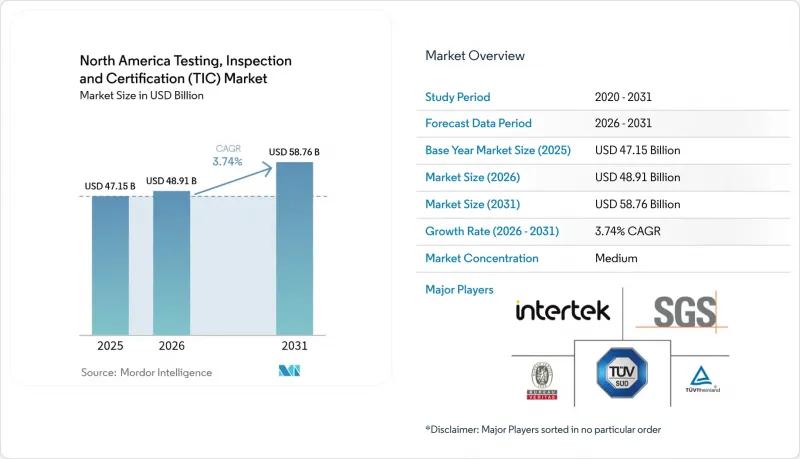
Mordor Intelligence에 의하면, 2026년 북미의 TIC 시장 규모는 489억 1,000만 달러로 추정되고, 2025년 471억 5,000만 달러에서 성장하여 2031년에는 587억 6,000만 달러에 이를 것으로 예측됩니다.
2026-2031년 연평균 성장률(CAGR)은 3.74%가 될 것으로 전망됩니다.
본 보고서는 서비스 유형별(시험, 검사, 인증), 조달 형태별(사내 실시, 외부 위탁), 산업 부문별(소비재 및 소매, ICT·통신, 자동차 및 운송, 기타), 서비스 제공 형태별(온사이트, 오프사이트·시험소, 원격·디지털), 국가별로 분류되어 있습니다. 시장 예측은 금액(달러) 기준으로 제시되어 있습니다.
북미의 시험, 검사, 인증(TIC) 시장 동향 및 인사이트
북미의 엄격한 규제 체계로 인한 높은 규정 준수 부담
국경 간 규제가 강화됨에 따라 제조업체는 엄격한 제3자 검증을 유지해야 할 의무가 있습니다. EPA(미국 환경보호청)의 2024년 TSCA 용제 규제에서는 이전 OSHA(미국 직업안전보건청)의 기준치보다 훨씬 낮은 노출 한도치가 도입되어 광범위한 모니터링 요건이 부과되었습니다. OSHA의 2024년 위험 정보 전달(HazCom) 업데이트로 인해 라벨 표기가 GHS 제7판에 부합하게 되었고, 재분류 프로젝트가 추가됨에 따라 시험소에 새로운 업무가 발생하고 있습니다. 캐나다는 2025년에 복합 목재의 포름알데히드 기준치를 미국과 일치시켜, 인증 시험소에 의한 시험 의무를 유지하면서도 무역 마찰을 완화했습니다. 화장품 및 제약 기업들은 현재 표준화된 방법을 사용한 FDA가 제안하는 석면 시험 프로토콜을 적용해야 하는 상황에 직면해 있으며, 이로 인해 시료 수는 더욱 증가하고 있습니다. 그 결과, 북미의 TIC 시장은 규정 준수에 대한 문서화된 독립적 증명을 요구하는 규제 환경으로부터 지속적으로 혜택을 받고 있습니다.
제조 공급망의 복잡화와 분산형 조달
다층적인 공급업체 네트워크는 특히 중요한 부품이 분산된 공장에서 공급될 경우 품질 보증 위험을 높입니다. 케임브리지 대학의 연구에서는 공급망의 복잡성과 제품 안전 사고 증가 간의 연관성이 지적되었으며, 전문적인 감사의 필요성이 강조되고 있습니다. SGS는 이에 대응하여 디지털 대시보드, 자가 평가 설문지, 현장 검증을 결합한 ‘공급업체 평가 및 인증 솔루션’을 제공함으로써 가시성의 격차를 해소하고 있습니다. 자동차, 항공우주, 전자 기업들은 조립 공정에 도달하기 전에 2차 공급업체의 취약점을 파악하기 위해 이러한 프로그램을 도입하고 있습니다. 북미의 니어쇼어링으로 인해 멕시코에 새로운 시설이 증가하고 있으며, OEM 기업들은 익숙하지 않은 파트너를 신속하게 검증할 수밖에 없는 상황에 처해 있습니다. 그 결과, 북미의 TIC 시장은 분산형 생산 모델의 위험 완화 파트너로서의 역할을 수행함으로써 장기적인 수요를 확보하고 있습니다.
TIC 공급업체 간의 높은 비용 압박과 경쟁
세계 기업들은 대량이며 표준화된 프로젝트를 놓고 치열하게 경쟁하고 있어, 수요가 확대되고 있음에도 불구하고 이익률은 압박을 받고 있습니다. 아웃소싱 제품 및 서비스의 약 7%를 차지하는 UL Solutions는 EBITDA 마진 24%를 목표로 하고 있지만, 현재는 20% 전후에 머물러 있어 효율화 추세의 역풍이 반영되고 있습니다. SGS는 규모의 경제를 추진하기 위해 여러 차례의 인수를 통해 환경 및 연결성 관련 시험소를 증설했습니다. 뷰로 베리타스는 Maxxam Analytics를 4억 8,500만 달러에 인수하여, 해당 회사를 통합함으로써 캐나다 내 사업 범위를 확대하는 동시에 고정비 분산을 도모했습니다. 상품화된 화학물질 스크리닝이나 반복적인 안전 감사에서는 차별화의 여지가 거의 없어, 서비스 제공업체들은 일괄 계약이나 다년간의 가격 고정 협상을 할 수밖에 없는 상황입니다. 거래량은 증가 추세에 있지만, 지속적인 산업 재편으로 인해 북미 TIC 시장의 성장률은 둔화되고 있습니다.
부문별 분석
2025년, 북미 TIC 시장 규모의 61.12%를 시험 서비스가 차지했으며, 규제 준수 및 제품 개발에서 시험 기관의 검증이 수행하는 기초적인 역할이 부각되었습니다. 인증 부문은 규모는 작지만, 원시 데이터뿐만 아니라 문서화된 적합성이 점점 더 요구되는 규제의 영향으로 2031년까지 연평균 성장률(CAGR) 4.41%를 나타낼 것으로 예측됩니다. 북미 TIC 시장은 새로운 PFAS, 배터리 안전성, 적층 가공 관련 기준이 등장하는 가운데, 대규모 화학, 환경, 재료 분석에 계속 의존하고 있습니다.
인증 부문의 성장은 OSHA의 GHS(세계 조화 시스템) 준수 및 EPA의 PFAS 관련 규제를 반영한 것으로, 이는 제조업체가 출하 전에 인증을 획득할 것을 의무화하고 있습니다. SGS의 ISO/IEC 17025 인증을 받은 파밍데일 시설 등, 항공우주 및 해양 부문의 화재 시험 업그레이드는 시험과 인증을 통합한 패키지가 어떻게 부가가치를 창출하는지를 보여줍니다. 두 서비스를 결합한 제공업체는 시장 점유율을 확보하고 고객과의 유대 관계를 강화함으로써 북미 TIC 산업에서 경쟁력을 강화할 수 있습니다.
2025년에는 북미 TIC 시장 점유율의 69.82%를 아웃소싱 프로젝트가 차지했으며, 기업들이 핵심 경쟁력에 집중하고 자본 집약적인 시험소에 대한 투자에 어려움을 겪는 가운데 그 비율은 상승하고 있습니다. 규제 강화와 전문 장비 비용 급등에 따라 아웃소싱 부문은 2031년까지 연평균 4.53% 성장할 것으로 예측됩니다. 그 결과, 북미 TIC 시장은 전략적 조달 패턴에 따라 변화하고 있으며, 품질 관리가 사내 팀에서 외부 전문가로 이전되고 있습니다.
디지털 원격 검사 플랫폼은 아웃소싱 도입을 가속화하고 있습니다. 뷰로 베리타스(Bureau Veritas)의 보고서에 따르면, 고객이 현장 샘플링과 가상 모니터링을 결합한 하이브리드 감사 모델로 전환함에 따라 프로젝트 주기가 단축되고 탄소 발자국이 감소하는 것으로 나타났습니다. UL 솔루션즈의 ‘CableBuilder’ 소프트웨어는 문서 흐름을 디지털화하여 이러한 추세를 뒷받침하며, 숙련된 인력 부족에 직면한 제조업체의 재작업량을 줄이고 있습니다. 이러한 사례들은 아웃소싱 제공업체가 기술을 활용하여 가치를 높이고, 고객의 품질 관리 팀을 보완하는 역할을 확고히 하고 있음을 보여줍니다.
기타 혜택
- 엑셀 형식 시장 전망(ME) 시트
- 3개월간의 애널리스트 지원
자주 묻는 질문
목차
제1장 서론
제2장 조사 방법
제3장 주요 요약
제4장 시장 구도
제5장 시장 규모 및 성장 예측
제6장 경쟁 구도
제7장 시장 기회 및 향후 전망
AJY 26.09.11According to Mordor Intelligence, North America TIC market size in 2026 is estimated at USD 48.91 billion, growing from 2025 value of USD 47.15 billion with 2031 projections showing USD 58.76 billion, growing at 3.74% CAGR over 2026-2031.
This report is Segmented by Service Type (Testing, Inspection, and Certification), Sourcing Type (In-House and Outsourced), Industry Vertical (Consumer Goods and Retail, ICT and Telecom, Automotive and Transportation, and More), Mode of Service Delivery (On-Site, Off-site/Laboratory, and Remote/Digital), and Country. The Market Forecasts are Provided in Terms of Value (USD).
North America Testing, Inspection And Certification (TIC) Market Trends and Insights
High Compliance Burden Due to Stringent North American Regulatory Frameworks
Escalating cross-border rules obligate manufacturers to maintain rigorous third-party verification. The EPA's 2024 TSCA solvent rules introduced exposure limits dramatically below earlier OSHA thresholds, triggering extensive monitoring requirements. OSHA's 2024 Hazard Communication update aligned labels with GHS Rev 7, adding re-classification projects that funnel fresh work to laboratories. Canada matched U.S. formaldehyde limits for composite wood in 2025, preserving accredited-lab testing mandates while easing trade frictions. Cosmetic and pharmaceutical companies now face FDA-proposed asbestos testing protocols using standardized methods, further lifting sample volumes. As a result, the North America TIC market consistently benefits from a regulatory environment that demands documented, independent proof of compliance.
Rising Complexity of Manufacturing Supply Chains and Distributed Sourcing
Multi-tier supplier networks heighten quality-assurance risk, especially when critical components originate in dispersed plants. University of Cambridge research links supply-chain complexity to higher product-safety incidents, underscoring the need for specialized audits. SGS responded with Supplier Evaluation and Qualification Solutions that blend digital dashboards, self-assessment questionnaires, and on-site verifications to close visibility gaps. Automotive, aerospace, and electronics firms deploy such programs to uncover tier-2 weaknesses before they reach assembly. North American nearshoring adds new facilities in Mexico, forcing original equipment manufacturers to validate unfamiliar partners quickly. Consequently, the North America TIC market secures long-term demand by acting as a risk-mitigation partner for distributed production models.
High Cost Pressure and Price Competition among TIC Providers
Global players vie aggressively for high-volume, standardized projects, compressing margins even as demand grows. UL Solutions, holding roughly 7% of outsourced product services, targets a 24% EBITDA margin but currently hovers near 20%, reflecting efficiency headwinds. SGS added environmental and connectivity labs via multiple acquisitions to drive scale economies. Bureau Veritas purchased Maxxam Analytics for USD 485 million, integrating it to broaden Canadian coverage and dilute fixed costs. Commoditized chemical screens and repetitive safety audits leave little room for differentiation, forcing providers to negotiate bundled contracts and multi-year price locks. Persistent consolidation tempers the growth rate of the North America TIC market, even as volumes trend upward.
Other drivers and restraints analyzed in the detailed report include:
- Digital Transformation Driving Demand for Data-Integrated Testing and Inspection Services
- Surge in Electric-Vehicle and Battery Production Requiring Specialized TIC
- Shortage of Skilled Inspectors and Laboratory Technicians in Specialized Domains
For complete list of drivers and restraints, kindly check the Table Of Contents.
Segment Analysis
Testing services accounted for 61.12% of the North America TIC market size in 2025, underlining the foundational role laboratory verification plays across regulatory compliance and product development. Certification, while smaller, is forecast to record a 4.41% CAGR through 2031, aided by rules that increasingly demand documented conformity beyond raw data. The North America TIC market continues to rely on large-scale chemical, environmental, and material analyses as new PFAS, battery-safety, and additive-manufacturing standards emerge.
Certification growth reflects OSHA's GHS alignment and EPA's PFAS mandates, which compel manufacturers to secure accredited sign-offs before shipments. Aerospace and maritime fire-testing upgrades, such as SGS's ISO/IEC 17025-accredited Farmingdale facility, demonstrate how integrated testing-plus-certification packages add value. Providers bundling both services can capture wallet share and create stickier client relationships, reinforcing competitive positioning within the North America TIC industry.
Outsourced engagements represented 69.82% of the North America TIC market share in 2025, rising as companies focus on core competencies and grapple with capital-intensive lab investments. Forecasts show the outsourced segment growing at 4.53% through 2031 as regulations proliferate and specialized instrumentation costs escalate. Consequently, the North America TIC market aligns with strategic procurement patterns, shifting quality control from in-house teams to external experts.
Digital remote-inspection platforms accelerate outsourcing adoption. Bureau Veritas reports faster project cycles and smaller carbon footprints when customers pivot to hybrid audit models combining on-site sampling with virtual oversight. UL Solutions' CableBuilder software augments this trend by digitizing documentation flows, reducing rework for manufacturers facing skilled-labor gaps. These examples illustrate how outsourced providers deploy technology to amplify value and cement their role as extensions of client quality teams.
Complete Report Scope:
- By Service Type
- Testing
- Inspection
- Certification
- By Sourcing Type
- In-house
- Outsourced
- By Industry Vertical
- Consumer Goods and Retail
- ICT and Telecom
- Automotive and Transportation
- Aerospace and Defense
- Oil, Gas and Petrochemicals
- Energy and Utilities
- Industrial Manufacturing and Machinery
- Chemicals and Materials
- Construction and Infrastructure
- Life Sciences and Healthcare
- Food, Agriculture and Beverage
- Other Industry Verticals (Environment, Sustainability, etc.)
- By Mode of Service Delivery
- On-site
- Off-site / Laboratory
- Remote / Digital
- By Country
- United States
- Canada
- Mexico
List of Companies Covered in this Report:
- SGS SA
- Bureau Veritas SA
- Intertek Group plc
- TUV SUD AG
- TUV Rheinland AG
- DEKRA SE
- Applus Services S.A.
- UL Solutions Inc.
- CSA Group
- Eurofins Scientific SE
- DNV AS
- Lloyd's Register Group Limited
- ALS Limited
- Element Materials Technology Group
- BSI Group
- Mistras Group Inc.
- Kiwa NV
- NSF International
- SAI Global Pty Limited
- RINA S.p.A.
- NTS (National Technical Systems)
- Core Laboratories Inc.
- Phenova Inc.
- Envirotest Laboratories Inc.
Additional Benefits:
- The market estimate (ME) sheet in Excel format
- 3 months of analyst support
TABLE OF CONTENTS
1 INTRODUCTION
- 1.1 Study Assumptions and Market Definition
- 1.2 Scope of the Study
2 RESEARCH METHODOLOGY
3 EXECUTIVE SUMMARY
4 MARKET LANDSCAPE
- 4.1 Market Overview
- 4.2 Market Drivers
- 4.2.1 High compliance burden due to stringent North American regulatory frameworks
- 4.2.2 Rising complexity of manufacturing supply chains and distributed sourcing
- 4.2.3 Digital transformation driving demand for data-integrated testing and inspection services
- 4.2.4 Surge in electric-vehicle and battery production requiring specialized TIC
- 4.2.5 Carbon-border adjustment policies prompting embedded-carbon verification
- 4.2.6 Proliferation of additive-manufacturing service bureaus needing certification
- 4.3 Market Restraints
- 4.3.1 High cost pressure and price competition among TIC providers
- 4.3.2 Shortage of skilled inspectors and laboratory technicians in specialized domains
- 4.3.3 Ambiguity in jurisdiction over remote/digital inspection results
- 4.3.4 Corporate sustainability self-declarations reducing third-party certification demand
- 4.4 Industry Value Chain Analysis
- 4.5 Impact of Macroeconomic Factors
- 4.6 Regulatory Landscape
- 4.7 Technological Outlook
- 4.8 Porter's Five Forces Analysis
- 4.8.1 Threat of New Entrants
- 4.8.2 Bargaining Power of Suppliers
- 4.8.3 Bargaining Power of Buyers
- 4.8.4 Threat of Substitutes
- 4.8.5 Competitive Rivalry
5 MARKET SIZE AND GROWTH FORECASTS (VALUES)
- 5.1 By Service Type
- 5.1.1 Testing
- 5.1.2 Inspection
- 5.1.3 Certification
- 5.2 By Sourcing Type
- 5.2.1 In-house
- 5.2.2 Outsourced
- 5.3 By Industry Vertical
- 5.3.1 Consumer Goods and Retail
- 5.3.2 ICT and Telecom
- 5.3.3 Automotive and Transportation
- 5.3.4 Aerospace and Defense
- 5.3.5 Oil, Gas and Petrochemicals
- 5.3.6 Energy and Utilities
- 5.3.7 Industrial Manufacturing and Machinery
- 5.3.8 Chemicals and Materials
- 5.3.9 Construction and Infrastructure
- 5.3.10 Life Sciences and Healthcare
- 5.3.11 Food, Agriculture and Beverage
- 5.3.12 Other Industry Verticals (Environment, Sustainability, etc.)
- 5.4 By Mode of Service Delivery
- 5.4.1 On-site
- 5.4.2 Off-site / Laboratory
- 5.4.3 Remote / Digital
- 5.5 By Country
- 5.5.1 United States
- 5.5.2 Canada
- 5.5.3 Mexico
6 COMPETITIVE LANDSCAPE
- 6.1 Market Concentration
- 6.2 Strategic Moves
- 6.3 Market Share Analysis
- 6.4 Company Profiles (includes Global level Overview, Market level overview, Core Segments, Financials as available, Strategic Information, Market Rank/Share for key companies, Products and Services, and Recent Developments)
- 6.4.1 SGS SA
- 6.4.2 Bureau Veritas SA
- 6.4.3 Intertek Group plc
- 6.4.4 TUV SUD AG
- 6.4.5 TUV Rheinland AG
- 6.4.6 DEKRA SE
- 6.4.7 Applus Services S.A.
- 6.4.8 UL Solutions Inc.
- 6.4.9 CSA Group
- 6.4.10 Eurofins Scientific SE
- 6.4.11 DNV AS
- 6.4.12 Lloyd's Register Group Limited
- 6.4.13 ALS Limited
- 6.4.14 Element Materials Technology Group
- 6.4.15 BSI Group
- 6.4.16 Mistras Group Inc.
- 6.4.17 Kiwa NV
- 6.4.18 NSF International
- 6.4.19 SAI Global Pty Limited
- 6.4.20 RINA S.p.A.
- 6.4.21 NTS (National Technical Systems)
- 6.4.22 Core Laboratories Inc.
- 6.4.23 Phenova Inc.
- 6.4.24 Envirotest Laboratories Inc.
7 MARKET OPPORTUNITIES AND FUTURE OUTLOOK
- 7.1 White-space and Unmet-need Assessment


