
|
시장보고서
상품코드
2124307
패시브 광 네트워크(PON) 장비 시장 : 시장 점유율 분석, 업계 동향 및 통계, 성장 예측(2026-2031년)Passive Optical Network (PON) Equipment - Market Share Analysis, Industry Trends & Statistics, Growth Forecasts (2026 - 2031) |
||||||
 Mordor Intelligence
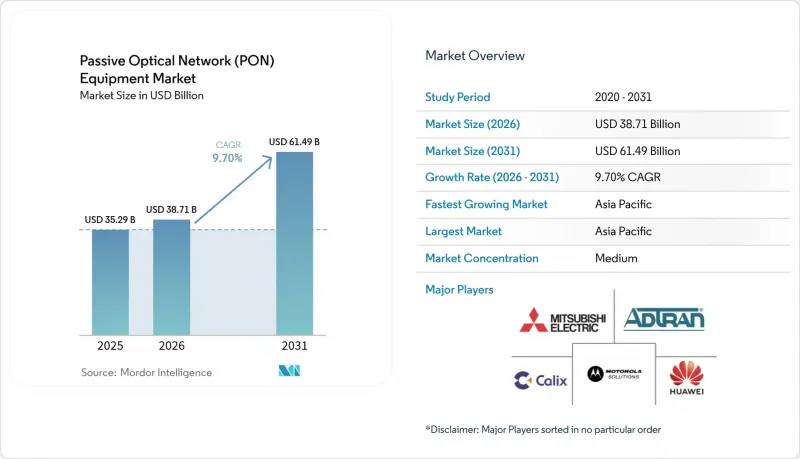
Mordor Intelligence에 의하면, 패시브 광 네트워크 장비 시장 규모는 2025년에 352억 9,000만 달러로 평가되었고, 2026년 387억 1,000만 달러에서 2031년까지 614억 9,000만 달러에 이를 것으로 예측되며, 예측 기간(2026-2031년) CAGR은 9.70%를 나타낼 전망입니다.
본 보고서는 구조별(이더넷 PON 장비, 기가비트 PON 장비, 기타), 구성 요소별(광회선 종단 장치, 기타), 용도별(FTTH/FTTx, 모바일 백홀·5G 전송, 기타), 최종 사용자 산업별(통신 사업자·ISP, 광섬유 전환을 추진하는 케이블 MSO, 기타), 지역별로 분류되어 있습니다. 시장 예측은 금액(달러) 기준으로 제시되어 있습니다.
세계의 패시브 광 네트워크(PON) 장비 시장 동향 및 인사이트
XGS-PON으로의 업그레이드 가속화가 북미의 현대화를 주도
AT&T, Verizon, Brightspeed 등 미국 통신 사업자들은 대칭형 10Gbps 처리량과 기존 GPON 회선과 공존 가능한 콤보 광 모듈을 이유로 XGS-PON을 향후 고정 액세스 전략의 핵심으로 자리매김하고 있습니다. 조달 대상은 섀시, 라인 카드, ONT 등이며, 이를 통해 사용자 1인당 평균 수익(ARPU)을 끌어올리는 프리미엄급 서비스 제공이 가능해집니다. 패시브 광 네트워크 장비 시장은 새로운 광섬유 설치 장소마다 중앙국용 및 고객 가정용 장비가 모두 필요하기 때문에 직접적인 혜택을 받고 있습니다. 표준화된 공존형 광 모듈을 통해 전환 시 서비스 중단이 최소화됩니다. 연방 정부의 광대역 보조금과 맞물려, 이러한 모멘텀은 설비 투자를 앞당기며 북미를 조기 도입의 거점으로 확고히 자리매김하고 있습니다.
정부 자금 지원 농촌 FTTH 프로그램이 수요를 재편
2024년에 전 세계적으로 1,000억 달러를 초과하는 공공 프로그램을 통해, 지금까지 서비스 대상에서 제외되었던 지방 가구가 광섬유 구축의 최우선 순위에 위치하게 되었습니다. 오픈 액세스 규정과 국내 조달 조항은 지역 공급업체와 더 높은 분기 비율에 유리하게 작용합니다. 통신 사업자가 긴 루프나 인구 밀도가 낮은 지역에 직면함에 따라, 장거리 대응 광 모듈과 내환경성이 뛰어난 실외용 ONT의 중요성이 높아지고 있습니다. 또한, 자금 조달 일정에 따라 건설 기간이 단축되면서 프로젝트 주기의 초기 단계에서 수주량이 증가하고 있습니다. 그 결과, 수동형 광네트워크 장비 시장에서는 인구 밀도가 높은 대도시권에서 지방 외곽 지역으로 수요가 지리적으로 재분배되고 있어, 중견 공급업체들에게 새로운 경쟁의 장이 열리고 있습니다.
공급망 병목 현상이 ONU 공급 제약
세계 반도체 공급 불균형으로 인해 고성능 10G 광모듈 및 SoC의 리드타임이 길어지면서, XGS-PON ONU의 납기 기간이 1년을 초과하는 상황이 발생하고 있습니다. 조달 역량이 부족한 중소규모 ISP는 Tier 1 통신사 뒤에 줄을 설 수밖에 없어, 가입자의 서비스 개시가 지연되고 수익 창출도 미뤄지고 있습니다. 일부 사업자는 비용이 높은 콤보 PON ONT를 발주함으로써 리스크를 헤지하고 있으며, 이로 인해 부품 원가가 상승하고 있습니다. 지정학적 긴장이 지속되는 가운데, 패시브 광 네트워크 장비 시장은 재고 버퍼 확대 및 생산 안정화를 목표로 한 리쇼어링 움직임에 직면해 있습니다.
부문 분석
현재 수익은 GPON의 확고한 시장 점유율을 반영하고 있지만, 통신 사업자들은 전략적으로 차세대 플랫폼에 대한 투자를 추진하고 있습니다. 2025년, GPON은 수동형 광 네트워크 장비 시장 규모의 39.90%라는 최대 점유율을 차지했습니다. 새로운 가정용 연결 목표에 대한 수요는 여전히 견조하지만, 대역폭 성장 곡선에 따라 통신 사업자들은 XGS-PON 오버레이 도입을 계획하고 있으며, 고밀도 대도시권에서는 50G-PON의 시범 도입을 점점 더 추진하고 있습니다. 단일 라인 카드에 콤보 광 모듈을 공급하는 벤더들은 통신 사업자가 비용과 로드맵의 확실성 사이에서 균형을 맞출 수 있도록 지원하며, 수동형 광 네트워크 장비 시장의 다중 표준 균형을 유지하고 있습니다. 예측 기간 동안 50G-PON/NG-PON2 장비는 연평균 성장률(CAGR) 10.55%로 확대될 것이며, 이러한 속도로 2031년까지 예측 시장 점유율 구성이 재조정될 전망입니다.
통신 사업자들은 파장 공존을 활용하여 GPON과 XGS-PON을 병행 운영하며, 고객의 업그레이드 계획에 맞추어 가입자 이탈이 조정될 때까지 스플리터와 ONT를 그대로 유지하고 있습니다. 아시아태평양이 50G-PON의 개념 증명(PoC)을 주도하는 한편, 미국의 통신 사업자들은 업스트림 트래픽 증가에 선제적으로 대응하기 위해 2026년부터 시범 운영을 검토하고 있습니다. 대칭형 광대역에 관한 정책적 의무도 기술 선정의 지침이 되고 있습니다. 그 결과, 수동형 광 네트워크 장비 시장에서는 장비를 전면 교체하기보다는 계층적 아키텍처로의 전환이 진행되고 있으며, 핫스왑이 가능한 광 모듈을 갖춘 모듈형 섀시가 선호되고 있습니다.
2025년에는 OLT 섀시와 라인 카드가 수동형 광네트워크 장비 시장 규모의 46.05%를 차지했으며, 집약형 인텔리전스로서의 극히 중요한 역할을 부각시켰습니다. 각 OLT 포트는 최대 128개의 가입자 가구를 지원하며, 대수는 적지만 매출에 기여하는 비중은 매우 크다고 할 수 있습니다. 기능 면에서의 차별화는 현재 오픈 API, SDN 에이전트, AI를 활용한 전력 스케일링에 중점을 두고 있으며, 이러한 특성들이 패시브 광 네트워크 장비 시장에서 소프트웨어 도입률 향상에 기여하고 있습니다. 광섬유망의 확대와 디바이스 교체 주기의 단축에 따라 ONT/ONU 출하 대수는 연평균 성장률(CAGR) 10.88%로 증가하고 있습니다.
부품 동향은 상용 실리콘 설계 및 플러그인 가능한 광 모듈로 전환되고 있으며, 이에 따라 화이트박스 벤더들이 시장 점유율을 확대되고 있습니다. 분산형 OLT 아키텍처는 제어 플레인과 데이터 플레인을 분리하여 통신 사업자가 상용 블레이드 및 타사 소프트웨어를 조달할 수 있게 합니다. 이는 데이터센터에서 이미 검증된 모델입니다. 패시브 스플리터, 감쇠기, WDM 커플러는 여전히 필수적이지만, 급속한 상품화가 진행 중이며, 이익률의 초점은 지능형 실리콘 및 제어 소프트웨어로 이동하고 있습니다. 그 결과, 패시브 광 네트워크 장비 시장에서는 개방형 인터페이스를 갖춘 엔드투엔드 생태계를 제공하는 공급업체가 우위를 점하고 있습니다.
지역별 분석
아시아태평양은 이미 3,000만 명의 가입자를 보유한 중국의 전국적인 FTTR 추진에 힘입어, 2025년 매출에서 38.40%라는 최대 점유율을 차지했습니다. 광섬유를 전략적 인프라로 규정하는 지역 정책에 따라 세제 혜택과 저리 대출이 확대되고 있으며, 이는 국내 벤더들에게 규모의 경제를 가져다주고 있습니다. 인도와 인도네시아는 중국의 모델을 본받아 2030년까지 매년 두 자릿수의 가정용 가입자 증가를 목표로 하고 있으며, 이에 따라 패시브 광 네트워크 장비 시장의 출하량도 두 자릿수 성장을 유지하고 있습니다.
북미에서는 ‘인프라 투자 및 고용법’에 따라 광대역 구축에 650억 달러가 배정됨에 따라, 자금을 원동력으로 한 급속한 성장이 나타나고 있습니다. Tier 1 통신 사업자들은 농촌 및 도시 외곽 지역으로의 XGS-PON 구축을 가속화하고 있는 반면, 유틸리티협동조합은 수익 다각화를 위해 PON을 도입하고 있습니다. 벤더의 다양화는 두드러진 주제이며, 통신 사업자들은 지정학적 리스크와 공급망 리스크를 완화하기 위해 최소 2개공급업체에 주문을 분산하고 있습니다. 가입자 1인당 전력 소비량이나 재활용 가능성 같은 지속가능성 지표가 현재 RFP(제안 요청서)의 평가 기준에 반영되어, 패시브 광 네트워크 장비 시장 전체의 벤더 로드맵에 영향을 미치고 있습니다.
유럽에서는 유럽투자은행(EIB)의 대출과 그린 네트워크 설계에 대한 집중적인 지원에 힘입어 꾸준한 성장을 유지하고 있습니다. 오픈 액세스 의무화로 인해 도매 광섬유 모델이 촉진되고 있으며, 경쟁 ISP들이 OLT 포트를 임대하는 움직임이 활발해지고 있습니다. 신흥 시장인 중동 및 아프리카(MEA)와 라틴아메리카의 주요 지역에서는 각국 정부가 광섬유 백본을 우선시하는 디지털 경제 청사진을 수립하고 있지만, 통화적 제약과 기술자 부족으로 인해 단기적인 수요는 억제되고 있습니다. 그럼에도 불구하고, 걸프협력회의(GCC) 회원국들의 시범 프로젝트에서는 지역 전체로 확대되는 기가비트 커뮤니티가 실현되고 있으며, 이는 수동형 광네트워크 장비 시장에 다양한 성장의 발판을 마련해 주고 있습니다.
기타 혜택
- 엑셀 형식 시장 예측(ME) 시트
- 3개월간의 애널리스트 지원
자주 묻는 질문
목차
제1장 서론
제2장 조사 방법
제3장 주요 요약
제4장 시장 구도
제5장 시장 규모 및 성장 예측
제6장 경쟁 구도
제7장 시장 기회 및 향후 전망
AJY 26.09.11According to Mordor Intelligence, the passive optical network equipment market size was valued at USD 35.29 billion in 2025 and estimated to grow from USD 38.71 billion in 2026 to reach USD 61.49 billion by 2031, at a CAGR of 9.70% during the forecast period (2026-2031).
This report is Segmented by Structure (Ethernet PON Equipment, Gigabit PON Equipment, and More), Component (Optical Line Terminal, and More), Application (FTTH/FTTx, Mobile Backhaul and 5G Transport, and More), End-User Vertical (Telecom Operators and ISPs, Cable MSOs Transitioning To Fibre, and More), and Geography. The Market Forecasts are Provided in Terms of Value (USD).
Global Passive Optical Network (PON) Equipment Market Trends and Insights
Accelerating XGS-PON Upgrades Drive North American Modernization
U.S. carriers such as AT&T, Verizon, and Brightspeed have placed XGS-PON at the center of their future fixed-access blueprints, citing symmetric 10 Gbps throughput and combo optics that coexist with installed GPON lines. Procurement spans chassis, line cards, and ONTs, enabling premium-tier offerings that lift average revenue per user. The Passive Optical Network Equipment market benefits directly because each new fiber location requires both central-office and customer-premises gear. Standardized coexistence optics minimize service disruption during cutovers. Coupled with federal broadband subsidies, the momentum pulls forward capital outlays and cements North America as an early adopter hub.
Government-Funded Rural FTTH Programs Reshape Demand
Public programs exceeding USD 100 billion globally in 2024 moved unserved rural households to the front of fiber deployment queues. Open-access rules and domestic-content clauses favor regional vendors and higher split ratios. Extended-reach optics and hardened outdoor ONTs gain relevance as operators confront long loops and sparse populations. Funding schedules also compress build timelines, propelling order volumes earlier in project cycles. The Passive Optical Network Equipment market therefore sees geographic demand redistribution from dense metros to rural fringes, creating a fresh competitive arena for mid-tier suppliers.
Supply-Chain Bottlenecks Constrain ONU Availability
Global semiconductor imbalances stretch lead times for advanced 10G optics and SoCs, pushing delivery windows for XGS-PON ONUs past one year. Smaller ISPs lacking procurement clout queue behind tier-1 carriers, holdup subscriber activations, and postpone revenue. Some operators hedge by ordering higher-cost combo-PON ONTs, raising bill-of-materials. As geopolitical tensions linger, the Passive Optical Network Equipment market contends with elevated inventory buffers and re-shoring initiatives aimed at stabilizing output.
Other drivers and restraints analyzed in the detailed report include:
- 50G-PON Standardization Accelerates Next-Generation Planning
- Energy-Efficient Combo-PON Designs Address Sustainability Mandates
- Skilled-Labor Shortages Slow Fiber Builds
For complete list of drivers and restraints, kindly check the Table Of Contents.
Segment Analysis
Current revenues reflect GPON's entrenched footprint, yet operators are strategically funding next-gen platforms. In 2025, GPON captured the largest 39.90% slice of Passive Optical Network Equipment market size. Demand is still healthy for greenfield homes-passed targets, but bandwidth growth curves push carriers to schedule XGS-PON overlays and, increasingly, pilot 50G-PON for dense metros. Vendors that ship combo optics on a single line card help operators balance cost with roadmap certainty, sustaining the Passive Optical Network Equipment market's multi-standard equilibrium. Over the outlook period, 50G-PON/NG-PON2 equipment scales at a 10.55% CAGR, a pace that recalibrates forecast share mixes by 2031.
Operators leverage wavelength coexistence to run GPON and XGS-PON concurrently, preserving splitters and ONTs until churn aligns with customer upgrade plans. Asia Pacific leads 50G-PON proof-of-concepts, while U.S. providers eye trials starting 2026 to keep ahead of upstream traffic deltas. Policy mandates for symmetrical broadband also steer technology selections. Consequently, the Passive Optical Network Equipment market exhibits a layered architecture path rather than wholesale swap-outs, favoring modular chassis with hot-swappable optics.
In 2025, OLT chassis and line cards realized 46.05% of Passive Optical Network Equipment market size, underscoring their pivotal role as aggregation intelligence. Each OLT port serves up to 128 premises, translating to outsized dollar contribution despite lower unit counts. Feature differentiation now centers on open APIs, SDN agents, and AI-powered power scaling, attributes that boost software attach rates inside the Passive Optical Network Equipment market. ONT/ONU shipments rise at an 10.88% CAGR as fiber builds expand footprints and device refresh cycles shorten.
The component landscape tilts toward merchant-silicon designs and pluggable optics, enabling white-box vendors to gain share. Disaggregated OLT architectures decouple control and data planes, allowing operators to source merchant blades and third-party software, a model already proven in data centers. Passive splitters, attenuators, and WDM couplers remain essential but commoditize rapidly, channeling margin pool shifts toward intelligent silicon and control software. As a result, the Passive Optical Network Equipment market rewards suppliers offering end-to-end ecosystems with open interfaces.
Complete Report Scope:
- By Structure
- Ethernet PON (EPON) Equipment
- Gigabit PON (GPON) Equipment
- 10 G PON / XGS-PON Equipment
- 50 G PON and NG-PON2 Equipment
- By Component
- Optical Line Terminal (OLT)
- Optical Network Terminal (ONT/ONU)
- Wavelength Division Mux/Demux
- Optical Power Splitters and Couplers
- Optical Cables and Passive Connectivity
- By Application
- FTTH / FTTx
- Mobile Backhaul and 5G Transport
- Passive Optical LAN (POL) / Enterprise
- Smart City and IoT Infrastructure
- Other Applications
- By End-User Vertical
- Telecom Operators and ISPs
- Cable MSOs transitioning to fibre
- Enterprises and Data Centres
- Government and Defense Networks
- Other End-User Verticals
- By Geography
- North America
- South America
- Europe
- Asia Pacific
- Middle East and Africa
Geography Analysis
Asia Pacific contributed the largest 38.40% share of 2025 revenues, buoyed by China's nationwide FTTR push that already counts 30 million subscribers. Regional policies that classify fiber as strategic infrastructure extend tax incentives and low-interest financing, giving domestic vendors scale advantages. India and Indonesia follow China's template, targeting double-digit home-pass-adds annually through 2030, which sustains double-digit shipment volumes for the Passive Optical Network Equipment market.
North America enjoys a funding-fueled surge as the Infrastructure Investment and Jobs Act allocates USD 65 billion toward broadband builds. Tier-1 carriers accelerate XGS-PON roll-outs to rural and urban fringe areas, while utility cooperatives deploy PON to diversify revenue. Vendor diversification is a salient theme; operators split awards across at least two suppliers to mitigate geopolitical and supply-chain risk. Sustainability metrics, such as watt-per-subscriber and recyclability, now factor into RFP scoring, influencing vendor roadmaps across the Passive Optical Network Equipment market.
Europe maintains steady growth, supported by European Investment Bank loans and an emphasis on green network design. Open-access mandates stimulate wholesale fiber models, encouraging competitive ISPs to rent OLT ports. In emerging MEA and Latin American corridors, governments draft digital-economy blueprints that prioritize fiber backbones, but currency constraints and technician shortages temper near-term volumes. Nevertheless, pilot projects in Gulf Cooperation Council nations showcase gigabit communities that will scale regionally, adding diverse growth legs for the Passive Optical Network Equipment market.
- ADTRAN Inc.
- Calix Inc.
- Huawei Technologies Co., Ltd.
- Nokia Corp.
- ZTE Corp.
- Cisco Systems Inc.
- Ciena Corp.
- DZS Inc.
- FiberHome Telecom Tech. Group
- Broadcom Inc.
- NEC Corp.
- Mitsubishi Electric Corp.
- Ericsson AB
- CommScope Holding Co. Inc.
- Radisys Corp.
- Iskratel d.d.
- STL Technologies Ltd.
- Juniper Networks Inc.
- Verizon Communications Inc.
- Tellabs Enterprises LLC
- Motorola Solutions, Inc.
Additional Benefits:
- The market estimate (ME) sheet in Excel format
- 3 months of analyst support
TABLE OF CONTENTS
1 INTRODUCTION
- 1.1 Study Assumptions and Market Definition
- 1.2 Scope of the Study
2 RESEARCH METHODOLOGY
3 EXECUTIVE SUMMARY
4 MARKET LANDSCAPE
- 4.1 Market Overview
- 4.2 Market Drivers
- 4.2.1 Accelerating XGS-PON upgrades in North America
- 4.2.2 Government-funded rural FTTH roll-outs
- 4.2.3 50 G-PON standardization and early trials
- 4.2.4 Energy-efficient "Combo-PON" OLT designs
- 4.2.5 Private POL (Passive Optical LAN) adoption in campuses and data-centres
- 4.2.6 Rapid uptake of cloud-managed disaggregated OLTs
- 4.3 Market Restraints
- 4.3.1 Short-term XGS-PON ONU supply shortages
- 4.3.2 Skilled-labour scarcity for fibre splicing in developing regions
- 4.3.3 Legacy copper/HFC asset write-off risk
- 4.3.4 Cyber-security concerns around vendor-specific OLT firmware
- 4.4 Regulatory Landscape
- 4.5 Technological Outlook
- 4.6 Porter's Five Forces Analysis
- 4.6.1 Bargaining Power of Suppliers
- 4.6.2 Bargaining Power of Buyers
- 4.6.3 Threat of New Entrants
- 4.6.4 Threat of Substitutes
- 4.6.5 Intensity of Competitive Rivalry
5 MARKET SIZE AND GROWTH FORECASTS (VALUE)
- 5.1 By Structure
- 5.1.1 Ethernet PON (EPON) Equipment
- 5.1.2 Gigabit PON (GPON) Equipment
- 5.1.3 10 G PON / XGS-PON Equipment
- 5.1.4 50 G PON and NG-PON2 Equipment
- 5.2 By Component
- 5.2.1 Optical Line Terminal (OLT)
- 5.2.2 Optical Network Terminal (ONT/ONU)
- 5.2.3 Wavelength Division Mux/Demux
- 5.2.4 Optical Power Splitters and Couplers
- 5.2.5 Optical Cables and Passive Connectivity
- 5.3 By Application
- 5.3.1 FTTH / FTTx
- 5.3.2 Mobile Backhaul and 5G Transport
- 5.3.3 Passive Optical LAN (POL) / Enterprise
- 5.3.4 Smart City and IoT Infrastructure
- 5.3.5 Other Applications
- 5.4 By End-User Vertical
- 5.4.1 Telecom Operators and ISPs
- 5.4.2 Cable MSOs transitioning to fibre
- 5.4.3 Enterprises and Data Centres
- 5.4.4 Government and Defense Networks
- 5.4.5 Other End-User Verticals
- 5.5 By Geography
- 5.5.1 North America
- 5.5.2 South America
- 5.5.3 Europe
- 5.5.4 Asia Pacific
- 5.5.5 Middle East and Africa
6 COMPETITIVE LANDSCAPE
- 6.1 Market Concentration
- 6.2 Strategic Moves
- 6.3 Market Share Analysis
- 6.4 Company Profiles (includes Global level Overview, Market level overview, Core Segments, Financials as available, Strategic Information, Market Rank/Share for key companies, Products and Services, and Recent Developments)
- 6.4.1 ADTRAN Inc.
- 6.4.2 Calix Inc.
- 6.4.3 Huawei Technologies Co., Ltd.
- 6.4.4 Nokia Corp.
- 6.4.5 ZTE Corp.
- 6.4.6 Cisco Systems Inc.
- 6.4.7 Ciena Corp.
- 6.4.8 DZS Inc.
- 6.4.9 FiberHome Telecom Tech. Group
- 6.4.10 Broadcom Inc.
- 6.4.11 NEC Corp.
- 6.4.12 Mitsubishi Electric Corp.
- 6.4.13 Ericsson AB
- 6.4.14 CommScope Holding Co. Inc.
- 6.4.15 Radisys Corp.
- 6.4.16 Iskratel d.d.
- 6.4.17 STL Technologies Ltd.
- 6.4.18 Juniper Networks Inc.
- 6.4.19 Verizon Communications Inc.
- 6.4.20 Tellabs Enterprises LLC
- 6.4.21 Motorola Solutions, Inc.
7 MARKET OPPORTUNITIES AND FUTURE OUTLOOK
- 7.1 White-space and Unmet-Need Assessment