

|
시장보고서
상품코드
2124310
스마트 정부 시장 : 시장 점유율 분석, 업계 동향 및 통계, 성장 예측(2026-2031년)Smart Government - Market Share Analysis, Industry Trends & Statistics, Growth Forecasts (2026 - 2031) |
||||||
 Mordor Intelligence
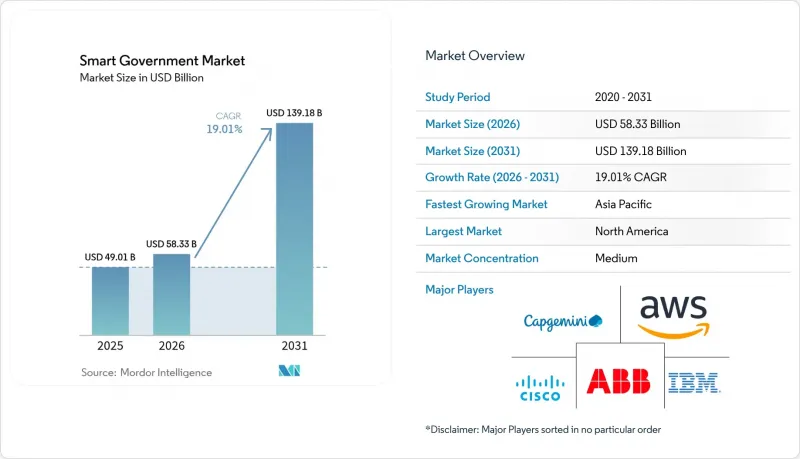
Mordor Intelligence에 의하면, 스마트 정부 시장 규모는 2025년에 490억 1,000만 달러로 평가되었고, 2026년 583억 3,000만 달러에서 성장하여 2031년까지 1,391억 8,000만 달러에 달할 것으로 예측됩니다.
예측 기간(2026-2031년) 연평균 성장률(CAGR)은 19.01%를 기록할 것으로 전망됩니다.
본 보고서는 구성 요소별(솔루션 및 서비스), 도입 모델별(온프레미스, 클라우드 등), 용도별(자원 계획(GRP/ERP), 시민 참여 플랫폼 등), 최종 사용자 수준별(국가/연방, 주/성), 지역별로 분류되어 있습니다.
세계의 스마트 정부 시장 동향 및 인사이트
디지털 전환을 위한 정부의 이니셔티브
현재, 행정 지침에 따라 장기간에 걸친 조달 주기를 뛰어넘는 엄격한 성과 목표가 부과되고 있으며, 변혁 프로젝트는 기한이 정해진 규정 준수 주도형 프로그램으로 변화하고 있습니다. 바이든 대통령의 행정명령 제14144호는 모든 연방 기관에 AI 보안 요건을 규정하고 있으며, 이로 인해 수년에 걸친 소프트웨어 투자가 확정되었습니다. 아랍에미리트(UAE)의 ‘디지털 정부 전략’은 2025년까지 서비스의 100% 디지털화와 90%의 만족도 달성을 목표로 하고 있으며, 종합적인 스택 현대화 분야에서 세계적인 벤치마크를 확립하고 있습니다. 지방 정부 역시 상호 운용성을 유지하고 높아지는 사용자 경험 기준을 충족하기 위해 이러한 프레임워크를 모방하고 있으며, 이에 따른 수요는 당초 국가 차원의 지침을 훨씬 뛰어넘어 확대되고 있습니다.
클라우드 기반 정부 IT 도입 확대
클라우드로의 전환을 통해 자본 지출이 예측 가능한 운영비로 전환되고, 각 기관은 엔터프라이즈급 기능을 활용할 수 있게 되어 운영 비용을 50%-60% 절감할 수 있게 됩니다. 미국 연방 정부의 클라우드 예산은 2016년 이후 5배로 증가했으며, 한편 싱가포르 육상교통청은 전환 후 컴퓨팅 비용을 60% 절감했습니다. 레거시 시스템에 대한 종속성은 여전히 우려 사항이지만(영국이 뿌리 깊은 공급업체와의 재협상에서 직면한 과제가 이를 여실히 보여주고 있습니다), 이식성을 보장하는 플랫폼이 지지를 얻으며 모든 서비스 계층에서 클라우드의 확산을 뒷받침하고 있습니다.
통합된 데이터 공유 법규의 부재
규제의 파편화로 인해 벤더는 관할 구역별로 특화된 시스템 구축을 강요받게 되어, 규모의 경제가 훼손되고 도입이 지연되고 있습니다. DORA나 NIS2와 같은 EU의 새로운 규제는 규정 준수에 드는 부담을 가중시키고 있으며, 많은 기관이 이에 대응할 준비가 되어 있지 않습니다. 중국과 러시아의 데이터 주권 관련 법령은 현지 호스팅을 의무화하고 있어, 전 세계적인 솔루션 확장을 저해하고 비용을 증가시키고 있습니다.
부문 분석
서비스 수익은 2031년까지 연평균 성장률(CAGR) 20.03%로 확대되어 솔루션의 성장률을 상회할 것입니다. 이는 실행의 질이 스마트 정부 성과에 결정적인 영향을 미칩니다는 점을 여실히 보여줍니다. 정부 기관에는 복잡한 멀티 벤더 생태계를 총괄할 수 있는 인력이 부족하기 때문에 현재 대부분의 입찰에는 시스템 통합 및 관리형 서비스 패키지가 포함되어 있습니다. 서비스의 확대는 개별 제품 기능보다 성과 기반의 마일스톤을 중시하는 조달 요건의 추세와 맞물려 있습니다. 그 결과, 전략 컨설팅 기업들은 틈새 GovTech 전문 지식을 확보하기 위해 M&A 활동을 활발히 전개하는 한편, 플랫폼 벤더들은 지속적인 수익을 확보하기 위해 전문 서비스를 통합하고 있습니다.
2025년에도 정부 기관은 여전히 구체적인 소프트웨어를 프로젝트 진행 상황과 동일시하고 있기 때문에 솔루션은 스마트 정부 시장의 60.45%를 계속 차지했습니다. 그러나 계약은 서비스가 가치 실현까지 걸리는 기간(Time-to-Value)을 보장하는 번들형 제공 방식으로 전환되고 있습니다. 지속적 전달 프레임워크와 공공 부문 인증 자격을 보유한 공급업체는 수년에 걸친 프로그램에서 만성적인 과제인 일정 지연을 완화할 수 있기 때문에 우위를 점하고 있습니다. 이러한 변화는 변혁 로드맵을 정책적 요구 사항과 조화시킬 수 있는 엔드투엔드 파트너에게 유리하게 작용하며, 컨설팅형 참여가 중요한 차별화 요인으로 자리 잡고 있습니다.
클라우드 모델은 유연한 비용 구조, 종량제, 그리고 내장된 규정 준수 도구라는 강점을 바탕으로 2025년 스마트 정부 시장 규모의 66.30%를 차지한 것으로 평가되었습니다. 퍼블릭 클라우드는 현재 정부 기관의 보안 기준을 충족하거나 그 이상을 충족하고 있기 때문에 그 도입은 연평균 성장률(CAGR) 20.65%로 가속화되고 있습니다. 하이브리드 전략은 여전히 과도기적인 수단으로 자리 잡고 있으며, IT 리더는 레거시 메인프레임의 합리화를 추진하는 한편, 새로운 워크로드를 연방 정부 인증 지역으로 이전할 여유를 확보하고 있습니다.
성공 지표를 살펴보면 민간 부문 기준과의 수렴 현상이 나타납니다. 정부 클라우드 프로젝트의 63%가 설정한 목표를 달성하고 있으며, 기업 벤치마킹와의 격차는 줄어들고 있습니다. 나머지 미달 요인은 플랫폼의 한계라기보다는 프로젝트 관리의 복잡성에 기인하며, 공통된 플레이북과 숙련된 통합업체를 통해 성숙도 격차가 점차 해소되고 있음을 시사합니다. 엣지 컴퓨팅의 활용 사례, 특히 외딴 지역의 국경 경비나 재난 대응 사례는 클라우드가 단일 목적지가 아니라 분산형 연속체로 진화하고 있음을 보여줍니다.
지역별 분석
북미는 37.70%라는 압도적인 점유율로 출발했으며, 인공지능, 제로 트러스트 보안, 시민 경험 재설계에 연방 및 주 정부의 막대한 자원을 계속해서 쏟아붓고 있습니다. 1,500억 달러 규모의 AI 투자 공약은 알고리즘을 통한 정책 실행으로의 국가적 전환을 뒷받침하는 한편, 캘리포니아주 등 일부 주에서는 입법 실사 업무에서 생성형 AI의 유효성이 입증되었습니다. 캐나다의 ‘디지털 앰비션(Digital Ambition)’은 이중 언어 서비스의 균등성과 옴니채널 접근성을 강화하고 있으며, 연방제와 다양성이 프로그램의 범위 설정에 어떻게 영향을 미치는지를 보여주고 있습니다. 지출 능력은 타의 추종을 불허하지만, 뿌리 깊은 레거시 시스템이 여전히 조달 주기를 길게 만들고 있어, 각 기관은 사이버 보안 및 지속적 제공을 통한 업그레이드가 통합된 클라우드 서비스 계약을 중심으로 한 단계적 현대화로 나아가고 있습니다.
아시아태평양은 연평균 성장률(CAGR) 21.05%와 광범위한 국가 변혁 로드맵을 내세우며 다른 모든 지역을 능가하고 있습니다. 싱가포르는 AI 센터 오브 엑설런스에 자금을 지원하고, 인도는 Aadhaar(아다르)와 연계된 공공 서비스를 확대하며, 베트남은 민관 보조금을 광대역 회랑에 투자하고 있습니다. 급속한 도시화로 인해 각 시 정부는 도시 계획, 교통, 환경 모니터링의 디지털화를 거의 동시에 추진할 수밖에 없게 되었으며, 이로 인해 스마트 정부 시장은 모듈식이며 재현성이 높은 플랫폼 도입에 적합한 상황이 되었습니다. 민첩한 제공 체계를 갖춘 벤더는 이러한 엄격한 일정에 대응할 수 있지만, 반면 유연성이 부족한 영구 라이선스 모델을 채택하는 벤더에 대한 수요는 감소 추세에 있습니다.
유럽에서는 데이터 이식성 및 보안에 관한 통일된 기준을 추진하는 브뤼셀 차원의 조정에 힘입어 꾸준한 성장세가 이어지고 있습니다. 각 프로젝트는 ‘InvestAI’ 기금에서 2,000억 유로를 활용하고 있으며, 이를 통해 회원국들은 조달 일정과 기술 스택의 일관성을 확보하고 있습니다. 영국의 독립적인 ‘GOV.UK Wallet’ 시범 운영은 국가 주권에 기반한 전략이 유럽 전체의 규범과 어떻게 공존할 수 있는지를 보여주고 있으며, 궁극적으로는 EU 외부에도 큰 영향을 미치는 기준을 확립하고 있습니다. 높은 규정 준수 요건으로 인해 EU의 디지털 주권에 정통한 현지 벤더의 역할이 커지고 있지만, GDPR(EU 개인정보보호규정) 및 DORA 인증을 획득한 EU域外の 공급업체도 여전히 경쟁력을 유지하고 있습니다.
기타 혜택 :
- 엑셀 형식 시장 예측(ME) 시트
- 3개월간의 애널리스트 지원
자주 묻는 질문
목차
제1장 서론
제2장 조사 방법
제3장 주요 요약
제4장 시장 구도
제5장 시장 규모 및 성장 예측
제6장 경쟁 구도
제7장 시장 기회 및 향후 전망
AJY 26.09.09According to Mordor Intelligence, the smart government market size was valued at USD 49.01 billion in 2025 and estimated to grow from USD 58.33 billion in 2026 to reach USD 139.18 billion by 2031, at a CAGR of 19.01% during the forecast period (2026-2031).
This report is Segmented by Component (Solutions and Services), Deployment Model (On-Premise, Cloud, and More), Application (Resource Planning (GRP/ERP), Citizen Engagement Platforms, and More), End-User Level (National/Federal, State/Provincial), and Geography.
Global Smart Government Market Trends and Insights
Government initiatives for digital transformation
Executive mandates now impose strict performance targets that override lengthy procurement cycles, turning transformation projects into time-boxed, compliance-driven programs. President Biden's Executive Order 14144 prescribes AI security requirements across all federal agencies, locking in multi-year software investments. The UAE's Digital Government Strategy aims for 100% service digitization and 90% satisfaction by 2025, setting a global benchmark for holistic stack modernization. Sub-national bodies replicate these frameworks to preserve interoperability and satisfy rising user-experience benchmarks, amplifying addressable demand well beyond the original sovereign mandates.
Growing adoption of cloud-based government IT
Cloud migration converts capital outlay into predictable operating expense, letting agencies unlock enterprise-grade capabilities and achieve 50%-60% cost savings on operations. U.S. federal cloud budgets have quintupled since 2016, while Singapore's Land Transport Authority trimmed compute costs by 60% post-migration. Although legacy lock-in remains a concern-highlighted by UK renegotiation challenges with entrenched vendors-platforms that guarantee portability win favor, pushing cloud penetration across every service tier.
Lack of uniform data-sharing laws
Fragmented regulations force vendors into jurisdiction-specific builds, undermining economies of scale and delaying rollouts. New EU rules, such as DORA and NIS2, raise compliance overhead that many agencies are unprepared to absorb. Data-sovereignty statutes in China and Russia compel local hosting, fracturing global solution footprints, and inflating costs.
Other drivers and restraints analyzed in the detailed report include:
- AI-driven citizen-centric analytics
- Government-as-a-Platform procurement model
- Data-privacy and cyber-theft concerns
For complete list of drivers and restraints, kindly check the Table Of Contents.
Segment Analysis
Services revenue expands at a 20.03% CAGR to 2031, eclipsing solution growth and underscoring that execution quality dictates Smart Government outcomes. Systems integration and managed services packages now accompany most bids because agencies lack the staff depth to orchestrate complex multi-vendor ecosystems. The Services rise parallels procurement language that values outcome-based milestones over discrete product features. Consequently, strategic consultancies increase M&A activity to secure niche GovTech expertise, while platform vendors embed professional services to lock in recurring revenue.
Solutions retain 60.45% of the Smart Government market in 2025 as governments still equate tangible software with project progress. However, contracts are shifting toward bundled offerings where services underpin time-to-value assurances. Providers with continuous-delivery frameworks and public-sector certifications gain an edge because they mitigate schedule slippage, a chronic pain point in multi-year programs. The change favors end-to-end partners capable of aligning transformation roadmaps with policy mandates, positioning consultative engagement as a critical differentiator.
Cloud models hold 66.30% share of the Smart Government market size in 2025 on the strength of elastic cost structures, pay-as-you-go pricing, and built-in compliance tooling. Adoption accelerates at a 20.65% CAGR because public cloud now meets or surpasses agency security baselines. Hybrid strategies persist as stepping-stones, giving IT leaders breathing space to rationalize legacy mainframes while steering new workloads into federally certified regions.
Success metrics reveal a convergence with private-sector norms: 63% of government cloud projects achieve stated objectives, narrowing the gap with enterprise benchmarks. Remaining shortfalls stem from project-management complexity rather than platform limitations, suggesting that common playbooks and skilled integrators are closing maturity gaps. Edge compute use cases, especially in remote border security and disaster response, illustrate that cloud is evolving into a distributed continuum, not a single destination.
Complete Report Scope:
- By Component
- Solutions
- Services
- By Deployment Model
- On-premise
- Cloud
- Hybrid
- By Application
- Resource Planning (GRP/ERP)
- Public Safety and Security
- Citizen Engagement Platforms
- Environmental and Infrastructure Monitoring
- Smart Mobility and Transport
- By End-user Level
- National/Federal
- State/Provincial
- Local/Municipal
- By Geography
- North America
- United States
- Canada
- Mexico
- South America
- Brazil
- Argentina
- Rest of South America
- Europe
- Germany
- United Kingdom
- France
- Italy
- Spain
- Russia
- Rest of Europe
- Asia Pacific
- China
- Japan
- India
- South Korea
- Rest of Asia Pacific
- Middle East
- Saudi Arabia
- United Arab Emirates
- Turkey
- Rest of Middle East
- Africa
- South Africa
- Nigeria
- Egypt
- Rest of Africa
- North America
Geography Analysis
North America starts with a dominant 37.70% stake and continues to funnel sizeable federal and state resources into artificial intelligence, zero-trust security, and citizen experience redesigns. The USD 150 billion AI investment pledge underpins a national shift toward algorithmic policy execution, while states such as California validate generative AI for legislative due-diligence tasks. Canada's Digital Ambition reinforces bilingual service parity and omnichannel accessibility, showing how federalism and diversity shape program scoping. Although spending capacity is unrivaled, entrenched legacy systems still elongate procurement cycles, nudging agencies toward phased modernization anchored by cloud service contracts that bake in cybersecurity and continuous-delivery upgrades.
Asia Pacific outpaces every other region with its 21.05% CAGR and expansive national transformation roadmaps. Singapore finances AI Centers of Excellence, India expands Aadhaar-linked public services, and Vietnam funnels public-private grants into broadband corridors. Rapid urbanization forces city governments to digitize planning, transport, and environmental monitoring almost in lockstep, making the Smart Government market ripe for modular, replicable platforms. Vendors with agile delivery frameworks meet these compressed timelines, whereas rigid perpetual-license models find fewer takers.
Europe enjoys steady momentum undergirded by Brussels-level coordination that drives uniform standards for data portability and security. Projects tap EUR 200 billion in InvestAI funds, prompting member states to synchronize procurement calendars and tech stacks. The UK's independent GOV.UK Wallet trials showcase how sovereign strategies can coexist with broader continental norms, ultimately setting references that echo well beyond the bloc. High compliance thresholds elevate the role of local vendors versed in EU digital sovereignty, though non-EU suppliers that certify against GDPR and DORA remain competitive.
- IBM
- Cisco Systems
- Amazon Web Services
- Oracle
- Huawei Technologies
- Capgemini
- ABB
- Microsoft
- Tyler Technologies
- Siemens
- SAP SE
- NEC Corporation
- Entrust
- HID Global (ASSA ABLOY)
- Nokia
- OpenGov
- Accenture
- Imex Systems
- Granicus
- GovPilot
Additional Benefits:
- The market estimate (ME) sheet in Excel format
- 3 months of analyst support
TABLE OF CONTENTS
1 INTRODUCTION
- 1.1 Study Assumptions and Market Definition
- 1.2 Scope of the Study
2 RESEARCH METHODOLOGY
3 EXECUTIVE SUMMARY
4 MARKET LANDSCAPE
- 4.1 Market Overview
- 4.2 Market Drivers
- 4.2.1 Government initiatives for digital transformation
- 4.2.2 Growing adoption of cloud-based government IT
- 4.2.3 AI-driven citizen-centric analytics
- 4.2.4 Government-as-a-Platform procurement model
- 4.2.5 Contact-free biometric identity programs
- 4.2.6 Climate-resilience monitoring mandates
- 4.3 Market Restraints
- 4.3.1 Lack of uniform data-sharing laws
- 4.3.2 Data-privacy and cyber-theft concerns
- 4.3.3 Public-sector digital-skills gap
- 4.3.4 SaaS vendor lock-in risk
- 4.4 Value / Supply-Chain Analysis
- 4.5 Regulatory Landscape
- 4.6 Technological Outlook
- 4.7 Porter's Five Forces
- 4.7.1 Bargaining Power of Suppliers
- 4.7.2 Bargaining Power of Buyers
- 4.7.3 Threat of New Entrants
- 4.7.4 Threat of Substitutes
- 4.7.5 Intensity of Competitive Rivalry
- 4.8 Investment Analysis
- 4.9 Impact of COVID-19 and Macroeconomic Outlook
5 MARKET SIZE AND GROWTH FORECASTS (VALUE)
- 5.1 By Component
- 5.1.1 Solutions
- 5.1.2 Services
- 5.2 By Deployment Model
- 5.2.1 On-premise
- 5.2.2 Cloud
- 5.2.3 Hybrid
- 5.3 By Application
- 5.3.1 Resource Planning (GRP/ERP)
- 5.3.2 Public Safety and Security
- 5.3.3 Citizen Engagement Platforms
- 5.3.4 Environmental and Infrastructure Monitoring
- 5.3.5 Smart Mobility and Transport
- 5.4 By End-user Level
- 5.4.1 National/Federal
- 5.4.2 State/Provincial
- 5.4.3 Local/Municipal
- 5.5 By Geography
- 5.5.1 North America
- 5.5.1.1 United States
- 5.5.1.2 Canada
- 5.5.1.3 Mexico
- 5.5.2 South America
- 5.5.2.1 Brazil
- 5.5.2.2 Argentina
- 5.5.2.3 Rest of South America
- 5.5.3 Europe
- 5.5.3.1 Germany
- 5.5.3.2 United Kingdom
- 5.5.3.3 France
- 5.5.3.4 Italy
- 5.5.3.5 Spain
- 5.5.3.6 Russia
- 5.5.3.7 Rest of Europe
- 5.5.4 Asia Pacific
- 5.5.4.1 China
- 5.5.4.2 Japan
- 5.5.4.3 India
- 5.5.4.4 South Korea
- 5.5.4.5 Rest of Asia Pacific
- 5.5.5 Middle East
- 5.5.5.1 Saudi Arabia
- 5.5.5.2 United Arab Emirates
- 5.5.5.3 Turkey
- 5.5.5.4 Rest of Middle East
- 5.5.6 Africa
- 5.5.6.1 South Africa
- 5.5.6.2 Nigeria
- 5.5.6.3 Egypt
- 5.5.6.4 Rest of Africa
- 5.5.1 North America
6 COMPETITIVE LANDSCAPE
- 6.1 Market Concentration
- 6.2 Strategic Moves
- 6.3 Market Share Analysis
- 6.4 Company Profiles (includes Global level Overview, Market level overview, Core Segments, Financials as available, Strategic Information, Market Rank/Share for key companies, Products and Services, and Recent Developments)
- 6.4.1 IBM
- 6.4.2 Cisco Systems
- 6.4.3 Amazon Web Services
- 6.4.4 Oracle
- 6.4.5 Huawei Technologies
- 6.4.6 Capgemini
- 6.4.7 ABB
- 6.4.8 Microsoft
- 6.4.9 Tyler Technologies
- 6.4.10 Siemens
- 6.4.11 SAP SE
- 6.4.12 NEC Corporation
- 6.4.13 Entrust
- 6.4.14 HID Global (ASSA ABLOY)
- 6.4.15 Nokia
- 6.4.16 OpenGov
- 6.4.17 Accenture
- 6.4.18 Imex Systems
- 6.4.19 Granicus
- 6.4.20 GovPilot
7 MARKET OPPORTUNITIES AND FUTURE OUTLOOK
- 7.1 White-space and Unmet-need Assessment


