
|
시장보고서
상품코드
2124311
통신 매니지드 서비스 시장 : 시장 점유율 분석, 업계 동향 및 통계, 성장 예측(2026-2031년)Telecom Managed Services - Market Share Analysis, Industry Trends & Statistics, Growth Forecasts (2026 - 2031) |
||||||
 Mordor Intelligence
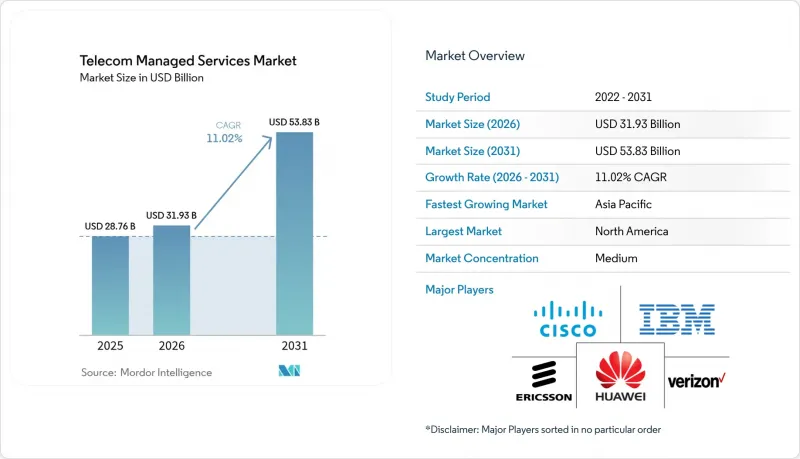
Mordor Intelligence에 의하면, 통신 매니지드 서비스 시장 규모는 2025년에 287억 6,000만 달러로 평가되었고, 2026년 319억 3,000만 달러에서 2031년까지 538억 3,000만 달러에 이를 것으로 예측되며, 예측 기간(2026-2031년) CAGR은 11.02%를 나타낼 전망입니다.
본 보고서는 조직 규모별(대기업, 중소기업), 서비스 유형별(매니지드 데이터센터 서비스, 매니지드 보안 서비스, 기타),구축 모델별(온프레미스, 클라우드 호스팅), 통신 사업자 유형별(MNO, MVNO, ISP), 최종 사용자 산업별(소비자 부문, 기업 부문, 기타), 지역별로 분류되어 있습니다. 시장 예측은 금액(달러) 기준으로 제시되어 있습니다.
세계의 통신 매니지드 서비스 시장 동향 및 인사이트
5G 네트워크 슬라이싱이 기업의 변혁을 주도
기업들의 5G 네트워크 슬라이싱 도입은 통신 매니지드 서비스 시장의 양상을 변화시키고 있습니다. 이는 조직이 미션 크리티컬한 용도로 성능이 보장된 분리된 가상 네트워크를 필요로 하기 때문입니다. 2026년 월드컵을 앞두고 버라이즌(Verizon)과 FIFA가 맺은 파트너십은 이벤트 운영자가 저지연 동영상 스트리밍 및 양방향 팬 경험을 제공하기 위해 프라이빗 슬라이스에 어떻게 의존하고 있는지를 여실히 보여줍니다. 테슬라(Tesla)와 같은 제조 산업의 선도 기업들은 프라이빗 5G를 활용하여 자율 생산 라인을 관리하고 있으며, 기존 IT 팀으로는 대응할 수 없는 특수한 매니지드 서비스 계약을 추진하고 있습니다. 싱텔의 동남아시아 스마트 팩토리 도입 사례는 엄격한 지연 시간 및 신뢰성 목표를 확실하게 충족하는 프리미엄 슬라이스를 제공함으로써 수익 창출의 가능성을 보여주고 있습니다. 각기 다른 QoS 매개변수를 가진 여러 슬라이스를 동시에 운영하는 데 따르는 복잡성으로 인해 외부 전문 지식이 필수적이며, 자동차, 의료, 엔터테인먼트 산업에서 수년에 걸친 아웃소싱 계약이 촉진되고 있습니다.
클라우드 네이티브 OSS/BSS 도입이 운영 효율을 가속화
통신 사업자들은 모놀리식 시스템에서 클라우드 네이티브 아키텍처로 전환하고 있으며, 이로 인해 통신 매니지드 서비스 시장에서 지속적인 수요가 발생하고 있습니다. 에릭슨(Ericsson)의 클라우드 네이티브 제품군은 T-Mobile이 네트워크 운영 비용을 30% 절감하고, 서비스 출시 주기를 몇 주에서 몇 시간으로 단축하는 데 기여했습니다. 2024년 노키아가 인피네라를 23억 달러에 인수한 것은 컨테이너화된 환경으로의 원활한 전환에 있어 하드웨어와 소프트웨어를 통합한 포트폴리오가 필수적임을 보여줍니다. 매니지드 서비스 제공업체(MSP)는 여전히 사내에서 부족한 쿠버네티스 엔지니어링, CI/CD 파이프라인, 마이크로서비스 오케스트레이션 기술을 제공합니다. 통신 사업자들이 레거시 플랫폼을 단계적으로 폐지함에 따라, 클라우드 호스팅 모델은 탄력적인 확장을 실현하고 산업용 IoT를 위한 엣지 컴퓨팅 서비스의 신속한 도입을 가능하게 하고 있습니다.
DevSecOps 인력 부족이 서비스 제공을 제약
통신 산업의 DevSecOps 채용 공고는 일반 IT 직종의 평균 2.8개월에 비해 평균 4.2개월 동안 공석으로 남아 있으며, 이로 인해 임금 상승률은 연 18%에 달하고 있습니다. 이러한 인력 부족은 엔지니어가 무선 기술 전문 지식과 컨테이너 보안 지식을 모두 갖추어야 하는 5G 클라우드 네이티브 환경에서 특히 심각합니다. 각 MSP 기업들은 전 세계 교육 허브 및 신입사원 아카데미 개설 등으로 대응하고 있지만, 인재 양성에 시간이 걸리기 때문에 프로젝트 일정이 지연되고, 프로바이더가 서비스 포트폴리오를 확대할 수 있는 속도가 제한되고 있습니다.
부문 분석
2025년에는 대기업이 매출의 55.72%를 차지했으며, 전송, IT, 보안 각 분야에 걸친 세계 확장을 통해 통신 매니지드 서비스 시장을 지탱하고 있습니다. 이러한 기업들의 예산을 통해 네트워크 슬라이싱, 프라이빗 5G, 통합 가시성 대시보드 등을 아우르는 맞춤형 솔루션이 실현되고 있습니다. 대조적으로, 중소기업(SME) 시장은 2031년까지 연평균 성장률(CAGR) 11.15%로 확대되며 서비스 제공업체에 새로운 수요를 창출하고 있습니다. 중소기업용 통신 매니지드 서비스 시장 규모는 표준화된 ‘사용량에 따른 과금’ 방식의 번들 플랜이 막대한 자본 장벽을 제거함에 따라 꾸준히 확대될 것으로 예측됩니다. 의료 클리닉, 중견 제조업체, 지역 소매업체는 사내 전문 지식이 제한적이라는 점을 보완하기 위해, 규정 준수 요건이 엄격한 통신 스택을 아웃소싱함으로써 이러한 급증을 주도하고 있습니다.
중소기업은 고도의 기술 인력을 보유하지 않더라도 산업 규제를 충족하는 클라우드 우선 네트워크, 매니지드 SD-WAN, 턴키형 보안 게이트웨이에 주목하고 있습니다. 한편, 다국적 기업들은 AI 기반 자동화를 활용하여 복잡하게 뻗어 있는 멀티 벤더 환경을 합리화하고, 사내 팀을 혁신 활동에 집중시키고 있습니다. 중소기업을 위한 가격 경쟁력 있는 패키지와 고도로 맞춤화된 엔터프라이즈용 프레임워크의 융합으로 인해, 제공업체들은 두 가지 시장 진출 전략을 유지해야 합니다.
2025년, 매니지드 네트워크 서비스는 매출 점유율 32.08%를 유지하며 통신 매니지드 서비스 시장의 핵심 부문으로서의 입지를 확고히 했습니다. 그러나 통신 사업자가 국가 주도의 위협과 엄격한 데이터 소재지 규제에 직면함에 따라, 매니지드 보안은 연평균 성장률(CAGR) 11.78%로 가장 빠르게 성장하고 있습니다. 매니지드 보안 부문의 통신 매니지드 서비스 시장 규모는 제로 트러스트 도입과 5G 코어 보호를 원동력으로 크게 확대될 것으로 예측됩니다. 데이터센터, 통신, 모빌리티 서비스는 안정적인 한 자릿수 중반대의 성장률을 유지하는 한편, AaaS(Analytics-as-a-Service)가 새로운 수익원으로 부상하고 있습니다.
보안 수요는 온프레미스 및 멀티 클라우드 환경에서의 위협 감지, SOC-as-a-Service, 규정 준수 보고에 이르기까지 다양합니다. 각 제공업체는 AI를 활용한 이상 감지 및 네트워크 에지에서의 자동화된 정책 적용을 통해 차별화를 꾀하고 있습니다. 네트워크 관리는 성숙한 부문이긴 하지만, 인텐트 기반 네트워킹(Intent-Based Networking)과 클로즈드 루프 어슈어런스(Closed-Loop Assurance)를 통해 재구축이 진행되고 있으며, 이 부문은 여전히 중요한 위치를 차지하고 있지만 보안 부문만큼 역동적이지는 않습니다.
지역별 분석
북미는 5G의 조기 도입, 기업 내 클라우드 보급률의 높음, 사설 네트워크 실험을 장려하는 지원적인 규제 프레임워크 덕분에 2025년에는 매출의 30.88%를 차지하며 1위를 차지했습니다. Verizon은 예정보다 빨리 고정 무선 접속 가입자 수가 420만 명을 돌파하며, 매니지드 광대역 대체 서비스에 대한 강력한 수요를 입증하고 있습니다. AT&T는 광섬유 가입자 수가 17분기 연속 증가하며, 통신 사업자가 운영하는 매니지드 연결 서비스에 대한 활발한 수요를 입증하고 있습니다. 경쟁이 성숙해짐에 따라 통신 사업자들은 차별화를 명확히 하기 위해 고도의 자동화, 분석, 보안 업무를 외부에 위탁하고 있습니다.
아시아태평양은 대규모 5G 인프라 구축과 정부 주도의 ‘인더스트리 4.0’ 프로그램의 뒷받침을 받아 2031년 연평균 성장률(CAGR)이 11.53%로 가장 빠르게 성장하고 있는 지역입니다. 중국은 2024년까지 340만 개의 5G 기지국을 구축하여 전례 없는 네트워크 관리 수요를 창출하고 있습니다. 일본은 스마트 팩토리를 위한 프라이빗 5G를 중시하는 반면, 인도의 Reliance Jio는 중견 제조업체를 위한 프라이빗 네트워크 및 매니지드 서비스를 상용화하기 위한 사업 부문을 설립했습니다. 한국에서 네이버 클라우드에 최초의 프라이빗 5G 라이선스가 발급된 것은 하이퍼스케일러들이 엔터프라이즈 커넥티비티 시장에 진입하고 있음을 보여줍니다.
유럽에서는 보급률이 성숙 단계에 접어든 가운데 한 자릿수 중반의 꾸준한 성장이 나타나고 있지만, ‘사이버 복원력법’ 등의 규제 프레임워크로 인해 통신 사업자들은 규정 준수를 목적으로 보안 및 보고 업무를 외부에 위탁해야 하는 상황에 직면해 있습니다. 중동 및 아프리카와 남미에서는 운영 비용(OpEx) 합리화 및 서비스가 미치지 못하는 지역으로의 커버리지 확대를 목적으로 한 아웃소싱에 대한 관심이 높아지고 있습니다. 지역 사업자들은 험준한 지형과 에너지 비용 문제에 대처하기 위해 매니지드 위성 백홀 및 에너지 효율이 뛰어난 RAN 서비스를 도입하고 있습니다.
기타 혜택
- 엑셀 형식 시장 예측(ME) 시트
- 3개월간의 애널리스트 지원
자주 묻는 질문
목차
제1장 서론
제2장 조사 방법
제3장 주요 요약
제4장 시장 구도
제5장 시장 규모 및 성장 예측
제6장 경쟁 구도
제7장 시장 기회 및 향후 전망
AJYAccording to Mordor Intelligence, the telecom managed services market size was valued at USD 28.76 billion in 2025 and estimated to grow from USD 31.93 billion in 2026 to reach USD 53.83 billion by 2031, at a CAGR of 11.02% during the forecast period (2026-2031).
This report is Segmented by Organization Size (Large Enterprises, Smes), Service Type (Managed Data Center Services, Managed Security Services, and More), Deployment Model (On-Premises, Cloud/Hosted), Telecom Operator Type (MNO, MVNO, ISP), End-User Vertical (Consumer Segment, Enterprise Segment, and More), and by Geography. The Market Forecasts are Provided in Terms of Value (USD).
Global Telecom Managed Services Market Trends and Insights
5G Network Slicing Drives Enterprise Transformation
Enterprise adoption of 5G network slicing is reshaping the telecom managed services market as organizations require isolated virtual networks with guaranteed performance for mission-critical applications. Verizon's collaboration with FIFA for the 2026 World Cup highlights how event operators rely on private slices to deliver low-latency video streams and interactive fan experiences. Manufacturing leaders such as Tesla use private 5G to orchestrate autonomous production lines, pushing specialized managed service contracts that traditional IT teams cannot support. Singtel's Southeast Asian smart-factory deployments demonstrate monetization potential by offering premium slices that lock in stringent latency and reliability targets. The complexity of simultaneously operating multiple slices each with distinct QoS parameters makes external expertise indispensable, stimulating multi-year outsourcing deals across automotive, healthcare and entertainment verticals.
Cloud-Native OSS/BSS Adoption Accelerates Operational Efficiency
Operators are migrating from monolithic systems to cloud-native architectures, generating sustained demand in the telecom managed services market. Ericsson's cloud-native suite helped T-Mobile cut network operations costs by 30% and compress service-launch cycles from weeks to hours. Nokia's USD 2.3 billion purchase of Infinera in 2024 indicates that integrated hardware-software portfolios are critical for seamless migration to containerized environments. Managed service providers (MSPs) supply Kubernetes engineering, CI/CD pipelines and microservices orchestration skills that remain scarce in-house. As operators decommission legacy platforms, cloud-hosted models unlock elastic scaling, enabling rapid introduction of edge computing services for industrial IoT.
DevSecOps Talent Shortage Constrains Service Delivery
Telecommunications DevSecOps vacancies remain open for 4.2 months on average versus 2.8 months for general IT roles, pushing wage inflation to 18% annually. The scarcity is most acute in 5G cloud-native environments, where engineers must combine radio expertise with container security. MSPs are responding with global training hubs and graduate academies, but onboarding cycles lengthen project timelines and limit the speed at which providers can scale service portfolios.
Other drivers and restraints analyzed in the detailed report include:
- AI-Driven Predictive Maintenance Transforms Network Operations
- Zero-Trust Security Architectures Drive Managed Security Demand
- Vendor Lock-in Concerns Slow Cloud Migration
For complete list of drivers and restraints, kindly check the Table Of Contents.
Segment Analysis
Large enterprises accounted for 55.72% revenue in 2025, underpinning the telecom managed services market with global rollouts that span transport, IT and security domains. Their budgets support tailored solutions encompassing network slicing, private 5G and unified observability dashboards. In contrast, SMEs expand at an 11.15% CAGR to 2031, unlocking fresh volume for service providers. The telecom managed services market size for SMEs is projected to climb steadily as standardized, pay-as-you-grow bundles remove hefty capital barriers. Healthcare clinics, mid-tier manufacturers and regional retailers collectively drive this surge by outsourcing compliance-heavy communication stacks to offset limited in-house expertise.
SMEs gravitate toward cloud-first networking, managed SD-WAN and turnkey security gateways that meet sector regulations without deep technical staffing. Meanwhile, multinationals leverage AI-assisted automation to rationalize sprawling multi-vendor estates, freeing up internal teams for innovation initiatives. The convergence of price-competitive packages for SMEs and highly customized enterprise frameworks ensures that providers must maintain dual go-to-market plays.
Managed network services retained 32.08% revenue share in 2025, underscoring their status as the core layer of the telecom managed services market. Yet managed security is the fastest riser at a 11.78% CAGR as operators confront nation-state threats and stringent data-residency rules. The telecom managed services market size for managed security is expected to swell notably, propelled by zero-trust rollouts and 5G core protection. Data center, communication and mobility services grow at steady mid-single-digit rates, while analytics-as-a-service emerges as an adjacent revenue stream.
Security demand spans threat hunting, SOC-as-a-service and compliance reporting across on-prem and multicloud estates. Providers differentiate via AI-powered anomaly detection and automated policy enforcement at network edges. Network management, though mature, is undergoing reinvention through intent-based networking and closed-loop assurance, keeping the segment relevant but less dynamic than security.
Complete Report Scope:
- By Organization Size
- Large Enterprises
- Small Enterprises
- By Service Type
- Managed Data Center Services
- Managed Security Services
- Managed Network Services
- Managed Data and Information Services
- Managed Communication Services
- Managed Mobility Services
- By Deployment Model
- On-Premises
- Cloud / Hosted
- By Telecom Operator Type
- Mobile Network Operator (MNO)
- Mobile Virtual Network Operator (MVNO)
- Internet Service Provider (ISP)
- By End-user Vertical
- Consumer Segment
- Enterprise Segment
- Government and Public Safety
- By Geography
- North America
- United States
- Canada
- Mexico
- South America
- Brazil
- Argentina
- Rest of South America
- Europe
- Germany
- United Kingdom
- France
- Italy
- Spain
- Rest of Europe
- Asia-Pacific
- China
- Japan
- India
- South Korea
- Southeast Asia
- Rest of Asia-Pacific
- Middle East and Africa
- Middle East
- Saudi Arabia
- United Arab Emirates
- Turkey
- Rest of Middle East
- Africa
- South Africa
- Nigeria
- Egypt
- Rest of Africa
- Middle East
- North America
Geography Analysis
North America led with 30.88% revenue in 2025 owing to early 5G deployment, high enterprise cloud adoption and supportive regulatory frameworks that encourage private-network experimentation. Verizon surpassed 4.2 million fixed-wireless access subscribers ahead of schedule, attesting to strong demand for managed broadband alternatives. AT&T posted 17 consecutive quarters of fiber subscriber gains, underscoring the robust appetite for carrier-operated managed connectivity. Mature competition pushes operators to outsource advanced automation, analytics and security tasks to sharpen differentiation.
Asia Pacific is the fastest-growing region at an 11.53% CAGR through 2031, buoyed by large-scale 5G infrastructure builds and government-backed Industry 4.0 programs. China deployed 3.4 million 5G base stations by 2024, fuelling unprecedented network-management requirements. Japan emphasized private 5G for smart factories, while India's Reliance Jio established a business unit to commercialize private networks and managed services for midsize manufacturers. South Korea's first private 5G licence issued to NAVER Cloud shows how hyperscalers are entering enterprise connectivity.
Europe registers steady mid-single-digit growth amid mature penetration levels, yet regulatory frameworks such as the Cyber Resilience Act press operators to outsource compliance-driven security and reporting. Middle East and Africa and South America exhibit rising interest in outsourcing to streamline OpEx and extend coverage into underserved areas. Regional players adopt managed satellite backhaul and energy-efficient RAN services to cope with challenging terrains and energy costs.
- Cisco Systems
- Huawei Technologies
- IBM
- Ericsson
- Verizon Business
- AT&T
- NTT Data
- Nokia
- ZTE
- Tech Mahindra
- Amdocs
- Fujitsu
- Comarch
- Lumen Technologies
- Orange Business Services
- Accenture
- HCL Technologies
- Cognizant
- Capgemini
- Tata Communications
Additional Benefits:
- The market estimate (ME) sheet in Excel format
- 3 months of analyst support
TABLE OF CONTENTS
1 INTRODUCTION
- 1.1 Study Assumptions and Market Definition
- 1.2 Scope of the Study
2 RESEARCH METHODOLOGY
3 EXECUTIVE SUMMARY
4 MARKET LANDSCAPE
- 4.1 Market Overview
- 4.2 Market Drivers
- 4.2.1 5G roll-out accelerating enterprise demand for managed network slicing
- 4.2.2 Cloud-native OSS/BSS adoption among Tier-1 operators
- 4.2.3 Shift to outcome-based SLAs lowering churn for MSPs
- 4.2.4 AI-driven predictive maintenance cutting OPEX
- 4.2.5 Demand for zero-trust architectures pushing managed security
- 4.2.6 Private 5G campus networks for Industry 4.0
- 4.3 Market Restraints
- 4.3.1 Skill-gap inflation in telecom DevSecOps talent
- 4.3.2 Vendor lock-in fears for cloud-hosted network functions
- 4.3.3 Latency-sensitive 5G URLLC use-cases limiting off-prem outsourcing
- 4.3.4 Fragmented regulatory compliance across regions
- 4.4 Supply-Chain Analysis
- 4.5 Regulatory Landscape
- 4.6 Technological Outlook
- 4.7 Porter's Five Forces
- 4.7.1 Bargaining Power of Suppliers
- 4.7.2 Bargaining Power of Buyers
- 4.7.3 Threat of New Entrants
- 4.7.4 Threat of Substitutes
- 4.7.5 Intensity of Competitive Rivalry
- 4.8 Assessment of Macroeconomic Factors on the Market
5 MARKET SIZE AND GROWTH FORECASTS (VALUE)
- 5.1 By Organization Size
- 5.1.1 Large Enterprises
- 5.1.2 Small Enterprises
- 5.2 By Service Type
- 5.2.1 Managed Data Center Services
- 5.2.2 Managed Security Services
- 5.2.3 Managed Network Services
- 5.2.4 Managed Data and Information Services
- 5.2.5 Managed Communication Services
- 5.2.6 Managed Mobility Services
- 5.3 By Deployment Model
- 5.3.1 On-Premises
- 5.3.2 Cloud / Hosted
- 5.4 By Telecom Operator Type
- 5.4.1 Mobile Network Operator (MNO)
- 5.4.2 Mobile Virtual Network Operator (MVNO)
- 5.4.3 Internet Service Provider (ISP)
- 5.5 By End-user Vertical
- 5.5.1 Consumer Segment
- 5.5.2 Enterprise Segment
- 5.5.3 Government and Public Safety
- 5.6 By Geography
- 5.6.1 North America
- 5.6.1.1 United States
- 5.6.1.2 Canada
- 5.6.1.3 Mexico
- 5.6.2 South America
- 5.6.2.1 Brazil
- 5.6.2.2 Argentina
- 5.6.2.3 Rest of South America
- 5.6.3 Europe
- 5.6.3.1 Germany
- 5.6.3.2 United Kingdom
- 5.6.3.3 France
- 5.6.3.4 Italy
- 5.6.3.5 Spain
- 5.6.3.6 Rest of Europe
- 5.6.4 Asia-Pacific
- 5.6.4.1 China
- 5.6.4.2 Japan
- 5.6.4.3 India
- 5.6.4.4 South Korea
- 5.6.4.5 Southeast Asia
- 5.6.4.6 Rest of Asia-Pacific
- 5.6.5 Middle East and Africa
- 5.6.5.1 Middle East
- 5.6.5.1.1 Saudi Arabia
- 5.6.5.1.2 United Arab Emirates
- 5.6.5.1.3 Turkey
- 5.6.5.1.4 Rest of Middle East
- 5.6.5.2 Africa
- 5.6.5.2.1 South Africa
- 5.6.5.2.2 Nigeria
- 5.6.5.2.3 Egypt
- 5.6.5.2.4 Rest of Africa
- 5.6.5.1 Middle East
- 5.6.1 North America
6 COMPETITIVE LANDSCAPE
- 6.1 Market Concentration
- 6.2 Strategic Moves
- 6.3 Market Share Analysis
- 6.4 Company Profiles (includes Global level Overview, Market level overview, Core Segments, Financials as available, Strategic Information, Market Rank/Share for key companies, Products and Services, and Recent Developments)
- 6.4.1 Cisco Systems
- 6.4.2 Huawei Technologies
- 6.4.3 IBM
- 6.4.4 Ericsson
- 6.4.5 Verizon Business
- 6.4.6 AT&T
- 6.4.7 NTT Data
- 6.4.8 Nokia
- 6.4.9 ZTE
- 6.4.10 Tech Mahindra
- 6.4.11 Amdocs
- 6.4.12 Fujitsu
- 6.4.13 Comarch
- 6.4.14 Lumen Technologies
- 6.4.15 Orange Business Services
- 6.4.16 Accenture
- 6.4.17 HCL Technologies
- 6.4.18 Cognizant
- 6.4.19 Capgemini
- 6.4.20 Tata Communications
7 MARKET OPPORTUNITIES AND FUTURE OUTLOOK
- 7.1 White-space and Unmet-Need Assessment