

|
시장보고서
상품코드
2124314
클라우드 IT 서비스 관리(ITSM) 시장 : 시장 점유율 분석, 업계 동향 및 통계, 성장 예측(2026-2031년)Cloud Information Technology Service Management (ITSM) - Market Share Analysis, Industry Trends & Statistics, Growth Forecasts (2026 - 2031) |
||||||
 Mordor Intelligence
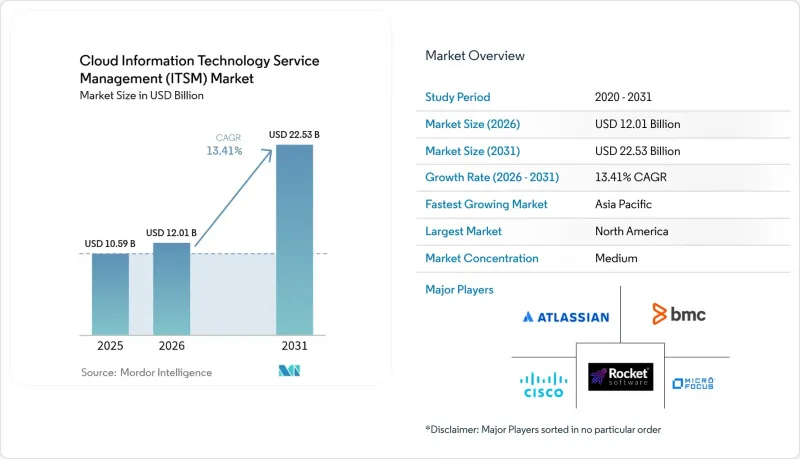
Mordor Intelligence에 의하면, 2026년 클라우드 IT 서비스 관리(ITSM) 시장 규모는 120억 1,000만 달러로 추정되고, 2025년 105억 9,000만 달러에서 성장하여 2031년에는 225억 3,000만 달러에 이를 것으로 예측됩니다.
2026-2031년 연평균 성장률(CAGR)은 13.41%를 나타낼 전망입니다.
본 보고서는 구성 요소별(솔루션 및 서비스), 배포 모델별(퍼블릭 클라우드, 프라이빗 클라우드, 하이브리드 클라우드), 조직 규모별(대기업, 중소기업), 용도별(구성 관리, 성능 관리, 기타), 최종 사용자 산업별(IT 및 통신, 은행, 금융서비스 및 보험(BFSI), 기타), 지역별로 분류되어 있습니다. 시장 예측은 금액(달러)으로 표시되어 있습니다.
세계의 클라우드 IT 서비스 관리(ITSM) 시장 동향 및 인사이트
분산된 DevOps 팀에서 멀티 클라우드 거버넌스에 대한 수요 증가
AWS, Microsoft Azure, Google Cloud에 걸쳐 워크로드를 운영하는 기업들은 마이크로서비스가 여러 리전 및 공급자에 걸쳐 확장됨에 따라 복잡성이 증가하고 있습니다. 통합형 클라우드 IT 서비스 관리(ITSM) 플랫폼은 하이브리드 환경 전반에 걸쳐 인시던트를 연관 짓는 자동 감지 및 종속성 매핑 기능을 제공하여, DevOps 팀이 개별 도구를 전환하지 않고도 서비스 수준을 유지할 수 있도록 지원합니다. 가시성을 통합함으로써 컨테이너화된 용도에 대한 예측 분석이 가능해지며, 중복된 모니터링 오버헤드가 감소하고, 국경을 넘는 데이터 흐름을 평가하는 감사관의 요구 사항을 충족하는 규정 준수 보고서가 제공됩니다.
ITSM 자동화가 필요한 원격 및 하이브리드 근무로의 급속한 전환
상시 하이브리드 업무 환경에서는 24시간 가동되는 셀프 서비스 포털과 Teams, Slack 등의 협업 허브와 통합된 AI 챗봇이 요구됩니다. 최신 클라우드 IT 서비스 관리 플랫폼에는 일상적인 티켓을 몇 초 만에 해결하고, 복잡한 문제를 완전한 맥락 정보를 첨부하여 에스컬레이션하는 자연어 지원 가상 에이전트가 내장되어 있어, 지원 대기열을 줄이고 직원 경험을 향상시킵니다. 예측 분석을 통해 사용자의 업무에 지장이 발생하기 전에 기기 고장을 감지할 수 있으며, 이 기능은 분산형 운영에 있어 필수적인 인프라로 간주됩니다.
국경을 넘는 인시던트 데이터의 흐름을 제한하는 데이터 소재지 규정
EU의 ‘디지털 운영 복원력 법’이나 한국의 데이터 주권 관련 규제 등의 프레임워크에서는 개인정보가 포함될 가능성이 있는 인시던트 로그의 현지 저장이 의무화되어 있어, 이로 인해 통합적인 분석이 제한되고, 클라우드 IT 서비스 관리 시장의 벤더들은 지역에 따라 데이터센터를 구축할 수밖에 없는 상황에 처해 있습니다. 다국적 기업들은 규정을 준수하기 위해 개별 인스턴스를 도입하고 있지만, 이로 인해 운영 비용이 증가하고 세계 대시보드가 분절되어 버립니다.
부문 분석
2025년, 솔루션은 클라우드 IT 서비스 관리 시장 점유율의 72.45%를 차지했으며, 고객이 견고한 플랫폼 기반 확보를 우선시하고 있음을 반영합니다. ServiceNow와 같은 벤더의 구독 수익은 2024년 2분기에 25억 달러를 넘어섰으며, 이는 AI 자동화 모듈, 워크플로우 엔진, 로우코드 앱 빌더에 대한 수요가 높음을 보여줍니다.
기업들이 지능형 라우팅 설정, CMDB 연동, DevOps 파이프라인 통합에 필요한 혁신 노력을 인식함에 따라 서비스 매출은 연평균 성장률(CAGR) 18.65%로 증가하고 있습니다. 관리형 서비스 제공업체들은 현재 MTTR(평균 복구 시간) 및 NPS(순추천지수)와 연계된 성과 기반 계약을 제공함으로써 운영 위험을 이전하는 동시에 가치 제공을 보장하고 있습니다.
퍼블릭 클라우드는 신속한 프로비저닝과 인프라 오버헤드 감소를 배경으로, 2025년에는 클라우드 IT 서비스 관리 시장 규모의 57.30%를 차지한 것으로 평가되었습니다. 반면, 규제 대상 산업에서는 분석을 위해 퍼블릭 클라우드의 AI 엔진을 활용하면서도 기밀 데이터를 프라이빗 노드에 보관하고 있기 때문에 하이브리드 클라우드는 연평균 성장률(CAGR) 16.08%로 확대되고 있습니다.
하이브리드 접근 방식은 벤더 종속성을 완화하는 데에도 도움이 됩니다. 가격이나 성능에 변화가 발생할 경우, 조직은 워크로드를 다른 환경으로 이전할 수 있기 때문입니다. 이에 따라 각 벤더들은 관리 업무의 중복을 초래하지 않으면서 환경 간 정책을 동기화하고, 지역적 제약을 준수하는 이식성 높은 아키텍처에 대한 투자를 추진하고 있습니다.
지역별 분석
북미는 클라우드의 광범위한 도입, AI 기술이 풍부한 인재, 하이퍼스케일러와 플랫폼 제공업체 간의 활발한 파트너십 생태계에 힘입어 2025년 총 지출의 39.60%를 차지했습니다. 기업들은 클라우드 청구 금액을 그 어느 때보다 엄격하게 모니터링하고, 확장의 비즈니스 가치를 검증하기 위해 FinOps 거버넌스를 추진하고 있습니다. 특히 경쟁이 치열한 서비스 산업에서는 자동화를 통해 측정 가능한 생산성 향상을 얻을 수 있는 부문에 대한 투자가 지속되고 있습니다.
아시아태평양은 가장 빠르게 성장하는 지역으로, 2031년 연평균 성장률(CAGR)은 17.08%에 달할 전망입니다. 한국과 싱가포르의 국가 디지털 아젠다는 현지 데이터센터를 장려하는 한편, 기업들은 데이터 소재지 요건을 준수하기 위해 클라우드 IT 서비스 관리 시장의 플랫폼을 도입하고 있습니다. Atlassian이 서울에서 ‘Jira Service Management’를 제공하기로 결정한 것은 국가별 규제에 대한 벤더의 대응을 여실히 보여줍니다. 또한, 인도와 인도네시아에서 중소기업이 급속히 설립되고 있는 점도 시장 규모 확대에 기여하고 있습니다.
유럽은 GDPR(EU 개인정보보호규정)과 2025년부터 시행될 금융 부문을 대상으로 한 DORA의 영향으로 꾸준한 성장세를 보이고 있습니다. 조직들은 강력한 암호화, 세밀한 감사 로그, 문서화된 정보 유출 통지 워크플로를 제공하는 공급업체를 선호하고 있습니다. 중동 및 아프리카에서는 정부 기관이 스마트 시티 구상을 추진하며 내결함성이 높은 IT 인프라를 필요로 하고 있어 도입이 확대되고 있습니다. 라틴아메리카에서는 비용을 중시하는 적정 수준의 도입이 진행되고 있으며, 기본적인 인시던트 추적 및 지식 관리 기능을 지원하는 경량형 번들이 선호되고 있습니다.
기타 혜택
- 엑셀 형식 시장 예측(ME) 시트
- 3개월간 애널리스트 지원
자주 묻는 질문
목차
제1장 서론
제2장 조사 방법
제3장 주요 요약
제4장 시장 구도
제5장 시장 규모 및 성장 예측
제6장 경쟁 구도
제7장 시장 기회 및 향후 전망
AJY 26.09.11According to Mordor Intelligence, the cloud information technology service management (ITSM) market size in 2026 is estimated at USD 12.01 billion, growing from 2025 value of USD 10.59 billion with 2031 projections showing USD 22.53 billion, growing at 13.41% CAGR over 2026-2031.
This report is Segmented by Component (Solutions, and Services), Deployment Model (Public, Private, and Hybrid), Organization Size (Large Enterprises, and Small and Medium Enterprises), Application (Configuration Management, Performance Management, and More), End-User Vertical (IT and Telecom, BFSI, and More), and Geography. The Market Forecasts are Provided in Terms of Value (USD).
Global Cloud Information Technology Service Management (ITSM) Market Trends and Insights
Rising demand for multi-cloud governance across distributed DevOps teams
Enterprises running workloads across AWS, Microsoft Azure, and Google Cloud face escalating complexity as microservices span multiple regions and providers. Unified cloud information technology service management market platforms now offer automated discovery and dependency mapping that correlate incidents across hybrid estates, allowing DevOps teams to maintain service levels without juggling point tools. Consolidating visibility enables predictive analytics on containerized applications, reduces duplicated monitoring overhead, and provides compliance reporting that satisfies auditors evaluating cross-border data flows.
Accelerated shift to remote and hybrid work requiring ITSM automation
Permanent hybrid workforces demand always-on self-service portals and AI chatbots integrated with collaboration hubs such as Teams and Slack. Modern cloud information technology service management market platforms embed natural-language virtual agents that resolve routine tickets in seconds and escalate complex issues with full context attached, trimming support queues and enhancing employee experience. Predictive insights flag device failures before users are disrupted, a capability viewed as essential infrastructure for dispersed operations.
Data residency regulations limiting cross-border incident data flow
Frameworks such as the EU's Digital Operational Resilience Act and South Korea's data sovereignty mandates require local storage of incident logs that may contain personal information, constraining central analytics and forcing cloud information technology service management market vendors to build regional data centers. Multinationals deploy separate instances to comply, which increases operational costs and fragments global dashboards.
Other drivers and restraints analyzed in the detailed report include:
- Proliferation of ITIL 4 adoption driving SaaS ITSM upgrades
- Integration of AI/ML for predictive incident management
- Legacy tool sprawl hindering unified CMDB migration to cloud
For complete list of drivers and restraints, kindly check the Table Of Contents.
Segment Analysis
Solutions captured 72.45% of the cloud information technology service management market share in 2025, reflecting customers priority to secure a robust platform foundation. Subscription revenues at vendors such as ServiceNow surpassed USD 2.5 billion in Q2 2024, illustrating demand for AI automation modules, workflow engines, and low-code app builders.
Services revenue is climbing at 18.65% CAGR as enterprises realize the transformation effort required to configure intelligent routing, federate CMDBs, and embed DevOps pipelines. Managed providers now offer outcome-based agreements tied to MTTR and Net Promoter Scores, transferring operational risk and assuring value delivery.
The public cloud is expected to represent 57.30% of the cloud information technology service management market size in 2025, driven by rapid provisioning and lower infrastructure overhead. Yet, Hybrid cloud is rising at a 16.08% CAGR because regulated sectors keep sensitive data on private nodes while exploiting public-cloud AI engines for analytics.
A hybrid stance also mitigates vendor lock-in: organizations can redirect workloads if pricing or performance shifts. Vendors, therefore, invest in portable architectures that synchronize policies across environments and respect locality constraints without duplicating administrative effort.
Complete Report Scope:
- By Component
- Solutions
- Services
- By Deployment Model
- Public Cloud
- Private Cloud
- Hybrid Cloud
- By Organization Size
- Large Enterprises
- Small and Medium Enterprises (SMEs)
- By Application
- Configuration Management
- Performance Management
- Network Management
- Database Management
- Service Desk and Incident Management
- Problem Management
- Other Applications
- By End-user Vertical
- IT and Telecom
- BFSI
- Retail and Consumer Goods
- Healthcare and Life Sciences
- Manufacturing
- Government and Public Sector
- Education
- Other End-user Verticals
- By Geography
- North America
- United States
- Canada
- Mexico
- Europe
- United Kingdom
- Germany
- France
- Italy
- Spain
- Rest of Europe
- Asia-Pacific
- China
- Japan
- India
- South Korea
- Rest of Asia-Pacific
- South America
- Brazil
- Argentina
- Chile
- Rest of South America
- Middle East
- Saudi Arabia
- United Arab Emirates
- Qatar
- Turkey
- Rest of Middle East
- Africa
- South Africa
- Egypt
- Nigeria
- Kenya
- Rest of Africa
- North America
Geography Analysis
North America contributed 39.60% of total spending in 2025, enabled by deep cloud adoption, readily available AI skills, and active partnership ecosystems between hyperscalers and platform providers. Enterprises monitor cloud bills more closely and pursue FinOps governance to validate the business value of expansions. Investment continues where automation yields measurable productivity gains, particularly in highly competitive service industries.
The Asia-Pacific region is the fastest-growing region, with a 17.08% CAGR through 2031. National digital agendas in South Korea and Singapore incentivize local data centers, while businesses adopt cloud information technology service management market platforms to comply with data residency mandates. Atlassian's decision to offer Seoul-hosted Jira Service Management illustrates the vendor's response to country-specific rules. Rapid SME formation in India and Indonesia also contributes to the growth in volume.
Europe expands at a steady pace, shaped by GDPR and, from 2025, DORA for finance. Organizations prefer suppliers offering strong encryption, granular audit logs, and documented breach-notification workflows. Middle East and Africa join the adoption curve as government entities pursue smart-city ambitions and require resilient IT backbones. Latin America follows with moderate, cost-sensitive uptake, favoring lighter bundles that address essential incident tracking and knowledge management.
- ASG Technologies Group, Inc.
- BMC Software Inc.
- IBM Corporation
- Atlassian Corporation Plc
- Micro Focus International Plc
- Broadcom (CA Technologies)
- Freshworks Inc.
- Cherwell Software LLC
- Hewlett Packard Enterprise
- ServiceNow Inc.
- Ivanti Inc.
- Citrix Systems Inc.
- Axios Systems Plc
- Sunrise Software Ltd.
- ManageEngine (Zoho Corp.)
- EasyVista S.A.
- SysAid Technologies Ltd.
- SolarWinds Corp.
- Fujitsu Limited
- Oracle Corporation
- Microsoft Corporation
Additional Benefits:
- The market estimate (ME) sheet in Excel format
- 3 months of analyst support
TABLE OF CONTENTS
1 INTRODUCTION
- 1.1 Study Assumptions and Market Definition
- 1.2 Scope of the Study
2 RESEARCH METHODOLOGY
3 EXECUTIVE SUMMARY
4 MARKET LANDSCAPE
- 4.1 Market Overview
- 4.2 Market Drivers
- 4.2.1 Rising Demand for Multi-Cloud Service Governance Across Distributed DevOps Teams
- 4.2.2 Accelerated Shift to Remote and Hybrid Work Requiring ITSM Automation
- 4.2.3 Proliferation of ITIL 4 Adoption Among Enterprises Driving SaaS ITSM Upgrades
- 4.2.4 Integration of AI/ML for Predictive Incident Management Reducing MTTR
- 4.2.5 Subscription-Based Opex Models Preferred Over Capex Especially Among SMEs
- 4.3 Market Restraints
- 4.3.1 Data Residency Regulations Limiting Cross-Border Incident Data Flow
- 4.3.2 Legacy Tool Sprawl Hindering Unified CMDB Migration to Cloud
- 4.3.3 Visibility Gaps in Highly Containerised Micro-services Environments
- 4.3.4 Rising Cloud Opex Costs Triggering FinOps Scrutiny and Renewal Delays
- 4.4 Value Chain Analysis
- 4.5 Regulatory Outlook
- 4.6 Porter's Five Forces Analysis
- 4.6.1 Threat of New Entrants
- 4.6.2 Bargaining Power of Buyers
- 4.6.3 Bargaining Power of Suppliers
- 4.6.4 Threat of Substitutes
- 4.6.5 Intensity of Competitive Rivalry
- 4.7 Assessment of Macro Economic Trends on the Market
5 MARKET SIZE AND GROWTH FORECASTS (VALUES)
- 5.1 By Component
- 5.1.1 Solutions
- 5.1.2 Services
- 5.2 By Deployment Model
- 5.2.1 Public Cloud
- 5.2.2 Private Cloud
- 5.2.3 Hybrid Cloud
- 5.3 By Organization Size
- 5.3.1 Large Enterprises
- 5.3.2 Small and Medium Enterprises (SMEs)
- 5.4 By Application
- 5.4.1 Configuration Management
- 5.4.2 Performance Management
- 5.4.3 Network Management
- 5.4.4 Database Management
- 5.4.5 Service Desk and Incident Management
- 5.4.6 Problem Management
- 5.4.7 Other Applications
- 5.5 By End-user Vertical
- 5.5.1 IT and Telecom
- 5.5.2 BFSI
- 5.5.3 Retail and Consumer Goods
- 5.5.4 Healthcare and Life Sciences
- 5.5.5 Manufacturing
- 5.5.6 Government and Public Sector
- 5.5.7 Education
- 5.5.8 Other End-user Verticals
- 5.6 By Geography
- 5.6.1 North America
- 5.6.1.1 United States
- 5.6.1.2 Canada
- 5.6.1.3 Mexico
- 5.6.2 Europe
- 5.6.2.1 United Kingdom
- 5.6.2.2 Germany
- 5.6.2.3 France
- 5.6.2.4 Italy
- 5.6.2.5 Spain
- 5.6.2.6 Rest of Europe
- 5.6.3 Asia-Pacific
- 5.6.3.1 China
- 5.6.3.2 Japan
- 5.6.3.3 India
- 5.6.3.4 South Korea
- 5.6.3.5 Rest of Asia-Pacific
- 5.6.4 South America
- 5.6.4.1 Brazil
- 5.6.4.2 Argentina
- 5.6.4.3 Chile
- 5.6.4.4 Rest of South America
- 5.6.5 Middle East
- 5.6.5.1 Saudi Arabia
- 5.6.5.2 United Arab Emirates
- 5.6.5.3 Qatar
- 5.6.5.4 Turkey
- 5.6.5.5 Rest of Middle East
- 5.6.6 Africa
- 5.6.6.1 South Africa
- 5.6.6.2 Egypt
- 5.6.6.3 Nigeria
- 5.6.6.4 Kenya
- 5.6.6.5 Rest of Africa
- 5.6.1 North America
6 COMPETITIVE LANDSCAPE
- 6.1 Market Concentration
- 6.2 Strategic Moves
- 6.3 Market Share Analysis
- 6.4 Company Profiles (includes Global Level Overview, Market Level Overview, Core Segments, Financials as available, Strategic Information, Market Rank/Share, Products and Services, Recent Developments)
- 6.4.1 ASG Technologies Group, Inc.
- 6.4.2 BMC Software Inc.
- 6.4.3 IBM Corporation
- 6.4.4 Atlassian Corporation Plc
- 6.4.5 Micro Focus International Plc
- 6.4.6 Broadcom (CA Technologies)
- 6.4.7 Freshworks Inc.
- 6.4.8 Cherwell Software LLC
- 6.4.9 Hewlett Packard Enterprise
- 6.4.10 ServiceNow Inc.
- 6.4.11 Ivanti Inc.
- 6.4.12 Citrix Systems Inc.
- 6.4.13 Axios Systems Plc
- 6.4.14 Sunrise Software Ltd.
- 6.4.15 ManageEngine (Zoho Corp.)
- 6.4.16 EasyVista S.A.
- 6.4.17 SysAid Technologies Ltd.
- 6.4.18 SolarWinds Corp.
- 6.4.19 Fujitsu Limited
- 6.4.20 Oracle Corporation
- 6.4.21 Microsoft Corporation
7 MARKET OPPORTUNITIES AND FUTURE OUTLOOK
- 7.1 White-space and Unmet-Need Assessment


