
|
시장보고서
상품코드
2124322
기업 WLAN 시장 : 점유율 분석, 업계 동향과 통계, 성장 예측(2026-2031년)Enterprise WLAN - Market Share Analysis, Industry Trends & Statistics, Growth Forecasts (2026 - 2031) |
||||||
 Mordor Intelligence
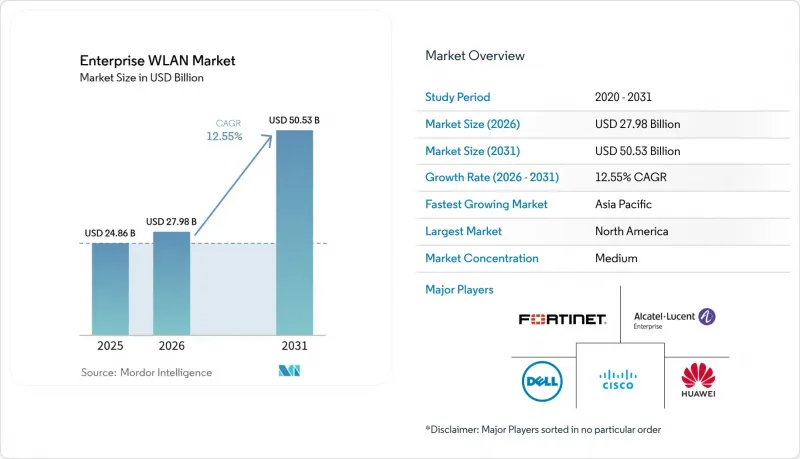
Mordor Intelligence에 의하면, 기업 WLAN 시장 규모는 2025년에 248억 6,000만 달러로 평가되었고 2026년 279억 8,000만 달러에서 2031년까지 505억 3,000만 달러에 이를 것으로 예측되며, 예측 기간(2026-2031년) CAGR은 12.55%를 나타낼 전망입니다.
본 보고서는 구성 요소(하드웨어, 소프트웨어, 서비스), 조직 규모(대기업, 중소기업), 최종 사용자 산업별(소매, 헬스케어, 은행 및 금융 서비스·보험, 제조업, 교육, 기타), 배포 방식별(On-Premise, 클라우드 관리형), 지역별로 분류되어 있습니다. 시장 예측은 금액(달러) 기준으로 제시되어 있습니다.
세계 엔터프라이즈 WLAN 시장 동향 및 인사이트
Wi-Fi 6/6E로의 업그레이드 주기 급증으로 성능이 비약적으로 향상될 전망
주요 하이라이트
- 6GHz 대역의 1,200MHz 주파수 대역이 개방됨에 따라, 기업들은 멀티 기가비트 WLAN용으로 처음으로 연속된 초광대역 채널을 이용할 수 있게 되었습니다. 또한, Wi-Fi 7의 멀티링크 운영을 통해 처리량이 향상되는 동시에 지연 시간이 감소합니다. 화상 협업, 몰입형 교육, AR을 활용한 유지보수 분야에서는 이러한 예측 가능한 성능이 요구되고 있으며, 이에 따라 대기업의 40%가 교체 일정을 앞당기고 있습니다. 인도 규제 당국은 2024년부터 2034년까지 6GHz 대역 주파수 할당에 따른 누적 경제 활동을 4조 300억 달러로 평가하며, 그 거시적인 영향을 강조하고 있습니다. 그러나 더 높은 전력 예산과 POE++ 스위치가 전제조건이 되기 때문에 구매자들은 액세스 계층과 스위칭 계층의 업그레이드를 동시에 진행하도록 권장받고 있습니다.
하이브리드 업무 모델이 요구하는 네트워크 혁신
하이브리드 근무는 이제 표준 관행이 되었으며, 사무실과 자택을 넘나드는 원활한 로밍, 세밀한 액세스 제어, 용도 수준의 QoS가 요구되고 있습니다. 기업들은 통합된 사용자 경험, VPN 수준의 보안, 분석을 통한 용량 계획을 가능하게 하기 위해 첨단 무선 프로젝트에 3년간 평균 1억 1,570만 달러를 할당하고 있습니다. Passpoint(IEEE 802.11u)는 직원 및 방문객의 안전한 온보딩을 간소화하고 헬프데스크 문의 건수를 줄이는 동시에 신원 확인의 신뢰성을 높입니다. CIO들이 네트워크 현대화와 업무 환경의 유연성 확보라는 요구 사항을 조화시켜 나가면서, 기업 WLAN 시장은 그 혜택을 누리고 있습니다.
지속적인 공급망 혼란이 성장을 제약하고 있습니다.
일부 데이터센터용 SKU의 경우, 네트워크용 ASIC의 리드 타임이 최대 52주에 달하여 구매자들은 도입을 연기하거나 하드웨어에 대한 의존도를 낮추는 클라우드 대체 솔루션을 채택할 수밖에 없는 상황입니다. 공급업체를 다각화하고 있는 벤더들은 공급 부족을 더 잘 극복하고, 전환된 수요를 확보하고 있습니다. Extreme Networks는 팬데믹 기간 동안의 회복력을 바탕으로 의료시설 개보수 공사에서 새로운 매출 기회를 창출했다고 밝혔습니다.
부문 분석
하드웨어는 2025년 매출의 60.55%를 차지하고 있으며, 강당, 공장, 병원 등에서 용도 성능을 보장하는 고밀도 Wi-Fi 6E 액세스 포인트에 대한 수요가 그 원동력이 되고 있습니다. 각 벤더들은 트리플 라디오 설계, 통합형 IoT 무선, 고급 RF 분석 기능을 묶어 프리미엄 가격 책정을 정당화하고 있습니다. 기업 WLAN 시장에서는 현재 차세대 AP를 구동하기 위해 2.5Gbps 또는 5Gbps 멀티 기가 이더넷에 더해 90W POE를 공급하는 스위치 업그레이드가 진행되고 있습니다. 소프트웨어 부문은 규모는 작지만, AI 네이티브 클라우드 제어, 어슈어런스 분석, 위협 중심의 마이크로 세분화이 필수적으로 대두됨에 따라 연평균 성장률(CAGR) 13.75%로 성장하고 있습니다. Mist AI와 Cisco DNA Center는 컨트롤러 로직, 네트워크 데이터 레이크, 머신러닝이 어떻게 통합되어 단일 화면에서 운영 경험을 실현하고 있는지 보여줍니다.
액세스 포인트의 펌웨어 및 라이선싱 구독을 통해, 과거에는 정기적인 자본 지출이었던 것이 지속적인 수익으로 전환되어 투자자를 유치하고 갱신 주기를 단축하고 있습니다. 한편, 조직 내에서는 사내 RF 계획 및 제로 트러스트 설계에 대한 역량이 부족하기 때문에 전문 서비스 및 관리형 서비스가 활성화되고 있습니다. 컨설턴트가 사이트 조사, 스펙트럼 감사, 규정 준수 검증을 총괄함으로써 벤더 생태계에 대한 정착도를 높이고 있습니다.
2025년에는 대기업이 기업 WLAN 시장 점유율의 57.35%를 차지하며, 이는 대규모 인증, 정책 엔진, 내결함성이 필요한 멀티 캠퍼스 환경을 반영한 것입니다. SASE 프레임워크에 통합된 SD-branch 아키텍처는 포춘 1000대 기업의 보안 요구 사항과 잘 부합합니다. 반면, 중소기업(SME)은 컨트롤러 하드웨어나 막대한 초기 비용이 필요 없는 구독형 ‘WLAN-as-a-Service’의 부양에 힘입어 12.95%라는 가장 높은 연평균 성장률(CAGR)을 기록하고 있습니다. 클라우드 도입과 자동화된 RF 최적화를 통해 소규모 IT 팀은 복잡한 CLI 워크플로우에서 해방되어, 공인 무선 엔지니어를 고용하지 않고도 엔터프라이즈급 기능을 활용할 수 있게 됩니다.
각 벤더들은 엔터프라이즈 기능을 신속한 도입, 성장에 따른 라이선싱 방식, 모바일 우선 대시보드를 중시하는 계층형 서비스로 재구성하고 있습니다. MSP 채널에서는 WLAN을 광대역 및 VoIP와 번들로 제공함으로써 소매, 호텔·관광, 전문 서비스 산업에서의 보급을 더욱 확대되고 있습니다. 인력 부족이 지속되는 가운데, 중소기업은 모니터링 업무의 외부 위탁에 주목하고 있으며, 클라우드 관리형 솔루션 도입 확대와 발맞추어 성장하는 서비스 부문을 주도하고 있습니다.
지역별 분석
북미는 2025년에 38.40%의 점유율로 최대 수익을 창출했습니다. 이는 FCC가 지원하는 6GHz 대역 주파수 할당을 통해 2023-2024년까지 추정 8,700억 달러의 경제적 가치가 창출된 것이 뒷받침되었습니다. InfotechLead에 따르면, 미국의 출하 대수는 2024년 2분기에 전년 동기 대비 30.6%의 큰 폭의 감소를 보였으나, 미결 주문이 해소되면서 전분기 대비 15.3%의 회복세를 나타냈습니다. 연방 정부의 광대역 자금 지원, 스마트 빌딩에 대한 인센티브, 호조를 보이는 매니지드 서비스 채널이 의료, 교육, 금융 서비스 부문의 지출을 뒷받침하고 있습니다.
아시아태평양은 2026년부터 2031년까지 13.05%라는 가장 높은 연평균 성장률(CAGR)을 나타낼 전망입니다. 중국은 디지털 공장 및 캠퍼스 구축을 뒷받침하는 산업 정책에 힘입어 계속해서 최대 시장으로 남을 것입니다. 인도의 정책 싱크탱크는 2034년까지의 누적 영향액을 4조 300억 달러로 평가하고 있으며, 이는 기업 WLAN 시장 수요를 더욱 촉진할 것으로 보입니다. 아세안(ASEAN) 회원국들은 제조 거점 확대와 공항 현대화를 추진하고 있으며, 모두 고밀도 Wi-Fi와 제로 트러스트 기반 세분화가 필요합니다.
유럽에서는 그 성장세에 편차가 나타나고 있습니다. InfotechLead에 따르면, 거시경제적 역풍으로 인해 2024년 2분기 출하 대수는 전년 동기 대비 22.3% 감소했으나, 재고 정상화가 진행된 3분기에는 소폭 회복되었습니다. ‘6G 네트워크 생태계에 대한 유럽 비전’에서는 AI 네이티브이며 통합된 감지 기능이 우선시되고 있으며, 주파수 규제 당국은 벤더의 혁신을 가속화하기 위한 공통 프레임워크를 추진하고 있습니다. 5G-Advanced와 Wi-Fi 7의 상호 운용성이 캠퍼스 환경의 설계 목표로 자리 잡고 있어, 이러한 노력은 기업 WLAN 업그레이드의 방향을 결정할 것으로 보입니다.
중동 및 아프리카는 여전히 규모는 작지만, 각국 정부가 스마트 시티에 대한 투자를 추진하는 가운데 두 자릿수 성장을 기록하고 있습니다. 아랍에미리트의 각 부처는 연방 정부 청사에 Wi-Fi와 IoT를 통합한 네트워크를 도입하고 있는 반면, 남아프리카공화국의 소매업체들은 옴니채널 상거래를 지원하기 위해 클라우드 관리형 WLAN을 채택하고 있습니다. 라틴아메리카는 낮은 수준에서 출발했지만, 공급 병목 현상이 완화되고 통화 안정성이 개선됨에 따라 2023년 3분기에는 전년 동기 대비 235%의 성장을 기록했습니다. 이 지역의 호텔·관광 산업 및 광업 부문에서는 투숙객 서비스 및 원격지 연결과 관련해 AI를 활용한 WLAN에 대한 관심이 특히 높아지고 있습니다.
기타 혜택
- 엑셀 형식 시장 예측(ME) 시트
- 3개월간의 애널리스트 지원
자주 묻는 질문
목차
제1장 서론
제2장 조사 방법
제3장 주요 요약
제4장 시장 구도
제5장 시장 규모와 성장 예측
제6장 경쟁 구도
제7장 시장 기회와 향후 전망
JHS 26.09.11According to Mordor Intelligence, the enterprise WLAN market size was valued at USD 24.86 billion in 2025 and estimated to grow from USD 27.98 billion in 2026 to reach USD 50.53 billion by 2031, at a CAGR of 12.55% during the forecast period (2026-2031).
This report is Segmented by Component (Hardware, Software, and Services), Organization Size (Large Enterprises, Small and Medium-Sized Enterprises), End-User Vertical (Retail, Healthcare, Banking, Financial Services, and Insurance, Manufacturing, Education, and More), Deployment Mode (On-Premises and Cloud-Managed), and Geography. The Market Forecasts are Provided in Terms of Value (USD).
Global Enterprise WLAN Market Trends and Insights
Surge in Wi-Fi 6/6E Upgrade Cycles Drives Performance Leap
Key Highlights
- Opening 1,200 MHz of 6 GHz spectrum gives enterprises the first contiguous stretch of ultra-wide channels for multigigabit WLAN, and multi-link operation in Wi-Fi 7 boosts throughput while trimming latency. Video collaboration, immersive training, and AR-assisted maintenance demand such deterministic performance, prompting 40% of large organizations to bring forward refresh schedules. Indian regulators value the 6 GHz allocation at USD 4,030 billion in cumulative economic activity for 2024-2034, underscoring its macro impact.Yet higher power budgets and POE++ switches are prerequisites, nudging buyers to coordinate access-layer and switching upgrades in tandem.
Hybrid Work Models Demand Network Transformation
Hybrid work is now standard practice, requiring seamless roaming, granular access control, and application-level QoS across offices and homes. Enterprises allocate an average of USD 115.7 million over three years for advanced wireless projects to enable unified user experiences, VPN-grade security, and analytics-driven capacity planning. Passpoint (IEEE 802.11u) simplifies secure onboarding for employees and guests, lowering help-desk tickets while tightening identity assurance. The enterprise WLAN market benefits as CIOs align network modernization with workplace flexibility mandates
Persistent Supply-Chain Disruptions Constrain Growth
Lead times for network ASICs stretch up to 52 weeks in some data-center SKUs, prompting buyers to postpone rollouts or adopt cloud alternatives that lessen hardware dependence. Vendors with diversified suppliers weather shortages better and capture displaced demand. Extreme Networks cites pandemic-era resilience that unlocked new sales in healthcare refits.
Other drivers and restraints analyzed in the detailed report include:
- IoT Density Drives Network Architecture Evolution
- Cloud Management Transforms Operational Economics
- Cybersecurity Skills Gap Threatens Network Security
For complete list of drivers and restraints, kindly check the Table Of Contents.
Segment Analysis
Hardware contributed 60.55% of 2025 revenue, powered by demand for high-density Wi-Fi 6E access points that safeguard application performance in auditoriums, factories, and hospitals. Vendors bundle tri-radio designs, integrated IoT radios, and advanced RF analytics that justify premium price points. The enterprise WLAN market is now cycling through switch upgrades that supply 2.5 Gbps or 5 Gbps multigig Ethernet plus 90 W POE to drive next-generation APs. The software category, though smaller, is climbing at a 13.75% CAGR as AI-native cloud control, assurance analytics, and threat-centric micro-segmentation become indispensable. Mist AI and Cisco DNA Center illustrate how controller logic, network data lakes, and machine learning converge into single-pane experiences.
Access point firmware and license subscriptions convert once-periodic capital spending into recurring revenue, enticing investors and compressing refresh intervals. Meanwhile, professional and managed services flourish because organizations lack in-house RF planning and zero-trust design skills. Consultants orchestrate site surveys, spectrum audits, and compliance validation, adding stickiness to vendor ecosystems
Large enterprises held 57.35% of the enterprise WLAN market share in 2025, reflecting multi-campus estates that demand scaled authentication, policy engines, and resiliency. SD-branch architectures feeding into SASE frameworks align well with Fortune 1000 security mandates. Yet SMEs post the strongest 12.95% CAGR, encouraged by subscription-based WLAN as a service that removes controller hardware and heavy upfront cost. Cloud onboarding and automated RF optimization free smaller IT teams from arcane CLI workflows, making enterprise-grade features accessible without hiring certified wireless engineers.
Vendors repackage enterprise functionality into tiered offerings that emphasize quick deployment, pay-as-you-grow licensing, and mobile-first dashboards. MSP channels bundle WLAN with broadband and VoIP, deepening penetration among retail, hospitality, and professional services. As talent shortages persist, SMEs turn to outsourced monitoring, driving a services layer that grows in lockstep with cloud-managed adoption.
Complete Report Scope:
- By Component
- Hardware
- Access Points
- WLAN Controllers
- Wireless Hotspot Gateways
- Software
- WLAN Security
- WLAN Management
- WLAN Analytics
- Other Software
- Services
- Professional Services
- Managed Services
- Hardware
- By Organization Size
- Large Enterprises
- Small and Medium-sized Enterprises (SME)
- By End-user Vertical
- Banking, Financial Services and Insurance
- Healthcare
- Retail
- IT and Telecommunications
- Manufacturing
- Education
- Hospitality
- Other Verticals
- By Deployment Mode
- On-premises
- Cloud-managed
- By Geography
- North America
- United States
- Canada
- Mexico
- South America
- Argentina
- Brazil
- Rest of South America
- Europe
- United Kingdom
- Germany
- France
- Italy
- Rest of Europe
- Asia-Pacific
- China
- Japan
- South Korea
- India
- Rest of Asia Pacific
- Middle East and Africa
- United Arab Emirates
- Saudi Arabia
- South Africa
- Rest of Middle and Africa
- North America
Geography Analysis
North America generated the highest revenue with a 38.40% share in 2025, buoyed by FCC-backed 6 GHz allocations that created an estimated USD 870 billion in economic value during 2023-2024. United States shipments swung sharply, down 30.6% year over year in Q2 2024, then rebounded 15.3% sequentially as backlogs cleared, according to InfotechLead. Federal broadband funding, smart-building incentives, and a vibrant managed services channel sustain spending across healthcare, education, and financial services.
Asia Pacific posts the fastest 13.05% CAGR between 2026 and 2031. China remains the biggest market, steered by industrial policies that favor digital factories and campus rollouts. India's policy think tank values unlicensed 6 GHz at USD 4,030 billion in cumulative impact through 2034, further catalyzing enterprise WLAN market demand. ASEAN members expand manufacturing footprints and modernize airports, both requiring high-density Wi-Fi and zero-trust segmentation.
Europe shows mixed momentum. Shipments sank 22.3% year over year in Q2 2024 amid macro headwinds, then ticked up modestly in Q3 as inventory normalization progressed, according to InfotechLead. The European Vision for 6G Network Ecosystems prioritizes AI-native and integrated sensing features, and spectrum regulators push common frameworks to accelerate vendor innovation.These initiatives will shape enterprise WLAN upgrades because interoperability between 5G-Advanced and Wi-Fi 7 is a design goal for campus environments.
The Middle East and Africa remain smaller but record double-digit growth as governments invest in smart cities. United Arab Emirates ministries deploy converged Wi-Fi/IoT networks in federal buildings, while South African retailers adopt cloud-managed WLAN to support omnichannel commerce. Latin America, starting from a low base, registered 235% year-over-year growth in Q3 2023 after supply bottlenecks eased and currency stability improved. The region's hospitality and mining sectors show particular interest in AI-assisted WLAN for guest services and remote site connectivity.
- Cisco Systems
- Hewlett Packard Enterprise Aruba
- Huawei Technologies
- Juniper Networks (Mist)
- Extreme Networks
- CommScope - Ruckus
- Dell Technologies
- Fortinet
- Ubiquiti Inc.
- Arista Networks
- Cambium Networks
- Zebra Technologies
- Netgear
- TP-Link Technologies
- Arista Networks
- Ruijie Networks
- Alcatel-Lucent Enterprise
- Huawei Technologies
- EnGenius Networks
- Cambium Networks
Additional Benefits:
- The market estimate (ME) sheet in Excel format
- 3 months of analyst support
TABLE OF CONTENTS
1 INTRODUCTION
- 1.1 Study Assumptions and Market Definition
- 1.2 Scope of the Study
2 RESEARCH METHODOLOGY
3 EXECUTIVE SUMMARY
4 MARKET LANDSCAPE
- 4.1 Market Overview
- 4.2 Market Drivers
- 4.2.1 Surge in Wi-Fi 6/6E upgrade cycles
- 4.2.2 Rapid adoption of BYOD and hybrid work
- 4.2.3 Exploding enterprise IoT node density
- 4.2.4 Cloud-managed WLAN lowers TCO
- 4.2.5 6 GHz spectrum allocations (global)
- 4.2.6 Smart-building stimulus funds
- 4.3 Market Restraints
- 4.3.1 Chip-set supply-chain volatility
- 4.3.2 Skills gap in Wi-Fi design and security
- 4.3.3 Enterprise private-5G substitution risk
- 4.3.4 Rising cybersecurity insurance premiums
- 4.4 Value Chain Analysis
- 4.5 Regulatory Landscape
- 4.6 Technological Outlook
- 4.7 Porter's Five Forces Analysis
- 4.7.1 Bargaining Power of Suppliers
- 4.7.2 Bargaining Power of Buyers
- 4.7.3 Threat of New Entrants
- 4.7.4 Threat of Substitutes
- 4.7.5 Competitive Rivalry
- 4.8 COVID-19 Impact Assessment
- 4.9 Investment Analysis
5 MARKET SIZE AND GROWTH FORECASTS (VALUE)
- 5.1 By Component
- 5.1.1 Hardware
- 5.1.1.1 Access Points
- 5.1.1.2 WLAN Controllers
- 5.1.1.3 Wireless Hotspot Gateways
- 5.1.2 Software
- 5.1.2.1 WLAN Security
- 5.1.2.2 WLAN Management
- 5.1.2.3 WLAN Analytics
- 5.1.2.4 Other Software
- 5.1.3 Services
- 5.1.3.1 Professional Services
- 5.1.3.2 Managed Services
- 5.1.1 Hardware
- 5.2 By Organization Size
- 5.2.1 Large Enterprises
- 5.2.2 Small and Medium-sized Enterprises (SME)
- 5.3 By End-user Vertical
- 5.3.1 Banking, Financial Services and Insurance
- 5.3.2 Healthcare
- 5.3.3 Retail
- 5.3.4 IT and Telecommunications
- 5.3.5 Manufacturing
- 5.3.6 Education
- 5.3.7 Hospitality
- 5.3.8 Other Verticals
- 5.4 By Deployment Mode
- 5.4.1 On-premises
- 5.4.2 Cloud-managed
- 5.5 By Geography
- 5.5.1 North America
- 5.5.1.1 United States
- 5.5.1.2 Canada
- 5.5.1.3 Mexico
- 5.5.2 South America
- 5.5.2.1 Argentina
- 5.5.2.2 Brazil
- 5.5.2.3 Rest of South America
- 5.5.3 Europe
- 5.5.3.1 United Kingdom
- 5.5.3.2 Germany
- 5.5.3.3 France
- 5.5.3.4 Italy
- 5.5.3.5 Rest of Europe
- 5.5.4 Asia-Pacific
- 5.5.4.1 China
- 5.5.4.2 Japan
- 5.5.4.3 South Korea
- 5.5.4.4 India
- 5.5.4.5 Rest of Asia Pacific
- 5.5.5 Middle East and Africa
- 5.5.5.1 United Arab Emirates
- 5.5.5.2 Saudi Arabia
- 5.5.5.3 South Africa
- 5.5.5.4 Rest of Middle and Africa
- 5.5.1 North America
6 COMPETITIVE LANDSCAPE
- 6.1 Market Concentration
- 6.2 Strategic Moves
- 6.3 Market Share Analysis
- 6.4 Company Profiles (includes Global level Overview, Market level overview, Core Segments, Financials as available, Strategic Information, Market Rank/Share for key companies, Products and Services, and Recent Developments)
- 6.4.1 Cisco Systems
- 6.4.2 Hewlett Packard Enterprise Aruba
- 6.4.3 Huawei Technologies
- 6.4.4 Juniper Networks (Mist)
- 6.4.5 Extreme Networks
- 6.4.6 CommScope - Ruckus
- 6.4.7 Dell Technologies
- 6.4.8 Fortinet
- 6.4.9 Ubiquiti Inc.
- 6.4.10 Arista Networks
- 6.4.11 Cambium Networks
- 6.4.12 Zebra Technologies
- 6.4.13 Netgear
- 6.4.14 TP-Link Technologies
- 6.4.15 Arista Networks
- 6.4.16 Ruijie Networks
- 6.4.17 Alcatel-Lucent Enterprise
- 6.4.18 Huawei Technologies
- 6.4.19 EnGenius Networks
- 6.4.20 Cambium Networks
7 MARKET OPPORTUNITIES AND FUTURE OUTLOOK
- 7.1 White-space and Unmet-need Assessment