

|
시장보고서
상품코드
2124325
자동차용 이더넷 시장 : 시장 점유율 분석, 업계 동향 및 통계, 성장 예측(2026-2031년)Automotive Ethernet - Market Share Analysis, Industry Trends & Statistics, Growth Forecasts (2026 - 2031) |
||||||
 Mordor Intelligence
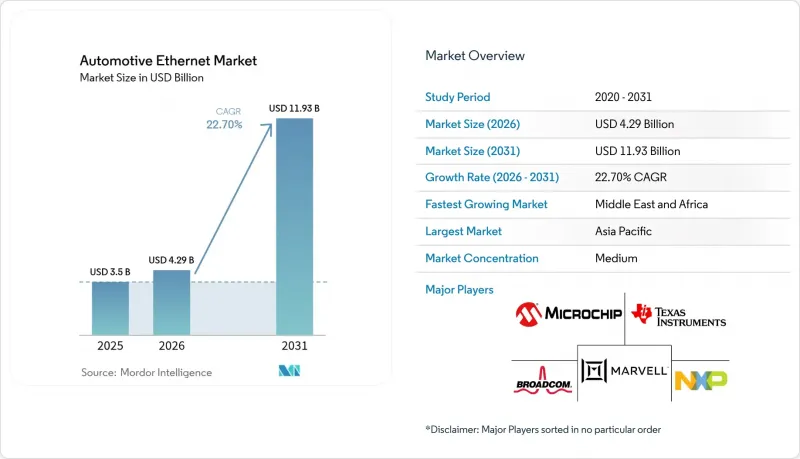
Mordor Intelligence에 의하면, 자동차용 이더넷 시장 규모는 2025년에 35억 달러로 평가되었고, 2026년 42억 9,000만 달러에서 2031년까지 119억 3,000만 달러에 이를 것으로 예측되며, 예측 기간(2026-2031년) CAGR은 22.70%를 기록할 전망입니다.
본 보고서는 구성 요소별(하드웨어, 소프트웨어, 서비스), 대역폭 및 작동 속도(10 Mbps(10BASE-T1S), 100 Mbps(100BASE-T1) 등), 용도별(ADAS 및 자율주행용 센서, 인포테인먼트 및 텔레매틱스, 파워트레인 등), 차종별(승용차, 소형 상용차 등), 그리고 지역별로 분류되어 있습니다. 시장 예측은 금액(달러)으로 표시되어 있습니다.
세계의 자동차용 이더넷 시장 동향 및 인사이트
인포테인먼트 및 ADAS 분야의 대역폭 수요 급증
고성능 카메라, 레이더, LiDAR 어레이는 최대 40 Gbps의 원시 데이터를 스트리밍할 수 있으며, 이 데이터는 최소한의 지연으로 중앙 처리 장치에 도달해야 합니다. 따라서 100 Mbps에서 10 Gbps까지 확장 가능한 이더넷 백본이 10 Mbps가 상한선인 레거시 버스를 대체하고 있으며, 고해상도 매핑과 몰입감 있는 차량 내 경험을 실현하고 있습니다. 고급 자동차 브랜드의 경우, 이미 프리미엄 모델의 약 60%에 이더넷 인포테인먼트 링크를 탑재하고 있으며, 이러한 추세는 예측 기간 동안 양산차 부문으로도 확산될 것으로 예측됩니다. 또한, 안전 알고리즘에는 결정론적 지연 시간 예산이 요구되기 때문에 실시간 멀티 센서 융합도 기가비트급 링크로의 전환을 가속화하고 있습니다. 이러한 요인들이 결합되어 네트워크 처리량은 상승 추세를 유지하며 칩셋의 지속적인 혁신을 뒷받침하고 있습니다.
저비용 싱글 페어 이더넷의 급속한 보급
싱글 페어 이더넷은 2쌍의 차동 페어를 제거함으로써 하네스 무게를 최대 40%, 배선 비용을 20% 가까이 절감하며, 이러한 이점은 전기차의 주행 거리 연장에 직접적으로 기여합니다. 10BASE-T1S는 멀티드롭 토폴로지를 지원하여, 복잡한 게이트웨이 없이도 여러 개의 에지 센서가 한 쌍의 트위스트 페어를 공유할 수 있습니다. 중국의 주요 OEM 프로그램에서는 도어, 시트, 조명 모듈을 연결하기 위해 SPE를 탑재한 시제품 차량이 이미 출시되었으며, 아날로그 디바이스(Analog Devices)와 같은 공급업체들은 보안 규정 준수를 간소화하기 위해 MACsec을 통합한 PHY를 제공합니다. 초기 도입 사례를 통해 배선 간소화가 구역형 아키텍처의 확산을 가속화하고, 비용 중심의 플랫폼 확장을 가능하게 한다는 점이 확인되었습니다.
상호 운용성 및 레거시 ECU 호환성 관련 과제
많은 양산 플랫폼은 여전히 CAN이나 LIN 도메인에 의존하고 있으며, 이러한 도메인은 하루아침에 사라지지 않을 것입니다. 브리지 게이트웨이는 타이밍 제약을 준수하면서 프로토콜을 변환해야 하므로, 부품 명세서(BOM) 비용과 소프트웨어의 복잡성을 증가시킵니다. 2025년에 21억 달러 규모 시장 성장이 예상되는 자동차용 중앙 게이트웨이 모듈 시장은 이러한 과도기적 아키텍처의 규모를 여실히 보여주고 있습니다. 따라서 Chery와 같은 중국 자동차 제조업체들은 계기판의 CAN 버스와 공존할 수 있도록 설계된 이더넷 게이트웨이를 개발하고 있으며, 이는 전환 전략을 통해 통합에 따른 과제를 완화할 수는 있더라도 완전히 해소할 수는 없음을 입증하고 있습니다. 향후 2년 동안 차량이 점차 완전한 이더넷 구역으로 전환되는 과정에서 이러한 게이트웨이는 계속해서 필수적인 존재가 될 것입니다.
부문 분석
하드웨어 부문은 2025년 매출의 62.35%를 차지했으며, 차량용 네트워크의 기반이 되는 PHY 트랜시버, 스위치, 컨트롤러가 이를 주도하고 있습니다. 마이크로칩(Microchip)과 같은 벤더들의 여러 세대에 걸친 로드맵에 따라, 단일 다이(die)에 100 Mbps에서 1 Gbps의 기능이 추가되어 비용 대비 성능이 향상되고 있습니다. 서비스 하위 부문은 절대 매출액으로는 작지만, 각 OEM 업체들이 규정 준수, TSN 튜닝, 딥 패킷 인스펙션을 점점 더 외부에 위탁하고 있기 때문에 연평균 성장률(CAGR) 26.95%로 가장 빠른 성장세를 보이고 있습니다. 키사이트의 자동 규정 준수 제품군은 IEEE 준수를 가속화하고 있으며, 테스트 전문 지식이 프리미엄 요금을 가져다준다는 점을 반영하고 있습니다. 전반적으로 이러한 추세로 인해 실리콘 출하량이 여전히 매출의 주축을 차지하고 있음에도 불구하고, 서비스는 전략적 성장의 원동력으로서의 입지를 확고히 하고 있습니다.
이와 동시에, 존 기반 아키텍처가 성숙해짐에 따라 보안 부팅, 네트워크 오케스트레이션 및 무선(OTA) 설정을 지원하는 소프트웨어 스택의 중요성이 커지고 있습니다. 실시간 OS 공급업체들은 도입을 간소화하기 위해 ISO 26262 인증 관련 자료를 번들로 제공하고 있으며, 자동차 이더넷 시장에서는 개별 구성 요소보다 턴키 솔루션이 더 높이 평가받고 있음이 입증되었습니다. 데이터 양이 증가함에 따라, 클라우드 연동형 분석 플랫폼이 인접한 서비스 계층으로 부상하여 자동차 이더넷 업계의 수익원을 더욱 다각화할 것입니다.
100BASE-T1은 2025년에도 41.10%의 점유율을 유지하며, 100 Mbps 미만이 상한선인 차체 제어 및 인포테인먼트의 요구 사항을 충족할 것입니다. 성숙한 비용 곡선과 OPEN Alliance의 상호 운용성 프로파일이 매력을 뒷받침하며, 처리량과 가격의 균형을 유지하고 있습니다. 2.5/5/10 Gbps 등급은 2031년까지 연평균 성장률(CAGR)이 36.60%로 가장 높은 성장세를 보일 것으로 예상되며, 예측 기간이 끝날 무렵에는 고속 링크용 자동차 이더넷 시장 규모를 수십억 달러 규모로 끌어올릴 전망입니다. 스위치용 실리콘에 10GBASE-T1 PHY가 통합됨에 따라 공급망의 준비 태세가 개선되어, 단일 패키지로 존 백본을 구현할 수 있게 되었습니다.
10BASE-T1S는 10 Mbps 멀티드롭 기능을 제공하여 에지 센서의 연결성을 실현하고, 결정론적 지연 시간이 그다지 중요하지 않은 상황에서는 게이트웨이 비용을 절감합니다. 한편, 1000BASE-T1은 현재의 요구 사항과 향후 구역화 노력을 연결하는 중간적인 역할을 수행하고 있습니다. 전반적으로 기가비트 및 멀티 기가비트 계층으로의 전환을 통해 실시간 물체 분류 및 고화질 차량 내 스트리밍과 같은 새로운 소프트웨어 정의 기능이 실현되어, 자동차 이더넷 시장의 확장을 뒷받침하고 있습니다.
지역별 분석
아시아태평양은 중국의 커넥티드카 및 자율주행차로의 급속한 전환을 견인력으로 삼아 2025년 전 세계 수요의 47.60%를 차지할 것으로 예측됩니다. GB/T 45503-2025 등의 국가 표준에 따라 ECU 적합성 시험 방법이 정의됨에 따라, 중국의 자동차용 이더넷 시장 규모는 2025년에 120억 위안(17억 달러)을 넘어설 것으로 예측됩니다. 현지 대형 반도체 기업들은 설계 주기를 단축하고 있어, 구역별 프로토타입의 신속한 반복 개발을 진행하는 국내 OEM에 혜택을 주고 있습니다. 일본과 한국은 수직 통합된 전자 및 자동차 공급망을 통해 지역 내 우위를 확대하고 있으며, 2025년까지 SPE 생산 라인을 도입할 예정입니다.
북미는 자사의 소프트웨어 생태계와 벤처 캐피털 파이프라인을 활용하여 첨단 소프트웨어 정의 차량(SDV)의 시범 운행을 추진하고 있습니다. 미국 상무부가 커넥티드카에 의심스러운 반도체 부품의 사용 제한을 검토하는 가운데, 규제 당국은 사이버 보안을 중시하고 있습니다. 디트로이트와 실리콘밸리의 각 OEM 기업들은 OTA(Over-the-Air) 프레임워크 도입을 가속화하여 기가비트 백본에 대한 수요를 촉진하고 있습니다. 중국과의 무역 마찰은 PHY 칩 물류와 관련된 공급망 리스크를 초래하고 있으며, 프로그램 일정을 유지하기 위해 니어쇼어링 전략과 듀얼 소싱 계약이 추진되고 있습니다.
중동 및 아프리카은 시장 규모는 작지만, 2031년까지 연평균 성장률(CAGR)이 24.75%로 지역별 가장 빠른 성장세를 보이고 있습니다. 사우디아라비아와 UAE 정부는 현지 조립 및 전기차 보급을 장려하고 있으며, 이를 통해 전 세계 OEM 업체들이 이더넷 지원 프리미엄 모델을 수입하도록 유도하고 있습니다. 스마트 시티의 전개는 고속 차량 네트워크를 보완하며, 신호 우선 제어 및 V2X를 통한 안전 기능의 발전을 촉진하고 있습니다. 유럽의 프리미엄 브랜드들은 자유무역지대를 활용하여 최신 모델을 출시하고 있으며, 이로 인해 해당 지역 전체에서 이더넷의 보급이 더욱 가속화되고 있습니다.
기타 혜택 :
- 엑셀 형식 시장 예측(ME) 시트
- 3개월간 애널리스트 지원
자주 묻는 질문
목차
제1장 서론
제2장 조사 방법
제3장 주요 요약
제4장 시장 구도
제5장 시장 규모 및 성장 예측
제6장 경쟁 구도
제7장 시장 기회 및 향후 전망
AJY 26.09.09According to Mordor Intelligence, the automotive ethernet market size was valued at USD 3.5 billion in 2025 and estimated to grow from USD 4.29 billion in 2026 to reach USD 11.93 billion by 2031, at a CAGR of 22.70% during the forecast period (2026-2031).
This report is Segmented by Component (Hardware, Software, and Services), Bandwidth/Operating Speed (10 Mbps [10BASE-T1S], 100 Mbps [100BASE-T1], and More), Application (ADAS and Autonomous Sensors, Infotainment and Telematics, Powertrain, and More), Vehicle Type (Passenger Cars, Light Commercial Vehicles, and More), and Geography. The Market Forecasts are Provided in Terms of Value (USD).
Global Automotive Ethernet Market Trends and Insights
Surging Infotainment & ADAS Bandwidth Demand
Advanced camera, radar, and LiDAR arrays can stream up to 40 Gbps of raw data that must reach centralized processors with minimal latency. Ethernet backbones scaling from 100 Mbps to 10 Gbps are therefore replacing legacy buses capped at 10 Mbps, enabling high-resolution mapping and immersive cabin experiences. Luxury brands already equip roughly 60% of premium models with Ethernet infotainment links, a pattern expected to cascade to volume segments over the forecast window. Real-time multi-sensor fusion is also accelerating the shift to gigabit-class links because safety algorithms require deterministic latency budgets. Together, these forces keep network throughput on an upward trajectory and underpin continuous chipset innovation.
Rapid Adoption of Low-Cost Single-Pair Ethernet
Single-pair Ethernet eliminates two differential pairs, cutting harness weight by up to 40% and wiring cost by nearly 20%, benefits that directly extend the range of electric vehicles. 10BASE-T1S supports multidrop topologies, allowing multiple edge sensors to share a single twisted pair without complex gateways. Leading OEM programs in China are already releasing pre-production vehicles with SPE to connect door, seat, and lighting modules, while suppliers such as Analog Devices offer PHYs with integrated MACsec to simplify security compliance. Early deployments confirm that simplified cabling accelerates zonal architecture rollouts and scales cost-sensitive platforms.
Interoperability & Legacy ECU Compatibility Issues
Many mass-production platforms still rely on CAN or LIN domains that do not disappear overnight. Bridging gateways must translate protocols while safeguarding timing constraints, adding bill-of-materials cost and software complexity. The Automotive Central Gateway Module market, valued at USD 2.1 billion in 2025, highlights the scale of this interim architecture. Chinese OEMs such as Chery have thus designed Ethernet gateways tailored to coexist with instrument-cluster CAN buses, proving that transition strategies can mitigate but not fully erase integration pain. Over the next two years, these gateways will remain essential as fleets slowly migrate toward full Ethernet zones.
Other drivers and restraints analyzed in the detailed report include:
- EV & Autonomous Platforms Shift to Zonal E/E Architectures
- OEM Standardization via OPEN Alliance & IEEE TSN Profiles
- Vehicle-Level Cybersecurity & Functional-Safety Certification Hurdles
For complete list of drivers and restraints, kindly check the Table Of Contents.
Segment Analysis
The hardware segment held 62.35% of 2025 revenue, led by PHY transceivers, switches, and controllers that anchor every in-vehicle network. Multi-generation roadmaps from vendors such as Microchip add 100 Mbps to 1 Gbps capabilities on a single die, underscoring performance-per-dollar improvements. The services sub-segment, though smaller in absolute revenue, is the fastest riser at a 26.95% CAGR because OEMs increasingly outsource compliance, TSN tuning, and deep packet inspection. Keysight's automated compliance suits accelerate IEEE conformance, reflecting how test expertise commands premium fees. Collectively, this dynamic positions services as a strategic growth lever even as silicon volumes remain the revenue anchor.
In parallel, software stacks that support secure boot, network orchestration, and over-the-air configuration gain relevance as zonal architectures mature. Real-time operating systems suppliers bundle ISO 26262 certification artifacts to simplify adoption, proving that the Automotive Ethernet market rewards turnkey solutions over discrete components. As data volumes rise, cloud-linked analytics platforms will likely emerge as an adjacent services layer, further diversifying revenue pools in the Automotive Ethernet industry.
100BASE-T1 retains a 41.10% share in 2025, serving body control and infotainment needs that top out below 100 Mbps. Its mature cost curve and OPEN Alliance interoperability profile sustain its appeal, balancing throughput against price. The 2.5/5/10 Gbps class exhibits the strongest upside with a 36.60% CAGR through 2031, moving the Automotive Ethernet market size for high-speed links into the multi-billion-dollar range by the end of the forecast window. Supply-chain readiness is improving as switch silicon integrates 10GBASE-T1 PHYs, allowing single-package zonal backbones.
10BASE-T1S addresses edge sensor connectivity by providing 10 Mbps multidrop capability, removing gateway cost where deterministic latency is less critical. Meanwhile, 1000BASE-T1 plays an intermediate role, bridging today's needs and tomorrow's zonal ambitions. Overall, the shift toward gigabit and multi-gigabit tiers unlocks new software-defined features, including real-time object classification and high-definition cabin streaming, reinforcing the Automotive Ethernet market expansion.
Complete Report Scope:
- By Component
- Hardware
- Software
- Services
- By Bandwidth/Operating Speed
- 10 Mbps (10BASE-T1S)
- 100 Mbps (100BASE-T1)
- 1 Gbps (1000BASE-T1)
- 2.5/5/10 Gbps Multi-Gig (2.5G/5G/10GBASE-T1)
- By Application
- ADAS and Autonomous Sensors
- Infotainment and Telematics
- Powertrain
- Chassis and Safety
- Body and Comfort
- Diagnostics and OTA Updates
- By Vehicle Type
- Passenger Cars
- Light Commercial Vehicles
- Heavy Commercial/Truck and Bus
- Off-Highway and Agriculture
- By Geography
- North America
- United States
- Canada
- Mexico
- South America
- Brazil
- Argentina
- Rest of South America
- Europe
- Germany
- France
- United Kingdom
- Italy
- Spain
- Russia
- Rest of Europe
- Asia-Pacific
- China
- Japan
- India
- South Korea
- Australia
- Rest of Asia-Pacific
- Middle East and Africa
- Middle East
- Saudi Arabia
- UAE
- Turkey
- Rest of Middle East
- Africa
- South Africa
- Egypt
- Nigeria
- Rest of Africa
- Middle East
- North America
Geography Analysis
Asia-Pacific commands 47.60% of global 2025 demand, anchored by China's rapid transition to connected and automated vehicles. The Chinese Automotive Ethernet market size is projected to surpass RMB 12 billion (USD 1.7 billion) in 2025 as national standards such as GB/T 45503-2025 define ECU compliance test methods. Local silicon champions shorten design cycles, benefiting domestic OEMs that iterate quickly on zonal prototypes. Japan and South Korea extend regional dominance through vertically integrated electronics and automotive supply chains, deploying SPE production lines by 2025.
North America leverages its software ecosystem and venture-capital pipeline to pilot advanced software-defined vehicles. Regulatory bodies emphasize cybersecurity, as the U.S. Department of Commerce weighs restrictions on suspect semiconductor inputs in connected vehicles. OEMs in Detroit and Silicon Valley accelerate OTA frameworks, fostering demand for gigabit backbones. Trade frictions with China inject supply-chain risk around PHY chip logistics, prompting near-shoring strategies and dual-sourcing agreements to sustain program schedules.
The Middle East & Africa holds a smaller base but exhibits the fastest regional growth at 24.75% CAGR through 2031. Governments in Saudi Arabia and the UAE incentivize local assembly and electric-vehicle uptake, encouraging global OEMs to import Ethernet-enabled premium models. Smart-city deployments complement high-speed vehicle networks, allowing traffic-signal priority and V2X safety features to flourish. Premium European brands leverage free-trade zones to position their latest models, further accelerating Ethernet penetration across the region.
- Broadcom Inc.
- NXP Semiconductors N.V.
- Marvell Technology Group Ltd.
- Microchip Technology Inc.
- Texas Instruments Inc.
- Molex Incorporated
- TE Connectivity Ltd.
- Cadence Design Systems Inc.
- Keysight Technologies Inc.
- TTTech Auto AG
- AMD Xilinx
- Analog Devices Inc.
- Renesas Electronics Corp.
- Realtek Semiconductor Corp.
- Rohde and Schwarz GmbH
- Vector Informatik GmbH
- Aptiv PLC
- Infineon Technologies AG
- Continental AG
- HMS Networks AB
- Aeonsemi Corp.
- Aukua Systems Inc.
- Spirent Communications PLC
Additional Benefits:
- The market estimate (ME) sheet in Excel format
- 3 months of analyst support
TABLE OF CONTENTS
1 Introduction
- 1.1 Study Assumptions and Market Definition
- 1.2 Scope of the Study
2 Research Methodology
3 Executive Summary
4 Market Landscape
- 4.1 Market Overview
- 4.2 Market Drivers
- 4.2.1 Surging infotainment and ADAS bandwidth demand
- 4.2.2 Rapid adoption of low-cost single-pair Ethernet (SPE)
- 4.2.3 EV and autonomous platforms shifting to zonal E/E architectures
- 4.2.4 OEM standardisation via OPEN Alliance and IEEE TSN profiles
- 4.2.5 OEM push for end-to-end OTA software pipelines needing GbE backbones
- 4.2.6 Weight-reduction incentives in EU/China favouring Ethernet over CAN-FD
- 4.3 Market Restraints
- 4.3.1 Interoperability and legacy ECU compatibility issues
- 4.3.2 Vehicle-level cyber-security and functional-safety certification hurdles
- 4.3.3 Multi-gig EMC/EMI compliance costs above 5 Gbps
- 4.3.4 US-China tariff volatility on PHY chip supply chains
- 4.4 Value/Supply-Chain Analysis
- 4.5 Regulatory Landscape
- 4.6 Technological Outlook (TSN, Multi-Gig, PoDL, Zonal)
- 4.7 Porter's Five Forces Analysis
- 4.7.1 Bargaining Power of Suppliers
- 4.7.2 Bargaining Power of Consumers
- 4.7.3 Threat of New Entrants
- 4.7.4 Threat of Substitutes
- 4.7.5 Intensity of Competitive Rivalry
- 4.8 Impact of Macroeconomic Trends on the Market
5 Market Size and Growth Forecasts (VALUE)
- 5.1 By Component
- 5.1.1 Hardware
- 5.1.2 Software
- 5.1.3 Services
- 5.2 By Bandwidth/Operating Speed
- 5.2.1 10 Mbps (10BASE-T1S)
- 5.2.2 100 Mbps (100BASE-T1)
- 5.2.3 1 Gbps (1000BASE-T1)
- 5.2.4 2.5/5/10 Gbps Multi-Gig (2.5G/5G/10GBASE-T1)
- 5.3 By Application
- 5.3.1 ADAS and Autonomous Sensors
- 5.3.2 Infotainment and Telematics
- 5.3.3 Powertrain
- 5.3.4 Chassis and Safety
- 5.3.5 Body and Comfort
- 5.3.6 Diagnostics and OTA Updates
- 5.4 By Vehicle Type
- 5.4.1 Passenger Cars
- 5.4.2 Light Commercial Vehicles
- 5.4.3 Heavy Commercial/Truck and Bus
- 5.4.4 Off-Highway and Agriculture
- 5.5 By Geography
- 5.5.1 North America
- 5.5.1.1 United States
- 5.5.1.2 Canada
- 5.5.1.3 Mexico
- 5.5.2 South America
- 5.5.2.1 Brazil
- 5.5.2.2 Argentina
- 5.5.2.3 Rest of South America
- 5.5.3 Europe
- 5.5.3.1 Germany
- 5.5.3.2 France
- 5.5.3.3 United Kingdom
- 5.5.3.4 Italy
- 5.5.3.5 Spain
- 5.5.3.6 Russia
- 5.5.3.7 Rest of Europe
- 5.5.4 Asia-Pacific
- 5.5.4.1 China
- 5.5.4.2 Japan
- 5.5.4.3 India
- 5.5.4.4 South Korea
- 5.5.4.5 Australia
- 5.5.4.6 Rest of Asia-Pacific
- 5.5.5 Middle East and Africa
- 5.5.5.1 Middle East
- 5.5.5.1.1 Saudi Arabia
- 5.5.5.1.2 UAE
- 5.5.5.1.3 Turkey
- 5.5.5.1.4 Rest of Middle East
- 5.5.5.2 Africa
- 5.5.5.2.1 South Africa
- 5.5.5.2.2 Egypt
- 5.5.5.2.3 Nigeria
- 5.5.5.2.4 Rest of Africa
- 5.5.5.1 Middle East
- 5.5.1 North America
6 Competitive Landscape
- 6.1 Market Concentration
- 6.2 Strategic Moves
- 6.3 Market Share Analysis
- 6.4 Company Profiles (includes Global level Overview, Market level overview, Core Segments, Financials as available, Strategic Information, Market Rank/Share, Products and Services, Recent Developments)
- 6.4.1 Broadcom Inc.
- 6.4.2 NXP Semiconductors N.V.
- 6.4.3 Marvell Technology Group Ltd.
- 6.4.4 Microchip Technology Inc.
- 6.4.5 Texas Instruments Inc.
- 6.4.6 Molex Incorporated
- 6.4.7 TE Connectivity Ltd.
- 6.4.8 Cadence Design Systems Inc.
- 6.4.9 Keysight Technologies Inc.
- 6.4.10 TTTech Auto AG
- 6.4.11 AMD Xilinx
- 6.4.12 Analog Devices Inc.
- 6.4.13 Renesas Electronics Corp.
- 6.4.14 Realtek Semiconductor Corp.
- 6.4.15 Rohde and Schwarz GmbH
- 6.4.16 Vector Informatik GmbH
- 6.4.17 Aptiv PLC
- 6.4.18 Infineon Technologies AG
- 6.4.19 Continental AG
- 6.4.20 HMS Networks AB
- 6.4.21 Aeonsemi Corp.
- 6.4.22 Aukua Systems Inc.
- 6.4.23 Spirent Communications PLC
7 Market Opportunities and Future Outlook
- 7.1 White-space and Unmet-Need Assessment


