

|
시장보고서
상품코드
2124327
투여 시스템 시장 : 점유율 분석, 업계 동향과 통계, 성장 예측(2026-2031년)Dosing System - Market Share Analysis, Industry Trends & Statistics, Growth Forecasts (2026 - 2031) |
||||||
 Mordor Intelligence
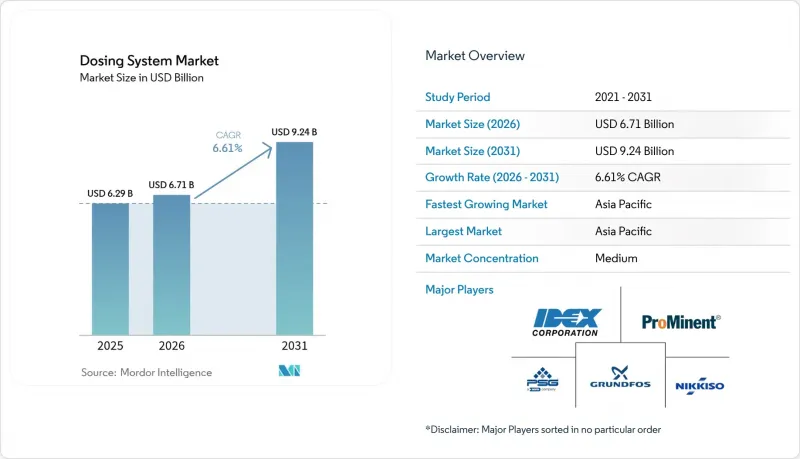
Mordor Intelligence에 의하면, 2026년 투여 시스템 시장 규모는 67억 1,000만 달러로 추정되고 있어 2025년 62억 9,000만 달러에서 확대해, 2031년에는 92억 4,000만 달러에 이를 것으로 예측됩니다.
2026-2031년 동안의 연평균 성장률(CAGR)은 6.61%가 될 것으로 전망됩니다.
본 보고서는 펌프 유형별(다이어프램 펌프, 피스톤/플런저 펌프, 페리스탈틱 펌프, 프로그레시브 캐비티 펌프, 기어 펌프 및 기타 용적식 펌프), 용도별(상하수도 처리, 화학제품 및 석유화학제품,제약·바이오기술, 펄프·제지, 기타), 지역별(북미, 유럽, 아시아태평양, 남미, 중동 및 아프리카)로 분류되어 있습니다.
전 세계 투여 시스템 시장 동향 및 인사이트
상하수도 처리 인프라에 대한 투자 확대
유틸리티 분야의 사상 최고 수준의 지출이 투여 시스템 시장을 견인하고 있습니다. 호주의 ‘내셔널 워터 그리드 펀드(National Water Grid Fund)’는 신규 플랜트 건설에 25억 달러를 배정했으며, 미주리 아메리칸 워터(Missouri American Water)사는 2024년에 노후된 배관 교체 및 약품 주입 스테이션 업그레이드를 위해 5억 달러 이상을 책정했습니다. 유틸리티자들은 화학약품의 과다 사용을 억제하는 자동 계량 펌프를 선호하고 있으며, 실시간 제어 플랫폼은 운영자가 점점 더 엄격해지는 방류 허가 요건을 준수하는 데 도움을 주고 있습니다. 가뭄이 자주 발생하는 지역에서는 미세 조정된 화학물질 주입을 통해 1리터도 낭비하지 않으며, 정밀한 펌프 작동은 장기적인 물 안보 전략에 필수적입니다.
석유 및 가스 산업의 증산 기술(EOR)용 화학 물질 주입 확대
사업자들은 갇혀 있는 탄화수소를 동원하여 생산량을 늘리는 폴리머, 계면활성제, CO2, 나노 규모의 첨가제를 주입함으로써 유전의 수명을 연장하고 있습니다. 쉐브론(Chevron)과 할리버튼(Halliburton)의 ‘ZEUS IQ’ 시스템은 현재 공정 실행을 자동화하고, 화학물질의 배합을 실시간으로 조정하고 있습니다. 계량 정밀도는 증산량에 직접적인 영향을 미치므로, 생산자들은 정밀도 허용 오차가 ±1% 이하인 고압 다이어프램 펌프를 지정하고 있습니다. 북미 셰일층의 재자극 프로젝트와 중동의 성숙 유전 프로젝트에 대한 투자 확대가 단기적인 펌프 수요의 기반이 되고 있습니다.
저비용 대체 펌프 기술의 등장
지역 공급업체들은 기본적인 스트로크 제어 키트가 장착된 원심 펌프와 기어 펌프를 정밀 계량 장치에 비해 최대 30% 할인된 가격에 판매하고 있습니다. 기본적인 염소 및 pH 조절에 있어 남아시아의 많은 지자체 시설은 이러한 저사양 대체품을 선택하고 있으며, 그 결과 프리미엄 OEM의 이익률이 압박받고 있습니다. 이에 따라 전통 있는 브랜드들은 수명 주기 비용, 더 엄격한 용적 정밀도, 사후 서비스를 강조하며 높은 초기 투자 비용을 정당화하고 있습니다.
부문 분석
2025년, 다이어프램식 유닛은 투여 시스템 시장 점유율의 47.68%를 차지했습니다. 이는 부식성이 강한 산이나 알칼리를 취급하는 데 필수적인 누출 없는 막과 내식성을 반영한 결과입니다. 다이어프램 기술을 활용한 투여 시스템 시장 규모는 지방자치단체의 소독 프로젝트 및 정유시설의 탈황 라인 확장에 따라 지속적으로 확대되고 있습니다. 페리스탈틱 방식은 일회용 튜브를 통해 교차 오염을 방지할 수 있어 연평균 성장률(CAGR) 6.78%로 성장세를 보이고 있습니다. 이는 바이오의약품 충전 및 마무리 라인에서 결정적인 요인이 되고 있습니다. 프로그레시브 캐비티 펌프는 바이오가스 소화조에서 전단에 민감한 슬러리 처리에 있어 여전히 최적의 선택이며, 이 부문은 아트라스콥코의 반겐 펌펜(Vangen Pumpen) 인수로 더욱 강화되었습니다. 피스톤 및 플런저식 모델은 펄스 없는 유량이 필수적인 고압 해양 유정에서 틈새 수요를 충족하고 있습니다.
혁신의 중심에는 유량 변동을 0.5% 미만으로 억제하는 소형 서보 구동 모터가 있습니다. Watson-Marlow의 최신 페리스탈틱 펌프 제품군은 양방향 정밀도를 실현하여 연속 생산 스키드에 적합합니다. 또한, OEM 업체들은 특수 폴리머 공급 부족을 극복하기 위해 세라믹 헤드와 PTFE 다이어프램을 채택하고 있습니다. 이러한 소재의 발전으로 구매자는 공급 변동의 영향을 덜 받게 되어, 투여 시스템 시장의 안정화에 기여하고 있습니다.
지역별 분석
2025년, 아시아태평양은 투여 시스템 시장에서 39.02%라는 최대 점유율을 차지하며, 2031년까지 연평균 성장률(CAGR) 7.08%로 성장할 전망입니다. 계절성 인플루엔자 백신의 45일 로트 릴리스 등, 중국의 의약품 등록 개혁 가속화는 국내 생명공학 산업의 확장을 뒷받침하며 스마트팜프 수요를 크게 끌어올리고 있습니다. 인도의 ‘Jal Jeevan Mission’은 신규 농촌 용수 처리 시설용 염소 투여 스키드에 자금을 지원하고 있는 반면, 동남아시아의 화학 산업은 2030년까지 4,480억 달러에 달할 것으로 예측되어 해당 지역의 고객 기반을 더욱 확대될 전망입니다.
북미는 계속해서 기술의 선두주자 역할을 하고 있으며, EPA(미국 환경보호청)의 PFAS 기준에 따라 2026년까지 90억 달러 규모의 오염 정화 시장이 창출될 것입니다. 유틸리티자들은 응집제, 분말 활성탄, 이온 교환 수지를 단일 프레임에서 처리할 수 있는 다중 채널 계량 펌프를 도입하여 처리 라인의 개조를 진행하고 있습니다. 캐나다의 새로운 위험 기반 폐수 규제는 2차 처리 시설의 자동화를 촉진하고 있으며, 디지털 펌프 로그를 통해 규정 준수 감사가 효율화되고 있습니다.
유럽에서는 ‘그린 딜(Green Deal)’의 지속가능성 목표를 배경으로 안정적인 교체 수요가 나타나고 있습니다. 독일과 북유럽의 지자체는 전력 소비를 최대 20% 절감하는 저에너지 펌프로의 전환을 추진하고 있습니다. 중동에서는 석유 증산(EOR) 및 해수 담수화 과정의 염수 처리를 위해 주입 시스템이 활용되고 있으며, 주요 성장 부문으로는 남아프리카의 광업과 이집트의 비료 생산을 꼽을 수 있습니다. 남미에서는 브라질의 펄프 공장과 아르헨티나의 관개 사업자가 선별적으로 투자하고 있으나, 환율 변동으로 인해 자본 유입은 억제되고 있습니다. 현지 조립 제휴를 통해 국제 브랜드들은 관세 장벽을 극복하고, 신흥 지역의 투여 시스템 시장에서 시장 점유율을 확대되고 있습니다.
기타 혜택
- 엑셀 형식 시장 예측(ME) 시트
- 3개월간의 애널리스트 지원
자주 묻는 질문
목차
제1장 서론
제2장 조사 방법
제3장 주요 요약
제4장 시장 구도
제5장 시장 규모와 성장 예측
제6장 경쟁 구도
제7장 시장 기회와 향후 전망
JHS 26.09.11According to Mordor Intelligence, dosing system market size in 2026 is estimated at USD 6.71 billion, growing from 2025 value of USD 6.29 billion with 2031 projections showing USD 9.24 billion, growing at 6.61% CAGR over 2026-2031.
This report is Segmented by Pump Type (Diaphragm Pumps, Piston/Plunger Pumps, Peristaltic Pumps, Progressive Cavity Pumps, and Gear and Other Positive-Displacement Pumps), Application (Water and Wastewater Treatment, Chemicals and Petrochemicals, Pharmaceuticals and Biotechnology, Pulp and Paper, and More), and Geography (North America, Europe, Asia-Pacific, South America, and Middle East and Africa).
Global Dosing System Market Trends and Insights
Rising Investments in Water & Wastewater Treatment Infrastructure
Record public-utility spending is fueling the dosing system market. Australia's National Water Grid Fund is allocating USD 2.5 billion for new plants, while Missouri American Water earmarked more than USD 500 million in 2024 to replace aging pipes and upgrade chemical feed stations . Utilities favor automated metering pumps that reduce chemical overuse, and real-time control platforms help operators comply with increasingly stringent discharge permits. In drought-prone regions, fine-tuned dosing ensures every liter is safeguarded, making precision pumping integral to long-term water security strategies.
Expansion of Oil & Gas Enhanced-Recovery Chemical Injection
Operators extend field life by injecting polymers, surfactants, CO2, and nanoscale additives that mobilize trapped hydrocarbons, thereby increasing production. Chevron and Halliburton's ZEUS IQ system now automates stage execution and adjusts chemical blends in real-time . Metering accuracy directly influences incremental recovery, so producers specify high-pressure diaphragm pumps with accuracy tolerances of +-1% or less. Growing investment in North American shale restimulation and mature-field projects in the Middle East underpins short-term pump demand.
Availability of Low-Cost Alternative Pump Technologies
Regional suppliers are marketing centrifugal and gear pumps equipped with rudimentary stroke-control kits at discounts of up to 30% compared to precision metering units. For basic chlorine or pH adjustment, many municipal plants in South Asia opt for these low-spec alternatives, thereby squeezing margins for premium OEMs. Established brands, therefore, emphasize life-cycle cost, tighter volumetric accuracy, and after-sales service to justify higher capital prices.
Other drivers and restraints analyzed in the detailed report include:
- Environmental Regulations Tightening Effluent Limits
- IIoT-Enabled Smart Dosing & Remote Monitoring Adoption
- Cyber-Security Risks in Connected Dosing Equipment
For complete list of drivers and restraints, kindly check the Table Of Contents.
Segment Analysis
Diaphragm units captured 47.68% of the dosing system market share in 2025, reflecting their leak-proof membranes and corrosion resistance, which are vital for handling aggressive acids and alkalis. The dosing system market size for diaphragm technology continues to expand in tandem with municipal disinfection projects and refinery desulfurization lines. Peristaltic designs are gaining traction at a 6.78% CAGR because single-use tubing eliminates cross-contamination, a decisive factor in biologics fill-finish suites. Progressive-cavity pumps remain the choice for shear-sensitive slurries in biogas digesters, an area bolstered by Atlas Copco's purchase of Wangen Pumpen. Piston and plunger models meet niche demand in high-pressure offshore wells, where pulseless flow is critical.
Innovation centers on compact, servo-driven motors that hold flow variance below 0.5%. Watson-Marlow's latest peristaltic portfolio delivers bidirectional accuracy, suited to continuous manufacturing skids. OEMs also integrate ceramic heads and PTFE diaphragms to overcome shortages of specialty polymers. These material advances insulate buyers from supply swings and help stabilize the dosing system market.
Complete Report Scope:
- By Pump Type
- Diaphragm Pumps
- Piston/Plunger Pumps
- Peristaltic (Hose) Pumps
- Progressive Cavity Pumps
- Gear and Other Positive-Displacement Pumps
- By Application
- Water and Wastewater Treatment
- Oil and Gas
- Chemicals and Petrochemicals
- Food and Beverage
- Pharmaceuticals and Biotechnology
- Power Generation
- Pulp and Paper
- By Geography
- North America
- United States
- Canada
- Mexico
- Europe
- Germany
- United Kingdom
- France
- Italy
- Spain
- Russia
- Rest of Europe
- Asia-Pacific
- China
- India
- Japan
- South Korea
- ASEAN Countries
- Australia and New Zealand
- Rest of Asia-Pacific
- South America
- Brazil
- Argentina
- Rest of South America
- Middle East and Africa
- Saudi Arabia
- United Arab Emirates
- South Africa
- Egypt
- Rest of Middle East and Africa
- North America
Geography Analysis
The Asia-Pacific region generated the largest share of the dosing system market in 2025, at 39.02%, and is poised for a 7.08% CAGR through 2031. China's fast-tracked drug registration reforms, including a 45-day batch release for seasonal flu shots, encourage domestic biotech expansion and turbocharge smart pump demand. India's Jal Jeevan Mission finances chlorine-dosing skids for new rural water plants, while Southeast Asia's chemical industry is projected to reach USD 448 billion by 2030, deepening the regional customer base.
North America remains a technology bellwether as the EPA's PFAS standards unlock USD 9 billion for remediation through 2026. Utilities are retrofitting treatment trains with multi-channel metering pumps that handle coagulants, powdered-activated carbon, and ion-exchange resins in a single frame. Canada's new risk-based wastewater rules are driving automation in secondary plants, with digital pump logs streamlining compliance audits.
Europe records stable replacement demand, anchored in the Green Deal's sustainability goals. German and Nordic municipalities are shifting toward low-energy pumps that reduce power draw by up to 20%. The Middle East utilizes dosing systems for enhanced oil recovery and desalination brine conditioning, whereas key growth pockets include South African mining and Egyptian fertilizer production. Brazilian pulp mills and Argentine irrigators invest selectively in South America, but currency volatility tempers capital imports. Local assembly partnerships help international brands navigate tariff barriers and expand their market footprint in the dosing system market across emerging regions.
- Dover Corporation
- Grundfos Holding A/S
- ProMinent GmbH
- IDEX Corporation
- Nikkiso Co., Ltd.
- SPX FLOW, Inc.
- Milton Roy LLC
- Verder Group
- SEKO S.p.A.
- Watson-Marlow (Spirax-Sarco)
- Flowserve Corporation
- LEWA GmbH
- Wanner Engineering (Hydra-Cell)
- Blue-White Industries
- Lutz-JESCO GmbH
- Neptune Chemical Pump Company
- SEEPEX GmbH
- NETZSCH Pumps & Systems
- Xylem Inc.
- Sulzer Ltd.
Additional Benefits:
- The market estimate (ME) sheet in Excel format
- 3 months of analyst support
TABLE OF CONTENTS
1 Introduction
- 1.1 Study Assumptions & Market Definition
- 1.2 Scope of the Study
2 Research Methodology
3 Executive Summary
4 Market Landscape
- 4.1 Market Overview
- 4.2 Market Drivers
- 4.2.1 Rising investments in water & wastewater treatment infrastructure
- 4.2.2 Expansion of oil & gas enhanced-recovery chemical injection
- 4.2.3 Stricter global hygiene standards in F&B processing
- 4.2.4 Environmental regulations tightening effluent limits
- 4.2.5 IIoT-enabled smart dosing & remote monitoring adoption
- 4.2.6 Micro-dosing needs in biologics & cell-therapy production
- 4.3 Market Restraints
- 4.3.1 Availability of low-cost alternative pump technologies
- 4.3.2 High maintenance & energy cost of high-pressure systems
- 4.3.3 Cyber-security risks in connected dosing equipment
- 4.3.4 Supply volatility of specialty polymer diaphragms
- 4.4 Supply-Chain Analysis
- 4.5 Regulatory Landscape
- 4.6 Technological Outlook
- 4.7 Porter's Five Forces
- 4.7.1 Bargaining Power of Suppliers
- 4.7.2 Bargaining Power of Buyers
- 4.7.3 Threat of New Entrants
- 4.7.4 Threat of Substitutes
- 4.7.5 Competitive Rivalry
5 Market Size & Growth Forecasts
- 5.1 By Pump Type
- 5.1.1 Diaphragm Pumps
- 5.1.2 Piston/Plunger Pumps
- 5.1.3 Peristaltic (Hose) Pumps
- 5.1.4 Progressive Cavity Pumps
- 5.1.5 Gear and Other Positive-Displacement Pumps
- 5.2 By Application
- 5.2.1 Water and Wastewater Treatment
- 5.2.2 Oil and Gas
- 5.2.3 Chemicals and Petrochemicals
- 5.2.4 Food and Beverage
- 5.2.5 Pharmaceuticals and Biotechnology
- 5.2.6 Power Generation
- 5.2.7 Pulp and Paper
- 5.3 By Geography
- 5.3.1 North America
- 5.3.1.1 United States
- 5.3.1.2 Canada
- 5.3.1.3 Mexico
- 5.3.2 Europe
- 5.3.2.1 Germany
- 5.3.2.2 United Kingdom
- 5.3.2.3 France
- 5.3.2.4 Italy
- 5.3.2.5 Spain
- 5.3.2.6 Russia
- 5.3.2.7 Rest of Europe
- 5.3.3 Asia-Pacific
- 5.3.3.1 China
- 5.3.3.2 India
- 5.3.3.3 Japan
- 5.3.3.4 South Korea
- 5.3.3.5 ASEAN Countries
- 5.3.3.6 Australia and New Zealand
- 5.3.3.7 Rest of Asia-Pacific
- 5.3.4 South America
- 5.3.4.1 Brazil
- 5.3.4.2 Argentina
- 5.3.4.3 Rest of South America
- 5.3.5 Middle East and Africa
- 5.3.5.1 Saudi Arabia
- 5.3.5.2 United Arab Emirates
- 5.3.5.3 South Africa
- 5.3.5.4 Egypt
- 5.3.5.5 Rest of Middle East and Africa
- 5.3.1 North America
6 Competitive Landscape
- 6.1 Market Concentration
- 6.2 Strategic Moves (M&A, Partnerships, PPAs)
- 6.3 Market Share Analysis (Market Rank/Share for key companies)
- 6.4 Company Profiles (includes Global level Overview, Market level overview, Core Segments, Financials as available, Strategic Information, Products & Services, and Recent Developments)
- 6.4.1 Dover Corporation
- 6.4.2 Grundfos Holding A/S
- 6.4.3 ProMinent GmbH
- 6.4.4 IDEX Corporation
- 6.4.5 Nikkiso Co., Ltd.
- 6.4.6 SPX FLOW, Inc.
- 6.4.7 Milton Roy LLC
- 6.4.8 Verder Group
- 6.4.9 SEKO S.p.A.
- 6.4.10 Watson-Marlow (Spirax-Sarco)
- 6.4.11 Flowserve Corporation
- 6.4.12 LEWA GmbH
- 6.4.13 Wanner Engineering (Hydra-Cell)
- 6.4.14 Blue-White Industries
- 6.4.15 Lutz-JESCO GmbH
- 6.4.16 Neptune Chemical Pump Company
- 6.4.17 SEEPEX GmbH
- 6.4.18 NETZSCH Pumps & Systems
- 6.4.19 Xylem Inc.
- 6.4.20 Sulzer Ltd.
7 Market Opportunities & Future Outlook
- 7.1 White-space & Unmet-Need Assessment


