

|
시장보고서
상품코드
2124330
초고분자량 폴리에틸렌 시장 : 시장 점유율 분석, 업계 동향 및 통계, 성장 예측(2026-2031년)Ultra-high Molecular Weight Polyethylene - Market Share Analysis, Industry Trends & Statistics, Growth Forecasts (2026 - 2031) |
||||||
 Mordor Intelligence
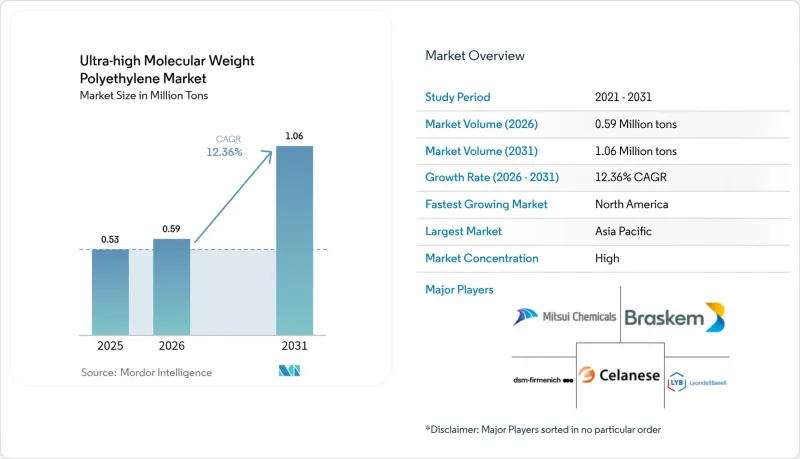
에 의하면, 초고분자량 폴리에틸렌 시장 규모는 2025년에 53만 톤으로 평가되었고, 2026년에 59만 톤으로 추정되고, 2031년까지 106만 톤에 이를 것으로 예측되며, 2026-2031년 CAGR 12.36%를 기록할 전망입니다.
본 보고서는 형태별(분말, 섬유, 시트·필름, 봉·튜브, 기타), 최종 이용 산업별(자동차, 항공우주 및 방위, 의료, 전자, 화학, 기타 최종 이용 산업), 지역별(아시아태평양, 북미, 유럽, 남미, 중동 및 아프리카)로 분류되어 있습니다. 시장 전망은 수량(톤) 기준으로 제시되어 있습니다.
세계의 초고분자량 폴리에틸렌 시장 동향 및 인사이트
EV용 배터리 분리막에서 고성능 폴리머의 대체
리튬 이온 배터리 분야의 셀 제조업체들은 열유도 상분리법을 통해 제조된 초고분자량 폴리에틸렌(UHMWPE) 막을 점점 더 많이 채택하고 있습니다. 이러한 추세는 해당 수지의 고분자량에 기인하며, 두께가 20µm 미만이라도 견고한 기계적 성능을 확보할 수 있기 때문입니다. 중요한 움직임으로, 브라스켐(Bluschem)사는 2024년 10월 미국 에너지부로부터 보조금을 확보했습니다. 이 자금은 텍사스주 내 분리막용 분말 생산 능력을 확대하고, 국내 공급망을 강화하는 동시에 숙련된 일자리를 창출하는 것을 목적으로 합니다. 또한, 나노 입자로 개질된 초고분자량 폴리에틸렌(UHMWPE)은 전해액의 습윤성을 향상시키고 셀의 임피던스를 저감하여, 자동차 제조업체가 요구하는 급속 충전 프로파일에 대응하고 있습니다. 분리막 수요가 급증하는 가운데, 분말 수요가 범용 시트 시장에서 현저히 이동하고 있어, 클린룸 내 압출 성형 및 자동차용 품질 관리 시스템에 투자하고 있는 제조업체들에게는 호재가 되고 있습니다.
아시아태평양의 조선 및 해상 풍력 발전용 로프 수요 급증
2023년, 중국은 해상 풍력 발전 용량을 확대했습니다. 1기가와트의 설비를 도입할 때마다 UHMWPE 로프가 소비되어, 연간 섬유 사용량은 총 (수치)에 달했습니다. 이 폴리머를 원료로 한 UHMWPE 로프는 강선에 비해 무게가 훨씬 가볍음에도 불구하고 뛰어난 인장 강도를 갖추고 있어 심해에 설치되는 터빈에 최적입니다. UHMWPE로의 대체율은 해마다 상승하고 있으며, 2030년까지 이러한 추세가 지속될 것으로 예측됩니다. 2024년 10월 시행 예정인 중국의 새로운 규격 ‘GB/T 21328-2024’에서는 파단 하중 및 마모에 관한 기준이 정해져 있어, 해당 지역에서의 채택이 더욱 가속화될 전망입니다. 또한, UHMWPE 복합재로 제작된 계류줄을 채택하기 시작한 한국 및 일본의 LNG 운반선에 대한 수요도 증가하고 있습니다.
높은 가공 에너지 소비량과 바이오 유래 대체 소재와의 비교
겔 방사 소재의 제조에는 기존의 폴리에틸렌 필름 압출 성형에 비해 1톤당 훨씬 많은 에너지가 필요합니다. 이러한 에너지 수요 증가는 다단계 연신 공정을 거치기 전에 폴리머를 고온의 데카린 또는 파라핀에 용해시켜야 하기 때문입니다. 2024년, 유럽의 탄소 가격 제도 도입으로 인해 UHMWPE의 생산 비용이 상승했습니다. 바이오 유래 폴리에틸렌은 탄소 발자국이 작다는 장점이 있지만, 이 장점이 범용 시트나 필름의 가격에 하락 압력으로 작용하고 있습니다. 초임계 CO₂ 용매 시험 및 폐열 회수 프로젝트에는 미래성이 기대되지만, 그 자본 집약적인 특성으로 인해 당장의 재정적 부담 경감으로 이어지지는 않고 있습니다.
부문별 분석
분말은 2025년에 수량 기준 44.65%의 점유율을 차지했으며, 2031년까지 연평균 성장률(CAGR) 12.64%로 성장할 것입니다. 이러한 성장은 2024년에 가동을 시작한 구슈코키 시설을 비롯한 대규모 겔 방사 라인의 가동으로 뒷받침되고 있습니다. 초고분자량 폴리에틸렌 분말 시장 규모는 예측 기간 동안 확대될 전망입니다. 방탄 장갑, 해양용 로프, 특수 필름으로의 용도 확대에 힘입은 섬유용 등급 수요가 설비 투자를 견인하고 있습니다. 한편, 압축 성형 시트와 램 압출 성형 로드는 내마모성 라이너로 활용되고 있습니다. 미쓰이 화학은 전략적 조치의 일환으로 2024년에 HI-ZEX의 생산 능력을 확대하여 배터리 세퍼레이터용 분말의 안정적인 공급을 확보했습니다.
시장에서 2위 점유율을 차지하는 섬유 제품은 국방 예산의 혜택을 받고 있습니다. 이러한 예산에서는 기존의 아라미드제 방탄재보다 훨씬 가벼우면서도 소총탄을 막아낼 수 있는 초고분자량 폴리에틸렌(UHMWPE) 적층재가 우선적으로 채택되고 있습니다. 시트와 필름은 반도체 웨이퍼 캐리어, 식품 가공 장비, 슈트 라이너 등에 활용되고 있으며, 이러한 용도에서는 낮은 마찰계수와 화학적 비활성 같은 특성이 매우 중요합니다. 한편, 봉 및 튜브는 기계 부품 분야에서 틈새 시장을 개척하고 있으나, 실험 단계에 있는 3D 프린팅용 필라멘트의 경우, 의료용 프로토타입에 대한 연구실 실증 실험에서는 유망한 결과가 얻어지고 있는 반면, 점도 관련 과제에 직면해 있습니다.
지역별 분석
아시아태평양은 2025년에 전체의 44.57%를 차지했으며, 초고분자량 폴리에틸렌 시장의 중심지로서의 위상을 유지하고 있습니다. 중국의 통합 공급망은 단량체에서 완성된 로프에 이르기까지 이어지며, 국가 표준인 GB/T 21328-2024에 따라 해상 풍력 발전 계약업체를 위한 품질 보증이 효율화되고 있습니다. 일본에서는 외과용 봉합사 및 테이진(Teijin)의 의료기기를 위해 분말이 조달되고 있는 반면, 한국의 조선 회사에서는 LNG 운반선에 초고분자량 폴리에틸렌(UHMWPE)으로 만든 계류 로프가 장착되고 있습니다. 인도 및 아세안(ASEAN) 국가에서는 현지 전기차(EV) 및 식품 가공 부문의 확장에 따라 소규모 기반에서 시장이 성장하고 있습니다.
북미는 에너지부가 블라스크엠(Blaskem)사의 텍사스주 분리 장치 공장에 자금을 지원하고, 국내 스펙트라 섬유 공급을 우선시하는 국방 지출에 힘입어 2031년까지 연평균 성장률(CAGR) 12.99%를 기록하며 지역별 가장 빠른 성장을 보이고 있습니다. FDA의 규제로 인해 진입 장벽은 높게 유지되고 있으며, 분자량 분포가 균일한 분말공급이 확보되어 있습니다. 캐나다에서는 오일샌드 채굴에 초고분자량 폴리에틸렌(UHMWPE) 슬러리 라이너가 사용되고 있으며, 멕시코의 자동차 공장에서는 분리기의 라미네이트 가공을 사내에서 직접 수행하는 방향으로 전환하고 있습니다. 하네웰사가 2026년 초까지 어드밴스트 머티리얼즈(Advanced Materials) 부문을 분사할 계획은 지역적 사업 확장을 위한 새로운 자금원을 개척할 가능성이 있습니다.
유럽은 생산량 면에서는 뒤처져 있지만, UHMWPE의 생체 적합성을 중시하는 엄격한 의료기기 규제의 혜택을 받고 있습니다. 독일의 고급 전기차 제조업체들은 분리막의 시범 도입을 추진하고 있으며, 영국에서는 치안 부대에 UHMWPE로 제작된 방탄 조끼가 배치되어 있습니다. DSM과 SABIC에 의한 재생 Dyneema의 시범 도입은 EU의 순환 경제에 대한 인센티브와 부합합니다. 남미, 중동 및 아프리카는 여전히 소규모 수입 지역에 그치고 있지만, 브라질의 광업 부문에서는 시트가 사용되고 있으며, 사우디아라비아에서는 부식성 염수용 UHMWPE 파이프라인 라이너에 대한 시험이 진행되고 있습니다.
기타 혜택 :
- 엑셀 형식 시장 예측(ME) 시트
- 3개월간의 애널리스트 지원
자주 묻는 질문
목차
제1장 서론
제2장 조사 방법
제3장 주요 요약
제4장 시장 구도
제5장 시장 규모 및 성장 예측
제6장 경쟁 구도
제7장 시장 기회 및 향후 전망
AJY 26.09.09According to Mordor Intelligence, the ultra-high molecular weight polyethylene market size is projected to be 0.53 million tons in 2025, 0.59 million tons in 2026, and reach 1.06 million tons by 2031, growing at a CAGR of 12.36% from 2026 to 2031.
This report is Segmented by Form (Powder, Fibers, Sheets and Films, Rods and Tubes, and Other Forms), End-Use Industry (Automotive, Aerospace and Defense, Medical, Electronics, Chemical, and Other End-User Industries), and Geography (Asia-Pacific, North America, Europe, South America, and Middle-East and Africa). Market Forecasts are Provided in Terms of Volume (Tons).
Global Ultra-high Molecular Weight Polyethylene Market Trends and Insights
High-Performance Polymer Substitution in EV Battery Separators
Cell makers in the lithium-ion sector are increasingly opting for UHMWPE membranes, produced via thermally induced phase separation. This preference stems from the resin's high molecular weight, which ensures robust mechanical performance even at sub-20 µm thickness. In a significant move, Braskem secured an award from the Department of Energy in October 2024. This funding aims to boost separator powder capacity in Texas, fortifying domestic supply chains and creating skilled jobs. Additionally, nanoparticle-modified UHMWPE is enhancing electrolyte wettability, reducing cell impedance, and accommodating the fast-charging profiles sought by vehicle OEMs. As demand for separators surges, there's a noticeable shift of powder away from commodity sheet markets, benefiting producers who are channeling investments into clean-room extrusion and automotive quality systems.
Surge in APAC Shipbuilding and Offshore Rope Demand
In 2023, China added offshore wind capacity. Each gigawatt installation consumed UHMWPE rope, totaling fiber for the year. UHMWPE rope, derived from the polymer, boasts a weight that's significantly lighter than steel wire, yet it offers a tensile strength that's superior, making it ideal for deeper-water turbines. The substitution rate of UHMWPE has risen over the years, with projections suggesting it will continue to grow by 2030. China's new GB/T 21328-2024 standard, set to take effect in October 2024, establishes criteria for breaking-load and abrasion, further hastening regional adoption. Additionally, there's a growing demand for Korean and Japanese LNG carriers, which are now incorporating UHMWPE composite mooring lines.
High Processing-Energy Intensity vs. Bio-Based Alternatives
Producing gel-spun materials requires significantly more energy per tonne compared to traditional polyethylene film extrusion. This heightened energy demand arises from the necessity of dissolving the polymer in hot decalin or paraffin prior to undergoing multi-stage drawing. In 2024, Europe's carbon pricing increased the production costs of UHMWPE. While bio-based polyethylene boasts a lighter carbon footprint, this advantage exerts downward pressure on the prices of commodity sheets and films. Despite the promise of super-critical CO2 solvent trials and waste-heat recovery projects, their capital-intensive nature curtails any immediate financial relief.
Other drivers and restraints analyzed in the detailed report include:
- Growing Use in Medical Wearables and Smart Textiles
- Growing Demand for 3D-Printed UHMWPE Orthopedic Implants
- Low Melting Point Limits High-Load Composite Designs
For complete list of drivers and restraints, kindly check the Table Of Contents.
Segment Analysis
Powder captured 44.65% volume in 2025 and grows at a 12.64% CAGR through 2031. This growth is bolstered by the launch of large-scale gel-spinning lines, notably Jiuzhou Xingji's facility, which came online in 2024. The market size for ultra-high molecular weight polyethylene powder is set to increase during the forecast period. Demand for fiber grades, driven by applications in ballistic armor, offshore ropes, and specialty films, is steering capital investments. Meanwhile, compression-molded sheets and ram-extruded rods are being utilized as wear-resistant liners. In a strategic move, Mitsui Chemicals boosted its HI-ZEX capacity in 2024, ensuring a robust supply of powder for battery separators.
Fibers, holding the second position in the market, are reaping benefits from defense budgets. These budgets prioritize UHMWPE laminates, which can halt rifle rounds at a weight significantly lighter than traditional aramid armor. Sheets and films find their applications in semiconductor wafer carriers, food-handling equipment, and chute liners, where attributes like low friction and chemical inertness are paramount. While rods and tubes have carved out a niche in mechanical components, experimental 3D-printing filaments are grappling with viscosity challenges, despite promising lab demonstrations for medical prototypes.
Complete Report Scope:
- By Form
- Powder
- Fibers
- Sheets and Films
- Rods and Tubes
- Other Forms (3-D Printing Filament, etc.)
- By End-use Industry
- Automotive
- Aerospace and Defense
- Medical
- Electronics
- Chemical
- Other End-user Industries (Oil and Gas, Sports, etc.)
- By Geography
- Asia-Pacific
- China
- Japan
- India
- South Korea
- ASEAN Countries
- Rest of Asia-Pacific
- North America
- United States
- Canada
- Mexico
- Europe
- Germany
- United Kingdom
- France
- Italy
- Russia
- Rest of Europe
- South America
- Brazil
- Argentina
- Rest of South America
- Middle-East and Africa
- Saudi Arabia
- South Africa
- Rest of Middle-East and Africa
- Asia-Pacific
Geography Analysis
Asia-Pacific accounted for 44.57% volume in 2025 and remains the epicenter of the ultra-high molecular weight polyethylene market. China's integrated chain stretches from monomer to finished rope, and its national GB/T 21328-2024 standard streamlines quality assurance for offshore wind contractors. Japan sources powder for surgical sutures and Teijin's medical devices, while South Korea's shipbuilders embed UHMWPE mooring lines in LNG carriers. India and ASEAN grow from a small base as local EV and food-processing sectors scale.
North America posts the fastest regional growth at a 12.99% CAGR through 2031, lifted by the Department of Energy's funding for Braskem's Texas separator plant and by defense spending that prioritizes domestic Spectra fiber supply. FDA regulations maintain high entry barriers, securing powder of consistent molecular weight distribution. Canada uses UHMWPE slurry liners in oil sands, and Mexican auto plants move toward in-house separator lamination. Honeywell's plan to spin off Advanced Materials by early 2026 may unlock new capital sources for regional expansions.
Europe trails by volume yet benefits from the strict Medical Device Regulation that favors UHMWPE's biocompatibility. German premium EV makers pilot separators, and the United Kingdom equips security forces with UHMWPE body armor. DSM and SABIC's recycled Dyneema trial aligns with EU circular-economy incentives. South America and Middle-East and Africa remain small importers; Brazil's mining sector uses sheets, and Saudi Arabia tests UHMWPE pipeline liners for corrosive brine.
- Asahi Kasei Corporation
- Avient Corporation
- Braskem
- Celanese Corporation
- dsm-firmenich
- DuPont
- Honeywell International Inc.
- Korea Petrochemical Ind. Co., LTD.
- LyondellBasell Industries Holdings B.V.
- Mitsui Chemicals Inc.
- Rochling SE & Co. KG
- Shandong Longforce Engineering Material Co., Ltd
- TEIJIN LIMITED
Additional Benefits:
- The market estimate (ME) sheet in Excel format
- 3 months of analyst support
TABLE OF CONTENTS
1 Introduction
- 1.1 Study Assumptions and Market Definition
- 1.2 Scope of the Study
2 Research Methodology
3 Executive Summary
4 Market Landscape
- 4.1 Market Overview
- 4.2 Market Drivers
- 4.2.1 High-performance-polymer substitution in EV battery separators
- 4.2.2 Surge in APAC ship-building and offshore rope demand
- 4.2.3 Growing use in medical wearables and smart textiles
- 4.2.4 Growing demand for 3-D-printed UHMWPE orthopedic implants
- 4.2.5 Closed-loop, medical-grade UHMWPE recycling routes
- 4.3 Market Restraints
- 4.3.1 High processing-energy intensity vs. bio-based alternatives
- 4.3.2 Low melting point limits high-load composite designs
- 4.3.3 Trade-remedy duties on Asian UHMWPE powder exports
- 4.4 Value Chain Analysis
- 4.5 Porter's Five Forces
- 4.5.1 Threat of New Entrants
- 4.5.2 Bargaining Power of Buyers
- 4.5.3 Bargaining Power of Suppliers
- 4.5.4 Threat of Substitutes
- 4.5.5 Degree of Competition
5 Market Size and Growth Forecasts (Volume)
- 5.1 By Form
- 5.1.1 Powder
- 5.1.2 Fibers
- 5.1.3 Sheets and Films
- 5.1.4 Rods and Tubes
- 5.1.5 Other Forms (3-D Printing Filament, etc.)
- 5.2 By End-use Industry
- 5.2.1 Automotive
- 5.2.2 Aerospace and Defense
- 5.2.3 Medical
- 5.2.4 Electronics
- 5.2.5 Chemical
- 5.2.6 Other End-user Industries (Oil and Gas, Sports, etc.)
- 5.3 By Geography
- 5.3.1 Asia-Pacific
- 5.3.1.1 China
- 5.3.1.2 Japan
- 5.3.1.3 India
- 5.3.1.4 South Korea
- 5.3.1.5 ASEAN Countries
- 5.3.1.6 Rest of Asia-Pacific
- 5.3.2 North America
- 5.3.2.1 United States
- 5.3.2.2 Canada
- 5.3.2.3 Mexico
- 5.3.3 Europe
- 5.3.3.1 Germany
- 5.3.3.2 United Kingdom
- 5.3.3.3 France
- 5.3.3.4 Italy
- 5.3.3.5 Russia
- 5.3.3.6 Rest of Europe
- 5.3.4 South America
- 5.3.4.1 Brazil
- 5.3.4.2 Argentina
- 5.3.4.3 Rest of South America
- 5.3.5 Middle-East and Africa
- 5.3.5.1 Saudi Arabia
- 5.3.5.2 South Africa
- 5.3.5.3 Rest of Middle-East and Africa
- 5.3.1 Asia-Pacific
6 Competitive Landscape
- 6.1 Market Concentration
- 6.2 Strategic Moves
- 6.3 Market Share(%)/Ranking Analysis
- 6.4 Company Profiles (includes Global level Overview, Market level overview, Core Segments, Financials as available, Strategic Information, Products and Services, and Recent Developments)
- 6.4.1 Asahi Kasei Corporation
- 6.4.2 Avient Corporation
- 6.4.3 Braskem
- 6.4.4 Celanese Corporation
- 6.4.5 dsm-firmenich
- 6.4.6 DuPont
- 6.4.7 Honeywell International Inc.
- 6.4.8 Korea Petrochemical Ind. Co., LTD.
- 6.4.9 LyondellBasell Industries Holdings B.V.
- 6.4.10 Mitsui Chemicals Inc.
- 6.4.11 Rochling SE & Co. KG
- 6.4.12 Shandong Longforce Engineering Material Co., Ltd
- 6.4.13 TEIJIN LIMITED
7 Market Opportunities and Future Outlook
- 7.1 White-space and Unmet-Need Assessment


