|
시장보고서
상품코드
2124331
자동화 테스트 시장 : 시장 점유율 분석, 업계 동향 및 통계, 성장 예측(2026-2031년)Automation Testing - Market Share Analysis, Industry Trends & Statistics, Growth Forecasts (2026 - 2031) |
||||||
 Mordor Intelligence
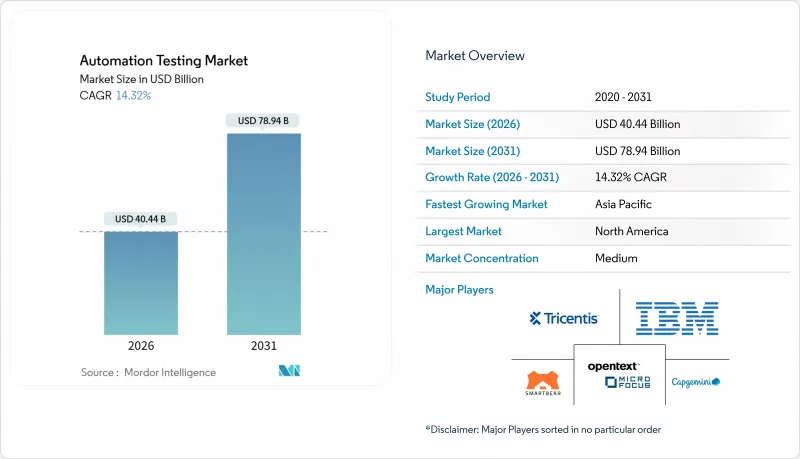
Mordor Intelligence에 의하면, 자동화 테스트 시장 규모는 2026년에 404억 4,000만 달러로 추정되고, 2031년까지 789억 4,000만 달러에 이를 것으로 예측되며, 예측 기간 동안 CAGR 14.32%로 성장할 전망입니다.
본 보고서는 구성 요소별(솔루션 및 서비스), 테스트 유형별(기능 테스트 및 비기능 테스트), 도입 형태별(온프레미스 및 클라우드), 최종 사용자 산업별(IT 및 통신, BFSI 등), 조직 규모별(대기업 및 중소기업), 인터페이스별(웹, 모바일 등), 지역별(북미, 유럽 등)로 분류되어 있습니다. 시장 전망은 금액(달러)으로 제시되어 있습니다.
세계의 자동화 테스트 시장 동향 및 인사이트
지속적 테스트를 위한 애자일 및 DevOps 도입 확대
조직들은 자동화된 회귀 테스트 스위트를 지속적 통합(CI) 파이프라인에 직접 통합하여 릴리스 주기를 분기별에서 주간 단위로 단축하고 있습니다. 마이크로소프트는 2025년에 Azure DevOps의 병렬 테스트 작업이 전년 대비 43% 증가했다고 보고했는데, 이는 수동 승인에서 ‘정책으로서의 코드(Policy-as-Code)’를 통한 게이트 관리로의 전환을 나타냅니다. 전달 속도의 향상으로 탐색적 테스트에 할애할 수 있는 시간이 줄어들면서, 팀은 과거 인간의 판단에 맡겨졌던 스모크 테스트, 통합 테스트, 엔드투엔드 시나리오를 자동화해야 하는 압박을 받고 있습니다. Docker의 2024년 조사에 따르면, DevOps 실무자의 68%가 커밋마다 자동화 테스트를 실행하고 있으며, 이는 전년도의 51%에서 증가한 수치입니다. 그 결과, 테스트 플랫폼은 Git 저장소 및 가시성 스택과 기본적으로 통합되어 결함 텔레메트리 데이터를 실시간으로 시각화함으로써, 통합된 DevOps 툴체인에 대한 수요를 창출하고 있습니다.
AI를 활용한 테스트 작성 및 유지보수 도구
생성형 AI는 자연어로 기술된 요구 사항을 실행 가능한 스크립트로 변환하고, UI 요소가 변경될 때 셀렉터를 자동으로 수정함으로써, 기존에는 QA 예산의 최대 40%를 차지하던 유지보수 비용을 절감합니다. IBM의 Watsonx Code Assistant는 COBOL 비즈니스 로직을 메인프레임 워크로드용 테스트 케이스로 변환합니다. Tricentis는 Waldo 및 Virtuoso 인수를 통해 자연어 기반 생성 기능을 자사 플랫폼에 통합했습니다. 이를 통해 테스터는 평이한 영어로 시나리오를 작성하기만 하면 몇 분 이내에 Selenium 스크립트를 얻을 수 있게 되었습니다. Applitools Visual AI는 픽셀 수준의 회귀를 감지하는 동시에, 파일럿 프로젝트에서 오감지 알림을 60% 줄였습니다. 이러한 발전 덕분에 기업은 인력을 비례적으로 늘리지 않고도 테스트 범위를 확대할 수 있게 되었으며, QA 엔지니어는 위험 기반의 우선순위 설정에 집중할 수 있게 되었습니다.
초기 단계에서의 도구 및 기술에 대한 막대한 투자
엔터프라이즈급 프레임워크를 도입하려면 라이선스 비용, 인프라 구축, 직원 역량 강화가 필요하며, 이는 중소기업에게 재정적 장벽이 되고 있습니다. PwC의 2025년 조사에 따르면, 중소기업의 42%가 자동화된 보안 테스트의 주요 장애물로 예산 제약을 꼽았습니다. 인력 부족이 이러한 장벽을 더욱 심화시키고 있으며, LinkedIn의 2024년 보고서에 따르면 북미의 자동화 엔지니어 수요는 공급의 2.3배에 달할 전망입니다. 경쟁력 있는 급여나 장기 구독 계약에 자금을 할당할 수 없는 기업은 자동화 프로그램 도입을 미룰 수밖에 없으며, 그 결과 수작업으로 인한 병목 현상이 만성화되어 출시 지연과 결함 누락률 증가를 초래하고 있습니다.
부문 분석
2025년 현재, 솔루션은 자동화 테스트 시장의 61.72%를 차지했으며, 이는 기업들이 DevOps 파이프라인에 직접 통합할 수 있는 패키지화된 기능 테스트, 성능 테스트, 보안 테스트 모듈에 의존하고 있음을 반영합니다. 반면, 서비스 부문은 2031년까지 연평균 성장률(CAGR) 15.23%로 가장 빠른 성장을 보일 것으로 예측됩니다. 이는 구매자들이 스크립트 유지 관리 및 하이브리드 클라우드 통합을 전문가에게 아웃소싱함으로써, 품질 보증을 고정 인력에서 온디맨드 전문 지식으로 전환하고 있기 때문입니다. 관리형 서비스 제공업체는 지속적 배포의 스프린트에 맞추어 회귀 테스트 팩을 업데이트함으로써 리드 타임을 단축하고, 사내 팀이 위험의 우선 순위 결정에 집중할 수 있도록 하고 있습니다.
규제 감사에서 추적성 매트릭스가 요구됨에 따라 서비스 관련 자동화 테스트 시장 규모가 확대되고 있으며, GDPR(EU 개인정보보호규정) 및 ISO 13485 준수 조항에 테스트 케이스를 매핑하는 컨설팅 시간에 대한 수요가 이를 주도하고 있습니다. 각 벤더는 자문, 프레임워크 튜닝 및 관리형 실행을 성과 기반 계약에 통합함으로써, 과거 자본 지출이었던 항목을 릴리스 속도에 따라 확장 가능한 운영 비용으로 전환하고 있습니다.
2025년, 기능 테스트 제품군은 자동화 테스트 시장에서 58.33%의 점유율을 유지했으며, 사용자 워크플로우 검증에서 그 기초적인 역할을 입증했습니다. 비기능 범주인 성능, 보안, 접근성은 연평균 성장률(CAGR) 16.94%로 확대될 전망이며, 이는 이 부문에서 가장 빠른 속도입니다. 이는 제로 트러스트 아키텍처 및 WCAG 3의 요구 사항으로 인해 지연 시간, 취약성, 사용성 지표가 이사회 수준의 위험 등록부에 통합되었기 때문입니다.
각 조직은 Apache JMeter의 부하 테스트 스크립트와 정적 분석 스캔을 기능 커버리지를 추적하는 대시보드에 통합하여, 서비스 수준 목표와 결함 동향을 연관 짓고 있습니다. 보안 침해나 페이지 로딩 지연은 기능적 결함보다 브랜드 이미지에 더 큰 타격을 주기 때문에 조달 팀은 비기능 테스트 도구에 더 많은 예산을 할당하고 있으며, 이로 인해 자동화 테스트 시장 규모는 이 두 범주 간의 지출이 균형을 이루는 방향으로 변화하고 있습니다.
지역별 분석
북미는 DevOps의 성숙한 도입, 연방 정부의 접근성 요구 사항, 그리고 AI 네이티브 플랫폼의 확장을 가속화하는 벤처 자금의 지원에 힘입어 2025년 매출의 39.54%를 차지했습니다. 미국 기업들은 GitHub Copilot 및 IBM watsonx를 파이프라인에 통합하여 커밋마다 단위 테스트 및 통합 테스트를 자동으로 생성하고 있습니다. 캐나다의 은행들은 규제상 복원력 지침을 충족하기 위해 회귀 테스트를 자동화하고 있는 반면, 멕시코의 제조업체들은 미국 당국과 통관 데이터를 교환하는 공급망 포털에 테스트 기능을 통합하고 있습니다.
아시아태평양은 2031년까지 연평균 성장률(CAGR) 16.13%로 가장 빠른 성장을 기록할 것으로 예측됩니다. 인도의 디지털 공공 인프라(DPI) 프로그램에서는 전국 규모의 Aadhaar 및 UPI API 검증이 요구되고 있습니다. 중국에서는 PIPL(개인정보보호법)에 기반한 데이터 주권 규정이 시행되어, 국경 내에 하이브리드 클라우드 네트워크 구축이 진행되고 있습니다. 일본의 산업 대기업은 HeadSpin Device Lab과 제휴하여 다양한 기후대에서 자동차용 펌웨어 검증을 수행하고 있으며, 호주 정부 기관은 시민용 포털 사이트에 대해 WCAG 준수 테스트를 의무화하고, Deque Systems 및 Applitools의 접근성 도구 도입을 촉진하고 있습니다.
유럽에서는 ‘유럽 접근성 법’과 ‘GDPR(EU 개인정보보호규정)’이 융합되는 가운데 견조한 수요가 유지되고 있으며, 자동화된 검증과 데이터 익명화가 필수적입니다. 독일의 자동차 제조업체는 엣지 환경의 지연 시나리오 하에서 ADAS 소프트웨어 테스트를 수행하고 있으며, 영국의 금융 부문은 재해 복구 테스트 실행을 자동화하기 위해 관리형 서비스 제공업체를 채용하고 있습니다. 또한, 프랑스의 의료 그룹은 국가 디지털 헬스 이니셔티브의 일환으로 HL7 FHIR 데이터 교환을 검증하고 있습니다. 중동 및 아프리카에서는 스마트 시티와 핀테크 플랫폼에 대한 투자가 집중되고 있는 반면, 라틴아메리카에서는 노코드 도구의 현지화 기능을 통해 중소기업 시장 진입이 확대되며 성장이 촉진되고 있습니다.
기타 혜택 :
- 엑셀 형식 시장 예측(ME) 시트
- 3개월간의 애널리스트 지원
자주 묻는 질문
목차
제1장 서론
제2장 조사 방법
제3장 주요 요약
제4장 시장 구도
제5장 시장 규모 및 성장 예측
제6장 경쟁 구도
제7장 시장 기회 및 향후 전망
AJY 26.09.09According to Mordor Intelligence, the automation testing market size reached USD 40.44 billion in 2026 and is projected to attain USD 78.94 billion by 2031, reflecting a 14.32% CAGR across the forecast period.
This report is Segmented by Component (Solutions, and Services), Testing Type (Functional, and Non-Functional), Deployment Mode (On-Premises, and Cloud), End-User Industry (IT and Telecommunications, BFSI, and More), Organization Size (Large Enterprises, and SMEs), Interface (Web, Mobile, and More), and Geography (North America, Europe, and More). The Market Forecasts are Provided in Terms of Value (USD).
Global Automation Testing Market Trends and Insights
Rising Adoption of Agile and DevOps for Continuous Testing
Organizations embed automated regression suites directly into continuous-integration pipelines, compressing release cycles from quarterly to weekly cadences. Microsoft reported a 43% year-over-year rise in parallel test jobs on Azure DevOps in 2025, indicating a shift from manual approvals toward policy-as-code gating. Higher delivery velocity narrows windows for exploratory testing, pushing teams to automate smoke, integration, and end-to-end scenarios once reserved for human judgment. Docker's 2024 survey noted that 68% of DevOps practitioners run automated tests on every commit, up from 51% a year earlier. As a result, test platforms integrate natively with Git repositories and observability stacks, surfacing defect telemetry in real time and creating demand for unified DevOps toolchains.
AI-Driven Test-Creation and Maintenance Tools
Generative AI turns natural-language requirements into executable scripts and self-heals selectors when UI elements change, trimming maintenance costs that historically consumed up to 40% of QA budgets. IBM's watsonx Code Assistant converts COBOL business logic into test cases for mainframe workloads. Tricentis folded natural-language authoring into its platform via the Waldo and Virtuoso acquisitions, enabling testers to describe scenarios in plain English and receive Selenium scripts in minutes. Applitools Visual AI flags pixel-level regressions and reduced false-positive alerts by 60% during pilot projects. These advances allow enterprises to expand coverage without proportional head-count growth, shifting QA engineers toward risk-based prioritization.
High Up-Front Tool and Skills Investment
Enterprise-grade frameworks require license fees, infrastructure provisioning, and staff upskilling, forming a capital barrier for SMEs. PwC's 2025 survey indicated 42% of smaller firms cite budget constraints as the chief obstacle to automated security testing. The talent gap compounds the hurdle, with LinkedIn's 2024 report showing demand for automation engineers outstripping supply by a factor of 2.3 in North America. Firms unable to fund competitive salaries or long-term subscriptions delay automation programs, perpetuating manual bottlenecks that slow releases and raise defect-escape rates.
Other drivers and restraints analyzed in the detailed report include:
- Expansion of Cloud-Native and Micro-Services Architectures
- Low-Code or No-Code Automation Democratizing QA
- Legacy-System Integration Complexity
For complete list of drivers and restraints, kindly check the Table Of Contents.
Segment Analysis
Solutions accounted for a 61.72% automation testing market share in 2025, reflecting enterprises' reliance on packaged functional, performance, and security modules that plug directly into DevOps pipelines. Services, however, are projected to capture the fastest-growth lane with a 15.23% CAGR through 2031 as buyers outsource script maintenance and hybrid-cloud integration to specialists, shifting quality assurance from fixed headcount to on-demand expertise. Managed providers update regression packs in lockstep with continuous-delivery sprints, shrinking lead times and freeing internal teams to focus on risk prioritization.
The automation testing market size tied to services is growing as regulatory audits demand traceability matrices, driving demand for consulting hours that map test cases to compliance clauses under the GDPR and ISO 13485. Vendors bundle advisory, framework tuning, and managed execution into outcome-based contracts, converting what once were capital purchases into operating expenses that scale with release velocity.
Functional suites retained a 58.33% market share in automation testing in 2025, confirming their foundational role in validating user workflows. Non-functional categories, performance, security, and accessibility are set to expand at a 16.94% CAGR, the fastest clip in this segmentation, as zero-trust architectures and WCAG 3 mandates elevate latency, vulnerability, and usability metrics to board-level risk registers.
Organizations integrate Apache JMeter load scripts and static-analysis scans into the same dashboards that track functional coverage, correlating service-level objectives with defect trends. As breaches and slow page loads inflict brand damage that exceeds functional defects, procurement teams allocate larger budgets to non-functional tooling, shifting the automation testing market size toward balanced spending across the two categories.
Complete Report Scope:
- By Component
- Solutions
- Functional Testing
- API Testing
- Security Testing
- Compliance Testing
- Usability Testing
- Load and Performance Testing
- Other Solutions
- Services
- Professional Services
- Managed Services
- Solutions
- By Testing Type
- Functional
- Non-Functional
- Performance
- Security
- Usability
- By Deployment Mode
- On-Premises
- Cloud
- Public
- Private
- Hybrid
- By End-User Industry
- IT and Telecommunications
- BFSI
- Healthcare and Life Sciences
- Retail and E-Commerce
- Transportation and Logistics
- Manufacturing
- Government and Public Sector
- Energy and Utilities
- Other End-User Industries
- By Organization Size
- Large Enterprises
- Small and Medium Enterprises
- By Interface
- Web
- Mobile
- Desktop
- API / Micro-Services
- IoT / Embedded
- By Geography
- North America
- United States
- Canada
- Mexico
- South America
- Brazil
- Argentina
- Rest of South America
- Europe
- Germany
- United Kingdom
- France
- Italy
- Spain
- Russia
- Rest of Europe
- Asia Pacific
- China
- Japan
- South Korea
- India
- Australia
- New Zealand
- Rest of Asia Pacific
- Middle East
- United Arab Emirates
- Saudi Arabia
- Turkey
- Rest of Middle East
- Africa
- South Africa
- Nigeria
- Kenya
- Rest of Africa
- North America
Geography Analysis
North America contributed 39.54% of the 2025 revenue, supported by mature DevOps adoption, federal accessibility mandates, and venture funding that accelerates the rollouts of AI-native platforms. United States enterprises integrate GitHub Copilot and IBM watsonx into pipelines, auto-generating unit and integration tests on every commit. Canadian banks automate regression checks to satisfy regulatory resilience guidelines, while Mexican manufacturers embed testing into supply-chain portals that exchange customs data with U.S. authorities.
Asia Pacific is projected to record the fastest expansion at a 16.13% CAGR through 2031. India's Digital Public Infrastructure programs demand validation of Aadhaar and UPI APIs at a national scale. China enforces PIPL data-sovereignty rules, prompting hybrid-cloud grids located within national borders. Japanese industrial conglomerates partner with HeadSpin device labs to vet automotive firmware across climate zones, and Australian agencies require WCAG-aligned testing for citizen portals, driving adoption of accessibility tools from Deque Systems and Applitools.
Europe maintains robust demand as the European Accessibility Act and GDPR converge, necessitating automated validation and data anonymization. German automakers test ADAS software under edge-latency scenarios, the United Kingdom's financial sector hires managed-service providers to automate disaster-recovery test runs, and French healthcare groups validate HL7 FHIR data exchanges under national digital-health initiatives. Middle East and Africa investment concentrates in smart-city and fintech platforms, while Latin American growth benefits from localization features in no-code tools that broaden SME participation.
- IBM Corporation
- OpenText Corporation (Micro Focus)
- Capgemini SE
- Tricentis USA Corp
- SmartBear Software Inc.
- Parasoft Corporation
- Cigniti Technologies Ltd.
- Keysight Technologies Inc.
- Sauce Labs Inc.
- Accenture plc
- Microsoft Corporation
- Katalon Inc.
- BrowserStack Inc.
- LambdaTest Inc.
- Leapwork A/S
- Applitools Ltd.
- Ranorex GmbH
- Worksoft Inc.
- Perfecto (Perforce Software Inc.)
- Functionize Inc.
- Testim.io Ltd.
- Virtuoso QA Ltd.
- Eggplant (Keysight)
- mabl Inc.
- HeadSpin Inc.
Additional Benefits:
- The market estimate (ME) sheet in Excel format
- 3 months of analyst support
TABLE OF CONTENTS
1 INTRODUCTION
- 1.1 Study Assumptions and Market Definition
- 1.2 Scope of the Study
2 RESEARCH METHODOLOGY
3 EXECUTIVE SUMMARY
4 MARKET LANDSCAPE
- 4.1 Market Overview
- 4.2 Market Drivers
- 4.2.1 Rising Adoption of Agile and DevOps for Continuous Testing
- 4.2.2 AI-Driven Test-Creation and Maintenance Tools
- 4.2.3 Expansion of Cloud-Native and Micro-Services Architectures
- 4.2.4 Low-Code or No-Code Automation Democratising QA
- 4.2.5 Digital-Accessibility Mandates (WCAG 3) Spurring Automated Accessibility Testing
- 4.2.6 On-Device Regression Needs for Edge and IoT Firmware
- 4.3 Market Restraints
- 4.3.1 High Up-Front Tool and Skills Investment
- 4.3.2 Legacy-System Integration Complexity
- 4.3.3 Data-Privacy Hurdles for Cloud-Based Testing
- 4.3.4 Rapid AI-Framework Obsolescence Risk
- 4.4 Industry Value Chain Analysis
- 4.5 Regulatory Landscape
- 4.6 Technological Outlook
- 4.7 Porter's Five Forces Analysis
- 4.7.1 Bargaining Power of Suppliers
- 4.7.2 Bargaining Power of Consumers
- 4.7.3 Threat of New Entrants
- 4.7.4 Threat of Substitutes
- 4.7.5 Intensity of Competitive Rivalry
- 4.8 Impact of Macroeconomic Factors on the Market
5 MARKET SIZE AND GROWTH FORECASTS (VALUES)
- 5.1 By Component
- 5.1.1 Solutions
- 5.1.1.1 Functional Testing
- 5.1.1.2 API Testing
- 5.1.1.3 Security Testing
- 5.1.1.4 Compliance Testing
- 5.1.1.5 Usability Testing
- 5.1.1.6 Load and Performance Testing
- 5.1.1.7 Other Solutions
- 5.1.2 Services
- 5.1.2.1 Professional Services
- 5.1.2.2 Managed Services
- 5.1.1 Solutions
- 5.2 By Testing Type
- 5.2.1 Functional
- 5.2.2 Non-Functional
- 5.2.2.1 Performance
- 5.2.2.2 Security
- 5.2.2.3 Usability
- 5.3 By Deployment Mode
- 5.3.1 On-Premises
- 5.3.2 Cloud
- 5.3.2.1 Public
- 5.3.2.2 Private
- 5.3.2.3 Hybrid
- 5.4 By End-User Industry
- 5.4.1 IT and Telecommunications
- 5.4.2 BFSI
- 5.4.3 Healthcare and Life Sciences
- 5.4.4 Retail and E-Commerce
- 5.4.5 Transportation and Logistics
- 5.4.6 Manufacturing
- 5.4.7 Government and Public Sector
- 5.4.8 Energy and Utilities
- 5.4.9 Other End-User Industries
- 5.5 By Organization Size
- 5.5.1 Large Enterprises
- 5.5.2 Small and Medium Enterprises
- 5.6 By Interface
- 5.6.1 Web
- 5.6.2 Mobile
- 5.6.3 Desktop
- 5.6.4 API / Micro-Services
- 5.6.5 IoT / Embedded
- 5.7 By Geography
- 5.7.1 North America
- 5.7.1.1 United States
- 5.7.1.2 Canada
- 5.7.1.3 Mexico
- 5.7.2 South America
- 5.7.2.1 Brazil
- 5.7.2.2 Argentina
- 5.7.2.3 Rest of South America
- 5.7.3 Europe
- 5.7.3.1 Germany
- 5.7.3.2 United Kingdom
- 5.7.3.3 France
- 5.7.3.4 Italy
- 5.7.3.5 Spain
- 5.7.3.6 Russia
- 5.7.3.7 Rest of Europe
- 5.7.4 Asia Pacific
- 5.7.4.1 China
- 5.7.4.2 Japan
- 5.7.4.3 South Korea
- 5.7.4.4 India
- 5.7.4.5 Australia
- 5.7.4.6 New Zealand
- 5.7.4.7 Rest of Asia Pacific
- 5.7.5 Middle East
- 5.7.5.1 United Arab Emirates
- 5.7.5.2 Saudi Arabia
- 5.7.5.3 Turkey
- 5.7.5.4 Rest of Middle East
- 5.7.6 Africa
- 5.7.6.1 South Africa
- 5.7.6.2 Nigeria
- 5.7.6.3 Kenya
- 5.7.6.4 Rest of Africa
- 5.7.1 North America
6 COMPETITIVE LANDSCAPE
- 6.1 Market Concentration
- 6.2 Strategic Moves
- 6.3 Market Share Analysis
- 6.4 Company Profiles
- 6.4.1 IBM Corporation
- 6.4.2 OpenText Corporation (Micro Focus)
- 6.4.3 Capgemini SE
- 6.4.4 Tricentis USA Corp
- 6.4.5 SmartBear Software Inc.
- 6.4.6 Parasoft Corporation
- 6.4.7 Cigniti Technologies Ltd.
- 6.4.8 Keysight Technologies Inc.
- 6.4.9 Sauce Labs Inc.
- 6.4.10 Accenture plc
- 6.4.11 Microsoft Corporation
- 6.4.12 Katalon Inc.
- 6.4.13 BrowserStack Inc.
- 6.4.14 LambdaTest Inc.
- 6.4.15 Leapwork A/S
- 6.4.16 Applitools Ltd.
- 6.4.17 Ranorex GmbH
- 6.4.18 Worksoft Inc.
- 6.4.19 Perfecto (Perforce Software Inc.)
- 6.4.20 Functionize Inc.
- 6.4.21 Testim.io Ltd.
- 6.4.22 Virtuoso QA Ltd.
- 6.4.23 Eggplant (Keysight)
- 6.4.24 mabl Inc.
- 6.4.25 HeadSpin Inc.
7 MARKET OPPORTUNITIES AND FUTURE OUTLOOK
- 7.1 White-Space and Unmet-Need Assessment