

|
시장보고서
상품코드
2124332
클라우드 인프라 서비스 시장 : 점유율 분석, 업계 동향과 통계, 성장 예측(2026-2031년)Cloud Infrastructure Services - Market Share Analysis, Industry Trends & Statistics, Growth Forecasts (2026 - 2031) |
||||||
 Mordor Intelligence
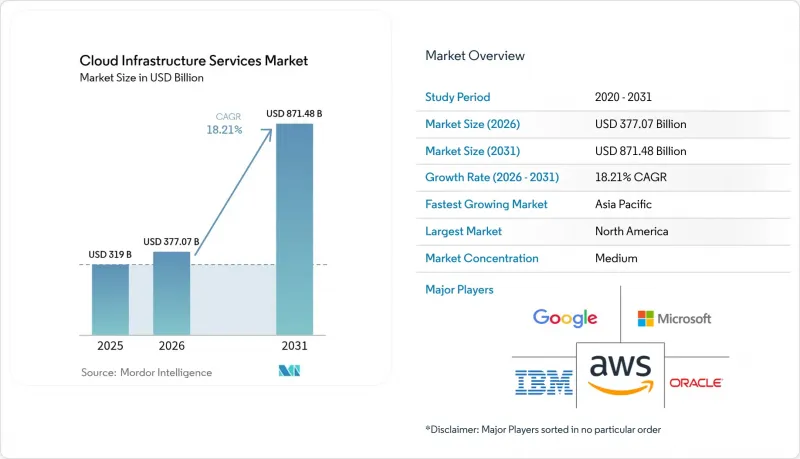
Mordor Intelligence에 의하면, 2026년 클라우드 인프라 서비스 시장 규모는 3,770억 7,000만 달러로 추정되고 있어 2025년 3,190억 달러에서 확대해, 2031년에는 8,714억 8,000만 달러에 이를 것으로 예측됩니다.
2026-2031년 동안의 연평균 성장률(CAGR)은 18.21%를 나타낼 전망입니다.
본 보고서는 서비스 유형별(Compute-as-a-Service, Storage-as-a-Service, 기타), 배포 모델별(퍼블릭 클라우드, 프라이빗 클라우드, 기타),조직 규모별(중소기업(SME), 기타), 최종 사용자 산업별(은행, 금융서비스 및 보험(BFSI), IT 및 통신, 기타), 지역별로 분류되어 있습니다. 시장 예측은 금액(달러) 기준으로 제시되어 있습니다.
세계 클라우드 인프라 서비스 시장 동향 및 인사이트
IaaS의 이점 확대
기업들은 운영의 유연성을 높이고, 급속히 노후화되는 하드웨어에 대한 설비 투자를 피하기 위해 IaaS(Infrastructure-as-a-Service) 도입을 가속화하고 있습니다. 각 하이퍼스케일러 기업들은 AI 훈련 수요를 흡수하기 위해, 13만 1,000개의 NVIDIA Blackwell GPU를 탑재한 Oracle의 ‘Zettascale Cloud Supercluster’와 같은 전용 GPU 클러스터를 구축하고 있습니다. 의료 서비스 제공업체들도 이러한 변화를 여실히 보여주고 있으며, 에픽(Epic)의 워크로드를 퍼블릭 클라우드로 이전한 결과, 비용 가시화 문제에 직면하기는 했지만 확장성과 사용자 만족도 향상을 기록했습니다. 서버 수명 주기가 연장됨에 따라(AWS는 2025년에 5년 감가상각으로 전환했습니다), 공급자의 이익률이 향상되어 그 이익을 새로운 용량에 재투자하는 것이 가능해졌습니다. 이러한 동향들이 결합되어 예측 불가능한 AI 워크로드의 피크에 대응하는 탄력적인 이용 모델을 가능하게 하며, 클라우드 인프라 서비스 시장의 성장 궤도를 끌어올리고 있습니다.
비용 절감 및 ROI에 대한 집중
예산 우선순위는 리소스 사용량에 상응하는 운영 지출에 중점을 두고 있으며, 이에 따라 조직들은 On-Premise 인프라를 종량제 클라우드 계약으로 대체하고 있습니다. 중소기업의 SaaS 도입률은 78%에 달하며, 서비스의 단순화가 기술적 장벽을 낮추고 있음을 여실히 보여주고 있습니다. 아랍에미리트(UAE)는 2030년까지 하이퍼스케일 클라우드 도입을 통해 주로 생산성 향상과 중소기업의 일자리 창출을 통해 누적 170억 달러의 경제적 가치가 창출될 것으로 전망하고 있습니다. 이러한 긍정적인 측면이 있음에도 불구하고, OECD 데이터에 따르면 클라우드 컴퓨팅을 이용하고 있는 중소기업은 고작 41%에 그치고 있어, 여전히 기술 격차가 존재함을 보여주고 있습니다. 각 제공업체들은 중소기업이 이용 현황을 모니터링할 수 있도록 AI를 활용한 자동화 도구 및 비용 관리 도구를 번들로 제공하는 움직임을 강화하고 있으며, 이를 통해 클라우드 인프라 서비스 시장의 종합적인 확대가 촉진되고 있습니다.
데이터 유출 및 개인정보 보호에 대한 우려
사이버 보안 사고는 여전히 주요 장벽으로 남아 있습니다. 조사 대상 연방 정부 기관의 90%가 지난 3년 이내에 랜섬웨어에 노출된 경험이 있다고 보고했으며, 이는 제로 트러스트 아키텍처로의 전환을 촉진하고 있습니다. 다국적 기업들은 GDPR(EU 개인정보보호규정)이나 미국의 CLOUD 법 등 상충되는 법규에 대응하는 데 어려움을 겪고 있어, 규정 준수 부담이 증가하고 있습니다. 소버린 클라우드(Sovereign Cloud)는 위험을 완화해 주지만, 멀티 클라우드의 복잡성과 운영 비용 증가를 초래하여 클라우드 인프라 서비스 시장의 성장을 저해하는 요인이 되고 있습니다.
부문 분석
기업들이 복잡한 AI 모델 훈련을 위해 탄력적인 처리 능력을 추구한 결과, ‘Compute-as-a-Service’는 2025년 매출의 45.72%를 차지했습니다. 컴퓨팅 부문에서 클라우드 인프라 서비스 시장 규모는 2025년에 1,458억 6,000만 달러를 넘어설 것으로 예상되며, 2031년까지 꾸준히 확대될 전망입니다. ‘NaaS(Networking-as-a-Service)’는 22.74%의 연평균 성장률(CAGR)을 보이고 있으며, 이는 5G 코어 네트워크와 지역 데이터센터를 상호 연결하는 엣지 노드의 보급을 반영한 것입니다. 구글이 에릭슨과 공동으로 구축한 캐리어급 ‘5G Core-as-a-Service’는 통합된 네트워크 기능과 AI 기능이 어떻게 새로운 비즈니스 기회를 개척하는지를 보여주고 있습니다. ‘Storage-as-a-Service’는 데이터 집약적 워크로드가 비용 효율성이 뛰어난 오브젝트 스토리지로 전환됨에 따라 꾸준한 확산세를 보이고 있습니다. 데이터베이스 및 매니지드 호스팅 각 부문은 엄격한 규정 준수 요건이 요구되는 산업을 지원하며, 사전 설정된 암호화 기능과 감사 추적을 제공합니다.
이러한 성장의 세부 내역은 분산 컴퓨팅에 활용된 아키텍처의 전환을 여실히 보여주고 있습니다. 다수의 센서가 탑재된 디바이스가 텔레메트리 데이터를 엣지 캐시로 직접 전송함에 따라 네트워크 서비스는 비약적인 성장세를 보이고 있습니다. 한편, 컴퓨팅 서비스는 생성형 AI 용도를 위해 GPU 간 대역폭을 향상시킨 Google의 A3 Ultra VM과 같은 맞춤형 가속기를 통합하거나, 네트워크, 컴퓨팅, 스토리지를 통합된 SLA 하에 결합한 번들 상품을 제공함으로써 시장 점유율을 유지하고 있습니다. 이를 통해 고객은 벤더 종속성에 얽매이지 않고 클라우드 인프라 서비스 시장 전반에서 조합형 리소스를 채택할 수 있게 됩니다.
퍼블릭 클라우드는 2025년에도 90.35%의 점유율을 유지하며, 새로운 디지털 프로그램의 기본 진입점으로 자리매김하고 있습니다. 그러나 하이브리드 모델은 연평균 성장률(CAGR) 26.35%를 나타낼 것으로 예측되며, 데이터에 민감한 워크로드에 유연성을 제공합니다. 기업들이 코로케이션 사이트 내에 프라이빗 확장 환경을 구축함에 따라, 하이브리드 환경에 속하는 클라우드 인프라 서비스 시장 점유율은 2031년까지 두 배로 증가할 전망입니다. 연방 정부 기관은 이미 3년 동안 전용 데이터센터의 이용률을 27%에서 5%로 줄였으며, 이는 레거시 환경에서의 전환이 돌이킬 수 없는 것임을 여실히 보여주고 있습니다.
하이브리드 전략은 기밀 데이터를 프라이빗 클라우드에 배치하는 동시에 퍼블릭 리전에서 버스트 용량을 활용함으로써 데이터 주권 및 지연 시간에 대한 우려를 해소합니다. 이러한 패턴의 오케스트레이션은 복잡하기 때문에 IBM은 64억 달러에 HashiCorp를 인수하고 Terraform의 자동화 기능을 자사 포트폴리오에 통합함으로써 워크플로우의 이식성을 단순화했습니다. 오케스트레이션의 표준화가 진행됨에 따라 하이브리드 솔루션과 관련된 클라우드 인프라 서비스 시장 규모는 가속화되고 있으며, 시스템 통합사업자와 멀티클라우드 관리 벤더에게 새로운 수익을 창출하고 있습니다.
지역별 분석
북미는 2025년 매출의 46.28%를 차지하고 있으며, 이는 기업의 클라우드 도입이 성숙 단계에 접어들었으며 하이퍼스케일러의 대규모 AI 투자를 반영한 결과입니다. 아마존은 펜실베이니아주와 노스캐롤라이나주의 새로운 데이터센터에 300억 달러 이상을 투자하고 1,750명의 숙련된 인력을 고용했습니다. 메타는 루이지애나주 시설에 100억 달러를 투자했으며, 3개의 추가 발전소가 필요한 이 시설은 확대되는 AI 추론 워크로드를 처리하고 있습니다. 전력망의 제약이 점점 더 큰 장벽이 되고 있습니다. 신규 발전 용량의 리드타임이 현재 최대 7년에 달함에 따라, 사업자들은 재생에너지 계약 협상이나 원자력 부문에서의 제휴 모색에 박차를 가하고 있습니다. 이러한 제약에도 불구하고, 포춘 500대 기업의 지속적인 수요와 공공 부문의 고도화된 디지털화 프로그램 덕분에 클라우드 인프라 서비스 시장은 이 지역에 계속 뿌리를 내리고 있습니다.
아시아태평양은 가장 빠르게 성장하는 지역으로, 2031년까지 연평균 성장률(CAGR) 23.41%로 확대될 것으로 예측됩니다. 이 지역의 데이터센터 시장은 IoT의 보급과 5G 도입에 힘입어 2029년까지 306억 9,000만 달러에 달할 가능성이 있습니다. 인도는 2026년까지 850MW의 용량 증설을 계획하고 있으며, AWS는 아시아에 127억 달러를 투자하겠다고 약속했습니다. 말레이시아의 조호르바루 지역은 1.6GW의 가동 공급량을 보유하고 있어 동남아시아의 주요 허브로서 싱가포르를 능가할 가능성이 있지만, 2035년까지 5GW에 달할 것으로 예측되는 수요는 지속가능성 목표 달성을 어렵게 할 우려가 있습니다. 아세안(ASEAN)의 총 발전 용량은 2028년까지 7,589MW로 5배 확대되어, 지역 공급업체들이 세계 주요 기업들과 어깨를 나란히 하게 될 것으로 보입니다. 이러한 기세에 힘입어 아시아태평양은 새로운 워크로드 도입의 중심지로서의 입지를 공고히 하며, 클라우드 인프라 서비스 시장을 기록적인 속도로 확장시키고 있습니다.
유럽, 남미, 중동 및 아프리카는 규모는 작지만 전략적으로 중요한 점유율을 차지하고 있습니다. 유럽의 성장은 GDPR(EU 개인정보보호규정) 및 향후 시행될 EU 데이터법에 부합하는 주권 클라우드 프레임워크를 중심으로 진행되고 있습니다. 6,000억 달러 이상의 규모를 자랑하며 연간 25-30%의 성장률을 기록하고 있는 아프리카의 클라우드 부문은 데이터 소재지 관련 법률과 제한된 현지 인프라로 인해 어려움을 겪고 있습니다. Africa Data Centres와 같은 사업자가 지역 POP를 증설하는 한편, 15개 아프리카 국가를 아우르는 Starlink의 위성 통신은 대안적인 라스트 마일 연결을 제공합니다. 이러한 노력들이 결합되어 클라우드 인프라 서비스 시장의 발자취를, 그동안 서비스가 미치지 못했던 지역으로 확대되고 있습니다.
기타 혜택
- 엑셀 형식 시장 예측(ME) 시트
- 3개월간의 애널리스트 지원
자주 묻는 질문
목차
제1장 서론
제2장 조사 방법
제3장 주요 요약
제4장 시장 구도
제5장 시장 규모와 성장 예측
제6장 경쟁 구도
제7장 시장 기회와 향후 전망
JHS 26.09.11According to Mordor Intelligence, cloud infrastructure services market size in 2026 is estimated at USD 377.07 billion, growing from 2025 value of USD 319 billion with 2031 projections showing USD 871.48 billion, growing at 18.21% CAGR over 2026-2031.
This report is Segmented by Service Type (Compute As A Service, Storage As A Service, and More), Deployment Model (Public Cloud, Private Cloud, and More), Organization Size (Small and Medium-Sized Enterprises (SMEs), and More), End-User Vertical (BFSI, IT and Telecommunications, and More), and by Geography. The Market Forecasts are Provided in Terms of Value (USD).
Global Cloud Infrastructure Services Market Trends and Insights
Growing IaaS Benefits
Enterprises accelerate adoption of Infrastructure as a Service to gain operational flexibility and avoid capital expenditure on rapidly obsolescing hardware. Hyperscalers deploy purpose-built GPU clusters such as Oracle's Zettascale Cloud Supercluster with 131,000 NVIDIA Blackwell GPUs to capture AI training demand. Healthcare providers illustrate this shift, as Epic workloads migrated to the public cloud recorded better scalability and user satisfaction, even while grappling with cost-visibility challenges. Extended server lifecycles, AWS moved to five-year depreciation in 2025, improve provider margins that can be reinvested in new capacity. These dynamics collectively elevate the cloud infrastructure services market trajectory by enabling elastic consumption models aligned to unpredictable AI workload peaks.
Cost-Savings and ROI Focus
Budget priorities favor operational spending that matches resource usage, prompting organizations to replace on-premises infrastructure with pay-as-you-go cloud contracts. Small businesses embrace SaaS at a 78% penetration rate, highlighting how simplified services lower technical barriers. The UAE projects USD 17 billion in cumulative economic value from hyperscale cloud deployments by 2030, mainly through productivity gains and SME job creation. Despite this upside, OECD data show only 41% of SMEs use cloud computing, evidencing a persistent skills gap. Providers increasingly bundle AI-powered automation and cost-governance tools to help smaller firms monitor consumption, reinforcing the inclusive expansion of the cloud infrastructure services market.
Data-Loss and Privacy Concerns
Cybersecurity incidents remain a primary barrier. Surveyed federal agencies reported 90% ransomware exposure within three years, prompting a pivot to zero-trust architectures. Multinationals juggle conflicting jurisdictions such as GDPR and the US CLOUD Act, adding compliance overhead. Although sovereign-cloud options mitigate exposure, they introduce multicloud complexity and higher run-rates, tempering the growth of the cloud infrastructure services market.
Other drivers and restraints analyzed in the detailed report include:
- Rapid Edge-Computing Roll-Outs
- Sovereign-Cloud Build-Outs
- GPU / Server Supply-Chain Bottlenecks
For complete list of drivers and restraints, kindly check the Table Of Contents.
Segment Analysis
Compute as a Service generated 45.72% of 2025 revenue as enterprises pursued elastic processing power for complex AI model training. The cloud infrastructure services market size for compute surpassed USD 145.86 billion in 2025 and is expected to expand steadily through 2031. Networking as a Service exhibits a 22.74% CAGR, reflecting the proliferation of edge nodes that interlink 5G core networks with regional data centers. Google's carrier-grade 5G Core-as-a-Service, built with Ericsson, illustrates how integrated networking and AI functions unlock incremental opportunities. Storage as a Service registers consistent uptake as data-intensive workloads migrate to cost-effective object storage. Database and managed-hosting lines address compliance-heavy industries, offering pre-configured encryption and audit trails.
The growth split underscores the architectural transition toward distributed computing. As sensor-rich devices push telemetry directly into edge caches, networking services experience outsized momentum. Meanwhile, compute services defend share by embedding custom accelerators, such as Google's A3 Ultra VMs that boost GPU-to-GPU bandwidth for generative AI positions, bundled offers that combine networking, compute, and storage under unified SLAs, enabling customers to adopt composable resources across the cloud infrastructure services market without vendor lock-in.
Public Cloud retained 90.35% share in 2025 and remains the default entry point for greenfield digital programs. However, the hybrid model is forecast to grow at 26.35% CAGR, adding flexibility for data-sensitive workloads. The cloud infrastructure services market share attributable to hybrid environments is set to double by 2031 as firms deploy private extensions inside colocation sites. Federal agencies have already cut exclusive data center usage from 27% to 5% within three years, highlighting irreversible migration away from legacy setups.
Hybrid strategies resolve sovereignty and latency concerns by placing sensitive data on private clouds while consuming burst capacity in public regions. Orchestrating these patterns is complex; therefore, IBM acquired HashiCorp for USD 6.4 billion to integrate Terraform automation into its portfolio and simplify workflow portability. As orchestration standards consolidate, the cloud infrastructure services market size tied to hybrid solutions accelerates, bringing new revenue for system integrators and multicloud management vendors.
Complete Report Scope:
- By Service Type
- Compute as a Service
- Storage as a Service
- Networking as a Service
- Other Service Types (DaaS, Managed Hosting)
- By Deployment Model
- Public Cloud
- Private Cloud
- Hybrid Cloud
- By Organisation Size
- Large Enterprises
- Small and Medium-sized Enterprises
- By End-user Vertical
- IT and Telecommunications
- BFSI
- Retail
- Healthcare and Life Sciences
- Government
- Other End-user Verticals
- By Geography
- North America
- South America
- Europe
- Asia-Pacific
- Middle East and Africa
Geography Analysis
North America controlled 46.28% of 2025 revenue, reflecting deep enterprise cloud maturity and large-scale AI investments by hyperscalers. Amazon earmarked more than USD 30 billion for new data centers in Pennsylvania and North Carolina, creating 1,750 skilled positions. Meta committed USD 10 billion to a Louisiana facility that will require three additional power plants, capturing expanding AI inference workloads. Power-grid limitations present a mounting hurdle: lead times for new capacity now span up to seven years, forcing operators to negotiate renewable energy contracts and explore nuclear partnerships. Despite these constraints, the cloud infrastructure services market remains anchored in the region thanks to sustained demand from Fortune 500 enterprises and advanced digital public-sector programs.
Asia-Pacific is the fastest-growing geography, forecast to rise at a 23.41% CAGR through 2031. The regional data-center market could reach USD 30.69 billion by 2029, buoyed by IoT proliferation and 5G adoption. India plans an additional 850 MW of capacity by 2026, with AWS pledging USa USD 12.7 billion investment in Asia. Malaysia's Johor Bahru region holds 1.6 GW in active supply and may surpass Singapore as Southeast Asia's prime hub, though the projected demand of 5 GW by 2035 strains sustainability targets. ASEAN aggregate capacity could quintuple to 7,589 MW by 2028, positioning regional providers alongside global incumbents. This momentum cements Asia-Pacific as the epicenter of new workload deployments, expanding the cloud infrastructure services market at record pace.
Europe, South America, and Middle East and Africa contribute smaller but strategic shares. European growth centers on sovereign-cloud frameworks that comply with GDPR and the forthcoming EU Data Act Lexology. Africa's cloud sector, valued at more than USD 600 billion and growing 25-30% annually, struggles with data-residency laws and limited local infrastructure. Operators like Africa Data Centres add regional POPs while Starlink's satellite coverage across 15 African nations offers alternative last-mile connectivity. These initiatives collectively expand the cloud infrastructure services market footprint into previously underserved territories.
- Amazon Web Services
- Microsoft Corporation
- Google LLC
- IBM Corporation
- Oracle Corporation
- Alibaba Cloud
- Rackspace Technology
- Fujitsu Ltd
- Lumen Technologies (CenturyLink)
- VMware Inc.
- DXC Technology
- NTT Ltd / Dimension Data
- Verizon Business
- Tencent Cloud
- ATandT Business
- NEC Corporation
Additional Benefits:
- The market estimate (ME) sheet in Excel format
- 3 months of analyst support
TABLE OF CONTENTS
1 INTRODUCTION
- 1.1 Study Assumptions and Market Definition
- 1.2 Scope of the Study
2 RESEARCH METHODOLOGY
3 EXECUTIVE SUMMARY
4 MARKET LANDSCAPE
- 4.1 Market Overview
- 4.2 Market Drivers
- 4.2.1 Growing IaaS benefits
- 4.2.2 Cost-savings and ROI focus
- 4.2.3 Rapid edge-computing roll-outs
- 4.2.4 Sovereign-cloud build-outs
- 4.2.5 AI-accelerator demand for custom silicon
- 4.2.6 Carbon-optimised green cloud contracts
- 4.3 Market Restraints
- 4.3.1 Data-loss and privacy concerns
- 4.3.2 High bandwidth and monitoring costs
- 4.3.3 GPU / server supply-chain bottlenecks
- 4.3.4 Egress-fee and localisation regulations
- 4.4 Industry Value Chain Analysis
- 4.5 Regulatory Landscape
- 4.6 Technological Outlook
- 4.7 Porter's Five Forces Analysis
- 4.7.1 Threat of New Entrants
- 4.7.2 Bargaining Power of Suppliers
- 4.7.3 Bargaining Power of Consumers
- 4.7.4 Threat of Substitutes
- 4.7.5 Intensity of Competitive Rivalry
5 MARKET SIZE AND GROWTH FORECASTS (VALUE)
- 5.1 By Service Type
- 5.1.1 Compute as a Service
- 5.1.2 Storage as a Service
- 5.1.3 Networking as a Service
- 5.1.4 Other Service Types (DaaS, Managed Hosting)
- 5.2 By Deployment Model
- 5.2.1 Public Cloud
- 5.2.2 Private Cloud
- 5.2.3 Hybrid Cloud
- 5.3 By Organisation Size
- 5.3.1 Large Enterprises
- 5.3.2 Small and Medium-sized Enterprises
- 5.4 By End-user Vertical
- 5.4.1 IT and Telecommunications
- 5.4.2 BFSI
- 5.4.3 Retail
- 5.4.4 Healthcare and Life Sciences
- 5.4.5 Government
- 5.4.6 Other End-user Verticals
- 5.5 By Geography
- 5.5.1 North America
- 5.5.2 South America
- 5.5.3 Europe
- 5.5.4 Asia-Pacific
- 5.5.5 Middle East and Africa
6 COMPETITIVE LANDSCAPE
- 6.1 Market Concentration
- 6.2 Strategic Moves
- 6.3 Market Share Analysis
- 6.4 Company Profiles
- 6.4.1 Amazon Web Services
- 6.4.2 Microsoft Corporation
- 6.4.3 Google LLC
- 6.4.4 IBM Corporation
- 6.4.5 Oracle Corporation
- 6.4.6 Alibaba Cloud
- 6.4.7 Rackspace Technology
- 6.4.8 Fujitsu Ltd
- 6.4.9 Lumen Technologies (CenturyLink)
- 6.4.10 VMware Inc.
- 6.4.11 DXC Technology
- 6.4.12 NTT Ltd / Dimension Data
- 6.4.13 Verizon Business
- 6.4.14 Tencent Cloud
- 6.4.15 ATandT Business
- 6.4.16 NEC Corporation
7 MARKET OPPORTUNITIES AND FUTURE OUTLOOK
- 7.1 White-space and Unmet-need Assessment


