|
시장보고서
상품코드
2124341
클라우드 시스템 관리 소프트웨어 시장 : 점유율 분석, 업계 동향과 통계, 성장 예측(2026-2031년)Cloud System Management Software - Market Share Analysis, Industry Trends & Statistics, Growth Forecasts (2026 - 2031) |
||||||
 Mordor Intelligence
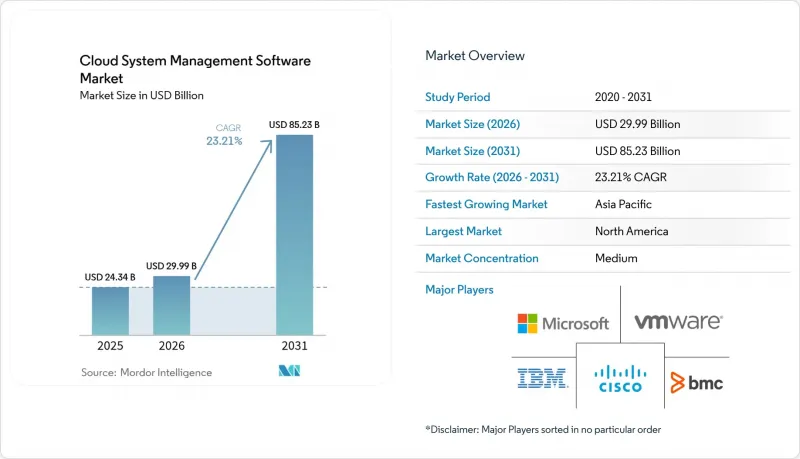
Mordor Intelligence에 의하면, 클라우드 시스템 관리 소프트웨어 시장 규모는 2025년 243억 4,000만 달러에서 2026년에는 299억 9,000만 달러로 확대되어 2026-2031년까지 CAGR 23.21%로 성장하여 2031년까지 852억 3,000만 달러에 이를 것으로 예측됩니다.
본 보고서는 구성 요소별(IT 운영 관리, IT 서비스 관리, 기타), 배포 모델별(퍼블릭 클라우드, 기타), 조직 규모별(대기업, 중소기업), 최종 사용자 산업별(IT 및 통신, 은행, 금융서비스 및 보험(BFSI), 헬스케어 및 생명과학, 기타), 지역별로 분류되어 있습니다. 시장 예측은 금액(달러) 기준으로 제시되어 있습니다.
세계 클라우드 시스템 관리 소프트웨어 시장 동향 및 인사이트
멀티클라우드 및 하이브리드 환경 도입 급증
2024년, 각 조직이 운영하는 퍼블릭 클라우드의 평균 수는 2.6개로, 전년의 2.2개에서 증가했습니다. 이는 제공업체가 늘어날수록 가시성의 격차가 확대되었기 때문입니다. AWS, Azure, Google Cloud에 걸친 텔레메트리(telemetry)를 표준화하는 플랫폼이 수동 스크립트 작성이 필요한 단일 기능 도구를 대체하고 있습니다. Terraform 프로바이더와 같은 기성 커넥터 및 정책 변환 키트를 통해 도입이 가속화되고, 규정 준수 확보도 촉진되고 있습니다. 현재 기업들은 최적화의 가장 큰 장애물로 도구 간의 비일관성을 꼽고 있으며, 이에 따라 독점적인 API를 숨기는 추상화 계층에 대한 수요가 높아지고 있습니다.
시프트 레프트(Shift Left) DevOps가 통합형 가시성 수요를 주도
DevOps 팀은 커밋 시 코드에 측정 기능을 통합함으로써 평균 해결 시간을 40% 단축하고, 가시성을 개발자의 주요 관심사로 자리매김하고 있습니다. 통합 플랫폼은 트레이스, 메트릭, 비즈니스 KPI를 상호 연관성 분석하여, 엔지니어가 사용자에게 영향이 미치기 전에 설정 오류를 파악할 수 있도록 지원합니다. 풀스택 가시성을 도입한 New Relic 고객은 알림 노이즈를 35% 줄였습니다. Datadog이 2024년에 Bits AI를 인수함에 따라, LLM을 활용한 근본 원인 분석이 운영 현장의 주류가 되었으며, 평이한 언어로 된 설명이 차별화 요소로 자리 잡고 있습니다.
컨트롤 플레인을 겨냥한 사이버 공격의 격화
중앙 집중화된 컨트롤 플레인에는 고가치 인증 정보와 설정 데이터가 보관되어 있습니다. 2024년에 발생한 Snowflake 침해 사건은 관리자 계정 탈취로 인한 것이었으며, 이는 멀티테넌트 환경의 위험성을 드러내어 기업들이 하드웨어 기반 다단계 인증(MFA) 및 불변 감사 로그를 도입하도록 촉진했습니다. ID 제공업체에서 발생한 유사한 사고로 인해 타사 통합에 대한 모니터링이 강화되었습니다. 규제 당국은 현재 최소 권한 원칙과 지속적인 인증을 철저히 적용하는 제로 트러스트 아키텍처를 권장하고 있습니다. 엄격한 보안 조치를 입증하지 못하는 벤더는 특히 규제 산업 분야에서 조달 주기가 길어지는 경향이 있습니다.
부문 분석
IT 자동화 및 구성 관리는 조직이 수동 스크립트를 선언형 ‘Infrastructure as Code(IaC)’로 대체함에 따라 구성 요소 중 가장 빠른 연평균 성장률(CAGR) 24.18%를 나타낼 것으로 전망됩니다. IT 자동화용 클라우드 시스템 관리 소프트웨어 시장 규모는 2025년 96억 7,000만 달러에서 2031년까지 354억 5,000만 달러로 성장할 것으로 예측됩니다. HashiCorp Terraform의 벤더 중립적인 언어는 현재 수천 가지 리소스 유형을 관리하고 있으며, 퍼블릭 클라우드와 On-Premise 시스템을 아우르는 도구에 대한 수요를 뒷받침하고 있습니다. 통합된 가시성이 여전히 기반을 이루고 있는 만큼, 2025년 클라우드 시스템 관리 소프트웨어 시장에서 IT 운영 관리는 41.02%의 시장 점유율을 유지했습니다. Cisco의 Splunk 인수와 같은 M&A는 네트워크 텔레메트리 및 용도 추적을 융합하여 가시성의 격차를 해소합니다.
기업들은 프로비저닝, 구성, 실행 시 모니터링, 서비스 관리를 엔드투엔드로 포괄하는 플랫폼을 점점 더 요구하고 있습니다. Argo CD나 Flux와 같은 쿠버네티스 네이티브 프로젝트는 GitOps 워크플로우를 확장하는 한편, ITSM 제품군은 AI 채팅을 통합하여 티켓을 보다 효율적으로 해결합니다. 레거시 환경을 보유한 팀의 경우, 에이전트 없는 감지 기능과 드리프트 감지 기능이 마이그레이션 로드맵을 가속화하고 수작업 부담을 줄여줍니다. 가시성과 자동화의 융합을 통해 통합된 포트폴리오를 제공하는 벤더는 틈새 시장용 포인트 솔루션을 제공하는 벤더보다 더 뛰어난 실적을 거두게 될 것입니다.
2025년에는 퍼블릭 클라우드가 매출의 52.21%를 차지했지만, 데이터 주권에 관한 규제가 강화되는 가운데 하이브리드 모델은 연평균 성장률(CAGR) 24.42%로 확대되고 있습니다. 하이브리드 클라우드 솔루션을 위한 클라우드 시스템 관리 소프트웨어 시장 규모는 2031년까지 448억 달러를 넘어설 것으로 예측됩니다. EU 규정에 따라 공급자는 벌금성 수수료를 부과하지 않고 데이터 이식성을 실현해야 할 의무가 있으며, 워크로드 배치를 추상화하는 쿠버네티스(Kubernetes)와 같은 개방형 오케스트레이션 레이어에 대한 수요가 증가하고 있습니다. AWS Outposts, Azure Arc, Google Anthos는 퍼블릭 클라우드의 API를 고객의 데이터센터에 도입하여, 팀이 이기종 리소스를 단일 제어 평면에서 관리할 수 있도록 합니다.
프라이빗 클라우드는 규제 대상 워크로드에서 여전히 중요하지만, 자본 집약적이기 때문에 성장 속도는 둔화되고 있습니다. 기업은 하이브리드 환경을 채택함으로써 개인 식별 정보를 On-Premise에 보관한 채, 분석 처리를 하이퍼스케일 지역으로 확장할 수 있게 됩니다. 따라서 거점 간 통합적인 비용 배분, 보안 태세 관리, 가시성은 더 이상 없어서는 안 될 필수 요건이 되었습니다. On-Premise와 퍼블릭 엔드포인트 간 기능의 균일성을 확보하지 못한 벤더는 고객이 일관된 경험을 추구하며 통합을 추진하는 과정에서 고객 이탈 위험에 직면하게 될 것입니다.
지역별 분석
2025년, 북미는 클라우드 시스템 관리 소프트웨어 시장을 주도하며 매출의 38.26%를 차지했습니다. 이는 AIOps의 조기 도입에 더해, 중앙 집중식 보안 이벤트 상관 분석의 중요성을 높이는 엄격한 정보 유출 통지법에 힘입은 결과입니다. 또한, 미국 기업들은 하이퍼스케일러의 지역적 입지와 관측 가능성(observability) 스타트업의 밀집된 생태계로부터도 혜택을 얻고 있으며, 이는 혁신과 파트너십 형성을 가속화하고 있습니다. Broadcom과 VMware, Cisco와 Splunk의 통합과 같은 통합 움직임은 경쟁을 심화시키고, 통합된 제어 플레인을 원하는 포춘 500대 기업 사용자들 사이에서 지출 모멘텀을 높이고 있습니다.
아시아태평양은 2031년까지 23.98%라는 가장 높은 성장률을 나타낼 것으로 예측됩니다. 인도의 공공 부문에서 클라우드 도입이 의무화됨에 따라, MeghRaj 프레임워크 하에서 정부 데이터는 국경 내에 보관되어야 하며, 이로 인해 로컬 데이터센터와 하이퍼스케일 용량을 융합한 하이브리드 아키텍처가 추진되고 있습니다. 중국의 사이버 보안 및 데이터 보안 관련 법은 중요 인프라 운영 사업자에게 국내 공급업체를 핵심으로 하는 주권 클라우드 스택으로의 전환을 촉진하고 있습니다. 또한, 일본 디지털청의 노력에 힘입어 기업들은 벤더를 초월하여 비용, 지속가능성, 보안 지표를 통합하는 매니지드 플랫폼으로의 전환을 더욱 가속화하고 있습니다.
유럽은 데이터 주권을 둘러싼 논의의 중심에 위치해 있으며, GDPR(EU 개인정보보호규정) 및 2024년 EU 데이터법에 따라 기업들은 기밀성이 높은 워크로드를 On-Premise에 유지하면서 분석 처리만 퍼블릭 클라우드에 위탁하도록 권장받고 있습니다. 독일의 BSI는 벤더 종속성을 완화하기 위해 멀티클라우드 설계를 추진하고 있으며, 개방형 오케스트레이션 레이어의 도입을 장려하고 있습니다. 중동의 정부계 펀드에 의한 하이퍼스케일 시설에 대한 투자는 현지 기업의 지연 시간을 단축하는 한편, 아프리카의 모바일 퍼스트 경제권에서는 대역폭이 제한된 환경에서도 작동하는 경량 API 기반 제품군이 중시되고 있습니다. 라틴아메리카의 GDPR(EU 개인정보보호규정) 스타일 규제 역시 세밀한 액세스 제어 및 감사 기능을 갖춘 관리 도구의 도입을 가속화하고 있습니다.
기타 혜택
- 엑셀 형식 시장 전망(ME) 시트
- 3개월간의 애널리스트 지원
자주 묻는 질문
목차
제1장 서론
제2장 조사 방법
제3장 주요 요약
제4장 시장 구도
제5장 시장 규모와 성장 예측
제6장 경쟁 구도
제7장 시장 기회와 향후 전망
JHSAccording to Mordor Intelligence, the cloud system management software market size is expected to grow from USD 24.34 billion in 2025 to USD 29.99 billion in 2026 and is forecast to reach USD 85.23 billion by 2031 at 23.21% CAGR over 2026-2031.
This report is Segmented by Component (IT Operations Management, IT Service Management, and More), Deployment Model (Public Cloud, and More), Organisation Size (Large Enterprises and Small and Medium Enterprises), End-User Industry (IT and Telecommunications, BFSI, Healthcare and Life Sciences, and More), and Geography. The Market Forecasts are Provided in Terms of Value (USD).
Global Cloud System Management Software Market Trends and Insights
Explosion of Multi-Cloud and Hybrid Adoption
Organizations ran an average of 2.6 public clouds in 2024, up from 2.2 the previous year, as visibility gaps increased with each additional provider. Platforms that normalize telemetry across AWS, Azure, and Google Cloud are displacing point tools that require manual scripting. Pre-built connectors and policy translation kits, such as Terraform providers, are speeding rollouts and boosting compliance. Enterprises now cite inconsistent tooling as the top barrier to optimization, reinforcing demand for abstraction layers that mask proprietary APIs.
Shift-Left DevOps Driving Demand for Unified Observability
DevOps teams instrument code at commit time, shrinking mean-time-to-resolution by 40% and elevating observability to a developer concern. Unified platforms correlate traces, metrics, and business KPIs, enabling engineers to identify misconfigurations before users are affected. New Relic customers who employ full-stack observability reduce alert noise by 35%. Datadog's 2024 purchase of Bits AI pulled LLM-powered root-cause analysis into mainstream operations, turning plain-language explanations into a differentiator.
Escalating Cyber-Attacks on Control Planes
Centralized control planes hold high-value credentials and configuration data. The 2024 Snowflake breach, traced to compromised admin accounts, exposed multi-tenant risks and drove firms to adopt hardware-backed MFA and immutable audit logs. Similar incidents at identity providers heightened scrutiny on third-party integrations. Regulatory agencies now recommend zero-trust architectures that enforce least privilege and continuous authentication. Vendors unable to demonstrate rigorous security controls often face longer procurement cycles, particularly in regulated industries.
Other drivers and restraints analyzed in the detailed report include:
- FinOps as a Board-Level Mandate for Cloud Cost Control
- Emergence of GenAI-Ready GPU Orchestration Layers
- Persistent Skills Shortage in Cloud Operations and AIOps
For complete list of drivers and restraints, kindly check the Table Of Contents.
Segment Analysis
IT Automation and Configuration Management is on track to post a 24.18% CAGR, the quickest clip among components as organizations replace manual scripts with declarative infrastructure-as-code. The cloud system management software market size for IT Automation is projected to grow from USD 9.67 billion in 2025 to USD 35.45 billion by 2031. HashiCorp Terraform's vendor-neutral language now governs thousands of resource types, reinforcing demand for tools that span public clouds and on-premises systems. IT Operations Management retained a 41.02% market share of cloud system management software in 2025, as unified observability remains foundational. Acquisitions, such as Cisco's acquisition of Splunk, fuse network telemetry with application traces to close visibility gaps.
Enterprises are increasingly seeking platforms that cover provisioning, configuration, runtime monitoring, and service management from end to end. Kubernetes-native projects, such as Argo CD and Flux, extend GitOps workflows, while ITSM suites integrate AI chat to resolve tickets more efficiently. For teams with legacy estates, agentless discovery and drift detection expedite migration roadmaps and reduce toil. The convergence of observability with automation positions vendors offering cohesive portfolios to out-execute niche point solutions.
Public cloud kept 52.21% revenue in 2025, yet hybrid models are expanding at a 24.42% CAGR as data-sovereignty mandates rise. The cloud system management software market size for hybrid cloud solutions is forecast to exceed USD 44.8 billion by 2031. EU rules now require providers to enable data portability without punitive fees, strengthening demand for open orchestration layers like Kubernetes that abstract workload placement. AWS Outposts, Azure Arc, and Google Anthos push public-cloud APIs into customer data centers, giving teams one control plane for disparate resources.
Private clouds remain relevant for regulated workloads but grow slower due to capital intensity. Enterprises adopt hybrid so analytics can burst to hyperscale regions while personally identifiable information stays on-premises. Unified cost allocation, security posture management, and observability across locations therefore become non-negotiable. Vendors lacking feature parity between on-premises and public endpoints risk churn as customers consolidate around consistent experiences.
Complete Report Scope:
- By Component
- IT Operations Management (ITOM)
- IT Service Management (ITSM)
- IT Automation and Configuration Management (ITACM)
- By Deployment Model
- Public Cloud
- Private Cloud
- Hybrid Cloud
- By Organisation Size
- Large Enterprises
- Small and Medium Enterprises (SMEs)
- By End-user Industry
- IT and Telecommunications
- Banking, Financial Services and Insurance (BFSI)
- Healthcare and Life Sciences
- Manufacturing
- Retail and Consumer Services
- Transport and Logistics
- Media and Entertainment
- Government and Public Sector
- By Geography
- North America
- United States
- Canada
- Mexico
- South America
- Brazil
- Argentina
- Rest of South America
- Europe
- Germany
- United Kingdom
- France
- Netherlands
- Rest of Europe
- Asia-Pacific
- China
- India
- Japan
- South Korea
- Rest of Asia-Pacific
- Middle East and Africa
- Middle East
- Saudi Arabia
- United Arab Emirates
- Rest of Middle East
- Africa
- South Africa
- Nigeria
- Rest of Africa
- Middle East
- North America
Geography Analysis
North America led the cloud system management software market in 2025 with 38.26% revenue, supported by early AIOps adoption and stringent breach-notification statutes that raise the premium on centralized security-event correlation. U.S. enterprises also benefit from the regional presence of hyperscalers and a dense ecosystem of observability startups, which accelerates innovation and partnership velocity. Consolidation moves such as Broadcom-VMware and Cisco-Splunk accentuate competition and keep spending momentum high among Fortune 500 users seeking integrated control planes.
The Asia-Pacific region is projected to post the fastest growth rate of 23.98% through 2031. India's public-sector cloud mandate requires government data to stay within national borders under the MeghRaj framework, driving hybrid architectures that blend local data centers with hyperscale capacity. China's cybersecurity and data-security laws push critical infrastructure operators toward sovereign-cloud stacks anchored by domestic providers. Japan's digital agency initiatives further draw enterprises into managed platforms that unify cost, sustainability, and security metrics across vendors.
Europe sits at the center of data-sovereignty debate, with GDPR and the 2024 EU Data Act prompting enterprises to keep sensitive workloads on-premises while bursting analytics to the public cloud. Germany's BSI promotes multi-cloud designs to mitigate vendor lock-in, spurring adoption of open orchestration layers. Middle East sovereign-wealth-fund investments in hyperscale facilities shorten latency for local enterprises, while Africa's mobile-first economies value lightweight, API-driven suites that function over constrained bandwidth. Latin America's GDPR-style regulations likewise accelerate adoption of management tools with granular access controls and auditability.
- VMware, Inc.
- Microsoft Corporation
- International Business Machines Corporation
- BMC Software, Inc.
- ServiceNow, Inc.
- Cisco Systems, Inc.
- Oracle Corporation
- Hewlett Packard Enterprise Company
- Amazon Web Services, Inc.
- Google LLC
- Dynatrace, Inc.
- New Relic, Inc.
- Splunk Inc.
- Datadog, Inc.
- Flexera Software LLC
- Broadcom Inc.
- Morpheus Data LLC
- CloudBolt Software, Inc.
- Harness Inc.
- HashiCorp Inc.
Additional Benefits:
- The market estimate (ME) sheet in Excel format
- 3 months of analyst support
TABLE OF CONTENTS
1 INTRODUCTION
- 1.1 Study Assumptions and Market Definition
- 1.2 Scope of the Study
2 RESEARCH METHODOLOGY
3 EXECUTIVE SUMMARY
4 MARKET LANDSCAPE
- 4.1 Market Overview
- 4.2 Market Drivers
- 4.2.1 Explosion Of Multi-Cloud And Hybrid Adoption
- 4.2.2 Shift-Left Devops Driving Demand For Unified Observability
- 4.2.3 Finops As a Board-Level Mandate for Cloud Cost Control
- 4.2.4 Emergence Of Genai-Ready GPU Orchestration Layers
- 4.2.5 Sustainability Reporting Mandates Embedded in Cmps
- 4.2.6 Quantum-Safe Crypto Modules Entering Cloud Management Stacks
- 4.3 Market Restraints
- 4.3.1 Escalating Cyber-Attacks on Control Planes
- 4.3.2 Persistent Skills Shortage In Cloud Operations and AIOps
- 4.3.3 Opaque Licensing of Proprietary Telemetry Apis
- 4.3.4 Edge-To-Cloud Data-Sovereignty Fragmentation
- 4.4 Industry Value Chain Analysis
- 4.5 Impact of Macroeconomic Factors on the Market
- 4.6 Regulatory Landscape
- 4.7 Technological Outlook
- 4.8 Porter's Five Forces Analysis
- 4.8.1 Threat of New Entrants
- 4.8.2 Bargaining Power of Buyers
- 4.8.3 Bargaining Power of Suppliers
- 4.8.4 Threat of Substitutes
- 4.8.5 Intensity of Competitive Rivalry
5 MARKET SIZE AND GROWTH FORECASTS (VALUE)
- 5.1 By Component
- 5.1.1 IT Operations Management (ITOM)
- 5.1.2 IT Service Management (ITSM)
- 5.1.3 IT Automation and Configuration Management (ITACM)
- 5.2 By Deployment Model
- 5.2.1 Public Cloud
- 5.2.2 Private Cloud
- 5.2.3 Hybrid Cloud
- 5.3 By Organisation Size
- 5.3.1 Large Enterprises
- 5.3.2 Small and Medium Enterprises (SMEs)
- 5.4 By End-user Industry
- 5.4.1 IT and Telecommunications
- 5.4.2 Banking, Financial Services and Insurance (BFSI)
- 5.4.3 Healthcare and Life Sciences
- 5.4.4 Manufacturing
- 5.4.5 Retail and Consumer Services
- 5.4.6 Transport and Logistics
- 5.4.7 Media and Entertainment
- 5.4.8 Government and Public Sector
- 5.5 By Geography
- 5.5.1 North America
- 5.5.1.1 United States
- 5.5.1.2 Canada
- 5.5.1.3 Mexico
- 5.5.2 South America
- 5.5.2.1 Brazil
- 5.5.2.2 Argentina
- 5.5.2.3 Rest of South America
- 5.5.3 Europe
- 5.5.3.1 Germany
- 5.5.3.2 United Kingdom
- 5.5.3.3 France
- 5.5.3.4 Netherlands
- 5.5.3.5 Rest of Europe
- 5.5.4 Asia-Pacific
- 5.5.4.1 China
- 5.5.4.2 India
- 5.5.4.3 Japan
- 5.5.4.4 South Korea
- 5.5.4.5 Rest of Asia-Pacific
- 5.5.5 Middle East and Africa
- 5.5.5.1 Middle East
- 5.5.5.1.1 Saudi Arabia
- 5.5.5.1.2 United Arab Emirates
- 5.5.5.1.3 Rest of Middle East
- 5.5.5.2 Africa
- 5.5.5.2.1 South Africa
- 5.5.5.2.2 Nigeria
- 5.5.5.2.3 Rest of Africa
- 5.5.5.1 Middle East
- 5.5.1 North America
6 COMPETITIVE LANDSCAPE
- 6.1 Market Concentration
- 6.2 Strategic Moves
- 6.3 Market Share Analysis
- 6.4 Company Profiles (includes Global level Overview, Market level overview, Core Segments, Financials as available, Strategic Information, Market Rank/Share for key companies, Products and Services, and Recent Developments)
- 6.4.1 VMware, Inc.
- 6.4.2 Microsoft Corporation
- 6.4.3 International Business Machines Corporation
- 6.4.4 BMC Software, Inc.
- 6.4.5 ServiceNow, Inc.
- 6.4.6 Cisco Systems, Inc.
- 6.4.7 Oracle Corporation
- 6.4.8 Hewlett Packard Enterprise Company
- 6.4.9 Amazon Web Services, Inc.
- 6.4.10 Google LLC
- 6.4.11 Dynatrace, Inc.
- 6.4.12 New Relic, Inc.
- 6.4.13 Splunk Inc.
- 6.4.14 Datadog, Inc.
- 6.4.15 Flexera Software LLC
- 6.4.16 Broadcom Inc.
- 6.4.17 Morpheus Data LLC
- 6.4.18 CloudBolt Software, Inc.
- 6.4.19 Harness Inc.
- 6.4.20 HashiCorp Inc.
7 MARKET OPPORTUNITIES AND FUTURE OUTLOOK
- 7.1 White-space and Unmet-need Assessment