

|
시장보고서
상품코드
2124374
은행 유지보수 지원 및 서비스 시장 : 점유율 분석, 업계 동향과 통계, 성장 예측(2026-2031년)Banking Maintenance Support And Services - Market Share Analysis, Industry Trends & Statistics, Growth Forecasts (2026 - 2031) |
||||||
 Mordor Intelligence
Mordor Intelligence에 의하면, 은행 유지보수 지원 및 서비스 시장 규모는 2025년 110억 2,000만 달러에서 2026년에는 116억 9,000만 달러로 확대되어 2026-2031년까지 CAGR 6.05%로 성장을 지속하여, 2031년에는 156억 8,000만 달러에 이를 것으로 예측됩니다.
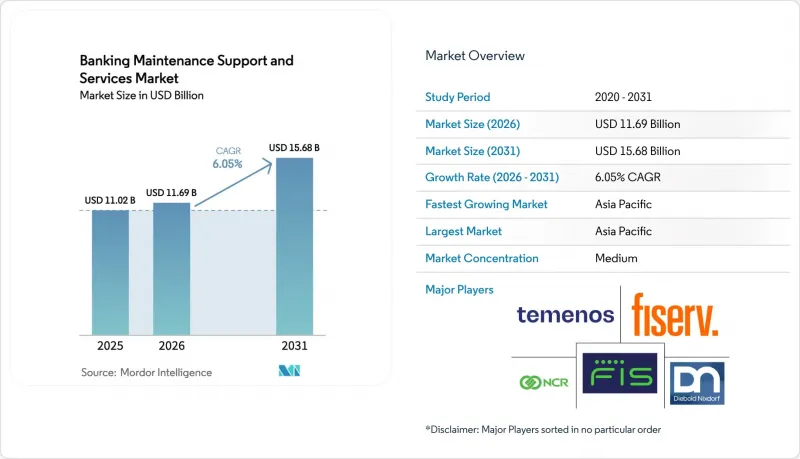
본 보고서는 서비스 유형별(예방 유지보수, ATM 관리형 서비스, 기타), 배포 모델별(클라우드, On-Premise, 하이브리드), 은행 유형별(소매/상업은행, 협동조합은행 및 상호은행, 투자은행, 디지털 전문/네오뱅크), 구성 요소별(코어 뱅킹 플랫폼, 채널, 기타), 지역별로 분류되어 있습니다. 시장 예측은 금액(달러) 기준으로 제시되어 있습니다.
전 세계 은행 유지보수 지원 및 서비스 시장 동향과 인사이트
코어 뱅킹 시스템의 급속한 노후화
메인프레임 OS의 지원 종료 통지에 따라 시스템 업데이트 일정이 앞당겨지고 있습니다. IBM은 2024년 9월에 z/OS 2.4에 대한 연장 지원을 종료했으며, 이로 인해 340개 은행이 시스템 마이그레이션을 수행하거나 40% 더 높은 유지보수 비용을 감수해야만 했습니다. Temenos에 따르면, 2024년 신규 라이선스 수주의 58%는 15년 이상 경과한 시스템의 교체를 위한 것이었으며, 마이그레이션에는 병렬 운영 모드에서 평균 18개월이 소요되었다고 합니다. FIS에서는 각 은행들이 2025년 11월 마감 기한을 앞두고 ISO 20022 준수 플랫폼을 요구함에 따라, 코어 시스템 현대화와 관련된 컨설팅 프로젝트가 29% 증가했습니다. 단계적 전환 과정에서 데이터 무결성을 확보하기 위해 메인프레임 JCL 전문가와 쿠버네티스 엔지니어를 결합한 하이브리드 지원 모델이 등장하고 있습니다. 그 결과, 레거시 플랫폼과 클라우드 네이티브 플랫폼을 동시에 관리할 수 있는 양쪽 기술을 모두 갖춘 유지보수 팀에 대한 수요가 꾸준히 증가하고 있습니다.
심화되는 사이버 위협 상황
2024년에는 코어 뱅킹 환경을 대상으로 한 랜섬웨어 공격이 127건 기록되었으며, 건당 평균 몸값 요구액은 420만 달러에 달했습니다. 오픈 뱅킹용 API 공개로 인해 취약성이 높아지고 있으며, 규제 당국은 감독 심사 과정에서 인증이 불충분한 사례 2,300건을 지적했습니다. 제로 트러스트 아키텍처 도입률은 전년 대비 2배인 41%에 달했으며, 이는 보안 운영 센터(SOC)의 종합적인 정액제 계약 확대를 뒷받침하고 있습니다. 코그니잔트(Cognizant)에 따르면, 이 회사의 은행 고객 중 68%가 현재 인프라 및 사이버 보안 지원을 단일 SLA 하에 통합하고 있어, 유지보수와 방어의 경계가 모호해지고 있습니다. 그 결과, 지속적인 구성 감사와 신속한 패치 적용 주기가 계약의 표준 조항이 되었습니다.
벤더 락인으로 인한 높은 전환 비용
Oracle(Oracle)의 공개 자료에 따르면, 계약 기간 만료 전 해지 시 잔여 계약 금액의 18-22%에 해당하는 해지 수수료가 발생하기 때문에 타사로의 전환이 저해되고 있습니다. 한 중견 유럽계 은행은 18년 치 데이터를 추출하는 데 380만 유로(442만 달러)를 지출했고, 클라우드 전환 일정을 14개월 연장할 수밖에 없었습니다. FIS는 2024년에 상위 100개 고객사의 94%를 유지했으나, 계약 갱신 성공 요인은 기능적 측면이 아니라 전환 장벽이 높았기 때문이라고 밝혔습니다. 독자적인 데이터 형식이나 지적 재산권 제한으로 인해 플랫폼 이전 시 맞춤형 모듈을 재개발하는 데 막대한 비용이 소요됩니다. 그 결과, 오픈소스 대안이 증가하고 있음에도 불구하고 기존 벤더들은 가격 결정력을 유지하고 있습니다.
부문 분석
시정 조치 및 사고 관리 계약이 최대 수익원이 되어, 2025년 은행 유지보수 지원 및 서비스 시장 규모의 34.58%를 차지했습니다. 은행들은 레거시 모놀리식 시스템과 마이크로서비스 모두에서 동시 다발적인 장애에 직면하고 있으며, 그 결과 장애 대응 및 티켓 우선순위 지정에 막대한 인력을 투입해야 하는 상황입니다. 한편, 클라우드 기반 관리형 서비스는 모니터링, 패치 적용, 대응 기능을 결합한 구독 번들로의 전환을 반영하여 2031년까지 연평균 성장률(CAGR) 6.58%를 나타낼 것으로 예측됩니다.
예방적 유지보수는 예측 분석으로 대체되고 있으며, 이로 인해 예정된 다운타임이 감소하고 있습니다. Infosys의 고객은 장애 예측 모델을 도입한 결과, 유지보수 시간을 34% 단축했습니다. ATM 서비스 계약에는 현재 현금 최적화 알고리즘이 통합되어 있습니다. NCR은 하드웨어 계약에 소프트웨어 업데이트를 추가함으로써 현금 보충 횟수를 28% 줄였습니다. PCI DSS 4.0의 출시와 함께 규정 준수를 중심으로 한 패치 관리 수요가 증가했습니다. 이로 인해 허용되는 패치 적용 기간이 절반으로 줄어들어, 자동화를 핵심으로 하는 벤더들에게 새로운 수익 기회가 창출되고 있습니다.
2025년 지출 중 On-Premise 환경이 59.10%를 차지하고 있지만, 확장 가능한 이용 형태와 자본 지출(CAPEX) 절감에 힘입어 클라우드 계약은 연평균 성장률(CAGR) 7.12%라는 가장 높은 성장률을 기록할 전망입니다. 감사 기관이 소버린 클라우드의 통제 체계에 대해 신뢰감을 갖게 되면, 은행 유지보수 지원 및 서비스 시장에서 On-Premise 모델의 점유율은 점차 축소될 것으로 보입니다.
신규 프로젝트에서는 하이브리드 모델이 주류를 이루고 있습니다. Fiserv 고객의 3분의 2는 고객용 채널을 AWS와 Azure로 분산하는 한편, 배치 결제는 메인프레임에서 유지하고 있습니다. IBM의 메인프레임 지원에는 현재 마이그레이션 로드맵이 포함되어 있으며, 벤더를 ‘리프트 앤 시프트(lift-and-shift)’ 프로세스에 초기 단계부터 참여시키고 있습니다. z/OS와 Kubernetes 양쪽 모두에 대한 인증 자격을 보유한 엔지니어에 대한 수요가 높으며, ECB의 클라우드 가이드라인에서는 은행이 비핵심 워크로드를 퍼블릭 클라우드에 배치하는 것을 허용함으로써 하이브리드 지원에 대한 필요성이 명확해지고 있습니다.
지역별 분석
아시아태평양은 인도의 UPI 및 중국의 디지털 화폐 시범 사업에 따른 거래량 급증을 반영하여 가장 높은 성장 궤적을 기록했습니다. 인도의 은행들은 거래 처리 능력과 연동된 성과 기반 계약을 협상하고 있으며, 벤더들에게 이기종 스택 전체에서 1초 미만의 응답 시간을 보장할 것을 요구하고 있습니다. 중국의 금융 기관들은 e-CNY 지갑의 확산에 따라 블록체인 노드와 레거시 코어 플랫폼을 동시에 지원해야 할 필요성이 대두되면서, 그 결과 이중 기술을 갖춘 인재 채용 붐이 일고 있습니다. 싱가포르의 MAS를 포함한 동남아시아 규제 당국은 채널 가용성을 99.95%로 유지할 것을 의무화하고 있으며, 이에 따라 신규 라이선스를 취득한 디지털 은행들 사이에서 프리미엄 지원 계층 도입이 진행되고 있습니다.
북미는 FedNow 즉시 결제가 오버나이트 결제에서 실시간 결제로 전환되는 가운데, 여전히 기술의 선도자 역할을 유지하고 있습니다. 미국의 Tier 1 은행들은 COBOL 폐지를 가속화하고 있으며, 조기 도입 기업들로부터 클라우드 네이티브 코어 시스템으로의 전환 후 운영 비용이 12% 절감되었습니다는 보고가 있습니다. OSFI의 복원력 프레임워크를 준수하는 캐나다 은행들은 메인프레임과 퍼블릭 클라우드를 아우르는 통합적인 가시성을 추구하고 있습니다. 하이퍼스케일러들이 금융 등급의 규정 준수를 전문으로 하는 파트너와 공동으로 관리형 서비스 번들을 판매함에 따라 벤더 간의 경쟁은 격화되고 있습니다.
유럽의 과제는 DORA 시행과 ISO 20022 표준화에 초점이 맞추어져 있습니다. 은행들은 GDPR(EU 개인정보보호규정), PSD2, 바젤 III 의무가 중복되어 부과되고 있어, 규제 당국을 위해 2시간 이내에 유지해야 하는 감사 추적 기록의 미로가 형성되고 있습니다. 매니지드 서비스 제공업체는 규정 준수 템플릿, 자동화된 사고 보고서, 제3자 위험 등록부를 SLA 기반 서비스에 통합하고 있습니다. 북유럽 은행들은 풍부한 수력발전을 활용하여 ESG 지표와 유지보수 KPI를 연계함으로써 친환경 데이터센터로의 전환을 선도하고 있습니다.
기타 혜택
- 엑셀 형식 시장 예측(ME) 시트
- 3개월간 애널리스트 지원
자주 묻는 질문
목차
제1장 서론
제2장 조사 방법
제3장 주요 요약
제4장 시장 구도
제5장 시장 역학
제6장 시장 규모와 성장 예측
제7장 경쟁 구도
제8장 시장 기회와 향후 전망
JHS 26.09.11According to Mordor Intelligence, the banking maintenance support and Services market size is expected to grow from USD 11.02 billion in 2025 to USD 11.69 billion in 2026 and is forecast to reach USD 15.68 billion by 2031 at 6.05% CAGR over 2026-2031.
This report is Segmented by Service Type (Preventive Maintenance, ATM Managed Services, and More), Deployment Model (Cloud, On-Premises, and Hybrid), Bank Type (Retail/Commercial, Cooperative and Mutual, Investment, and Digital-only/Neo-banks), Component Supported (Core Banking Platforms, Channels, and More), and Geography. The Market Forecasts are Provided in Terms of Value (USD).
Global Banking Maintenance Support And Services Market Trends and Insights
Rapid Core-Banking System Obsolescence
End-of-life notices for mainframe operating systems are bringing forward refresh timelines. IBM ended extended support for z/OS 2.4 in September 2024, prompting 340 banks to migrate or accept 40% higher maintenance costs. Temenos stated that 58% of its new-license bookings in 2024 originated from replacements of systems older than 15 years, with migrations averaging 18 months in parallel-run mode. FIS logged a 29% jump in core-modernization consulting engagements as banks seek ISO 20022-compliant platforms ahead of the November 2025 deadline. Hybrid support models are emerging, pairing mainframe JCL specialists with Kubernetes engineers to ensure data integrity during staged cut-overs. The result is steady demand for dual-skilled maintenance teams able to manage legacy and cloud-native platforms in tandem.
Intensifying Cyber-Threat Landscape
Ransomware assaults on core-banking environments reached 127 recorded events in 2024, with average demands of USD 4.2 million per incident. API exposure for open-banking has heightened vulnerability, as regulators flagged 2,300 inadequate-authentication cases during supervisory reviews. Zero-trust architecture adoption doubled year-over-year to 41%, fueling growth in bundled security-operations-center retainers. Cognizant noted that 68% of its banking clients now combine infrastructure and cybersecurity support under a single SLA, blurring maintenance and defense boundaries. Continuous configuration audits and rapid patch cycles have consequently become baseline contract inclusions.
High Vendor-Lock-In Switching Costs
Oracle disclosures show exit fees of 18-22% of remaining contract value for early termination, dissuading migrations. A mid-tier European bank spent EUR 3.8 million(USD 4.42 million) extracting 18 years of data, extending its cloud timeline by 14 months. FIS retained 94% of top-100 clients in 2024, crediting renewal success to elevated switching friction rather than functionality. Proprietary data formats and IP restrictions force costly redevelopment of customized modules during platform shifts. Consequently, incumbent vendors maintain pricing power despite rising open-source alternatives.
Other drivers and restraints analyzed in the detailed report include:
- Regulatory Mandates for 24/7 Uptime
- Shift to X-as-a-Service Operating Models
- Capital Spending Freeze in Tier-2/3 Banks
For complete list of drivers and restraints, kindly check the Table Of Contents.
Segment Analysis
Corrective and incident-management contracts produced the largest stream of revenue, accounting for 34.58% of Banking Maintenance Support and Services market size in 2025. Banks confront concurrent failures across legacy monoliths and microservices, resulting in high headcounts for break-fix and ticket-triage. Cloud-based managed services, however, are expected to grow at a 6.58% CAGR to 2031, reflecting the migration to subscription bundles that combine monitoring, patching, and response capabilities.
Preventive maintenance is being replaced by predictive analytics, which curtails scheduled downtime. Infosys clients trimmed maintenance windows by 34% after deploying failure-forecast models. ATM service contracts now integrate cash-optimization algorithms; NCR cut replenishment runs by 28%, adding software renewals to hardware deals. Compliance-driven patch management demand intensified with the release of PCI DSS 4.0, which halves the permissible patch windows, creating new revenue opportunities for automation-centric vendors.
On-premises setups commanded 59.10% of 2025 spending, but cloud contracts will log the fastest 7.12% CAGR, aided by scalable consumption and freed capex. The Banking Maintenance Support and Services market share for on-premises models will erode as auditors gain comfort with sovereign-cloud controls.
Hybrid models dominate new projects. Two-thirds of Fiserv's clients split customer-facing channels between AWS and Azure, while retaining batch settlement on mainframes. IBM's mainframe support now includes migration road maps, embedding vendors early in lift-and-shift journeys. Dual-skilled engineers certified in z/OS and Kubernetes are in high demand, and ECB cloud guidelines clarify hybrid-support needs by allowing banks to park non-critical workloads in public clouds.
Complete Report Scope:
- By Service Type
- Preventive Maintenance
- Corrective and Incident Management
- ATM Managed Services
- Software Upgrade and Patch Management
- Regulatory Compliance and Audit Support
- IT Infrastructure Support
- By Deployment Model
- Cloud
- On-Premises
- Hybrid
- By Bank Type
- Retail / Commercial Banks
- Cooperative and Mutual Banks
- Investment Banks
- Digital-only / Neo-banks
- By Component
- Supported Core Banking Platforms
- Channels (ATM / POS / Online / Mobile)
- Payment Processing Systems
- Risk and Compliance Systems
- Ancillary Systems (CRM, Treasury, HR)
- By Geography
- North America
- United States
- Canada
- Mexico
- South America
- Brazil
- Argentina
- Rest of South America
- Europe
- Germany
- United Kingdom
- France
- Italy
- Spain
- Rest of Europe
- Asia Pacific
- China
- Japan
- India
- South Korea
- Rest of Asia Pacific
- Middle East and Africa
- Middle East
- Saudi Arabia
- United Arab Emirates
- Turkey
- Rest of the Middle East
- Africa
- South Africa
- Nigeria
- Rest of Africa
- Middle East
- North America
Geography Analysis
Asia-Pacific posted the highest growth trajectory, reflecting transaction-volume surges from India's UPI and China's digital-currency pilots. Banks in India are negotiating outcome-based contracts tied to transaction throughput, compelling vendors to guarantee sub-second response across heterogeneous stacks. Chinese institutions, as they roll out e-CNY wallets, require simultaneous support for blockchain nodes and legacy core platforms, resulting in dual-skill hiring waves. Southeast Asian regulators, including Singapore's MAS, mandate 99.95% channel availability, driving the uptake of premium support tiers among newly licensed digital banks.
North America remains a technology bellwether as FedNow instant payments migrate from overnight settlement to real-time. U.S. Tier-1 banks are accelerating the retirement of COBOL; early adopters report 12% operational cost savings after shifting to cloud-native cores. Canadian banks, governed by OSFI resilience frameworks, request unified observability across mainframes and public clouds. Vendor competition intensifies as hyperscalers co-sell managed-services bundles with partners specializing in financial-grade compliance.
Europe's agenda centers on DORA enforcement and ISO 20022 standardization. Banks face overlapping GDPR, PSD2 and Basel III obligations, creating a labyrinth of audit trails that must be maintained within two hours for regulators. Managed-services providers bundle compliance templates, automated incident-reports and third-party risk registers into SLA-backed offerings. Nordic banks pioneer green-data-center migrations, aided by abundant hydroelectric power, linking ESG metrics to maintenance KPIs.
- NCR Corporation
- Diebold Nixdorf, Incorporated
- Fidelity National Information Services, Inc. (FIS)
- Fiserv, Inc.
- Temenos AG
- Infosys Limited
- Tata Consultancy Services Limited
- Wipro Limited
- Hewlett-Packard Enterprise Company
- IBM Corporation
- DXC Technology Company
- Oracle Financial Services Software Limited
- Sopra Steria Group SA
- Jack Henry & Associates, Inc.
- Cognizant Technology Solutions Corporation
- Capgemini SE
- Atos SE
- Finastra
- Intellect Design Arena Limited
- Backbase
Additional Benefits:
- The market estimate (ME) sheet in Excel format
- 3 months of analyst support
TABLE OF CONTENTS
1 INTRODUCTION
- 1.1 Study Assumptions and Market Definition
- 1.2 Scope of the Study
2 RESEARCH METHODOLOGY
3 EXECUTIVE SUMMARY
4 MARKET LANDSCAPE
- 4.1 Market Overview
- 4.1.1 Rapid Core-Banking System Obsolescence
- 4.1.2 Intensifying Cyber-Threat Landscape
- 4.1.3 Regulatory Mandates for 24/7 Uptime
- 4.1.4 Shift to X-as-a-Service Operating Models
- 4.1.5 Cloud-Native Observability Toolchains
- 4.1.6 ESG-Driven Decommissioning of Legacy Hardware
- 4.2 Industry Value Chain Analysis
- 4.3 Regulatory Landscape
- 4.4 Technological Outlook
- 4.5 Impact of Macroeconomic Factors on the Market
- 4.6 Impact of COVID-19 on the Enterprise Resource Planning for Schools Market
- 4.7 Porter's Five Forces Analysis
- 4.7.1 Bargaining Power of Suppliers
- 4.7.2 Bargaining Power of Buyers/Consumers
- 4.7.3 Threat of New Entrants
- 4.7.4 Threat of Substitute Products
- 4.7.5 Intensity of Competitive Rivalry
5 MARKET DYNAMICS
- 5.1 Market Drivers
- 5.1.1 Rapid Core-Banking System Obsolescence
- 5.1.2 Intensifying Cyber-Threat Landscape
- 5.1.3 Regulatory Mandates for 24/7 Uptime
- 5.1.4 Shift to X-as-a-Service Operating Models
- 5.1.5 Cloud-Native Observability Toolchains
- 5.1.6 ESG-Driven Decommissioning of Legacy Hardware
- 5.2 Market Restraints
- 5.2.1 High Vendor Lock-In Switching Costs
- 5.2.2 Scarcity of L3 Talent for COBOL and Mainframe Stacks
- 5.2.3 Capital Spending Freeze in Tier-2/3 Banks
- 5.2.4 Rising Open-Source Community Support Lowering Paid Contracts
6 MARKET SIZE AND GROWTH FORECASTS (VALUE)
- 6.1 By Service Type
- 6.1.1 Preventive Maintenance
- 6.1.2 Corrective and Incident Management
- 6.1.3 ATM Managed Services
- 6.1.4 Software Upgrade and Patch Management
- 6.1.5 Regulatory Compliance and Audit Support
- 6.1.6 IT Infrastructure Support
- 6.2 By Deployment Model
- 6.2.1 Cloud
- 6.2.2 On-Premises
- 6.2.3 Hybrid
- 6.3 By Bank Type
- 6.3.1 Retail / Commercial Banks
- 6.3.2 Cooperative and Mutual Banks
- 6.3.3 Investment Banks
- 6.3.4 Digital-only / Neo-banks
- 6.4 By Component
- 6.4.1 Supported Core Banking Platforms
- 6.4.2 Channels (ATM / POS / Online / Mobile)
- 6.4.3 Payment Processing Systems
- 6.4.4 Risk and Compliance Systems
- 6.4.5 Ancillary Systems (CRM, Treasury, HR)
- 6.5 By Geography
- 6.5.1 North America
- 6.5.1.1 United States
- 6.5.1.2 Canada
- 6.5.1.3 Mexico
- 6.5.2 South America
- 6.5.2.1 Brazil
- 6.5.2.2 Argentina
- 6.5.2.3 Rest of South America
- 6.5.3 Europe
- 6.5.3.1 Germany
- 6.5.3.2 United Kingdom
- 6.5.3.3 France
- 6.5.3.4 Italy
- 6.5.3.5 Spain
- 6.5.3.6 Rest of Europe
- 6.5.4 Asia Pacific
- 6.5.4.1 China
- 6.5.4.2 Japan
- 6.5.4.3 India
- 6.5.4.4 South Korea
- 6.5.4.5 Rest of Asia Pacific
- 6.5.5 Middle East and Africa
- 6.5.5.1 Middle East
- 6.5.5.1.1 Saudi Arabia
- 6.5.5.1.2 United Arab Emirates
- 6.5.5.1.3 Turkey
- 6.5.5.1.4 Rest of the Middle East
- 6.5.5.2 Africa
- 6.5.5.2.1 South Africa
- 6.5.5.2.2 Nigeria
- 6.5.5.2.3 Rest of Africa
- 6.5.5.1 Middle East
- 6.5.1 North America
7 COMPETITIVE LANDSCAPE
- 7.1 Market Concentration
- 7.2 Strategic Moves
- 7.3 Market Share Analysis
- 7.4 Company Profiles (includes Global level Overview, Market level overview, Core Segments, Financials as available, Strategic Information, Market Rank/Share for key companies, Products and Services, and Recent Developments)
- 7.4.1 NCR Corporation
- 7.4.2 Diebold Nixdorf, Incorporated
- 7.4.3 Fidelity National Information Services, Inc. (FIS)
- 7.4.4 Fiserv, Inc.
- 7.4.5 Temenos AG
- 7.4.6 Infosys Limited
- 7.4.7 Tata Consultancy Services Limited
- 7.4.8 Wipro Limited
- 7.4.9 Hewlett-Packard Enterprise Company
- 7.4.10 IBM Corporation
- 7.4.11 DXC Technology Company
- 7.4.12 Oracle Financial Services Software Limited
- 7.4.13 Sopra Steria Group SA
- 7.4.14 Jack Henry & Associates, Inc.
- 7.4.15 Cognizant Technology Solutions Corporation
- 7.4.16 Capgemini SE
- 7.4.17 Atos SE
- 7.4.18 Finastra
- 7.4.19 Intellect Design Arena Limited
- 7.4.20 Backbase
8 MARKET OPPORTUNITIES AND FUTURE OUTLOOK
- 8.1 White-Space and Unmet-Need Assessment


