|
시장보고서
상품코드
2124388
IPaaS(Integration Platform-as-a-Service) 시장 : 점유율 분석, 업계 동향과 통계, 성장 예측(2026-2031년)Integration Platform-as-a-Service - Market Share Analysis, Industry Trends & Statistics, Growth Forecasts (2026 - 2031) |
||||||
 Mordor Intelligence
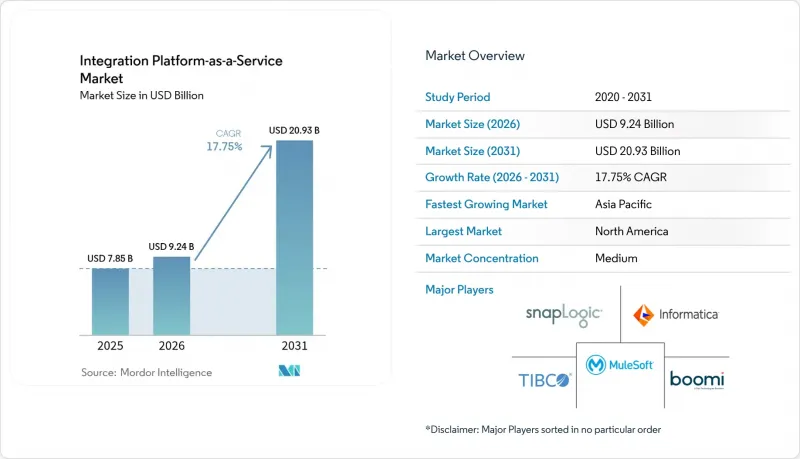
Mordor Intelligence에 의하면, IPaaS(Integration Platform-as-a-Service) 시장 규모는 2025년 78억 5,000만 달러에서 2026년에는 92억 4,000만 달러로 확대되어 2026-2031년까지 CAGR 17.75%로 성장을 지속하여, 2031년까지 209억 3,000만 달러에 이를 것으로 예측됩니다.
본 보고서는 배포 모델별(퍼블릭 클라우드, 하이브리드 클라우드, 기타), 최종 사용자 산업별(은행, 금융서비스 및 보험(BFSI), 제조업, IT 및 통신, 기타), 조직 규모별(대기업 및 중소기업(SME)), 서비스 유형별(애플리케이션 통합, 데이터/ETL 통합, 기타), 지역별로 분류되어 있습니다. 시장 예측은 금액(달러)으로 표시되어 있습니다.
세계 IPaaS(Integration Platform-as-a-Service) 시장 동향 및 인사이트
AI를 활용한 통합 및 GenAI 설계 어시스턴트
MuleSoft의 Einstein이나 SnapLogic의 SnapGPT와 같은 주요 플랫폼에 통합된 생성형 AI 덕분에, 기술에 익숙하지 않은 직원도 쉬운 언어로 흐름을 지정할 수 있게 되어 설계 주기가 몇 주에서 몇 시간으로 단축되었습니다. SnapGPT의 월간 문서 처리량은 2024년에 4조 7,000억 건에 달하여 워크로드량의 급증세를 여실히 보여주고 있습니다. 이러한 어시스턴트는 대화형 도구를 IDE에 직접 통합하는 한편, 기밀 데이터가 학습 모델을 통과할 때 거버넌스상의 과제도 발생시킵니다. 안전한 프롬프트와 엔터프라이즈 정책 제어를 모두 충족할 수 있는 제공업체는 확실한 우위를 점하게 됩니다.
API의 난립과 ‘컴포저블 엔터프라이즈’의 요구
기업들은 400개 이상의 활성 API를 관리하고 있으며, 이는 마이크로서비스 및 SaaS 도입에 따른 제품별 현황입니다. 공장 디지털화를 추진하는 제조업체들은 예측 유지보수 전략을 유지하기 위해 IoT 센서, ERP, 디지털 트윈 모델 간의 실시간 연동에 의존하고 있습니다. ‘컴포저블 비즈니스’ 설계는 특히 아시아태평양의 산업 거점에서 인기가 높으며, 이 지역 서비스 산업 리더의 75%가 2025년에 추가적인 디지털 투자를 계획하고 있어 통합 오케스트레이션 및 스트리밍 백플레인에 대한 수요를 뒷받침하고 있습니다.
하이퍼스케일러에 의한 ‘네이티브 통합’ 확대에 따른 시장 잠식
AWS AppFlow, Azure Logic Apps, Google Apigee Integration은 핵심 클라우드 서비스에 번들로 제공되어 가격 및 편의성 측면에서 독립형 벤더를 능가하고 있습니다. 기존 클라우드 계약을 보유한 중견 기업의 구매자들은 특히 표준 커넥터 이상의 고급 기능이 필요하지 않은 경우, 이러한 네이티브 옵션을 기본으로 선택하는 경우가 많습니다. 독립 벤더들은 하이퍼스케일러가 아직 따라잡지 못한 멀티클라우드 지원, 산업별 전용 커넥터, 고도화된 AI 오케스트레이션을 강조함으로써 이에 대응하고 있습니다.
부문 분석
퍼블릭 클라우드는 2025년 매출에서 70.35%를 차지하며, IPaaS(Integration Platform-as-a-Service) 시장 규모에서 가장 큰 점유율을 유지하고 있습니다. 하이브리드 클라우드는 규모는 작지만, 기업들이 클라우드의 확장성과 데이터 주권 관리를 양립함에 따라 2031년까지 연평균 성장률(CAGR) 27.35%라는 빠른 속도로 그 격차를 좁히고 있습니다. 이러한 전환 패턴은 퍼블릭 클라우드로의 완전한 오프로드를 제한하는 GAIA-X 프레임워크 및 금융·의료 분야의 부문별 규제와 상관관계가 있습니다. 독립형 공급업체들은 현재 퍼블릭 클라우드의 런타임을 재현한 사전 구축형 On-Premise 에이전트를 제공하여, 규제 대상 워크로드가 국내에 머무르면서도 공유 통합 패브릭에 참여할 수 있도록 하고 있습니다.
기업들은 기밀성이 높은 개인 식별 정보(PII)나 기업 기밀을 포함하는 워크로드를 프라이빗 코어에 할당하는 한편, 고객용 서비스에 대해서는 퍼블릭 엣지를 통해 이벤트 스트림을 오케스트레이션하는 경향이 강해지고 있습니다. 유럽의 통신 사업자들은 주권형 iPaaS 레이어를 활용하여 5G 네트워크 API를 개발자에게 안전하게 공개하고 있는 반면, 일본의 자동차 제조업체들은 고도화된 분석을 위해 생산 라인의 텔레메트리 데이터를 지역 클라우드에 미러링하고 있습니다. 이러한 하이브리드 전략이 성숙해짐에 따라, 퍼블릭 클라우드가 차지하던 IPaaS(Integration Platform-as-a-Service) 시장 점유율의 우위는 점차 축소되고 있습니다.
BFSI(은행 및 금융 및 보험) 부문은 오픈 뱅킹 API, 실시간 결제, 규정 준수 보고를 원동력으로 2025년 IPaaS(Integration Platform-as-a-Service) 시장 점유율의 21.60%를 차지했습니다. 한편, 헬스케어 및 생명과학 부문은 전자건강기록(EHR)의 상호 운용성, HL7 FHIR 의무화, 원격의료 인프라 업그레이드를 배경으로 연평균 성장률(CAGR) 29.95%라는 가장 급격한 성장을 기록하고 있습니다. 의료 서비스 제공업체는 가치 기반 의료를 지원하기 위해 임상 시스템, 청구 시스템, 분석 시스템 간의 즉각적인 데이터 동기화가 필요합니다.
대규모 병원 네트워크에서는 스트리밍형 iPaaS 노드를 도입하여 연결된 기기에서 생체 신호를 수집하고, 이를 AI 진단 모델에 공급하고 있습니다. 제약 기업의 연구개발 팀은 LIMS를 분자 시뮬레이션 엔진과 통합하여 사이클 타임을 단축하고 있습니다. BFSI(은행 및 금융 및 보험) 부문은 보안 메시징 프로토콜 및 사기 방지 이벤트 흐름에 대한 투자를 지속하고 있지만, 의료 분야의 규제 기한이 임박함에 따라 조달 결정이 가속화되고 있으며, HIPAA 준수 커넥터를 갖춘 전문 플랫폼에 대한 추가 지출이 증가하고 있습니다.
지역별 분석
2025년 북미의 매출 점유율 45.40%는 기업 내 클라우드 도입이 정착되고 iPaaS 벤더가 밀집해 있는 현상을 반영합니다. 이 지역의 매출 구성은 AI를 활용한 통합 및 멀티 클라우드 자동화에 치우쳐 있으며, 2025년 5월 Salesforce가 80억 달러에 Informatica를 인수하여 데이터 관리와 워크플로우 오케스트레이션을 융합한 것이 그 대표적인 예입니다. 금융 및 연방 정부 기관 등 규정 준수를 중시하는 부문에서는 락인 리스크를 완화하기 위해 여전히 소버린 확장 기능에 대한 검증이 진행되고 있습니다.
아시아태평양은 정부의 디지털 서비스 프로그램과 ‘인더스트리 4.0’ 지침에 따른 제조업의 근본적인 개혁에 힘입어, 2031년까지 연평균 성장률(CAGR) 23.20%로 가장 빠른 성장을 이루고 있습니다. 아시아개발은행(ADB)의 ‘디지털 개발 시설(Digital Development Facility)’은 AI 및 빅데이터 플랫폼에 대한 기술 지원을 제공함으로써, 간접적으로 견고한 통합 인프라에 대한 수요를 높이고 있습니다. 일본과 한국의 주요 전자 기업들은 스마트 팩토리의 트윈을 클라우드 분석에 연결하고 있는 반면, 아세안(ASEAN)의 디지털 ID 체계는 부처 간 API 게이트웨이에 의존하고 있습니다. 유럽에서는 기회와 제약의 균형이 잡혀 있습니다. GAIA-X는 개방형 연합형 클라우드 생태계를 추진하고 있으나, GDPR(EU 개인정보보호규정) 및 심의 중인 AI 관련 법안으로 인해 평가 주기가 장기화되고 있습니다. 남미, 중동 및 아프리카에서는 현재 수익 규모는 작지만, 모바일 보급과 핀테크 현대화가 급속히 진행되고 있어 ‘클라우드 퍼스트’ 통합에 대한 수요가 높아지고 있습니다.
기타 혜택
- 엑셀 형식 시장 예측(ME) 시트
- 3개월간의 애널리스트 지원
자주 묻는 질문
목차
제1장 서론
제2장 조사 방법
제3장 주요 요약
제4장 시장 구도
제5장 시장 규모와 성장 예측
제6장 경쟁 구도
제7장 시장 기회와 향후 전망
JHS 26.09.11According to Mordor Intelligence, the integration platform-as-a-Service market size is expected to grow from USD 7.85 billion in 2025 to USD 9.24 billion in 2026 and is forecast to reach USD 20.93 billion by 2031 at 17.75% CAGR over 2026-2031.
This report is Segmented by Deployment Mode (Public Cloud, Hybrid Cloud, and More), End-User Vertical (BFSI, Manufacturing, IT and Telecom, and More), Organization Size (Large Enterprises and Small and Mid-Size Enterprises (SME)), Service Type (Application Integration, Data / ETL Integration, and More), and Geography. The Market Forecasts are Provided in Terms of Value (USD).
Global Integration Platform-as-a-Service Market Trends and Insights
AI-augmented integration and GenAI design assistants
Generative AI inside leading platforms such as MuleSoft's Einstein and SnapLogic's SnapGPT lets non-technical staff specify flows in plain language, trimming design cycles from weeks to hours. Monthly document throughput on SnapGPT reached 4.7 trillion in 2024, underscoring surging workload volumes. These assistants bring conversational tooling directly into IDEs, yet also raise governance questions whenever sensitive data travels through learning models. Providers able to marry secure prompts with enterprise policy controls gain a clear edge.
API-sprawl and "composable enterprise" mandates
Enterprises manage 400+ active APIs, a side-effect of microservices and SaaS adoption. Manufacturers digitising factories rely on real-time links between IoT sensors, ERP and digital-twin models to sustain predictive maintenance strategies. Composable business design, especially popular across APAC industrial hubs where 75% of service leaders plan extra digital spend in 2025, drives appetite for unified orchestration and streaming backplanes.
Growing hyperscale native-integration cannibalization
AWS AppFlow, Azure Logic Apps, and Google Apigee Integration come bundled with core cloud services, undercutting standalone vendors on price and convenience. Mid-market buyers with existing cloud commitments often default to these native options, especially where feature depth beyond standard connectors is unnecessary. Independent vendors counter by emphasizing multi-cloud reach, industry-specific connectors, and advanced AI orchestration that hyperscalers do not yet match.
Other drivers and restraints analyzed in the detailed report include:
- Rise of event-stream and IoT edge integrations
- Low-/no-code integration democratization
- Vendor lock-in and switching-cost anxiety
For complete list of drivers and restraints, kindly check the Table Of Contents.
Segment Analysis
Public Cloud retains the largest slice of the Integration Platform-as-a-Service market size at a 70.35% revenue contribution in 2025. Hybrid Cloud, though smaller, is cutting the gap at a rapid 27.35% CAGR to 2031 as firms reconcile cloud elasticity with sovereign data controls. This migration pattern correlates with GAIA-X frameworks and sector rules in finance and healthcare that restrict full public-cloud offload. Independent providers now position pre-engineered on-prem agents that mirror public-cloud runtimes, letting regulated workloads participate in shared integration fabrics while remaining in the country.
Enterprises increasingly allocate sensitive PII or trade-secret workloads to private cores yet orchestrate event streams across public edges for customer-facing services. European telcos use sovereign iPaaS layers to expose 5G network APIs safely to developers, while Japanese automakers mirror production-line telemetry into regional clouds for advanced analytics. The Integration Platform-as-a-Service market share advantage of Public Cloud narrows as these hybrid playbooks mature.
BFSI captured 21.60% of Integration Platform-as-a-Service market share in 2025, powered by open-banking APIs, real-time payments and compliance reporting. Healthcare and Life Sciences, meanwhile, charts the steepest growth at 29.95% CAGR on the back of EHR interoperability, HL7 FHIR mandates and telehealth infrastructure upgrades. Providers need instant data synchronization between clinical, claims and analytics systems to support value-based care.
Large hospital networks deploy streaming iPaaS nodes to collect vitals from connected devices and feed AI diagnostic models. Pharmaceutical R&D teams integrate LIMS with molecular simulation engines to cut cycle times. BFSI continues to invest in secure message protocols and anti-fraud event flows, yet regulatory deadlines in healthcare accelerate procurement decisions, tilting incremental spending toward specialized platforms with HIPAA-grade connectors.
Complete Report Scope:
- By Deployment Model
- Public Cloud
- Private Cloud
- Hybrid Cloud
- By End-user Vertical
- BFSI
- Retail and E-commerce
- Healthcare and Life Sciences
- Manufacturing
- IT and Telecom
- Media and Entertainment
- By Organisation Size
- Large Enterprises
- Small and Mid-size Enterprises (SME)
- By Service Type
- Application Integration
- Data / ETL Integration
- API and Event Integration
- B2B / E-commerce Integration
- By Geography
- North America
- South America
- Europe
- Asia-Pacific
- Middle East and Africa
Geography Analysis
North America's 45.40% revenue share in 2025 reflects entrenched enterprise cloud adoption and a dense concentration of iPaaS vendors. The region's revenue mix tilts toward AI-augmented integration and multi-cloud automation, illustrated by Salesforce's USD 8 billion Informatica acquisition in May 2025 that fused data management with workflow orchestration. Compliance-focused sectors such as finance and federal agencies still test sovereign extensions to mitigate lock-in risk.
APAC grows fastest at 23.20% CAGR through 2031, propelled by government digital-service programs and manufacturing overhauls under Industry 4.0 charters. The Asian Development Bank's Digital Development Facility funnels technical assistance into AI and big-data platforms, indirectly raising demand for robust integration backbones. Japanese and Korean electronics giants connect smart-factory twins to cloud analytics, while ASEAN digital-ID schemes hinge on cross-agency API gateways. Europe balances opportunity and constraint: GAIA-X pushes open, federated cloud ecosystems, yet GDPR and pending AI laws prolong evaluation cycles. South America, Middle East and Africa currently register smaller revenues but show growing appetite for cloud-first integration where mobile adoption and fintech modernization are rapid.
- Salesforce (MuleSoft)
- Boomi
- Informatica
- SAP
- Oracle
- IBM
- SnapLogic
- Workato
- Microsoft (Azure Logic Apps)
- Google (Apigee Integration)
- AWS (AppFlow)
- TIBCO
- Celigo
- Jitterbit
- Talend
- Fivetran
- Tray.io
- Adeptia
- ONEiO
Additional Benefits:
- The market estimate (ME) sheet in Excel format
- 3 months of analyst support
TABLE OF CONTENTS
1 INTRODUCTION
- 1.1 Study Assumptions and Market Definition
- 1.2 Scope of the Study
2 RESEARCH METHODOLOGY
3 EXECUTIVE SUMMARY
4 MARKET LANDSCAPE
- 4.1 Market Overview
- 4.2 Market Drivers
- 4.2.1 AI-augmented integration and GenAI design assistants
- 4.2.2 API-sprawl and "composable enterprise" mandates
- 4.2.3 Rise of event-stream and IoT edge integrations
- 4.2.4 Low-/no-code integration democratisation
- 4.2.5 CSPs' marketplace bundling of iPaaS SKUs
- 4.2.6 Pay-per-flow pricing unlocking SME adoption
- 4.3 Market Restraints
- 4.3.1 Growing hyperscaler "native-integration" cannibalisation
- 4.3.2 Vendor lock-in and switching-cost anxiety
- 4.3.3 Sovereign-cloud / data-residency compliance hurdles
- 4.3.4 Scarcity of integration-literate talent in emerging markets
- 4.4 Value Chain Analysis
- 4.5 Regulatory Landscape
- 4.6 Technological Outlook
- 4.7 Porter's Five Forces Analysis
- 4.7.1 Threat of New Entrants
- 4.7.2 Bargaining Power of Buyers
- 4.7.3 Bargaining Power of Suppliers
- 4.7.4 Threat of Substitutes
- 4.7.5 Competitive Rivalry
5 MARKET SIZE AND GROWTH FORECASTS (VALUE)
- 5.1 By Deployment Model
- 5.1.1 Public Cloud
- 5.1.2 Private Cloud
- 5.1.3 Hybrid Cloud
- 5.2 By End-user Vertical
- 5.2.1 BFSI
- 5.2.2 Retail and E-commerce
- 5.2.3 Healthcare and Life Sciences
- 5.2.4 Manufacturing
- 5.2.5 IT and Telecom
- 5.2.6 Media and Entertainment
- 5.3 By Organisation Size
- 5.3.1 Large Enterprises
- 5.3.2 Small and Mid-size Enterprises (SME)
- 5.4 By Service Type
- 5.4.1 Application Integration
- 5.4.2 Data / ETL Integration
- 5.4.3 API and Event Integration
- 5.4.4 B2B / E-commerce Integration
- 5.5 By Geography
- 5.5.1 North America
- 5.5.2 South America
- 5.5.3 Europe
- 5.5.4 Asia-Pacific
- 5.5.5 Middle East and Africa
6 COMPETITIVE LANDSCAPE
- 6.1 Market Concentration
- 6.2 Strategic Moves
- 6.3 Market Share Analysis
- 6.4 Company Profiles {(includes Global level Overview, Market level overview, Core Segments, Financials as available, Strategic Information, Market Rank/Share for key companies, Products and Services, and Recent Developments)}
- 6.4.1 Salesforce (MuleSoft)
- 6.4.2 Boomi
- 6.4.3 Informatica
- 6.4.4 SAP
- 6.4.5 Oracle
- 6.4.6 IBM
- 6.4.7 SnapLogic
- 6.4.8 Workato
- 6.4.9 Microsoft (Azure Logic Apps)
- 6.4.10 Google (Apigee Integration)
- 6.4.11 AWS (AppFlow)
- 6.4.12 TIBCO
- 6.4.13 Celigo
- 6.4.14 Jitterbit
- 6.4.15 Talend
- 6.4.16 Fivetran
- 6.4.17 Tray.io
- 6.4.18 Adeptia
- 6.4.19 ONEiO
7 MARKET OPPORTUNITIES AND FUTURE OUTLOOK
- 7.1 White-space and Unmet-need Assessment