|
시장보고서
상품코드
2124393
IoT 분야 AI 시장 : 점유율 분석, 업계 동향과 통계, 성장 예측(2026-2031년)AI In IoT - Market Share Analysis, Industry Trends & Statistics, Growth Forecasts (2026 - 2031) |
||||||
 Mordor Intelligence
Mordor Intelligence에 의하면, IoT 분야 AI시장 규모는 2025년에 607억 1,000만 달러로 평가되었고 2026년 740억 4,000만 달러에서 2031년까지 1,994억 6,000만 달러에 이를 것으로 예측되며, 예측 기간(2026-2031년) CAGR은 21.95%를 나타낼 전망입니다.
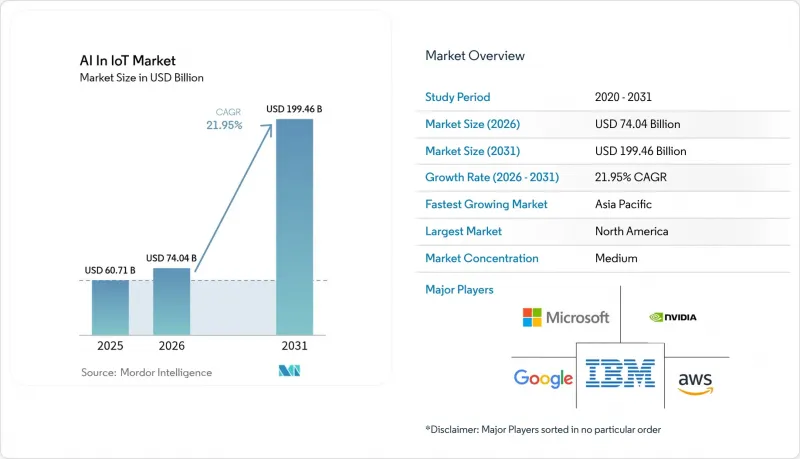
본 보고서는 구성 요소별(소프트웨어 및 서비스), 배포 방식별(On-Premise 및 클라우드), 기술별(머신러닝 및 딥러닝, 자연어 처리, 기타), IoT 연결 방식별(셀룰러, LPWAN, 기타), 최종 사용자 산업별(제조업, 에너지·유틸리티, 기타),지역별로 분류되어 있습니다.
전 세계 IoT 분야 AI 시장 동향 및 인사이트
연결 기기에서 생성되는 빅데이터 양 증가
2025년에는 IoT 엔드포인트가 약 80제타바이트의 데이터를 생성할 것으로 예상되며, 그중 산업용 센서가 73.1제타바이트를 차지할 것으로 전망됩니다. 이 방대한 데이터를 클라우드만으로 처리할 경우 대역폭 예산에 부담이 가중되므로, 제조업체들은 현장에서 데이터 스트림을 압축·분석하는 엣지 AI를 도입하여 네트워크 비용을 절감하는 동시에, 품질 관리에서 1초 미만의 응답 목표치를 달성하고 있습니다. 선도적으로 도입한 기업들로부터는 중요한 분석 기능을 생산 라인에 통합된 스마트 컨트롤러로 이전한 결과, 생산성이 두 자릿수 향상되었습니다는 보고가 접수되고 있습니다. 이러한 추세는 물류 허브 및 공공 서비스 부문으로도 확산되고 있으며, 현장에서의 추론 처리를 통해 원시 센서 데이터의 백홀 전송에 소요되는 고액의 비용을 절감하고 있습니다.
IoT 데이터를 수익화하기 위한 실시간 AI 분석에 대한 수요
소매 은행, 전력 트레이더, 도시 교통 사업자들은 1초의 지연이 발생할 때마다 인사이트의 가치가 상실된다고 지적하고 있습니다. 현재 도입의 초점은 실시간 센서 측정값을 즉각적인 가격 최적화, 채널 변경 또는 안전 경보로 변환하여 수익을 직접 향상시키거나 벌금을 줄이는 데 맞추어져 있습니다. 게이트웨이에 내장된 생성형 알고리즘은 창고 직원에게 지시를 내리고, 로봇의 경로를 조정하며, 재고를 미세 조정하는 작업을 며칠이 아닌 몇 분 만에 수행하고 있습니다. 시간적 제약이 있는 수익화에 중점을 두면서, 선진국 전반에 걸쳐 엣지 AI 플랫폼의 파일럿 단계에서 운영 환경으로의 전환 주기가 가속화되고 있습니다.
이종 혼합 IoT 노드에서의 데이터 보안 및 개인정보 보호 취약점
장치의 기능이 다양하기 때문에 공격자가 악용할 수 있는 ‘가장 취약한 고리’가 되는 취약점이 발생하고 있습니다. ScienceDirect의 리뷰에 따르면, 레거시 센서에는 보안 부팅이나 하드웨어 기반 신뢰의 근원(Root of Trust)이 결여된 경우가 많아, AI 모델이 변조 위험에 노출되어 있습니다. EU의 ‘인공지능법’은 위험 감사와 암호화 업그레이드를 의무화하고 있어, 규정 준수 대응으로 인한 지연과 예산 초과를 초래하고 있습니다. 벤더들은 제로 트러스트 프레임워크나 기기 내 이상 감지를 통해 대응하고 있지만, 수백만 대가 넘는 자산군에서 수명 주기 전반에 걸친 패치 적용은 여전히 어려운 과제로 남아 있습니다.
부문 분석
2025년에는 소프트웨어가 매출의 67.88%를 차지하며, 알고리즘, 미들웨어, 분석 엔진이 IoT 분야 AI 시장의 가치 창출 대부분을 주도하고 있는 것으로 확인되었습니다. 기업들이 모델 튜닝, 기기 온보딩, 라이프사이클 모니터링을 외부에 위탁함에 따라 서비스 부문은 연평균 성장률(CAGR) 23.6%로 확대되고 있습니다. 이러한 급속한 성장에 힘입어 스트리밍 분석, 엣지 오케스트레이션, 제로 트러스트 보안을 통합한 하이퍼스케일 플랫폼을 중심으로 한 생태계 통합이 진행되고 있습니다. 기업들이 관리된 가동 시간 보장을 우선시함에 따라, 서비스 연동형 제품의 IoT 분야 AI 시장 규모는 급속히 확대될 것으로 전망됩니다. 한편, 특수 추론 엔진의 라이선싱 모델은 영구 라이선스 비용에서 기기 수에 따른 구독 번들로 전환되고 있으며, 이로 인해 예산 관리는 원활해지지만 고객은 벤더의 로드맵에 얽매이게 됩니다.
2세대 용도 관리 제품군에서는 컨셉 드리프트에 기반한 모델 재훈련이 자동화되는 한편, 디바이스 관리 포털에서는 다운타임을 최소화하는 차등 업데이트가 제공되고 있습니다. 보안 계층은 더욱 고도화되어, 전체 디바이스 군의 이상 현상을 상호 연관 짓는 자동 위협 감지 기능이 추가되었습니다. 이러한 동향으로 인해 하드웨어에 의존하지 않는 아키텍처가 촉진되어, 고객은 분석 파이프라인을 재작성하지 않고도 서로 다른 브랜드의 게이트웨이를 혼합하여 사용할 수 있게 됩니다. 상용 오픈소스 코어와 독자적인 최적화 라이브러리를 결합함으로써 투명성과 성능의 균형을 맞추고, 엄격한 감사 요건도 충족됩니다.
2025년에는 제조업체와 병원이 기밀 데이터를 보호하고 결정론적 지연 시간을 보장하기 위해 On-Premise 배포의 점유율이 70.65%를 차지했습니다. 그럼에도 클라우드 워크로드는 연평균 성장률(CAGR) 23.9%로 더 빠르게 확대되고 있으며, 이는 로컬 추론을 통해 익명화된 요약 정보를 클라우드 클러스터로 전송하여 대규모 훈련 작업을 수행하는 하이브리드 모델로의 전환을 반영합니다. IoT 분야 AI는 기업이 개인을 식별할 수 있는 데이터를 규제 대상 시설 내에 보관하면서도, 계절별 재훈련에는 하이퍼스케일 지역의 탄력적인 그래픽스 처리를 활용함으로써 이점을 얻습니다. 이러한 2계층 토폴로지를 통해 규정 준수 목표를 유지하면서 로컬 서버에 대한 자본 투자를 줄일 수 있습니다.
엣지 게이트웨이에서는 오케스트레이션을 위해 퍼블릭 클라우드에 안전하게 연결되는 컨테이너화된 마이크로서비스가 점점 더 많이 호스팅되고 있습니다. 이 구성을 통해 사업자는 생산 라인을 중단하지 않고도 매일 밤 비전 모델을 업데이트할 수 있습니다. 금융 서비스 기업들도 유사한 모델을 채택하고 있으며, 개별 거래 내역은 On-Premise에 저장하는 한편, 집계된 동향을 분석하기 위해 클라우드상의 대규모 언어 모델을 활용하고 있습니다. 클라우드 제공업체는 퍼블릭 인터넷을 거치지 않고 하드웨어 기반의 기밀 컴퓨팅 엔클레이브를 제공하는 ‘프라이빗 링크’ 서비스를 통해 이러한 전환을 뒷받침하고 있습니다.
지역별 분석
북미는 견실한 벤처 자금, 광범위한 5G 구축, 유리한 지적 재산권 제도의 뒷받침을 받아 2025년에는 매출의 41.60%를 차지했습니다. AWS만 해도 2025년에 새로운 AI 인프라에 1,000억 달러 이상을 예산으로 편성하여, 고객이 고성능 컴퓨팅에 원활하게 접근할 수 있도록 보장하고 있습니다. 스마트 항구 및 국방 프로젝트를 신속하게 추진하는 연방 정부의 프로그램도 수요를 더욱 자극하고 있습니다. 임금 상승과 인력 부족으로 인해 신흥 시장에 비해 이 지역의 성장률은 억제되고 있습니다.
아시아태평양은 2031년까지 연평균 성장률(CAGR)이 23.0%로 가장 높습니다. 중국 벤더들은 기기의 반도체부터 클라우드 대시보드에 이르기까지 수직 통합을 통해 비용을 절감하고 제품 개선 주기를 가속화하고 있습니다. 일본과 한국은 세계 최고 수준의 로봇 기술과 전국을 아우르는 고밀도 5G 네트워크를 결합하여 실시간 산업용 비전 기술을 상용화하고 있습니다. 인도에서 인도네시아에 이르기까지, 정부가 자금을 지원하는 스마트 시티 계획에서는 교통 모니터링, 폐기물 분리 수거, 홍수 경보 시스템을 구축하는 스타트업 기업에 보조금이 투입되고 있습니다. 아시아태평양의 IoT 분야 AI 시장 규모는 평균 판매 가격이 여전히 낮은 편이지만, 판매 대수 면에서는 다른 지역을 앞지르고 있습니다.
유럽에서는 ‘인공지능법’에 따라 의무 사항이 명확해지고 규정 준수 절차가 늘어난 반면, 자본 예산 확보가 가능해지면서 꾸준한 진전이 나타나고 있습니다. 독일은 자동차 생산 라인에서의 예측 유지보수를 주도하고 있는 반면, 네덜란드에서는 운하 수위 제어를 위한 엣지 AI 시범 운영이 진행되고 있습니다. 데이터 주권에 관한 규제로 인해 기업들은 On-Premise 및 엣지 환경 도입을 강요받고 있으며, 이로 인해 기밀 계산용 프로세서에 대한 수요가 자극되고 있습니다. 중동 및 아프리카에서는 유전 모니터링 및 스마트 관개 부문에서 초기 진전이 나타나고 있으며, 지상 네트워크의 커버리지가 제한된 지역에서도 위성 백홀을 통해 이러한 과제를 해결하고 있습니다. 현지 숙련 인력 양성이 진행되고 있는 가운데, 도입 속도는 완만한 양상을 보이고 있습니다.
기타 혜택
- 엑셀 형식 시장 예측(ME) 시트
- 3개월간 애널리스트 지원
자주 묻는 질문
목차
제1장 서론
제2장 조사 방법
제3장 주요 요약
제4장 시장 구도
제5장 시장 규모와 성장 예측
제6장 경쟁 구도
제7장 시장 기회와 향후 전망
JHS 26.09.11According to Mordor Intelligence, the AI in IoT market size was valued at USD 60.71 billion in 2025 and estimated to grow from USD 74.04 billion in 2026 to reach USD 199.46 billion by 2031, at a CAGR of 21.95% during the forecast period (2026-2031).
This report is Segmented by Component (Software and Services), Deployment Mode (On-Premises and Cloud), Technology (Machine Learning and Deep Learning, Natural Language Processing, and More), Iot Connectivity Type (Cellular, LPWAN, and More), End-User Vertical (Manufacturing, Energy and Utilities, and More), and Geography.
Global AI In IoT Market Trends and Insights
Rising Big-Data Volumes Generated by Connected Devices
IoT end-points will create about 80 zettabytes of data in 2025, with industrial sensors contributing 73.1 zettabytes. Processing this torrent in the cloud alone strains bandwidth budgets, so manufacturers are adopting edge AI that compresses and analyses streams on-site, trimming network costs and meeting sub-second response targets for quality control. Early movers report double-digit productivity gains after shifting critical analytics to smart controllers embedded in production lines. The pattern is spreading across logistics hubs and utilities where local inference prevents expensive back-haul of raw sensor feeds.
Demand for Real-Time AI Analytics to Monetise IoT Data
Retail banks, power traders and city transit operators note that insight loses value with every second of delay. Deployments now focus on turning live sensor readings into instant price optimisation, routing changes or safety alerts that directly lift revenue or cut penalties. Generative algorithms embedded on gateways are guiding warehouse staff, adjusting robotic paths and fine-tuning inventory in minutes instead of days. The emphasis on time-sensitive monetisation is accelerating pilot-to-production cycles for edge AI platforms across developed economies.
Data-Security and Privacy Gaps Across Heterogeneous IoT Nodes
Diverse device capabilities leave weakest-link gaps that adversaries exploit. A ScienceDirect review shows legacy sensors often lack secure boot or hardware roots of trust, exposing AI models to tampering. The EU Artificial Intelligence Act compels risk audits and encryption upgrades, adding compliance delays and budget overruns. Vendors respond with zero-trust frameworks and on-device anomaly detection, yet lifecycle patching remains arduous for fleets exceeding millions of assets.
Other drivers and restraints analyzed in the detailed report include:
- Edge-AI Chipsets Lowering Latency and Energy Use
- 5G-NTN Convergence Unlocking Remote AIoT Deployments
- Scarcity of AIoT-Skilled Talent and High Integration Costs
For complete list of drivers and restraints, kindly check the Table Of Contents.
Segment Analysis
Software commanded 67.88% revenue in 2025, confirming that algorithms, middleware, and analytics engines drive most value creation within the AI in IoT market. Services expand at a 23.6% CAGR because enterprises outsource model tuning, device onboarding, and lifecycle monitoring. This surge fosters ecosystem consolidation around hyperscale platforms that bundle streaming analytics, edge orchestration, and zero-trust security. The AI in IoT market size for services-linked offerings is projected to expand quickly as companies prioritise managed uptime commitments. Meanwhile, licensing models for specialised inference engines are shifting toward subscription bundles aligned with device counts rather than perpetual fees, smoothing budgets yet locking customers into vendor roadmaps.
Second-generation application-management suites now automate model retraining based on concept drift while device-management portals push differential updates that limit downtime. Security layers grow more sophisticated, adding automated threat hunting that cross-correlates anomalies across fleets. These trends encourage hardware-agnostic architectures so customers can mix gateway brands without rewriting analytics pipelines. Commercial open-source cores joined with proprietary optimisation libraries balance transparency with performance, meeting stringent audit requirements.
On-premises deployments held a 70.65% share in 2025 because manufacturers and hospitals safeguard sensitive data and guarantee deterministic latency. Still, cloud workloads scale faster at 23.9% CAGR, reflecting a swing toward hybrid patterns where local inference feeds anonymised summaries to cloud clusters for heavy training tasks. The AI in IoT market benefits when enterprises keep personally identifiable data inside regulated facilities, yet exploit elastic graphics processing in hyperscale regions for seasonal retraining. Such dual-tier topologies reduce capital expense on local servers while preserving compliance objectives.
Edge gateways increasingly host containerised microservices that tunnel securely to public clouds for orchestration. This set-up lets operators update vision models nightly without halting production lines. Financial services firms adopt similar blueprints, storing individual transaction details on-site but leveraging cloud-resident large-language models to analyse aggregate trends. Cloud providers encourage the shift with private-link offerings that avoid the public internet and supply hardware-rooted confidential-computing enclaves.
Complete Report Scope:
- By Component
- Software
- Application Management
- Connectivity Management
- Device Management
- Data Management
- Network Bandwidth Management
- Real-time Streaming Analytics
- Remote Monitoring
- Security
- Edge Solution
- Services
- Managed Services
- Professional Services
- Software
- By Deployment Mode
- On-premises
- Cloud
- By Technology
- Machine Learning and Deep Learning
- Natural Language Processing
- Computer Vision
- Context-Aware Computing
- By IoT Connectivity Type
- Cellular (2G-5G)
- LPWAN (LoRa, NB-IoT, Sigfox)
- Satellite / NTN
- Short-range (Wi-Fi, BLE, Zigbee)
- By End-user Vertical
- Manufacturing
- Energy and Utilities
- Healthcare
- BFSI
- IT and Telecom
- Transportation and Mobility
- Government
- Retail and e-Commerce
- Agriculture
- By Geography
- North America
- United States
- Canada
- Mexico
- Europe
- Germany
- United Kingdom
- France
- Italy
- Spain
- Russia
- Rest of Europe
- Asia-Pacific
- China
- Japan
- India
- South Korea
- ASEAN
- Australia and New Zealand
- Rest of Asia-Pacific
- South America
- Brazil
- Argentina
- Rest of South America
- Middle East and Africa
- Middle East
- Saudi Arabia
- UAE
- Turkey
- Rest of Middle East
- Africa
- South Africa
- Nigeria
- Rest of Africa
- Middle East
- North America
Geography Analysis
North America controlled 41.60% of revenue in 2025, powered by robust venture backing, extensive 5G roll-outs, and favourable intellectual property regimes. AWS alone budgeted more than USD 100 billion for new AI infrastructure in 2025, ensuring customers have low-friction access to high-performance compute. Federal programmes that fast-track smart port and defence projects further stimulate demand. Nevertheless, wage inflation and talent shortages temper the regional growth rate compared with emerging markets.
Asia-Pacific records the highest 23.0% CAGR through 2031. Chinese vendors integrate vertically from device silicon to cloud dashboards, compressing costs and accelerating iteration cycles. Japan and South Korea pair world-class robotics with dense nationwide 5G to commercialise real-time industrial vision. Government-funded smart-city schemes from India to Indonesia channel subsidies toward start-ups building traffic-monitoring, waste-sorting, and flood-alert systems. The AI in IoT market size for Asia-Pacific eclipses other regions in unit volumes, even though average selling prices remain lower.
Europe advances steadily as the Artificial Intelligence Act clarifies obligations and unlocks capital budgets despite adding compliance steps. Germany spearheads predictive maintenance in automotive lines, while the Netherlands pilots edge AI to control canal water levels. Data-sovereignty rules push enterprises to adopt on-premises and edge configurations, stimulating demand for confidential-computing processors. Middle East and Africa see early traction in oil-field surveillance and smart irrigation, where satellite backhaul circumvents sparse terrestrial coverage. Implementation pace is modest while local skills pipelines build up.
- Amazon Web Services
- Microsoft
- IBM
- Oracle
- Cisco Systems
- NVIDIA
- Siemens
- Bosch.IO
- ARM
- Qualcomm
- Intel
- Huawei
- Schneider Electric
- Honeywell
- PTC
- SAS Institute
- General Electric
- Hitachi
- Salesforce
Additional Benefits:
- The market estimate (ME) sheet in Excel format
- 3 months of analyst support
TABLE OF CONTENTS
1 INTRODUCTION
- 1.1 Study Assumptions and Market Definition
- 1.2 Scope of the Study
2 RESEARCH METHODOLOGY
3 EXECUTIVE SUMMARY
4 MARKET LANDSCAPE
- 4.1 Market Overview
- 4.2 Market Drivers
- 4.2.1 Rising big-data volumes generated by connected devices
- 4.2.2 Demand for real-time AI analytics to monetize IoT data
- 4.2.3 Edge-AI chipsets lowering latency and energy use
- 4.2.4 5G-NTN convergence unlocking remote AIoT deployments
- 4.2.5 Sustainability-linked regulations driving AI-optimised energy use
- 4.2.6 Predictive-maintenance push for supply-chain resilience
- 4.3 Market Restraints
- 4.3.1 Data-security and privacy gaps across heterogeneous IoT nodes
- 4.3.2 Scarcity of AIoT-skilled talent and high integration costs
- 4.3.3 Fragmented standards limiting model portability
- 4.3.4 Looming post-quantum threats to device cryptography
- 4.4 Value Chain Analysis
- 4.5 Regulatory Landscape
- 4.6 Technological Outlook
- 4.7 Porter's Five Forces Analysis
- 4.7.1 Bargaining Power of Suppliers
- 4.7.2 Bargaining Power of Buyers
- 4.7.3 Threat of New Entrants
- 4.7.4 Threat of Substitutes
- 4.7.5 Intensity of Competitive Rivalry
- 4.8 Assessment of the Impact of Macroeconomic Trends on the Market
5 MARKET SIZE AND GROWTH FORECASTS (VALUE)
- 5.1 By Component
- 5.1.1 Software
- 5.1.1.1 Application Management
- 5.1.1.2 Connectivity Management
- 5.1.1.3 Device Management
- 5.1.1.4 Data Management
- 5.1.1.5 Network Bandwidth Management
- 5.1.1.6 Real-time Streaming Analytics
- 5.1.1.7 Remote Monitoring
- 5.1.1.8 Security
- 5.1.1.9 Edge Solution
- 5.1.2 Services
- 5.1.2.1 Managed Services
- 5.1.2.2 Professional Services
- 5.1.1 Software
- 5.2 By Deployment Mode
- 5.2.1 On-premises
- 5.2.2 Cloud
- 5.3 By Technology
- 5.3.1 Machine Learning and Deep Learning
- 5.3.2 Natural Language Processing
- 5.3.3 Computer Vision
- 5.3.4 Context-Aware Computing
- 5.4 By IoT Connectivity Type
- 5.4.1 Cellular (2G-5G)
- 5.4.2 LPWAN (LoRa, NB-IoT, Sigfox)
- 5.4.3 Satellite / NTN
- 5.4.4 Short-range (Wi-Fi, BLE, Zigbee)
- 5.5 By End-user Vertical
- 5.5.1 Manufacturing
- 5.5.2 Energy and Utilities
- 5.5.3 Healthcare
- 5.5.4 BFSI
- 5.5.5 IT and Telecom
- 5.5.6 Transportation and Mobility
- 5.5.7 Government
- 5.5.8 Retail and e-Commerce
- 5.5.9 Agriculture
- 5.6 By Geography
- 5.6.1 North America
- 5.6.1.1 United States
- 5.6.1.2 Canada
- 5.6.1.3 Mexico
- 5.6.2 Europe
- 5.6.2.1 Germany
- 5.6.2.2 United Kingdom
- 5.6.2.3 France
- 5.6.2.4 Italy
- 5.6.2.5 Spain
- 5.6.2.6 Russia
- 5.6.2.7 Rest of Europe
- 5.6.3 Asia-Pacific
- 5.6.3.1 China
- 5.6.3.2 Japan
- 5.6.3.3 India
- 5.6.3.4 South Korea
- 5.6.3.5 ASEAN
- 5.6.3.6 Australia and New Zealand
- 5.6.3.7 Rest of Asia-Pacific
- 5.6.4 South America
- 5.6.4.1 Brazil
- 5.6.4.2 Argentina
- 5.6.4.3 Rest of South America
- 5.6.5 Middle East and Africa
- 5.6.5.1 Middle East
- 5.6.5.1.1 Saudi Arabia
- 5.6.5.1.2 UAE
- 5.6.5.1.3 Turkey
- 5.6.5.1.4 Rest of Middle East
- 5.6.5.2 Africa
- 5.6.5.2.1 South Africa
- 5.6.5.2.2 Nigeria
- 5.6.5.2.3 Rest of Africa
- 5.6.5.1 Middle East
- 5.6.1 North America
6 COMPETITIVE LANDSCAPE
- 6.1 Market Concentration
- 6.2 Strategic Moves
- 6.3 Market Share Analysis
- 6.4 Company Profiles (includes Global level Overview, Market level overview, Core Segments, Financials as available, Strategic Information, Market Rank/Share for key companies, Products and Services, and Recent Developments)
- 6.4.1 Amazon Web Services
- 6.4.2 Microsoft
- 6.4.3 IBM
- 6.4.4 Google
- 6.4.5 Oracle
- 6.4.6 Cisco Systems
- 6.4.7 NVIDIA
- 6.4.8 Siemens
- 6.4.9 Bosch.IO
- 6.4.10 ARM
- 6.4.11 Qualcomm
- 6.4.12 Intel
- 6.4.13 Huawei
- 6.4.14 Schneider Electric
- 6.4.15 Honeywell
- 6.4.16 PTC
- 6.4.17 SAS Institute
- 6.4.18 General Electric
- 6.4.19 Hitachi
- 6.4.20 Salesforce
7 MARKET OPPORTUNITIES AND FUTURE OUTLOOK
- 7.1 White-space and Unmet-Need Assessment