|
시장보고서
상품코드
2124398
신속 애플리케이션 개발 시장 : 점유율 분석, 업계 동향과 통계, 성장 예측(2026-2031년)Rapid Application Development - Market Share Analysis, Industry Trends & Statistics, Growth Forecasts (2026 - 2031) |
||||||
 Mordor Intelligence
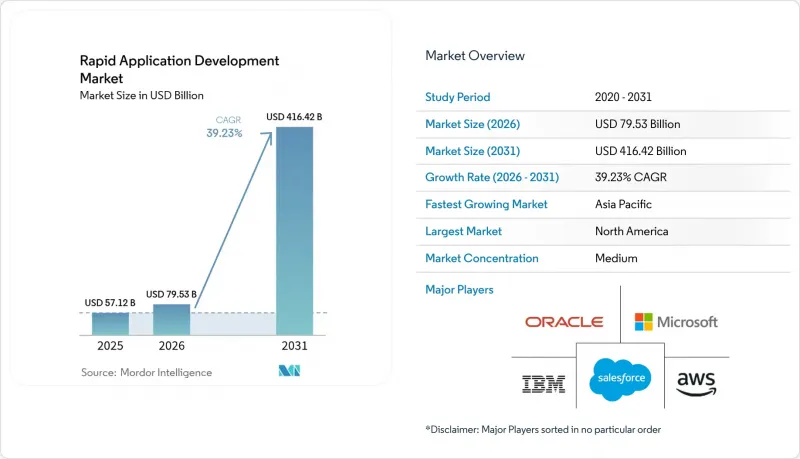
Mordor Intelligence에 의하면, 신속 애플리케이션 개발 시장 규모는 2025년에 571억 2,000만 달러로 평가되었고 2026년 795억 3,000만 달러에서 성장할 것으로 예측 기간(2026-2031년) CAGR 39.23%로 성장을 지속하여, 2031년에는 4,164억 2,000만 달러에 이를 것으로 추정되고 있습니다.
본 보고서는 유형별(로우코드 개발 플랫폼, 노코드 개발 플랫폼), 배포 방식별(On-Premise, 클라우드), 조직 규모별(중소기업, 대기업), 최종 사용자 산업별(소매 및 전자상거래, 정보 기술, 에너지·유틸리티, 제조업, 기타), 지역별로 분류되어 있습니다. 시장 예측은 금액(달러)으로 표시되어 있습니다.
세계 신속 애플리케이션 개발(RAD) 시장 동향 및 인사이트
비즈니스 혁신과 첨단 기술의 통합
기업들은 마이크로서비스, 이벤트 주도형 아키텍처, 서버리스 컴퓨팅으로 전환하고 있으며, RAD 플랫폼도 비주얼 커넥터를 통해 이러한 구성 요소를 통합할 수 있도록 진화하고 있습니다. ServiceNow와 Appian은 워크플로우 엔진의 프로비저닝 시간을 며칠에서 몇 분으로 단축하는 사전 구축된 마이크로서비스 템플릿을 제공합니다. 제조업체들은 Siemens Mendix를 활용하여 IoT 센서 데이터를 네트워크 에지에서 작동하는 로우코드 대시보드와 융합함으로써 예측 유지보수 이용 사례를 실현하고 있습니다. 이러한 통합을 통해 선언적 모델 뒤에 숨겨진 복잡한 인프라를 추상화함으로써 기술적 부채를 경감하는 동시에, 전략이 성숙해짐에 따라 애플리케이션이 클라우드에 종속되지 않도록 보장합니다. 도입이 가장 활발한 지역은 북미와 유럽이며, 이곳에서는 5G의 확산과 성숙한 DevOps 문화가 지속적인 개선 주기를 뒷받침하고 있습니다.
소프트웨어 개발자 부족을 배경으로 높아지는 로우코드 플랫폼에 대한 수요
미국 노동통계국은 2024년, 소프트웨어 개발자 고용이 2022년부터 2032년까지 25% 증가하여 공급 증가율을 상회할 것으로 예측했습니다. 로우코드 도구는 비즈니스 분석가가 드래그 앤 드롭 방식의 인터페이스를 통해 웹 앱이나 모바일 앱을 구축할 수 있도록 함으로써 이러한 부족 현상을 완화하고, 시니어 엔지니어가 핵심 알고리즘에 집중할 수 있도록 지원합니다. OutSystems의 조사에 따르면, 74%의 조직이 향후 1년 동안 최소 10개의 애플리케이션을 로우코드로 제공할 계획이며, 그중 31%는 제공 속도를 높이기 위해 내장형 AI를 활용하고 있습니다. JPMorgan Chase와 같은 금융 기관은 Appian을 도입한 후 대출 심사 주기를 18개월에서 6주로 단축했습니다. 2024년에는 개발자 임금 상승률이 15%를 넘어서면서 운영 예산에 대한 압박이 커졌고, 제한된 인력을 최대한 활용하기 위한 ‘시민 개발자(Citizen Developer)’ 프로그램에 대한 수요가 높아졌습니다.
규제가 엄격한 산업에서의 보안 및 데이터 거버넌스 우려
금융 서비스 및 의료 기관은 감사 추적, 암호화, 데이터 거주에 관한 엄격한 요구 사항에 직면해 있지만, 많은 RAD 플랫폼이 이를 지원하기 시작한 것은 아주 최근의 일입니다. Open Web Application Security Project(OWASP)는 일반 사용자가 구축한 앱에서 발생하는 ‘안전하지 않은 직접 객체 참조’와 같은 일반적인 취약점을 보고하고 있습니다. 도이치은행은 공급업체가 SOC 2 Type II 및 ISO 27001 인증을 획득할 때까지 로우코드 사용을 고객 대응 이외의 워크플로우로 제한했습니다. 의료 기관은 기본 권한 설정에서 HIPAA 준수 미비점을 지적하여, 프로덕션 환경으로의 출시가 지연되었습니다. GDPR(EU 개인정보보호규정)과 같은 더 엄격한 프레임워크에서는 지역별 데이터센터가 요구되며, Betty Blocks와 같은 벤더는 유럽 고객을 위해 프랑크푸르트에 시설을 개설하기에 이르렀습니다. 플랫폼이 기본적으로 종단 간 거버넌스를 제공할 수 있게 될 때까지는 규제가 엄격한 업종에서의 도입이 규제가 완화된 산업에 비해 뒤처질 것으로 보입니다.
부문 분석
2025년, 로우코드 플랫폼은 신속 애플리케이션 개발 시장에서 63.70%의 시장 점유율을 차지했습니다. 이를 주도한 것은 드래그 앤 드롭 방식의 설계와 성능이 중요한 경로를 위한 선택적 사용자 정의 코드를 결합한 Microsoft Power Platform과 OutSystems였습니다. 노코드 플랫폼은 비즈니스 사용자가 IT 부서의 개입 없이 Airtable이나 Quickbase를 활용하여 승인 워크플로우와 대시보드를 구축함에 따라 2031년까지 연평균 성장률(CAGR) 41.20%를 나타낼 것으로 예측됩니다. 이러한 추세는 IT 부서가 전사적 시스템에 대한 감독 권한을 유지하면서도, 부서 내 생산성 향상을 위한 시각적 도구에 대한 신뢰가 높아지고 있음을 보여줍니다.
노코드(No-code)의 성장은 로우코드(Low-code)를 대체하는 것이 아니라 이를 보완하는 것입니다. 각 부서에서는 신속한 프로토타이핑을 위해 노코드를 시험적으로 사용한 후, 사용자 수가 증가하거나 실시간 데이터 동기화가 필요해지는 단계에서 로우코드로 전환하는 경우가 많습니다. 이러한 상호 작용을 통해 도구의 복잡성을 워크로드 요구 사항에 맞추게 됨으로써, 신속 애플리케이션 개발 시장이 확대되고 다양한 기술 역량을 가진 사용자층에서 더 광범위한 채택이 촉진될 것입니다.
2025년에는 클라우드 도입이 매출의 73.15%를 차지하며, 2031년까지 연평균 성장률(CAGR) 40.95%로 확대되어 신규 워크로드와 마이그레이션 모두를 확보할 것으로 전망됩니다. 통합된 ID 관리, 종량제 과금, 실시간 협업을 통해 클라우드 플랫폼은 On-Premise형 솔루션에 비해 결정적인 우위를 차지합니다.
On-Premise형 솔루션은 데이터 주권이나 에어갭 네트워크가 필수적인 경우, 예를 들어 국방 시설이나 일부 금융 기관 등에서 여전히 사용되고 있습니다. Oracle APEX나 하이브리드형 OutSystems 스택은 이러한 요구를 충족시키고 있지만, 총 소유 비용(TCO)은 클라우드 기반 솔루션보다 여전히 높습니다. 규제 준수 체계가 발전함에 따라 점점 더 많은 사용자가 클라우드로 전환하고 있으며, 이로 인해 신속 애플리케이션 개발 시장의 주요 성장 동력으로서 클라우드의 입지가 더욱 공고해지고 있습니다.
지역별 분석
북미는 성숙한 IT 예산과 시민 개발자 프로그램의 보급에 힘입어 2025년 매출의 38.90%를 차지했습니다. Microsoft, Salesforce, ServiceNow는 도입 파트너로 구성된 광범위한 생태계를 활용하고 있어, 포춘 500대 기업이 플랫폼을 도입하기가 용이해졌습니다. 캐나다 공공 부문에서는 현지 데이터 저장 관련 법규를 준수하면서 레거시 시스템을 개편하기 위해 RAD가 도입되었습니다. 멕시코의 제조 공장에서는 AWS Honeycode를 기반으로 한 공급업체용 포털을 미국 파트너와 공유하고 있어, 국경을 넘는 워크플로우의 디지털화가 진행되고 있음을 알 수 있습니다.
아시아태평양은 2031년까지 연평균 성장률(CAGR) 41.95%를 나타낼 것으로 예측되며, 지역별로는 가장 높은 성장 속도를 보이고 있습니다. 인도의 ‘디지털 인디아(Digital India)’ 이니셔티브와 중국의 ‘제14차 5개년 계획’은 현지 기업들에게 맞춤형 코딩 시간을 최소화하도록 장려하고 있으며, 이는 Zoho Creator 및 Alibaba Cloud의 로우코드 제품군의 보급을 뒷받침하고 있습니다. 일본에서는 노동력 고령화에 따른 개발자 부족을 보완하기 위해 RAD(신속 애플리케이션 개발)가 활용되고 있습니다. 한편, 호주의 은행에서는 오픈 뱅킹 요건을 준수하기 위해 로우코드가 도입되고 있습니다. 중국의 ‘개인정보보호법(PIPL)’ 등 현지 데이터 보호 규제로 인해 벤더들은 지역별 데이터센터 구축을 피할 수 없게 되었지만, 이러한 투자는 다양한 시장의 잠재적 수요를 확대하는 결과로 이어지고 있습니다.
유럽, 남미, 중동 및 아프리카는 꾸준히 기여하고 있습니다. GDPR(EU 개인정보보호규정) 준수로 인해 보안 기능에 대한 요구 수준이 높아지면서 규제가 엄격한 부문에서의 도입은 둔화되고 있는 반면, 견고한 감사 로그와 국내 호스팅을 갖춘 플랫폼에 대한 수요는 가속화되고 있습니다. 브라질의 중소기업들은 수익 변동성에 대응할 수 있는 구독형 RAD 도구를 선호합니다. 걸프협력회의(GCC) 회원국들은 ServiceNow 및 OutSystems를 기반으로 한 전자정부 프로그램에 자금을 지원하고 있으며, 케냐의 스타트업 기업들은 모바일 우선 RAD 제품군을 활용하여 데스크톱 개발 단계를 건너뛰고 있습니다.
기타 혜택
- 엑셀 형식 시장 예측(ME) 시트
- 3개월간의 애널리스트 지원
자주 묻는 질문
목차
제1장 서론
제2장 조사 방법
제3장 주요 요약
제4장 시장 구도
제5장 시장 규모와 성장 예측
제6장 경쟁 구도
제7장 시장 기회와 향후 전망
JHSAccording to Mordor Intelligence, the rapid application development market size was valued at USD 57.12 billion in 2025 and estimated to grow from USD 79.53 billion in 2026 to reach USD 416.42 billion by 2031, at a CAGR of 39.23% during the forecast period (2026-2031).
This report is Segmented by Type (Low-Code Development Platforms, No-Code Development Platforms), Deployment Mode (On-Premise, Cloud), Organization Size (Small and Medium Enterprises, Large Enterprises), End-User Industry (Retail and E-Commerce, Information Technology, Energy and Utilities, Manufacturing, and More), and Geography. The Market Forecasts are Provided in Terms of Value (USD).
Global Rapid Application Development Market Trends and Insights
Innovation in Businesses and Integration of Advanced Technologies
Enterprises are pivoting to microservices, event-driven architectures, and serverless compute, and RAD platforms have evolved to integrate these components through visual connectors. ServiceNow and Appian expose pre-built microservice templates that shorten provisioning time for workflow engines from days to minutes. Manufacturers exploit Siemens Mendix to fuse IoT sensor data with low-code dashboards that run at the network edge, unlocking predictive maintenance use cases. These integrations reduce technical debt by abstracting complex infrastructure behind declarative models, while ensuring that applications remain cloud-agnostic as strategies mature. Adoption is most advanced in North America and Europe, where 5G rollouts and mature DevOps cultures support continuous improvement cycles.
Rising Demand for Low-Code Platforms Amid Software-Developer Shortages
The United States Bureau of Labor Statistics projected in 2024 that software developer employment would grow 25% from 2022 to 2032, outpacing supply growth. Low-code tools mitigate the shortfall by enabling business analysts to build web and mobile apps through drag-and-drop interfaces, freeing senior engineers to focus on core algorithms. An OutSystems study reported that 74% of organizations planned to deliver at least 10 applications via low-code in the next year, with 31% using embedded AI for faster delivery. Financial institutions such as JPMorgan Chase compressed loan-origination cycles from 18 months to 6 weeks after adopting Appian. Wage inflation exceeding 15% for developers in 2024 raised pressure on operating budgets and boosted demand for citizen-developer programs that stretch limited talent.
Security and Data-Governance Concerns Within Highly Regulated Sectors
Financial services and healthcare institutions face strict mandates for audit trails, encryption, and data residency that many RAD platforms only recently addressed. The Open Web Application Security Project reported common weaknesses such as insecure direct object references in citizen-built apps. Deutsche Bank limited low-code use to non-customer-facing workflows until vendors achieved SOC 2 Type II and ISO 27001 certifications. Healthcare providers cited HIPAA compliance gaps in default permission settings, delaying production launches. Stricter frameworks, such as GDPR, require regional data centers, prompting vendors like Betty Blocks to open a Frankfurt facility for European customers. Until platforms deliver end-to-end governance as the default, adoption in regulated verticals will lag behind less-regulated industries.
Other drivers and restraints analyzed in the detailed report include:
- Accelerating Digital Transformation Initiatives Among Small and Medium Enterprises
- AI-Assisted Application Generation Capabilities Embedded in RAD Tools
- Lack of Skilled Professionals to Scale, Govern, and Secure RAD Deployments
For complete list of drivers and restraints, kindly check the Table Of Contents.
Segment Analysis
Low-code platforms held a 63.70% market share in the rapid application development market in 2025, led by Microsoft Power Platform and OutSystems, which combine drag-and-drop design with optional custom code for performance-critical paths. No-code platforms are forecast to grow at a 41.20% CAGR through 2031 as business users tap Airtable and Quickbase to build approval workflows and dashboards without IT involvement. This trajectory illustrates growing trust in visual tools for departmental productivity while IT retains oversight for enterprise-wide systems.
No-code growth complements rather than replaces low-code. Departments often experiment with no-code for rapid prototyping and later migrate to low-code when user counts increase or real-time data synchronization is required. The interplay expands the rapid application development market by matching tool complexity to workload requirements, driving broader adoption across mixed skill profiles.
Cloud deployment accounted for 73.15% of revenue in 2025 and is forecast to expand at a 40.95% CAGR through 2031, capturing both new workloads and migrations. Bundled identity management, consumption-based billing, and real-time collaboration give cloud platforms a decisive advantage over on-premise alternatives.
On-premise solutions persist where data sovereignty or air-gapped networks are mandatory, for example, in defense installations and select financial institutions. Oracle APEX and hybrid OutSystems stacks cater to these needs; however, the total cost of ownership remains higher than that of cloud equivalents. As compliance frameworks evolve, more users switch, reinforcing cloud as the primary growth engine for the rapid application development market.
Complete Report Scope:
- By Type
- Low-Code Development Platforms
- No-Code Development Platforms
- By Deployment Mode
- On-Premise
- Cloud
- By Organization Size
- Small and Medium Enterprises
- Large Enterprises
- By End-User Industry
- Banking, Financial Services and Insurance
- Retail and E-Commerce
- Government and Defense
- Healthcare
- Information Technology
- Energy and Utilities
- Manufacturing
- Other End-User Industries
- By Geography
- North America
- United States
- Canada
- Mexico
- South America
- Brazil
- Argentina
- Rest of South America
- Europe
- Germany
- United Kingdom
- France
- Italy
- Spain
- Russia
- Rest of Europe
- Asia Pacific
- China
- Japan
- India
- South Korea
- Australia
- Rest of Asia Pacific
- Middle East and Africa
- Middle East
- Saudi Arabia
- United Arab Emirates
- Turkey
- Rest of Middle East
- Africa
- South Africa
- Nigeria
- Egypt
- Rest of Africa
- Middle East
- North America
Geography Analysis
North America accounted for 38.90% of 2025 revenue, driven by mature IT budgets and widespread citizen-developer programs. Microsoft, Salesforce, and ServiceNow leverage extensive ecosystems of implementation partners, making platform adoption straightforward for Fortune 500 companies. Canada's public sector adopted RAD to refresh legacy systems while meeting local data-residency laws. Mexico's manufacturing plants share supplier portals built on AWS Honeycode with U.S. partners, illustrating cross-border workflow digitization.
Asia Pacific is projected to grow at 41.95% CAGR through 2031, the highest regional pace. India's Digital India initiative and China's 14th Five-Year Plan encourage local firms to minimize custom coding hours, fueling the uptake of Zoho Creator and Alibaba Cloud's low-code suites. Japan uses RAD to offset developer shortages amid an aging workforce, while Australia's banks adopt low-code to comply with open banking requirements. Local data-protection rules, such as China's PIPL, force vendors to establish regional data centers; yet, this investment expands addressable demand across diverse markets.
Europe, South America, the Middle East, and Africa make steady contributions. GDPR compliance raised the bar for security features, slowing uptake in highly regulated sectors yet accelerating demand for platforms with robust audit logs and on-shore hosting. Brazil's SMEs prefer subscription-priced RAD tools that match revenue volatility. Gulf Cooperation Council states fund e-government programs built on ServiceNow and OutSystems, and Kenya's startups leverage mobile-first RAD suites to leapfrog desktop development.
List of Companies Covered in this Report:
- Microsoft Corporation
- Salesforce Inc.
- Oracle Corporation
- International Business Machines Corporation
- Amazon Web Services Inc.
- Appian Corporation
- ServiceNow Inc.
- Zoho Corporation Private Limited
- OutSystems - Software em Rede S.A.
- LANSA Inc.
- Mendix Technology B.V.
- Pegasystems Inc.
- Siemens AG (Mendix)
- Google LLC (AppSheet)
- Airtable Inc.
- Quickbase Inc.
- Betty Blocks B.V.
- Temenos AG (Temenos Quantum, formerly Kony)
- Creatio EOOD
- Nintex Global Ltd.
- WaveMaker Inc.
- Neptune Software AS
Additional Benefits:
- The market estimate (ME) sheet in Excel format
- 3 months of analyst support
TABLE OF CONTENTS
1 INTRODUCTION
- 1.1 Study Assumptions and Market Definition
- 1.2 Scope of the Study
2 RESEARCH METHODOLOGY
3 EXECUTIVE SUMMARY
4 MARKET LANDSCAPE
- 4.1 Market Overview
- 4.2 Market Drivers
- 4.2.1 Innovation In Businesses And Integration Of Advanced Technologies
- 4.2.2 Flexibility To Customise Solutions as Per Dynamic Enterprise Requirements
- 4.2.3 Rising Demand For Low-Code Platforms Amid Software-Developer Shortages
- 4.2.4 Accelerating Digital Transformation Initiatives Among Small And Medium Enterprises
- 4.2.5 AI-Assisted Application Generation Capabilities Embedded in RAD Tools
- 4.2.6 Corporate Citizen-Developer Programs Scaling Under Revised IT Governance
- 4.3 Market Restraints
- 4.3.1 Lack Of Skilled Professionals to Scale, Govern and Secure RAD Deployments
- 4.3.2 Security And Data-Governance Concerns Within Highly Regulated Sectors
- 4.3.3 Vendor Lock-In Risks Owing to Proprietary Meta-Data Models
- 4.3.4 Performance Limitations for Complex, Compute-Intensive Workloads
- 4.4 Industry Value Chain Analysis
- 4.5 Regulatory Landscape
- 4.6 Technological Outlook
- 4.7 Impact of Macroeconomic Factors
- 4.8 Porter's Five Forces Analysis
- 4.8.1 Bargaining Power of Suppliers
- 4.8.2 Bargaining Power of Consumers
- 4.8.3 Threat of New Entrants
- 4.8.4 Intensity of Competitive Rivalry
- 4.8.5 Threat of Substitute Products
5 MARKET SIZE AND GROWTH FORECASTS (VALUE)
- 5.1 By Type
- 5.1.1 Low-Code Development Platforms
- 5.1.2 No-Code Development Platforms
- 5.2 By Deployment Mode
- 5.2.1 On-Premise
- 5.2.2 Cloud
- 5.3 By Organization Size
- 5.3.1 Small and Medium Enterprises
- 5.3.2 Large Enterprises
- 5.4 By End-User Industry
- 5.4.1 Banking, Financial Services and Insurance
- 5.4.2 Retail and E-Commerce
- 5.4.3 Government and Defense
- 5.4.4 Healthcare
- 5.4.5 Information Technology
- 5.4.6 Energy and Utilities
- 5.4.7 Manufacturing
- 5.4.8 Other End-User Industries
- 5.5 By Geography
- 5.5.1 North America
- 5.5.1.1 United States
- 5.5.1.2 Canada
- 5.5.1.3 Mexico
- 5.5.2 South America
- 5.5.2.1 Brazil
- 5.5.2.2 Argentina
- 5.5.2.3 Rest of South America
- 5.5.3 Europe
- 5.5.3.1 Germany
- 5.5.3.2 United Kingdom
- 5.5.3.3 France
- 5.5.3.4 Italy
- 5.5.3.5 Spain
- 5.5.3.6 Russia
- 5.5.3.7 Rest of Europe
- 5.5.4 Asia Pacific
- 5.5.4.1 China
- 5.5.4.2 Japan
- 5.5.4.3 India
- 5.5.4.4 South Korea
- 5.5.4.5 Australia
- 5.5.4.6 Rest of Asia Pacific
- 5.5.5 Middle East and Africa
- 5.5.5.1 Middle East
- 5.5.5.1.1 Saudi Arabia
- 5.5.5.1.2 United Arab Emirates
- 5.5.5.1.3 Turkey
- 5.5.5.1.4 Rest of Middle East
- 5.5.5.2 Africa
- 5.5.5.2.1 South Africa
- 5.5.5.2.2 Nigeria
- 5.5.5.2.3 Egypt
- 5.5.5.2.4 Rest of Africa
- 5.5.5.1 Middle East
- 5.5.1 North America
6 COMPETITIVE LANDSCAPE
- 6.1 Market Concentration
- 6.2 Strategic Moves
- 6.3 Market Share Analysis
- 6.4 Company Profiles (includes Global level Overview, Market level overview, Core Segments, Financials as available, Strategic Information, Market Rank/Share for key companies, Products and Services, and Recent Developments)
- 6.4.1 Microsoft Corporation
- 6.4.2 Salesforce Inc.
- 6.4.3 Oracle Corporation
- 6.4.4 International Business Machines Corporation
- 6.4.5 Amazon Web Services Inc.
- 6.4.6 Appian Corporation
- 6.4.7 ServiceNow Inc.
- 6.4.8 Zoho Corporation Private Limited
- 6.4.9 OutSystems - Software em Rede S.A.
- 6.4.10 LANSA Inc.
- 6.4.11 Mendix Technology B.V.
- 6.4.12 Pegasystems Inc.
- 6.4.13 Siemens AG (Mendix)
- 6.4.14 Google LLC (AppSheet)
- 6.4.15 Airtable Inc.
- 6.4.16 Quickbase Inc.
- 6.4.17 Betty Blocks B.V.
- 6.4.18 Temenos AG (Temenos Quantum, formerly Kony)
- 6.4.19 Creatio EOOD
- 6.4.20 Nintex Global Ltd.
- 6.4.21 WaveMaker Inc.
- 6.4.22 Neptune Software AS
7 MARKET OPPORTUNITIES AND FUTURE OUTLOOK
- 7.1 White-Space and Unmet-Need Assessment