

|
시장보고서
상품코드
2124412
자동차용 차동 기어 시장 : 점유율 분석, 업계 동향과 통계, 성장 예측(2026-2031년)Automotive Differential - Market Share Analysis, Industry Trends & Statistics, Growth Forecasts (2026 - 2031) |
||||||
 Mordor Intelligence
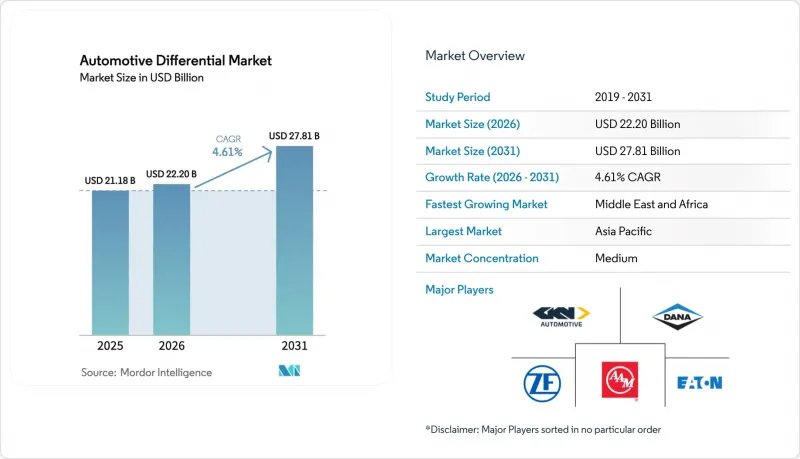
Mordor Intelligence에 의하면, 자동차용 차동 기어 시장 규모는 2025년 211억 8,000만 달러에서 2026년에는 222억 달러로 확대되어 예측 기간(2026-2031년)에서 CAGR 4.61%로 성장을 지속하여, 2031년까지 278억 1,000만 달러에 이를 것으로 예측됩니다.
본 보고서는 구동 방식별(전륜구동(FWD), 후륜구동(RWD), 기타), 차종별(승용차, 소형 상용차, 기타), 추진 방식별(내연기관(ICE), 전기차(EV)), 구성품별(차동 기어 케이스, 차동 기어 베어링, 기타), 지역별(북미, 남미, 기타)로 분류되어 있습니다. 시장 예측은 금액(달러) 기준으로 제시되어 있습니다.
전 세계 자동차용 차동 기어 시장 동향 및 인사이트
AWD/4WD 차량 보급률 상승
북미에서는 구매자들이 사륜구동(AWD)을 안전성 향상, 높은 재판매 가치, 겨울철 트랙션 성능 향상과 연관 짓고 있습니다. 이러한 인식으로 인해 프리미엄 브랜드와 대중 자동차 브랜드 모두에서 AWD의 매력이 높아지고 있습니다. 전륜구동(FWD)에서 AWD로의 전환에는 일반적으로 리어 차동 기어과 센터 차동 기어의 추가가 필요하며, 이러한 변경으로 인해 차량당 부품 수가 3배로 늘어나 평균 판매 가격이 상승합니다. 토요타 ‘RAV4’와 같은 일반용 크로스오버 차량에는 현재 안정성 제어 시스템과 연동된 전자 제어식 온디맨드 AWD 모듈이 채택되어 있으며, 이는 이러한 확대 추세를 뒷받침하고 있습니다. 또한, 상용차 개조 업체들도 업무용 픽업 트럭에 파트타임 4WD를 채택하는 사례가 늘어나고 있으며, 오프로드 주행에 대응하기 위해 견고한 잠금식 차동 기어를 추가하는 경우가 많아지고 있습니다. 세단 수요가 감소하고 있음에도 불구하고, 이러한 판매 대수와 사양 동향이 자동차용 차동 기어 시장을 뒷받침하고 있습니다.
전 세계 소형 및 중대형 상용차 생산 대수 증가
2025년, 인도에서는 대형 트럭 생산이 증가했으며, 중국에서는 중형 및 대형 트럭 두 부문 모두에서 현저한 성장이 나타났습니다. 현재 각 트럭의 섀시에는 견고한 하이포이드 기어 세트, 더 두꺼운 베어링 슬리브, 윤활유 용량 증가 등 기능 강화가 이루어지고 있습니다. 이러한 업그레이드로 인해 소형차에 비해 차축당 매출액은 3배로 증가했습니다. 점검 및 정비 주기 연장을 중시하는 차량 운영 업체들은 재생 캐리어와 순정 수리 키트를 구하기 위해 평판이 좋은 공급업체에 의뢰하는 경우가 많아, 이를 통해 재구매가 확보되고 있습니다. 한편, 베트남과 태국의 수출 주도형 조립 제조업체들은 사업 범위를 확대하고 있으며, 자동차용 차동 기어 시장을 자국 이외의 지역으로 넓혀가고 있습니다.
차동 기어의 필요성을 줄여주는 전기차(EV)의 인휠 모터 아키텍처
테슬라 ‘모델 S 플레이드’와 루시드 ‘에어 드림 에디션’은 4모터 구동이 기계식 차동 기어보다 정밀한 토크 제어를 실현하는 동시에 질량과 마찰을 줄일 수 있음을 입증하고 있습니다. Protean Electric은 2024년에 상용 등급의 인휠 허브를 출하할 예정이며, Elaphe는 승용차용 검증 프로그램을 확보하고 있어 이 아키텍처가 성숙해 가고 있음을 보여줍니다. 비용이 낮아짐에 따라 고급 전기차는 센터 캐리어나 액슬 캐리어를 생략할 가능성이 있으며, 이는 기존 공급업체들에게 구조적인 리스크가 될 수 있습니다. 각 차동 기어 제조업체들은 듀얼 모터 전기차용 액슬에 전기 기계식 토크 벡터링 모듈을 제공하며 대응하고 있지만, 시장의 전환 속도는 여전히 역풍으로 작용하고 있습니다.
부문 분석
2025년, 사륜구동(AWD) 시스템은 자동차 차동 기어 시장 점유율의 44.08%를 차지하며 최대 수익원이 되었습니다. 이는 각 차량에 일반적으로 최소 2개의 차동 기어가 탑재되고, 많은 경우 전자 제어식 센터 유닛도 장착되어 있기 때문입니다. AWD용 자동차 차동 기어 시장은 전 세계적인 크로스오버 차량으로의 전환과 능동형 안전 규제에 대응해야 할 필요성을 배경으로, 2031년까지 연평균 성장률(CAGR) 5.92%를 나타낼 것으로 예측됩니다. AWD 수요는 혹독한 겨울 날씨가 구매 결정에 영향을 미치는 캐나다, 스칸디나비아, 아시아의 산악 지역에서 견조합니다. 유럽의 고급 세단과 일본의 그란투리스모는 토크 벡터링 기능을 갖춘 리어 차동 기어를 중시하고 있으며, 이를 통해 주행 감각이 향상되어 높은 가격 책정을 정당화하고 있습니다.
전륜 구동은 비용을 중시하는 해치백 및 세단의 기반으로서 여전히 큰 점유율을 차지하고 있습니다. 부품 구조가 단순하여 평균 판매 가격은 낮게 유지되고 있지만, 전 세계 판매 대수는 여전히 높은 수준을 유지하고 있어 공급업체에게 안정적인 기반이 되고 있습니다. 후륜구동은 종방향 레이아웃의 장점을 살린 고급 쿠페나 상용 밴에 집중되어 있으며, 상당한 시장 점유율을 차지하고 있습니다. 파트타임 허브와 트랜스퍼 케이스를 채택한 사륜구동은 풀사이즈 픽업 트럭이나 전용 오프로드 차량에 힘입어 눈부신 성장을 이루고 있습니다. 전반적으로 크로스오버 차량에 대한 소비자 선호도의 변화로 인해 차량당 차동 기어 장착량은 계속 증가하고 있으며, 이것이 자동차용 차동 기어 시장 전체를 지탱하고 있습니다.
2025년 기준, 승용차는 자동차용 차동 기어 시장 점유율의 56.12%를 차지하고 있으며, 아세안(ASEAN)과 남미 지역의 중산층 수요 증가를 배경으로 2031년까지 연평균 성장률(CAGR) 6.86%를 나타낼 것으로 예측됩니다. 컴팩트 SUV의 장비 고도화가 진행됨에 따라, 2개 또는 3개의 차동 기어를 탑재한 차량이 증가하고 있으며, 이는 달러 기준 부품 가치를 끌어올리고 있습니다. 한편, 소형 상용차는 큰 점유율을 차지하고 있습니다. 이는 전자상거래 분야에서 다축 트랙션 시스템을 갖춘 기동성이 높은 배송용 밴에 대한 수요가 증가하고 있기 때문입니다.
중형 및 대형 트럭도 상당한 시장 점유율을 차지하고 있습니다. 다만, 이러한 차량은 대형 하이포이드 기어 세트, 플래닛 록, 가혹한 가동 주기에서도 작동하는 특수 씰을 채택하고 있어 단가가 가장 높습니다. 광업 및 건설 부문의 차량 운영 사업자들은 수명이 긴 합성 윤활유와 원격 모니터링 기능을 요구하고 있으며, 그 결과 애프터마켓 및 서비스 수익이 안정적입니다. 대량으로 공급되는 승용차와 고부가가치 상용차 수요 간의 상호작용으로 인해, 자동차 차동 기어 시장은 경기 순환을 통해 균형을 유지하고 있습니다.
지역별 분석
아시아태평양은 2025년 자동차 차동 기어 시장에서 48.35%의 점유율을 유지했습니다. 이는 자동차 생산의 주요 거점인 중국, 일본, 한국이 주도한 결과입니다. 중국 한 나라만으로도 고성능 토크 벡터링 유닛을 탑재한 국내 조립 고급차 모델에 힘입어, 지역 전체 차동 기어 수요에서 큰 비중을 차지했습니다. 인도의 경우, 트럭 생산의 대폭적인 증가가 대형 차량용 차동 기어 수입을 뒷받침하는 한편, 국내 기계 가공 능력도 확대되고 있습니다. 동남아시아 국가들은 자유무역지대를 활용하여 완성차 SUV를 전 세계로 수출하고 있으며, 이를 통해 자동차용 차동 기어 시장에서 지역의 우위를 유지하고 있습니다.
북미는 큰 점유율을 차지하고 있으며, 2031년까지의 연평균 성장률(CAGR) 전망도 두드러집니다. 섀시 1대당 평균 3개의 차동 기어를 탑재하는 풀사이즈 픽업 트럭이 견실한 수익을 뒷받침하고 있습니다. 멕시코로의 기어 생산 니어쇼어링을 통해 리드타임 단축과 환율 리스크 저감을 도모하고 있으며, USMCA의 현지 조달률 요건도 충족하고 있습니다. 캐나다의 액슬 조립 공장은 ‘디트로이트 3사’의 프로그램에 부품을 공급하며, 지역의 자급자족을 확보하고 있습니다.
유럽에서는 눈에 띄는 성장이 나타나고 있으며, 코너링 안정성 기준을 충족하기 위해 전자 제어 리미티드 슬립 유닛을 탑재한 프리미엄 모델이 특징입니다. 엄격한 NVH 및 CO₂ 규제로 인해 공급업체들은 경량 하우징과 초정밀 가공된 톱니면의 채택을 요구받고 있습니다.
중동 및 아프리카는 남아프리카, 튀르키예, 아랍에미리트연합(UAE)에 새로운 조립 라인이 설립됨에 따라 지역 내 소비용 SUV 및 픽업 트럭 생산이 현지화될 것으로 예상되어, 2031년까지 연평균 성장률(CAGR) 6.33%라는 가장 높은 성장률을 나타낼 것으로 전망됩니다.
기타 혜택
- 엑셀 형식 시장 예측(ME) 시트
- 3개월간의 애널리스트 지원
자주 묻는 질문
목차
제1장 서론
제2장 조사 방법
제3장 주요 요약
제4장 시장 구도
제5장 시장 규모와 성장 예측
제6장 경쟁 구도
제7장 시장 기회와 향후 전망
JHS 26.09.11According to Mordor Intelligence, the automotive differential market size is expected to grow from USD 21.18 billion in 2025 to USD 22.20 billion in 2026 and is forecast to reach USD 27.81 billion by 2031 at a 4.61% CAGR during the forecast period (2026-2031).
This report is Segmented by Drive Type (Front-Wheel Drive, Rear-Wheel Drive, and More), Vehicle Type (Passenger Cars, Light Commercial Vehicles, and More), Propulsion Type (Internal Combustion Engine, Electric Vehicles), Component (Differential Case, Differential Bearings, and More), and Geography (North America, South America, and More). The Market Forecasts are Provided in Terms of Value (USD).
Global Automotive Differential Market Trends and Insights
Rising Penetration of AWD/4WD Vehicles
In North America, buyers associate multi-axle drive (AWD) with enhanced safety, better resale value, and improved winter traction. This perception has bolstered its appeal among both premium and mainstream automotive brands. Transitioning from front-wheel drive (FWD) to AWD typically involves adding a rear and a center differential, a change that triples the content per vehicle and boosts average selling prices. Mainstream crossovers, like the Toyota RAV4, are now incorporating electronic on-demand AWD modules tied to stability control, underscoring this growing trend. Furthermore, commercial upfitters are increasingly opting for part-time 4WD in vocational pickups, often adding robust locking differentials to navigate off-road challenges. These trends in volume and content are bolstering the automotive differential market, even as demand for sedans wanes.
Growth in Global Light and Medium-Heavy-Commercial-Vehicle Production
In 2025, India increased its production of heavy-duty trucks, while China experienced significant growth across both its medium- and heavy-duty truck segments. Each truck chassis now boasts enhanced features: robust hypoid gearsets, thicker bearing sleeves, and increased lubricant capacity. These upgrades have tripled per-axle revenue compared to a compact car. Fleets that value extended service intervals often turn to established suppliers for remanufactured carriers and authentic repair kits, thereby ensuring repeat business. Meanwhile, export-driven assemblers in Vietnam and Thailand are expanding their reach, taking the automotive differential market beyond their home countries.
EV In-Wheel-Motor Architectures Reducing Need for Differentials
Tesla Model S Plaid and Lucid Air Dream Edition demonstrate that quad-motor propulsion can deliver finer torque management than a mechanical differential while removing mass and friction. Protean Electric shipped commercial-grade in-wheel hubs in 2024, and Elaphe secured passenger-car validation programs, showing the architecture is maturing . As costs fall, Luxury EVs may bypass center and axle carriers, posing a structural risk for conventional suppliers. Differential companies counter by offering electromechanical torque-vectoring modules for dual-motor EV axles, but market conversion speed remains a headwind.
Other drivers and restraints analyzed in the detailed report include:
- Surge in Advanced (eLSD / Torque-Vectoring) Differential Adoption
- Expansion of APAC Passenger-Car Output and Model Launches
- Raw-Material (Steel, Al) Price Volatility
For complete list of drivers and restraints, kindly check the Table Of Contents.
Segment Analysis
All-wheel drive (AWD) systems captured 44.08% of the automotive differential market share in 2025, generating the largest revenue pool, as each vehicle typically carries at least two differentials and often an electronically controlled center unit. The automotive differential market for AWD is projected to grow at a 5.92% CAGR through 2031, driven by the global shift toward crossovers and the need to comply with active-safety mandates. AWD demand is robust in Canada, Scandinavia, and mountainous Asian provinces where harsh winters influence purchase decisions. Premium European sedans and Japanese grand tourers emphasize torque-vectoring rear differentials, which heighten the driving feel and justify their higher price tags.
Front-wheel drive retains a significant share as the foundation for cost-focused hatchbacks and sedans. Its component simplicity limits average selling price, but global unit volume remains high, preserving a steady baseline for suppliers. Rear-wheel drive holds a notable share, concentrated in luxury coupes and commercial vans that benefit from longitudinal packaging. Four-wheel drive, which utilizes part-time hubs and a transfer case, has seen significant growth, driven by full-size pickups and dedicated off-roaders. Collectively, shifting buyer tastes toward crossover body styles continues to amplify differential content per vehicle, underpinning the broader automotive differential market.
Passenger cars accounted for 56.12% of the automotive differential market share in 2025 and are forecasted to grow at a 6.86% CAGR through 2031, driven by increasing middle-class demand in ASEAN and South America. High feature proliferation in compact SUVs means more vehicles carry two or three differentials, boosting dollar content. Meanwhile, light commercial vehicles log a significant share, as e-commerce requires agile delivery vans with multi-axle traction systems.
Medium and heavy trucks account for a notable share. Still, they deliver the highest unit price due to larger hypoid gear sets, planetary lockers, and specialized seals that function in extreme duty cycles. Fleet operators in the mining and construction segments demand long-life synthetic lubricants and remote monitoring, resulting in stable aftermarket and service revenue. The interplay of high-volume passenger-car supply and high-value commercial-vehicle demand keeps the automotive differential market balanced across economic cycles.
Complete Report Scope:
- By Drive Type
- Front-Wheel Drive (FWD)
- Rear-Wheel Drive (RWD)
- All-Wheel Drive (AWD)
- Four-Wheel Drive (4WD)
- By Vehicle Type
- Passenger Cars
- Light Commercial Vehicles
- Medium and Heavy Commercial Vehicles
- By Propulsion Type
- Internal Combustion Engine (ICE)
- Electric Vehicles (EVs)
- By Component
- Differential Case
- Differential Bearings
- Differential Gears
- Differential Pinion
- Others
- By Geography
- North America
- United States
- Canada
- Rest of North America
- South America
- Brazil
- Argentina
- Rest of South America
- Europe
- Germany
- United Kingdom
- France
- Italy
- Spain
- Rest of Europe
- Asia-Pacific
- China
- India
- Japan
- South Korea
- Rest of Asia-Pacific
- Middle East and Africa
- United Arab Emirates
- Saudi Arabia
- South Africa
- Turkey
- Rest of Middle East and Africa
- North America
Geography Analysis
The Asia-Pacific region maintained a 48.35% share of the automotive differential market in 2025, led by China, Japan, and South Korea, which serve as key hubs for vehicle production. China alone accounted for a significant share of regional differential demand, driven by domestically assembled luxury models featuring advanced torque-vectoring units. India's significant jump in truck production boosts heavy-duty differential imports, while its indigenous machining capacity scales. Southeast Asian nations utilize free-trade zones to export fully built SUVs worldwide, thereby sustaining regional dominance in the automotive differential market.
North America accounted for a significant share, with a notable CAGR outlook through 2031. Full-size pickups averaging three differentials per chassis underpin revenue resilience. Near-shoring gear production to Mexico reduces lead times and currency exposure, aligning with USMCA content requirements. Canadian axle assembly plants supply Detroit Three programs, ensuring regional self-sufficiency.
Europe is experiencing notable growth, characterized by premium models that feature electronically limited-slip units to meet cornering stability metrics. Strict NVH and CO2 rules push suppliers to adopt lightweight housings and super-finished tooth flanks.
The Middle East and Africa are expected to grow at the fastest rate of 6.33% CAGR through 2031, thanks to the establishment of new assembly lines in South Africa, Turkey, and the United Arab Emirates, which will localize SUV and pickup production for regional consumption .
- American Axle & Manufacturing, Inc.
- GKN Automotive Limited
- ZF Friedrichshafen AG
- Dana Incorporated
- BorgWarner Inc.
- Eaton Corporation plc
- JTEKT Corporation
- Schaeffler AG
- Magna International Inc.
- Continental AG
- Hyundai Wia Corporation
- Musashi Seimitsu Industry Co., Ltd.
- Auburn Gear LLC
- Neapco Holdings, LLC
- Drexler Automotive GmbH
- RT Quaife Engineering Ltd.
- Xtrac Limited
- Bharat Gears Limited
Additional Benefits:
- The market estimate (ME) sheet in Excel format
- 3 months of analyst support
TABLE OF CONTENTS
1 Introduction
- 1.1 Study Assumptions & Market Definition
- 1.2 Scope of the Study
2 Research Methodology
3 Executive Summary
4 Market Landscape
- 4.1 Market Overview
- 4.2 Market Drivers
- 4.2.1 Rising Penetration of AWD/4WD Vehicles
- 4.2.2 Growth in Global Light and Medium-Heavy-Commercial-Vehicle Production
- 4.2.3 Surge in Advanced (eLSD / Torque-Vectoring) Differential Adoption
- 4.2.4 Expansion of APAC Passenger-Car Output and Model Launches
- 4.2.5 Telematics-Enabled Predictive-Maintenance Demand
- 4.2.6 Tariff-Driven North-American Near-Shoring of Gear Production
- 4.3 Market Restraints
- 4.3.1 EV In-Wheel-Motor Architectures Reducing Need for Differentials
- 4.3.2 Raw-Material (Steel, Al) Price Volatility
- 4.3.3 Global Shortage of High-Precision Gear-Cutting Equipment
- 4.3.4 New EU Acoustic Rules Raising NVH Compliance Costs
- 4.4 Value / Supply-Chain Analysis
- 4.5 Regulatory Landscape
- 4.6 Technological Outlook
- 4.7 Porter's Five Forces
- 4.7.1 Threat of New Entrants
- 4.7.2 Bargaining Power of Suppliers
- 4.7.3 Bargaining Power of Buyers
- 4.7.4 Threat of Substitutes
- 4.7.5 Competitive Rivalry
5 Market Size & Growth Forecasts (Value, USD)
- 5.1 By Drive Type
- 5.1.1 Front-Wheel Drive (FWD)
- 5.1.2 Rear-Wheel Drive (RWD)
- 5.1.3 All-Wheel Drive (AWD)
- 5.1.4 Four-Wheel Drive (4WD)
- 5.2 By Vehicle Type
- 5.2.1 Passenger Cars
- 5.2.2 Light Commercial Vehicles
- 5.2.3 Medium and Heavy Commercial Vehicles
- 5.3 By Propulsion Type
- 5.3.1 Internal Combustion Engine (ICE)
- 5.3.2 Electric Vehicles (EVs)
- 5.4 By Component
- 5.4.1 Differential Case
- 5.4.2 Differential Bearings
- 5.4.3 Differential Gears
- 5.4.4 Differential Pinion
- 5.4.5 Others
- 5.5 By Geography
- 5.5.1 North America
- 5.5.1.1 United States
- 5.5.1.2 Canada
- 5.5.1.3 Rest of North America
- 5.5.2 South America
- 5.5.2.1 Brazil
- 5.5.2.2 Argentina
- 5.5.2.3 Rest of South America
- 5.5.3 Europe
- 5.5.3.1 Germany
- 5.5.3.2 United Kingdom
- 5.5.3.3 France
- 5.5.3.4 Italy
- 5.5.3.5 Spain
- 5.5.3.6 Rest of Europe
- 5.5.4 Asia-Pacific
- 5.5.4.1 China
- 5.5.4.2 India
- 5.5.4.3 Japan
- 5.5.4.4 South Korea
- 5.5.4.5 Rest of Asia-Pacific
- 5.5.5 Middle East and Africa
- 5.5.5.1 United Arab Emirates
- 5.5.5.2 Saudi Arabia
- 5.5.5.3 South Africa
- 5.5.5.4 Turkey
- 5.5.5.5 Rest of Middle East and Africa
- 5.5.1 North America
6 Competitive Landscape
- 6.1 Market Concentration
- 6.2 Strategic Moves
- 6.3 Market Share Analysis
- 6.4 Company Profiles (Includes Global Level Overview, Market Level Overview, Core Segments, Financials as Available, Strategic Information, Market Rank/Share for Key Companies, Products and Services, SWOT Analysis, and Recent Developments)
- 6.4.1 American Axle & Manufacturing, Inc.
- 6.4.2 GKN Automotive Limited
- 6.4.3 ZF Friedrichshafen AG
- 6.4.4 Dana Incorporated
- 6.4.5 BorgWarner Inc.
- 6.4.6 Eaton Corporation plc
- 6.4.7 JTEKT Corporation
- 6.4.8 Schaeffler AG
- 6.4.9 Magna International Inc.
- 6.4.10 Continental AG
- 6.4.11 Hyundai Wia Corporation
- 6.4.12 Musashi Seimitsu Industry Co., Ltd.
- 6.4.13 Auburn Gear LLC
- 6.4.14 Neapco Holdings, LLC
- 6.4.15 Drexler Automotive GmbH
- 6.4.16 RT Quaife Engineering Ltd.
- 6.4.17 Xtrac Limited
- 6.4.18 Bharat Gears Limited
7 Market Opportunities & Future Outlook
- 7.1 White-space & Unmet-Need Assessment


