|
시장보고서
상품코드
2124413
자동차 파워 스티어링 모터 시장 : 시장 점유율 분석, 업계 동향 및 통계, 성장 예측(2026-2031년)Automotive Power Steering Motor - Market Share Analysis, Industry Trends & Statistics, Growth Forecasts (2026 - 2031) |
||||||
 Mordor Intelligence
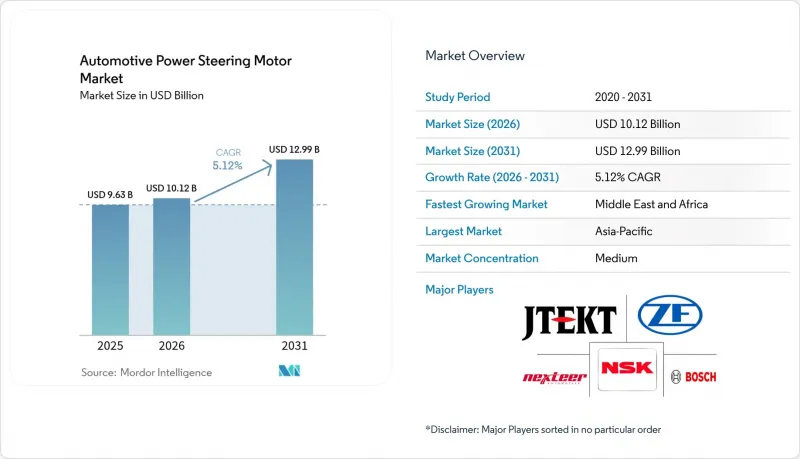
Mordor Intelligence에 의하면, 2026년 자동차 파워 스티어링 모터 시장 규모는 101억 2,000만 달러로 추정되며, 2025년 96억 3,000만 달러에서 2031년에는 129억 9,000만 달러에 달할 것으로 예측됩니다.
2026-2031년 연평균 성장률(CAGR)은 5.12%를 나타낼 전망입니다.
본 보고서는 차종별(승용차, 소형 상용차 등), 파워 스티어링 방식별(유압식 등), 제품 유형별(랙 어시스트식 EPS 등), 모터 기술별(브러쉬리스 DC 모터 등), 차량 구동 방식별(ICE, BEV 등), 판매 채널별(OEM 및 애프터마켓), 그리고 지역별로 분류되어 있습니다. 시장 예측은 금액(달러) 기준으로 제시되어 있습니다.
세계의 자동차 파워 스티어링 모터 시장 동향 및 인사이트
연비 향상 및 CO2 배출 규제 대응을 위한 EPS로의 전환
규제 압력으로 인해 EPS 채택이 진행되고 있으며, 자동차 제조업체들은 유압 시스템에 비해 2-4%의 연비 개선을 추구하고 있습니다. 이 기술로 인해 지속적으로 2-6마력을 소비하는 엔진 구동식 유압 펌프가 불필요해지기 때문입니다. 유럽연합(EU)이 2025년까지 95g/km로 정한 CO2 배출량 목표와 중국의 듀얼 크레딧 정책으로 인해, 기존의 비용 대비 효과 계산을 넘어선 규정 준수의 시급성이 높아지고 있습니다. 이러한 규제 추세에 힘입어, 초기 비용이 높다는 이유로 제조업체들이 그동안 이 기술의 도입을 꺼려왔던 저가차 부문에서도 EPS의 보급이 가속화되고 있습니다. EPS 시스템은 일정한 유압을 유지하는 것이 아니라 필요할 때만 조향 보조를 수행하기 때문에 자동차 제조업체는 차량 성능을 저하시키지 않으면서도 모든 차종에 걸쳐 배기가스 감축을 실현할 수 있습니다. 상용차 제조업체들도 엄격한 배기가스 기준을 충족하는 동시에, 작동유 유지보수가 불필요해지고 연비가 향상됨에 따라 총 소유 비용(TCO)을 절감하기 위해 EPS 채택을 확대되고 있습니다.
중국 및 인도에서의 전기차 생산 급증
중국 내 BEV(배터리식 전기차) 생산의 급증은 EPS 모터에 대한 집중적인 수요를 창출하고 있으며, BYD 등의 국내 제조업체와 신생 기업들은 내연기관차(ICE) 개조용이 아닌, 전기차 아키텍처에 최적화된 조향 시스템을 필요로 하고 있습니다. 인도에서는 새롭게 도입된 전동화 정책이 이러한 수요를 더욱 부추기고 있습니다. 타타 모터스(Tata Motors)와 같은 자동차 제조업체들은 수입 의존도를 낮추기 위해 자체 모터 생산을 포함해 전기차 부품의 80%를 현지에서 조달하는 체제를 구축하고 있습니다. 이러한 지역적 수요 집중은 현지 생산 체계를 구축할 수 있는 EPS 모터 제조업체에게 공급망 효율화를 가져다주는 한편, 희토류 소재 조달 및 기술 이전 요건을 둘러싼 지정학적 위험에 시장을 노출시키기도 합니다.
2025-27년 반도체 공급망 부족
자동차용 반도체 부족은 계속해서 EPS 모터 생산에 영향을 미치고 있습니다. 특히, 전원 관리 IC와 모터 제어 프로세서의 리드타임이 길어지면서 제조 일정의 혼란과 부품 비용 증가를 초래하고 있습니다. 자동차 업계의 800V 전기 아키텍처로의 전환은 이 문제를 더욱 심각하게 만들고 있습니다. 이는 생산 능력이 제한적이고, 엄격한 자동차용 인증 요건이 부과되는 특수한 실리콘 카바이드 반도체가 필요하기 때문입니다. EPS 제조업체들은 자동차용이 단위당 수익성이 더 높음에도 불구하고, 반도체 공급업체들이 대량 생산되는 소비자용 전자기기를 우선시하기 때문에 공급 배분 제약에 직면해 있습니다. 이러한 공급 부족으로 인해 장기 공급 계약이나 재고 완충 장치 확보가 불가피해졌으며, 운전자금 수요가 증가하는 반면, 수요 변동에 대응하기 위한 생산 유연성은 제한받고 있습니다.
부문별 분석
승용차는 규제 준수 요건과 정밀한 전자식 조향 제어가 필요한 ADAS(첨단 운전자 지원 시스템)에 대한 소비자 수요에 힘입어, 2025년 자동차용 파워 스티어링 모터 시장 점유율의 91.48%를 차지하며 시장을 계속 독점하고 있습니다. 대형 상용차는 더 높은 출력 요구 사항과 내구성에 대한 우려로 인해 EPS 시스템의 도입이 비교적 더디게 진행되고 있습니다. 그러나 전기 상용차 분야의 새로운 용도 출현은 고토크 모터 설계에 새로운 기회를 제공합니다. 소형 상용차는 2026-2031년 연평균 성장률(CAGR) 7.12%로 가장 빠른 성장세를 보이고 있으며, 시장 점유율은 작지만 승용차를 상회하고 있습니다. 이는 차량 운영 사업자들이 유지보수 비용 절감 및 연비 효율 향상 등 EPS 시스템이 가져다주는 총 소유 비용(TCO)상의 이점을 중시하기 때문입니다.
상용차의 전환은 더 광범위한 차량 함대의 전동화 의무를 반영하고 있으며, 운영자는 차량 효율을 최적화하고 운영상의 복잡성을 줄이기 위해 조향, 제동, 파워트레인 제어를 결합한 통합 솔루션을 요구하고 있습니다. 차량 관리 시스템에서는 EPS 시스템이 통합된 센서 및 통신 프로토콜을 통해 구현되는 원격 진단 및 예측 유지보수 기능에 대한 수요가 점점 더 높아지고 있습니다. 이를 통해 서비스 주기 연장 및 가동 중단 비용 절감을 위한 원격 모니터링 기능을 갖춘, 차량 관리에 최적화된 솔루션을 제공할 수 있는 공급업체에게 차별화의 기회가 생기고 있습니다.
전동 파워 스티어링은 2025년에 자동차용 파워 스티어링 모터 시장 점유율의 70.31%를 차지한 것으로 평가되었으며, 2031년까지 연평균 성장률(CAGR) 8.18%로 성장할 것으로 전망됩니다. 이는 해당 기술이 연비 개선 수단에서 첨단 차량 기능을 실현하는 기반으로 진화하고 있음을 반영합니다. 유압식 파워 스티어링 시스템은 자동차 제조업체들이 복잡성을 줄이고 전동화를 실현하기 위해 유압 부품을 배제하고 있어 수요 감소에 직면해 있지만, 최대 조향력이 필요한 대형 차량 용도에서는 여전히 이 기술이 채택되고 있습니다. 전기유압식 파워 스티어링은 기존 플랫폼을 업그레이드하는 제조업체에게 과도기적인 기술로 기능하고 있으며, 순수한 EPS 시스템으로는 제공할 수 없는 높은 출력이 필요한 용도에서 전동 모터에 의한 보조와 유압에 의한 백업을 결합하고 있습니다.
EPS의 성장 궤도는 이 기술이 ADAS(첨단 운전자 보조 시스템) 통합 및 자율주행 개발의 필수 요건이 됨에 따라, 기존의 도입 곡선을 상회하는 속도로 가속화되고 있습니다. 자동차 제조업체들은 소프트웨어 업데이트 기능 및 차량 안정성 제어와의 통합을 이유로 EPS 시스템을 점점 더 많이 채택하고 있습니다. 이에 따라 부품 공급에 그치지 않고 소프트웨어 개발 및 검증 서비스에 이르기까지 공급업체와의 파트너십이 형성되고 있습니다. 이러한 변화로 인해 EPS 공급업체는 단순한 기계 부품 공급업체에서 임베디드 인텔리전스 및 커넥티비티 기능을 갖춘 종합적인 스티어링 솔루션을 제공할 수 있는 통합 기술 파트너로 변모하고 있습니다.
지역별 분석
아시아태평양은 중국의 자동차 생산 대수에서 차지하는 주도적 지위와 배터리식 전기차 판매 대수의 급증에 힘입어, 2025년에도 자동차용 파워 스티어링 모터 시장의 54.55%를 계속 차지했습니다. 모터의 현지 생산은 지역 내 반도체 백엔드 조립 체계와 긴밀한 자석 밸류체인의 혜택을 받고 있습니다. 일본 및 한국의 1차 공급업체는 정밀한 알고리즘 설계로 주도권을 쥐고 있는 반면, 중국 공급업체는 규모의 경제를 활용하여 수출 시장 진출을 추진하고 있습니다. 인도는 신형 전기차 모델의 국내 부가가치를 높이는 현지화 인센티브를 통해 그 성장세를 더욱 강화하고 있습니다.
중동 및 아프리카는 여전히 규모는 작지만, 모로코와 사우디아라비아가 수출 지향적인 조립 공장을 육성하고 있어 2031년까지 연평균 성장률(CAGR) 9.35%라는 가장 높은 성장세를 보일 것으로 예측됩니다. 정부가 지원하는 산업단지에서는 세제 혜택 및 재생에너지 가격 책정을 통해 스티어링 모터 공장의 운영 비용이 절감되고 있습니다. 또한, 이 지역의 성장은 핵심 부품 조달에 있어 지리적 다양성을 제공함으로써 유럽공급 리스크에 대한 우려를 완화하는 역할도 하고 있습니다.
유럽과 북미에서는 전동화 및 레벨 2+ 운전 지원 시스템으로의 전환이 착실히 진행되면서, ISO/SAE 21434를 준수하고 사이버 보안 대책이 적용된 업데이트 가능한 모터에 대한 수요가 촉진되고 있습니다. EU의 충돌 안전 기준 및 배기가스 규제로 인해 EPS(전동 파워 스티어링)는 모든 차종 등급에서 표준 사양으로 자리 잡아가고 있습니다. 한편, 미국은 USMCA(미국·멕시코·캐나다 협정)를 활용하여 멕시코의 산업 회랑으로의 부품 생산 유치를 추진하고 있습니다. 반도체 부족은 여전히 역풍으로 작용하고 있지만, 다중 조달 전략과 온쇼어링 보조금을 통해 공급 충격 완화가 도모되고 있습니다. 이를 종합해 보면, 성숙한 지역이 자동차용 파워 스티어링 모터 시장의 3분의 1 이상을 차지하고 있으며, 향후 성장은 주로 소프트웨어 수익화와 자율주행 대응 스티어링 모듈에 좌우될 전망입니다.
기타 혜택 :
- 엑셀 형식 시장 예측(ME) 시트
- 3개월간의 애널리스트 지원
자주 묻는 질문
목차
제1장 서론
제2장 조사 방법
제3장 주요 요약
제4장 시장 구도
제5장 시장 규모 및 성장 예측
제6장 경쟁 구도
제7장 시장 기회 및 향후 전망
AJY 26.09.09According to Mordor Intelligence, automotive power steering motor market size in 2026 is estimated at USD 10.12 billion, growing from 2025 value of USD 9.63 billion with 2031 projections showing USD 12.99 billion, growing at 5.12% CAGR over 2026-2031.
This report is Segmented by Vehicle Type (Passenger Cars, Light Commercial Vehicles, and More), Power-Steering Type (Hydraulic, and More), Product Type (Rack-Assist EPS, and More), Motor Technology (Brushless DC Motor and More), Vehicle Propulsion (ICE, BEV and More), Sales Channel (OEM and Aftermarket), and Geography. The Market Forecasts are Provided in Terms of Value (USD).
Global Automotive Power Steering Motor Market Trends and Insights
Shift to EPS for Fuel-Economy and CO2 Compliance
Regulatory pressure drives EPS adoption as automakers seek 2-4% fuel economy improvements over hydraulic systems, with the technology eliminating engine-driven hydraulic pumps that consume 2-6 horsepower continuously. European Union's CO2 emission targets of 95g/km by 2025 and China's dual-credit policy create compliance urgency that extends beyond traditional cost-benefit calculations. This regulatory momentum accelerates EPS penetration in budget vehicle segments where manufacturers previously avoided the technology due to higher upfront costs. The shift enables automakers to achieve fleet-wide emission reductions without compromising vehicle performance, as EPS systems provide steering assistance only when needed rather than maintaining constant hydraulic pressure. Commercial vehicle manufacturers increasingly adopt EPS to meet stringent emission standards while reducing total cost of ownership through eliminated hydraulic fluid maintenance and improved fuel efficiency.
Rapid Electrified-Vehicle Production in China and India
China's BEV production surge creates concentrated demand for EPS motors, with domestic manufacturers like BYD and emerging players requiring steering systems optimized for electric vehicle architectures rather than ICE retrofits. India's emerging electrification policies compound this demand, as automakers like Tata Motors achieve 80% localization for EV components, including in-house motor production to reduce import dependency. This regional concentration creates supply chain efficiencies for EPS motor manufacturers capable of establishing local production capabilities, while also exposing the market to geopolitical risks around rare-earth material access and technology transfer requirements.
Semiconductor Supply-Chain Tightness 2025-27
Automotive-grade semiconductor shortages continue affecting EPS motor production, with power management ICs and motor control processors experiencing extended lead times that disrupt manufacturing schedules and increase component costs. The automotive industry's transition to 800V electrical architectures compounds this challenge, requiring specialized silicon carbide semiconductors with limited production capacity and stringent automotive qualification requirements. EPS manufacturers face allocation constraints from semiconductor suppliers prioritizing higher-volume consumer electronics over automotive applications, despite automotive's higher per-unit profitability. This supply tightness forces longer-term supply agreements and inventory buffers that increase working capital requirements while limiting production flexibility to respond to demand fluctuations.
Other drivers and restraints analyzed in the detailed report include:
- Integration with ADAS and Steer-by-Wire Roadmaps
- Tier-1 Vendor Localization in ASEAN and Mexico
- High EPS Repair Cost for Budget-Car Segments
For complete list of drivers and restraints, kindly check the Table Of Contents.
Segment Analysis
Passenger cars maintain market dominance at 91.48% of the automotive power steering motor market share in 2025, driven by regulatory compliance requirements and consumer demand for advanced driver assistance features that require precise electronic steering control. Heavy commercial vehicles adopt EPS systems more gradually due to higher power requirements and durability concerns. However, emerging applications in electric commercial vehicles create new opportunities for high-torque motor designs. Light commercial vehicles exhibit the fastest growth at 7.12% CAGR 2026-2031, outpacing passenger cars despite representing a smaller market share, as fleet operators prioritize total cost of ownership benefits from EPS systems, including reduced maintenance and improved fuel efficiency.
The commercial vehicle transition reflects broader fleet electrification mandates, where operators seek integrated solutions combining steering, braking, and powertrain controls to optimize vehicle efficiency and reduce operational complexity. Fleet management systems increasingly require remote diagnostics and predictive maintenance capabilities that EPS systems enable through integrated sensors and communication protocols. This creates differentiation opportunities for suppliers capable of delivering fleet-optimized solutions with extended service intervals and remote monitoring capabilities that reduce downtime costs.
Electric power steering commands 70.31% of the automotive power steering motor market share in 2025 while growing at 8.18% CAGR through 2031, reflecting the technology's evolution from a fuel economy solution to an enabling platform for advanced vehicle features. Hydraulic power steering systems face declining demand as automakers eliminate hydraulic components to reduce complexity and enable electrification, though the technology persists in heavy-duty applications requiring maximum steering force. Electro-hydraulic power steering serves as transitional technology for manufacturers upgrading existing platforms, combining electric motor assistance with hydraulic backup for applications requiring higher power output than pure EPS systems can deliver.
The EPS growth trajectory accelerates beyond traditional adoption curves as the technology becomes a prerequisite for ADAS integration and autonomous driving development. Automakers increasingly specify EPS systems for their software update capabilities and integration with vehicle stability control, creating vendor partnerships that extend beyond component supply to software development and validation services. This shift transforms EPS suppliers from mechanical component providers to integrated technology partners capable of delivering complete steering solutions with embedded intelligence and connectivity features.
Complete Report Scope:
- By Vehicle Type
- Passenger Cars
- Light Commercial Vehicles
- Heavy Commercial Vehicles
- By Power-Steering Type
- Hydraulic Power Steering (HPS)
- Electro-hydraulic Power Steering (EHPS)
- Electric Power Steering (EPS)
- By Product Type
- Rack-Assist EPS (REPS)
- Column-Assist EPS (CEPS)
- Pinion-Assist EPS (PEPS)
- Dual-Pinion EPS (DPEPS)
- Parallel-Axis EPS (PA-EPS)
- By Motor Technology
- Brushless DC Motor
- Brushed DC Motor
- By Propulsion Type
- Internal-Combustion Engine (ICE)
- Hybrid Electric Vehicle (HEV/PHEV)
- Battery Electric Vehicle (BEV)
- Plug-in Hybrid Electric Vehicles
- By Sales Channel
- OEM
- Aftermarket
- By Geography
- North America
- United States
- Canada
- Rest of North America
- South America
- Brazil
- Argentina
- Rest of South America
- Europe
- Germany
- France
- United Kingdom
- Italy
- Spain
- Russia
- Rest of Europe
- Asia-Pacific
- China
- Japan
- India
- South Korea
- Indonesia
- Vietnam
- Philippines
- Australia
- Rest of Asia-Pacific
- Middle East and Africa
- Saudi Arabia
- United Arab Emirates
- Egypt
- Turkey
- South Africa
- Rest of Middle East and Africa
- North America
Geography Analysis
Asia-Pacific retained a 54.55% of the automotive power steering motor market in 2025, thanks to China's leadership in vehicle output and accelerating battery-electric volumes. Localized motor production benefits from regional semiconductor back-end assembly and a dense magnet supply chain. Japanese and Korean Tier-1s lead in precision algorithm design, while Chinese suppliers push scale advantages into export markets. India amplifies momentum with localization incentives that raise domestic value content on new EV models.
While still small, the Middle East and Africa region is forecast to post the fastest 9.35% CAGR to 2031 as Morocco and Saudi Arabia nurture export-oriented assembly plants. Government-backed industrial zones provide tax holidays and renewable-energy pricing that lower operating costs for steering-motor plants. Regional growth also mitigates Europe's supply-risk concerns by adding geographical diversity in critical component sourcing.
Europe and North America transition steadily toward electrification and Level 2+ driver assistance, stimulating demand for motors capable of ISO/SAE 21434 cyber-secure updates. EU crash-worthiness and emissions rules cement EPS as a default specification across vehicle classes. At the same time, the United States leverages the USMCA trade pact to draw component production into Mexican industrial corridors. Semiconductor shortages remain a headwind, but multi-sourcing strategies and onshoring grants help cushion supply shocks. Combined, mature regions account for over one-third of the automotive power steering motor market, with future expansion tied mainly to software monetization and autonomous-ready steering modules.
- JTEKT Corporation
- Robert Bosch GmbH
- Nexteer Automotive Corp.
- ZF Friedrichshafen AG
- NSK Ltd.
- Hyundai Mobis Co. Ltd.
- Hitachi Astemo CO. Ltd.
- Thyssenkrupp AG
- Mando Corp.
- DENSO Corporation
- Nidec Corporation
- Mitsubishi Electric Corp.
- DY Auto
- BorgWarner Inc.
Additional Benefits:
- The market estimate (ME) sheet in Excel format
- 3 months of analyst support
TABLE OF CONTENTS
1 Introduction
- 1.1 Study Assumptions and Market Definition
- 1.2 Scope of the Study
2 Research Methodology
3 Executive Summary
4 Market Landscape
- 4.1 Market Overview
- 4.2 Market Drivers
- 4.2.1 Shift to EPS for fuel-economy and CO2 compliance
- 4.2.2 Rapid electrified-vehicle production in China and India
- 4.2.3 Integration with ADAS and steer-by-wire roadmaps
- 4.2.4 Tier-1 vendor localization in ASEAN and Mexico
- 4.2.5 Silicon-carbide inverter cost declines
- 4.2.6 OEM over-the-air torque-map updates
- 4.3 Market Restraints
- 4.3.1 Semiconductor supply-chain tightness 2025-27
- 4.3.2 High EPS repair cost for budget-car segments
- 4.3.3 Rare-earth magnet price volatility
- 4.3.4 Cyber-security compliance cost burden
- 4.4 Value / Supply-Chain Analysis
- 4.5 Regulatory Landscape
- 4.6 Technological Outlook
- 4.7 Porter's Five Forces
- 4.7.1 Bargaining Power of Suppliers
- 4.7.2 Bargaining Power of Buyers/Consumers
- 4.7.3 Threat of New Entrants
- 4.7.4 Threat of Substitutes
- 4.7.5 Intensity of Competitive Rivalry
5 Market Size and Growth Forecasts (Value (USD))
- 5.1 By Vehicle Type
- 5.1.1 Passenger Cars
- 5.1.2 Light Commercial Vehicles
- 5.1.3 Heavy Commercial Vehicles
- 5.2 By Power-Steering Type
- 5.2.1 Hydraulic Power Steering (HPS)
- 5.2.2 Electro-hydraulic Power Steering (EHPS)
- 5.2.3 Electric Power Steering (EPS)
- 5.3 By Product Type
- 5.3.1 Rack-Assist EPS (REPS)
- 5.3.2 Column-Assist EPS (CEPS)
- 5.3.3 Pinion-Assist EPS (PEPS)
- 5.3.4 Dual-Pinion EPS (DPEPS)
- 5.3.5 Parallel-Axis EPS (PA-EPS)
- 5.4 By Motor Technology
- 5.4.1 Brushless DC Motor
- 5.4.2 Brushed DC Motor
- 5.5 By Propulsion Type
- 5.5.1 Internal-Combustion Engine (ICE)
- 5.5.2 Hybrid Electric Vehicle (HEV/PHEV)
- 5.5.3 Battery Electric Vehicle (BEV)
- 5.5.4 Plug-in Hybrid Electric Vehicles
- 5.6 By Sales Channel
- 5.6.1 OEM
- 5.6.2 Aftermarket
- 5.7 By Geography
- 5.7.1 North America
- 5.7.1.1 United States
- 5.7.1.2 Canada
- 5.7.1.3 Rest of North America
- 5.7.2 South America
- 5.7.2.1 Brazil
- 5.7.2.2 Argentina
- 5.7.2.3 Rest of South America
- 5.7.3 Europe
- 5.7.3.1 Germany
- 5.7.3.2 France
- 5.7.3.3 United Kingdom
- 5.7.3.4 Italy
- 5.7.3.5 Spain
- 5.7.3.6 Russia
- 5.7.3.7 Rest of Europe
- 5.7.4 Asia-Pacific
- 5.7.4.1 China
- 5.7.4.2 Japan
- 5.7.4.3 India
- 5.7.4.4 South Korea
- 5.7.4.5 Indonesia
- 5.7.4.6 Vietnam
- 5.7.4.7 Philippines
- 5.7.4.8 Australia
- 5.7.4.9 Rest of Asia-Pacific
- 5.7.5 Middle East and Africa
- 5.7.5.1 Saudi Arabia
- 5.7.5.2 United Arab Emirates
- 5.7.5.3 Egypt
- 5.7.5.4 Turkey
- 5.7.5.5 South Africa
- 5.7.5.6 Rest of Middle East and Africa
- 5.7.1 North America
6 Competitive Landscape
- 6.1 Market Concentration
- 6.2 Strategic Moves
- 6.3 Market Share Analysis
- 6.4 Company Profiles (includes Global level Overview, Market level overview, Core Segments, Financials as available, Strategic Information, Market Rank/Share, Products and Services, Recent Developments)
- 6.4.1 JTEKT Corporation
- 6.4.2 Robert Bosch GmbH
- 6.4.3 Nexteer Automotive Corp.
- 6.4.4 ZF Friedrichshafen AG
- 6.4.5 NSK Ltd.
- 6.4.6 Hyundai Mobis Co. Ltd.
- 6.4.7 Hitachi Astemo CO. Ltd.
- 6.4.8 Thyssenkrupp AG
- 6.4.9 Mando Corp.
- 6.4.10 DENSO Corporation
- 6.4.11 Nidec Corporation
- 6.4.12 Mitsubishi Electric Corp.
- 6.4.13 DY Auto
- 6.4.14 BorgWarner Inc.
7 Market Opportunities and Future Outlook
- 7.1 White-space and Unmet-need Assessment