

|
시장보고서
상품코드
2124423
중동 및 아프리카의 목재 코팅 시장 : 점유율 분석, 업계 동향과 통계, 성장 예측(2026-2031년)Middle-East And Africa Wood Coatings - Market Share Analysis, Industry Trends & Statistics, Growth Forecasts (2026 - 2031) |
||||||
 Mordor Intelligence
Mordor Intelligence에 의하면, 중동 및 아프리카 목재 코팅 시장 규모는 2025년 4억 453만 달러에서 2026년에는 4억 1,609만 달러로 확대되어 2026-2031년까지 CAGR 2.86%로 성장을 지속하여, 2031년에는 4억 7,922만 달러에 이를 것으로 예측됩니다.
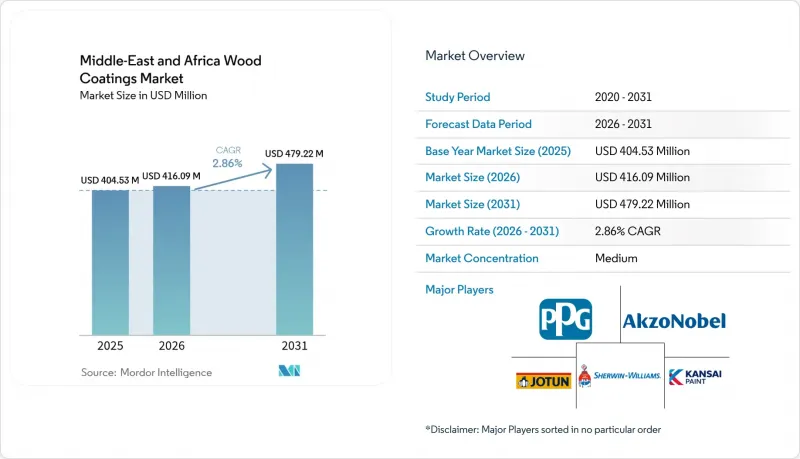
본 보고서는 수지 유형별(폴리우레탄, 폴리에스터, 니트로셀룰로오스, 기타), 기술별(수성, 용제형, UV 경화형, 분말),용도별(가구·비품, 문과 창문, 기타), 지역별(남아프리카, 이집트, 모로코, 나이지리아, 알제리, 케냐, 사우디아라비아, 아랍에미리트, 기타)로 분류되어 있습니다. 시장 예측은 금액(달러) 기준으로 제시되어 있습니다.
중동 및 아프리카 목재 코팅 시장 동향 및 인사이트
GCC 및 동아프리카의 건설 프로젝트 급증
공공 자본 지출로 인해 건축물 유형에 관계없이 수요 양상이 변화하고 있습니다. 사우디아라비아의 공공투자기금(PIF)은 목재를 많이 사용하는 호텔 및 레스토랑 산업의 인테리어를 우선시하는 프로젝트에 400억 달러를 투자하고 있으며, 이로 인해 습도 90%를 견딜 수 있는 해양용 폴리우레탄의 채택이 촉진되고 있습니다. 또한, 케냐의 저렴한 주택 프로그램에서는 창호에 현지산 목재를 사용하도록 규정하고 있어, 이로 인해 인테리어용 목재 수요가 증가했습니다. 에티오피아의 관세 정책으로 인해 수성 프라이머 수입이 제한되고 있어, 아디스아바바에서 부동산 붐이 일고 있음에도 불구하고 용제계 제품이 여전히 주류를 차지하고 있습니다. 따라서 각 도료 제조업체는 고성능이 요구되는 걸프 연안 국가들의 프로젝트와 비용을 중시하는 동아프리카의 주택 프로젝트 모두에 대응하기 위해 두 개의 생산 라인을 병행하여 가동하고 있습니다.
지역 내 가구 제조 거점 확대
모로코는 2024년에 3억 5,800만 달러 상당의 가구를 수출했습니다. 그 중심이 된 것은 유럽의 내스크래치성 기준을 충족하기 위해 2액형 폴리우레탄을 채택한 카사블랑카와 탕헤르의 공장입니다. 4억 5,200만 달러 규모의 케냐 가구 산업은 가마 건조 목재 부족으로 계속해서 어려움을 겪고 있으며, UV 경화형 마감재의 불량률은 여전히 높아 니트로셀룰로오스계 도료의 우위가 더욱 공고해지고 있습니다. 남아프리카공화국 웨스트케이프주의 제조업체들은 엔지니어드 우드로의 전환을 추진하여, 주 정부의 대기질 계획에 따라 용제 배출량을 35% 감축했습니다. 수출 지향적인 거점에서는 품질 기준을 충족하는 안정적인 도료가 요구되는 반면, 케냐나 남아프리카공화국의 소규모 공방에서는 성능보다 가격을 우선시하는 경우가 많습니다.
엄격한 VOC 규제/REACH와 유사한 규제
이집트의 250 g/L 상한치로 인해 많은 니트로셀룰로오스계 제품이 기준을 충족하지 못하게 되어, 15-20% 더 높은 비용으로 수성 대체품을 수입할 수밖에 없는 상황입니다. 모로코에서는 현재 유럽으로 수출할 때 VOC 신고가 의무화되어 있어, 소규모 공방에게는 큰 부담이 되는 시험 비용이 추가로 발생하고 있습니다. 남아프리카 당국은 2024년에 14건의 시정 권고를 발부하여, 기준을 충족하지 못하는 공장은 가동 중단 위기에 직면했습니다. GCC 프로젝트에서는 LEED 기준을 준수하는 저VOC 도료에 대한 수요가 증가하고 있으며, 수성 도료 시장 침투율은 2022년 30%에서 2024년 48%로 상승했습니다. 스프레이 라인 개조에 드는 자본 비용은 여전히 장벽으로 작용하고 있어, 케냐와 나이지리아의 많은 공장에서는 이익률이 낮음에도 불구하고 용제형 제품을 계속 사용하고 있습니다.
부문 분석
폴리우레탄은 2025년에 중동 및 아프리카 목재 코팅 시장 점유율의 59.10%를 차지하며, 2031년까지 연평균 성장률(CAGR) 2.94%로 성장하고 있습니다. 제다, 도하, 두바이의 시공업체들은 습도 90%의 환경에서 층간 박리 위험이 있는 실외용 창호에 대해 2액형 PU를 일상적으로 지정하고 있습니다. 약 10.20%의 점유율을 차지하는 폴리에스테르는 건조한 사우디아라비아 내륙 지역에서는 여전히 인기가 있지만, 열 사이클 하에서는 취성이 나타납니다. 니트로셀룰로오스는 이집트의 VOC 규제로 인해 수출업체들이 기존 배합을 폐지할 수밖에 없게 되면서 시장 점유율이 10%로 하락했습니다. 'Bayhydur'와 'Laromer' 브랜드로 판매되는 수성 폴리우레탄 분산액은 유통업체이 EU 규정을 준수함을 강조한 결과, 북아프리카에서 두 자릿수 성장을 기록했습니다. UV 경화형 아크릴 수지는 튀르키예와 이집트의 MDF 공장에서 디지털 인쇄가 보급됨에 따라 시장을 급성장하고 있습니다.
폴리우레탄의 프리미엄 계층은 동아프리카의 국내 가구 시장을 독점하고 있는 단일 성분 아크릴 수지나 여전히 남아 있는 니트로셀룰로오스와 같은 저가 계층과 공존하고 있습니다. 이러한 양극화로 인해 공급업체들은 병행된 공급망을 운영할 수밖에 없는 상황에 몰리고 있습니다. 예측 기간 동안 걸프 지역의 관광 프로젝트가 증가함에 따라 폴리우레탄 시장 점유율은 서서히 상승할 가능성이 있는 반면, 수출 지향적 클러스터에서는 니트로셀룰로오스의 점유율이 계속해서 감소할 전망입니다.
기타 혜택
- 엑셀 형식 시장 예측(ME) 시트
- 3개월간의 애널리스트 지원
자주 묻는 질문
목차
제1장 서론
제2장 조사 방법
제3장 주요 요약
제4장 시장 구도
제5장 시장 규모와 성장 예측
제6장 경쟁 구도
제7장 시장 기회와 향후 전망
JHS 26.09.11According to Mordor Intelligence, the Middle East and Africa wood coatings market size is expected to grow from USD 404.53 million in 2025 to USD 416.09 million in 2026 and is forecast to reach USD 479.22 million by 2031 at 2.86% CAGR over 2026-2031.
This report is Segmented by Resin Type (Polyurethane, Polyester, Nitrocellulose, and More), Technology (Water-Borne, Solvent-Borne, UV Cured, and Powder), Application (Furniture and Fixtures, Doors and Windows, and More), and Geography (South Africa, Egypt, Morocco, Nigeria, Algeria, Kenya, Saudi Arabia, UAE, and More). Market Forecasts are Provided in Terms of Value (USD).
Middle-East And Africa Wood Coatings Market Trends and Insights
Surge in GCC and East Africa Construction Pipeline
Public capital outlays are reshaping demand across building types. Saudi Arabia's Public Investment Fund has directed USD 40 billion to projects that prioritize wood-intensive hospitality interiors, driving the specification of marine-grade polyurethane that withstands 90% humidity. Kenya's affordable-housing program, which stipulates the use of locally sourced timber for the joinery, boosted interior-wood demand. Ethiopian customs tariffs discourage waterborne primer imports, so solvent lines remain dominant despite Addis Ababa's real estate boom. Formulators therefore operate dual production lines to serve both high-performance Gulf projects and cost-sensitive East African housing.
Expansion of Regional Furniture Manufacturing Hubs
Morocco exported USD 358 million in furniture during 2024, led by Casablanca and Tangier plants that have adopted two-component polyurethane to meet European scratch-resistance standards. Kenya's furniture sector, valued at USD 452 million, continues to struggle with a shortage of kiln-dried timber; reject rates for UV-cured finishes remain high, reinforcing nitrocellulose's dominance. South Africa's Western Cape manufacturers pivoted to engineered wood, reducing solvent emissions by 35% in line with provincial air-quality plans. Export-oriented hubs demand consistent, compliant coatings, whereas small workshops in Kenya and South Africa often prioritize price over performance.
Stringent VOC / REACH-Like Regulations
Egypt's 250 g/L cap disqualified many nitrocellulose lines, forcing import of water-borne alternatives at 15-20% higher cost. Morocco now requires VOC declarations for exports to Europe, adding testing overhead that small workshops struggle to absorb. South African authorities issued 14 compliance notices in 2024; non-compliant plants faced shutdown threats. GCC projects increasingly request LEED-aligned low-VOC coatings, pushing water-borne penetration from 30% in 2022 to 48% in 2024. Capital costs for spray-line retrofits remain a hurdle, so many Kenyan and Nigerian shops keep solvent products despite lower margins.
Other drivers and restraints analyzed in the detailed report include:
- Regulatory Shift Toward Water-Borne Systems
- Tourism Mega-Projects Demanding Premium Wood Finishes
- Petro-Resin Price Volatility
For complete list of drivers and restraints, kindly check the Table Of Contents.
Segment Analysis
Polyurethane captured 59.10% of the Middle-East and Africa wood coatings market share in 2025 and is rising at a 2.94% CAGR through 2031. Contractors in Jeddah, Doha, and Dubai routinely specify two-component PU for exterior joinery where 90% humidity threatens delamination. Polyester, which holds around 10.20%, remains popular in dry, inland Saudi regions, but exhibits brittleness under thermal cycling. Nitrocellulose fell to 10% because Egypt's VOC cap forced exporters to drop legacy formulas. Water-borne polyurethane dispersions, marketed under the Bayhydur and Laromer brands, experienced double-digit growth in North Africa after distributors highlighted their EU compliance. UV-cured acrylics are expanding fast thanks to digital printing at Turkish and Egyptian MDF plants.
Polyurethane's premium tier coexists with a value tier of single-component acrylics and residual nitrocellulose, which dominate the East African domestic furniture market. The bifurcation pressures vendors to run parallel supply chains. Over the forecast horizon, polyurethane's share may inch higher as Gulf tourism projects multiply, while nitrocellulose continues to retreat in export-oriented clusters.
Complete Report Scope:
- By Resin Type
- Polyurethane
- Polyester
- Nitrocellulose
- Acrylics
- Others
- By Technology
- Water-borne
- Solvent-borne
- UV cured
- Powder
- By Application
- Furniture and Fixtures
- Doors and Windows
- Cabinets
- Others
- By Geography
- South Africa
- Egypt
- Morocco
- Nigeria
- Algeria
- Kenya
- Saudi Arabia
- United Arab Emirates
- Iran
- Rest of Middle East and Africa
List of Companies Covered in this Report:
- Akzo Nobel N.V.
- Asian Paints Ltd.
- Caparol Paints (DAW SE)
- Crown Paints Kenya PLC
- Hempel A/S
- IVM Chemicals SRL
- Jotun
- Kansai Paint Co., Ltd.
- KAPCI Coatings
- Mas Paints
- National Paints Factories Co. Ltd.
- Nippon Paint Holdings Co., Ltd.
- PPG Industries Inc.
- Ritver
- RPM International Inc.
- Sipes Egypt
- The Sherwin-Williams Company
Additional Benefits:
- The market estimate (ME) sheet in Excel format
- 3 months of analyst support
TABLE OF CONTENTS
1 Introduction
- 1.1 Study Assumptions and Market Definition
- 1.2 Scope of the Study
2 Research Methodology
3 Executive Summary
4 Market Landscape
- 4.1 Market Overview
- 4.2 Market Drivers
- 4.2.1 Surge in GCC and East-Africa construction pipeline
- 4.2.2 Expansion of regional furniture manufacturing hubs
- 4.2.3 Regulatory shift toward water-borne systems
- 4.2.4 Tourism mega-projects demanding premium wood finishes
- 4.2.5 Rise of digital-printing on engineered wood
- 4.3 Market Restraints
- 4.3.1 Stringent VOC / REACH-like regulations
- 4.3.2 Petro-resin price volatility
- 4.3.3 Shortage of kiln-dried timber supply
- 4.4 Value Chain Analysis
- 4.5 Porter's Five Forces
- 4.5.1 Bargaining Power of Suppliers
- 4.5.2 Bargaining Power of Consumers
- 4.5.3 Threat of New Entrants
- 4.5.4 Threat of Substitutes
- 4.5.5 Degree of Competition
5 Market Size and Growth Forecasts (Value)
- 5.1 By Resin Type
- 5.1.1 Polyurethane
- 5.1.2 Polyester
- 5.1.3 Nitrocellulose
- 5.1.4 Acrylics
- 5.1.5 Others
- 5.2 By Technology
- 5.2.1 Water-borne
- 5.2.2 Solvent-borne
- 5.2.3 UV cured
- 5.2.4 Powder
- 5.3 By Application
- 5.3.1 Furniture and Fixtures
- 5.3.2 Doors and Windows
- 5.3.3 Cabinets
- 5.3.4 Others
- 5.4 By Geography
- 5.4.1 South Africa
- 5.4.2 Egypt
- 5.4.3 Morocco
- 5.4.4 Nigeria
- 5.4.5 Algeria
- 5.4.6 Kenya
- 5.4.7 Saudi Arabia
- 5.4.8 United Arab Emirates
- 5.4.9 Iran
- 5.4.10 Rest of Middle East and Africa
6 Competitive Landscape
- 6.1 Market Concentration
- 6.2 Strategic Moves
- 6.3 Market Share(%)/Ranking Analysis
- 6.4 Company Profiles (includes Global level Overview, Market level overview, Core Segments, Financials as available, Strategic Information, Market Rank/Share for key companies, Products and Services, and Recent Developments)
- 6.4.1 Akzo Nobel N.V.
- 6.4.2 Asian Paints Ltd.
- 6.4.3 Caparol Paints (DAW SE)
- 6.4.4 Crown Paints Kenya PLC
- 6.4.5 Hempel A/S
- 6.4.6 IVM Chemicals SRL
- 6.4.7 Jotun
- 6.4.8 Kansai Paint Co., Ltd.
- 6.4.9 KAPCI Coatings
- 6.4.10 Mas Paints
- 6.4.11 National Paints Factories Co. Ltd.
- 6.4.12 Nippon Paint Holdings Co., Ltd.
- 6.4.13 PPG Industries Inc.
- 6.4.14 Ritver
- 6.4.15 RPM International Inc.
- 6.4.16 Sipes Egypt
- 6.4.17 The Sherwin-Williams Company
7 Market Opportunities and Future Outlook
- 7.1 White-space and Unmet-need Assessment


