

|
시장보고서
상품코드
2124425
용매 : 시장 점유율 분석, 업계 동향과 통계, 성장 예측(2026-2031년)Solvents - Market Share Analysis, Industry Trends & Statistics, Growth Forecasts (2026 - 2031) |
||||||
 Mordor Intelligence
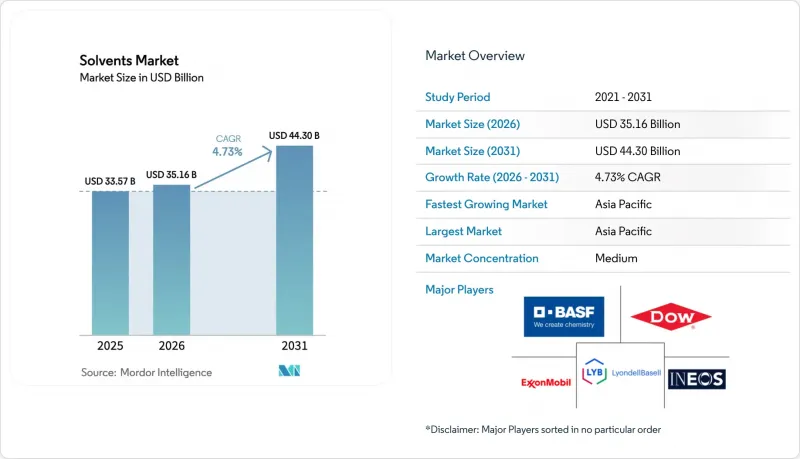
Mordor Intelligence에 의하면, 용매 시장 규모는 2025년에 335억 7,000만 달러로 평가되었고, 2026년 351억 6,000만 달러에서 2031년까지 443억 달러에 이를 것으로 추정되고 있어 예측 기간(2026-2031년) CAGR은 4.73%를 기록할 전망입니다.
본 보고서는 원료별(바이오 유래 용매 및 석유화학 유래 용매), 유형별(산소 함유 용매, 탄화수소계 용매, 할로겐화 용매), 용도별(페인트 및 코팅,접착제, 의약품 등) 및 지역별(아시아태평양, 북미, 유럽, 남미, 중동 및 아프리카)로 분류되어 있습니다. 시장 예측은 금액(달러) 기준으로 제시되어 있습니다.
세계 용매 시장 동향 및 인사이트
페인트 및 코팅 분야 수요 급증
2025년에는 건축용 및 산업용 코팅이 전 세계 용매 생산량의 거의 절반을 차지할 것으로 예상되며, VOC 함량에 대한 규제 상한선으로 인해 아세톤, 메틸에틸케톤 및 아세트산 에스테르로의 배합 변경이 가속화되고 있습니다. 2024년에 시행된 미국 에어로졸 도료 국가 배출 기준은 VOC를 중량비 45%로 제한하고 있으며, 이에 따라 배합 제조업체들은 탄화수소 블렌드를 저VOC 산소 함유 화합물로 대체해야 하는 상황에 직면해 있습니다. 중국은 2025년에 저VOC 도료의 의무 적용을 재도장 및 가구용 도료 분야로 확대했으며, 이에 따라 기준을 충족하는 글리콜 에테르에 대한 수요가 두 자릿수 성장세를 보였습니다. 동시에, 2030년까지 1,200억 달러를 넘어설 것으로 예상되는 중동의 파이프라인 개보수 예산으로 인해, 높은 용해성을 지닌 산소화 캐리어에 의존하는 에폭시 및 폴리우레탄계 도료 수요가 뒷받침되고 있습니다. 그 결과, 범용 탄화수소 공급업체들은 이익률 압박에 직면하고 있는 반면, 특수 산소화 제품 제조업체들은 규정을 준수하는 배합에서 10%-15%의 가격 프리미엄을 확보하고 있습니다.
아시아태평양 신흥 클러스터에서의 의약품 제조 가속화
2025년, 인도와 중국은 전 세계 원료의약품(API) 생산량의 38%를 차지했습니다. 이는 20억 달러 상당의 생산 연계형 인센티브와 수출 지향형 제조 단지의 급증에 힘입은 결과입니다. 하이난섬 자유무역항만 해도 2024년부터 2025년에 걸쳐 80억 달러 규모의 제약 관련 설비 투자를 유치하여 연간 12만 메트르톤 이상의 용매 수요를 창출했습니다. 베트남에서는 신규 건설된 API 공장에 대한 10년간의 면세 조치로 인해 2030년까지 15억 달러의 수출이 예상되며, 이에 따라 고순도 에탄올, 이소프로판올, 테트라하이드로푸란에 대한 지역 내 수요가 더욱 높아질 것으로 전망됩니다. 이러한 시장에서는 환경 규제가 비교적 완만하지만, 국제조화회의(ICH)에 의한 잔류 용매 관련 개정안이 예정되어 있어 순도 기준이 엄격해질 전망입니다. 이에 따라 견고한 품질 관리 체계와 검증된 회수 루프를 갖춘 공급업체가 우위를 점할 것입니다.
석유계 용매의 원료 가격 변동과 이익률에 대한 압박
2024년부터 2025년에 걸쳐 브렌트 원유 가격은 배럴당 70달러에서 85달러 사이에서 변동할 것으로 예상되며, 10달러의 가격 변동마다 통합형 용매 사업의 마진이 100-150 베이시스 포인트 변동하게 되었습니다. 2025년 1월 노르웨이공급 중단으로 인해 유럽 사업자들은 천연가스 원료 가격이 1메가와트시당 45유로까지 급등하는 추가적인 타격을 입었으며, 이로 인해 예정에 없던 크래커 가동이 중단되어 나프타를 원료로 하는 용매 생산이 위축되었습니다. 헤지 프로그램이나 정유시설와의 통합이 없는 소규모 독립형 플랜트의 경우, 매출이 5%-8% 감소했을 뿐만 아니라 자산 매각이 가속화되었습니다. 바이오 유래 경로는 어느 정도 위험 회피 효과를 가져오지만, 옥수수나 설탕 가격 변동에 따른 위험도 공존하고 있으며, 규모의 불이익으로 인해 대규모 크래커 복합 시설에 비해 현금 비용이 높은 수준을 유지하고 있습니다.
부문별 분석
2025년, 석유화학 등급 용매는 시장 점유율 84.23%를 유지했으나, 바이오 유래 대체품은 연평균 성장률(CAGR) 8.13%로 확대되고 있으며, 이는 용매 시장 전체 성장률의 거의 2배에 해당합니다. EU의 탄소 집약도 평가와 캘리포니아주의 저탄소 의무가 거래 가능한 크레딧으로 이어짐에 따라, 바이오 유래 경로에 기인한 용매 시장 규모는 2031년까지 80억 달러를 넘어설 것으로 예측됩니다. 카길(Cargill)은 2025년, 탄소 라벨을 내세운 의약품 합성용 원료를 공급하기 위해 바이오에탄올 생산량을 5만 메트릭톤 확대했습니다. 그룹 벨켐(Group Berkem)의 리그닌 유래 스트리퍼는 ISO 14001 인증을 획득했으며, 유럽의 세정 라인에서 N-메틸-2-피롤리돈의 대체재로 보급되고 있습니다.
가격에 민감한 접착제 및 금속 세정 분야에서는 비용 측면에서 여전히 석유화학계 용매가 주류를 차지하고 있습니다. 쉘과 엑슨모빌은 현재 크래커 내에서 인증된 바이오나프타를 공동 처리하여, 전용 제조 설비 없이도 재생 가능 라벨이 부착된 물질 수지 용매를 생산하고 있습니다. 이는 CoC(생산 이력)의 신뢰성에 대해 NGO의 엄격한 감시를 받고 있음에도 불구하고 시장 점유율을 지키기 위한 전략입니다. 규제가 점점 더 엄격해짐에 따라 용매 시장은 더욱 양극화될 전망입니다. 규제 대상 지역에서는 바이오 또는 물질 수지 방식의 용매가 공급되는 반면, 아시아태평양의 성장에 힘입어 석유화학계 용매 수요는 견조한 추세를 보일 것입니다.
지역별 분석
아시아태평양은 2025년에 용매 시장 점유율의 42.35%를 차지할 것으로 예상되며, 2031년까지 연평균 성장률(CAGR) 5.21%로 확대될 것으로 전망됩니다. 인도는 2024년부터 2025년에 걸쳐 제약 허브에 45억 달러의 외국인 직접 투자를 유치했으며, 이로 인해 용매 수요가 연간 9만 미터톤 증가했습니다. 중국에서는 2025년에 2급 도시에서 주택 건설이 재개됨에 따라 도료 생산량이 6% 증가했으며, 국내 주요 기업들이 용매 생산 능력을 12만 메트르톤 증설하게 되었습니다. 베트남의 세제 혜택으로 인해 2031년까지 지역 수요가 2만 메트르톤 더 증가할 가능성이 있습니다.
북미에서는 VOC 규제로 인해 소비가 탄화수소 혼합물에서 산소 함유 및 바이오 제품으로 전환되고 있습니다. 미국 환경보호청(EPA)은 2024년 화학물질 저장 탱크에 대한 증기 회수 규제를 강화했으며, 이에 대응하기 위해 3억-5억 달러를 지출해야 했습니다. 이로 인해 규제 대상이 아닌 아세톤과 메틸아세테이트가 재배합용 용매로 선호되고 있습니다. 멕시코에서는 2025년 자동차 생산 대수가 380만 대에 달하고, 2027년 이후 방향족 화합물 사용 금지가 임박했음에도 불구하고, OEM용 도료 소비량은 5%의 성장세를 유지하고 있습니다.
유럽의 용매 수요는 독일에서 진행 중인 12억 유로 규모의 용매 회수 설비 업그레이드가 주도하고 있으며, 이를 통해 신규 용매 수요를 최대 40%까지 줄이고 있습니다. 프랑스에서는 저VOC 도료 라인을 위해 2025년에 3만 메트르톤 규모의 바이오프로판올 공장이 가동을 시작했습니다. 남미, 중동 및 아프리카에서는 수요가 확대되고 있으며, 브라질의 제초제 제형과 에탄 자원이 풍부한 걸프 연안 국가들의 용매 수출이 각 지역의 틈새 시장을 채우고 있습니다.
기타 혜택:
- 엑셀 형식 시장 예측(ME) 시트
- 3개월간의 애널리스트 지원
자주 묻는 질문
목차
제1장 서론
제2장 조사 방법
제3장 주요 요약
제4장 시장 구도
제5장 시장 규모와 성장 예측
제6장 경쟁 구도
제7장 시장 기회와 향후 전망
LSH 26.09.14According to Mordor Intelligence, the solvents market size was valued at USD 33.57 billion in 2025 and is estimated to grow from USD 35.16 billion in 2026 to reach USD 44.30 billion by 2031, at a CAGR of 4.73% during the forecast period (2026-2031).
This report is Segmented by Source (Bio-Based Solvents and Petrochemical-Based Solvents), Type (Oxygenated Solvents, Hydrocarbon Solvents, and Halogenated Solvents), Application (Paints and Coatings, Adhesives, Pharmaceuticals, and More), and Geography (Asia-Pacific, North America, Europe, South America, Middle East and Africa). Market Forecasts are Provided in Terms of Value (USD).
Global Solvents Market Trends and Insights
Surging Demand From Paints And Coatings
Architectural and industrial coatings absorbed nearly half of global solvent output in 2025, and regulatory ceilings on VOC content are accelerating reformulation toward acetone, methyl ethyl ketone, and acetate esters. The U.S. National Emission Standards for aerosol coatings that became effective in 2024 limit VOC to 45% by weight, prompting formulators to displace hydrocarbon blends with low-VOC oxygenates. China extended its low-VOC coatings mandate in 2025 to refinishing and furniture lines, triggering a double-digit jump in demand for compliant glycol ethers. Simultaneously, Middle Eastern pipeline refurbishment budgets exceeding USD 120 billion through 2030 are sustaining epoxy and polyurethane coatings that rely on high-solvency oxygenated carriers. Commodity hydrocarbon suppliers, therefore, face margin pressure, while specialty oxygenated producers command 10%-15% price premiums in compliant formulations.
Accelerating Pharmaceutical Manufacturing In Emerging Asia-Pacific Clusters
India and China produced 38% of global active pharmaceutical ingredients in 2025, lifted by Production-Linked Incentives worth USD 2 billion and a surge of export-oriented manufacturing parks. Hainan's Free Trade Port alone attracted USD 8 billion of pharma capital expenditure in 2024-2025, adding solvent demand surpassing 120,000 metric tons per year. Vietnam's ten-year tax holidays for greenfield API plants are set to pull in USD 1.5 billion of exports by 2030, further lifting regional uptake of high-purity ethanol, isopropanol, and tetrahydrofuran. Although these markets apply lighter environmental oversight, planned International Council for Harmonisation (ICH) residual-solvent updates will tighten purity targets, favoring suppliers with robust quality systems and validated recovery loops.
Feedstock Volatility And Margin Pressure For Petro-Solvents
Brent crude oscillated between USD 70 and USD 85 per barrel during 2024-2025, translating each USD 10 move into a 100- to 150-basis-point swing in integrated solvent margins. European operators endured an additional spike in natural-gas feedstock to EUR 45 per megawatt-hour after Norwegian outages in January 2025, triggering unplanned cracker shutdowns and curtailing naphtha-sourced solvent output. Smaller standalone units, lacking hedging programs or refinery integration, recorded revenue declines of 5%-8% and accelerated asset divestitures. Although bio-routes offer partial insulation, volatility in corn and sugar prices introduces parallel risk profiles, and scale disadvantages keep cash costs higher than large cracker complexes.
Other drivers and restraints analyzed in the detailed report include:
- Tightening VOC Caps In North America And EU Encouraging Solvent Substitution
- Rapid Scale-Up Of Solvent-Based Polymer Recycling Technologies
- High Cost-Of-Ownership For Bio-Solvent Formulations In High-Spec Inks
For complete list of drivers and restraints, kindly check the Table Of Contents.
Segment Analysis
Petrochemical grades retained 84.23% solvents market share in 2025, yet bio-based alternatives are advancing at an 8.13% CAGR that nearly doubles overall solvents market growth. The solvents market size attributable to bio routes is projected to surpass USD 8 billion by 2031 as EU carbon-intensity scoring and California's low-carbon mandates translate into tradable credits. Cargill expanded bio-ethanol output by 50,000 metric tons in 2025 to supply pharmaceutical syntheses with carbon-label claims. Groupe Berkem's lignin-derived stripper landed ISO 14001 certification and is displacing N-methyl-2-pyrrolidone in European cleaning lines.
In price-sensitive adhesives and metal cleaning, petrochemical solvents still dominate on cost grounds. Shell and ExxonMobil now co-process certified bio-naphtha within crackers, producing mass-balance solvents that carry renewable labels without dedicated units-a tactic that shields share while facing scrutiny from NGOs over chain-of-custody credibility. As regulatory intensity rises, the solvents market is likely to bifurcate further: bio-based or mass-balance streams serve regulated regions, while Asia-Pacific growth keeps petrochemical demand buoyant.
Complete Report Scope:
- By Source
- Bio-based Solvents
- Petrochemical-based Solvents
- By Type
- Oxygenated Solvents
- Hydrocarbon Solvents
- Halogenated Solvents
- By Application
- Paints and Coatings
- Adhesives
- Pharmaceuticals
- Personal Care
- Polymer Production
- Other Applications (Printing Inks, Agricultural Chemicals, and Metal Cleaning)
- By Geography
- Asia-Pacific
- China
- India
- Japan
- South Korea
- Malaysia
- Thailand
- Indonesia
- Vietnam
- Rest of Asia-Pacific
- North America
- United States
- Canada
- Mexico
- Europe
- Germany
- United Kingdom
- France
- Italy
- Spain
- Nordic
- Turkey
- Russia
- Rest of Europe
- South America
- Brazil
- Argentina
- Colombia
- Rest of South America
- Middle East and Africa
- Saudi Arabia
- Qatar
- United Arab Emirates
- South Africa
- Nigeria
- Egypt
- Rest of Middle East and Africa
- Asia-Pacific
Geography Analysis
Asia-Pacific generated 42.35% of the solvents market share in 2025 and is forecast to expand at a 5.21% CAGR through 2031. India secured USD 4.5 billion of foreign direct investment into pharma hubs between 2024-2025, boosting solvent uptake by 90,000 metric tons annually. China's coatings output rose 6% in 2025 as residential construction in tier-2 cities resumed, prompting domestic giants to add 120,000 metric tons of solvent capacity. Vietnam's tax incentives could lift regional demand by another 20,000 metric tons by 2031.
In North America, VOC regulations redirect consumption from hydrocarbon blends toward oxygenated and bio-based streams. The U.S. EPA tightened vapor-recovery rules for chemical storage tanks in 2024, compelling a USD 300-500 million spend on compliance that favors exempt acetone and methyl acetate as reformulation solvents. Mexico's 3.8 million vehicle output in 2025 sustains 5% growth in OEM coatings consumption, even as aromatic bans loom post-2027.
Europe's solvent demand is led by Germany's EUR 1.2 billion solvent-recovery upgrades that cut virgin demand by up to 40%. France commissioned a 30,000-metric-ton bio-propanol plant in 2025 to serve low-VOC coatings lines. South America and the Middle East and Africa are witnessing rising demand, with Brazil's herbicide formulations and Gulf ethane-advantaged solvent exports filling regional niches.
- ADM
- Arkema
- Ashland
- BASF SE
- Bharat Petroleum Corporation Limited
- Braskem
- Cargill, Incorporated
- Celanese Corporation
- Chevron Phillips Chemical Company LLC
- Clariant
- Dow
- Eastman Chemical Company
- Exxon Mobil Corporation
- Gandhar Oil Refinery (India) Limited
- GROUPE BERKEM
- Honeywell International Inc.
- Huntsman International LLC
- Idemitsu Kosan Co., Ltd.
- INEOS
- LyondellBasell Industries Holdings BV
- OXEA
- Sasol Limited
- Shell plc
- Solvay
- TotalEnergies SE
Additional Benefits:
- The market estimate (ME) sheet in Excel format
- 3 months of analyst support
TABLE OF CONTENTS
1 Introduction
- 1.1 Study Assumptions and Market Definition
- 1.2 Scope of the Study
2 Research Methodology
3 Executive Summary
4 Market Landscape
- 4.1 Market Overview
- 4.2 Market Drivers
- 4.2.1 Surging demand from paints and coatings
- 4.2.2 Accelerating pharmaceutical manufacturing in emerging Asia-Pacific clusters
- 4.2.3 Tightening VOC caps in North-America and EU encouraging solvent substitution
- 4.2.4 Rapid scale-up of solvent-based polymer recycling technologies
- 4.2.5 AI-driven, closed-loop solvent-recovery systems cutting opex for end-users
- 4.3 Market Restraints
- 4.3.1 Feed-stock volatility and margin pressure for petro-solvents
- 4.3.2 High cost-of-ownership for bio-solvent formulations in high-spec inks
- 4.3.3 Growing OEM bans on aromatic solvents in automotive interiors post-2027
- 4.4 Value Chain Analysis
- 4.5 Porter's Five Forces
- 4.5.1 Bargaining Power of Suppliers
- 4.5.2 Bargaining Power of Buyers
- 4.5.3 Threat of New Entrants
- 4.5.4 Threat of Substitute Products and Services
- 4.5.5 Degree of Competition
5 Market Size and Growth Forecasts (Value)
- 5.1 By Source
- 5.1.1 Bio-based Solvents
- 5.1.2 Petrochemical-based Solvents
- 5.2 By Type
- 5.2.1 Oxygenated Solvents
- 5.2.2 Hydrocarbon Solvents
- 5.2.3 Halogenated Solvents
- 5.3 By Application
- 5.3.1 Paints and Coatings
- 5.3.2 Adhesives
- 5.3.3 Pharmaceuticals
- 5.3.4 Personal Care
- 5.3.5 Polymer Production
- 5.3.6 Other Applications (Printing Inks, Agricultural Chemicals, and Metal Cleaning)
- 5.4 By Geography
- 5.4.1 Asia-Pacific
- 5.4.1.1 China
- 5.4.1.2 India
- 5.4.1.3 Japan
- 5.4.1.4 South Korea
- 5.4.1.5 Malaysia
- 5.4.1.6 Thailand
- 5.4.1.7 Indonesia
- 5.4.1.8 Vietnam
- 5.4.1.9 Rest of Asia-Pacific
- 5.4.2 North America
- 5.4.2.1 United States
- 5.4.2.2 Canada
- 5.4.2.3 Mexico
- 5.4.3 Europe
- 5.4.3.1 Germany
- 5.4.3.2 United Kingdom
- 5.4.3.3 France
- 5.4.3.4 Italy
- 5.4.3.5 Spain
- 5.4.3.6 Nordic
- 5.4.3.7 Turkey
- 5.4.3.8 Russia
- 5.4.3.9 Rest of Europe
- 5.4.4 South America
- 5.4.4.1 Brazil
- 5.4.4.2 Argentina
- 5.4.4.3 Colombia
- 5.4.4.4 Rest of South America
- 5.4.5 Middle East and Africa
- 5.4.5.1 Saudi Arabia
- 5.4.5.2 Qatar
- 5.4.5.3 United Arab Emirates
- 5.4.5.4 South Africa
- 5.4.5.5 Nigeria
- 5.4.5.6 Egypt
- 5.4.5.7 Rest of Middle East and Africa
- 5.4.1 Asia-Pacific
6 Competitive Landscape
- 6.1 Market Concentration
- 6.2 Strategic Moves
- 6.3 Market Share/Ranking Analysis
- 6.4 Company Profiles (includes Global level Overview, Market level overview, Core Segments, Financials as available, Strategic Information, Market Rank/Share for key companies, Products and Services, and Recent Developments)
- 6.4.1 ADM
- 6.4.2 Arkema
- 6.4.3 Ashland
- 6.4.4 BASF SE
- 6.4.5 Bharat Petroleum Corporation Limited
- 6.4.6 Braskem
- 6.4.7 Cargill, Incorporated
- 6.4.8 Celanese Corporation
- 6.4.9 Chevron Phillips Chemical Company LLC
- 6.4.10 Clariant
- 6.4.11 Dow
- 6.4.12 Eastman Chemical Company
- 6.4.13 Exxon Mobil Corporation
- 6.4.14 Gandhar Oil Refinery (India) Limited
- 6.4.15 GROUPE BERKEM
- 6.4.16 Honeywell International Inc.
- 6.4.17 Huntsman International LLC
- 6.4.18 Idemitsu Kosan Co., Ltd.
- 6.4.19 INEOS
- 6.4.20 LyondellBasell Industries Holdings BV
- 6.4.21 OXEA
- 6.4.22 Sasol Limited
- 6.4.23 Shell plc
- 6.4.24 Solvay
- 6.4.25 TotalEnergies SE
7 Market Opportunities and Future Outlook
- 7.1 White-space and Unmet-need Assessment


