

|
시장보고서
상품코드
2124451
알카라인 배터리 : 시장 점유율 분석, 업계 동향 및 통계, 성장 예측(2026-2031년)Alkaline Battery - Market Share Analysis, Industry Trends & Statistics, Growth Forecasts (2026 - 2031) |
||||||
 Mordor Intelligence
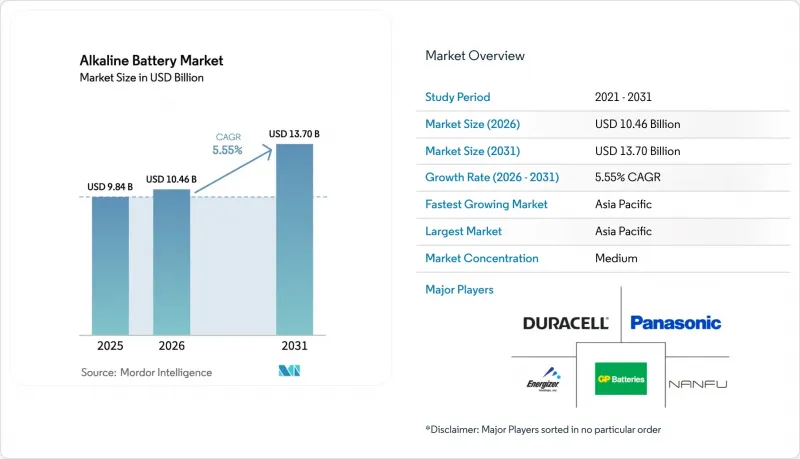
Mordor Intelligence에 의하면, 알카라인 배터리 시장 규모는 2025년에 98억 4,000만 달러로 평가되었습니다. 2026년 104억 6,000만 달러에서 2031년까지 137억 달러에 이를 것으로 추정되고 예측 기간(2026-2031년) CAGR은 5.55%를 나타낼 전망입니다.
본 보고서는 배터리 유형(1차 전지·2차 전지), 크기(AA, AAA, 9볼트, C, D, 코인형·특수 크기), 용도(소비자 가전, 산업용·상업용 기기, 의료기기, 조명·손전등 등), 지역(북미, 유럽, 아시아태평양, 남미, 중동 및 아프리카)별로 분류되어 있습니다. 시장 규모 및 예측은 금액(달러)으로 표시되어 있습니다.
세계의 알카라인 배터리 시장 동향 및 인사이트
소비자 가전 분야에서 일회용 전원에 대한 수요 증가
2025년에도 소비자 가전 분야의 점유율은 45.6%를 유지했으나, 사용 패턴은 리튬이온 배터리를 채택한 프리미엄 기기와, 비용과 신뢰성 측면에서 여전히 알카라인 배터리를 선호하는 저전력 주변기기, 리모컨, 시계, 스마트홈 센서 등 방대한 기존 기기군으로 양분되고 있습니다. 인도의 소매 현대화로 인해 브랜드 배터리가 체계적인 진열대에 배치되면서, 소비자들이 아연-탄소 배터리에서 고급 제품으로 전환함에 따라 판매량이 증가했습니다. 파나소닉과 듀라셀은 현재 스마트 홈 허브를 겨냥해 10년 누출 방지 보증을 제공하는 장수명 AA 및 AAA 제품군을 출시하고 있습니다. 부유층 시장에서는 USB 충전식 기기가 확산되고 있지만, 아시아와 라틴 아메리카 전역의 보급형 기기 판매량 증가로 인해 견고한 교체 주기가 유지되고 있습니다. 그 결과, 리튬이온 배터리가 다른 분야에서 성장하고 있음에도 알칼리 배터리 시장을 뒷받침하는 안정적인 수요 기반이 형성되었습니다.
저전력 IoT 센서 기기의 보급
싱가포르, 선전, 서울의 각 시 정부는 마이크로암페어급 전류만 소비하는 대기질 센서나 주차 센서를 수천 대 도입하고 있습니다. 이는 알칼리 건전지가 아연-탄소 건전지보다 와트당 비용 대비 성능이 뛰어나고, 리튬 1차 전지처럼 유해 폐기물로 표시할 필요가 없다는 점에서 그야말로 ‘최적의 영역’입니다. IEC 60086 준수를 통해 호환성 있는 조달이 가능해지며, 이는 부품 부족 시 장점으로 작용합니다. 각 공급업체는 표준화된 AA 카트리지를 채택하고 있어 현장 작업자가 전용 공구 없이도 배터리를 교체할 수 있으므로 출장 대응 비용을 절감할 수 있습니다. 2024년 조사에서는 저부하 조건에서 알카라인 배터리가 아연-탄소 전지보다 높은 에너지 밀도를 갖는 것으로 확인되었지만, 펄스 전류의 제한은 여전히 무선 원격 측정에서 제약 요인으로 남아 있습니다. 에너지 수확 모듈 덕분에 향후 10년 후반에는 교체 빈도가 줄어들 가능성이 있지만, 현재로서는 지자체 입찰에서 여전히 1차 알칼리 건전지가 기본으로 채택되고 있어 장기적인 판매량 예측 가능성이 높아지고 있습니다.
리튬이온 충전식 배터리와의 성능 격차
리튬 이온 배터리는 전력 소모가 큰 기기에서 1차 알칼리 건전지의 3-5배에 달하는 에너지 밀도를 실현하고 있어, 이로 인해 알칼리 건전지는 플래그십 모델의 카메라나 게임 컨트롤러에서 점차 배제되고 있습니다. 충전식 알카라인 배터리는 25-50회 충전 주기밖에 지속되지 않기 때문에 더 안전한 수계 전해액을 채택하고 있음에도 불구하고 보급에는 한계가 있습니다. 2024년에는 이산화망간-아연 충전식 배터리의 연구 개발이 실험실 수준에서 진전을 보였으나, 덴드라이트 형성이 여전히 양산화의 걸림돌로 남아 있습니다. 각 브랜드는 작동 시간을 약간 향상시킨 ‘궁극의’ 알카라인 배터리 시리즈로 대응하고 있지만, 펄스 전류 특성 면에서는 물리적 특성상 리튬 이온 전지가 우위에 있습니다. 고급 가제트가 USB-C 표준화로 나아가고 있는 가운데, 알카라인 배터리는 존재 의의를 유지하기 위해 저전력 소비 틈새 시장으로 무게중심을 옮겨야 합니다.
부문별 분석
2025년, 1차 알카라인 배터리는 매출 점유율 74.5%를 유지하며 알카라인 배터리 시장에서의 우위를 확고히 했습니다. 유지보수가 필요 없다는 특성은 비상용 키트, 화재 감지기, IoT 센서와 잘 어울립니다. 군사 분야의 구매자들은 충전식 배터리로는 달성할 수 없는 10년의 보관 기간을 요구 사항으로 지정하고 있습니다. 1차 알카라인 배터리 시장 규모는 2031년까지 101억 달러에 달할 전망이며, 기존 기업들에게는 견실한 현금 흐름 창출이 지속될 것으로 보입니다.
2차 알카라인 배터리는 현재 극히 적은 시장 점유율에 불과하지만, 환경 의식이 높은 가정이 일회용 전지와 리튬이온 전지 사이의 중간적인 해결책을 모색함에 따라 2031년까지 연평균 성장률(CAGR) 8.9%로 성장할 것으로 전망됩니다. 각 제조업체는 소비자의 회의적인 시각을 불식시키기 위해 안전한 수계 전해액과 친숙한 형태를 강조하고 있습니다. 조기 도입처로는 레이저 포인터 등 전력 소비량이 중간 정도인 기기를 빈번하게 재사용하는 학교나 사무실을 들 수 있습니다. 다만, 사이클 수명이 100회 충전에 가까워질 때까지는 2차 전지가 1차 전지의 판매를 잠식하기보다는 보완하는 역할을 수행하며, 알카라인 배터리 시장 전체의 균형 잡힌 성장을 뒷받침하게 될 것입니다.
지역별 분석
아시아태평양은 2025년에 38.3%의 점유율로 1위를 차지했으며, 중국의 제조업 규모와 인도의 소매업 현대화에 힘입어 2031년까지 연평균 6.4%의 성장이 예상됩니다. 중국은 아연·망간 통합 공급망에 힘입어 전 세계 알칼리 건전지 생산량의 약 70%를 공급하고 있습니다. 인도 소비자들은 대형 마트에서 브랜드 제품의 멀티팩을 구매하는 경향이 강해지고 있어 잠재적 수요가 확대되고 있습니다. 아세안(ASEAN) 국가들의 스마트 시티 도입으로 저전력 AA 센서에 대한 수요가 꾸준히 증가하고 있으며, 각국 정부는 유지보수를 용이하게 하기 위해 표준 폼 팩터의 채택을 장려하고 있습니다.
북미와 유럽은 성숙한 시장이지만 수익성이 높은 분야입니다. 각 브랜드는 위조 방지 포장이나 긴 수명을 내세워 프리미엄 가격을 실현하고 있습니다. EU 규정에 따라 2025년까지 65%의 회수율이 의무화되어 제조업체들은 재활용에 투자할 수밖에 없지만, 그와 동시에 과거에는 유해 물질 표시로 인해 진입이 차단되었던 식료품점 유통 채널로 진출할 수 있는 길이 열리고 있습니다. 또한 소비자들이 충전식 제품으로 전환하고 있음에도 불구하고, 미군의 광범위한 온도 범위를 지원하는 D형·C형 배터리 조달로 인해 산업용 수요는 안정적입니다.
남미, 중동 및 아프리카는 소규모 기반에서 점차 확대되고 있습니다. 브라질과 멕시코에서는 현대적인 소매점의 진열 공간이 증가하고 있지만, 농촌 지역에서는 ‘캐시 앤 캐리’ 방식이 주류를 이루고 있어 시장 침투에는 한계가 있습니다. 아랍에미리트(UAE)와 사우디아라비아에서는 민방위 키트에 알칼리 건전지가 포함되어 있는 반면, 아프리카의 NGO들은 태양광 충전기 보급이 산발적인 지역에서 1차 전지로 구동되는 손전등을 배포하고 있습니다. 공급망 마찰, 항만 혼잡, 환율 변동이 비용 증가 요인으로 작용하고 있지만, 도시화의 진전은 알카라인 건전지 시장에 장기적인 호재로 작용하고 있습니다.
기타 혜택 :
- 엑셀 형식 시장 예측(ME) 시트
- 3개월간의 애널리스트 지원
자주 묻는 질문
목차
제1장 서론
제2장 조사 방법
제3장 주요 요약
제4장 시장 구도
제5장 시장 규모 및 성장 예측
제6장 경쟁 구도
제7장 시장 기회 및 향후 전망
KTH 26.09.14According to Mordor Intelligence, the alkaline battery market size was valued at USD 9.84 billion in 2025 and is estimated to grow from USD 10.46 billion in 2026 to reach USD 13.70 billion by 2031, at a CAGR of 5.55% during the forecast period (2026-2031).
This report is Segmented by Battery Type (Primary and Secondary), Size (AA, AAA, 9-Volt, C, D, and Coin and Specialty), Application (Consumer Electronics, Industrial and Commercial Devices, Medical Devices, Lighting and Flashlights, and More), and Geography (North America, Europe, Asia-Pacific, South America, and Middle East and Africa). The Market Sizes and Forecasts are Provided in Terms of Value (USD).
Global Alkaline Battery Market Trends and Insights
Rising Demand for Disposable Power in Consumer Electronics
Consumer electronics retained a 45.6% share in 2025, yet usage is splitting between premium gadgets adopting lithium-ion and a large installed base of low-drain peripherals, remote controls, clocks, and smart-home sensors that still prefer alkaline for cost and reliability. India's retail modernization placed branded batteries on organized shelves, lifting unit volumes as shoppers traded up from zinc-carbon packs. Panasonic and Duracell now market extended-life AA and AAA lines with 10-year leak-proof guarantees aimed at smart-home hubs. Although USB-rechargeable devices proliferate in affluent segments, volume growth in entry-level gadgets across Asia and Latin America preserves a robust replacement cycle. The net result is a stable demand core that underpins the alkaline battery market even while lithium-ion expands elsewhere.
Penetration of Low-Drain IoT Sensing Devices
City governments in Singapore, Shenzhen, and Seoul deploy thousands of air-quality or parking sensors that draw micro-amp currents, a sweet spot where alkaline delivers better cost-per-watt than zinc-carbon without the hazardous-waste labeling lithium-primary chemistries require. Compliance with IEC 60086 enables interchangeable sourcing, an advantage during component shortages. Vendors adopt standardized AA cartridges so field crews can swap cells without proprietary tools, reducing truck-roll costs. Research in 2024 confirmed alkaline's higher energy density under low loads versus zinc-carbon, though pulse-current limitations remain a boundary in wireless telemetry. Energy-harvesting modules could trim replacement rates later in the decade, yet municipal tenders still default to primary alkaline today, bolstering long-term volume visibility.
Performance Gap Versus Lithium-Ion Rechargeables
Lithium-ion delivers 3-5X the energy density of primary alkaline in high-drain devices, pushing alkaline out of flagship cameras and game controllers. Rechargeable alkaline offers only 25-50 cycles, limiting adoption despite a safer aqueous electrolyte. R&D into zinc-manganese dioxide rechargeables made lab progress in 2024, yet dendrite formation still curtails mass-market readiness. Brands respond with "ultimate" alkaline lines that squeeze incremental runtime gains, but physics favors lithium-ion for pulse-current profiles. As premium gadgets march toward USB-C standardization, alkaline cells must pivot to low-drain niches to remain relevant.
Other drivers and restraints analyzed in the detailed report include:
- Expansion of Organized Retail in Emerging Economies
- Growing Off-Grid Emergency-Preparedness Spend
- Rising E-Commerce Counterfeit Battery Incidents
For complete list of drivers and restraints, kindly check the Table Of Contents.
Segment Analysis
Primary alkaline cells retained 74.5% revenue share in 2025, underlining their dominance in the alkaline battery market. Their zero-maintenance nature aligns with emergency kits, smoke detectors, and IoT sensors. Military buyers specify a 10-year shelf-life that rechargeable formats cannot match. The alkaline battery market size for primary cells is poised to reach USD 10.1 billion by 2031, maintaining healthy cash generation for incumbents.
Secondary alkaline variants, while only a sliver today, are set to grow at an 8.9% CAGR to 2031 as environmentally minded households seek midway solutions between disposables and lithium-ion. Manufacturers emphasize safe aqueous electrolytes and familiar form factors to overcome consumer skepticism. Early adopters are schools and offices that cycle through moderate-drain devices like laser pointers. However, until cycle life approaches 100 charges, secondary formats will complement rather than cannibalize primary sales, supporting balanced growth inside the alkaline battery market.
Complete Report Scope:
- By Battery Type
- Primary
- Secondary (Rechargeable Alkaline)
- By Size
- AA (LR6)
- AAA (LR03)
- 9-Volt
- C
- D
- Coin and Specialty
- By Application
- Consumer Electronics
- Industrial and Commercial Devices
- Medical Devices
- Toys and Entertainment
- Lighting and Flashlights
- By Geography
- North America
- United States
- Canada
- Mexico
- Europe
- Germany
- United Kingdom
- France
- Italy
- NORDIC Countries
- Russia
- Rest of Europe
- Asia-Pacific
- China
- India
- Japan
- South Korea
- ASEAN Countries
- Australia and New Zealand
- Rest of Asia-Pacific
- South America
- Brazil
- Argentina
- Colombia
- Rest of South America
- Middle East and Africa
- Saudi Arabia
- United Arab Emirates
- South Africa
- Egypt
- Rest of Middle East and Africa
- North America
Geography Analysis
Asia-Pacific dominated with 38.3% share in 2025 and should post 6.4% annual growth to 2031, fueled by China's manufacturing heft and India's retail modernization. China supplies roughly 70% of global alkaline output, underpinned by integrated zinc and manganese supply chains. Indian consumers increasingly buy branded multipacks in hypermarkets, widening addressable demand. ASEAN smart-city deployments add steady volumes for low-drain AA sensors, and governments encourage standard form factors to facilitate maintenance.
North America and Europe are mature but profitable arenas. Brands command premium prices via anti-counterfeit packaging and long-life claims. EU regulations enforce a 65% collection rate by 2025, compelling producers to invest in recycling yet opening grocery channels once barred by hazardous labeling. U.S. military procurement for wide-temperature D and C cells stabilizes industrial demand despite consumer shifts to rechargeable alternatives.
South America and the Middle East-Africa corridor expand from smaller bases. Brazil and Mexico gain shelf space in modern retail, yet rural cash-and-carry dominance limits penetration. The UAE and Saudi Arabia incorporate alkaline batteries into civil-defense kits, while African NGOs distribute torches powered by primary cells where solar-charger reach is sporadic. Supply-chain friction, port congestion, and currency swings add cost, but rising urbanization provides a long-run tailwind for the alkaline battery market.
- Duracell Inc
- Energizer Holdings Inc
- Panasonic Corporation
- GP Batteries International Ltd
- Nanfu Battery Co Ltd
- VARTA AG
- Koninklijke Philips NV
- Fujitsu Ltd
- Maxell Holdings Ltd
- Sony Group (Murata Manufacturing battery business)
- Spectrum Brands (Rayovac)
- Toshiba Corporation
- Camelion Battery Co
- Shenzhen PKCELL Battery Co Ltd
- Eveready Industries India Ltd
- Zhejiang Must Power Co Ltd
- Sunbeam Products Inc
- Amperex Technology Ltd (ATL) - Primary division
- Union Battery Corporation
- Euroforce Battery Co
Additional Benefits:
- The market estimate (ME) sheet in Excel format
- 3 months of analyst support
TABLE OF CONTENTS
1 Introduction
- 1.1 Study Assumptions & Market Definition
- 1.2 Scope of the Study
2 Research Methodology
3 Executive Summary
4 Market Landscape
- 4.1 Market Overview
- 4.2 Market Drivers
- 4.2.1 Rising demand for disposable power in consumer electronics
- 4.2.2 Penetration of low-drain IoT sensing devices
- 4.2.3 Expansion of organized retail in emerging economies
- 4.2.4 Growing off-grid emergency-preparedness spend
- 4.2.5 Military need for wide-temperature-range primary cells
- 4.2.6 Post-mercury regulations opening new retail channels
- 4.3 Market Restraints
- 4.3.1 Performance gap versus Li-ion rechargeables
- 4.3.2 Rising e-commerce counterfeit battery incidents
- 4.3.3 Municipal landfill restrictions on single-use cells
- 4.3.4 Supply volatility of zinc and manganese ores
- 4.4 Supply-Chain Analysis
- 4.5 Regulatory Landscape
- 4.6 Technological Outlook
- 4.7 Porter's Five Forces
- 4.7.1 Bargaining Power of Suppliers
- 4.7.2 Bargaining Power of Consumers
- 4.7.3 Threat of New Entrants
- 4.7.4 Threat of Substitute Products & Services
- 4.7.5 Intensity of Competitive Rivalry
5 Market Size & Growth Forecasts
- 5.1 By Battery Type
- 5.1.1 Primary
- 5.1.2 Secondary (Rechargeable Alkaline)
- 5.2 By Size
- 5.2.1 AA (LR6)
- 5.2.2 AAA (LR03)
- 5.2.3 9-Volt
- 5.2.4 C
- 5.2.5 D
- 5.2.6 Coin and Specialty
- 5.3 By Application
- 5.3.1 Consumer Electronics
- 5.3.2 Industrial and Commercial Devices
- 5.3.3 Medical Devices
- 5.3.4 Toys and Entertainment
- 5.3.5 Lighting and Flashlights
- 5.4 By Geography
- 5.4.1 North America
- 5.4.1.1 United States
- 5.4.1.2 Canada
- 5.4.1.3 Mexico
- 5.4.2 Europe
- 5.4.2.1 Germany
- 5.4.2.2 United Kingdom
- 5.4.2.3 France
- 5.4.2.4 Italy
- 5.4.2.5 NORDIC Countries
- 5.4.2.6 Russia
- 5.4.2.7 Rest of Europe
- 5.4.3 Asia-Pacific
- 5.4.3.1 China
- 5.4.3.2 India
- 5.4.3.3 Japan
- 5.4.3.4 South Korea
- 5.4.3.5 ASEAN Countries
- 5.4.3.6 Australia and New Zealand
- 5.4.3.7 Rest of Asia-Pacific
- 5.4.4 South America
- 5.4.4.1 Brazil
- 5.4.4.2 Argentina
- 5.4.4.3 Colombia
- 5.4.4.4 Rest of South America
- 5.4.5 Middle East and Africa
- 5.4.5.1 Saudi Arabia
- 5.4.5.2 United Arab Emirates
- 5.4.5.3 South Africa
- 5.4.5.4 Egypt
- 5.4.5.5 Rest of Middle East and Africa
- 5.4.1 North America
6 Competitive Landscape
- 6.1 Market Concentration
- 6.2 Strategic Moves (M&A, Partnerships, PPAs)
- 6.3 Market Share Analysis (Market Rank/Share for key companies)
- 6.4 Company Profiles (includes Global level Overview, Market level overview, Core Segments, Financials as available, Strategic Information, Products & Services, and Recent Developments)
- 6.4.1 Duracell Inc
- 6.4.2 Energizer Holdings Inc
- 6.4.3 Panasonic Corporation
- 6.4.4 GP Batteries International Ltd
- 6.4.5 Nanfu Battery Co Ltd
- 6.4.6 VARTA AG
- 6.4.7 Koninklijke Philips NV
- 6.4.8 Fujitsu Ltd
- 6.4.9 Maxell Holdings Ltd
- 6.4.10 Sony Group (Murata Manufacturing battery business)
- 6.4.11 Spectrum Brands (Rayovac)
- 6.4.12 Toshiba Corporation
- 6.4.13 Camelion Battery Co
- 6.4.14 Shenzhen PKCELL Battery Co Ltd
- 6.4.15 Eveready Industries India Ltd
- 6.4.16 Zhejiang Must Power Co Ltd
- 6.4.17 Sunbeam Products Inc
- 6.4.18 Amperex Technology Ltd (ATL) - Primary division
- 6.4.19 Union Battery Corporation
- 6.4.20 Euroforce Battery Co
7 Market Opportunities & Future Outlook
- 7.1 White-Space & Unmet-Need Assessment


