|
시장보고서
상품코드
2124454
상용 항공기 엔진 : 시장 점유율 분석, 업계 동향과 통계, 성장 예측(2026-2031년)Commercial Aircraft Engines - Market Share Analysis, Industry Trends & Statistics, Growth Forecasts (2026 - 2031) |
||||||
 Mordor Intelligence
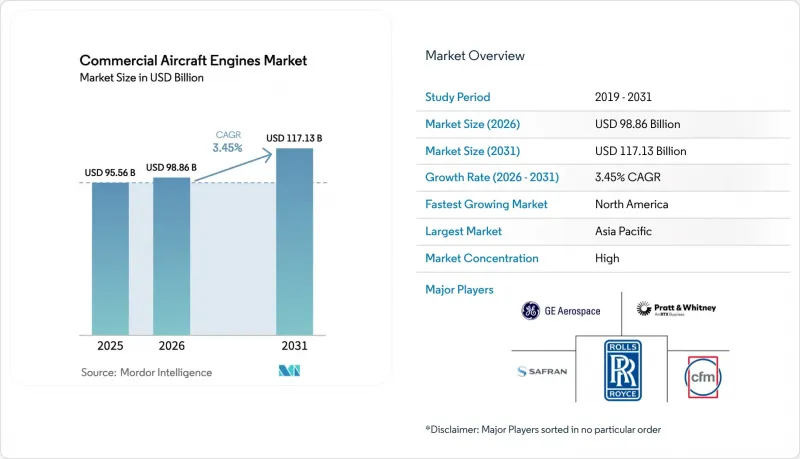
Mordor Intelligence에 의하면, 상용 항공기 엔진 시장 규모는 2025년 955억 6,000만 달러에서 2026년에는 988억 6,000만 달러에 이르고, 2026-2031년 CAGR 3.45%로 성장을 지속하여 2031년에는 1,171억 3,000만 달러에 달할 것으로 예측됩니다.
본 보고서는 항공기 유형(나로우드, 와이드바디, 리저널), 엔진 유형(터보팬, 터보프롭), 엔진 구성품(압축기, 터빈 등), 추력 등급(10,000Lbf 미만 등), 최종 사용자(OEM 공장 장착 등), 기술(기존, GTF 등), 지역(북미, 남미 등)에 따라 분류되어 있습니다. 시장 예측은 금액(달러) 기준으로 제시되어 있습니다.
전 세계 상용 항공기 엔진 시장 동향 및 인사이트
LCC 주도의 아시아태평양 기단 확대
인도, 베트남, 인도네시아의 저비용 항공사(LCC)는 과거 평균 인도 대수를 상회하는 규모로 계속해서 단일 통로형 항공기를 발주하고 있습니다. 인디고(IndiGo)의 A320neo 계열 500대 수주와 벳젯(VietJet)의 A321neo 100대 구매 계약은 해당 지역의 여객 수송량 구조적 증가를 뒷받침하고 있으며, 이에 따라 각 엔진 제조업체들은 벵갈루루,호치민시, 자카르타에 MRO(정비·수리·오버홀) 체계를 사전에 구축하고 있습니다. 하루 12시간을 초과하는 가동은 핫 섹션의 마모를 가속화하며, 이로 인해 정비 입고 일정이 앞당겨져 애프터마켓 수요가 안정화됩니다. 따라서 엔진 공급사들은 운항 신뢰성 리스크를 완화하기 위해 아시아태평양 항공사들을 대상으로 좁은 동체 항공기용 예비 엔진 풀을 확보하고 있습니다. 상업용 항공기 엔진 시장은 모든 기체에 2기의 추진 장치가 필요하다는 점에 더해, 이에 상응하는 다년간의 서비스 계약이 존재한다는 사실로부터 혜택을 받고 있습니다.
연비 효율이 높은 엔진을 통한 협폭기 교체 가속화
유나이티드 항공,사우스웨스트 항공, 그리고 유럽의 각 항공사는 경제적 수명을 대폭 앞당겨 CFM56-7B 및 V2500-A5 엔진을 퇴역시키고, 후속 기종인 LEAP-1B나 PW1100G를 통해 15-20%의 연료 소비 절감 효과를 얻으려 하고 있습니다. 제트 연료비 급등으로 인해 투자 회수 기간이 단축되면서, 항공기 신속 교체가 경제적으로 합리적인 선택이 되고 있습니다. 그러나 조기 퇴역으로 인해 사용되었으나 여전히 작동 가능한 부품이 중고 부품 시장에 대량으로 유입되어 OEM의 예비 부품 가격을 낮추는 한편, 엔진 제조업체들은 디지털 서비스를 통한 수익 확대에 주력하고 있습니다. 또한, 교체 주기의 단축은 추력 정격 변경을 위한 인증 일정을 앞당겨 엔지니어링 팀에 압박을 주는 한편, 차세대 엔진의 가치 제안을 강화하는 결과로 이어지고 있습니다. 그 결과, 상용 항공기 엔진 시장의 각 기업은 예측 가능한 이익률을 확보하기 위해 장기 ‘운행 시간당 과금(Power-by-the-Hour)’ 계약을 조합하여 제공합니다.
단조 및 주조 공급 병목 현상 지속
고압 터빈 디스크 및 니켈 합금 단조품은 LEAP 및 GTF의 각 생산 라인에서 여전히 병목 현상을 일으키고 있습니다. GE 에어로스페이스, 사프란, 플랫 앤 휘트니 각사는 이에 대응하기 위해 단조 제조업체에 대한 출자 및 적층 가공(애디티브 매뉴팩처링) 거점 확대를 추진하여, 비핵심 부품의 생산 능력 부족을 해소하고 있습니다. 이러한 대책에도 불구하고, 2025년에는 15-20%공급 격차가 발생하여 다수의 엔진 출하가 지연되었고, 항공기 제조업체들은 납기 일정을 재조정할 수밖에 없었습니다. 중기적인 완화는 새로운 프레스 설비의 가동과 분말 금속 빌렛의 인증에 달려 있지만, 수직 통합에 따라 주 계약업체의 자본 집약도는 높아질 전망입니다. 이러한 병목 현상으로 인해 상용 항공기 엔진 시장 리드타임은 2027년까지 장기화될 것으로 예측됩니다.
부문 분석
2025년 상용 항공기 엔진 시장의 매출액 중 57.76%는 터보팬 플랫폼이 차지했습니다. LEAP-1A/B 및 PW1100G 제품군과 같은 협폭기용 기종은 여전히 생산의 주류를 이루고 있지만, Trent XWB나 GE9X와 같은 광폭기용 프로그램이 장거리 노선의 성장을 뒷받침하고 있습니다. 한편, 터보프롭 항공기는 지역 항공사들이 ATR 42/72 기체를 연료 소비량을 3% 절감하고 객실 소음을 50% 저감하는 PW127XT-M 엔진으로 교체함에 따라 연평균 성장률(CAGR) 4.24%의 궤도에 올라섰습니다.
성장의 양극화는 분명합니다. 신흥국에서는 단거리 노선을 연결하기 위해 터보프롭 항공기가 선호되는 반면, 유럽의 네트워크 항공사들은 Dash 8 기단을 퇴역시키고 대용량 지역 제트기로 전환하고 있습니다. OEM 각사는 이에 대응하여, 자본 지출(CAPEX)과 운영 지출(OPEX)의 균형을 고려하는 운항사를 유치하기 위해, 연비 효율 향상과 정비 비용 상한 설정을 세트로 묶은 제안을 하고 있습니다. 엔진 제조업체들은 자산 가치의 미래성을 확보하기 위해 터보프롭기 부문에서도 지속 가능한 항공 연료(SAF) 대응을 점점 더 추진하고 있습니다. 이처럼 상용 항공기 엔진 시장에서는 제트기가 주류를 이루는 노선 구조와 프로펠러기가 중심이 되는 노선 구조 모두를 아우르기 위해 추진 시스템 포트폴리오의 다각화가 진행되고 있습니다.
A320neo 및 737 MAX의 납품을 배경으로, 협폭기용 엔진은 2025년 상용 항공기 엔진 시장 점유율의 61.27%를 차지했습니다. 리저널 제트기용 엔진은 단가는 낮지만, 와이드바디기나 대용량 단일 통로기로는 수익성을 확보하기 어려운 저수익 노선을 운항하는 항공사들 사이에서 엠브라에르의 E2 제품군이 지지를 얻고 있어 연평균 성장률(CAGR) 5.3%가 예상됩니다.
동남아시아 및 라틴아메리카의 기체 계획 담당자들은 탑승률과 운항 빈도의 균형을 맞추기 위해 150석 미만의 제트기를 선호하고 있으며, 이것이 PW1700G 및 PW1900G 수요를 끌어올리고 있습니다. 한편, 북미에서는 기체 소형화가 진행되고 있으며, 대형 항공사들이 A321neo로 기종 변경을 추진하고 있어 추력이 소폭 향상된 엔진이 요구되고 있습니다. 이러한 상반된 동향으로 인해 상업용 항공기 엔진 시장의 대추력급과 소추력급 모두에서 견조한 수주 전망이 유지되고 있으며, 애프터마켓의 업무량도 균형 있게 확보되고 있습니다.
지역별 분석
아시아태평양은 2025년 상용 항공기 엔진 시장 매출의 36.87%를 차지했습니다. 이는 엔진 수요를 300억 달러 이상으로 끌어올린 인디고와 비엣젯의 A320neo 대규모 수주가 주도한 결과입니다. 기체 확대는 중산층의 여행 수요 증가와 항공 서비스 협정 자유화에 대응하기 위한 것으로, OEM 각사는 향후 정비·수리·오버홀(MRO) 수요를 확보하기 위해 현지화된 MRO 허브에 투자할 수밖에 없습니다.
북미에서는 유나이티드 항공, 아메리칸 항공, 델타 항공이 2025년까지 총 500대 이상의 단일 통로 항공기를 발주함에 따라, 2031년까지의 연평균 성장률(CAGR)이 4.55%를 나타낼 것으로 예측됩니다. 이러한 추세는 기체 교체가 주된 원동력입니다. 각 항공사는 LEAP-1B 엔진의 연비 효율을 활용하기 위해 CFM56 엔진을 탑재한 737-800을 퇴역시키는 동시에, 중고로 운용 가능한 기체를 시장에 내놓으면서 부품 가격 재편으로 이어지고 있습니다. 2025년에 24%의 점유율을 차지할 유럽은 툴루즈와 함부르크를 중심으로 한 에어버스 생산의 혜택을 받고 있지만, PW1100G공급 문제를 배경으로 위즈에어가 LEAP 엔진으로의 다각화를 추진하고 있는 것은 리스크 완화 전략의 한 예라고 할 수 있습니다.
중동은 수익에서 큰 비중을 차지하고 있지만, 와이드바디기의 비중이 높아 평균 판매 가격(ASP)이 상승하고 있습니다. 에미레이트 항공의 777X 기종 205대 계약만으로도 GE9X 관련 사업에서 150억 달러의 매출을 보장하는 것입니다. 남미와 아프리카는 규모는 작지만 전략적으로 중요하며, 단거리 노선에서는 터보프롭기나 리저널 제트기가 선호되고 있습니다. 아줄 항공의 ATR 72-600 구매는 이러한 틈새 시장을 여실히 보여줍니다. 아시아태평양 시장의 18%를 차지하는 중국은 AECC의 CJ-1000A를 통해 자급자족을 추구하고 있으며, 이는 2028년 이후 세계 공급망이 양극화될 가능성을 시사합니다. 미국의 성숙한 기단은 애프터마켓 수요를 현저히 끌어올리고 있으며, 북미가 상용 항공기 엔진 시장의 서비스 수익 주력 분야로서의 입지를 공고히 하고 있습니다.
기타 혜택:
- 엑셀 형식 시장 예측(ME) 시트
- 3개월간의 애널리스트 지원
자주 묻는 질문
목차
제1장 서론
제2장 조사 방법
제3장 주요 요약
제4장 시장 구도
제5장 시장 규모와 성장 예측
제6장 경쟁 구도
제7장 시장 기회와 향후 전망
LSH 26.09.14According to Mordor Intelligence, the commercial aircraft engines market size is expected to grow from USD 95.56 billion in 2025 to USD 98.86 billion in 2026 and is forecasted to reach USD 117.13 billion by 2031 at a 3.45% CAGR over 2026-2031.
This report is Segmented by Aircraft Type (Narrowbody, Widebody, Regional), Engine Type (Turbofan, Turboprop), Engine Component (Compressor, Turbine, and More), Thrust Class (Less Than 10, 000 Lbf, and More), End-User (OEM Factory-Fit, and More), Technology (Conventional, GTF, and More), and Geography (North America, South America, and More). Market Forecasts are Provided in Terms of Value (USD).
Global Commercial Aircraft Engines Market Trends and Insights
Asia-Pacific Fleet Expansion Led by LCCs
Low-cost carriers in India, Vietnam, and Indonesia continue to order single-aisle aircraft at volumes that exceed historic delivery averages. IndiGo's 500-unit A320neo family order and VietJet's 100-unit A321neo commitment underscore a structural rise in passenger traffic in the region, prompting engine makers to pre-position MRO capacity in Bangalore, Ho Chi Minh City, and Jakarta. Daily utilization exceeding 12 hours accelerates hot-section wear, which pulls forward shop-visit schedules and stabilizes aftermarket demand. Engine suppliers are therefore earmarking narrowbody spare-engine pools for Asia-Pacific operators to mitigate dispatch reliability risks. The commercial aircraft engines market benefits from the fact that every frame requires two propulsion units, along with corresponding multi-year service agreements.
Accelerated Narrow-Body Replacement with Fuel-Efficient Engines
United Airlines, Southwest, and European carriers are retiring CFM56-7B and V2500-A5 engines well ahead of their economic life to capture 15-20% fuel-burn savings from LEAP-1B and PW1100G successors. Surging jet-fuel costs have sharpened payback periods, making rapid fleet turnover economically rational. Early retirements, however, inject a wave of used serviceable material into secondary parts channels, depressing OEM spare-part pricing and nudging engine makers to emphasize digital-service revenue. Accelerated replacements also compress certification timetables for thrust-rating changes, pressuring engineering teams but reinforcing the value proposition of next-generation engines. Consequently, commercial aircraft engines market players are bundling long-term power-by-the-hour contracts to lock in predictable margins.
Persistent Forge and Casting Supply Bottlenecks
High-pressure turbine disks and nickel-alloy forgings remain the rate-limiting factor across LEAP and GTF production lines. GE Aerospace, Safran, and Pratt & Whitney have responded by acquiring equity stakes in forging houses and expanding their additive-manufacturing footprints, thereby bypassing capacity shortfalls for non-critical parts. Despite these measures, a 15-20% supply gap in 2025 delayed multiple engine shipments, compelling airframers to revise their delivery schedules. Medium-term relief hinges on new press capacity and the qualification of powder-metal billets, but vertical integration will likely increase capital intensity for prime contractors. This bottleneck keeps commercial aircraft engines market lead times extended into 2027.
Other drivers and restraints analyzed in the detailed report include:
- Ageing Fleet Pushing Engine-MRO Demand
- Unscheduled PW1100G and LEAP Shop-Visit Surge
- Escalating Certification and R&D Costs
For complete list of drivers and restraints, kindly check the Table Of Contents.
Segment Analysis
Turbofan platforms supplied 57.76% of 2025 revenue in the commercial aircraft engines market. Narrowbody variants, such as the LEAP-1A/B and PW1100G families, remain production workhorses, whereas widebody programs, like the Trent XWB and GE9X, underpin long-haul growth. Turboprops, however, are on a 4.24% CAGR trajectory as regional carriers refresh ATR 42/72 fleets with PW127XT-M powerplants that deliver 3% lower fuel burn and 50% cabin noise reduction.
Growth polarity is evident: developing economies favor turboprops for short-range connectivity, while network airlines in Europe retire Dash 8 fleets for high-capacity regional jets. OEMs respond by bundling fuel-efficiency upgrades with maintenance-cost caps to entice operators who balance capital expenditures (capex) and operating expenditures (opex) trade-offs. Engine manufacturers are increasingly promoting the readiness of sustainable aviation fuel, even in the turboprop segment, to future-proof asset values. As such, the commercial aircraft engines market continues to diversify propulsion portfolios to cover both jet-dense and prop-centric route structures.
Narrowbody engines represented 61.27% of the 2025 commercial aircraft engines market share on the back of A320neo and 737 MAX deliveries. Regional-jet engines, though smaller in unit value, are set for a 5.3% CAGR as Embraer's E2 family gains traction among carriers serving thin routes where widebodies or high-capacity single-aisles are uneconomical.
Fleet planners in Southeast Asia and Latin America prefer sub-150-seat jets to balance load factors and frequency, boosting PW1700G and PW1900G demand. Conversely, fleet densification in North America sees major airlines up-gauging to A321neo, requiring marginal thrust enhancements. Such dual dynamics sustain a healthy pipeline for both large and small thrust classes within the commercial aircraft engines market, ensuring balanced aftermarket workloads.
Complete Report Scope:
- By Aircraft Type
- Narrowbody Aircraft
- Widebody Aircraft
- Regional Aircraft
- By Engine Type
- Turbofan
- Turboprop
- By Engine Component
- Compressor
- Turbine
- Nozzle
- Gearbox
- Other Components (Fan, Combustor,FADEC and Control Electronics, etc.)
- By Thrust Class
- Less than 10,000
- 10,001 to 25,000
- 25,001 to 50,000
- Greater than 50,000
- By End-User
- OEM Factory-Fit
- Replacement/Aftermarket
- By Technology
- Conventional Turbofan/Turboprop
- Geared Turbofan (GTF)
- Contra-Rotating Open Rotor
- Hybrid-Electric Propulsion
- By Geography
- North America
- United States
- Canada
- Mexico
- Europe
- United Kingdom
- France
- Germany
- Russia
- Rest of Europe
- Asia-Pacific
- China
- India
- Japan
- South Korea
- Rest of Asia-Pacific
- South America
- Brazil
- Rest of South America
- Middle East and Africa
- Middle East
- United Arab Emirates
- Saudi Arabia
- Rest of Middle East
- Africa
- South Africa
- Rest of Africa
- Middle East
- North America
Geography Analysis
Asia-Pacific generated 36.87% of 2025 revenue for the commercial aircraft engines market, anchored by IndiGo's and VietJet's blockbuster A320neo orders that drove engine demand exceeding USD 30 billion. Fleet expansion responds to rising middle-class travel and liberalized air-service agreements, compelling OEMs to invest in localized MRO hubs to secure future maintenance, repair, and overhaul (MRO) streams.
North America is projected to record a 4.55% CAGR through 2031, as United Airlines, American Airlines, and Delta Air Lines collectively firm more than 500 single-aisle orders in 2025. The trend is replacement-driven: carriers retire CFM56-powered 737-800s to capitalize on LEAP-1B fuel efficiency, simultaneously releasing used, serviceable material that reshapes parts pricing. Europe, with a 24% share in 2025, benefits from Toulouse- and Hamburg-centric Airbus output, while Wizz Air's diversification to LEAP engines exemplifies risk-mitigation strategies amid PW1100G supply issues.
The Middle East contributes a significant share of revenue, but widebody weighting lifts ASPs: Emirates' 205-unit 777X deal alone underwrites USD 15 billion in GE9X business. South America and Africa remain small yet strategic, favoring turboprops and regional jets for short-haul connectivity; Azul's ATR 72-600 purchase illustrates this niche. China, representing 18% of the Asia-Pacific market, pursues self-sufficiency via AECC's CJ-1000A, signaling a potential bifurcation of global supply chains post-2028. Mature US fleets generate outsized aftermarket volumes, reinforcing North America's status as the commercial aircraft engines market's service revenue anchor.
- CFM International
- GE Aerospace
- Safran SA
- Rolls-Royce PLC
- Pratt & Whitney (RTX Corporation)
- United Engine Corporation (Rostec)
- Honeywell International Inc.
- MTU Aero Engines AG
- IHI Corporation
- Mitsubishi Heavy Industries Aero Engines, Ltd.
- Lycoming Engines (Textron, Inc.)
- Williams Companies, Inc.
- Lufthansa Technik AG
- GKN Aerospace Services Limited
- Singapore Technologies Engineering Ltd.
- StandardAero Aviation Holdings, Inc.
Additional Benefits:
- The market estimate (ME) sheet in Excel format
- 3 months of analyst support
TABLE OF CONTENTS
1 INTRODUCTION
- 1.1 Study Assumptions and Market Definition
- 1.2 Scope of the Study
2 RESEARCH METHODOLOGY
3 EXECUTIVE SUMMARY
4 MARKET LANDSCAPE
- 4.1 Market Overview
- 4.2 Market Drivers
- 4.2.1 APAC fleet expansion led by LCCs
- 4.2.2 Accelerated narrow-body replacement with fuel-efficient engines
- 4.2.3 Ageing fleet pushing engine-MRO demand
- 4.2.4 Unscheduled PW1100G and LEAP shop-visit surge
- 4.2.5 OEM digital-twin subscription revenues
- 4.2.6 Long-term SAF-backed offtake agreements driving re-engining
- 4.3 Market Restraints
- 4.3.1 Persistent forge and casting supply bottlenecks
- 4.3.2 Escalating certification and R&D costs
- 4.3.3 Powder-metal contamination grounding (GTF)
- 4.3.4 Coming CFM56 USM glut eroding aftermarket margins
- 4.4 Value Chain Analysis
- 4.5 Regulatory Landscape
- 4.6 Technological Outlook
- 4.7 Porter's Five Forces Analysis
- 4.7.1 Bargaining Power of Buyers/Consumers
- 4.7.2 Bargaining Power of Suppliers
- 4.7.3 Threat of New Entrants
- 4.7.4 Threat of Substitute Products
- 4.7.5 Intensity of Competitive Rivalry
5 MARKET SIZE AND GROWTH FORECASTS (VALUE)
- 5.1 By Aircraft Type
- 5.1.1 Narrowbody Aircraft
- 5.1.2 Widebody Aircraft
- 5.1.3 Regional Aircraft
- 5.2 By Engine Type
- 5.2.1 Turbofan
- 5.2.2 Turboprop
- 5.3 By Engine Component
- 5.3.1 Compressor
- 5.3.2 Turbine
- 5.3.3 Nozzle
- 5.3.4 Gearbox
- 5.3.5 Other Components (Fan, Combustor,FADEC and Control Electronics, etc.)
- 5.4 By Thrust Class
- 5.4.1 Less than 10,000
- 5.4.2 10,001 to 25,000
- 5.4.3 25,001 to 50,000
- 5.4.4 Greater than 50,000
- 5.5 By End-User
- 5.5.1 OEM Factory-Fit
- 5.5.2 Replacement/Aftermarket
- 5.6 By Technology
- 5.6.1 Conventional Turbofan/Turboprop
- 5.6.2 Geared Turbofan (GTF)
- 5.6.3 Contra-Rotating Open Rotor
- 5.6.4 Hybrid-Electric Propulsion
- 5.7 By Geography
- 5.7.1 North America
- 5.7.1.1 United States
- 5.7.1.2 Canada
- 5.7.1.3 Mexico
- 5.7.2 Europe
- 5.7.2.1 United Kingdom
- 5.7.2.2 France
- 5.7.2.3 Germany
- 5.7.2.4 Russia
- 5.7.2.5 Rest of Europe
- 5.7.3 Asia-Pacific
- 5.7.3.1 China
- 5.7.3.2 India
- 5.7.3.3 Japan
- 5.7.3.4 South Korea
- 5.7.3.5 Rest of Asia-Pacific
- 5.7.4 South America
- 5.7.4.1 Brazil
- 5.7.4.2 Rest of South America
- 5.7.5 Middle East and Africa
- 5.7.5.1 Middle East
- 5.7.5.1.1 United Arab Emirates
- 5.7.5.1.2 Saudi Arabia
- 5.7.5.1.3 Rest of Middle East
- 5.7.5.2 Africa
- 5.7.5.2.1 South Africa
- 5.7.5.2.2 Rest of Africa
- 5.7.5.1 Middle East
- 5.7.1 North America
6 COMPETITIVE LANDSCAPE
- 6.1 Market Concentration
- 6.2 Strategic Moves
- 6.3 Market Share Analysis
- 6.4 Company Profiles (includes Global level Overview, Market level overview, Core Segments, Financials as available, Strategic Information, Market Rank/Share for key companies, Products and Services, and Recent Developments)
- 6.4.1 CFM International
- 6.4.2 GE Aerospace
- 6.4.3 Safran SA
- 6.4.4 Rolls-Royce PLC
- 6.4.5 Pratt & Whitney (RTX Corporation)
- 6.4.6 United Engine Corporation (Rostec)
- 6.4.7 Honeywell International Inc.
- 6.4.8 MTU Aero Engines AG
- 6.4.9 IHI Corporation
- 6.4.10 Mitsubishi Heavy Industries Aero Engines, Ltd.
- 6.4.11 Lycoming Engines (Textron, Inc.)
- 6.4.12 Williams Companies, Inc.
- 6.4.13 Lufthansa Technik AG
- 6.4.14 GKN Aerospace Services Limited
- 6.4.15 Singapore Technologies Engineering Ltd.
- 6.4.16 StandardAero Aviation Holdings, Inc.
7 MARKET OPPORTUNITIES AND FUTURE OUTLOOK
- 7.1 White-space and Unmet-Need Assessment