

|
시장보고서
상품코드
2124461
데이터 히스토리안 : 시장 점유율 분석, 업계 동향 및 통계, 성장 예측(2026-2031년)Data Historian - Market Share Analysis, Industry Trends & Statistics, Growth Forecasts (2026 - 2031) |
||||||
 Mordor Intelligence
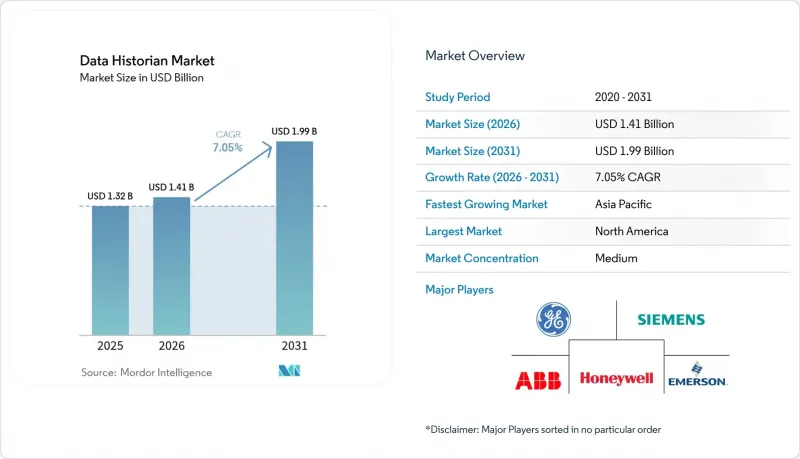
Mordor Intelligence에 의하면, 2026년 데이터 히스토리안 시장 규모는 14억 1,000만 달러로 추정되고 2025년 13억 2,000만 달러에서 확대해, 2031년에는 19억 9,000만 달러에 이를 것으로 예측됩니다.
2026년부터 2031년까지 연평균 성장률(CAGR) 7.05%로 성장할 것으로 전망됩니다.

본 보고서는 구성 요소별(소프트웨어, 서비스), 배포 모드별(On-Premise, 클라우드), 최종 사용자별(석유 및 가스, 전력 및 유틸리티, 제지 및 펄프, 화학제품 및 석유화학제품,금속 및 광업, 기타), 데이터 처리 빈도별(실시간, 준실시간, 배치/정기), 지역별로 분류되어 있습니다. 시장 규모 및 전망은 금액(달러) 기준으로 제시되어 있습니다.
세계의 데이터 히스토리안 시장 동향 및 인사이트
산업 성과 최적화를 위한 통합 데이터에 대한 수요 증가
제조 기업들은 생산, 유지보수, 품질 데이터 세트를 통합하는 통일된 히스토리안 플랫폼으로 사일로화된 스토리지 환경을 대체하고 있습니다. 프록터 앤 갬블(P&G)이 GE Vernova의 클라우드 히스토리안을 도입한 사례에서는 자산 데이터와 ERP 데이터 스트림을 통합함으로써 공정 설정 시간이 50% 단축된 것으로 나타났습니다. 컨텍스트 기반 데이터 모델링을 통해 이종 태그가 자동으로 연관되어, 운영자는 하류 품질 편차의 업스트림 원인을 파악하고, 감사 대응이 가능한 리니지를 갖춘 지속가능성 지표를 보고할 수 있게 되었습니다.
증가하는 산업용 IoT 빅데이터 스트림의 양
스마트 센서의 보급으로 데이터 수집 속도가 초당 수천 개 태그에서 수백만 개 태그로 증가함에 따라, 기존의 모놀리식형 데이터베이스에 부하가 가해지고 있습니다. 2024년 5월 중국의 산업 생산은 전년 동월 대비 5.6% 증가했으며, 첨단 제조업에서는 10.0%의 급증세가 나타났습니다. 이는 압축 알고리즘과 엣지 분석 노드가 필요한 데이터 부하가 급속히 증가하고 있음을 보여줍니다. 각 벤더는 자동 스케일링을 수행하고, 중요도가 낮은 패킷을 Tier 2 스토리지로 라우팅하여 원격 시설의 대역폭을 확보하는 컨테이너화된 마이크로서비스로 이에 대응하고 있습니다.
전사적 히스토리안 도입에 따른 높은 총소유비용
엔드투엔드 프로젝트에는 라이선싱, 전용 하드웨어, 통합 서비스, 지속적인 업그레이드가 필요하며, 이로 인해 자본 지출이 300%나 증가할 가능성이 있습니다. 록웰 오토메이션의 2024 회계연도 결산에서 매출이 21% 감소한 것으로 나타났습니다. 이는 거시경제의 불확실성 속에서 새로운 예산을 배정하는 데 신중한 태도를 보이고 있는 상황을 반영합니다. 숨겨진 비용에는 태그 합리화, 데이터 정제, 성능 튜닝, 직원 역량 강화 등이 포함되어 있어 중견 제조업체의 도입을 저해하고 있습니다.
부문별 분석
2025년 데이터 히스토리안 시장에서 소프트웨어가 시장 점유율의 65.60%를 차지하며, 수집, 저장, 분석, 시각화를 통합한 스위트형 솔루션에 대한 선호도가 입증되었습니다. 각 벤더는 시계열 데이터 압축, 자산 모델, 노코드 대시보드를 묶은 구독 모델을 점점 더 많이 제공하고 있으며, 이를 통해 플랜트 네트워크 내 도구의 난립이 완화되고 있습니다. 서비스 분야는 운영자가 OT-IT 융합, 사이버 보안 패치 적용, AI 파이프라인 오케스트레이션을 위해 통합 파트너를 채용함에 따라 2031년까지 연평균 성장률(CAGR) 8.85%로 확대되고 있습니다. HighByte의 1,200만 달러 규모의 자금 조달 라운드는 멀티 벤더 환경에 걸친 히스토리안 데이터를 활용하는 산업용 DataOps 서비스에 대한 투자자들의 관심을 보여줍니다.
데이터 히스토리안 시장 규모 확대는 관리형 서비스 도입에 계속해서 좌우될 것입니다. 이 분야에서 제공업체들은 지속적인 최적화, 모델 재학습, 규제 보고를 통해 수익화를 도모하고 있습니다. 고객이 히스토리안의 라이프사이클 관리를 외부에 위탁함에 따라, 전문 컨설팅 기업들은 제약, 에너지, 식음료 분야에서의 도메인별 차별화를 심화시켜 지속적 수익 전망을 높이는 동시에, 데이터 히스토리안 시장 내 ‘플랫폼+서비스’라는 패러다임을 강화하고 있습니다.
2025년에도 지연 시간에 대한 민감도, 데이터 주권에 관한 규제 요건, 위험이 수반되는 산업 분야의 뿌리 깊은 조달 관행으로 인해 On-Premise 배포는 데이터 히스토리안 시장의 70.90%를 계속 차지했습니다. 각 플랜트에서는 랙 마운트형 어플라이언스의 업그레이드, 이중화된 페일오버 클러스터의 도입, 에어 갭 방식의 백업 노드 유지가 계속해서 이루어지고 있습니다. 동시에, CIO들이 탄력적인 용량, 관리된 보안 체제, 마이크로서비스의 민첩성을 추구함에 따라 클라우드 인스턴스는 연평균 성장률(CAGR) 8.20%로 확대되고 있습니다. 규제 당국은 현재 승인된 퍼블릭 리전에서의 프로세스 데이터 호스팅에 관한 지침을 발표하여, 기존 장벽이 완화되고 있습니다.
조직이 저빈도 태그 데이터를 클라우드로 스트리밍하는 한편, 실시간 루프 데이터는 로컬에 보관하게 됨에 따라 데이터 히스토리안 시장에서는 하이브리드 토폴로지가 주류를 이루고 있습니다. 클라우드 벤더들은 결정론적 페일세이프 모드를 갖춘 엣지 게이트웨이를 제공함으로써, AI 모델 훈련을 위한 히스토리 데이터 세트의 ‘시프트 앤 리프트(shift-and-lift)’를 촉진하고 있습니다. 예측 기간 동안 총 소유 비용(TCO) 비교에서는 종량제 요금제가 계속해서 유리할 것으로 보이며, 이산 제조업 및 급성장 중인 전동화 분야의 워크로드 이전이 가속화될 것입니다.
지역별 분석
북미는 석유 및 가스, 발전, 자동차 조립 분야의 대규모 도입 실적을 바탕으로 2025년에는 35.10%의 점유율로 데이터 히스토리안 시장을 독점했습니다. 연방 정부의 인프라 프로그램과 노동력 현대화를 위한 보조금 덕분에 노후화된 DCS 노드를 API 지원 히스토리안으로 업데이트하는 움직임이 가속화되고 있습니다. 지멘스가 텍사스주와 캘리포니아주에 100억 달러를 투자하고 있는 것은 OEM 제조와 AI 데이터센터의 성장이 국내 수요를 어떻게 뒷받침하고 있는지를 여실히 보여줍니다.
아시아태평양은 중국의 데이터 경제 청사진과 일본의 선진적인 로봇 공학 이니셔티브를 배경으로, 2031년까지 연평균 성장률(CAGR) 8.25%로 가장 높은 성장률을 기록할 전망입니다. 히타치와 마이크로소프트는 생성형 AI 조사 기법에 대해 5만 명의 직원을 대상으로 역량 강화 계획을 수립하고 있으며, 이는 히스토리안 도입에 있어 인적 자본의 중요성을 부각시키고 있습니다. 반도체 팹 및 전기차 배터리 공장에 대한 인도의 정책 인센티브로 인해, 해당 지역 내 히스토리안의 신규 도입 사례는 더욱 확대되고 있습니다. 또한, 베이징의 3개년 행동 계획에서는 데이터 산업의 연간 성장률 20% 및 300건 이상의 이용 사례 실증을 목표로 하고 있어, 강력한 정책 지원이 강조되고 있습니다. 유럽에서는 데이터 저장, 감사, 전송에 관한 규정을 공식적으로 정한 강화된 ‘GDPR(EU 개인정보보호규정) 2024’ 요건 하에서 꾸준한 기여를 이어가고 있습니다.
유럽에서는 개정된 GDPR(EU 개인정보보호규정) 규정과 ‘디지털 운영 복원력법’에 따라 기업이 산업 데이터의 계보, 접근 제어, 불변성을 입증해야 할 의무가 부과됨에 따라 완만한 성장이 예상됩니다. 에너지 집약적 산업에서는 탄소 발자국 공개를 입증하기 위해 히스토리안이 도입되고 있는 반면, 수소 밸류체인에 대한 EU의 투자는 전해조 군 전체에 걸친 고주파 데이터 수집 수요를 불러일으키고 있습니다. 라틴아메리카, 중동 및 아프리카의 신흥 경제국들은 레거시 시스템의 제약에 얽매이지 않고 새로운 공정 플랜트를 건설하고 있어, 데이터 히스토리안 시장에서 클라우드 기반 히스토리안 토폴로지로 직접 도약할 수 있다는 점에서 아직 발전 단계에 있기는 하지만 장기적으로는 매력적인 기회가 되고 있습니다.
기타 혜택 :
- 엑셀 형식 시장 예측(ME) 시트
- 3개월간의 애널리스트 지원
자주 묻는 질문
목차
제1장 서론
제2장 조사 방법
제3장 주요 요약
제4장 시장 구도
제5장 시장 규모 및 성장 예측
제6장 경쟁 구도
제7장 시장 기회 및 향후 전망
KTH 26.09.14According to Mordor Intelligence, the data historian market size in 2026 is estimated at USD 1.41 billion, growing from 2025 value of USD 1.32 billion with 2031 projections showing USD 1.99 billion, growing at 7.05% CAGR over 2026-2031.
This report is Segmented by Component (Software, Services), by Deployment Mode (On-Premise, Cloud), by End-User (Oil and Gas, Power and Utilities, Paper and Pulp, Chemicals and Petrochemicals, Metals and Mining, and More), by Data Frequency (Real-Time, Near-Real-Time, and Batch/Periodic), and by Geography. The Market Sizes and Forecasts are Provided in Terms of Value (USD).
Global Data Historian Market Trends and Insights
Increasing Demand for Consolidated Data to Optimize Industrial Performance
Manufacturing groups are replacing siloed storage silos with unified historian platforms that merge production, maintenance, and quality datasets. Procter & Gamble's adoption of GE Vernova's cloud historian illustrates a 50% reduction in process-setup time through integrated asset and ERP data streams. Contextual data-modeling now automatically links disparate tags, helping operators pinpoint upstream causes of downstream quality deviations and report sustainability metrics with audit-ready lineage.
Rising Volumes of Industrial IoT Big Data Streams
Smart-sensor proliferation is lifting ingestion rates from thousands to millions of tags per second, straining traditional monolithic databases. China's industrial output expanded 5.6% year-on-year in May 2024, accompanied by a 10.0% surge in high-tech manufacturing, underscoring rapidly growing data loads that require compression algorithms and edge-analytics nodes.Vendors are responding with containerized micro-services that auto-scale and route non-critical packets to tier-two storage, preserving bandwidth at remote facilities.
High Total Cost of Ownership for Enterprise-Wide Historian Roll-Outs
End-to-end projects require licenses, specialized hardware, integration services, and ongoing upgrades that can inflate capital outlays by 300%. Rockwell Automation's FY 2024 results revealed a 21% revenue decline, reflecting hesitation to commit fresh budgets amid macro uncertainty. Hidden costs include tag rationalization, data cleansing, performance tuning, and workforce upskilling, constraining adoption among mid-tier manufacturers.
Other drivers and restraints analyzed in the detailed report include:
- Migration of Legacy Historians to Cloud-Native, Micro-Service Architectures
- Vendor Bundling of Historian Functionality Inside Full-Stack OT Platforms
- Cybersecurity Concerns Over Exposing OT Data to IT Networks/Cloud
For complete list of drivers and restraints, kindly check the Table Of Contents.
Segment Analysis
Software accounted for 65.60% of the data historian market share in 2025, validating preference for unified suites that blend collection, storage, analytics, and visualization. Vendors increasingly deliver subscription models that bundle time-series compression, asset models, and no-code dashboards, reducing tool sprawl inside plant networks. The services segment is advancing at a 8.85% CAGR through 2031 as operators enlist integration partners for OT-IT convergence, cybersecurity patching, and AI pipeline orchestration. HighByte's USD 12 million financing round showcased investor appetite for Industrial DataOps services that unlock historian data across multi-vendor fleets.
The data historian market size upside remains tied to managed-services adoption, where providers monetize continuous optimization, model retraining, and regulatory reporting. As customers outsource historian lifecycle management, specialist consultancies deepen domain differentiation in pharmaceuticals, energy, and food & beverage, boosting recurring revenue visibility and reinforcing the platform-plus-services paradigm of the data historian market.
On-premise deployments retained 70.90% of the data historian market in 2025 due to latency sensitivity, sovereignty mandates, and ingrained procurement habits in hazardous industries. Plants continue to upgrade rack-mounted appliances, deploy redundant fail-over clusters, and maintain air-gapped backup nodes. Simultaneously, cloud instances are gaining 8.20% CAGR as CIOs pursue elastic capacity, managed security postures, and micro-service agility. Regulatory bodies now publish guidance on hosting process data in approved public regions, diminishing historical barriers.
Hybrid topologies are becoming mainstream in the data historian market as organizations stream low-frequency tags to the cloud while preserving real-time loops locally. Cloud vendors provide edge gateways with deterministic fail-safe modes, encouraging shift-and-lift of historical datasets for AI model training. Over the forecast horizon, total cost of ownership comparisons will continue to favor consumption-based billing, hastening workload migration in discrete manufacturing and fast-growing electrification verticals.
Complete Report Scope:
- By Component
- Software
- Services
- By Deployment Mode
- On-premise
- Cloud
- By End-user Industry
- Oil and Gas
- Power and Utilities
- Chemicals and Petrochemicals
- Pulp and Paper
- Metals and Mining
- Water and Waste-water
- Data Centers
- Food and Beverages
- Pharmaceuticals
- By Data Frequency
- Real-time (<1 sec)
- Near-real-time (1 sec - 1 min)
- Batch / Periodic (>1 min)
- By Geography
- North America
- United States
- Canada
- Mexico
- South America
- Brazil
- Argentina
- Rest of South America
- Europe
- Germany
- United Kingdom
- France
- Italy
- Spain
- Russia
- Rest of Europe
- APAC
- China
- Japan
- India
- South Korea
- Australia and New Zealand
- Southeast Asia
- Rest of APAC
- Middle East
- Saudi Arabia
- UAE
- Turkey
- Rest of Middle East
- Africa
- South Africa
- Egypt
- Nigeria
- Rest of Africa
- North America
Geography Analysis
North America dominates the data historian market with 35.10% share in 2025, underwritten by large installed bases in oil & gas, power generation, and automotive assembly. Federal infrastructure programs and workforce modernization grants accelerate retrofits of aging DCS nodes into API-enabled historians. Siemens' USD 10 billion investments in Texas and California illustrate how OEM manufacturing and AI data-center growth reinforce domestic demand.
Asia-Pacific delivers the fastest CAGR at 8.25% through 2031 on the back of China's data-economy blueprint and Japan's advanced robotics initiatives. Hitachi and Microsoft plan to upskill 50,000 staff in generative-AI methodologies, highlighting the human-capital dimension of historian adoption. Indian policy incentives for semiconductor fabs and electric-vehicle battery plants further enlarge the regional pipeline of green-field historian installations. Also, Beijing's three-year action plan targets 20% annual data-industry growth and over 300 use-case demonstrations, highlighting strong policy support. Europe maintains steady contributions under reinforced GDPR 2024 mandates that formalize retention, audit, and transfer rules.
Europe records moderate growth as revised GDPR provisions and the Digital Operational Resilience Act compel firms to prove lineage, access controls, and immutability of industrial data. Energy-intensive industries adopt historians to certify carbon-footprint disclosures, while EU investment in hydrogen value chains triggers demand for high-frequency data capture across electrolyzer fleets. Emerging economies in Latin America, Middle East, and Africa remain nascent yet attractive long-term opportunities as they install new process plants without legacy constraints, enabling direct leapfrog to cloud-ready historian topologies within the data historian market.
List of Companies Covered in this Report:
- AVEVA Group plc (incl. PI System)
- Honeywell International Inc.
- Siemens AG
- General Electric Company
- ABB Group
- Emerson Electric Co.
- Rockwell Automation Inc.
- Schneider Electric SE
- Yokogawa Electric Corp.
- Aspen Technology Inc.
- Inductive Automation LLC
- Canary Labs Inc.
- ICONICS Inc.
- Mitsubishi Electric Corp.
- Kongsberg Digital AS
- Hitachi Energy Ltd.
- Open Automation Software LLC
- Wonderware (AVEVA)
- InduSoft (Schneider)
- Softing AG
Additional Benefits:
- The market estimate (ME) sheet in Excel format
- 3 months of analyst support
TABLE OF CONTENTS
1 INTRODUCTION
- 1.1 Study Assumptions and Market Definition
- 1.2 Scope of the Study
2 RESEARCH METHODOLOGY
3 EXECUTIVE SUMMARY
4 MARKET LANDSCAPE
- 4.1 Market Overview
- 4.2 Market Drivers
- 4.2.1 Increasing demand for consolidated data to optimize industrial performance
- 4.2.2 Rising volumes of industrial IoT big data streams
- 4.2.3 Migration of legacy historians to cloud-native, micro-service architectures
- 4.2.4 Vendor bundling of historian functionality inside full-stack OT platforms
- 4.2.5 Regulations mandating long-term process data retention in regulated industries
- 4.2.6 Rapid adoption of AI/ML requiring clean historical datasets
- 4.3 Market Restraints
- 4.3.1 High total cost of ownership for enterprise-wide historian roll-outs
- 4.3.2 Cyber-security concerns over exposing OT data to IT networks/cloud
- 4.3.3 Shortage of OT-IT convergence skillsets to manage historian projects
- 4.3.4 Vendor lock-in due to proprietary data models and licensing schemes
- 4.4 Value / Supply-Chain Analysis
- 4.5 Regulatory Landscape
- 4.6 Technological Outlook
- 4.7 Porter's Five Forces Analysis
- 4.7.1 Bargaining Power of Suppliers
- 4.7.2 Bargaining Power of Buyers
- 4.7.3 Threat of New Entrants
- 4.7.4 Threat of Substitutes
- 4.7.5 Intensity of Competitive Rivalry
- 4.8 Investment and Funding Analysis
5 MARKET SIZE AND GROWTH FORECASTS (VALUE)
- 5.1 By Component
- 5.1.1 Software
- 5.1.2 Services
- 5.2 By Deployment Mode
- 5.2.1 On-premise
- 5.2.2 Cloud
- 5.3 By End-user Industry
- 5.3.1 Oil and Gas
- 5.3.2 Power and Utilities
- 5.3.3 Chemicals and Petrochemicals
- 5.3.4 Pulp and Paper
- 5.3.5 Metals and Mining
- 5.3.6 Water and Waste-water
- 5.3.7 Data Centers
- 5.3.8 Food and Beverages
- 5.3.9 Pharmaceuticals
- 5.4 By Data Frequency
- 5.4.1 Real-time (<1 sec)
- 5.4.2 Near-real-time (1 sec - 1 min)
- 5.4.3 Batch / Periodic (>1 min)
- 5.5 By Geography
- 5.5.1 North America
- 5.5.1.1 United States
- 5.5.1.2 Canada
- 5.5.1.3 Mexico
- 5.5.2 South America
- 5.5.2.1 Brazil
- 5.5.2.2 Argentina
- 5.5.2.3 Rest of South America
- 5.5.3 Europe
- 5.5.3.1 Germany
- 5.5.3.2 United Kingdom
- 5.5.3.3 France
- 5.5.3.4 Italy
- 5.5.3.5 Spain
- 5.5.3.6 Russia
- 5.5.3.7 Rest of Europe
- 5.5.4 APAC
- 5.5.4.1 China
- 5.5.4.2 Japan
- 5.5.4.3 India
- 5.5.4.4 South Korea
- 5.5.4.5 Australia and New Zealand
- 5.5.4.6 Southeast Asia
- 5.5.4.7 Rest of APAC
- 5.5.5 Middle East
- 5.5.5.1 Saudi Arabia
- 5.5.5.2 UAE
- 5.5.5.3 Turkey
- 5.5.5.4 Rest of Middle East
- 5.5.6 Africa
- 5.5.6.1 South Africa
- 5.5.6.2 Egypt
- 5.5.6.3 Nigeria
- 5.5.6.4 Rest of Africa
- 5.5.1 North America
6 COMPETITIVE LANDSCAPE
- 6.1 Market Concentration
- 6.2 Strategic Moves
- 6.3 Market Share Analysis
- 6.4 Company Profiles (includes Global level overview, Market level overview, Core segments, Financials as available, Strategic information, Market rank/share for key companies, Products and Services, and Recent Developments)
- 6.4.1 AVEVA Group plc (incl. PI System)
- 6.4.2 Honeywell International Inc.
- 6.4.3 Siemens AG
- 6.4.4 General Electric Company
- 6.4.5 ABB Group
- 6.4.6 Emerson Electric Co.
- 6.4.7 Rockwell Automation Inc.
- 6.4.8 Schneider Electric SE
- 6.4.9 Yokogawa Electric Corp.
- 6.4.10 Aspen Technology Inc.
- 6.4.11 Inductive Automation LLC
- 6.4.12 Canary Labs Inc.
- 6.4.13 ICONICS Inc.
- 6.4.14 Mitsubishi Electric Corp.
- 6.4.15 Kongsberg Digital AS
- 6.4.16 Hitachi Energy Ltd.
- 6.4.17 Open Automation Software LLC
- 6.4.18 Wonderware (AVEVA)
- 6.4.19 InduSoft (Schneider)
- 6.4.20 Softing AG
7 MARKET OPPORTUNITIES AND FUTURE OUTLOOK
- 7.1 White-space and Unmet-need Assessment


