

|
시장보고서
상품코드
2124474
적외선 온도계 : 시장 점유율 분석, 업계 동향 및 통계, 성장 예측(2026-2031년)Infrared Thermometer - Market Share Analysis, Industry Trends & Statistics, Growth Forecasts (2026 - 2031) |
||||||
 Mordor Intelligence
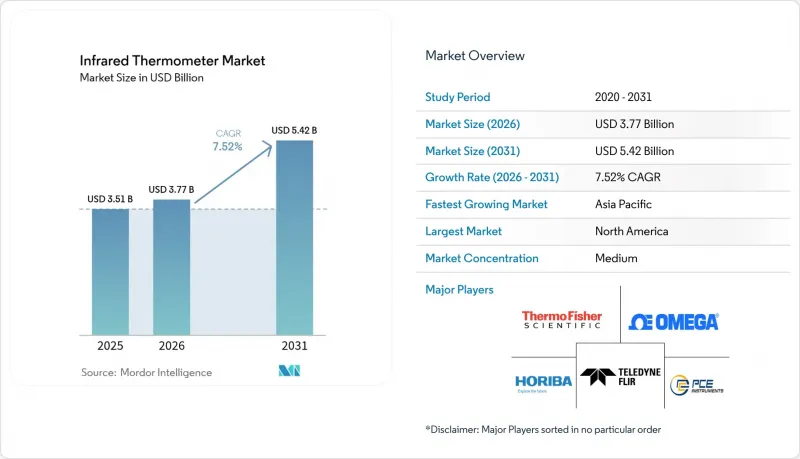
Mordor Intelligence에 의하면, 적외선 온도계 시장 규모는 2025년 35억 1,000만 달러로 평가되었습니다. 2026년에는 37억 7,000만 달러로 확대되어 2026년부터 2031년에 걸쳐 CAGR 7.52%로 성장을 지속하여, 2031년에는 54억 2,000만 달러에 이를 것으로 예측됩니다.
본 보고서는 제품 유형(접촉식 적외선 온도계·비접촉식 적외선 온도계), 폼 팩터(핸드헬드형(권총형 그립), 포켓형/펜형 등), 온도 범위(-50°C 미만, 50°C-500°C, 500°C 이상),최종 사용자 산업(의료 및 헬스케어, 식품 및 음료 가공, 기타), 지역별로 분류되어 있습니다. 시장 예측은 금액(달러) 기준으로 제시되어 있습니다.
세계의 적외선 온도계 시장 동향 및 인사이트
아시아 교통 거점에서의 예방적 검진 급증
아시아태평양의 교통 당국은 공항, 철도 터미널, 항만에 열화상 카메라를 도입하여, ASTM E 1965-98의 정확도 기준을 충족하면서 시간당 1,000명 이상의 승객을 실시간으로 검사할 수 있게 되었습니다. AI를 활용한 이미지 처리를 통해 감도는 94% 이상으로 향상되었으며, 오경보도 감소했습니다. 이와 유사한 인프라는 장거리 노선을 위한 웨어러블 기기로 전환되고 있어, 페리나 도시 간 버스에서 지속적인 모니터링이 가능해졌습니다. 중국과 일본의 정부 자금 지원 프로그램에서는 영구적인 발열 검사 설비 설치에 자금이 배정되고 있으며, 이러한 움직임은 일시적인 것이 아니라 구조적인 것으로 자리 잡고 있습니다.
이산형 제조업에서의 예측 유지보수를 위한 산업용 IoT와의 통합
공장 운영자는 적외선 프로브를 엣지 게이트웨이와 통합함으로써 베어링, 모터, 개폐 장치의 고장을 고장 발생 최대 2주 전에 예측하여 예기치 못한 가동 중단 시간을 최대 35%까지 줄이고 있습니다. 대규모 자동차 및 전자기기 공장에서는 연간 1,500만-2,500만 달러의 비용 절감이 보고되고 있습니다. 머신러닝을 통한 보정 덕분에 센서의 정확도가 약 65% 향상되어, 고가의 기준 장비 대신 저렴한 장치를 사용할 수 있게 되었습니다. IoT 플랫폼이 구독 방식으로 전환됨에 따라, 이 기법은 2차 공급업체로도 확산되고 있습니다.
고습도 환경에서의 센서 교정 드리프트
상대 습도가 80%를 초과하면 센서의 드리프트가 15-20% 가속화되어, 임상 및 식품 안전 현장에서는 오차가 2℃를 초과하게 됩니다. 동남아시아의 가공 업체들은 현재 추가적인 재교정 주기를 예산에 반영하고 있어 운영 비용이 증가하고 있습니다. 듀얼 블랙바디 방식은 드리프트를 완화하지만 숙련된 기술자가 필요합니다. 각 벤더사는 방습 사양의 광학 시스템과 습도 보정 기능이 탑재된 펌웨어를 설계하고 있지만, 도입 현황에는 편차가 있습니다.
부문별 분석
비접촉식 온도계는 2025년에 82.95%의 점유율을 차지했고, 2031년까지 연평균 성장률(CAGR) 7.56%로 선두를 유지할 전망이며, 이는 비접촉식 검진에 대한 장기적인 수요를 반영한 것입니다. 병원에서는 구강용 프로브에서 적외선 체온계로 전환한 결과, 교차 오염이 90% 감소했습니다. 현재, 첨단 알고리즘을 통해 방사율의 편차와 주변 환경에 의한 드리프트가 보정되어 ±0.3℃의 정확도가 유지되고 있습니다. 현재의 추세가 지속된다면, 비접촉식 적외선 온도계 시장 규모는 2031년까지 44억 4,000만 달러에 육박할 전망입니다.
접촉식 체온계는 표면 온도의 평형 상태가 필수적인 분야(반도체 웨이퍼 검사나 야금 실험실 등)에서 여전히 필수적입니다. 무선 로깅 기능과 클라우드 대시보드의 도입으로 두 카테고리의 가치가 높아지고 있습니다. 정확성과 편의성을 모두 확보하기 위해, 접촉식과 비접촉식을 융합한 하이브리드 시스템의 시제품 개발이 연구 기관에서 진행되고 있습니다. 지속적인 연구 개발과 광학 부품의 비용 절감에 힘입어, 적외선 온도계 시장은 현재의 성장 궤도를 유지할 전망입니다.
2025년에는 HVAC(공조·환기·냉난방) 및 플랜트 유지보수 분야에서 높은 범용성을 바탕으로, 피스톨 그립형 휴대용 기기가 매출의 54.65%를 차지했습니다. 그러나 진료소가 진단 도구를 통합함에 따라, 귀·이마 하이브리드형은 2031년까지 연평균 성장률(CAGR) 8.72%로 성장할 전망입니다. 다목적 기기 시장에서 적외선 온도계 시장 점유율은 향후 10년 말까지 20%를 넘어설 가능성이 있습니다.
자동 생산 라인에서는 고정식 인라인 센서가 보급되어 데이터를 MES 플랫폼으로 직접 스트리밍하고 있습니다. 주머니에 들어갈 만한 펜형 체온계는 첨단 광학 성능보다 휴대성을 중시하는 현장 기술자의 요구를 충족시키고 있습니다. 웨어러블 패치와 스마트 헬멧이 등장하고 있으며, 이는 향후 적외선 복사 온도계 시장의 구조를 바꿀 가능성이 있는 새로운 틈새 시장을 시사합니다.
지역별 분석
북미는 원격 의료용 키오스크와 엄격한 식품 안전 규제를 배경으로 2025년 매출의 31.95%를 차지했습니다. 임상용 적외선 복사 온도계에 대한 FDA의 규제 완화로 도입이 더욱 가속화되고 있습니다. 개별 제조업 분야의 산업용 IoT(IIoT) 도입 확대가 이 지역 수요 동향을 더욱 뒷받침하고 있습니다. 서모피셔(Thermo Fisher)가 국내 시설에 20억 달러를 투자하겠다고 발표한 것은 현지 계측 기기 시장에서 리더십을 확보하겠다는 확고한 의지를 보여줍니다.
아시아태평양은 2031년까지 연평균 성장률(CAGR) 8.25%를 기록하며 전 세계에서 가장 빠른 성장률을 보일 것으로 전망됩니다. 중국의 반도체 분야 우위, 일본의 고령화, 그리고 동남아시아 교통수단 내 검역 조치가 강력한 성장 요인의 조합을 형성하고 있습니다. 습도가 높은 기후에서 발생하는 교정 드리프트라는 과제로 인해, 각 벤더들은 내습성 광학 시스템 개발에 주력하고 있습니다. 호리바사의 기록적인 매출은 이 지역에서 정밀 측정에 대한 수요가 높음을 보여줍니다. 게르마늄 수출 규제로 인해 공급 측면의 과제가 심각해지고 있어, 소재 혁신과 지역 내 조달이 추진되고 있습니다.
유럽은 HACCP의 철저한 이행, 인더스트리 4.0 도입, 전기차 배터리 열 관리를 기반으로 꾸준한 성장 궤도를 유지하고 있습니다. 독일 자동차 업계에서는 배터리 안전성을 확보하기 위해 팩 내장형 적외선 어레이의 실증 실험이 진행되고 있으며, 북유럽의 건축물에는 에너지 절약형 HVAC 시스템에 열 센서가 탑재되어 있습니다. 이 지역의 지속가능성 추진 노력이 장수명 센서 개발을 뒷받침하고 있습니다. 라틴아메리카, 중동 및 아프리카는 절대 규모 면에서는 뒤처져 있지만, 의료 인프라 확충과 산업 다각화가 진행됨에 따라 한 자릿수 후반대의 높은 성장률을 달성하고 있습니다.
기타 혜택 :
- 엑셀 형식 시장 예측(ME) 시트
- 3개월간의 애널리스트 지원
자주 묻는 질문
목차
제1장 서론
제2장 조사 방법
제3장 주요 요약
제4장 시장 구도
제5장 시장 규모 및 성장 예측
제6장 경쟁 구도
제7장 시장 기회 및 향후 전망
KTH 26.09.14According to Mordor Intelligence, the infrared thermometer market size is expected to grow from USD 3.51 billion in 2025 to USD 3.77 billion in 2026 and is forecast to reach USD 5.42 billion by 2031 at 7.52% CAGR over 2026-2031.
This report is Segmented Into Product Type (Contact Infrared Thermometers, and Non-Contact Infrared Thermometers), Form Factor (Handheld (Pistol-Grip), Pocket/Pen-style, and More), Temperature Range (Below - 50 °C, 50 °C - 500 °C, and Above 500 °C), End User Industry (Healthcare and Medical, Food and Beverage Processing, and More), and Geography. The Market Forecasts are Provided in Terms of Value (USD).
Global Infrared Thermometer Market Trends and Insights
Surge in Preventive Screening at Transportation Hubs in Asia
Transportation authorities across Asia-Pacific have embedded thermal cameras in airports, rail terminals and ports, enabling real-time screening of more than 1,000 passengers per hour while meeting ASTM E 1965-98 accuracy thresholds. AI-enhanced imaging drives sensitivity above 94% and lowers false alarms. The same infrastructure is migrating to wearable devices for long-haul routes, permitting continuous monitoring on ferries and inter-city buses. Government funding programs in China and Japan allocate capital for permanent fever-screening installations, making the driver structural rather than transient.
Integration with Industrial IoT for Predictive Maintenance in Discrete Manufacturing
Factory operators integrate infrared probes with edge gateways to predict bearing, motor and switchgear failures up to two weeks before breakdown, cutting unplanned downtime by as much as 35%. Annual savings of USD 15-25 million are reported in large automotive and electronics plants. Machine-learning calibration raises sensor accuracy roughly 65%, letting inexpensive devices replace costly reference units. The practice is spreading to tier-2 suppliers as IoT platforms become subscription-priced.
Calibration Drift of Sensors in High-humidity Climates
Relative humidity above 80% accelerates sensor drift by 15-20%, pushing errors beyond 2 °C in clinical and food-safety settings. Southeast Asian processors now budget extra recalibration cycles, raising operating costs. Dual-blackbody methods alleviate drift yet require skilled technicians. Vendors are designing moisture-sealed optics and humidity-compensated firmware, but deployment remains uneven.
Other drivers and restraints analyzed in the detailed report include:
- Regulatory HACCP Compliance Driving Food-processing Adoption in Europe
- Rapid Expansion of Cloud-connected Tele-health Kiosks in North America
- Import Curbs on Uncooled LWIR Sensors Limiting Supply Chains
For complete list of drivers and restraints, kindly check the Table Of Contents.
Segment Analysis
Non-contact instruments commanded 82.95% share in 2025 and will keep the lead with a 7.56% CAGR to 2031, mirroring long-term preference for touch-free screening. Hospitals recorded 90% declines in cross-contamination when switching from oral probes to infrared devices. Advanced algorithms now correct emissivity variance and ambient drift, holding +-0.3 °C accuracy. The infrared thermometer market size for non-contact models is poised to approach USD 4.44 billion by 2031 at the current pace.
Contact thermometers remain essential where surface equilibrium is mandatory-semiconductor wafer checks and metallurgy labs. Wireless logging and cloud dashboards elevate both categories. Hybrid systems that fuse contact and non-contact modes are being prototyped in research institutes, aiming to merge accuracy with convenience. Sustained R&D and lower optics costs should keep the infrared thermometer market on its current growth curve.
Handheld pistol-grip units held 54.65% revenue in 2025 due to versatility in HVAC and plant maintenance. Yet ear-forehead hybrids are on course for a 8.72% CAGR to 2031 as clinics consolidate diagnostic tools. The infrared thermometer market share for multipurpose devices could exceed 20% before the end of the decade.
Fixed in-line sensors proliferate on automated lines, streaming data directly to MES platforms. Pocket pen thermometers cater to field technicians who value portability over advanced optics. Wearable patches and smart helmets are emerging, pointing to new niches that may reshape the infrared thermometer market over time.
Complete Report Scope:
- By Type
- Contact Infrared Thermometers
- Non-contact Infrared Thermometers
- By Form Factor
- Handheld (Pistol-grip)
- Pocket/Pen-style
- Fixed/Inline Process-mount
- Multipurpose Ear-Forehead Devices
- By Temperature Range
- Below - 50 °C
- 50 °C - 500 °C
- Above 500 °C
- By End-user Industry
- Healthcare and Medical
- Food and Beverage Processing
- Electronics and Semiconductor
- Industrial Manufacturing
- Automotive and Transportation
- HVAC and Building Automation
- Veterinary and Animal Health
- Others
- By Distribution Channel
- Direct/Institutional Procurement
- Retail Pharmacies and Specialty Stores
- Online/E-commerce
- By Geography
- North America
- United States
- Canada
- Mexico
- Europe
- Germany
- United Kingdom
- France
- Nordics
- Rest of Europe
- South America
- Brazil
- Rest of South America
- Asia-Pacific
- China
- Japan
- India
- South-East Asia
- Rest of Asia-Pacific
- Middle East and Africa
- Middle East
- Gulf Cooperation Council Countries
- Turkey
- Rest of Middle East
- Africa
- South Africa
- Rest of Africa
- Middle East
- North America
Geography Analysis
North America generated 31.95% of 2025 turnover, underpinned by telehealth kiosks and strict food-safety enforcement. FDA deregulation of clinical infrared thermometers further accelerates deployments. Industrial IoT retrofits in discrete manufacturing compound the region's demand profile. Thermo Fisher's pledge to invest USD 2 billion in domestic facilities illustrates the commitment to local instrumentation leadership.
Asia-Pacific will post an 8.25% CAGR to 2031, the fastest worldwide. China's semiconductor dominance, Japan's aging demographics and Southeast Asia's transport screening create a potent mix of drivers. Calibration drift challenges in humid climates push vendors to innovate moisture-resistant optics. Record sales by HORIBA demonstrate the region's appetite for precision measurement. Export restrictions on germanium heighten supply challenges, prompting material innovation and regional sourcing.
Europe maintains a steady path grounded in HACCP enforcement, Industry 4.0 adoption and EV battery thermal management. Germany's auto sector experiments with in-pack infrared arrays for battery safety, while Nordic buildings integrate thermal sensors into energy-saving HVAC systems. The region's sustainability ethos spurs development of longer-life sensors. Latin America and the Middle East & Africa trail in absolute size yet deliver high-single-digit growth as healthcare infrastructure scales and industrial diversification intensifies.
- Thermo Fisher Scientific Inc.
- Omega Engineering Inc.
- HORIBA Ltd.
- PCE Instruments
- Teledyne FLIR
- Extech Instruments Corporation
- Excelitas Technologies
- Optris GmbH
- Fluke Corporation
- General Tools and Instruments LLC
- Hioki E.E. Corporation
- SKF Group
- OMRON Corporation
- Thermomedics Inc.
- Microlife Corporation
- TriMedika Ltd.
- Braun GmbH
- Exergen Corporation
- Tecnimed Srl
- Paul Hartmann AG
- Lynred
- AMETEK Land
- A&D Company Ltd.
- Medtronic plc
- CHINO Corporation
Additional Benefits:
- The market estimate (ME) sheet in Excel format
- 3 months of analyst support
TABLE OF CONTENTS
1 INTRODUCTION
- 1.1 Study Assumptions and Market Definition
- 1.2 Scope of the Study
2 RESEARCH METHODOLOGY
3 EXECUTIVE SUMMARY
4 MARKET LANDSCAPE
- 4.1 Market Overview
- 4.2 Market Drivers
- 4.2.1 Surge in Preventive Screening at Transportation Hubs in Asia
- 4.2.2 Integration with Industrial IoT for Predictive Maintenance in Discrete Manufacturing
- 4.2.3 Regulatory HACCP Compliance Driving Food-processing Adoption in Europe
- 4.2.4 Rapid Expansion of Cloud-connected Tele-health Kiosks in North America
- 4.2.5 Rising Demand for Autonomous Thermal Control in EV Battery Packs
- 4.2.6 Shift Toward Non-contact QA Tools in Semiconductor Foundries
- 4.3 Market Restraints
- 4.3.1 Calibration Drift of Sensors in High-humidity Climates
- 4.3.2 Import Curbs on Uncooled LWIR Sensors (ITAR and Dual-Use) Limiting Supply Chains
- 4.3.3 Proliferation of Counterfeit Devices Depressing ASPs
- 4.3.4 Accuracy Loss on Low-Emissivity Automotive Coatings
- 4.4 Industry Ecosystem Analysis
- 4.5 Regulatory or Technological Outlook
- 4.6 Porter's Five Forces Analysis
- 4.6.1 Bargaining Power of Suppliers
- 4.6.2 Bargaining Power of Buyers
- 4.6.3 Threat of New Entrants
- 4.6.4 Threat of Substitutes
- 4.6.5 Intensity of Competitive Rivalry
5 MARKET SIZE AND GROWTH FORECASTS (VALUES)
- 5.1 By Type
- 5.1.1 Contact Infrared Thermometers
- 5.1.2 Non-contact Infrared Thermometers
- 5.2 By Form Factor
- 5.2.1 Handheld (Pistol-grip)
- 5.2.2 Pocket/Pen-style
- 5.2.3 Fixed/Inline Process-mount
- 5.2.4 Multipurpose Ear-Forehead Devices
- 5.3 By Temperature Range
- 5.3.1 Below - 50 °C
- 5.3.2 50 °C - 500 °C
- 5.3.3 Above 500 °C
- 5.4 By End-user Industry
- 5.4.1 Healthcare and Medical
- 5.4.2 Food and Beverage Processing
- 5.4.3 Electronics and Semiconductor
- 5.4.4 Industrial Manufacturing
- 5.4.5 Automotive and Transportation
- 5.4.6 HVAC and Building Automation
- 5.4.7 Veterinary and Animal Health
- 5.4.8 Others
- 5.5 By Distribution Channel
- 5.5.1 Direct/Institutional Procurement
- 5.5.2 Retail Pharmacies and Specialty Stores
- 5.5.3 Online/E-commerce
- 5.6 By Geography
- 5.6.1 North America
- 5.6.1.1 United States
- 5.6.1.2 Canada
- 5.6.1.3 Mexico
- 5.6.2 Europe
- 5.6.2.1 Germany
- 5.6.2.2 United Kingdom
- 5.6.2.3 France
- 5.6.2.4 Nordics
- 5.6.2.5 Rest of Europe
- 5.6.3 South America
- 5.6.3.1 Brazil
- 5.6.3.2 Rest of South America
- 5.6.4 Asia-Pacific
- 5.6.4.1 China
- 5.6.4.2 Japan
- 5.6.4.3 India
- 5.6.4.4 South-East Asia
- 5.6.4.5 Rest of Asia-Pacific
- 5.6.5 Middle East and Africa
- 5.6.5.1 Middle East
- 5.6.5.1.1 Gulf Cooperation Council Countries
- 5.6.5.1.2 Turkey
- 5.6.5.1.3 Rest of Middle East
- 5.6.5.2 Africa
- 5.6.5.2.1 South Africa
- 5.6.5.2.2 Rest of Africa
- 5.6.5.1 Middle East
- 5.6.1 North America
6 COMPETITIVE LANDSCAPE
- 6.1 Market Concentration
- 6.2 Strategic Moves
- 6.3 Market Share Analysis
- 6.4 Company Profiles (includes Global Overview, Market-level Overview, Core Segments, Financials, Strategic Information, Market Rank/Share, Products and Services, Recent Developments)
- 6.4.1 Thermo Fisher Scientific Inc.
- 6.4.2 Omega Engineering Inc.
- 6.4.3 HORIBA Ltd.
- 6.4.4 PCE Instruments
- 6.4.5 Teledyne FLIR
- 6.4.6 Extech Instruments Corporation
- 6.4.7 Excelitas Technologies
- 6.4.8 Optris GmbH
- 6.4.9 Fluke Corporation
- 6.4.10 General Tools and Instruments LLC
- 6.4.11 Hioki E.E. Corporation
- 6.4.12 SKF Group
- 6.4.13 OMRON Corporation
- 6.4.14 Thermomedics Inc.
- 6.4.15 Microlife Corporation
- 6.4.16 TriMedika Ltd.
- 6.4.17 Braun GmbH
- 6.4.18 Exergen Corporation
- 6.4.19 Tecnimed Srl
- 6.4.20 Paul Hartmann AG
- 6.4.21 Lynred
- 6.4.22 AMETEK Land
- 6.4.23 A&D Company Ltd.
- 6.4.24 Medtronic plc
- 6.4.25 CHINO Corporation
7 MARKET OPPORTUNITIES AND FUTURE OUTLOOK
- 7.1 White-space and Unmet-need Assessment


