

|
시장보고서
상품코드
2124496
앱 분석 : 시장 점유율 분석, 업계 동향과 통계, 성장 예측(2026-2031년)App Analytics - Market Share Analysis, Industry Trends & Statistics, Growth Forecasts (2026 - 2031) |
||||||
 Mordor Intelligence
Mordor Intelligence에 의하면, 2026년 앱 분석 시장 규모는 98억 1,000만 달러로 추정되며, 2025년 82억 2,000만 달러에서 2031년에는 237억 4,000만 달러에 달할 것으로 예측됩니다.
또한, 2026-2031년 연평균 성장률(CAGR)은 19.32%를 기록할 것으로 전망됩니다.
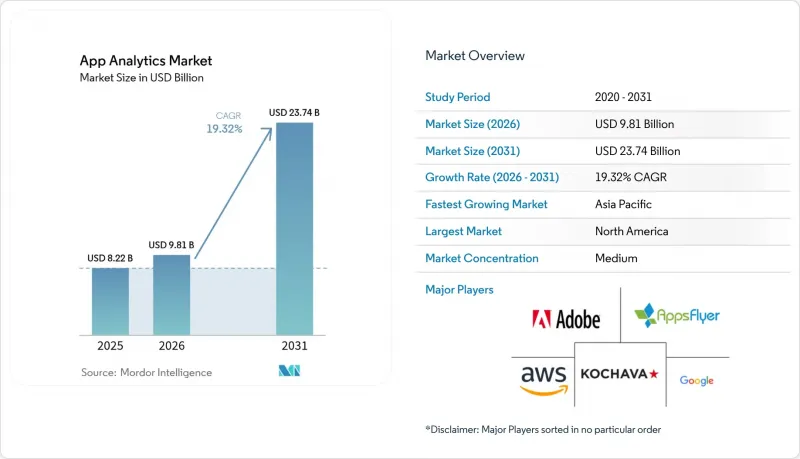
본 보고서는 유형별(모바일 앱, 웹사이트/데스크톱 앱, 프로그레시브 웹 앱), 용도별(마케팅/광고 분석, 수익 분석 등), 도입 모델별(클라우드, On-Premise, 하이브리드), 최종 사용자 산업별(은행, 금융서비스 및 보험(BFSI), 전자상거래·소매 등),조직 규모별(대기업, 중소기업), 지역별로 분류되어 있습니다. 시장 예측은 금액(달러) 기준으로 제시되어 있습니다.
세계 앱 분석 시장 동향 및 인사이트
업계를 불문하고 증가하는 앱 이용
소매 업계에 그치지 않고, 많은 기업이 생산, 물류 및 현장 서비스 워크플로우에 모바일 인터페이스를 통합하고 있습니다. 폭스바겐의 AI 기반 모바일 모니터링은 분석을 통한 최적화를 통해 공장 비용을 10억 유로(11억 3,000만 달러) 절감했습니다. 이는 제조, 의료, 공공 서비스와 같은 분야가 오프라인 동기화, IoT 연동, 규정 준수 보고를 위해 전용 SDK에 의존하고 있는 실태를 여실히 보여줍니다. 기존 B2B 기업들이 모바일 프론트엔드를 주요 고객 접점으로 인식하는 가운데, 앱 분석 시장은 운영 데이터를 수익화하고 공급업체 생태계를 확장하는 산업별 고유한 새로운 모듈을 개척하고 있습니다.
5G의 급속한 보급과 스마트폰의 확산
초저지연 5G 네트워크를 통해 디바이스에서 행동 데이터를 전처리하는 엣지 엔진이 구현되어, 게임, 스트리밍, AR 기업에서 왕복 지연을 최대 90%까지 줄이고 있습니다. 중국, 한국, 일본의 도시 지역에서 스마트폰 보급률이 85% 이상의 아시아태평양에서는 예측 기반 컨텐츠 전달과 실시간 부정 행위 감지가 표준화되고 있습니다. 이러한 밀리초 단위의 인사이트는 고객 유지율과 앱 내 결제 금액을 직접적으로 향상시키며, 릴리스 주기마다 고급 텔레메트리 기술을 도입해야 할 경제적 근거를 더욱 공고히 하고 있습니다.
증가하는 데이터 개인정보 보호 및 보안에 대한 우려
기본 SDK는 개발자가 파악하지 못하는 곳에서 사용자 식별자를 수집하는 경우가 많으며, 이 사실이 발각되면 기업의 평판이 실추되거나 벌금이 부과될 수 있습니다. 동의 획득 메커니즘, 암호화 루틴, 합성 데이터 파이프라인을 구축하는 것은 특히 유지 관리와 교육을 가장 큰 장벽으로 꼽는 중소기업의 경우 일정과 예산 증가로 이어집니다. 법적 복잡성으로 인해 기능 제공보다 규정 준수 체크리스트에 자원을 할당하는 것이 우선시되면서 시장 성장이 둔화되고 있습니다.
부문 분석
모바일 앱은 2025년 매출의 55.78%를 차지하며, 사용자 참여에서 확고한 역할을 하고 있음을 입증하고 있습니다. 한편, 기업들이 앱 스토어의 장벽 없이 단일 코드 기반으로 도달 범위를 확대하기를 원하는 가운데, 프로그레시브 웹 앱(PWA)은 2031년까지 연평균 성장률(CAGR) 21.90%로 성장할 전망입니다. Intershop의 PWA 도입 사례에서는 Google Tag Manager와 Matomo를 통합하여 전환 퍼널을 최적화함으로써, 네이티브 텔레메트리 못지않은 성능을 입증하고 있습니다.
현재 앱 분석 시장에서는 플랫폼에 구애받지 않는 추적 기능이 중시되고 있으며, 이를 통해 제품 팀은 어트리뷰션을 잃지 않고 브라우저에서 설치에 이르는 사용자 행동을 추적할 수 있습니다. 서비스 워커를 통해 오프라인 이벤트 캐싱이 가능해졌으며, 통합된 API를 통해 분석가는 컨테이너 유형에 관계없이 세션 깊이를 비교할 수 있게 되었습니다. 모바일, PWA, 데스크톱 파이프라인을 통합하는 벤더들은 고객사가 채널별 대시보드를 폐지함에 따라 시장 점유율을 확대되고 있습니다. 이러한 유연성 덕분에 앱 분석 시장은 옴니채널 여정의 분석 기반으로서 입지를 공고히 하고 있습니다.
2025년에는 마케팅 및 광고 분석이 40.75%의 점유율을 차지했으나, 사용자 행동 및 내비게이션 도구가 연평균 성장률(CAGR) 21.25%로 가장 빠르게 성장할 전망입니다. 이러한 변화는 고객 확보 비용의 상승과 고객 유지의 ROI 우위를 반영하고 있습니다. 세션 히트맵, 퍼널 이탈 알림, 예측 이탈 모델은 현재 표준 모듈로 제공되고 있습니다. 실시간 클릭스트림 피드백을 활용한 소매 업계의 시범 프로젝트에서는 재고 정확도가 40% 향상되었으며, 이는 직접적으로 이익률 확대로 이어졌습니다.
선견지명을 가진 구매 담당자들은 고객 확보, 참여도, 수익화 지표를 하나의 화면에서 통합해 보여주는 플랫폼을 원하고 있습니다. 광고 소스 어트리뷰션과 제품 내 상세한 행동 스코어링을 결합한 패키지가 등장함에 따라, 팀이 LTV가 낮은 코호트에 대한 지출을 억제할 수 있게 될 것으로 예측됩니다. 구독 및 마켓플레이스 운영자들이 평생 가치(LTV) 확보를 위해 예산을 재배분함에 따라, 행동 중심 플랫폼의 앱 분석 시장 규모는 더욱 확대될 것으로 전망됩니다.
지역별 분석
북미는 2025년 매출의 35.74%를 차지했습니다. 이는 생성형 AI 도구에 339억 달러가 투입된 벤처 캐피털 지출에 힘입은 것으로, 이들 중 상당수는 실시간 앱 내 텔레메트리 기능을 통합하고 있습니다. 규제의 명확화는 실험을 촉진하고 있지만, 주 차원에서 새로 제정된 개인정보 보호법으로 인해 통합에 드는 오버헤드가 증가하고 있습니다. 캐나다 제조업의 디지털화와 멕시코의 수출 지향형 공장도 산업용 분석 수요를 견인하며, 이 지역의 꾸준한 성장을 뒷받침하고 있습니다.
아시아태평양은 스마트폰 보급과 공공 부문의 ‘디지털 퍼스트’ 정책에 힘입어 연평균 성장률(CAGR) 20.98%로 가장 빠르게 성장하는 시장입니다. 중국의 모바일 컨텐츠 시장은 연평균 성장률(CAGR) 29.5%를 기록하며 2030년에는 3,025억 달러에 달할 전망입니다. 일본의 서비스 수출 붐과 인도에서 음식 배달 앱 다운로드 수가 143% 증가한 것은 특정 부문의 급속한 성장이 텔레메트리 데이터량의 급증으로 어떻게 이어지는지를 보여줍니다.
유럽에서는 혁신과 거버넌스의 균형이 잘 잡혀 있습니다. GDPR(EU 개인정보보호규정)(일반 데이터 보호 규정) 준수가 차등 프라이버시 및 연방 학습의 도입을 촉진하고 있으며, 다른 지역에서도 유사한 규제가 도입됨에 따라 유럽 벤더들에게는 수출 가능한 경쟁 우위가 생겨나고 있습니다. 독일의 ‘인더스트리 4.0’ 프로그램,영국의 오픈 뱅킹 열풍, 프랑스의 건강 데이터 허브는 모두 분야별 고유한 특성과 엄격한 데이터 거주 요건을 융합한 분석을 필요로 합니다. 동유럽은 비용 효율이 뛰어난 엔지니어링 인력을 공급하고 있으며, 공급업체의 연구개발(R&D) 센터 거점으로 자리 잡고 있습니다.
기타 혜택:
- 엑셀 형식 시장 예측(ME) 시트
- 3개월간의 애널리스트 지원
자주 묻는 질문
목차
제1장 서론
제2장 조사 방법
제3장 주요 요약
제4장 시장 구도
제5장 시장 규모와 성장 예측
제6장 경쟁 구도
제7장 시장 기회와 향후 동향
LSH 26.09.14According to Mordor Intelligence, app analytics market size in 2026 is estimated at USD 9.81 billion, growing from 2025 value of USD 8.22 billion with 2031 projections showing USD 23.74 billion, growing at 19.32% CAGR over 2026-2031.
This report is Segmented by Type (Mobile Apps, Website/Desktop Apps, and Progressive Web Apps), Application (Marketing/Advertising Analytics, Revenue Analytics, and More), Deployment Model (Cloud, On-Premise, and Hybrid), End-User Industry (BFSI, E-Commerce and Retail, and More), Organisation Size (Large Enterprises and Small and Medium Enterprises), and Geography. The Market Forecasts are Provided in Terms of Value (USD).
Global App Analytics Market Trends and Insights
Rising App Usage Across Industries
Enterprises well beyond retail now embed mobile interfaces into production, logistics, and field-service workflows. Volkswagen's AI-enabled mobile monitoring trimmed factory expenses by EUR 1 billion (USD 1.13 billion) through analytics-guided optimization, illustrating how manufacturing, healthcare, and utilities rely on specialized SDKs for offline sync, IoT hooks, and compliance reporting. As traditional B2B firms view mobile front ends as the chief client touchpoint, the app analytics market unlocks new vertical-specific modules that monetize operational data and expand supplier ecosystems.
Rapid 5G Roll-out and Smartphone Penetration
Ultra-low-latency 5G networks enable edge engines that pre-process behavior data on the device, cutting round-trip delays by up to 90% for gaming, streaming, and AR companies. Asia-Pacific, where smartphone penetration tops 85% in urban China, South Korea, and Japan, sees predictive content delivery and real-time fraud detection become standard. These millisecond insights directly uplift retention and in-app spend, strengthening the economic case for advanced telemetry inside every release cycle.
Heightened Data-privacy and Security Concerns
Default SDKs often siphon user identifiers without developer visibility, triggering reputational damage and fines when uncovered. Building consent layers, encryption routines, and synthetic-data pipelines inflate timelines and budgets, especially for SMEs that already cite maintenance and training as top barriers. Market growth slows where legal complexity diverts resources from feature delivery to compliance checklists.
Other drivers and restraints analyzed in the detailed report include:
- Time-spent on Mobiles Driving CX Analytics
- Privacy-preserving Analytics as Competitive Edge
- Stringent Global Data-protection Laws (GDPR/CCPA)
For complete list of drivers and restraints, kindly check the Table Of Contents.
Segment Analysis
Mobile Apps retained 55.78% of 2025 revenue, underscoring their entrenched role in user engagement. Yet Progressive Web Apps are set for a 21.90% CAGR through 2031 as businesses seek a single-code-base reach without app-store friction. Intershop's PWA deployment integrates Google Tag Manager and Matomo to refine conversion funnels, demonstrating parity with native telemetry.
The app analytics market now values platform-agnostic tracking so that product teams follow users from browser to install without losing attribution. Service workers enable offline event caching, and unified APIs let analysts compare session depth regardless of container. Vendors that unify mobile, PWA, and desktop pipelines expand wallet share as clients retire channel-specific dashboards. This fluidity cements the app analytics market as the analytics backbone for omnichannel journeys.
Marketing and Advertising Analytics held a 40.75% share in 2025, but User Behaviour and Navigation tools will grow fastest at 21.25% CAGR. The shift mirrors rising acquisition costs and the superior ROI of retention. Session heatmaps, funnel drop-off alerts, and predictive churn models now ship as standard modules. Retail pilots using live clickstream feedback saw 40% inventory accuracy gains that flowed directly into margin expansion.
Forward-looking buyers demand platforms that stitch acquisition, engagement, and monetization metrics into one view. Expect packages that pair ad-source attribution with deep in-product behavior scoring so that teams can suppress spend on low-LTV cohorts. The app analytics market size for behavior-centric platforms is forecast to widen further as subscription and marketplace operators pivot budgets toward lifetime-value safeguards.
Complete Report Scope:
- By Type
- Mobile Apps
- Website/Desktop Apps
- Progressive Web Apps
- By Application
- Marketing/Advertising Analytics
- Revenue Analytics
- In-app Performance Analytics
- User Behaviour & Navigation Analytics
- By Deployment Model
- Cloud
- On-premise
- Hybrid
- By End-user Industry
- BFSI
- E-commerce and Retail
- Media and Entertainment (incl. Social and Gaming)
- Travel and Hospitality
- IT and Telecom
- Healthcare
- Government and Public Sector
- Manufacturing
- Other End-user Industries
- By Organisation Size
- Large Enterprises
- Small and Medium Enterprises
- By Geography
- North America
- United States
- Canada
- Mexico
- South America
- Brazil
- Argentina
- Chile
- Rest of South America
- Europe
- Germany
- United Kingdom
- France
- Italy
- Spain
- Russia
- Rest of Europe
- Asia-Pacific
- China
- India
- Japan
- South Korea
- Singapore
- Malaysia
- Australia
- Rest of Asia-Pacific
- Middle East and Africa
- Middle East
- United Arab Emirates
- Saudi Arabia
- Turkey
- Rest of Middle East
- Africa
- South Africa
- Nigeria
- Egypt
- Rest of Africa
- Middle East
- North America
Geography Analysis
North America contributed 35.74% of 2025 revenue, aided by venture capital outlays that poured USD 33.9 billion into generative-AI tooling, many of which embed real-time in-app telemetry. Regulatory clarity encourages experimentation, yet new state-level privacy acts add integration overhead. Canada's manufacturing digitization and Mexico's export-oriented plants also fuel industrial analytics demand, supporting steady regional growth.
Asia-Pacific is the fastest-growing arena at 20.98% CAGR, underpinned by smartphone ubiquity and public-sector digital-first mandates. China's mobile content market is racing toward USD 302.5 billion in 2030 at 29.5% CAGR. Japan's services-export boom and India's 143% leap in food-and-dining app downloads illustrate how sector-specific surges translate into telemetry volume spikes.
Europe balances innovation with governance. GDPR compliance drives adoption of differential privacy and federated learning, giving European vendors an exportable advantage as other regions impose similar restrictions. Germany's Industry 4.0 programs, the UK's open-banking wave, and France's health-data hubs all demand analytics that fuses domain specificity with strict residency. Eastern Europe supplies cost-efficient engineering talent, anchoring provider R&D centers.
- AppsFlyer Ltd.
- Kochava Inc.
- Google LLC
- Amazon Web Services, Inc.
- Adobe Inc.
- Upland Software, Inc. (Localytics)
- Mixpanel Inc.
- Countly Ltd.
- Cisco Systems, Inc. (AppDynamics)
- Yahoo Inc. (Flurry)
- data.ai Inc. (App Annie)
- Adjust GmbH
- Amplitude Inc.
- Sensor Tower Inc.
- Branch Metrics Inc.
- Singular Labs Inc.
- CleverTap Inc.
- Heap Inc.
- Smartlook.com s.r.o.
- UXCam Inc.
- Airbridge Pte. Ltd.
- AppTweak SA
- Appsumer Ltd. (InMobi)
- Airship Group Inc.
- Pendo.io Inc.
Additional Benefits:
- The market estimate (ME) sheet in Excel format
- 3 months of analyst support
TABLE OF CONTENTS
1 INTRODUCTION
- 1.1 Study Assumptions and Market Definition
- 1.2 Scope of the Study
2 RESEARCH METHODOLOGY
3 EXECUTIVE SUMMARY
4 MARKET LANDSCAPE
- 4.1 Market Overview
- 4.2 Market Drivers
- 4.2.1 Rising app usage across industries
- 4.2.2 Rapid 5G roll-out and smartphone penetration
- 4.2.3 Time-spent on mobiles driving CX analytics
- 4.2.4 Privacy-preserving analytics as competitive edge
- 4.2.5 Demand for edge & real-time analytics
- 4.3 Market Restraints
- 4.3.1 Heightened data-privacy and security concerns
- 4.3.2 Stringent global data-protection laws (GDPR/CCPA)
- 4.3.3 Apple ATT and death of device IDs
- 4.3.4 Uncertain ad-measurement post-cookie deprecation
- 4.4 Industry Value Chain Analysis
- 4.5 Regulatory Landscape
- 4.6 Technological Outlook
- 4.7 Industry Attractiveness - Porter's Five Forces Analysis
- 4.7.1 Bargaining Power of Suppliers
- 4.7.2 Bargaining Power of Buyers/Consumers
- 4.7.3 Threat of New Entrants
- 4.7.4 Threat of Substitute Products
- 4.7.5 Intensity of Competitive Rivalry
- 4.8 Impact of Macroeconomic Factors on the Market
5 MARKET SIZE AND GROWTH FORECASTS (VALUES)
- 5.1 By Type
- 5.1.1 Mobile Apps
- 5.1.2 Website/Desktop Apps
- 5.1.3 Progressive Web Apps
- 5.2 By Application
- 5.2.1 Marketing/Advertising Analytics
- 5.2.2 Revenue Analytics
- 5.2.3 In-app Performance Analytics
- 5.2.4 User Behaviour & Navigation Analytics
- 5.3 By Deployment Model
- 5.3.1 Cloud
- 5.3.2 On-premise
- 5.3.3 Hybrid
- 5.4 By End-user Industry
- 5.4.1 BFSI
- 5.4.2 E-commerce and Retail
- 5.4.3 Media and Entertainment (incl. Social and Gaming)
- 5.4.4 Travel and Hospitality
- 5.4.5 IT and Telecom
- 5.4.6 Healthcare
- 5.4.7 Government and Public Sector
- 5.4.8 Manufacturing
- 5.4.9 Other End-user Industries
- 5.5 By Organisation Size
- 5.5.1 Large Enterprises
- 5.5.2 Small and Medium Enterprises
- 5.6 By Geography
- 5.6.1 North America
- 5.6.1.1 United States
- 5.6.1.2 Canada
- 5.6.1.3 Mexico
- 5.6.2 South America
- 5.6.2.1 Brazil
- 5.6.2.2 Argentina
- 5.6.2.3 Chile
- 5.6.2.4 Rest of South America
- 5.6.3 Europe
- 5.6.3.1 Germany
- 5.6.3.2 United Kingdom
- 5.6.3.3 France
- 5.6.3.4 Italy
- 5.6.3.5 Spain
- 5.6.3.6 Russia
- 5.6.3.7 Rest of Europe
- 5.6.4 Asia-Pacific
- 5.6.4.1 China
- 5.6.4.2 India
- 5.6.4.3 Japan
- 5.6.4.4 South Korea
- 5.6.4.5 Singapore
- 5.6.4.6 Malaysia
- 5.6.4.7 Australia
- 5.6.4.8 Rest of Asia-Pacific
- 5.6.5 Middle East and Africa
- 5.6.5.1 Middle East
- 5.6.5.1.1 United Arab Emirates
- 5.6.5.1.2 Saudi Arabia
- 5.6.5.1.3 Turkey
- 5.6.5.1.4 Rest of Middle East
- 5.6.5.2 Africa
- 5.6.5.2.1 South Africa
- 5.6.5.2.2 Nigeria
- 5.6.5.2.3 Egypt
- 5.6.5.2.4 Rest of Africa
- 5.6.5.1 Middle East
- 5.6.1 North America
6 COMPETITIVE LANDSCAPE
- 6.1 Market Concentration
- 6.2 Strategic Moves
- 6.3 Market Share Analysis
- 6.4 Company Profiles (includes Global level Overview, Market level overview, Core Segments, Financials as available, Strategic Information, Market Rank/Share for key companies, Products and Services, and Recent Developments)
- 6.4.1 AppsFlyer Ltd.
- 6.4.2 Kochava Inc.
- 6.4.3 Google LLC
- 6.4.4 Amazon Web Services, Inc.
- 6.4.5 Adobe Inc.
- 6.4.6 Upland Software, Inc. (Localytics)
- 6.4.7 Mixpanel Inc.
- 6.4.8 Countly Ltd.
- 6.4.9 Cisco Systems, Inc. (AppDynamics)
- 6.4.10 Yahoo Inc. (Flurry)
- 6.4.11 data.ai Inc. (App Annie)
- 6.4.12 Adjust GmbH
- 6.4.13 Amplitude Inc.
- 6.4.14 Sensor Tower Inc.
- 6.4.15 Branch Metrics Inc.
- 6.4.16 Singular Labs Inc.
- 6.4.17 CleverTap Inc.
- 6.4.18 Heap Inc.
- 6.4.19 Smartlook.com s.r.o.
- 6.4.20 UXCam Inc.
- 6.4.21 Airbridge Pte. Ltd.
- 6.4.22 AppTweak SA
- 6.4.23 Appsumer Ltd. (InMobi)
- 6.4.24 Airship Group Inc.
- 6.4.25 Pendo.io Inc.
7 MARKET OPPORTUNITIES AND FUTURE TRENDS
- 7.1 White-Space and Unmet-Need Assessment


