
|
시장보고서
상품코드
2124499
유럽의 스마트 주차 : 시장 점유율 분석, 업계 동향과 통계, 성장 예측(2026-2031년)Europe Smart Parking - Market Share Analysis, Industry Trends & Statistics, Growth Forecasts (2026 - 2031) |
||||||
 Mordor Intelligence
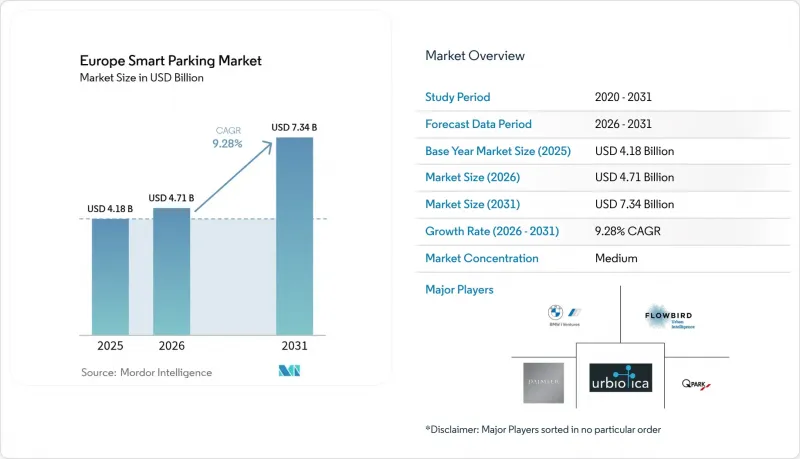
Mordor Intelligence에 의하면, 유럽의 스마트 주차 시장 규모는 2025년에 41억 8,000만 달러, 2026년에 47억 1,000만 달러에 이르고, 2031년까지 73억 4,000만 달러에 이를 것으로 예측되며, 2026-2031년 CAGR 9.28%를 기록할 전망입니다.
본 보고서는 제공업체 유형(주차장 운영 사업자, 주차장 관리 회사, 인프라 제공업체 등), 솔루션(하드웨어, 소프트웨어, 서비스), 기술(지중 매설형 및 초음파 센서, 전기차 충전 기능이 탑재된 주차장 등),최종 사용자(지자체·정부 기관, 교통 허브 등), 지역별로 분류되어 있습니다. 시장 전망은 금액(달러) 기준으로 제시되어 있습니다.
유럽의 스마트 주차 시장 동향 및 인사이트
전기차로 인한 주차 공간 부족
2024년에는 배터리식 전기차(BEV) 등록 대수가 공공 충전소 100만 곳을 돌파할 것으로 예상되며, 분석가들은 2030년까지 그 수가 두 배로 증가할 것으로 전망하고 있습니다. 이로 인해 사업자들은 시설 개보수를 불가피하게 하게 되었으며, 전력 용량 증설, 배선관 설치, 결제 시스템 통합 등이 요구되고 있습니다. ‘대체 연료 인프라 규정’에 따라 모든 회원국은 2030년까지 전기차 10대당 공공 충전기 1기를 설치해야 할 의무가 있으며, 주차장은 분산형 에너지 거점으로 변모하고 있습니다. E.ON 등의 에너지 사업자는 충전 네트워크에 400억 유로(452억 달러)를 예산으로 편성했으며, 현재 자동차 제조업체와 공동으로 V2G(차량에서 전력망으로의 전력 공급) 서비스 시범 운영을 진행하고 있습니다. 이러한 노력은 새로운 수익원을 창출하는 한편, 주차장 관리자가 계량 규정을 준수하고 피크 시간대의 요금 부담을 관리해야 하기 때문에 운영상의 복잡성도 야기하고 있습니다. 주차 데이터와 충전 데이터를 통합하는 지자체는 기후 목표를 달성하는 동시에, 혼잡통행료 제도와의 시너지 효과를 이끌어낼 수 있으며, 전기차 전용 주차 공간을 프리미엄 부동산으로 자리매김할 수 있습니다.
모바일 결제와 주차 앱의 부상
팬데믹 기간 동안 비접촉 결제가 주류가 되었으며, 2025년까지 영국에서 주차 요금의 비접촉 결제 보급률은 81%에 달하고, 대다수의 사용자가 차량 내 결제나 스마트폰 결제를 선호하게 되었습니다. EasyPark는 2025년에 4,000개 도시에서 2억 5,000만 건 이상의 주차 세션을 처리했으며, 코인식 주차 미터기에서 상세한 이용 현황을 파악할 수 있는 디지털 세션으로의 전환이 두드러졌습니다. 직불카드 0.2%, 신용카드 0.3%라는 인터체인지 수수료 상한선 설정으로 인해 소규모 지자체에게도 카드 결제 시스템을 도입할 때의 비용 장벽이 낮아졌습니다. 또한 모바일 앱을 통해 정적인 키오스크에서는 불가능했던 실시간 푸시 알림, 모빌리티 혜택과의 연동, 동적 가격 책정 실험이 가능해졌습니다. 노상 주차 관리가 데이터 주도형으로 전환됨에 따라, 디지털 결제를 활용하는 사업자는 요금 설정 최적화 및 주차 공간 찾기에 소요되는 시간 단축으로 이어지는 인사이트력을 얻을 수 있으며, 이는 인구 밀집 도심 지역의 대기 질 개선에 기여하고 있습니다.
초기 센서 및 토목 공사 비용
지자체는 지하 센서 설치에 주차 공간 1구획당 300-500달러를 지출하고 있으며, 여기에는 굴착, 배선, 백홀 연결 비용이 포함됩니다. 이러한 부담은 주차 수입이 제한적인 소규모 도시의 도입을 저해하는 요인이 되고 있습니다. 3,676개의 센서를 사용한 체코의 시범 사업에서는 배터리 교체까지의 평균 수명이 5년 남짓인 것으로 나타났으며, 이는 자금 사정이 어려운 지자체에게 지속적인 지출 부담이 되고 있습니다. 역사적 보존 구역에서는 굴착 작업 시 고고학적 감독이나 엄격한 복원 기준 준수가 요구되기 때문에 비용이 더욱 증가합니다. 카메라 기반 시스템은 토목 공사 비용을 절감할 수 있지만, 라이선스 비용이나 데이터 개인정보 보호 규정 준수에 드는 비용이 높습니다. 외부 보조금이나 성과 연동형 자금 조달이 없는 경우, 많은 지자체는 스마트 주차 시스템의 전면 도입 대신 주차 미터기의 단계적 교체를 선택하기 때문에 전반적인 보급이 더딘 상황입니다.
부문 분석
CAGR은 11.02%를 기록하며 가장 빠른 성장 궤도를 보였습니다. 이러한 급속한 성장은 2025년 주차 운영 사업자가 보유했던 39.87%의 시장 점유율을 잠식하고 있으며, 고정 요금이나 장기 계약에 의존하는 컨세션 사업자에 대한 압박을 가중시키고 있습니다. JustPark, ParkBee, Parclick 등의 마켓플레이스는 실시간 공석 정보, 투명한 가격 책정, 로열티 혜택을 내세우며, 기존의 현금 결제나 키오스크 환경에서는 실현할 수 없는 원활한 사용자 경험을 제공합니다. 그 결과, 유럽의 스마트 주차 시장에서는 콘크리트를 타설하지 않고도 국경을 넘어 사업을 확장할 수 있는 데이터 기반 플랫폼으로 힘의 균형이 이동하고 있습니다.
주차장 운영 사업자들은 공항이나 도심 주차장에서 여전히 전략적 우위를 유지하고 있지만, 이익률을 지키기 위해서는 앱 현대화, 동적 가격 책정 도입, 전기차 충전 네트워크와의 제휴가 필수적입니다. 지자체들이 오픈 데이터 제공을 의무화하는 가운데, 독자적인 시스템에 집착하는 운영 사업자들은 MaaS 애그리게이터 시장에서 뒤처질 위험에 직면해 있습니다. P2P(개인 간) 호스트는 여전히 구역 지정, 보험, 세제와 같은 장벽에 직면해 있지만, 이러한 체계가 성숙해지면 낮은 자본 집약도 덕분에 유럽의 스마트 주차 시장의 성장 최전선에 계속 서게 될 것입니다.
매니지드 서비스는 2031년까지 연평균 성장률(CAGR) 10.14%로 확대될 것으로 예측됩니다. 이는 가동 시간 및 데이터 정확도 관련 위험을 공급업체에 전가하는 성과 연동형 계약에 대한 지방자치단체 수요를 반영한 것입니다. 소프트웨어 라이선스, 센서 유지보수, 분석 대시보드를 포함한 번들 패키지는 예산이 제한된 지방자치단체가 막대한 설비 투자를 예측 가능한 운영비로 전환하는 데 도움이 됩니다. 2025년 시점에서 소프트웨어는 이미 유럽의 스마트 주차 시장 점유율의 44.91%를 차지하고 있으며, 이는 해당 부문이 하드웨어 중심의 도입에서 실시간 공석 현황 데이터를 통합하고 API 연결을 지원하는 클라우드 네이티브 플랫폼으로 전환되고 있음을 보여줍니다.
하드웨어는 여전히 중요하지만, 센서 가격 하락과 다중 공급업체 간의 상호 운용성이 표준화됨에 따라 점차 상품화되고 있습니다. 서비스 기업들은 신속한 도입, KPI 보장, 통합에 대한 전문 지식을 통해 차별화를 꾀하고 있으며, 이를 통해 지자체 관리자들은 사내 데이터 사이언스자를 고용하지 않고도 규제 일정을 충족할 수 있게 됩니다. 성과 기반 입찰을 채택하는 지자체들이 늘어남에 따라, 도입부터 운영 종료까지 종합적인 지원을 제공하는 벤더는 유럽의 스마트 주차 시장에서 지속적인 수익을 창출하는 데 유리한 입장에 있습니다.
기타 혜택:
- 엑셀 형식 시장 예측(ME) 시트
- 3개월간의 애널리스트 지원
자주 묻는 질문
목차
제1장 서론
제2장 조사 방법
제3장 주요 요약
제4장 시장 구도
제5장 시장 규모와 성장 예측
제6장 경쟁 구도
제7장 시장 기회와 향후 전망
LSH 26.09.14According to Mordor Intelligence, the Europe smart parking market size is projected to be USD 4.18 billion in 2025, USD 4.71 billion in 2026, and reach USD 7.34 billion by 2031, growing at a CAGR of 9.28% from 2026 to 2031.
This report is Segmented by Provider Type (Parking Operators, Parking Management Companies, Infrastructure Providers, and More), Solution (Hardware, Software, and Services), Technology (In-Ground and Ultrasonic Sensors, EV-Charging Integrated Parking, and More), End-User (Municipalities and Government, Transport Hubs, and More), and Geography. The Market Forecasts are Provided in Terms of Value (USD).
Europe Smart Parking Market Trends and Insights
EV-Driven Parking Space Stress
Battery-electric vehicle registrations passed 1 million public charging points in 2024, and analysts see that figure doubling by 2030, forcing operators to retrofit facilities with power upgrades, conduit, and payment integration. The Alternative Fuels Infrastructure Regulation compels every member state to provide one public charger for every 10 EVs by 2030, converting parking areas into distributed energy nodes. Energy utilities such as E.ON have earmarked EUR 40 billion (USD 45.2 billion) for charging networks and are now piloting vehicle-to-grid services with automotive OEMs. These initiatives create fresh revenue streams but introduce operational complexity as parking managers must comply with metering rules and manage peak-tariff exposure. Municipalities that blend parking and charging data can unlock congestion-pricing synergies while meeting climate targets, positioning EV-ready bays as premium real estate.
Rise of Mobile Payments and Parking Apps
Contactless transactions became mainstream during the pandemic, and by 2025 the United Kingdom recorded 81% penetration for parking fees, with most users preferring in-car or smartphone payments. EasyPark processed more than 250 million parking sessions across 4,000 cities in 2025, highlighting the shift from coin-operated meters to digital sessions that capture granular occupancy data. Interchange-fee caps, 0.2% for debit and 0.3% for credit, lowered the cost barrier for small municipalities to adopt card-based systems . Mobile apps also enable real-time push notifications, bundled mobility rewards, and dynamic pricing experiments that were impossible with static kiosks. As curb management becomes data-rich, operators leveraging digital payments gain insights to calibrate tariffs and reduce cruising time, improving air quality in dense urban cores
Up-Front Sensor and Civil-Works Costs
Municipalities spend USD 300-500 per bay to install in-ground sensors, covering excavation, cabling, and backhaul connectivity, a burden that deters smaller cities with modest parking revenues. A Czech pilot using 3,676 sensors showed an average lifespan of just over five years before battery replacement, adding a recurring outlay for cash-strapped councils. Heritage zones further inflate costs because trenching requires archaeological supervision and adherence to strict restoration codes. Camera-based systems lower civil-works outlays but carry higher licensing fees and data-privacy compliance costs. Without external grants or outcome-based financing, many towns choose incremental meter upgrades rather than full smart-parking rollouts, slowing overall penetration.
Other drivers and restraints analyzed in the detailed report include:
- EU Smart-City Funding for MaaS Pilots
- Corporate Scope-3 Decarbonization Targets
- Fragmented Municipal Procurement Cycles
For complete list of drivers and restraints, kindly check the Table Of Contents.
Segment Analysis
Peer-to-peer players recorded the fastest growth trajectory, with an 11.02% projected CAGR through 2031, as asset-light models monetize idle residential driveways and off-peak office lots. This surge is eating into the 39.87% share parking operators held in 2025, pressuring concessionaires that rely on fixed tariffs and long-term contracts. Marketplaces such as JustPark, ParkBee, and Parclick advertise real-time availability, transparent pricing, and loyalty perks, creating a seamless user journey that traditional cash or kiosk environments cannot match. The Europe smart parking market is therefore witnessing a power shift toward data-driven platforms that can scale across borders without laying concrete.
Parking operators retain strategic advantages in airports and city-center garages, yet they must modernize apps, embed dynamic pricing, and partner with EV-charging networks to defend margins. As municipalities mandate open data, operators that cling to proprietary systems risk being sidelined in MaaS aggregators. Peer-to-peer hosts still navigate zoning, insurance, and tax hurdles, but once these frameworks mature, their low capital intensity will keep them at the growth frontier of the Europe smart parking market.
Managed services are forecast to expand at a 10.14% CAGR to 2031, reflecting municipal appetite for outcome-based contracts that shift uptime and data-accuracy risk to vendors. Bundled packages that include software licenses, sensor maintenance, and analytics dashboards help budget-constrained cities convert large capital outlays into predictable operating expenses. Software already held 44.91% of Europe smart parking market share in 2025, illustrating the sector's pivot from hardware-centric deployments to cloud-native platforms that aggregate real-time occupancy feeds and support API connectivity.
Hardware remains critical but is inching toward commoditization as sensor prices fall and multi-vendor interoperability becomes the norm. Services firms differentiate through rapid deployment, KPI guarantees, and integration expertise, enabling city managers to meet regulatory timelines without hiring in-house data scientists. As more municipalities adopt performance-based tenders, vendors offering cradle-to-grave support are well positioned to capture recurring revenue in the Europe smart parking market.
Complete Report Scope:
- By Provider Type
- Parking Operators
- Parking Management Companies
- Infrastructure Providers (HW and SW)
- Peer-to-Peer (P2P) Parking Platforms
- Aggregators and Marketplaces
- By Solution
- Hardware
- Software
- Services
- By Technology
- In-Ground and Ultrasonic Sensors
- Camera and Computer-Vision and ANPR
- IoT Connectivity Platforms
- Mobile Apps and Digital Payments
- EV-Charging Integrated Parking
- By End-User
- Municipalities and Government
- Commercial Car-Parks and Malls
- Transport Hubs (Airports, Rail)
- Corporate Campuses and Business Parks
- Residential and Mixed-Use Developments
- By Region
- Germany
- United Kingdom
- France
- Spain
- Italy
- Netherlands
- Nordics
- Rest of Europe
List of Companies Covered in this Report:
- APCOA Parking Holdings GmbH
- EasyPark Group AB
- Indigo Group S.A.
- Q-Park NV
- Flowbird SASU
- Parkopedia Ltd.
- Urbiotica SL
- Cleverciti Systems GmbH
- JustPark Parking Ltd.
- Parclick S.L.
- ParkBee B.V.
- RingGo Ltd.
- Telpark (Empark Aparcamientos y Servicios S.A.)
- Parklio d.o.o.
- ParkHub Inc.
- FlashParking, Inc.
- ParkAir Systems AB
- Daimler Mobility
- Park+ Mobility B.V.
- Bosch Service Solutions SE (Parking-as-a-Service)
- BMW i Ventures (ParkNow Heritage Assets)
Additional Benefits:
- The market estimate (ME) sheet in Excel format
- 3 months of analyst support
TABLE OF CONTENTS
1 INTRODUCTION
- 1.1 Study Assumptions and Market Definition
- 1.2 Scope of the Study
2 RESEARCH METHODOLOGY
3 EXECUTIVE SUMMARY
4 MARKET LANDSCAPE
- 4.1 Market Overview
- 4.2 Market Drivers
- 4.2.1 EV-Driven Parking Space Stress
- 4.2.2 Rise of Mobile Payments and Parking Apps
- 4.2.3 EU Smart-City Funding for MaaS Pilots
- 4.2.4 Corporate Scope-3 Decarbonization Targets
- 4.2.5 EU Data-Sharing Mandates Under Revised ITS Directive
- 4.2.6 15-Minute-City Zoning Accelerating Curb Reforms
- 4.3 Market Restraints
- 4.3.1 Up-Front Sensor and Civil-Works Costs
- 4.3.2 Fragmented Municipal Procurement Cycles
- 4.3.3 GDPR-Driven Restrictions on ANPR Analytics
- 4.3.4 EV-First Kerb Allocation Shrinking Paid Bays
- 4.4 Impact of Macroeconomic Factors on the Market
- 4.5 Regulatory Landscape
- 4.6 Technological Outlook
- 4.7 Industry Value Chain Analysis
- 4.8 Porter's Five Forces Analysis
- 4.8.1 Bargaining Power of Suppliers
- 4.8.2 Bargaining Power of Buyers
- 4.8.3 Threat of New Entrants
- 4.8.4 Threat of Substitutes
- 4.8.5 Intensity of Competitive Rivalry
- 4.9 Industry Ecosystem Analysis
- 4.10 Case Studies, Flagship European Deployments
- 4.11 Investment Analysis
5 MARKET SIZE AND GROWTH FORECASTS (VALUE)
- 5.1 By Provider Type
- 5.1.1 Parking Operators
- 5.1.2 Parking Management Companies
- 5.1.3 Infrastructure Providers (HW and SW)
- 5.1.4 Peer-to-Peer (P2P) Parking Platforms
- 5.1.5 Aggregators and Marketplaces
- 5.2 By Solution
- 5.2.1 Hardware
- 5.2.2 Software
- 5.2.3 Services
- 5.3 By Technology
- 5.3.1 In-Ground and Ultrasonic Sensors
- 5.3.2 Camera and Computer-Vision and ANPR
- 5.3.3 IoT Connectivity Platforms
- 5.3.4 Mobile Apps and Digital Payments
- 5.3.5 EV-Charging Integrated Parking
- 5.4 By End-User
- 5.4.1 Municipalities and Government
- 5.4.2 Commercial Car-Parks and Malls
- 5.4.3 Transport Hubs (Airports, Rail)
- 5.4.4 Corporate Campuses and Business Parks
- 5.4.5 Residential and Mixed-Use Developments
- 5.5 By Region
- 5.5.1 Germany
- 5.5.2 United Kingdom
- 5.5.3 France
- 5.5.4 Spain
- 5.5.5 Italy
- 5.5.6 Netherlands
- 5.5.7 Nordics
- 5.5.8 Rest of Europe
6 COMPETITIVE LANDSCAPE
- 6.1 Market Concentration
- 6.2 Strategic Moves and Developments
- 6.3 Market Share Analysis
- 6.4 Company Profiles (includes Global Level Overview, Market Level Overview, Core Segments, Financials as available, Strategic Information, Market Rank/Share, Products and Services, Recent Developments)
- 6.4.1 APCOA Parking Holdings GmbH
- 6.4.2 EasyPark Group AB
- 6.4.3 Indigo Group S.A.
- 6.4.4 Q-Park NV
- 6.4.5 Flowbird SASU
- 6.4.6 Parkopedia Ltd.
- 6.4.7 Urbiotica SL
- 6.4.8 Cleverciti Systems GmbH
- 6.4.9 JustPark Parking Ltd.
- 6.4.10 Parclick S.L.
- 6.4.11 ParkBee B.V.
- 6.4.12 RingGo Ltd.
- 6.4.13 Telpark (Empark Aparcamientos y Servicios S.A.)
- 6.4.14 Parklio d.o.o.
- 6.4.15 ParkHub Inc.
- 6.4.16 FlashParking, Inc.
- 6.4.17 ParkAir Systems AB
- 6.4.18 Daimler Mobility
- 6.4.19 Park+ Mobility B.V.
- 6.4.20 Bosch Service Solutions SE (Parking-as-a-Service)
- 6.4.21 BMW i Ventures (ParkNow Heritage Assets)
7 MARKET OPPORTUNITIES AND FUTURE OUTLOOK
- 7.1 White-Space and Unmet-Need Assessment
- 7.2 Opportunity Hotspots
- 7.3 Strategic Roadmap for Stakeholders