
|
시장보고서
상품코드
2124500
주택용 A2W 히트펌프 : 시장 점유율 분석, 업계 동향 및 통계, 성장 예측(2026-2031년)Residential Air To Water Heat Pump - Market Share Analysis, Industry Trends & Statistics, Growth Forecasts (2026 - 2031) |
||||||
 Mordor Intelligence
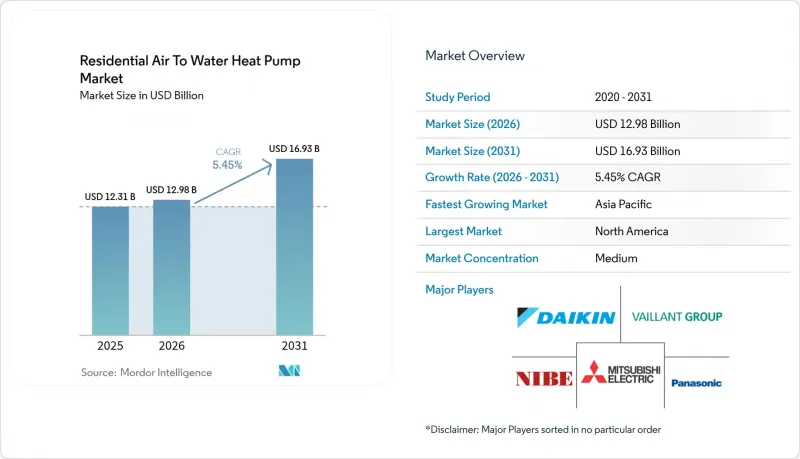
주택용 A2W 히트펌프 시장 규모는 2025년 123억 1,000만 달러로 평가되었습니다. 2026년에는 129억 8,000만 달러로 확대되어 2026년부터 2031년에 걸쳐 CAGR 5.45%로 성장을 지속하여, 2031년에는 169억 3,000만 달러에 이를 것으로 예측됩니다.
본 보고서는 유형별(스플릿 시스템, 모노블록 시스템, 올인원 일체형 등), 용량별(10kW 미만, 10-20kW, 10kW 초과),냉매별(R410A, R32 등), 용도(단독주택, 공동주택), 설치 형태(신축, 개보수·교체), 지역별로 분류되어 있습니다. 시장 예측은 금액(달러) 기준으로 제시되어 있습니다.
세계의 주택용 A2W 히트펌프 시장 동향 및 인사이트
EU 전역의 화석 연료 보일러 금지 조치가 히트펌프로의 개조를 가속화하고 있습니다.
2025년부터 신축 주택을 대상으로 시작되어 2040년까지 교체 대상 주택으로 확대될 강제적인 단계적 폐지 조치로 인해, 권장되는 온수 난방 솔루션에 대한 잔존하던 불확실성이 해소되었습니다. 이러한 엄격한 기한으로 인해, 기존 라디에이터를 통해 높은 출수 온도를 실현할 수 있는 공기-물식 히트펌프에 대한 향후 수십 년간 수요가 확고해질 것입니다. 네덜란드 등 시장에서는 설치 비용의 최대 30%를 보조하는 제도를 통해 주택 소유주에게 경제적 이점이 커지고 있습니다. 산발적인 인센티브의 급증 대신, 예측 가능한 규제 준수 일정이 OEM의 생산 능력 계획과 유통업체의 재고 수준을 이끌게 되었습니다. 또한, 가스 보일러 교체 시 매년 더 높은 탄소세가 부과되므로, 이 정책으로 인해 투자 회수 기간도 단축됩니다. 이러한 요인들이 결합되어, 이 조치는 유럽 전역에서 주거용 공기-물식 히트펌프 시장을 ‘기본 기술’로서의 지위로 끌어올리고 있습니다.
우크라이나 사태 이후의 가스 가격 변동이 유럽 내 총소유비용(TCO) 격차를 확대
북서유럽 전역의 현물 가스 가격은 2022년 이전 평균의 3배에 달하고 있으며, 이로 인해 수명 주기 비용의 균형이 열펌프 쪽으로 크게 기울고 있습니다. 정부 분석에 따르면, 독일 가구는 전환 후 연간 난방비를 최대 60% 절감할 수 있는 것으로 나타났습니다. 이러한 절감 효과는 이전에는 히트펌프를 ‘친환경적인 사치품’으로 여겼던 중산층 주택 소유자들에게 큰 반향을 일으키고 있습니다. 이 가격 변동은 일시적인 것이 아니라 구조적인 것입니다. EU의 에너지 정책이 파이프라인 가스에서 영구적으로 탈피하고 에너지 공급원을 다각화하는 것을 목표로 하고 있기 때문입니다. 이러한 추세로 인해 매년 겨울, 주거용 공기-물 히트펌프 시장의 비교 우위가 더욱 높아지고 있습니다.
EU의 인구 밀집 교외 지역에서는 송전망 용량 제한으로 인해 연결이 지연되고 있습니다.
전기화율이 낮다는 전제 하에 건설된 배전 선로는 거리 전체에 6-10kW 단위가 도입됨에 따라 피크 부하의 급격한 증가에 직면하고 있습니다. 독일의 연간 50만 대 도입 목표는 겨울철 피크 수요를 10GW까지 끌어올릴 가능성이 있어, 전력 회사는 연결 우선순위를 정할 수밖에 없습니다. 농촌 지역에서는 연결 비용이 가구당 1,200유로를 초과하는 반면, 도시 지역에서는 비교적 저렴합니다. 이러한 격차로 인해 송전망에 제약이 있는 지역에서는 송전망 보강 공사가 완료될 때까지 주택용 A2W 히트펌프 시장의 초기 단계 도입 대수가 둔화될 것입니다.
부문별 분석
2025년에는 설치 업체들이 기존의 보일러 회로를 반영한 익숙한 구성 레이아웃을 중시함에 따라, 스플릿형 유닛이 매출의 41.35%를 차지했습니다. 이러한 우위는 주택용 A2W 히트펌프 시장에서 상당한 점유율로 이어지고 있습니다. 그러나 극한의 한파가 닥쳤을 때 백업용 연소 설비를 원하는 가구가 늘어나고 있어, 히트펌프와 보일러를 결합한 하이브리드 패키지는 연평균 성장률(CAGR) 8.83%로 급속히 성장하고 있습니다. 이 부문의 성장은 기술적 필요성이라기보다는 소비자의 위험 회피 성향을 반영한 것입니다. 이는 최신 R290 모델이 주변 온도가 -20℃인 환경에서도 65℃의 온수를 유지할 수 있기 때문입니다. 향후 실제 데이터를 통해 순수 히트펌프의 신뢰성이 입증됨에 따라, 하이브리드 제품에 대한 수요는 정점에 달할 가능성이 높습니다. 모노블록형이나 올인원형은 설치 공간이 제한된 리모델링 공사에 적합하여, 이 주택용 A2W 히트펌프 시장에 유익한 폭을 넓혀가고 있습니다.
스플릿형 제품은 대량 생산에 따른 비용 절감 효과로 하드웨어 비용을 낮춰, 보급형 가격 경쟁력을 유지하고 있습니다. 한편, 하이브리드형은 프리미엄 가격으로 책정되어 있지만, 안심감이라는 부가가치를 제공하여 한랭한 대륙성 기후 지역에서 공감을 얻고 있습니다. 각 OEM 업체들은 연결형 온도 조절기나 지능형 전환 알고리즘을 번들로 제공하여 운전 조건을 자동으로 최적화하고 있습니다. 이러한 소프트웨어 계층이 브랜드 간 차별화를 도모하며, 주택용 A2W 히트펌프 업계를 서비스 중심의 수익 모델로 이끌고 있습니다.
2025년 설치 대수의 54.30%를 차지한 것은 10kW 미만 기종으로, 이는 일반적인 단독주택에 최적입니다. 한편, 20kW를 초과하는 기종은 공동주택이나 고급 주택 개발업자들이 집중형 플랜트를 선택하는 경향이 있어 8.14%라는 가장 높은 연평균 성장률(CAGR)을 기록했습니다. 이러한 급증으로 인해 주택용 A2W 히트펌프 시장에서 20kW 초과 기종의 점유율은 2031년까지 2배로 늘어날 가능성이 있습니다. 비스만(Wiesmann)의 40 kW ‘Vitocal 250-A PRO’는 라디에이터의 온도차(델타 T) 요구 사항이 높은 오래된 건물에서 고출력 프로판 유닛이 어떻게 대응할 수 있는지를 보여줍니다.
10-20 kW급 시스템은 교외의 단독 주택과 소규모 공동 주택 수요를 연결하는 역할을 하고 있습니다. 탄소 배출 규제가 엄격해지는 가운데, 프랑스, 이탈리아 및 캐나다의 일부 지역에서는 이 중용량 대역이 가장 빠르게 확대되고 있습니다. 유체 온도가 70°C까지 상승함에 따라 용량 대역의 경계가 모호해지고 있어, 향후 시장 세분화가 여전히 적절한지에 대한 의문이 제기되고 있습니다. 그럼에도 불구하고, 설치 업체의 작업 흐름, 냉매 충전량 제한, 전력계통 연결 방식에는 여전히 충분한 차이가 존재하므로, 주택용 A2W 히트펌프 시장에서 이러한 용량 대는 여전히 의미 있는 구분으로 기능하고 있습니다.
지역별 분석
유럽은 잘 갖춰진 온수 배관 인프라와 적극적인 탄소 정책 덕분에 2025년에도 전 세계 매출의 33.60%를 차지했습니다. 그러나 거시경제적 역풍과 규제 불확실성으로 인해 2024년 판매 대수는 22% 감소했습니다. 프랑스와 이탈리아에서 국가 차원의 보조금 제도가 재검토되면서 소비자 심리에 큰 부담을 주었고, 주거용 공냉식 히트펌프 온수·난방 시스템 시장에서 정책에 대한 민감성이 두드러지게 나타났습니다. 그럼에도 불구하고, 브뤼셀은 2030년의 목표로 유럽 내 누적 설치 대수 6,000만 대를 제시하고 있으며, 이는 현재 수준에서 급격한 성장을 의미합니다.
북미에서는 2024년 하반기 출하 대수가 15% 증가하며 회복 조짐을 보였습니다. 연방 및 주 차원의 보조금 제도가 결합되어 일부 우편번호 지역에서는 인센티브 총액이 1만 달러에 달하고 있으며, 이것이 주택용 A2W 히트펌프 시장의 성장세를 뒷받침하고 있습니다. 현지 조달 규정이 공급망을 재편하고 있습니다. 예를 들어, 켄튀르키예주에 신설되는 압축기 공장으로 인해 리드타임이 30% 단축될 전망입니다. 캐나다 각 주에서는 한랭지 전용 분류가 추가되고, 증기 분사식 압축기의 연구 개발이 촉진되어 극한의 추위가 기승을 부리는 프레리 지역의 계절 효율이 향상되고 있습니다.
아시아태평양은 중국 시장 규모와 전기화 비율 상승에 힘입어 7.82%라는 가장 높은 연평균 성장률(CAGR)을 기록하고 있습니다. 2024년에는 수출 수주가 둔화되었음에도 불구하고, 국내 제조업체의 출하 대수는 13% 증가하여 국내 시장의 견고한 성장세를 여실히 보여주고 있습니다. 중동은 현재 시장 규모가 작지만, 지역 냉방 사업자들이 겨울철 운영을 위해 가역형 수루프 시스템 개조를 추진함에 따라 7.82%라는 동등한 성장률을 달성하고 있습니다. 일본과 한국은 기술적으로는 선진적이지만, 공동주택에서 가스 보일러에 대한 문화적 애착이 뿌리 깊게 자리 잡고 있어, 주거용 공냉식 히트펌프 온수·난방 시스템 시장의 이 부문에서 보급 속도가 비교적 완만한 이유입니다.
기타 혜택 :
- 엑셀 형식 시장 예측(ME) 시트
- 3개월간의 애널리스트 지원
자주 묻는 질문
목차
제1장 서론
제2장 조사 방법
제3장 주요 요약
제4장 시장 구도
제5장 시장 규모 및 성장 예측
제6장 경쟁 구도
제7장 시장 기회 및 향후 전망
KTHAccording to Mordor Intelligence, the residential air-to-water heat pump market size is expected to grow from USD 12.31 billion in 2025 to USD 12.98 billion in 2026 and is forecast to reach USD 16.93 billion by 2031 at 5.45% CAGR over 2026-2031.
This report is Segmented by Type (Split Systems, Monobloc Systems, All-In-One Integrated, and More), Capacity (Less Than 10 KW, 10 - 20 KW, and More), Refrigerant (R410A, R32, and More), Application (Single, Multi-Family Residences), Installation Type (New Construction, Retrofit/Replacement), and Geography. The Market Forecasts are Provided in Terms of Value (USD).
Global Residential Air To Water Heat Pump Market Trends and Insights
EU-wide ban on fossil-fuel boilers accelerating heat-pump retrofits
Mandatory phase-outs that start in 2025 for new homes and extend to replacements by 2040 remove any remaining ambiguity over the preferred hydronic heating solution. This hard deadline locks in multi-decade demand for air-to-water units able to deliver high flow temperatures via existing radiators. Subsidies covering up to 30% of installed cost in markets such as the Netherlands sweeten the economics for homeowners. Instead of sporadic incentive spikes, a predictable compliance calendar now guides OEM capacity planning and distributor stocking levels. The policy also shortens payback periods because gas-boiler replacements face higher carbon levies each year. Taken together, the measure pushes the residential air to water heat pump market toward default-technology status across Europe.
Post-Ukraine gas-price volatility widening TCO gap in Europe
Spot gas prices across northwest Europe ran three times above the pre-2022 average, tilting lifetime costs sharply in favor of heat pumps. Government analysis shows German households can cut annual heating bills by up to 60% after switching. Such savings resonate with middle-income owners who previously viewed heat pumps as a green luxury. Volatility is structural, not cyclical, because EU energy policy seeks permanent diversification away from pipeline gas. That dynamic deepens the comparative advantage of the residential air to water heat pump market every winter.
Grid-capacity caps delaying hook-ups in dense EU suburbs
Distribution feeders built for low electrification levels face sharp peak-load jumps as entire streets add 6-10 kW units. Germany's 500,000-unit annual target could raise peak winter demand by 10 GW, forcing utilities to triage connections. Rural tie-in fees climb above EUR 1,200 per dwelling, while urban districts fare better. This mismatch slows early-stage volumes for the residential air to water heat pump market in grid-constrained neighbourhoods until reinforcement work catches up.
Other drivers and restraints analyzed in the detailed report include:
- US Inflation Reduction Act rebates for >= 15 SEER heat pumps
- Low-GWP R290 / R32 models easing F-Gas phase-down compliance
- Shortage of hydronic-skilled installers inflating labor cost
For complete list of drivers and restraints, kindly check the Table Of Contents.
Segment Analysis
Split units held 41.35% of revenue in 2025 as installers value familiar component layouts that mirror legacy boiler circuits. That dominance translates into a sizeable slice of the residential air to water heat pump market. Hybrid pump-and-boiler packages, however, are racing ahead at a 8.83% CAGR as households want backup combustion during polar cold snaps. The segment's growth reflects behavioral risk aversion more than technical necessity, because modern R290 models sustain 65 °C supply water at -20 °C ambient. Over time, as field data validates pure-pump reliability, hybrid appeal is likely to plateau. Monobloc and all-in-one variants court space-constrained retrofits, adding useful breadth to this residential air to water heat pump market.
Split offerings benefit from mass-production economics that compress hardware costs, keeping entry prices competitive. Conversely, hybrids command premium pricing but deliver perceived peace of mind, a value proposition resonating in cold continental climates. OEMs are bundling connected thermostats and intelligent switchover algorithms to optimize operating points automatically. This software layer differentiates brands and nudges the residential air to water heat pump industry toward service-centric revenue streams.
< 10 kW units represented 54.30% of installs in 2025, a natural fit for typical detached homes. At the other end, >20 kW machines posted the quickest 8.14% CAGR as developers of multi-dwelling blocks and luxury residences opt for central plants. That surge means the > 20 kW slice of the residential air to water heat pump market size could double by 2031. Viessmann's 40 kW Vitocal 250-A PRO illustrates how high-output propane units tackle older buildings where radiator delta-T demands are high.
Systems in the 10-20 kW tier bridge suburban villas and small apartment houses. As carbon caps tighten, this mid-range is broadening fastest in France, Italy and parts of Canada. With flow temperatures climbing to 70 °C, the capacity brackets converge, raising questions about future segmentation relevance. Nevertheless, installer workflows, refrigerant charge limits and grid-connection forms still differ enough to keep the capacity bands meaningful within the residential air to water heat pump market.
Complete Report Scope:
- By Type
- Split Systems
- Monobloc Systems
- All-in-One Integrated
- Hybrid (HP + Boiler)
- By Capacity (kW)
- Less than 10 kW
- 10 - 20 kW
- Greater than 20 kW
- By Refrigerant
- R410A
- R32
- R290 (Propane)
- CO2 (R744)
- By Application
- Single-Family Homes
- Multi-Family Residences
- By Installation Type
- New Construction
- Retrofit / Replacement
- By Geography
- North America
- United States
- Canada
- Mexico
- South America
- Brazil
- Argentina
- Rest of South America
- Europe
- Germany
- France
- Italy
- United Kingdom
- Spain
- Rest of Europe
- Middle East
- UAE
- Saudi Arabia
- Turkey
- Rest of Middle East
- Africa
- South Africa
- Egypt
- Nigeria
- Rest of Africa
- Asia-Pacific
- China
- Japan
- South Korea
- Australia
- India
- Rest of Asia-Pacific
- North America
Geography Analysis
Europe retained 33.60% of global revenue in 2025 thanks to dense hydronic infrastructure and aggressive carbon policy. Nevertheless, macro headwinds and regulatory ambiguity shaved 22% off unit sales during 2024. National subsidy resets in France and Italy weighed on consumer sentiment, illustrating policy sensitivity inside the residential air to water heat pump market. Still, Brussels sees 60 million cumulative European installs as a 2030 milestone, implying a steep climb from today's base.
North America rebounded late-2024 with a 15% jump in shipments. Federal and state rebate stacks have pushed total incentives toward USD 10,000 in some ZIP codes, driving momentum in the residential air to water heat pump market. Local content rules are re-shaping supply chains; for example, the new Kentucky compressor plant will cut lead times by 30%. Canadian provinces add cold-climate tiers that spur R&D on vapor-injection compressors, raising seasonal efficiencies in frigid Prairies.
Asia-Pacific posts the fastest 7.82% CAGR led by China's scale and rising electrification quotas. Domestic producers shipped 13% more units in 2024, even as export orders softened, highlighting robust internal momentum. The Middle East, while small today, matches that 7.82% growth rate as district-cooling operators retrofit reversible water-loop systems for winter service. Japan and South Korea remain technologically advanced but culturally attached to gas boilers in multi-family blocks, explaining a more modest uptake pace in that slice of the residential air to water heat pump market.
- Daikin Industries Ltd
- Mitsubishi Electric Corp.
- Panasonic Corp.
- Vaillant Group
- NIBE Industrier AB
- Ariston Thermo SpA
- Viessmann Climate Solutions
- Bosch Thermotechnology
- Carrier Global Corp.
- LG Electronics Inc.
- Samsung Electronics Co.
- Stiebel Eltron GmbH
- Glen Dimplex Group
- Hitachi Heat Pump Systems
- Gree Electric Appliances
- Midea Group Co.
- Ferroli SpA
- Baxi Heating ( BDR Thermea )
- Clivet SpA
- Swegon Group AB
- A.O. Smith Corp.
- Johnson Controls International
- Danfoss A/S
- Thermia Heat Pumps
Additional Benefits:
- The market estimate (ME) sheet in Excel format
- 3 months of analyst support
TABLE OF CONTENTS
1 INTRODUCTION
- 1.1 Study Assumptions and Market Definition
- 1.2 Scope of the Study
2 RESEARCH METHODOLOGY
3 EXECUTIVE SUMMARY
4 MARKET LANDSCAPE
- 4.1 Market Overview
- 4.2 Market Drivers
- 4.2.1 EU-wide ban on fossil-fuel boilers accelerating heat-pump retrofits
- 4.2.2 Post-Ukraine gas-price volatility widening TCO gap in Europe
- 4.2.3 U.S. Inflation Reduction Act rebates for greater than 15 SEER heat pumps
- 4.2.4 Low-GWP R290 / R32 models easing F-Gas Phase-Down compliance
- 4.2.5 Inverter compressors lifting seasonal COP in sub-zero climates
- 4.2.6 Rooftop solar parity unlocking self-consumption heating in China
- 4.3 Market Restraints
- 4.3.1 Grid-capacity caps delaying hook-ups in dense EU suburbs
- 4.3.2 Shortage of hydronic-skilled installers inflating labor cost
- 4.3.3 Urban noise-regulation setbacks on outdoor-unit placement
- 4.3.4 Consumer preference for gas boilers in East-Asian multi-family
- 4.4 Value / Supply-Chain Analysis
- 4.5 Regulatory Outlook
- 4.6 Technological Outlook
- 4.7 Porter's Five Forces Analysis
- 4.7.1 Bargaining Power of Suppliers
- 4.7.2 Bargaining Power of Consumers
- 4.7.3 Threat of New Entrants
- 4.7.4 Threat of Substitutes
- 4.7.5 Intensity of Competitive Rivalry
- 4.8 Impact of COVID-19 on the Heat-Pump Industry
5 MARKET SIZE AND GROWTH FORECASTS (VALUE)
- 5.1 By Type
- 5.1.1 Split Systems
- 5.1.2 Monobloc Systems
- 5.1.3 All-in-One Integrated
- 5.1.4 Hybrid (HP + Boiler)
- 5.2 By Capacity (kW)
- 5.2.1 Less than 10 kW
- 5.2.2 10 - 20 kW
- 5.2.3 Greater than 20 kW
- 5.3 By Refrigerant
- 5.3.1 R410A
- 5.3.2 R32
- 5.3.3 R290 (Propane)
- 5.3.4 CO2 (R744)
- 5.4 By Application
- 5.4.1 Single-Family Homes
- 5.4.2 Multi-Family Residences
- 5.5 By Installation Type
- 5.5.1 New Construction
- 5.5.2 Retrofit / Replacement
- 5.6 By Geography
- 5.6.1 North America
- 5.6.1.1 United States
- 5.6.1.2 Canada
- 5.6.1.3 Mexico
- 5.6.2 South America
- 5.6.2.1 Brazil
- 5.6.2.2 Argentina
- 5.6.2.3 Rest of South America
- 5.6.3 Europe
- 5.6.3.1 Germany
- 5.6.3.2 France
- 5.6.3.3 Italy
- 5.6.3.4 United Kingdom
- 5.6.3.5 Spain
- 5.6.3.6 Rest of Europe
- 5.6.4 Middle East
- 5.6.4.1 UAE
- 5.6.4.2 Saudi Arabia
- 5.6.4.3 Turkey
- 5.6.4.4 Rest of Middle East
- 5.6.5 Africa
- 5.6.5.1 South Africa
- 5.6.5.2 Egypt
- 5.6.5.3 Nigeria
- 5.6.5.4 Rest of Africa
- 5.6.6 Asia-Pacific
- 5.6.6.1 China
- 5.6.6.2 Japan
- 5.6.6.3 South Korea
- 5.6.6.4 Australia
- 5.6.6.5 India
- 5.6.6.6 Rest of Asia-Pacific
- 5.6.1 North America
6 COMPETITIVE LANDSCAPE
- 6.1 Market Concentration
- 6.2 Strategic Moves
- 6.3 Market Share Analysis
- 6.4 Company Profiles {(includes Global level Overview, Market level Overview, Core Segments, Financials, Strategic Information, Market Rank/Share, Products and Services, Recent Developments)}
- 6.4.1 Daikin Industries Ltd
- 6.4.2 Mitsubishi Electric Corp.
- 6.4.3 Panasonic Corp.
- 6.4.4 Vaillant Group
- 6.4.5 NIBE Industrier AB
- 6.4.6 Ariston Thermo SpA
- 6.4.7 Viessmann Climate Solutions
- 6.4.8 Bosch Thermotechnology
- 6.4.9 Carrier Global Corp.
- 6.4.10 LG Electronics Inc.
- 6.4.11 Samsung Electronics Co.
- 6.4.12 Stiebel Eltron GmbH
- 6.4.13 Glen Dimplex Group
- 6.4.14 Hitachi Heat Pump Systems
- 6.4.15 Gree Electric Appliances
- 6.4.16 Midea Group Co.
- 6.4.17 Ferroli SpA
- 6.4.18 Baxi Heating ( BDR Thermea )
- 6.4.19 Clivet SpA
- 6.4.20 Swegon Group AB
- 6.4.21 A.O. Smith Corp.
- 6.4.22 Johnson Controls International
- 6.4.23 Danfoss A/S
- 6.4.24 Thermia Heat Pumps
7 MARKET OPPORTUNITIES AND FUTURE OUTLOOK
- 7.1 White-Space and Unmet-Need Assessment