

|
시장보고서
상품코드
2124506
모바일 러닝 : 시장 점유율 분석, 업계 동향과 통계, 성장 예측(2026-2031년)Mobile Learning - Market Share Analysis, Industry Trends & Statistics, Growth Forecasts (2026 - 2031) |
||||||
 Mordor Intelligence
Mordor Intelligence에 의하면, 모바일 러닝 시장 규모는 2026년에 957억 7,000만 달러로 추정되고 있어 예측 기간(2026-2031년)에 CAGR 15.89%로 확대되어 2031년에는 2,002억 4,000만 달러에 이를 전망입니다.
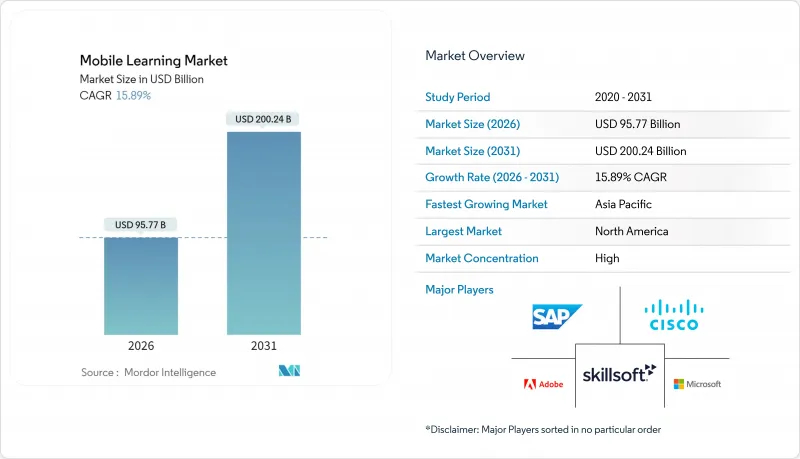
본 보고서는 솔루션별(전자책, 상호작용형 평가, 모바일 및 동영상 기반 코스웨어 등), 용도별(교실 학습, 기업 연수, 시뮬레이션 기반 학습 등), 최종 사용자별(교육 기관, 기업), 제공업체 유형별(컨텐츠 제공업체, 서비스 제공업체), 그리고 지역별로 분류되어 있습니다. 시장 전망은 금액(달러) 단위로 제시되어 있습니다.
세계 모바일 러닝 시장 동향 및 인사이트
기업의 학습 및 개발(L&D) 분야에서 디지털 학습 솔루션의 급속한 보급;
2024년 하이브리드 근무 방식이 정착된 후, 기업의 예산은 모바일 우선 채널로 전환되었습니다. 포춘 500대 기업은 현재 교육비의 상당 부분을 스마트폰 지원 모듈에 할당하고 있으며, 이러한 추세는 2024년 LinkedIn Learning의 기업 이용률이 78%를 기록한 사실로 입증되었습니다. 모바일 우선 프로그램은 데스크톱 전용 프로그램에 비해 일관되게 높은 수료율과 숙련도 지표를 보여주고 있으며, 측정 가능한 생산성 향상을 가져오고 있습니다. 워크플로우 도구에 통합된 적시 학습은 목표 달성을 촉진합니다. 또한 플랫폼이 가동되기 시작하면 학습자 1명을 추가할 때의 한계 비용은 거의 0에 가까워지므로, 규모 확대가 경쟁 우위를 재정의하게 됩니다.
기업 내 BYOD(개인 소유 기기 반입) 정책의 확산
2024년, NIST가 단계적 보안 지침을 발표함에 따라 BYOD 수용이 가속화되었고, 최고정보책임자(CIO)의 주저함이 완화되었습니다. 직원들은 출퇴근 중에 개인 스마트폰을 사용하는 것을 선호하며, 기업은 하드웨어 비용을 40%-60% 절감할 수 있습니다. 그러나 위험은 사이버 보안 분야로 이동하고 있으며, 엔드포인트 취약점 건수가 증가함에 따라 사용자 1인당 연간 평균 15-25달러의 모바일 위협 방어 라이선스 투자가 시급해졌습니다. 보안 관련 추가 비용이 발생하더라도 경제성은 여전히 양호하여, 더 광범위한 도입을 뒷받침하고 있습니다.
모바일 지원 인프라에 대한 막대한 초기 투자
중견 기업들은 모바일 학습 관리 시스템을 기존의 인사 관리 시스템이나 인증 시스템과 통합하기 위해 120만-280만 달러를 지출하고 있습니다. 그 총액의 거의 절반은 학습 플랫폼 자체가 아니라 레거시 시스템과의 연동 기능에 할당되고 있습니다. 클라우드 네이티브 벤더들은 기성 API를 제공하고 있지만, 맞춤화에는 여전히 평균 6-9개월이 소요되어 가치 실현까지의 시간을 지연시키고 있습니다. 소규모 기업들은 도입을 미루거나 일반 소비자용 도구에 의존하는 경우가 많아, 그 결과 대기업과의 기술 격차가 더욱 확대되고 있습니다.
부문 분석
기업들이 고가의 신규 컨텐츠 제작을 의뢰하기보다는 데스크톱용 과정을 모바일 환경에 최적화하는 것을 가속화하고 있어, M-enablement 시장은 2031년까지 연평균 성장률(CAGR) 16.82%로 확대되고 있습니다. 2025년, 전자책에 기인한 모바일 학습 시장 규모는 총 수익의 30.46%를 차지하며, 기초 컨텐츠에서 이 형식의 높은 비용 대비 효과가 입증되었습니다. 기존 컨텐츠의 모바일 최적화를 통해 제공 주기가 12개월에서 3개월로 대폭 단축됩니다. 이는 기술 역량이 5년 만에 구식이 되어버리는 현대 사회에서 결정적인 우위가 됩니다. 한편, 전자책은 학습자가 한 번 다운로드하면 오프라인에서도 학습할 수 있기 때문에 저대역폭 환경에서도 여전히 필수적이며, 데이터 통신 요금에 민감한 지역에서도 모바일 러닝 시장에 대한 접근성을 보장하고 있습니다.
상호작용형 평가, 게임화 요소를 도입한 퀴즈, AI를 활용한 적응형 테스트가 주요 형식을 보완하고 있습니다. IBM의 왓슨(Watson)을 탑재한 형성 평가 도구는 채점 업무 부담을 60% 줄여, 교사가 채점 대신 지도에 전념할 수 있게 해줍니다. xAPI와 같은 개방형 데이터 표준을 지원하는 벤더는 구매자가 벤더 종속에 얽매이지 않고 전자책, 인터랙티브 동영상, 시뮬레이션을 자유롭게 조합할 수 있게 해주므로 경쟁 우위를 점하고 있습니다. 독자적인 컨테이너 사용을 강제하는 플랫폼은 기업들이 디지털 라이브러리의 미래성을 확보하기 위해 개방성을 중시하는 경향이 있기 때문에 고객 이탈의 위험을 안고 있습니다.
2025년에도 K-12(유치원부터 고등학교까지) 및 학위 프로그램이 자리 잡은 상태이기 때문에 대면 학습의 수익 점유율은 여전히 36.67%를 차지하고 있지만, 의료, 항공, 에너지 분야에서 중대한 실수를 줄일 수 있다는 점에서 시뮬레이션 기반 학습은 연평균 성장률(CAGR) 17.33%로 성장하고 있습니다. 5G 네트워크상에서 AR 및 VR 모듈이 주류가 됨에 따라, 모바일 학습 시장에서 시뮬레이션의 점유율은 상승할 것으로 예측됩니다. 기업의 학습 및 개발(L&D) 팀은 오류 및 다운타임의 측정 가능한 감소를 중시하고 있으며, 에드테크 벤더들은 현재 시뮬레이션 라이브러리에 분석 대시보드를 묶어 제공함으로써 수년이 아닌 수개월 단위로 ROI를 입증하고 있습니다.
모바일 기기를 활용한 숙제 연장은 교실의 경계를 모호하게 만들고, 야간 시간을 지속적인 학습의 기회로 바꾸고 있습니다. 소매 및 접객업 분야의 체인 기업들은 신입 사원이 48시간 이내에 수료할 수 있는 단기 시나리오형 교육을 도입하여 업무 숙련에 걸리는 시간을 절반으로 줄이고 있습니다. 한편, 긱 워커나 프리랜서는 자율적인 학습을 추진하고 있으며, 고용주에 구애받지 않고 통용되는 이식성 있는 자격증을 자비로 취득하는 경우가 많아, 이러한 추세가 데스크톱 포털보다 모바일 플랫폼을 뒷받침하고 있습니다.
지역별 분석
북미는 2025년 전 세계 매출의 31.36%를 차지하고 있으며, 이는 교육 기관에서의 도입 시 데이터 공유에 대한 우려를 완화한 명확한 FERPA(가족 교육 권리 및 개인정보 보호법) 지침에 힘입은 결과입니다. 포춘 500대 기업은 직원 1인당 연간 1,200달러를 모바일 L&D에 지출하고 있으며, 2027년까지 모든 공무원 연수를 모바일 플랫폼으로 전환한다는 캐나다 연방 지침에 따라 3억 3,000만 달러의 추가 조달이 예상됩니다. 멕시코의 자동차 산업 클러스터도 이에 발맞추어 교대 근무자를 위한 스페인어 앱을 출시하고 있습니다.
아시아태평양은 2031년까지 연평균 성장률(CAGR)이 18.15%로 가장 빠르게 성장하는 시장이며, 그 원동력은 2024년 인도의 DIKSHA 플랫폼에서 기록된 60억 회의 세션과, 중국이 2027년까지 모바일 지원 K-12(유치원부터 고등학교까지) 컨텐츠 제공을 의무화할 예정이라는 점입니다. 일본은 공립학교 개보수에 2,400억 엔(16억 달러)을 배정했으며, 한국은 국내 OEM의 강점을 활용하고 있습니다. 삼성은 사내 모바일 도구를 활용하여 신입 사원 교육 비용을 35% 절감했습니다. 인도네시아와 필리핀에서는 인프라 미비로 인해 성장세가 둔화되고 있지만, 오프라인 동기화 기능을 통해 네트워크 격차가 일부 상쇄되고 있습니다.
유럽은 도입 1건당 평균 230만 유로(260만 달러)의 GDPR(EU 개인정보보호규정) 준수 비용으로 인해 성장률이 10%대 중반에 머물고 있습니다. 독일의 견습 제도에는 모바일 모듈이 통합되어 있으며, 영국에서는 디지털 자격 증명서와 연동된 비자 포인트 제도를 통해 마이크로 배지 등록 건수가 40% 증가했습니다. 남미, 중동 및 아프리카는 여전히 장기적인 과제로 남아 있지만, 시범 사업에서 활기를 보이고 있습니다. 브라질에서는 5,000개 농촌 학교에 설비가 도입되었으며, 사우디아라비아에서는 ‘비전 2030’의 일환으로 180억 사우디아라비아 리얄(48억 달러)이 배정되었고, 나이지리아에서는 170개 대학에서 모바일 컨텐츠 도입이 의무화되었습니다.
기타 혜택:
- 엑셀 형식 시장 예측(ME) 시트
- 3개월간의 애널리스트 지원
자주 묻는 질문
목차
제1장 서론
제2장 조사 방법
제3장 주요 요약
제4장 시장 구도
제5장 시장 규모와 성장 예측
제6장 경쟁 구도
제7장 시장 기회와 향후 전망
LSH 26.09.14According to Mordor Intelligence, the mobile learning market size is estimated at USD 95.77 billion in 2026, and is expected to reach USD 200.24 billion by 2031, at a CAGR of 15.89% during the forecast period (2026-2031).
This report is Segmented by Solution (E-Books, Interactive Assessment, Mobile and Video-Based Courseware, and More), by Application (In-Class Learning, Corporate Learning, Simulation-Based Learning, and More), End-User (Academic Institutes, and Corporate Enterprises), Provider Type (Content Providers, and Service Providers), and Geography. The Market Forecasts are Provided in Terms of Value (USD).
Global Mobile Learning Market Trends and Insights
Rapid Adoption of Digital Learning Solutions in Corporate L&D
Corporate budgets pivoted toward mobile-first channels after hybrid work took hold in 2024. Fortune 500 firms now direct most training spend to smartphone-ready modules, a stance validated when LinkedIn Learning registered 78% corporate usage in 2024. Mobile-first programs consistently post higher completion and proficiency metrics than desktop-only equivalents, delivering measurable productivity dividends. Just-in-time learning embedded inside workflow tools drives quota attainment, and the marginal cost of adding each learner approaches zero once the platform is live, letting scale redefine competitive advantage.
Bring-Your-Own-Device Policies Across Enterprises
BYOD acceptance accelerated in 2024 when NIST issued step-by-step security guidelines, reducing chief information officer hesitation. Workers prefer using personal phones on commutes, and enterprises reap 40%-60% hardware savings. Yet, risk shifts to cybersecurity; endpoint vulnerability counts climb, forcing investments in mobile threat defense licenses that average USD 15-25 per user annually. Even with added security spend, the economics remain favorable, supporting wider adoption.
High Upfront Investment in Mobile-Ready Infrastructure
Mid-sized enterprises spend USD 1.2-2.8 million integrating mobile learning management systems with existing HR and authentication stacks. Nearly half of that total funds legacy-system connectors rather than the learning platform itself. Although cloud-native vendors offer pre-built APIs, customization still averages six to nine months, slowing time-to-value. Smaller companies often postpone adoption or rely on consumer-grade tools, deepening skill gaps versus larger peers.
Other drivers and restraints analyzed in the detailed report include:
- Rising Global Penetration of Smartphones, Tablets and Laptops
- Global 5G Roll-Out Enabling High-Definition Video and AR Mobile Courses
- Data-Security and Privacy Compliance Risks on Personal Devices
For complete list of drivers and restraints, kindly check the Table Of Contents.
Segment Analysis
M-enablement is growing at 16.82% CAGR through 2031 as enterprises fast-track desktop-course conversions rather than commission expensive net-new productions. The mobile learning market size attributed to e-books represented 30.46% of overall revenue in 2025, confirming the format's cost-effectiveness for foundational content. Retrofits slash delivery cycles from 12 months to 3 months, a decisive edge when tech skills now expire in half a decade. E-books, however, remain vital in low-bandwidth settings because learners can download once and study offline, keeping the mobile learning market accessible in data-cost-sensitive geographies.
Interactive assessments, gamified quizzes, and AI-driven adaptive testing supplement core formats. IBM's Watson-powered formative tools cut grading workloads by 60%, freeing faculty to coach rather than mark. Vendors that support open data standards like xAPI hold an advantage because buyers can mix and match e-books, interactive video, and simulations without vendor lock-in. Platforms forcing proprietary containers risk churn as enterprises favor openness to future-proof their digital libraries.
In-class learning still held 36.67% revenue share in 2025 due to entrenched K-12 and degree programs, yet simulation-based learning is tracking a 17.33% CAGR because it mitigates high-stakes mistakes in healthcare, aviation, and energy. The mobile learning market share of simulations is expected to rise as AR and VR modules become mainstream on 5G networks. Corporate L&D teams value the measurable drop in errors and downtime, and ed-tech vendors now bundle simulation libraries with analytics dashboards, proving ROI in months rather than years.
Mobile homework extensions blur the classroom boundary, turning evenings into continuous learning windows. Retail and hospitality chains deploy bite-sized scenario training that new hires consume within 48 hours, halving ramp-up time. Gig-workers and freelancers meanwhile drive independent learning, often self-funding portable credentials that cross employers, a trend reinforcing mobile platforms over desktop portals.
Complete Report Scope:
- By Solution
- E-Books
- Interactive Assessment
- Mobile and Video-Based Courseware
- M-Enablement
- Other Solutions
- By Application
- In-Class Learning
- Corporate Learning
- Simulation-Based Learning
- Online On-the-Job Training
- Independent Learning
- By End-User
- Academic Institutes
- Corporate Enterprises
- By Provider Type
- Content Providers
- Service Providers
- By Geography
- North America
- United States
- Canada
- Mexico
- South America
- Brazil
- Argentina
- Rest of South America
- Europe
- Germany
- United Kingdom
- France
- Italy
- Spain
- Rest of Europe
- Asia-Pacific
- China
- Japan
- India
- South Korea
- ASEAN
- Rest of Asia-Pacific
- Middle East
- Saudi Arabia
- United Arab Emirates
- Rest of Middle East
- Africa
- South Africa
- Nigeria
- Rest of Africa
- North America
Geography Analysis
North America commanded 31.36% of 2025 global revenue, supported by clear FERPA guidance that eased data-sharing concerns for institutional deployments. Fortune 500 companies spend USD 1,200 per employee annually on mobile L&D, and Canada's federal directive to migrate all civil-service training to mobile platforms by 2027 adds USD 330 million in incremental procurement. Mexico's automotive clusters follow suit, rolling out Spanish-language apps for shift workers.
Asia Pacific is the fastest-growing arena at 18.15% CAGR to 2031, powered by India's DIKSHA platform's 6 billion sessions in 2024 and China's upcoming 2027 deadline for mobile-ready K-12 content. Japan earmarked JPY 240 billion (USD 1.6 billion) to retrofit public schools, and South Korea leverages domestic OEM strength - Samsung cut new-hire training costs 35% using internal mobile tools. Uneven infrastructure tempers gains in Indonesia and the Philippines, though offline-sync capabilities partly offset network gaps.
Europe trails at mid-teens growth due to GDPR compliance costs that average EUR 2.3 million (USD 2.6 million) per rollout. Germany's apprenticeship system integrates mobile modules, and the United Kingdom's visa points regime tied to digital credentials drove a 40% increase in micro-badge enrollments. South America, Middle East, and Africa remain longer-term plays yet reveal pilot momentum: Brazil equips 5,000 rural schools, Saudi Arabia allocates SAR 18 billion (USD 4.8 billion) under Vision 2030, and Nigeria mandates mobile content across 170 universities.
- SAP SE
- Microsoft Corporation
- Adobe Inc.
- Skillsoft Corporation
- Cisco Systems, Inc.
- Citrix Systems, Inc.
- Dell Technologies Inc.
- International Business Machines Corporation
- AT&T Inc.
- Upside Learning Solutions Pvt. Ltd.
- Learning Technologies Group plc
- Coursera Inc.
- Udemy, Inc.
- D2L Corporation
- Blackboard Inc.
- Docebo Inc.
- Cornerstone OnDemand, Inc.
- Pluralsight, Inc.
- 360Learning SA
- Allen Interactions Inc.
- Instructure Holdings, Inc.
- Google LLC
- Apple Inc.
- Oracle Corporation
- Promethean Limited
- NetDimensions Limited
Additional Benefits:
- The market estimate (ME) sheet in Excel format
- 3 months of analyst support
TABLE OF CONTENTS
1 INTRODUCTION
- 1.1 Study Assumptions and Market Definition
- 1.2 Scope of the Study
2 RESEARCH METHODOLOGY
3 EXECUTIVE SUMMARY
4 MARKET LANDSCAPE
- 4.1 Market Overview
- 4.2 Market Drivers
- 4.2.1 Rapid Adoption of Digital Learning Solutions in Corporate L&D
- 4.2.2 Bring-Your-Own-Device (BYOD) Policies Across Enterprises
- 4.2.3 Rising Global Penetration of Smartphones, Tablets and Laptops
- 4.2.4 Global 5G Roll-Out Enabling High-Definition Video and AR Mobile Courses
- 4.2.5 AI-driven Hyper-Personalised Micro-Learning Analytics Boosting ROI
- 4.2.6 Gig-economy Credential Portability Catalysing Mobile Micro-credentials
- 4.3 Market Restraints
- 4.3.1 High Upfront Investment in Mobile-ready Infrastructure
- 4.3.2 Data-security and Privacy Compliance Risks on Personal Devices
- 4.3.3 Device/OS Fragmentation Inflating Content-maintenance Costs
- 4.3.4 Smartphone Tariff Volatility and Supply-chain Constraints Raising TCO
- 4.4 Industry Value Chain Analysis
- 4.5 Regulatory Landscape
- 4.6 Technological Outlook
- 4.7 Porter's Five Forces Analysis
- 4.7.1 Bargaining Power of Suppliers
- 4.7.2 Bargaining Power of Buyers
- 4.7.3 Threat of New Entrants
- 4.7.4 Threat of Substitutes
- 4.7.5 Intensity of Competitive Rivalry
5 MARKET SIZE AND GROWTH FORECASTS (VALUE)
- 5.1 By Solution
- 5.1.1 E-Books
- 5.1.2 Interactive Assessment
- 5.1.3 Mobile and Video-Based Courseware
- 5.1.4 M-Enablement
- 5.1.5 Other Solutions
- 5.2 By Application
- 5.2.1 In-Class Learning
- 5.2.2 Corporate Learning
- 5.2.3 Simulation-Based Learning
- 5.2.4 Online On-the-Job Training
- 5.2.5 Independent Learning
- 5.3 By End-User
- 5.3.1 Academic Institutes
- 5.3.2 Corporate Enterprises
- 5.4 By Provider Type
- 5.4.1 Content Providers
- 5.4.2 Service Providers
- 5.5 By Geography
- 5.5.1 North America
- 5.5.1.1 United States
- 5.5.1.2 Canada
- 5.5.1.3 Mexico
- 5.5.2 South America
- 5.5.2.1 Brazil
- 5.5.2.2 Argentina
- 5.5.2.3 Rest of South America
- 5.5.3 Europe
- 5.5.3.1 Germany
- 5.5.3.2 United Kingdom
- 5.5.3.3 France
- 5.5.3.4 Italy
- 5.5.3.5 Spain
- 5.5.3.6 Rest of Europe
- 5.5.4 Asia-Pacific
- 5.5.4.1 China
- 5.5.4.2 Japan
- 5.5.4.3 India
- 5.5.4.4 South Korea
- 5.5.4.5 ASEAN
- 5.5.4.6 Rest of Asia-Pacific
- 5.5.5 Middle East
- 5.5.5.1 Saudi Arabia
- 5.5.5.2 United Arab Emirates
- 5.5.5.3 Rest of Middle East
- 5.5.6 Africa
- 5.5.6.1 South Africa
- 5.5.6.2 Nigeria
- 5.5.6.3 Rest of Africa
- 5.5.1 North America
6 COMPETITIVE LANDSCAPE
- 6.1 Market Concentration
- 6.2 Strategic Moves
- 6.3 Market Share Analysis
- 6.4 Company Profiles (includes Global level Overview, Market Level Overview, Core Segments, Financials as Available, Strategic Information, Market Rank/Share for Key Companies, Products and Services, and Recent Developments)
- 6.4.1 SAP SE
- 6.4.2 Microsoft Corporation
- 6.4.3 Adobe Inc.
- 6.4.4 Skillsoft Corporation
- 6.4.5 Cisco Systems, Inc.
- 6.4.6 Citrix Systems, Inc.
- 6.4.7 Dell Technologies Inc.
- 6.4.8 International Business Machines Corporation
- 6.4.9 AT&T Inc.
- 6.4.10 Upside Learning Solutions Pvt. Ltd.
- 6.4.11 Learning Technologies Group plc
- 6.4.12 Coursera Inc.
- 6.4.13 Udemy, Inc.
- 6.4.14 D2L Corporation
- 6.4.15 Blackboard Inc.
- 6.4.16 Docebo Inc.
- 6.4.17 Cornerstone OnDemand, Inc.
- 6.4.18 Pluralsight, Inc.
- 6.4.19 360Learning SA
- 6.4.20 Allen Interactions Inc.
- 6.4.21 Instructure Holdings, Inc.
- 6.4.22 Google LLC
- 6.4.23 Apple Inc.
- 6.4.24 Oracle Corporation
- 6.4.25 Promethean Limited
- 6.4.26 NetDimensions Limited
7 MARKET OPPORTUNITIES AND FUTURE OUTLOOK
- 7.1 White-space and Unmet-Need Assessment


