

|
시장보고서
상품코드
2124508
통신 운영 관리 : 시장 점유율 분석, 업계 동향 및 통계, 성장 예측(2026-2031년)Telecom Operations Management - Market Share Analysis, Industry Trends & Statistics, Growth Forecasts (2026 - 2031) |
||||||
 Mordor Intelligence
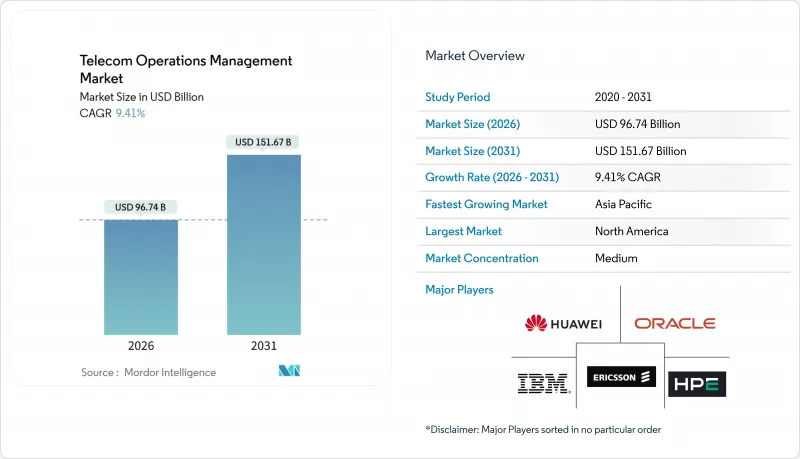
통신 운영 관리 시장 규모는 2026년에 967억 4,000만 달러에 달하고, 2031년까지 1,516억 7,000만 달러에 이를 것으로 예측되며, CAGR은 9.41%를 나타낼 전망입니다.
본 보고서는 도입 형태(On-Premise, 클라우드), 솔루션 유형(소프트웨어, 서비스), 사업자 유형(모바일 네트워크 사업자, 유선 통신 사업자, MVNO 및 MVNE, OTT 및 디지털 서비스 제공업체), 최종 이용 산업(통신 서비스 제공업체, IT·기술,정부 기관, 은행, 금융서비스 및 보험(BFSI), 제조업, 의료, 기타) 및 지역별로 분류되어 있습니다. 시장 예측은 금액(달러) 기준으로 제시되어 있습니다.
세계의 통신 운영 관리 시장 동향 및 인사이트
클라우드 네이티브 OSS/BSS 플랫폼의 급속한 보급
Kubernetes 기반 스택을 통해 탄력성을 확보한 통신 사업자는 자본 지출을 최대 40% 절감하고, 서비스 출시를 가속화하며, 트래픽 급증 시에도 99.999%의 가용성을 실현하고 있습니다. 따라서 주요 통신 사업자들은 듀얼 스택의 유지 관리로 인해 단기 운영 비용(OPEX)이 증가함에도 불구하고, 레거시 과금 시스템을 컨테이너 클러스터로 ‘리프트 앤 시프트(lift-and-shift)’하기 위한 예산을 배정하고 있습니다. 벤더 생태계는 엣지 용도 도입을 간소화하는 턴키 방식의 과금, 정책 및 노출 기능을 제공합니다. 이러한 움직임은 선순환을 만들어 내며, 초기 도입자들이 비용 절감 효과를 입증함으로써 후속 사업자들이 유사한 아키텍처를 채택하도록 촉진하고 있습니다. 그러나 지속적인 기술 인력 부족으로 인해 많은 통신 사업자들은 마이그레이션을 완료하기 위해 매니지드 서비스 계약에 의존할 수밖에 없는 상황에 처해 있습니다.
5G 스탠드얼론(SA)의 전개가 네트워크 자동화에 대한 투자를 견인
스탠드얼론형 코어 네트워크는 슬라이싱 및 URLLC(초저지연·초고신뢰성 통신) 기능을 구현하지만, 이를 대규모로 관리할 수 있는 것은 자동화된 오케스트레이션뿐입니다. 차이나모바일은 자동화 플랫폼을 활용하여 10분 이내에 슬라이스를 프로비저닝하고, 워크플로우를 90% 줄이고 있습니다. 미국의 신규 도입 사례에 따르면, 기존 OSS 스택을 운영하는 기존 사업자와 비교하여 총 소유 비용(TCO)이 최대 50% 감소한 것으로 보고되고 있습니다. 표준화 기구는 2027년까지 12억 건의 독립형 연결이 발생할 것으로 예측하고 있으며, 인프라 예산의 18%-22%가 소프트웨어 자동화에 할당될 전망입니다. 인도 및 중동의 통신 사업자들은 주파수 대역의 복잡성을 해소하고 산업용 이용 사례에서 지연을 보장하기 위해 초기 단계부터 자동화를 도입하고 있습니다. 이러한 도입이 맞물려 무선 네트워크 구축에 따라 소프트웨어 지출이 증가함에 따라 통신 운영 관리 시장 전체가 활성화되고 있습니다.
효율적인 시스템 통합사업자의 부족
메인프레임 COBOL과 컨테이너 오케스트레이션 모두에 정통한 아키텍트에 대한 수요가 공급을 초과하고 있어, Tier 1 컨설팅 기업의 대기 기간은 18개월 이상에 달하고 있습니다. 라틴아메리카 및 동남아시아의 통신 사업자들은 현지 규제에 대한 지식이 부족한 해외 팀에 의존하는 경우가 많아, 이로 인해 프로젝트 일정이 40%-60% 지연되고 있습니다. 대형 IT 기업들은 통신 업계 외부의 수익성이 높은 클라우드 전환을 우선시하고 있어, 자원 부족이 더욱 심각해지고 있습니다. 벤더 측은 신속한 도입이 가능한 블루프린트나 로우코드 컨피규레이터를 제공하며 대응하고 있지만, 복잡한 데이터 매핑에는 여전히 통합 업체가 필요합니다. 인력 부족이 해소될 때까지 통신 운영 관리 시장은 실행상의 병목 현상에 직면하게 되며, 성장이 억제될 것입니다.
부문별 분석
2025년, 클라우드 도입은 통신 운영 관리 시장 점유율의 66.89%를 차지했으며, 2031년까지 연평균 성장률(CAGR) 9.89%로 지출이 확대됨에 따라 이 점유율은 더욱 확대될 전망입니다. 중요도가 낮은 워크로드를 퍼블릭 클라우드에서 호스팅함으로써 탄력적인 확장성과 ‘성장에 따른 과금’이라는 경제성이 실현되어, 통신 사업자는 자본의 고정을 초래하지 않고도 새로운 서비스를 시험적으로 도입할 수 있게 됩니다. 하이브리드 아키텍처는 데이터를 국내에 보관해야 하는 시장의 규정 준수 요건을 충족하며, On-Premise 과금 시스템과 클라우드 호스팅형 분석 기능을 융합함으로써 주권과 민첩성을 양립시키고 있습니다. On-Premise 시스템에 할당되는 통신 운영 관리 시장 규모는 전용 하드웨어의 노후화와 벤더의 지원 축소에 따라 총 소유 비용(TCO)이 상승함에 따라 계속해서 축소되고 있습니다. 그러나 사하라 이남 아프리카나 라틴아메리카의 일부 지역 통신 사업자의 경우, 백홀 회선의 신뢰성이 낮아 클라우드 가용성을 확보할 수 없기 때문에 여전히 On-Premise를 선호하는 경향이 있습니다. 신규 진출기업들은 퍼블릭 클라우드로의 완전한 전환을 통해 수명 주기 비용을 50% 절감할 수 있음을 입증하고 있으며, 이에 따라 규제 당국은 규제를 완화하여 보다 광범위한 도입을 가속화하고 있습니다.
클라우드로의 전환 추세는 조달 패턴에도 영향을 미치고 있습니다. 통신 사업자들은 벤더에게 구독형 라이선싱, 지속적인 제공, 오픈 API 제공을 요구하며, 10년 단위의 엔터프라이즈 계약을 갱신할 필요가 없는 SaaS 계약으로 대체하고 있습니다. 하이퍼스케일러 각사는 인프라 크레딧과 마이그레이션 서비스를 묶음 상품으로 제공함으로써 가치 실현까지의 시간을 단축하고 있습니다. 한편, 기밀성이 높은 가입자 데이터를 취급하거나 엄격한 은행 수준의 보안 규정을 준수하며 운영되는 Tier 1 통신사에게는 프라이빗 클라우드 구축이 여전히 중요한 선택지로 남아 있습니다. 이러한 다양한 모델이 존재함으로써, 클라우드가 주류가 되는 상황에서도 하이브리드형 솔루션은 통신 운영 관리 시장에서 상당한 점유율을 유지하게 될 것입니다.
소프트웨어는 2025년에도 59.11%의 점유율을 차지하며 수익의 주축으로 남아 있었지만, 멀티 벤더 환경의 복잡성이 심화됨에 따라 서비스 부문은 9.84%라는 더 높은 연평균 성장률(CAGR)로 성장하고 있습니다. 마이크로서비스 아키텍처에서는 수십 개의 컨테이너 클러스터에 걸친 오케스트레이션이 필요하기 때문에 시스템 통합은 현재 서비스 수익의 4분의 1 이상을 차지하고 있습니다. DevOps 전문 지식이 부족한 Tier 2 및 Tier 3 사업자들 사이에서는 매니지드 서비스 계약이 활발해지고 있으며, 리스크 및 인력 관리 부담이 벤더 측으로 이전되고 있습니다. 이러한 추세에 따라, 정의된 서비스 수준 계약(SLA)에 연계된 구독형 서비스 번들에 할당되는 통신 운영 관리 시장 규모가 확대되고 있습니다. 또한, 통신 사업자들이 5G 독립형(SA) 및 API 마켓플레이스의 수익화를 위한 청사진을 모색함에 따라 컨설팅 수요도 증가하고 있습니다.
소프트웨어 분야에서는 네트워크 관리 제품군이 여전히 주류를 이루고 있지만, 실시간 과금 솔루션이 가장 빠르게 성장하는 하위 부문으로 부상하고 있습니다. 통신 사업자는 슬라이스 기반 연결 및 엣지 컴퓨팅 워크로드에 대해 트랜잭션 단위로 과금해야 하므로, 2028년 사용량 전환점을 앞두고 시스템 업그레이드가 진행되고 있습니다. 고객 및 제품 관리 모듈은 연결, 컨텐츠, 클라우드의 동적 번들링을 지원하기 위해 개편되고 있으며, 이는 고객 경험의 우선순위가 백오피스 도구를 어떻게 재구성하고 있는지를 여실히 보여주고 있습니다. 이러한 변화들이 결합되어 서비스가 성장의 원동력으로서 확고한 입지를 다지는 한편, 소프트웨어는 계속해서 통신 운영 관리 시장을 지탱하는 기반 계층으로서의 역할을 수행하고 있습니다.
지역별 분석
북미는 2025년 지출의 36.73%를 차지했으며, 3대 주요 통신 사업자의 150억 달러 규모의 OSS/BSS 현대화와 DOCSIS 4.0으로 업그레이드하는 케이블 사업자의 병행 투자가 이를 뒷받침하고 있습니다. 규제 프레임워크에 따라, 암호화 및 감사 관리가 연방 지침을 충족하는 것을 조건으로 가입자 데이터를 통신 사업자의 시설 외부에서 호스팅하는 것이 허용됨에 따라 퍼블릭 클라우드 도입이 확대되고 있습니다. 디시 네트워크(Dish Network)의 신규 플랫폼을 통해 총 비용을 50% 절감할 수 있는 시나리오가 입증되면서, 기존 사업자들이 하이퍼스케일러와 클라우드 크레딧 협상을 진행하는 데 박차를 가하고 있습니다. 또한, 공급망 위험으로부터 네트워크를 보호하기 위해 운영 콘솔과 직접 연동되는 자동 위협 감지 모듈의 도입도 진행되고 있습니다.
유럽에서는 ‘디지털 시장법’과 ‘네트워크 및 정보 보안 지침 2’가 회원국마다 다른 규정 준수 부담을 부과하고 있어 대응이 제각각입니다. 주요 다국적 그룹은 2024년부터 2025년에 걸쳐 100억 유로(113억 달러)를 투자하여, 지역별 데이터 상주 요건을 준수하면서도 지역을 초월한 클라우드 네이티브 코어를 구축했습니다. 이로 인해 규제상의 마찰이 있음에도 불구하고 통신 운영 관리 시장 규모는 확대되고 있습니다. 브렉시트 이후의 규제 차이로 인해 영국과 유럽 대륙 양쪽에서 사업을 전개하는 통신 사업자는 이중의 규정 준수 대응을 강요받게 되어 프로젝트의 간접비가 증가하고 있습니다. 러시아의 엄격한 현지화 법규로 인해 퍼블릭 클라우드 점유율은 낮은 수준을 유지하고 있으며, On-Premise 부문은 여전히 일정 규모를 유지하고 있습니다.
아시아태평양은 10.44%라는 가장 높은 연평균 성장률(CAGR)을 기록하고 있습니다. 중국의 통신 사업자들은 360만 개 이상의 5G 기지국을 운영하고 있으며, 프로비저닝 자동화를 통해 운송 비용을 대폭 절감함으로써 다른 어떤 지역보다 빠르게 통신 운영 관리 시장을 확대되고 있습니다. 인도의 주요 통신 사업자는 전국적인 5G 구축에 앞서 현대화에 80억 달러를 투자했습니다. 한편, 일본 및 한국의 기존 통신 사업자는 사고 해결 시간을 절반으로 줄이기 위해 AI 코파일럿을 시범 운영하고 있습니다. 호주에서는 외딴 지역의 고정 무선 서비스에 대한 투자가 진행되고 있으며, 이는 지역적 요인이 아키텍처 선택을 좌우하는 실례가 되고 있습니다. 중동에서는 ‘비전 2030’ 및 각국의 디지털화 계획과 연계된 노력을 통해 사설 네트워크의 자동화가 가속화되고 있습니다. 반면, 아프리카에서는 통합 업체의 부족으로 인해 신중한 진전에 그치고 있지만, 획기적인 클라우드 네이티브 BSS 계약이 향후 성장을 시사하고 있습니다. 남미에서는 4G 커버리지 확대가 우선시되고 있어 성장세는 완만하지만, 브라질의 2024년 주파수 경매를 계기로 2026년 이후에는 증가세로 전환될 것으로 전망됩니다.
기타 혜택 :
- 엑셀 형식 시장 예측(ME) 시트
- 3개월간의 애널리스트 지원
자주 묻는 질문
목차
제1장 서론
제2장 조사 방법
제3장 주요 요약
제4장 시장 구도
제5장 시장 규모 및 성장 예측
제6장 경쟁 구도
제7장 시장 기회 및 향후 전망
KTH 26.09.14According to Mordor Intelligence, the telecom operations management market size stands at USD 96.74 billion in 2026 and is projected to reach USD 151.67 billion by 2031, advancing at a 9.41% CAGR.
This report is Segmented by Deployment (On-Premise, Cloud), Solution Type (Software, Services), Operator Type (Mobile Network Operators, Fixed-Line Operators, Mvnos and MVNEs, OTT and Digital Service Providers), End-Use Industry (Telecom Service Providers, IT and Technology, Government, BFSI, Manufacturing, Healthcare, Other), and Geography. Market Forecasts are Provided in Terms of Value (USD).
Global Telecom Operations Management Market Trends and Insights
Rapid Adoption of Cloud-Native OSS/BSS Platforms
Operators gaining elasticity from Kubernetes-based stacks cut capital outlays by up to 40%, accelerate service launches, and achieve five-nines availability during traffic spikes. Major carriers, therefore, commit budgets to lift-and-shift legacy billing into container clusters even though dual-stack maintenance inflates short-term opex. Vendor ecosystems provide turnkey charging, policy, and exposure functions that simplify onboarding for edge applications. These moves create a virtuous cycle in which early adopters showcase cost savings, compelling followers to emulate architectures. Ongoing skills shortages, however, force many operators to rely on managed service contracts to complete migrations.
5G Standalone Rollouts Driving Network Automation Spend
Standalone cores unlock slicing and URLLC capabilities that only automated orchestration can manage at scale. China Mobile provisions slices in under 10 minutes using automation platforms, achieving a 90% reduction in workflow. Greenfield U.S. implementations report up to 50% lower total cost of ownership than incumbents running legacy OSS stacks. Standards bodies forecast 1.2 billion standalone connections by 2027, with 18%-22% of infrastructure budgets earmarked for software automation. Operators in India and the Middle East embed automation early to tame spectrum complexity and guarantee latency for industrial use cases. These deployments collectively lift the telecom operations management market as software spend shadow-tracks radio rollouts.
Shortage of Efficient System Integrators
Demand for architects skilled in both mainframe COBOL and container orchestration outstrips supply, pushing wait times for Tier-1 consultancies to more than 18 months. Latin American and Southeast Asian operators often rely on offshore teams that lack local regulatory insight, adding 40%-60% to project timelines. Large IT firms prioritize higher-margin cloud migrations outside telecom, further tightening capacity. Vendors respond by launching rapid-deployment blueprints and low-code configurators, but still need integrators for complex data mapping. Until the talent gap narrows, the telecom operations management market encounters execution bottlenecks that temper growth.
Other drivers and restraints analyzed in the detailed report include:
- Integration of AI Copilot Tools into Network Operations Centers
- Increasing Operational Costs and Complexity
- High Upfront Cost of Migrating Legacy Systems
For complete list of drivers and restraints, kindly check the Table Of Contents.
Segment Analysis
Cloud implementations captured 66.89% of the telecom operations management market share in 2025, and this share is poised to widen as spending grows at a 9.89% CAGR through 2031. Public-cloud hosting of noncritical workloads delivers elastic scaling and pay-as-you-grow economics, letting operators trial new services without capital lock-in. Hybrid architectures address compliance needs in markets where data must remain on soil, blending on-premises billing with cloud-hosted analytics to reconcile sovereignty with agility. The telecom operations management market size allocated to on-premise systems continues to shrink because the total cost of ownership rises when proprietary hardware ages and vendor support winds down. Yet some rural carriers in Sub-Saharan Africa and Latin America still favor on-premise because unreliable backhaul links challenge cloud availability. Greenfield entrants demonstrate that full public-cloud deployments can achieve 50% lower lifetime costs, prompting regulators to ease restrictions and accelerate broader adoption.
Momentum toward cloud also shapes procurement patterns. Operators demand subscription licensing, continuous delivery, and open-API exposure from vendors, replacing decade-long enterprise contracts with evergreen SaaS agreements. Hyperscalers bundle infrastructure credits with migration services, compressing time-to-value. Meanwhile, private-cloud builds remain relevant for Tier-1 carriers handling highly sensitive subscriber data or operating under stringent banking-grade security rules. These divergent models ensure that, as cloud rules, hybrid options maintain a sizeable share of the telecom operations management market.
Software remained the revenue backbone with a 59.11% share in 2025, but escalating multi-vendor complexity is propelling services to a faster 9.84% CAGR. Systems integration now accounts for more than one-quarter of service revenue because microservice architectures require orchestration across dozens of container clusters. Managed-service contracts flourish among Tier-2 and Tier-3 players lacking DevOps expertise, shifting risk and staffing overhead to vendors. This trend increases the size of the telecom operations management market allocated to subscription-style service bundles tied to defined service-level agreements. Consulting demand also rises as carriers seek blueprints for monetizing 5G standalone and API marketplaces.
In software, network management suites still dominate, yet real-time charging solutions are the fastest-growing subsegment. Operators need per-transaction accounting for slice-based connectivity and edge compute workloads, driving upgrades ahead of 2028 volume inflection points. Customer and product management modules undergo a makeover to support dynamic bundling of connectivity, content, and cloud, underscoring how consumer experience priorities reshape back-office tooling. Collectively, these shifts cement services as the growth engine while software remains the foundational layer that anchors the telecom operations management market.
Complete Report Scope:
- By Deployment
- On-premise
- Cloud
- Public Cloud
- Private Cloud
- Hybrid Cloud
- By Solution Type
- Software
- Network Management
- Customer and Product Management
- Revenue Management
- Inventory Management and Other Software
- Services
- Planning and Consulting
- Operations and Maintenance
- System Integration
- Managed Services
- Software
- By Operator Type
- Mobile Network Operators
- Fixed-line Operators
- MVNOs and MVNEs
- OTT and Digital Service Providers
- By End-Use Industry
- Telecom Service Providers
- IT and Technology Enterprises
- Government and Public Sector
- Banking and Financial Services
- Manufacturing and Automotive
- Consumer Goods and Retail
- Healthcare
- Other End-Use Industries
- By Geography
- North America
- United States
- Canada
- Mexico
- Europe
- Germany
- United Kingdom
- France
- Russia
- Rest of Europe
- Asia-Pacific
- China
- Japan
- India
- South Korea
- Australia
- Rest of Asia-Pacific
- Middle East and Africa
- Middle East
- Saudi Arabia
- United Arab Emirates
- Rest of Middle East
- Africa
- South Africa
- Egypt
- Rest of Africa
- Middle East
- South America
- Brazil
- Argentina
- Rest of South America
- North America
Geography Analysis
North America retained 36.73% of spending in 2025, underpinned by USD 15 billion in OSS/BSS modernization across the three largest carriers and parallel investments by cable operators upgrading to DOCSIS 4.0. Public-cloud deployments proliferate because regulatory frameworks permit hosting subscriber data outside carrier premises, provided encryption and audit controls meet federal guidelines. Dish Network's greenfield platform validated 50% lower total cost scenarios, encouraging incumbents to negotiate cloud credits with hyperscalers. Securing networks against supply-chain risks also drives uptake of automated threat-detection modules that integrate directly with operations consoles.
Europe follows a patchwork path because the Digital Markets Act and the Network and Information Security Directive 2 impose divergent compliance burdens across member states. Major multi-country groups invested EUR 10 billion (USD 11.3 billion) in 2024-2025 to create pan-regional cloud-native cores that still respect local data residency, nudging the telecom operations management market size higher despite regulatory friction. Post-Brexit divergence forces dual compliance tracks for operators straddling the United Kingdom and continental Europe, inflating project overhead. Russia's strict localization laws keep public cloud share low, sustaining a residual on-premises segment.
Asia Pacific delivers the fastest CAGR of 10.44%. Chinese carriers operate more than 3.6 million 5G base stations and are automating provisioning to slash transport costs, expanding the telecom operations management market faster than any other territory. India's leading operators invested USD 8 billion in modernization ahead of nationwide 5G rollouts, while Japanese and South Korean incumbents pilot AI copilots to halve incident resolution times. Australia channels spending toward fixed-wireless services in remote areas, illustrating how geography dictates architecture choices. Middle East commitments tied to Vision 2030 and national digitization agendas accelerate private-network automation, whereas Africa advances cautiously amid integrator shortages, though landmark cloud-native BSS deals signal future growth. South America moderates due to 4G coverage priorities, yet Brazil's 2024 spectrum auctions set the stage for upticks from 2026 onward.
- IBM Corporation
- Telefonaktiebolaget LM Ericsson
- Oracle Corporation
- Hewlett Packard Enterprise Development LP
- Nokia Corporation
- Amdocs Inc.
- Huawei Technologies Co., Ltd.
- Cisco Systems Inc.
- Accenture plc
- SAP SE
- NEC Corporation
- Comarch SA
- ZTE Corporation
- ServiceNow Inc.
- Tata Consultancy Services Limited
- Netcracker Technology Corporation
- CSG Systems International Inc.
- Tech Mahindra Ltd.
- Mavenir Systems Inc.
- Subex Ltd.
- Infosys Ltd.
Additional Benefits:
- The market estimate (ME) sheet in Excel format
- 3 months of analyst support
TABLE OF CONTENTS
1 INTRODUCTION
- 1.1 Study Assumptions and Market Definition
- 1.2 Scope of the Study
2 RESEARCH METHODOLOGY
3 EXECUTIVE SUMMARY
4 MARKET LANDSCAPE
- 4.1 Market Overview
- 4.2 Market Drivers
- 4.2.1 Rising Demand for Enhanced Customer Experience
- 4.2.2 Increasing Operational Costs and Complexity
- 4.2.3 Rapid Adoption of Cloud-Native OSS/BSS Platforms
- 4.2.4 5G Standalone Rollouts Driving Network Automation Spend
- 4.2.5 Integration of AI Copilot Tools into Network Operations Centers
- 4.2.6 Telecom API Monetization Push Creating OSS/BSS Upgrade Cycles
- 4.3 Market Restraints
- 4.3.1 Shortage of Efficient System Integrators
- 4.3.2 High Upfront Cost of Migrating Legacy Systems
- 4.3.3 Security Liability Concerns in Multi-Tenant OSS SaaS Contracts
- 4.3.4 Fragmentation of Open RAN Toolchains Slowing Integrated Operations
- 4.4 Industry Value Chain Analysis
- 4.5 Regulatory Landscape
- 4.6 Technological Outlook
- 4.7 Porter's Five Forces Analysis
- 4.7.1 Bargaining Power of Suppliers
- 4.7.2 Bargaining Power of Consumers
- 4.7.3 Threat of New Entrants
- 4.7.4 Intensity of Competitive Rivalry
- 4.7.5 Threat of Substitute Products
- 4.8 Impact of Macroeconomic Factors on the Market
- 4.9 Industry Use Cases
5 MARKET SIZE AND GROWTH FORECASTS (VALUE)
- 5.1 By Deployment
- 5.1.1 On-premise
- 5.1.2 Cloud
- 5.1.2.1 Public Cloud
- 5.1.2.2 Private Cloud
- 5.1.2.3 Hybrid Cloud
- 5.2 By Solution Type
- 5.2.1 Software
- 5.2.1.1 Network Management
- 5.2.1.2 Customer and Product Management
- 5.2.1.3 Revenue Management
- 5.2.1.4 Inventory Management and Other Software
- 5.2.2 Services
- 5.2.2.1 Planning and Consulting
- 5.2.2.2 Operations and Maintenance
- 5.2.2.3 System Integration
- 5.2.2.4 Managed Services
- 5.2.1 Software
- 5.3 By Operator Type
- 5.3.1 Mobile Network Operators
- 5.3.2 Fixed-line Operators
- 5.3.3 MVNOs and MVNEs
- 5.3.4 OTT and Digital Service Providers
- 5.4 By End-Use Industry
- 5.4.1 Telecom Service Providers
- 5.4.2 IT and Technology Enterprises
- 5.4.3 Government and Public Sector
- 5.4.4 Banking and Financial Services
- 5.4.5 Manufacturing and Automotive
- 5.4.6 Consumer Goods and Retail
- 5.4.7 Healthcare
- 5.4.8 Other End-Use Industries
- 5.5 By Geography
- 5.5.1 North America
- 5.5.1.1 United States
- 5.5.1.2 Canada
- 5.5.1.3 Mexico
- 5.5.2 Europe
- 5.5.2.1 Germany
- 5.5.2.2 United Kingdom
- 5.5.2.3 France
- 5.5.2.4 Russia
- 5.5.2.5 Rest of Europe
- 5.5.3 Asia-Pacific
- 5.5.3.1 China
- 5.5.3.2 Japan
- 5.5.3.3 India
- 5.5.3.4 South Korea
- 5.5.3.5 Australia
- 5.5.3.6 Rest of Asia-Pacific
- 5.5.4 Middle East and Africa
- 5.5.4.1 Middle East
- 5.5.4.1.1 Saudi Arabia
- 5.5.4.1.2 United Arab Emirates
- 5.5.4.1.3 Rest of Middle East
- 5.5.4.2 Africa
- 5.5.4.2.1 South Africa
- 5.5.4.2.2 Egypt
- 5.5.4.2.3 Rest of Africa
- 5.5.4.1 Middle East
- 5.5.5 South America
- 5.5.5.1 Brazil
- 5.5.5.2 Argentina
- 5.5.5.3 Rest of South America
- 5.5.1 North America
6 COMPETITIVE LANDSCAPE
- 6.1 Market Concentration
- 6.2 Strategic Moves
- 6.3 Market Share Analysis
- 6.4 Company Profiles {(includes Global level Overview, Market level overview, Core Segments, Financials as available, Strategic Information, Market Rank/Share for key companies, Products and Services, and Recent Developments)}
- 6.4.1 IBM Corporation
- 6.4.2 Telefonaktiebolaget LM Ericsson
- 6.4.3 Oracle Corporation
- 6.4.4 Hewlett Packard Enterprise Development LP
- 6.4.5 Nokia Corporation
- 6.4.6 Amdocs Inc.
- 6.4.7 Huawei Technologies Co., Ltd.
- 6.4.8 Cisco Systems Inc.
- 6.4.9 Accenture plc
- 6.4.10 SAP SE
- 6.4.11 NEC Corporation
- 6.4.12 Comarch SA
- 6.4.13 ZTE Corporation
- 6.4.14 ServiceNow Inc.
- 6.4.15 Tata Consultancy Services Limited
- 6.4.16 Netcracker Technology Corporation
- 6.4.17 CSG Systems International Inc.
- 6.4.18 Tech Mahindra Ltd.
- 6.4.19 Mavenir Systems Inc.
- 6.4.20 Subex Ltd.
- 6.4.21 Infosys Ltd.
7 MARKET OPPORTUNITIES AND FUTURE OUTLOOK
- 7.1 White-Space and Unmet-Need Assessment


