|
시장보고서
상품코드
2124541
감열지 : 시장 점유율 분석, 산업 동향 및 통계 데이터, 성장 예측(2026-2031년)Thermal Paper - Market Share Analysis, Industry Trends & Statistics, Growth Forecasts (2026 - 2031) |
||||||
 Mordor Intelligence
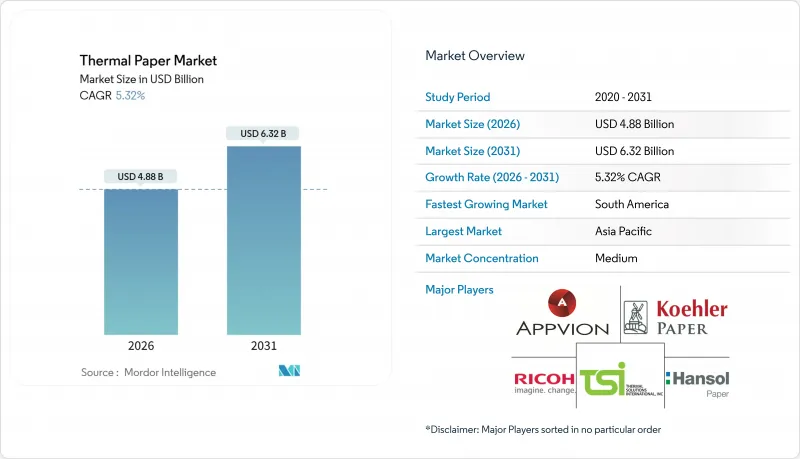
Mordor Intelligence에 의하면, 감열지 시장 규모는 2026년에 48억 8,000만 달러에 이르고, 2031년까지 63억 2,000만 달러에 이를 것으로 예측되며, CAGR은 5.32%로 성장할 전망입니다.
본 보고서는 제품 유형(탑코트 포함, 탑코트 미포함, BPA 프리 등), 면중량(55 gsm 상당, 56-70 gsm, 70 gsm 이상),폭(57 mm, 58-79 mm, 80 mm), 최종 사용자 산업(소매업, 물류, 티켓·복권·게임, 은행 및 금융, 의료 및 제약, 기타) 및 지역별로 분류되어 있습니다. 시장 예측은 금액(달러) 기준으로 제시되어 있습니다.
세계의 감열지 시장 동향 및 인사이트
신흥국에서의 소매용 POS 확대
전자 결제 생태계의 급속한 성장에 힘입어 새로운 하드웨어 도입과 롤지 소비가 지속적으로 촉진되고 있습니다. 인도의 도입 대수는 2025년 1월까지 1,120만 대에 달하여 QR 코드 기반 거래의 급증과 함께 29% 증가를 보였으나, 상품 및 서비스세(GST) 규정 준수를 위해 인쇄된 영수증은 여전히 필수적입니다. 인도네시아, 베트남 및 걸프협력회의(GCC) 국가들에서도 유사한 추세가 나타나고 있으며, 디지털 채널이 보급되는 가운데서도 저가형 감열지에 대한 대량 주문이 정착되고 있습니다. 서비스 계약에 영수증 롤을 포함시키는 장비 공급업체들은 제지 제조업체 및 가공업체와의 관계를 강화하고 있으며, 소규모 사업자의 도입을 지원하는 보조금 덕분에 판매량은 더욱 증가하고 있습니다. 그 결과, 감열지 시장에서는 기존에 수기 청구서에 의존하던 소규모 사업자 부문으로의 판매 채널 다각화가 진행되고 있습니다.
물류 및 전자상거래 분야의 라벨 수요 증가
소포 처리량이 증가함에 따라, 풀필먼트 센터에서의 라벨 소비량은 소매 영수증을 능가하는 속도로 확대되고 있습니다. 창고 자동화에 대한 투자로 인해 전 세계 지출액은 2024년 265억 달러에서 2034년까지 1,160억 달러로 증가할 것으로 예측되며, 이는 시설당 프린터 도입 대수가 비약적으로 증가할 것임을 의미합니다. 2031년까지 1차원 바코드에서 2차원 바코드로 전환한다는 GS1의 로드맵에 따라, 코팅의 균일성 향상과 이미지 해상도 향상이 요구되고 있습니다. 라스트 마일 업무에서 라벨 결함으로 인한 벌금은 컨버터가 견고한 탑코트가 적용된 중범위 56-70 gsm 등급을 지정하도록 유도하고 있으며, 이로 인해 두께 관리를 안정적으로 수행할 수 있는 제지 제조업체로 수익이 흘러가고 있습니다. 물류 분야 수요와 온라인 식료품 판매의 확대가 맞물리면서, 이 부문은 감열지 시장의 주요 성장 동력이 되고 있습니다.
변동이 심한 펄프 및 류코 염료의 원자재 가격
2025년 11월, 목재 펄프 생산자 물가 지수는 213.2에 달했고, 가공지 지수는 더욱 상승하여 하류 부문의 수익성이 압박받고 있습니다. 특수 류코 염료는 현재 중국의 수출 규제 대상인 금속 촉매에 의존하고 있어, 이로 인해 화학 약품 비용의 급등이 더욱 가속화되고 있습니다. 에너지 요금 급등과 배출 규제 강화에 직면한 유럽의 제지 제조업체들은 가장 심각한 이익률 하락에 직면해 있습니다. 헤지 전략과 펄프 사업에 대한 후방 통합이 필수적이지만, 중소규모 기업들은 규모가 부족하여 감열지 시장 내 업계 재편이 가속화되고 있습니다.
부문별 분석
2025년 매출은 탑코트 제품이 주도했으며, 이는 계산대에서 요구되는 엄격한 인쇄 품질 기준을 반영한 것입니다. 그러나 유럽 및 캘리포니아주의 식품 접촉 규제를 주요 소매업체들이 준수함에 따라 BPA 프리 제품은 7.90%의 성장률을 달성하고 있습니다. Appvion사와 미쓰비시 하이테크사의 페놀 프리 기술은 ISEGA 및 FDA의 식품 안전 인증을 바탕으로 프리미엄 진열 공간을 확보해 나가고 있습니다. 특수 보안 등급 제품은 자외선 섬유나 위조 감지 표시기를 채택하고 있어 복권 및 티켓 발행 기관으로부터 지지를 받고 있습니다. 범용화된 비탑코트 용지가 시장 점유율을 잃어가는 상황에서도 틈새 수요를 유지하고 있습니다. 페놀 프리 하위 부문의 감열지 시장 규모는 EU 기준을 채택하는 관할 구역이 늘어남에 따라 2031년까지 꾸준히 확대될 것으로 예측됩니다.
펄프에서 제지까지 일관 생산을 하는 대기업이 화학 기술의 노하우를 활용하여 더 안전한 제품 인증을 취득하는 한편, 제3자 제조업체의 점보 롤에 의존하는 가공업체는 고객 이탈 위험에 직면하고 있어, 경쟁 구도는 양극화되고 있습니다. 인증 비용은 고액이지만, 선도 기업에게는 확고한 우위를 가져다주며, 화학 물질 규제를 준수하는 공급품을 요구하는 전 세계 패스트푸드 체인과의 다년 계약 체결이 가능해집니다.
폭 55 gsm 이하의 롤지는 기판 비용 절감을 통해 직접적인 재료비를 줄이고 프린터의 가동 시간을 연장할 수 있기 때문에 식료품점 및 할인 소매점에서의 판매량을 지속적으로 견인하고 있습니다. 그러나 수주 상황을 살펴보면, 옴니채널 풀필먼트 센터에서는 기계적 취급 시 인열 저항성과 바코드의 선명도가 요구되기 때문에 56-70 gsm 소재로의 전환이 진행되고 있습니다. 발송인이 분류 오류를 줄이기 위해 두꺼운 기재를 표준화해 나감에 따라, 이 중중량 대의 감열지 시장 점유율은 계속 상승할 것입니다. GS1의 조사에 따르면, 창고의 70%에서 매주 판독 오류가 발생하고 있으며, 이로 인해 조달 팀은 견고한 코팅을 우선시하고 있습니다.
폭 70 gsm 이상의 초고내구성 등급은 컨테이너 터미널의 스티커나 항공사의 수하물 태그에 여전히 필수적입니다. 미쓰비시의 라이너리스 ‘LL 77’ 시리즈는 더 두꺼운 구조로 접착제 비용을 상쇄하는 동시에 실리콘 처리된 라이너를 제거함으로써 지속가능성 측면에서도 우수함을 입증하고 있습니다. 제지 제조업체의 경우, 광범위한 중량 범위에 걸쳐 두께와 수분 함량을 유연하게 관리함으로써, 감열지 시장에서 여러 라벨 유형을 지원하는 단일 공급업체를 찾는 컨버터 시장 점유율을 확대할 수 있는 길이 열립니다.
지역별 분석
아시아태평양은 2025년에도 매출의 47.23%라는 압도적인 점유율을 유지했습니다. 인도의 POS 단말기 급속한 보급과 중국의 수직 통합형 공급망이 규모의 경제를 뒷받침하는 한편, 일본과 한국에서는 고사양의 의약품 및 전자기기용 등급이 수요를 주도하고 있습니다. 디지털이면서도 인쇄 가능한 구매 증명을 장려하는 정부의 정책에 힘입어, 핀테크 앱의 보급이 진전되는 상황에서도 소비의 기준선은 유지되고 있습니다. 호주 및 뉴질랜드에서는 재생 섬유를 우선시하는 지속가능성 목표가 추구되고 있지만, 관광 관련 키오스크 인쇄 덕분에 판매량 감소는 완화되고 있습니다.
남미는 가장 빠르게 성장하고 있으며, 브라질과 아르헨티나가 현금에서 카드와 QR 코드를 병용하는 생태계로 전환함에 따라 2031년까지 연평균 성장률(CAGR)은 6.41%를 기록할 전망입니다. 전자 청구서 의무화는 발송되는 소포에 여전히 접착식 식별 라벨이 필요하기 때문에 열전사 라벨의 사용을 잠식하기보다는 오히려 보완하는 역할을 하고 있습니다. 국내 제지 제조업체들은 운임 변동 위험을 헤지하고 있지만, 아시아산 수입품은 순수한 비용 면에서 여전히 경쟁력이 있어 현지 생산자들은 서비스의 기동성에 집중할 수밖에 없는 상황에 몰리고 있습니다.
유럽의 전망은 다소 소극적입니다. 2025년에 발효되는 비스페놀 A 금지 조치는 대륙 전체에 걸쳐 비용이 많이 드는 배합 변경을 촉발했지만, 펄프 원료 가격 변동과 엄격한 재활용 가능성 관련 규제가 수익성을 압박하고 있습니다. 독일에는 세계 최대 규모의 페놀 프리 생산 라인이 2개 있어 기술적 우위를 유지하고 있습니다. 영국에서는 2029년에 도입될 전자 부가가치세(VAT) 제도로 인해 영수증 발행 건수가 더욱 감소할 것으로 예상되지만, 로테르담 및 앤트워프 주변의 물류 허브에서는 라벨 재고가 계속해서 소진되고 있습니다.
북미에서는 시장의 성숙과 혁신이 공존하고 있습니다. FDA의 시리얼화 규제로 인해 의약품 라벨 업그레이드가 진행되고 있으며, 전자상거래로 인해 소포용 스티커 수요는 견조한 추세를 보이고 있습니다. 그러나 소매 부문에서는 SMS를 통해 QR코드만 포함된 영수증을 전송하는 시범 운영이 진행 중이며, 이에 따라 다운스트림 공정에서의 롤지 주문량이 감소하고 있습니다. 멕시코 내 공급망의 현지화에 따라, 니어쇼어링 공장에 공급하기 위한 컨버터에 대한 새로운 투자가 활발해지고 있습니다.
중동 및 아프리카는 아직 발전 단계에 있지만, 미래가 기대되고 있습니다. 걸프협력회의(GCC) 회원국들은 콤팩트한 57mm 티켓이 필요한 스마트 시티 교통 시스템에 투자하고 있으며, 튀르키예의 수출 지향형 제지 공장은 유럽과의 근접성을 활용하고 있습니다. 사하라 이남 아프리카는 수입 관세의 복잡성에 직면해 있지만, 모바일 머니 키오스크가 풀뿌리 수준 수요를 창출하고 있으며, 인프라가 정비됨에 따라 그 수요는 더욱 확대될 것입니다.
기타 혜택 :
- 엑셀 형식 시장 예측(ME) 시트
- 3개월간의 애널리스트 지원
자주 묻는 질문
목차
제1장 서론
제2장 분석 방법
제3장 주요 요약
제4장 시장 구도
제5장 시장 규모 및 성장률 예측
제6장 경쟁 구도
제7장 시장 기회 및 향후 전망
KTH 26.09.14According to Mordor Intelligence, the thermal paper market size reached USD 4.88 billion in 2026 and is projected to attain USD 6.32 billion by 2031, expanding at a 5.32% CAGR.

This report is Segmented by Product Type (Top-Coated, Non-Top-Coated, BPA-Free, and More), Basis Weight (Equal To 55 Gsm, 56-70 Gsm, and Above 70 Gsm), Width Format (57 Mm, 58-79 Mm, and 80 Mm), End-User Industry (Retail, Logistics, Ticketing Lottery and Gaming, Banking and Financial, Medical and Pharmaceutical, and More), and Geography. The Market Forecasts are Provided in Terms of Value (USD).
Global Thermal Paper Market Trends and Insights
Retail-POS Expansion In Emerging Economies
Rapid growth in electronic-payment ecosystems is stimulating fresh hardware installations and recurring roll consumption. India's installed base rose to 11.2 million terminals by January 2025, a 29% jump that paralleled a surge in QR-based transactions, yet printed receipts remain mandatory for goods-and-services tax compliance. Similar patterns in Indonesia, Vietnam, and the Gulf Cooperation Council are locking in high-volume orders for low-cost grades even as digital channels proliferate. Equipment vendors bundling receipt rolls with service contracts are reinforcing mill-converter relationships, and subsidies for small-merchant onboarding amplify incremental tonnage. Consequently, the thermal paper market is witnessing channel diversification into micro-merchant segments that historically relied on handwritten invoices.
Growth Of Logistics And E-commerce Label Demand
Fulfillment centers are scaling label consumption faster than retail receipts as parcel throughput rises. Warehouse-automation outlays are forecast to lift global spend from USD 26.5 billion in 2024 to USD 116 billion by 2034, translating into exponential printer deployments per facility. GS1's roadmap to migrate from 1-D to 2-D codes by 2031 necessitates tighter coating uniformity and higher image resolution. Label failure penalties in last-mile operations incentivize converters to specify mid-range 56-70 gsm grades with robust top coats, steering revenue toward mills capable of consistent caliper control. The logistics pull, combined with e-grocery expansion, is turning the segment into the primary growth engine of the thermal paper market.
Volatile Pulp And Leuco-Dye Input Prices
Producer price indices for wood pulp hit 213.2 in November 2025, while converted-paper indices climbed even higher, squeezing downstream profitability. Specialty leuco dyes depend on metal catalysts now subject to Chinese export curbs, amplifying chemical cost spikes. European mills confronted by elevated energy tariffs and tighter emission caps face the sharpest margin erosion. Hedging strategies and backward-integration into pulp have become critical, yet small and mid-sized players lack scale, accelerating consolidation within the thermal paper market.
Other drivers and restraints analyzed in the detailed report include:
- Mandatory Pharma Serialization And Cold-Chain Labeling
- Shift To BPA-Free And Phenol-Free Formulations
- Digital Receipts And E-Invoicing Uptake
For complete list of drivers and restraints, kindly check the Table Of Contents.
Segment Analysis
Top-coated variants dominated 2025 revenue, a reflection of stringent print-quality needs at checkout counters. BPA-free lines, however, are achieving a 7.90% growth clip as leading retailers align with food-contact legislation in Europe and California. Phenol-free technology from Appvion and Mitsubishi HiTec is carving premium shelf space, supported by ISEGA and FDA food-safety validations. Specialty security grades employ ultraviolet fibers and tamper indicators favored by lotteries and ticketing bodies, retaining niche demand even as commoditized non-top-coated stock loses share. The thermal paper market size for phenol-free sub-segments is expected to scale steadily through 2031 as additional jurisdictions copy EU norms.
Competitive positioning is bifurcating as integrated pulp-to-paper majors capitalize on chemistry know-how to certify safer products, whereas converters relying on third-party jumbo rolls risk customer churn. Elevated certification fees, though significant, grant early movers defensible advantages, allowing them to negotiate multi-year contracts with global quick-service-restaurant chains keen on chemical-compliant supplies.
<=55 gsm rolls continue to drive volumes in grocery and discount retail because reduced basis cuts direct material outlay and extends printer uptime. However, order books show a migration toward 56-70 gsm material in omnichannel fulfillment centers, where mechanical handling demands tear resistance and barcode clarity. The thermal paper market share of this mid-weight band will keep rising as shippers standardize on thicker substrates that lower mis-sort incidents. GS1 surveys reveal weekly readability failures in 70% of warehouses, prompting procurement teams to prioritize robust coatings.
Above-70 gsm super-durable grades remain indispensable in container-terminal stickers and airline baggage tags. Mitsubishi's linerless LL 77 series exemplifies how heavier constructions can offset adhesive costs while eliminating siliconized liners, boosting sustainability credentials. For mills, elasticity in caliper and moisture control across a wide weight span offers an avenue to deepen wallet share among converters seeking a single supplier for multiple label classes within the thermal paper market.
Complete Report Scope:
- By Product Type
- Top-Coated
- Non-Top-Coated
- BPA-Free
- Phenol-Free
- Specialty Color and Security Grades
- By Basis Weight
- Equal to 55 gsm
- 56 - 70 gsm
- Above 70 gsm
- By Width Format
- 57 mm
- 58 - 79 mm
- 80 mm
- By End-User Industry
- Retail
- Logistics
- Ticketing, Lottery and Gaming
- Banking and Financial
- Medical and Pharmaceutical
- Parking and Transit
- Other End-User Industry
- By Geography
- North America
- United States
- Canada
- Mexico
- Europe
- Germany
- United Kingdom
- France
- Italy
- Spain
- Russia
- Rest of Europe
- Asia-Pacific
- China
- Japan
- India
- South Korea
- Australia
- Rest of Asia-Pacific
- Middle East
- Saudi Arabia
- United Arab Emirates
- Turkey
- Rest of Middle East
- Africa
- South Africa
- Nigeria
- Rest of Africa
- South America
- Brazil
- Argentina
- Rest of South America
- North America
Geography Analysis
Asia-Pacific retained a commanding 47.23% revenue slice in 2025. India's surging POS footprint and China's vertically integrated supply chain anchor scale economics, while Japan and South Korea absorb high-spec pharma and electronics grades. Government programs that incentivize digital but printable proof of purchase preserve baseline consumption even as fintech apps spread. Australia and New Zealand pursue sustainability goals that favor recycled fibers, yet volume attrition is mitigated by tourism-related kiosk printing.
South America is the fastest climber, clocking a 6.41% CAGR through 2031 as Brazil and Argentina transition from cash to card-plus-QR ecosystems. Mandated electronic invoicing complements, not cannibalizes, thermal label usage because outbound parcels still require adhesive identifiers. Domestic mills hedge freight volatility, but Asian imports remain competitive on pure cost, pressuring local producers to focus on service agility.
Europe's outlook is more muted. The bisphenol-A prohibition effective 2025 catalyzed costly reformulation across the continent, while pulp input volatility and stringent recyclability rules weigh on profitability. Germany hosts two of the largest phenol-free lines worldwide, maintaining a technology edge. The United Kingdom's 2029 electronic VAT schema forebodes further decline in receipt volumes, though logistics hubs around Rotterdam and Antwerp continue to soak up label stocks.
North America mixes maturity with innovation. FDA serialization is driving pharmaceutical label upgrades, and e-commerce keeps parcel sticker volumes buoyant. Yet retail divisions are piloting QR-code-only receipts delivered via SMS, trimming downstream roll orders. Supply-chain localization inside Mexico is injecting fresh converter investments to serve nearshoring factories.
The Middle East and Africa remain nascent but promising. Gulf Cooperation Council states invest in smart-city transit systems requiring compact 57 mm tickets, and Turkey's export-oriented mills leverage proximity to Europe. Sub-Saharan Africa faces import-duty complexities, but mobile-money kiosks are seeding grass-roots demand that will compound as infrastructure solidifies.
- Oji Holdings Corporation
- Koehler Paper SE
- Ricoh Company Ltd.
- Appvion LLC
- Mitsubishi HiTec Paper Europe GmbH
- Hansol Paper Co. Ltd.
- Kanzaki Specialty Papers Inc.
- Jujo Thermal Ltd.
- Iconex LLC
- Twin Rivers Paper Company Inc.
- Thermal Solutions International Inc.
- Henan JiangHE Paper Co. Ltd.
- Rotolificio Bergamasco SRL
- Bizerba SE and Co. KG
- Paper Rolls Plus
- Panda Paper Roll
- Telemark Diversified Graphics
- Nakagawa Mfg (USA) Inc.
- Shenzhen Shen Paper Co.
- Jiangsu Wampolet Paper Co.
Additional Benefits:
- The market estimate (ME) sheet in Excel format
- 3 months of analyst support
TABLE OF CONTENTS
1 INTRODUCTION
- 1.1 Study Assumptions and Market Definition
- 1.2 Scope of the Study
2 RESEARCH METHODOLOGY
3 EXECUTIVE SUMMARY
4 MARKET LANDSCAPE
- 4.1 Market Overview
- 4.2 Market Drivers
- 4.2.1 Retail-POS Expansion in Emerging Economies
- 4.2.2 Growth of Logistics and E-commerce Label Demand
- 4.2.3 Mandatory Pharma Serialisation and Cold-Chain Labelling
- 4.2.4 Shift to BPA-Free and Phenol-Free Formulations
- 4.2.5 Integration of RFID-Embedded Smart Thermal Tags
- 4.2.6 Temperature-Indicating (TTI) Ticket Innovation
- 4.3 Market Restraints
- 4.3.1 Volatile Pulp and Leuco-Dye Input Prices
- 4.3.2 Digital Receipts and E-Invoicing Uptake
- 4.3.3 Regulatory Scrutiny on Bisphenol Chemicals
- 4.3.4 EU Carbon-Border Taxes on Asian Thermal Rolls
- 4.4 Industry Value Chain Analysis
- 4.5 Regulatory Landscape
- 4.6 Technological Outlook
- 4.7 Impact of Macroeconomic Factors
- 4.8 Porter's Five Forces Analysis
- 4.8.1 Threat of New Entrants
- 4.8.2 Bargaining Power of Suppliers
- 4.8.3 Bargaining Power of Buyers
- 4.8.4 Threat of Substitutes
- 4.8.5 Competitive Rivalry
5 MARKET SIZE AND GROWTH FORECASTS (VALUE)
- 5.1 By Product Type
- 5.1.1 Top-Coated
- 5.1.2 Non-Top-Coated
- 5.1.3 BPA-Free
- 5.1.4 Phenol-Free
- 5.1.5 Specialty Color and Security Grades
- 5.2 By Basis Weight
- 5.2.1 Equal to 55 gsm
- 5.2.2 56 - 70 gsm
- 5.2.3 Above 70 gsm
- 5.3 By Width Format
- 5.3.1 57 mm
- 5.3.2 58 - 79 mm
- 5.3.3 80 mm
- 5.4 By End-User Industry
- 5.4.1 Retail
- 5.4.2 Logistics
- 5.4.3 Ticketing, Lottery and Gaming
- 5.4.4 Banking and Financial
- 5.4.5 Medical and Pharmaceutical
- 5.4.6 Parking and Transit
- 5.4.7 Other End-User Industry
- 5.5 By Geography
- 5.5.1 North America
- 5.5.1.1 United States
- 5.5.1.2 Canada
- 5.5.1.3 Mexico
- 5.5.2 Europe
- 5.5.2.1 Germany
- 5.5.2.2 United Kingdom
- 5.5.2.3 France
- 5.5.2.4 Italy
- 5.5.2.5 Spain
- 5.5.2.6 Russia
- 5.5.2.7 Rest of Europe
- 5.5.3 Asia-Pacific
- 5.5.3.1 China
- 5.5.3.2 Japan
- 5.5.3.3 India
- 5.5.3.4 South Korea
- 5.5.3.5 Australia
- 5.5.3.6 Rest of Asia-Pacific
- 5.5.4 Middle East
- 5.5.4.1 Saudi Arabia
- 5.5.4.2 United Arab Emirates
- 5.5.4.3 Turkey
- 5.5.4.4 Rest of Middle East
- 5.5.5 Africa
- 5.5.5.1 South Africa
- 5.5.5.2 Nigeria
- 5.5.5.3 Rest of Africa
- 5.5.6 South America
- 5.5.6.1 Brazil
- 5.5.6.2 Argentina
- 5.5.6.3 Rest of South America
- 5.5.1 North America
6 COMPETITIVE LANDSCAPE
- 6.1 Market Concentration
- 6.2 Strategic Moves
- 6.3 Market Share Analysis
- 6.4 Company Profiles (includes Global level Overview, Market level overview, Core Segments, Financials as available, Strategic Information, Market Rank/Share for key companies, Products and Services, and Recent Developments)
- 6.4.1 Oji Holdings Corporation
- 6.4.2 Koehler Paper SE
- 6.4.3 Ricoh Company Ltd.
- 6.4.4 Appvion LLC
- 6.4.5 Mitsubishi HiTec Paper Europe GmbH
- 6.4.6 Hansol Paper Co. Ltd.
- 6.4.7 Kanzaki Specialty Papers Inc.
- 6.4.8 Jujo Thermal Ltd.
- 6.4.9 Iconex LLC
- 6.4.10 Twin Rivers Paper Company Inc.
- 6.4.11 Thermal Solutions International Inc.
- 6.4.12 Henan JiangHE Paper Co. Ltd.
- 6.4.13 Rotolificio Bergamasco SRL
- 6.4.14 Bizerba SE and Co. KG
- 6.4.15 Paper Rolls Plus
- 6.4.16 Panda Paper Roll
- 6.4.17 Telemark Diversified Graphics
- 6.4.18 Nakagawa Mfg (USA) Inc.
- 6.4.19 Shenzhen Shen Paper Co.
- 6.4.20 Jiangsu Wampolet Paper Co.
7 MARKET OPPORTUNITIES AND FUTURE OUTLOOK
- 7.1 White-Space and Unmet-Need Assessment