|
시장보고서
상품코드
2124543
임베디드 SIM(eSIM) : 시장 점유율 분석, 업계 동향과 통계, 성장 예측(2026-2031년)Embedded SIM (eSIM) - Market Share Analysis, Industry Trends & Statistics, Growth Forecasts (2026 - 2031) |
||||||
 Mordor Intelligence
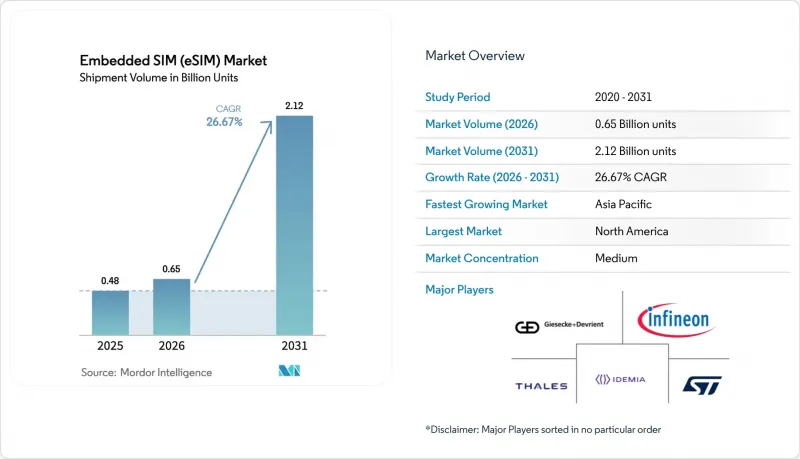
Mordor Intelligence에 의하면, 출하대수 기반 임베디드 SIM 시장 규모는 2025년에 4억 8,000만 대, 2026년에 6억 5,000만 대에 이르고, 2031년까지 21억 2,000만 대에 이를 것으로 예측되며, 2026-2031년 CAGR26.67%를 기록할 전망입니다.
본 보고서는 네트워크 유형(5G, 4G/LTE 등), 기기 유형(스마트폰, 태블릿 및 노트북 등), 최종 사용자 산업(소비자 가전, 자동차 및 운송 장비 등), 폼 팩터(MFF2, 웨이퍼 레벨 CSP 등),프로비저닝 사양(SGP.02 등), 지역별로 분류되어 있습니다. 시장 예측은 수량(대수) 기준으로 제시되어 있습니다.
전 세계 임베디드 SIM(eSIM) 시장 동향 및 인사이트
5G의 급속한 확산이 eSIM 수요를 가속화
스탠드얼론형 5G 네트워크는 그동안 셀룰러 IoT를 제한해 온 지연 및 처리량 제약을 해소하고, 물리적 개입 없이 기기가 네트워크 슬라이스나 로밍 파트너를 전환할 수 있게 합니다. 중국에서는 2024년에 5G 연결 건수가 10억 건을 돌파했으며, 중국 통신 사업자들은 2025년 10월까지 전국적인 eSIM 지원을 완료했습니다. 일본은 2024년에 인구 커버리지 98.4%를 달성했으며, 2030년까지 99%를 목표로 하고 있어, 이를 통해 기업은 원격 프로비저닝을 위한 전국적인 연속적인 네트워크 기반을 확보할 수 있습니다. 유럽에서는 2024년에 가구 커버리지율이 94.3%에 달하여, 납땜형 SIM에 의존하는 스마트 홈 및 산업용 센서의 도입 기반이 마련되었습니다. 2025년 4월, 보다폰이 A1 및 에릭슨과 공동으로 실시한 5G 독립형(SA) 방식의 로밍 실증 실험에서는 국경을 초월한 원활한 프로파일 전환이 입증되었습니다. 통신 사업자가 네트워크 슬라이싱을 상용화함으로써, 기업은 통신 사업자를 동적으로 선택하면서 서비스 품질을 보장할 수 있게 되어, 산업용 게이트웨이 및 커넥티드카의 출하 대수 증가를 뒷받침하게 될 것입니다.
eCall 및 UN-R155 의무화로 자동차 분야 도입 촉진
2024년 7월부터 신차에 의무화되는 유엔의 UN-R155 규정은 사이버 위협 모니터링과 안전한 무선 업데이트를 요구하고 있으며, 이는 모두 변조 방지 기능을 갖춘 임베디드 SIM의 설계를 뒷받침하고 있습니다. 유럽의 eCall 지침에 따라 승용차에 셀룰러 긴급 통신 기능을 탑재하는 것은 이미 의무화되어 있으며, 신차에서는 탈거 방지 요건을 충족하기 위해 납땜된 eSIM의 채택이 점점 더 늘어나고 있습니다. 콘티넨탈(Continental)은 2024년 11월, eSIM 모듈을 통합하고 보안 인증서를 원격으로 배포하는 UN-R155 준수 사이버 보안 솔루션을 발표했습니다. 이에 이어 2025년 2월에는 탈레스(Thales)와 큐빅(Cubic)이 SGP.32를 준수하는 자동차용 플랫폼을 발표했습니다. 이 플랫폼을 통해 차량 관리자는 무선 통신망을 통해 이동통신사를 변경할 수 있게 되어, 국경을 넘는 운영 시 로밍 요금을 절감할 수 있습니다(thalesgroup.com). 다른 지역에서도 유럽의 프레임워크가 채택됨에 따라, 자동차 생산 대수는 견고한 eSIM 폼 팩터에 대한 수년에 걸친 수요로 직결될 것입니다.
분산된 M2M 액세스 권한 사양
수명이 긴 산업용 자산을 관리하는 기업들은 기존의 SGP.02 프로비저닝 스택과 새로운 SGP.32 워크플로를 병행하여 운영할 수밖에 없게 되어, 그 결과 통합 예산이 증가하고 공격 표면이 확대되고 있습니다. 기제케 앤 드블린트(Giesecke & Devrint)가 2025년 4월 SGP.32 완전 인증을 획득하는 과정에서 대규모 서버 재구축과 벤더 간 테스트 주기가 필요했으며, 이로 인해 기술적 부담이 크다는 점이 부각되었습니다. 기기 수명 주기가 15년에 달하는 유틸리티, 물류, 운송 업계에서는 이미 도입된 SGP.02 지원 기기군을 폐기하는 데 소극적이며, 적어도 2035년까지는 듀얼 스택 운영을 피할 수 없는 실정입니다. 그 결과 발생하는 복잡성은 SGP.32 모듈의 단기 출하량 증가세를 둔화시켜, 임베디드 SIM(eSIM) 시장의 급격한 성장 곡선을 부분적으로 상쇄하고 있습니다.
부문 분석
2025년, 스마트폰 및 IoT 센서의 방대한 도입 기반이 기존 네트워크에 계속 정착함에 따라, 4G/LTE는 내장형 SIM(eSIM) 시장에서 52.11%의 점유율을 유지했습니다. 그러나 5G 부문은 네트워크 슬라이싱, 초고신뢰성 저지연 통신, 캐리어 어그리게이션을 가능하게 하는 독립형 코어로의 통신 사업자 전환을 반영하여 연평균 성장률(CAGR) 26.89%로 확대될 것으로 예측됩니다. 중국의 3대 통신사는 2025년 10월 전국 규모의 eSIM 구축을 완료하고, 5G 아키텍처를 활용하여 자율주행 트럭 전용 도로에서 동적인 프로파일 전환을 실현했습니다. 일본 및 유럽연합(EU)에서는 5G 인구 커버리지율이 합계 94%를 초과함에 따라, 커넥티드 팩토리 및 스마트 시티 그리드를 위한 실시간 무선 프로비저닝이 가능해졌습니다.
mm파를 통한 네트워크 고밀도화가 진행됨에 따라, 도시 지역의 사설 네트워크에서는 다운타임 없이 퍼블릭 슬라이스와 전용 슬라이스를 전환할 수 있는 시장 규모에 맞는 내장형 SIM(eSIM) 모듈이 채택될 것입니다. 한편, 지방 시장의 통신 사업자들은 저대역폭 센서를 위해 NB-IoT 및 LTE-M의 구축을 계속하고 있어, 멀티모드 eSIM 칩셋에 유리한 듀얼 네트워크 전략이 형성되고 있습니다. 예측 기간 동안 4G는 유지 관리 모드로 전환되는 반면, 산업 자동화, 원격 의료 및 결정론적 지연 보장이 필요한 몰입형 미디어 용도에 힘입어 5G가 임베디드 SIM(eSIM) 시장 매출에서 차지하는 비중은 급증할 전망입니다.
2025년 출하 대수에서 스마트폰이 차지하는 비중은 60.29%였으나, 이 부문의 성장률은 한 자릿수 중반에 머무르는 반면, 웨어러블 기기의 경우 2031년까지 연평균 성장률(CAGR)이 26.76%를 나타낼 것으로 예측됩니다. 메드트로닉(Medtronic)과 애보트(Abbott)의 연속 혈당 모니터, 심장 임플란트, 낙상 감지 펜던트는 클라우드 대시보드에 상시 연결된 셀룰러 통신에 의존하고 있어 스마트폰과의 테더링이 필요하지 않습니다. 임베디드 SIM 솔루션은 습기, 먼지 및 부정 조작의 침입 경로를 차단하므로, 24시간 착용하는 의료 및 피트니스 기기에 매우 중요합니다. 노트북과 태블릿은 판매 시점에 데이터 요금제를 번들로 제공하는 ‘즉시 연결형’ 금융 모델을 활용하는 반면, M2M 모듈은 자산 추적용 비콘이나 스마트 계량기의 개조를 가능하게 합니다.
웨어러블 기기도 전력 소비를 절반으로 줄여주는 웨이퍼 레벨 칩 스케일 패키징(Wafer Level Chip Scale Packaging)의 혜택을 받아, 얇은 폼 팩터에서 배터리 수명을 연장하고 있습니다. 삼성의 eSIM v3.0 사양에서는 여러 개의 유효 프로파일이 도입되어, 하나의 시계로 개인용 및 기업용 회선을 모두 지원합니다. 한편, 퀄컴 탈레스의 iSIM 플랫폼에서는 보안 요소가 시스템 온 칩(SoC) 내에 통합되어 있습니다. 건강보험사가 원격 모니터링 비용을 보상하고, 기업이 현장 직원의 디지털화를 추진하는 가운데, 웨어러블용 내장형 SIM(eSIM) 시장의 출하량은 예측 기간 중반까지 태블릿을 추월할 것으로 보이며, 이 부문은 스마트폰에 이어 두 번째로 큰 기여 분야로서의 입지를 공고히 할 전망입니다.
지역별 분석
북미는 애플의 eSIM 전용 아이폰 라인업과 의료·물류 분야의 기업용 IoT 도입을 배경으로 2025년 출하 대수의 39.39%를 차지했습니다. 통신 사업자들은 성숙한 5G 독립형 코어를 활용하여 프리미엄 데이터 요금제를 통한 수익화를 도모하는 한편, 유전 및 철도 네트워크에 걸쳐 있는 산업용 게이트웨이에 대한 원격 프로비저닝을 수행하고 있습니다. 소비자층의 eSIM 보급은 여행용 eSIM 패키지를 무제한 요금제에 묶어 제공하는 통신 사업자들의 광범위한 마케팅 전략에 힘입어 가속화되고 있습니다.
아시아태평양은 2031년까지 연평균 성장률(CAGR) 27.36%를 기록하며 가장 빠르게 성장하는 지역이 될 전망입니다. 2025년 10월 중국에서 실시된 전국적 확대로 10억 건 이상의 5G 연결이 실현되었으며, 이를 통해 저가형 안드로이드 제조업체들은 SIM 트레이를 폐지하고 더 대용량의 배터리를 탑재할 수 있는 기판 공간을 확보할 수 있게 되었습니다. 이어 인도에서는 2025년 10월 타타 커뮤니케이션즈와 BSNL이 인도 전역에 걸쳐 eSIM 서비스를 개시하여, 스마트폰 사용자와 농촌 전기화 프로그램의 스마트 계량기 도입을 모두 대상으로 하고 있습니다. 이미 5G 커버리지율이 거의 포화 상태에 이른 일본과 한국에서는 커넥티드카, 웨어러블 결제 단말기, 스마트 팩토리에 eSIM이 도입되고 있습니다.
유럽에서는 규제 측면의 뒷받침에 힘입어 가구당 5G 커버리지가 94.3%에 달하는 한편, eCall이나 UN-R155와 같이 차량 형식 인증에 연결 기능을 포함하도록 의무화하는 규제가 도입되었습니다. 2025년 8월에 시행될 ‘무선기기 지침’은 사이버 보안 기준을 강화하고, 기기 제조업체들에게 납땜식 eSIM 설계로의 전환을 촉진하고 있습니다. 중동에서는 도입이 가속화되고 있으며, 사우디아라비아의 stc가 구축한 전국 플랫폼을 통해 SIM 카드 물류 비용이 절감되어, MENA 지역의 연결 건수는 2028년까지 1억 3,500만 건에 달할 것으로 예측됩니다. 아프리카는 남아프리카공화국과 나이지리아의 시범 프로그램을 제외하면 여전히 초기 단계에 머물러 있습니다. 이들 국가에서는 도시 지역의 통신 사업자들이 주재원 및 기업 차량을 대상으로 eSIM을 시험적으로 도입하고 있습니다.
남미에서는 14개국 30개 통신사업자가 eSIM 서비스를 제공하고 있으며, 그 기세가 점점 더 커지고 있습니다. 브라질과 아르헨티나의 로밍 친화적인 관광 시장의 호재도 더해져, eSIM 보급률은 2023년 5%에서 2030년까지 스마트폰 연결 건수의 75%를 나타낼 것으로 예측됩니다. 소비자 대상 인식 제고 캠페인과 저렴한 eSIM 지원 단말기의 보급이 맞물려, 선불 시장 전체에서 잠재적 수요가 창출될 것으로 전망됩니다.
기타 혜택:
- 엑셀 형식 시장 예측(ME) 시트
- 3개월간의 애널리스트 지원
자주 묻는 질문
목차
제1장 서론
제2장 조사 방법
제3장 주요 요약
제4장 시장 구도
제5장 시장 규모와 성장 예측
제6장 경쟁 구도
제7장 시장 기회와 향후 전망
LSH 26.09.14According to Mordor Intelligence, the embedded SIM market size in terms of shipment volume is projected to be 0.48 Billion units in 2025, 0.65 Billion units in 2026, and reach 2.12 Billion units by 2031, growing at a CAGR of 26.67% from 2026 to 2031.
This report is Segmented by Network Type (5G, 4G/LTE, and More), Device Type (Smartphones, Tablets and Laptops, and More), End-User Industry (Consumer Electronics, Automotive and Transportation, and More), Form Factor (MFF2, Wafer-Level CSP, and More), Provisioning Specification (SGP. 02, and More), and Geography. The Market Forecasts are Provided in Terms of Volume (Units).
Global Embedded SIM (eSIM) Market Trends and Insights
Rapid 5G Roll-Outs Accelerating eSIM Demand
Standalone 5G networks remove latency and throughput constraints that previously limited cellular IoT, enabling devices to switch network slices and roaming partners without physical intervention. China surpassed 1 billion 5G connections in 2024, and carriers there finalized nationwide eSIM enablement by October 2025. Japan achieved 98.4% population coverage in 2024 and targets 99% by 2030, giving enterprises a contiguous national footprint for remote provisioning. In Europe, household coverage reached 94.3% in 2024, creating a launchpad for smart-home and industrial sensors that rely on soldered SIMs. Vodafone's 5G standalone roaming proof-of-concept with A1 and Ericsson in April 2025 showcased frictionless cross-border profile switching. As operators commercialize network slicing, enterprises can guarantee quality of service while dynamically selecting carriers, catalyzing shipment growth across industrial gateways and connected vehicles.
Mandates for eCall and UN-R155 Driving Automotive Adoption
The United Nations UN-R155 regulation, compulsory for new vehicle types from July 2024, demands cyber-threat monitoring and secure over-the-air updates, both of which favor tamper-resistant embedded SIM designs. Europe's eCall directive has already hard-wired cellular emergency connectivity into passenger cars, and new models increasingly adopt soldered eSIMs to meet anti-removal requirements. Continental launched UN-R155-aligned cybersecurity solutions in November 2024 integrating eSIM modules to push security certificates remotely. Thales and Cubic followed in February 2025 with an SGP.32-compliant automotive platform that allows fleet managers to change mobile network operators over the air, lowering roaming charges for cross-border operations thalesgroup.com. As other regions copy the European framework, vehicle production volumes translate directly into multi-year demand for robust eSIM form factors.
Fragmented M2M Entitlement Specifications
Enterprises managing long-life industrial assets must juggle legacy SGP.02 provisioning stacks alongside newer SGP.32 workflows, inflating integration budgets and expanding the attack surface. Giesecke and Devrient's April 2025 attainment of full SGP.32 certification required major server re-architecture and cross-vendor test cycles, illustrating the technical lift. Utilities, logistics, and transportation verticals with 15-year device lifecycles are unwilling to abandon installed SGP.02 fleets, forcing dual-stack operations through at least 2035. The resulting complexity dampens near-term shipment growth for SGP.32 modules and partially offsets the embedded SIM (eSIM) market's otherwise steep expansion curve.
Other drivers and restraints analyzed in the detailed report include:
- Apple-Led Smartphone OEM Shift to eSIM-Only Flagships
- Limited Consumer Awareness Outside Premium Handsets
For complete list of drivers and restraints, kindly check the Table Of Contents.
Segment Analysis
4G/LTE retained 52.11% embedded SIM (eSIM) market share in 2025 as a sizable installed base of smartphones and IoT sensors remained anchored to established networks. The 5G segment is, however, projected to scale at a 26.89% CAGR, reflecting operator migration to standalone cores that permit network slicing, ultra-reliable low-latency communication, and carrier aggregation. China's three national carriers concluded nationwide eSIM rollouts in October 2025, leveraging 5G architecture to deliver dynamic profile switching for autonomous trucking corridors. In Japan and the European Union, combined 5G population coverage above 94% enables real-time over-the-air provisioning for connected factories and smart-city grids.
As millimeter-wave densification advances, urban private networks will adopt embedded SIM (eSIM) market size modules that can toggle between public and dedicated slices without downtime. Operators in rural markets continue to deploy NB-IoT and LTE-M for low-bandwidth sensors, creating a dual-network strategy that favors multi-mode eSIM chipsets. Over the forecast horizon, 4G will migrate into maintenance mode, while 5G's contribution to embedded SIM (eSIM) market revenues surges, propelled by industrial automation, remote health care, and immersive media applications that demand deterministic latency guarantees.
Smartphones accounted for 60.29% of 2025 unit shipments, yet the category's mid-single-digit growth contrasts with the 26.76% CAGR expected for wearables through 2031. Continuous-glucose monitors, cardiac implants, and fall-detection pendants from Medtronic and Abbott rely on always-on cellular links to cloud dashboards, removing the need for handset tethering. Embedded SIM solutions eliminate ingress points for moisture, dust, and tampering, critical to medical and fitness devices worn 24 hours a day. Laptops and tablets exploit instant-connect financing models that bundle data plans at point of sale, while M2M modules enable asset-tracking beacons and smart-meter retrofits.
Wearables also benefit from wafer-level chip-scale packaging that halves energy draw, extending battery life for thin form factors. Samsung's eSIM v3.0 specification introduces multiple enabled profiles, supporting personal and corporate lines on a single watch, while Qualcomm-Thales iSIM platforms place the secure element inside the system-on-chip. As health insurers reimburse remote monitoring and enterprises embrace field-force digitization, embedded SIM (eSIM) market size shipments for wearables are set to eclipse tablets by mid-forecast, solidifying the segment as the second-largest contributor after smartphones.
Complete Report Scope:
- Overall Market Estimates
- Total Market Value
- By Network Type
- 5G
- 4G/LTE
- NB-IoT / LTE-M
- By Device Type
- Smartphones
- Tablets and Laptops
- Wearables
- M2M/IoT Modules
- By End-User Industry
- Consumer Electronics
- Automotive and Transportation
- Industrial and Manufacturing
- Logistics and Asset Tracking
- Energy and Utilities
- Healthcare and Wearables
- By Form Factor
- MFF2
- Wafer-Level CSP
- Plug-In eSIM
- By Provisioning Specification
- SGP.02 (M2M)
- SGP.22 (Consumer)
- SGP.32 (IoT)
- By Geography
- North America
- United States
- Canada
- Mexico
- South America
- Brazil
- Argentina
- Rest of South America
- Europe
- United Kingdom
- Germany
- France
- Italy
- Spain
- Rest of Europe
- Asia-Pacific
- China
- Japan
- South Korea
- India
- Rest of Asia-Pacific
- Middle East
- Saudi Arabia
- United Arab Emirates
- Israel
- Rest of Middle East
- Africa
- South Africa
- Nigeria
- Rest of Africa
- North America
Geography Analysis
North America held 39.39% of 2025 unit volumes on the back of Apple's eSIM-only iPhone lineup and enterprise IoT rollouts in healthcare and logistics. Operators leverage matured 5G standalone cores to monetize premium data plans and remotely provision industrial gateways across oilfields and rail networks. Consumer adoption benefits from widespread carrier marketing that bundles travel eSIM packages into unlimited plans.
Asia Pacific is set to become the fastest-expanding region at a 27.36% CAGR to 2031. China's October 2025 nationwide rollout covers more than 1 billion 5G connections, enabling low-cost Android makers to eliminate SIM trays and free board space for larger batteries. India followed with Tata Communications and BSNL launching pan-India eSIM in October 2025, targeting both smartphone users and smart-meter deployments in rural electrification programs. Japan and South Korea, already near-saturated in 5G coverage, deploy eSIM in connected cars, wearable payment devices, and smart factories.
Europe enjoys regulatory pull, with 94.3% household 5G coverage and mandates such as eCall and UN-R155 that embed connectivity into vehicle homologation. The Radio Equipment Directive coming into force in August 2025 raises cybersecurity bars, nudging device makers toward soldered eSIM designs. Middle East adoption accelerates, with stc's national platform in Saudi Arabia cutting SIM logistics and MENA connections forecast to reach 135 million by 2028. Africa remains at a nascent stage except for pilot programs in South Africa and Nigeria, where urban operators test eSIM to serve expatriates and enterprise fleets.
South America shows rising momentum as 30 operators in 14 nations offer eSIM services. Penetration jumps from 5% in 2023 to an expected 75% of smartphone connections by 2030, aided by roaming-friendly tourist markets in Brazil and Argentina. Consumer awareness campaigns, combined with lower-cost eSIM-ready handsets, are expected to unlock latent demand across prepaid segments.
- Thales Group
- Giesecke + Devrient GmbH
- STMicroelectronics N.V.
- Infineon Technologies AG
- IDEMIA Group S.A.S
- Valid S.A.
- Workz Group
- Arm Ltd. / Kigen
- Truphone Ltd.
- GigSky Inc.
- Apple Inc.
- Samsung Electronics Co. Ltd.
- Qualcomm Technologies Inc.
- NXP Semiconductors N.V.
- Deutsche Telekom AG
- Vodafone Group Plc
- Sierra Wireless Inc. (Semtech)
- u-blox Holding AG
- Telit Cinterion
- Nordic Semiconductor ASA
Additional Benefits:
- The market estimate (ME) sheet in Excel format
- 3 months of analyst support
TABLE OF CONTENTS
1 INTRODUCTION
- 1.1 Study Assumptions and Market Definition
- 1.2 Scope of the Study
2 RESEARCH METHODOLOGY
3 EXECUTIVE SUMMARY
4 MARKET LANDSCAPE
- 4.1 Market Overview
- 4.2 Market Drivers
- 4.2.1 Rapid 5G Roll-Outs Accelerating eSIM Demand
- 4.2.2 Mandates for eCall and UN-R155 Driving Automotive Adoption
- 4.2.3 Apple-Led Smartphone OEM Shift to eSIM-Only Flagships
- 4.2.4 Telco OPEX Savings Via Remote SIM Provisioning
- 4.2.5 Government IoT Security Regulations Favouring Soldered SIMs
- 4.2.6 Emergence of GSMA SGP.32 Specification Unlocking Mass-Scale IoT Deployments
- 4.3 Market Restraints
- 4.3.1 Fragmented M2M Entitlement Specifications
- 4.3.2 Limited Consumer Awareness Outside Premium Handsets
- 4.3.3 Supply-Chain Trust Concerns (Tamper and Side-Channel Attacks)
- 4.3.4 Operator Lock-In Worries Among Enterprise IoT Buyers
- 4.4 Industry Value/Supply-Chain Analysis
- 4.5 Regulatory Landscape
- 4.6 Technological Outlook
- 4.7 Impact of Macroeconomic Factors on the Market
- 4.8 Porter's Five Forces Analysis
- 4.8.1 Bargaining Power of Suppliers
- 4.8.2 Bargaining Power of Consumers
- 4.8.3 Threat of New Entrants
- 4.8.4 Threat of Substitute Products
- 4.8.5 Intensity of Competitive Rivalry
5 MARKET SIZE AND GROWTH FORECASTS (VALUE)
- 5.1 Overall Market Estimates
- 5.1.1 Total Market Value
- 5.2 By Network Type
- 5.2.1 5G
- 5.2.2 4G/LTE
- 5.2.3 NB-IoT / LTE-M
- 5.3 By Device Type
- 5.3.1 Smartphones
- 5.3.2 Tablets and Laptops
- 5.3.3 Wearables
- 5.3.4 M2M/IoT Modules
- 5.4 By End-User Industry
- 5.4.1 Consumer Electronics
- 5.4.2 Automotive and Transportation
- 5.4.3 Industrial and Manufacturing
- 5.4.4 Logistics and Asset Tracking
- 5.4.5 Energy and Utilities
- 5.4.6 Healthcare and Wearables
- 5.5 By Form Factor
- 5.5.1 MFF2
- 5.5.2 Wafer-Level CSP
- 5.5.3 Plug-In eSIM
- 5.6 By Provisioning Specification
- 5.6.1 SGP.02 (M2M)
- 5.6.2 SGP.22 (Consumer)
- 5.6.3 SGP.32 (IoT)
- 5.7 By Geography
- 5.7.1 North America
- 5.7.1.1 United States
- 5.7.1.2 Canada
- 5.7.1.3 Mexico
- 5.7.2 South America
- 5.7.2.1 Brazil
- 5.7.2.2 Argentina
- 5.7.2.3 Rest of South America
- 5.7.3 Europe
- 5.7.3.1 United Kingdom
- 5.7.3.2 Germany
- 5.7.3.3 France
- 5.7.3.4 Italy
- 5.7.3.5 Spain
- 5.7.3.6 Rest of Europe
- 5.7.4 Asia-Pacific
- 5.7.4.1 China
- 5.7.4.2 Japan
- 5.7.4.3 South Korea
- 5.7.4.4 India
- 5.7.4.5 Rest of Asia-Pacific
- 5.7.5 Middle East
- 5.7.5.1 Saudi Arabia
- 5.7.5.2 United Arab Emirates
- 5.7.5.3 Israel
- 5.7.5.4 Rest of Middle East
- 5.7.6 Africa
- 5.7.6.1 South Africa
- 5.7.6.2 Nigeria
- 5.7.6.3 Rest of Africa
- 5.7.1 North America
6 COMPETITIVE LANDSCAPE
- 6.1 Market Concentration
- 6.2 Strategic Moves
- 6.3 Market Share Analysis
- 6.4 Company Profiles (includes Global Level Overview, Market Level Overview, Core Segments, Financials as Available, Strategic Information, Market Rank/Share for Key Companies, Products and Services, and Recent Developments)
- 6.4.1 Thales Group
- 6.4.2 Giesecke + Devrient GmbH
- 6.4.3 STMicroelectronics N.V.
- 6.4.4 Infineon Technologies AG
- 6.4.5 IDEMIA Group S.A.S
- 6.4.6 Valid S.A.
- 6.4.7 Workz Group
- 6.4.8 Arm Ltd. / Kigen
- 6.4.9 Truphone Ltd.
- 6.4.10 GigSky Inc.
- 6.4.11 Apple Inc.
- 6.4.12 Samsung Electronics Co. Ltd.
- 6.4.13 Qualcomm Technologies Inc.
- 6.4.14 NXP Semiconductors N.V.
- 6.4.15 Deutsche Telekom AG
- 6.4.16 Vodafone Group Plc
- 6.4.17 Sierra Wireless Inc. (Semtech)
- 6.4.18 u-blox Holding AG
- 6.4.19 Telit Cinterion
- 6.4.20 Nordic Semiconductor ASA
7 MARKET OPPORTUNITIES AND FUTURE OUTLOOK
- 7.1 White-Space and Unmet-Need Assessment