|
시장보고서
상품코드
2124544
유럽의 화력발전 시장 : 시장 점유율 분석, 업계 동향과 통계, 성장 예측(2026-2031년)Europe Thermal Power - Market Share Analysis, Industry Trends & Statistics, Growth Forecasts (2026 - 2031) |
||||||
 Mordor Intelligence
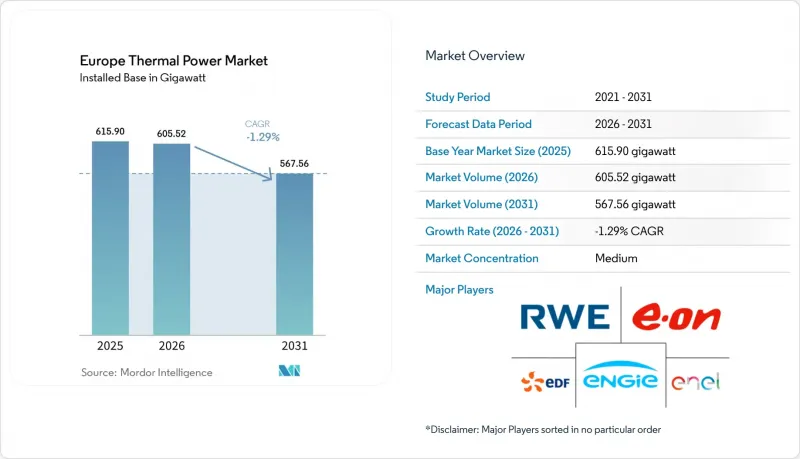
Mordor Intelligence에 의하면, 유럽의 화력발전 시장 규모(설치용량 기반)는 2025년 615.90기가와트에서 2026년에는 605.52기가와트로 축소되고, 2031년까지 567.56기가와트까지 감소할 것으로 예상되고 있어 2026-2031년 CAGR -1.29%로 축소될 전망입니다.
본 보고서는 연료 유형별(석탄, 천연가스, 석유, 원자력, 기타), 기술별(증기 터빈, CCGT, 내연기관, CHP, 기타),출력별(100MW 미만, 100-500MW, 500-1,000MW, 1,000MW 이상), 용도별(유틸리티 규모, 산업용 자가 소비, 분산형, 피크 대응 발전소), 지역별(영국, 독일, 프랑스, 러시아, 기타 유럽)로 분류되어 있습니다. 시장 전망은 용량(GW) 단위로 제시되어 있습니다.
유럽 화력 발전 시장 동향 및 인사이트
노후화된 석탄 화력 발전소의 CCGT로 대체
석탄 화력 발전소 폐쇄 계획에 따라 유럽 화력 발전 시장에서 고효율 대체 발전 용량에 대한 수요가 가속화되고 있습니다. ENTSO-E 보고서에 따르면, 2024년부터 2025-2026년 겨울에 걸쳐 경질탄 및 갈탄 발전 용량은 12 GW 감소한 반면, 가스 발전 용량은 4GW 증가했습니다. 독일은 2026년 1월, 유럽위원회와 2031년까지 가동을 예정하고 있는 12 GW의 제어 가능하고 수소 대응이 가능한 발전 용량에 관한 프레임워크에 합의했습니다. 이 프로그램에서는 기존 계통 연결을 보유한 개발 사업자에게 우위가 주어집니다. 이는 기존 설비의 교체 프로젝트가 신규 부지 건설보다 신속하게 진행될 수 있기 때문입니다. GE Vernova는 2025년 11월, Enea Group으로부터 코지엔이체(Kozienice)에 위치한 9HA.01형 복합 사이클 발전 유닛 2기에 대한 수주를 확보했습니다. 증기 터빈은 폴란드 엘블라그(Elblag)에서 제조될 예정입니다. 현지에서의 설비 생산은 조달 기간을 단축할 수 있을 뿐만 아니라, 석탄에서 가스로의 전환을 추진하는 과정에서 국가의 산업 목표를 뒷받침하는 결과로 이어집니다.
데이터센터 및 전기화로 인한 전력 수요 증가
데이터센터 수요 증가로 인해 유럽 화력 발전 시장에서 확정 공급 용량의 가치가 높아지고 있습니다. ENTSO-E의 예측에 따르면, 유럽 데이터센터의 전력 소비량은 2024년 87 TWh에서 2030년까지 134 TWh를 넘어설 것으로 전망됩니다. 99.999%의 가동률을 요구하는 시설에서는 재생에너지 발전량이 적을 때에도 신뢰성 높은 전력 공급이 필요합니다. 이러한 상황에서는 가스 화력 발전이 조절 전력을 공급하여 전력계의 안정성을 뒷받침할 수 있습니다. 더블린, 암스테르담, 런던,프랑크푸르트에서의 부하 집중은 지역 송전망에 부담을 주며, 수요 중심지에 가까운 발전 용량의 중요성을 높이고 있습니다. 데이터센터 단지 근처에 설치된 분산형 열병합 발전 설비나 피크 대응 발전소는 유럽 화력 발전 시장의 도매 수급 조정 패턴에 대한 의존도가 낮은 직접 전력 계약을 확보할 가능성이 있습니다.
급등하는 EU 배출권 거래 제도(EU ETS)의 탄소 가격
EU 탄소 가격의 상승으로 인해 유럽 화력 발전 시장에서 화석 연료 발전소의 운영 비용이 증가하고 있습니다. ESMA 보고서에 따르면, EU 배출권 가격은 2025년에 이산화탄소 환산 1톤당 평균 74유로가 되었으며, 2026년 1월에는 1톤당 90유로에 달했습니다. 개정된 EU ETS는 2030년까지 2005년 대비 대상 배출량을 62% 감축하는 것을 목표로 하고 있습니다. 배출 강도가 더 높기 때문에 비용 부담이 가장 큰 것은 석탄 화력 발전소입니다. 가스 화력 발전소는 탄소 배출량이 적지만, 전력 가격이 연료비나 배출권 비용을 상쇄하지 못할 경우 수익률도 하락할 가능성이 있습니다. 가동률이 낮은 구형 개방형 사이클 발전 설비는 유럽 화력 발전 시장에서 공식적인 폐지 명령이 내려지지 않더라도 조기에 폐쇄될 가능성이 있습니다.
부문별 분석
2025년 발전원별 시장 점유율에서 천연가스는 51.9%를 차지하고 있으며, 2031년까지 연평균 성장률(CAGR) 1.1%로 확대될 것으로 예측됩니다. 이러한 위상은 전체 설비 용량이 감소하고 있음에도 불구하고, 독일, 폴란드,그리스, 우크라이나에서의 신규 가스 발전 설비 증설을 반영한 것입니다. 석탄은 폐지 정책과 탄소 비용으로 인해 경제성이 저하되고 있어 구조적인 쇠퇴가 지속되고 있습니다. 독일과 폴란드는 여전히 대규모 석탄 화력 발전소를 보유하고 있지만, 향후 발전 용량 계획에서는 대체 발전에 대한 의존도가 높아지고 있습니다. 원자력 발전은 발전에 증기 사이클을 이용하고 있기 때문에 광의의 화력 발전 분류에서 여전히 중요한 위치를 차지하고 있습니다. 석유 및 지열 발전의 용량은 해당 지역의 총 발전 용량에서 차지하는 비중은 작지만, 고립된 전력 계통이나 외딴 지역의 산업 지대에서 특히 중요한 역할을 수행하고 있습니다.
러시아는 가스 화력 발전 용량이 큰 비중을 차지하고 있으며, 이 발전 유형에 서유럽과는 다른 역할을 부여하고 있습니다. 가즈프롬(Gazprom)은 모세네르고(Mosenergo) 등의 자회사를 통해 대규모 전력 및 열 공급 능력을 보유하고 있다고 밝혔습니다. 러시아에서는 가스가 여전히 안정적인 전력 및 열 공급의 주요 원천으로 자리 잡고 있습니다. EU의 많은 지역에서는 변동성이 큰 재생에너지 발전 용량의 확대에 따라, 유연성 확보를 위한 수단으로서 가스 이용이 증가하고 있습니다. 이러한 차이로 인해 유럽의 화력 발전 시장에는 베이스 로드를 주로 담당하는 가스 발전 설비와, 재생에너지의 출력 변동에 맞추어 운영되는 유연성이 높은 가스 발전소가 모두 존재합니다. 그 결과, 천연가스가 여전히 핵심 연료이긴 하지만, 그 운영 패턴은 국가에 따라 크게 다른 전력 공급 구조를 형성하고 있습니다.
2025년 기준 CCGT(복합 사이클 가스 발전)는 시장 점유율의 33.2%를 차지하고 있으며, 가장 빠르게 성장하고 있는 기술입니다. 유럽의 CCGT 화력 발전 시장 규모는 2031년까지 연평균 성장률(CAGR) 2.6%로 확대될 것으로 예측됩니다. 복합 사이클 발전소는 구형 증기 사이클 발전 설비보다 높은 효율을 자랑하며, 수소 대응 설계 요건에도 더 적합합니다. 증기 터빈 발전소는 특히 석탄 화력 발전이나 구형 중앙 발전소가 집중된 지역에서 여전히 대규모 도입 실적을 유지하고 있습니다. 내연기관(ICE) 발전소는 소규모화 및 모듈식 설치가 중요한 분산형 발전이나 고립된 전력망에서의 이용에 적합합니다. 열병합발전(CHP) 시스템은 스칸디나비아, 발트 국가, 그리고 중부 유럽 전역의 산업 시설 및 지역 열 공급 네트워크에서 여전히 중요한 역할을 수행하고 있습니다.
독일의 신규 제어 가능 발전 용량에 관한 프레임워크는 수소 대응 CCGT에 대한 투자를 뒷받침하고 있습니다. 유니퍼(Uniper)는 2026년 4월, 슈타우딩거(Staudinger)에 위치한 890MW 규모의 수소 대응 유닛에 대해 예비 승인을 획득했습니다. 라리사 써모일렉트릭(Larissa Thermoelectric)은 2026년 8월, 미쓰비시 파워(Mitsubishi Power)의 기술을 채택한 그리스의 794MW CCGT 프로젝트에 대해 AVAX를 선정했습니다. DTEK는 GE Vernova와 공동으로 부르슈틴(Brustyn)의 650MW CCGT 프로젝트를 추진하고 있습니다. DTEK. 이러한 프로젝트들은 유럽 화력 발전 업계가 기존의 증기 기술이 아닌 복합 사이클 발전 설비로 개발의 중점을 옮기고 있음을 보여줍니다.
기타 혜택:
- 엑셀 형식 시장 예측(ME) 시트
- 3개월간의 애널리스트 지원
자주 묻는 질문
목차
제1장 서론
제2장 조사 방법
제3장 주요 요약
제4장 시장 구도
제5장 시장 규모와 성장 예측
제6장 경쟁 구도
제7장 시장 기회와 향후 전망
LSH 26.09.14According to Mordor Intelligence, the Europe thermal power market size in terms of installed base is expected to decrease from 615.90 gigawatt in 2025 to 605.52 gigawatt in 2026 and decline to 567.56 gigawatt by 2031, declining at a CAGR of -1.29% over 2026-2031.
This report is Segmented by Source Type (Coal, Natural Gas, Oil, Nuclear, Others), Technology (Steam Turbine, CCGT, ICE, CHP, Others), Capacity (Below 100 MW, 100-500 MW, 500-1000 MW, Above 1000 MW), Application (Utility-Scale, Industrial Captive, Distributed, Peaker Plants), and Geography (United Kingdom, Germany, France, Russia, Rest of Europe). The Market Forecasts are Provided in Terms of Volume (GW).
Europe Thermal Power Market Trends and Insights
Ageing Coal Fleet Replacement with CCGT
Coal retirement plans are accelerating demand for efficient replacement capacity in the Europe thermal power market. ENTSO-E reported that hard coal and lignite capacity fell by 12 GW between 2024 and the winter of 2025-2026, while gas capacity rose by 4 GW. Germany agreed a framework with the European Commission in January 2026 for 12 GW of controllable, hydrogen-ready capacity that is intended to operate by 2031. The program gives developers with existing grid connections an advantage because replacement projects can move faster than new sites. GE Vernova received an order from Enea Group in November 2025 for two 9HA.01 combined-cycle blocks at Kozienice, with steam turbines to be made in Elblag, Poland. Local equipment production can shorten procurement timelines and support national industrial objectives during coal-to-gas replacement.
Rising Electricity Demand from Data Centers and Electrification
Data center demand is increasing the value of firm capacity in the Europe thermal power market. ENTSO-E expects European data center electricity consumption to exceed 134 TWh by 2030, compared with 87 TWh in 2024. Facilities requiring 99.999% uptime need a dependable electricity supply when renewable output is low. Gas-fired generation can provide balancing power and support grid stability in these conditions. Load concentration in Dublin, Amsterdam, London, and Frankfurt adds pressure to regional networks and favors capacity close to demand centers. Distributed CHP units and peaking plants near data campuses may secure direct power contracts that are less dependent on wholesale dispatch patterns in the Europe thermal power market.
Escalating EU ETS Carbon Prices
EU carbon prices are raising operating costs for fossil-fired plants in the Europe thermal power market. ESMA reported that EU allowance prices averaged EUR 74 per tonne of carbon dioxide equivalent in 2025 and reached EUR 90 per tonne in January 2026. The revised EU ETS targets a 62% reduction in covered emissions by 2030 from 2005 levels. The cost burden is greatest for coal plants because of their higher emissions intensity. Gas plants emit less carbon, but their margins can also weaken when electricity prices do not offset fuel and allowance costs. Older open-cycle units with low utilization may face earlier closure without a formal retirement order in the Europe thermal power market.
Other drivers and restraints analyzed in the detailed report include:
- Government Backing for Natural-Gas Bridge Capacity
- Abundant New LNG/Gas Import Infrastructure
- Rapid Fall in Solar and Wind Power LCOE
For complete list of drivers and restraints, kindly check the Table Of Contents.
Segment Analysis
Natural gas held 51.9% of the market share by source type in 2025 and is forecast to grow at a 1.1% CAGR through 2031. Its position reflects new gas additions in Germany, Poland, Greece, and Ukraine, even as the overall installed base declines. Coal remains in structural decline as retirement policies and carbon costs weaken its economics. Germany and Poland continue to have major coal fleets, but their future capacity plans rely increasingly on replacement generation. Nuclear power remains relevant within the broader thermal classification because it uses a steam cycle for electricity generation. Oil and geothermal capacity represent a smaller part of the regional fleet and are most relevant in island systems and remote industrial locations.
Russia anchors a large share of gas-fired capacity and gives the source type a different role than in Western Europe. Gazprom states that its generation assets include large electric and thermal capacity through subsidiaries such as Mosenergo. In Russia, gas remains a major source of regular power and heat supply. In much of the EU, gas is increasingly used for flexibility as variable renewable capacity grows. This difference means that the Europe thermal power market contains both baseload-oriented gas fleets and flexible gas plants that operate around renewable output. The result is a source mix in which natural gas remains the core fuel, but its operating patterns vary substantially by country.
CCGT held 33.2% of the market share in 2025 and is the fastest-growing technology, with the Europe thermal power market size for CCGT forecast to expand at a 2.6% CAGR through 2031. Combined-cycle plants offer higher efficiency than older steam-cycle units and are better suited to hydrogen-ready design requirements. Steam turbine plants remain a large installed base, especially where coal generation and older central power stations are concentrated. ICE plants serve distributed generation and island-grid applications where smaller scale and modular installation are important. CHP systems remain relevant in industrial facilities and district heating networks across Scandinavia, the Baltics, and Central Europe.
Germany's framework for new controllable capacity supports hydrogen-ready CCGT investment. Uniper received preliminary approval in April 2026 for an 890 MW hydrogen-ready unit at Staudinger. Larissa Thermoelectric selected AVAX in August 2026 for a 794 MW CCGT project in Greece that will use Mitsubishi Power technology. DTEK is advancing a 650 MW CCGT project at Burshtyn with GE Vernova. DTEK. These projects show that the Europe thermal power industry is directing development activity toward combined-cycle capacity rather than legacy steam technology.
Complete Report Scope:
- By Source Type
- Coal
- Natural Gas
- Oil
- Nuclear
- Others (geothermal, etc.)
- By Technology
- Steam turbine Power Plant
- Combined Cycle Gas Turbine (CCGT)
- Internal Combustion Engine (ICE) Power Plants
- Cogeneration / Combined Heat and Power (CHP) Plants
- Others (CSP, Open Cycle, etc.)
- By Capacity
- Below 100 MW
- 100-500 MW
- 500-1000 MW
- Above 1000 MW
- By Application
- Utility-Scale Thermal Plants
- Industrial Captive Power Plants
- Distributed Thermal Plants
- Peaker Plants
- By Geography
- United Kingdom
- Germany
- France
- Russia
- Rest of Europe
List of Companies Covered in this Report:
- Engie SA
- Electricite de France SA
- Enel S.p.A.
- RWE AG
- E.ON SE
- Rosatom State Atomic Energy Corp.
- Siemens Energy AG
- Iberdrola SA
- Endesa SA
- Uniper SE
- Vattenfall AB
- Fortum Oyj
- CEZ Group
- Verbund AG
- PGE Polska Grupa Energetyczna
- SSE plc
- Statkraft AS
- Drax Group plc
- Orsted A/S
- Gazprom Energoholding
Additional Benefits:
- The market estimate (ME) sheet in Excel format
- 3 months of analyst support
TABLE OF CONTENTS
1 INTRODUCTION
- 1.1 Study Assumptions and Market Definition
- 1.2 Scope of the Study
2 RESEARCH METHODOLOGY
3 EXECUTIVE SUMMARY
4 MARKET LANDSCAPE
- 4.1 Market Overview
- 4.2 Market Drivers
- 4.2.1 Ageing coal fleet replacement with CCGT
- 4.2.2 Rising electricity demand from data centres & electrification
- 4.2.3 Government backing for natural-gas 'bridge' capacity
- 4.2.4 Abundant new LNG/gas import infrastructure
- 4.2.5 Licensing wave of small modular high-temperature reactors
- 4.2.6 Coal-to-biomass repowering for capacity-market payments
- 4.3 Market Restraints
- 4.3.1 Escalating EU ETS carbon prices
- 4.3.2 Rapid fall in solar- & wind-power LCOE
- 4.3.3 Stricter IED air-emission ceilings
- 4.3.4 Cooling-water scarcity & coastal permitting hurdles
- 4.4 Supply-Chain Analysis
- 4.5 Regulatory Policy Outlook
- 4.6 Technological Outlook
- 4.7 Porter's Five Forces Analysis
- 4.7.1 Threat of New Entrants
- 4.7.2 Bargaining Power of Buyers
- 4.7.3 Bargaining Power of Suppliers
- 4.7.4 Threat of Substitutes
- 4.7.5 Competitive Rivalry
- 4.8 PESTLE Analysis
- 4.9 Investment Analysis
- 4.10 Impacts of Global Geopolitical Tensions on the Market
5 MARKET SIZE AND GROWTH FORECASTS
- 5.1 By Source Type
- 5.1.1 Coal
- 5.1.2 Natural Gas
- 5.1.3 Oil
- 5.1.4 Nuclear
- 5.1.5 Others (geothermal, etc.)
- 5.2 By Technology
- 5.2.1 Steam turbine Power Plant
- 5.2.2 Combined Cycle Gas Turbine (CCGT)
- 5.2.3 Internal Combustion Engine (ICE) Power Plants
- 5.2.4 Cogeneration / Combined Heat and Power (CHP) Plants
- 5.2.5 Others (CSP, Open Cycle, etc.)
- 5.3 By Capacity
- 5.3.1 Below 100 MW
- 5.3.2 100-500 MW
- 5.3.3 500-1000 MW
- 5.3.4 Above 1000 MW
- 5.4 By Application
- 5.4.1 Utility-Scale Thermal Plants
- 5.4.2 Industrial Captive Power Plants
- 5.4.3 Distributed Thermal Plants
- 5.4.4 Peaker Plants
- 5.5 By Geography
- 5.5.1 United Kingdom
- 5.5.2 Germany
- 5.5.3 France
- 5.5.4 Russia
- 5.5.5 Rest of Europe
6 COMPETITIVE LANDSCAPE
- 6.1 Market Concentration
- 6.2 Strategic Moves
- 6.3 Market Share Analysis
- 6.4 Company Profiles of International Majors (Includes Market Level Overview, Core Segments, Financials as available, Strategic Information, Market Rank/Share for key companies, recent trends and developments, etc.)
- 6.4.1 Engie SA
- 6.4.2 Electricite de France SA
- 6.4.3 Enel S.p.A.
- 6.4.4 RWE AG
- 6.4.5 E.ON SE
- 6.4.6 Rosatom State Atomic Energy Corp.
- 6.4.7 Siemens Energy AG
- 6.4.8 Iberdrola SA
- 6.4.9 Endesa SA
- 6.4.10 Uniper SE
- 6.4.11 Vattenfall AB
- 6.4.12 Fortum Oyj
- 6.4.13 CEZ Group
- 6.4.14 Verbund AG
- 6.4.15 PGE Polska Grupa Energetyczna
- 6.4.16 SSE plc
- 6.4.17 Statkraft AS
- 6.4.18 Drax Group plc
- 6.4.19 Orsted A/S
- 6.4.20 Gazprom Energoholding
7 MARKET OPPORTUNITIES AND FUTURE OUTLOOK
- 7.1 White-Space and Unmet-Need Assessment