|
시장보고서
상품코드
2124545
오픈소스 서비스 : 시장 점유율 분석, 산업 동향 및 통계 데이터, 성장 예측(2026-2031년)Open Source Service - Market Share Analysis, Industry Trends & Statistics, Growth Forecasts (2026 - 2031) |
||||||
 Mordor Intelligence
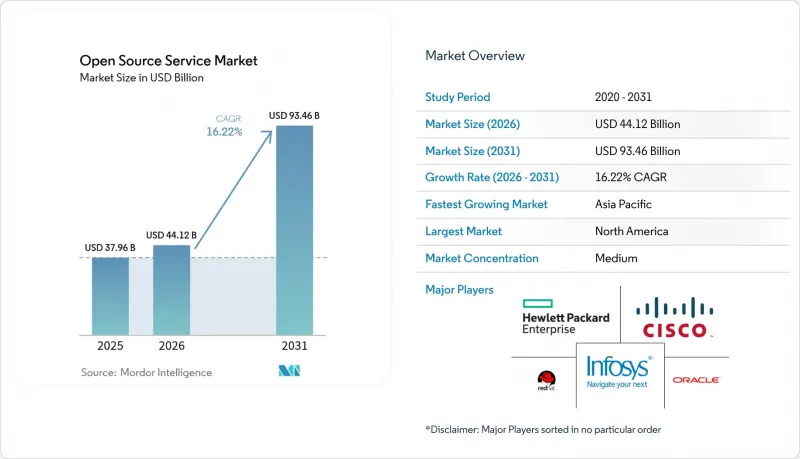
Mordor Intelligence에 의하면, 오픈소스 서비스 시장 규모는 2025년 379억 6,000만 달러로 평가되었습니다. 2026년에는 441억 2,000만 달러로 확대되어 2026년부터 2031년에 걸쳐 CAGR 16.22%로 성장을 지속하여, 2031년에는 934억 6,000만 달러에 이를 것으로 예측됩니다.
본 보고서는 서비스 유형(컨설팅·구현, 지원 및 유지보수·관리, 기타), 배포 방식(On-Premise, 클라우드), 용도(인프라 관리, 애플리케이션 개발·통합, 기타), 최종 사용자 산업(은행, 금융서비스 및 보험(BFSI), 기타), 지역별로 분류되어 있습니다. 시장 예측은 금액(달러) 기준으로 제시되어 있습니다.
세계의 오픈소스 서비스 시장 동향 및 인사이트
총 소유 비용(TCO) 절감 및 시장 출시 기간 단축
조직들은 라이선스 비용을 절감하고 솔루션 배포를 가속화하기 위해 오픈소스를 채택하고 있습니다. 2025년에는 53%가 비용 절감을 주요 도입 동기로 꼽았습니다. 금융 서비스 기업들은 이러한 변화를 여실히 보여주고 있으며, 78%가 오픈소스 도입을 통해 높은 가치를 얻었습니다고 보고했고, 90%는 이 접근 방식이 향후 업무에 필수적이라고 판단하고 있습니다. 무료로 이용 가능한 프레임워크 덕분에 AI 프로젝트에서 신속한 프로토타이핑이 가능해지면서 조달 주기가 단축되고 있지만, 안전한 프로덕션 환경으로의 배포에 대한 수요가 높아짐에 따라 유료 지원 계약이 확대되고 있습니다.
클라우드 네이티브 및 DevOps 도입 급증
컨테이너화와 GitOps를 추진하는 기업들은 오픈소스 도구에 크게 의존하고 있으며, 전문 컨설팅에 대한 수요를 높이고 있습니다. 현재 조사 대상 기업의 90%가 컨테이너를 활용하고 있으며, 86%가 쿠버네티스(Kubernetes) 클러스터를 운영하고 있는 반면, 85%는 이러한 환경을 관리하기 위해 전문가의 지원이 필요합니다. 도이치 텔레콤(Deutsche Telekom) 등 통신 그룹은 5G 네트워크 재구축에 이러한 기법을 적용하며, 오픈 표준의 확장성을 입증하고 있습니다.
보안 및 취약점에 대한 우려
금융 기관의 91%가 오픈소스 보안에 신뢰를 두고 있지만, 주목을 받은 공급망 공격으로 인해 위험에 대한 인식이 높아지고 있습니다. 2025년 4월 CVE 시스템에 대한 연방 정부의 자금 지원이 중단됨에 따라 취약점 추적이 어려워질 것입니다. 최근 리눅스와 Ruby-SAML에서 발견된 결함은 취약점 발견에 상당한 지연이 발생하고 있음을 여실히 보여주었으며, 기업들은 전문적인 모니터링 및 패치 적용 서비스 구매에 나서고 있습니다.
부문별 분석
2025년, 기업들이 복잡한 전환을 추진한 결과, 컨설팅 및 구현 분야는 오픈소스 서비스 시장에서 42.74%의 점유율을 유지했습니다. 한편, 매니지드 서비스는 기업들이 성과 기반 계약 및 지속적인 최적화로 무게중심을 옮기면서 연평균 성장률(CAGR) 17.6%를 나타낼 것으로 예측됩니다. 컨테이너의 무분별한 증가에 직면한 기업(85%가 프로덕션 환경의 워크로드에 대한 지원이 필요함)은 일회성 지원보다 장기적인 매니지드 계약을 선호하는 경향이 있습니다.
교육 및 인증 분야는 급속히 성장하고 있습니다. 이는 관리직의 52%가 인증 자격을 보유한 인재를 채용하는 것을 선호하기 때문입니다. 한편, 지원, 유지보수 및 관리는 다양한 스택을 확장하는 조직에 여전히 필수적인 요소입니다. 오픈소스 서비스 시장은 이러한 다층적인 수요 구조의 혜택을 누리고 있으며, 기술 인력 부족을 벤더에게 지속적인 수익 기회로 전환하고 있습니다.
2025년, On-Premise는 오픈소스 서비스 시장 규모의 67.78%를 차지했으며, 이는 규제 및 데이터 주권에 대한 요구를 반영합니다. 그러나 하이브리드 아키텍처가 정착됨에 따라 클라우드 도입은 연평균 성장률(CAGR) 18.03%로 진행되고 있습니다. 통신 사업자들은 클라우드 전환의 효과성을 77%로 보고하고 있지만, 기밀성이 높은 워크로드에 대해서는 프라이빗 환경을 유지하고 있습니다.
컨테이너 도입으로 인해 도입 형태의 구분이 모호해지고 있습니다. 이는 기업의 90%가 On-Premise와 퍼블릭 클라우드 양쪽 플랫폼에서 컨테이너화된 코드를 실행하고 있기 때문입니다. 이러한 융합으로 인해 오픈소스 서비스 시장은 모든 인프라 모델에서 탄력성을 유지하고 있으며, 통합 전문가의 활동 범위가 확대되고 있습니다.
지역별 분석
북미는 기업의 성숙한 도입 현황, 풍부한 인재 풀, 그리고 상용 오픈소스 스타트업을 향한 벤처 캐피털의 지원 덕분에 2025년 매출의 37.35%를 차지했습니다. FINOS와 같은 금융 서비스 컨소시엄이 코드 공유를 촉진하고 있으며, 대규모 M&A(IBM의 HashiCorp 64억 달러 인수 등)는 기존 기업들이 오픈소스 포트폴리오에 대한 투자를 강화하고 있음을 보여줍니다. 이 지역의 가치 제안은 복잡하고 수익성이 높은 컨설팅 프로젝트에 중점을 두고 있습니다.
아시아태평양은 가장 빠르게 성장하는 지역으로, 2031년까지 연평균 성장률(CAGR)이 16.92%를 나타낼 것으로 예측됩니다. 중국은 오픈소스를 기술 자립의 핵심 축으로 삼고 있는 반면, 인도의 IT 서비스 부문은 전 세계로 전문 지식을 수출하고 있습니다. APAC 지역 기업들은 세계 현대화 지표에서 선도적인 위치를 차지하고 있으며, 67%가 오픈소스 인프라 도구를 활용하고 있습니다. 일본, 한국, 호주의 통신 사업자들은 쿠버네티스(Kubernetes)를 활용한 5G 코어를 구축하며, 이 지역 내 서비스의 성장세를 유지하고 있습니다.
유럽의 동향은 ‘디지털 시장법’과 각국의 주권 확보 프로그램의 혜택을 받고 있습니다. 독일의 ‘openDesk’ 도입과 스위스의 연방법 ‘EMBAG’은 독점적 소프트웨어 제품군에서 벗어나도록 촉진하고 있습니다. 규정 준수 관련 노하우와 다국어 지원 팀을 보유한 서비스 제공업체들이 증가하는 수요를 흡수하고 있으며, 이에 따라 유럽 전역의 오픈소스 서비스 시장 전망은 견조합니다.
기타 혜택 :
- 엑셀 형식 시장 예측(ME) 시트
- 3개월간의 애널리스트 지원
자주 묻는 질문
목차
제1장 서론
제2장 분석 방법
제3장 주요 요약
제4장 시장 구도
제5장 시장 규모 및 성장률 예측
제6장 경쟁 구도
제7장 시장 기회 및 향후 전망
KTH 26.09.14According to Mordor Intelligence, the open source service market size is expected to grow from USD 37.96 billion in 2025 to USD 44.12 billion in 2026 and is forecast to reach USD 93.46 billion by 2031 at 16.22% CAGR over 2026-2031.

This report is Segmented by Service Type (Consulting and Implementation, Support, Maintenance, and Management, and More), Deployment Mode (On-Premise and Cloud), Application (Infrastructure Management, Application Development and Integration, and More), End-User Industry (Banking, Financial Services and Insurance (BFSI), and More), and Geography. The Market Forecasts are Provided in Terms of Value (USD).
Global Open Source Service Market Trends and Insights
Reduced Cost of Ownership and Time-to-Market
Organizations select open source to cut licensing fees and accelerate solution rollout. In 2025, 53% cited cost reduction as their prime adoption impulse. Financial-services firms illustrate this shift: 78% reported higher value from open-source implementations and 90% deemed the approach vital for future operations. Rapid prototyping in AI projects, made possible by freely available frameworks, trims procurement cycles, yet the need for secure production rollouts fuels paid support engagements.
Cloud-Native and DevOps Adoption Surge
Enterprises pursuing containerization and GitOps rely heavily on open-source tooling, pushing demand for specialized consulting. Container usage now spans 90% of surveyed firms, with 86% running Kubernetes clusters, while 85% require professional assistance to manage these environments. Telecommunications groups such as Deutsche Telekom apply these practices to re-architect 5G networks, proving the scalability of open standards.
Security and Vulnerability Concerns
Although 91% of financial institutions express confidence in open-source security, high-profile supply-chain attacks elevate risk perceptions. The April 2025 withdrawal of federal funding for the CVE system complicates vulnerability tracking. Recent flaws in Linux and Ruby-SAML spotlight long discovery lags, prompting enterprises to purchase professional monitoring and patching services.
Other drivers and restraints analyzed in the detailed report include:
- Enterprise Digital-Transformation Budgets
- Interoperability and Customisation Flexibility
- Scarcity of Skilled Open-Source Talent
For complete list of drivers and restraints, kindly check the Table Of Contents.
Segment Analysis
Consulting and Implementation retained a 42.74% Open Source Service market share in 2025 as enterprises tackled complex migrations. Managed Services, however, is forecast to post a 17.6% CAGR as firms pivot toward outcome-based engagements and continuous optimization. Enterprises confronting container sprawl-85% need help with production workloads-prefer long-term managed contracts to ad-hoc support.
Training and Certification grows quickly because 52% of managers favor certified hires, while Support, Maintenance and Management remains a staple for organizations scaling diverse stacks. The Open Source Service market benefits from this layered demand structure, turning skill scarcity into recurring-revenue opportunities for service vendors.
On-premise held 67.78% of the Open Source Service market size in 2025, reflecting regulatory and data-sovereignty needs. Yet cloud deployments are advancing at an 18.03% CAGR as hybrid architectures normalize. Telecom operators report 77% effectiveness for cloud migrations, but maintain private environments for sensitive workloads.
Container adoption blurs deployment distinctions because 90% of firms run containerized code on both on-premise and public-cloud platforms. This convergence keeps the Open Source Service market resilient across infrastructure models and expands the addressable scope for integration specialists.
Complete Report Scope:
- By Service Type
- Consulting and Implementation
- Support, Maintenance and Management
- Managed Services
- Training and Certification
- By Deployment Mode
- On-premise
- Cloud
- By Application
- Infrastructure Management
- Application Development and Integration
- Data Management and Analytics
- Security and Compliance
- By End-user Industry
- Banking, Financial Services and Insurance (BFSI)
- IT and Telecom
- Manufacturing
- Government and Public Sector
- Healthcare and Life Sciences
- Other End-user Industries
- By Geography
- North America
- United States
- Canada
- Mexico
- Europe
- Germany
- United Kingdom
- France
- Italy
- Spain
- Rest of Europe
- Asia-Pacific
- China
- Japan
- India
- South Korea
- Australia
- Rest of Asia-Pacific
- South America
- Brazil
- Argentina
- Rest of South America
- Middle East and Africa
- Middle East
- Saudi Arabia
- United Arab Emirates
- Turkey
- Rest of Middle East
- Africa
- South Africa
- Egypt
- Nigeria
- Rest of Africa
- Middle East
- North America
Geography Analysis
North America accounted for 37.35% of 2025 revenue thanks to mature enterprise adoption, a deep talent pool, and venture-capital backing for commercial open-source startups. Financial-services consortia such as FINOS encourage code sharing, and large-scale M&A-IBM's USD 6.4 billion HashiCorp purchase-shows incumbents doubling down on open-source portfolios. The region's value proposition centers on complex, high-margin consulting engagements.
Asia-Pacific is the fastest-growing region, projected at 16.92% CAGR through 2031. China positions open source as a pillar of tech self-reliance, while India's IT services sector exports expertise worldwide. APAC organizations lead global modernization metrics, with 67% using open-source infrastructure tools. Telecommunications carriers in Japan, South Korea, and Australia deploy Kubernetes-driven 5G cores, sustaining regional service momentum.
Europe's trajectory benefits from the Digital Markets Act and national sovereignty programs. Germany's openDesk rollout and Switzerland's federal EMBAG law are spurring migration away from proprietary suites. Service providers with compliance know-how and multilingual delivery teams capture rising demand, making the Open Source Service market outlook robust across the continent.
- Accenture plc
- Atos SE
- AWS (Amazon Web Services)
- Cisco Systems Inc.
- Deloitte
- Google LLC
- HCL Technologies
- Hewlett Packard Enterprise
- IBM Corporation
- Infosys Ltd.
- NTT Data
- Oracle Corporation
- Red Hat Inc.
- SUSE
- Tata Consultancy Services (TCS)
- Tech Mahindra
- VMware (Tanzu)
- Wipro Ltd.
- Canonical Ltd.
- HashiCorp
Additional Benefits:
- The market estimate (ME) sheet in Excel format
- 3 months of analyst support
TABLE OF CONTENTS
1 INTRODUCTION
- 1.1 Study Assumptions and Market Definition
- 1.2 Scope of the Study
2 RESEARCH METHODOLOGY
3 EXECUTIVE SUMMARY
4 MARKET LANDSCAPE
- 4.1 Market Overview
- 4.2 Market Drivers
- 4.2.1 Reduced cost of ownership and time-to-market
- 4.2.2 Interoperability and customisation flexibility
- 4.2.3 Cloud-native and DevOps adoption surge
- 4.2.4 Enterprise digital-transformation budgets
- 4.2.5 EU Digital Markets Act-driven open standards push
- 4.2.6 Sustainability-led vendor-lock-in avoidance
- 4.3 Market Restraints
- 4.3.1 Security and vulnerability concerns
- 4.3.2 Scarcity of skilled open-source talent
- 4.3.3 Licence-compliance complexity
- 4.3.4 Risk of community project abandonment
- 4.4 Value Chain Analysis
- 4.5 Regulatory Landscape
- 4.6 Technological Outlook
- 4.7 Porter's Five Forces Analysis
- 4.7.1 Bargaining Power of Suppliers
- 4.7.2 Bargaining Power of Buyers
- 4.7.3 Threat of New Entrants
- 4.7.4 Threat of Substitutes
- 4.7.5 Intensity of Competitive Rivalry
5 MARKET SIZE AND GROWTH FORECASTS (VALUE)
- 5.1 By Service Type
- 5.1.1 Consulting and Implementation
- 5.1.2 Support, Maintenance and Management
- 5.1.3 Managed Services
- 5.1.4 Training and Certification
- 5.2 By Deployment Mode
- 5.2.1 On-premise
- 5.2.2 Cloud
- 5.3 By Application
- 5.3.1 Infrastructure Management
- 5.3.2 Application Development and Integration
- 5.3.3 Data Management and Analytics
- 5.3.4 Security and Compliance
- 5.4 By End-user Industry
- 5.4.1 Banking, Financial Services and Insurance (BFSI)
- 5.4.2 IT and Telecom
- 5.4.3 Manufacturing
- 5.4.4 Government and Public Sector
- 5.4.5 Healthcare and Life Sciences
- 5.4.6 Other End-user Industries
- 5.5 By Geography
- 5.5.1 North America
- 5.5.1.1 United States
- 5.5.1.2 Canada
- 5.5.1.3 Mexico
- 5.5.2 Europe
- 5.5.2.1 Germany
- 5.5.2.2 United Kingdom
- 5.5.2.3 France
- 5.5.2.4 Italy
- 5.5.2.5 Spain
- 5.5.2.6 Rest of Europe
- 5.5.3 Asia-Pacific
- 5.5.3.1 China
- 5.5.3.2 Japan
- 5.5.3.3 India
- 5.5.3.4 South Korea
- 5.5.3.5 Australia
- 5.5.3.6 Rest of Asia-Pacific
- 5.5.4 South America
- 5.5.4.1 Brazil
- 5.5.4.2 Argentina
- 5.5.4.3 Rest of South America
- 5.5.5 Middle East and Africa
- 5.5.5.1 Middle East
- 5.5.5.1.1 Saudi Arabia
- 5.5.5.1.2 United Arab Emirates
- 5.5.5.1.3 Turkey
- 5.5.5.1.4 Rest of Middle East
- 5.5.5.2 Africa
- 5.5.5.2.1 South Africa
- 5.5.5.2.2 Egypt
- 5.5.5.2.3 Nigeria
- 5.5.5.2.4 Rest of Africa
- 5.5.5.1 Middle East
- 5.5.1 North America
6 COMPETITIVE LANDSCAPE
- 6.1 Market Concentration
- 6.2 Strategic Moves
- 6.3 Market Share Analysis
- 6.4 Company Profiles (includes Global level Overview, Market level overview, Core Segments, Financials as available, Strategic Information, Market Rank/Share, Products and Services, Recent Developments)
- 6.4.1 Accenture plc
- 6.4.2 Atos SE
- 6.4.3 AWS (Amazon Web Services)
- 6.4.4 Cisco Systems Inc.
- 6.4.5 Deloitte
- 6.4.6 Google LLC
- 6.4.7 HCL Technologies
- 6.4.8 Hewlett Packard Enterprise
- 6.4.9 IBM Corporation
- 6.4.10 Infosys Ltd.
- 6.4.11 NTT Data
- 6.4.12 Oracle Corporation
- 6.4.13 Red Hat Inc.
- 6.4.14 SUSE
- 6.4.15 Tata Consultancy Services (TCS)
- 6.4.16 Tech Mahindra
- 6.4.17 VMware (Tanzu)
- 6.4.18 Wipro Ltd.
- 6.4.19 Canonical Ltd.
- 6.4.20 HashiCorp
7 MARKET OPPORTUNITIES AND FUTURE OUTLOOK
- 7.1 White-space and Unmet-need Assessment