

|
시장보고서
상품코드
2124547
광섬유 자이로스코프 : 시장 점유율 분석, 업계 동향과 통계, 성장 예측(2026-2031년)Fiber Optic Gyroscope - Market Share Analysis, Industry Trends & Statistics, Growth Forecasts (2026 - 2031) |
||||||
 Mordor Intelligence
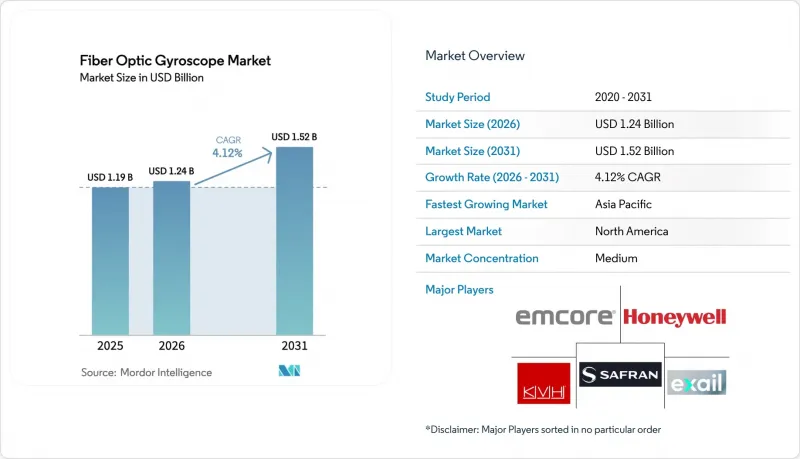
Mordor Intelligence에 의하면, 광섬유 자이로스코프 시장 규모는 2025년에 11억 9,000만 달러로 평가되었고, 2026년 12억 4,000만 달러에서 2031년까지 15억 2,000만 달러에 이를 것으로 예측되며, 예측 기간(2026-2031년) CAGR은 4.12%를 기록할 전망입니다.
본 보고서는 코일 유형(플랜지형, 허브형, 자립형), 감지 축(1축, 2축, 3축), 기술(오픈 루프 I-FOG, 클로즈드 루프 D-FOG), 장치(자이로컴퍼스, IMU 등), 광섬유 유형(싱글모드, 멀티모드 등), 최종 사용자 산업(항공우주/민간 항공 등), 지역별로 분류되어 있습니다. 시장 예측은 금액(달러) 기준으로 제시되어 있습니다.
전 세계 광섬유 자이로스코프 시장 동향 및 인사이트
NATO 회원국의 자율형 UAV 및 UGV 조달 가속화
NATO 회원국 국방부는 현대화 전략의 중심에 무인 시스템을 두고 있으며, 현재 각 입찰에서 편차 안정도가 0.01°/hr 미만인 INS 등급의 항법 기능이 명시되어 있습니다. 35억 달러 규모의 미국 ‘임베디드 GPS/INS’ 프로그램은 광섬유 자이로스코프 시장 공급업체들을 수년에 걸친 납품 일정에 묶어두는 선도적인 사례가 되고 있습니다. 유럽에서는 영국 해군의 기뢰 제거함을 위해 노스롭 그루먼사에 수여된 2,050만 파운드(2,739만 달러) 규모의 계약이 이와 유사한 요건을 뒷받침하고 있습니다. 이러한 계약에서는 민수용 등급의 MEMS 센서가 제외되어 있어, 높은 수익률을 자랑하는 폐쇄 루프형 FOG(광섬유 자이로스코프)에 대한 수요가 유지되고 있습니다. 주목할 만한 수주 사례 외에도, 합동 훈련 결과 터널 내에서 작동하는 지상 로봇은 몇 분 이내에 MEMS에 의한 방위 정보를 상실하는 반면, FOG는 수 시간 동안 정확도를 유지하는 것으로 밝혀져 도입 추세가 더욱 가속화되고 있습니다.
유럽 내 IMO E-Navigation 준수를 위한 INS 등급 항법 장치의 의무화
MSC.467(101)에 따르면, 500 GT를 초과하는 선박에 대해 2027년까지 항해용 등급의 INS를 탑재해야 할 의무가 부과되어 있으며, 약
12,000척의 유럽 선박이 여전히 업그레이드가 필요합니다. 현재 상선 운항 사업자들은 해군 함대에서 이미 실적이 입증된 MARINS 및 PHINS의 FOG 시스템을 사후 도입하고 있으며, 이를 통해 인증 위험을 줄이고 있습니다. 싱가포르가 이 규정을 반영할 의사를 밝힘에 따라 대상 선단이 확대되고 있으며, 광섬유 자이로스코프 시장은 아시아태평양의 해양 허브로 확장되고 있습니다. 개조 기간이 제한적이기 때문에 통합 업체들은 코일과 변조기를 사전 주문하고 있으며, 이로 인해 단기적으로는 부품 리드타임이 급증하여 수직 통합형 유럽 공급업체들에게 유리하게 작용하고 있습니다.
미니 드론용 MEMS 자이로의 단기 설계 수주
5kg 미만의 드론은 12주 설계 주기로 출하되며, 50달러 미만의 MEMS 자이로스코프는 그 완만한 바이어스 목표를 충족하고 있습니다. DJI의 2025년 제품 라인은 FOG 채널을 단 하나도 탑재하지 않으면서도 소비자용 드론 시장의 4분의 3을 차지하고 있으며, 그 규모가 MEMS 중심공급망을 지탱하고 있습니다. 미니 드론은 공중 로봇 분야에서 가장 많은 판매량을 차지하고 있기 때문에 FOG 공급업체들은 예측 기간 동안 이 분야가 광섬유 자이로스코프 시장이 미치지 못하는 영역으로 남을 것임을 인정하고 있습니다.
부문 분석
2025년, 플랜지가 있는 코일은 43.72%라는 확고한 점유율을 차지하고 있으며, 이는 2g RMS를 초과하는 충격이 가해지는 미사일 및 해군 환경에서 그 견고성을 입증하고 있습니다. 발사 시에도 바이어스 안정성은 일관되게 0.01°/hr 이내로 유지되며, 이는 자립형 설계에서는 대규모로 재현되지 않는 벤치마크입니다. 따라서 방위 분야의 주요 제조업체들은 플랜지가 부착된 유닛을 기존의 인증 부품 목록에 계속 포함하고 있으며, 교체 주기만으로도 광섬유 자이로스코프 시장에서 상당한 점유율을 확보하고 있습니다. 하지만 로켓 발사 사업자와 소형 위성 제조업체는 무게를 1그램 단위로 중요하게 여기고 있으며, 자립형 코일은 조립 중량을 최대 30%까지 줄일 수 있으므로 이러한 장점은 탑재량 여유로 직접 이어집니다. 그 결과, 자립형 코일은 2031년까지 연평균 성장률(CAGR) 5.72%로 시장 전체를 상회하는 성장이 예상되며, 특히 위성의 ADCS 모듈이나 장거리 비행형 무인항공기(UAV)에서 이러한 경향이 두드러집니다.
우주 분야에서는 Redwire Space사가 CubeSat 버스를 위해 축당 500g 미만의 자립형 FOG를 지정하고 있는 반면, 방위 항공 분야에서는 유로파이터 타이푼이 인증의 용이성 때문에 노스롭 그루먼사의 플랜지가 부착된 LCR-100을 계속 채택하고 있습니다. 허브가 있는 코일은 이 두 극단 중간에 위치하며, 경쟁력 있는 가격대에서 적절한 내진동성을 제공하여 아시아의 철도 시스템 통합사업자들로부터 지지를 얻고 있습니다. 중공 섬유 코일의 제조가 가능해지면, 그 무게 및 열적 이점 덕분에 설계 선택지가 완전히 바뀔 가능성이 있지만, 상용화 시기는 현재 예측 기간을 넘어섭니다.
3축 아키텍처는 자율 주행 차량, 유도 미사일, 창고 로봇의 6자유도(6-DOF) 내비게이션 요구 사항 덕분에 2025년 매출의 51.63%를 차지했습니다. 모든 축을 하나의 하우징에 통합함으로써 배선을 대폭 줄이고, 열 관리를 간소화하며, 공유 프로세서에서 칼만 필터링을 가능하게 하여 전체 시스템의 오차를 줄입니다. 2축 FOG는 시장 점유율 면에서는 뒤처져 있지만, 선체 탑재형 소나의 안정화 등 허브(상하 운동) 및 수직 가속도의 중요도가 낮은 부문 수요로부터 혜택을 받고 있습니다. 연평균 성장률(CAGR) 6.13%가 예상되는 2축 모델은 2031년까지 가장 빠르게 보급될 것으로 예상되며, 특히 원격 조종을 도입하는 해양 지원선에서 이러한 경향이 두드러질 것입니다. 단축 자이로는 공간이 제한된 개조 프로젝트에서 여전히 사용되고 있지만, 적용 범위가 제한적이어서 광섬유 자이로스코프 시장 전체적으로는 장기적인 감소 추세를 보이고 있습니다.
뮌헨과 피닉스에 있는 자동차 업계의 시험 차량군에서는 이미 3축 FOG가 LiDAR 및 레이더 스택과 통합되어 있으며, 2시간의 자율 주행 루프에서 10cm 미만의 드리프트가 보고되고 있습니다. 한편, 해군에서는 통합형 INS 유닛이 전자적 장애를 겪을 경우에 대비해 독립형 방위 자이로스코프를 백업으로 보유하는 경우가 많습니다. 이러한 이중화 구조야말로 2축형에 비해 단가가 높음에도 불구하고 틈새 시장인 단축형에 대한 수요가 지속되고 있는 이유를 설명해 줍니다.
지역별 분석
북미는 2025년에도 32.19%라는 최대의 광섬유 자이로 시장 점유율을 유지했습니다. 이는 미국 국방부의 임베디드형 GPS-INS 유닛 및 위성 군집용 페이로드에 대한 다년간의 생산 계약이 뒷받침하고 있습니다. 물류 임무를 위한 자율 주행 지상 차량의 조기 도입과 구형 항공기 개조 계약이 꾸준히 이어지고 있는 것이 수요를 더욱 뒷받침하는 한편, 캐나다 북극권에 초점을 맞춘 해군 현대화와 멕시코 항공우주 클러스터의 성장이 수요를 더욱 끌어올리고 있습니다. 최근 허니웰의 애리조나 공장에 지급된 양자 센서 연구 보조금은 차세대 자이로스코프로의 장기적인 전환을 시사하고 있지만, 상업적 도입은 현재 예측 기간 내에는 예상되지 않습니다. 이러한 요인들이 결합되어 북미의 광섬유 자이로스코프 시장 규모는 2031년까지 안정적인 성장 궤도를 유지할 것으로 전망됩니다.
유럽은 2025년 매출의 약 28%를 차지하며 그 뒤를 잇습니다. 이는 2027년까지 12,000척의 상선에 INS 등급 센서 장착을 의무화하는 국제해사기구(IMO)의 전자 항법 규정에 힘입은 것입니다. 독일, 프랑스, 스페인의 철도 현대화 프로그램은 시속 250km의 운행을 유지하기 위해 FOG 기반 IMU를 탑재한 선로 형상 측정 차량에 의존하고 있으며, 이로 인해 지역 공급업체에 대한 코일 주문이 지속적으로 발생하고 있습니다. 국방 지출도 수요를 뒷받침하고 있습니다. 영국이 왕립 해군의 기뢰 제거정을 위해 체결한 2,050만 파운드(2,739만 달러) 규모의 계약에 따라, 2027년까지 폐쇄 루프형 유닛공급이 확정되었습니다. 수출 규제로 인해 러시아 시장 진입은 제한되고 있지만, 사프란(Safran)과 엑세일(Exail)은 ITAR(국제무기거래규정)의 적용을 받지 않는 공급망을 활용하여 지역 시장에서 점유율을 확보하고 있습니다.
아시아태평양은 2026-2031년 연평균 성장률(CAGR) 6.17%로 가장 빠른 성장을 기록할 것으로 예상되며, 그 원동력은 FOG 가격을 서유럽의 동급 제품보다 최대 70% 낮게 책정한 중국의 실리콘 포토닉스 공급업체들입니다. 일본 내각부의 ‘우주 기술 전략’은 내방사선성 FOG가 필요한 위성 건조를 가속화하고 있는 반면, 인도의 국방연구개발기구(DRDO)는 전투기 및 잠수함용 국내 프로그램에 자금을 지원하고 있습니다. 중국에서 15,000km에 달하는 지방 철도의 전철화와 인도 및 한국에서 대규모 궤도 감시 시스템 수주가 산업 분야에서의 채택을 확대되고 있습니다. 그 밖의 지역에서는 사우디 아람코의 고온 시추 프로젝트와 아랍에미리트(UAE)의 무인항공기(UAV) 조달 확대가 중동 수요를 끌어올리고 있는 반면, 브라질의 항공우주 및 해양 분야가 남미에서의 발판이 되고 있습니다. 이러한 동향들이 맞물리면서 지역별 수요 기반이 다각화되고, 세계 공급업체공급망 리스크가 완화되고 있습니다.
기타 혜택:
- 엑셀 형식 시장 예측(ME) 시트
- 3개월간의 애널리스트 지원
자주 묻는 질문
목차
제1장 서론
제2장 조사 방법
제3장 주요 요약
제4장 시장 구도
제5장 시장 규모와 성장 예측
제6장 경쟁 구도
제7장 시장 기회와 향후 전망
LSH 26.09.14According to Mordor Intelligence, the fiber optic gyroscope market size was valued at USD 1.19 billion in 2025 and is estimated to grow from USD 1.24 billion in 2026 to reach USD 1.52 billion by 2031, at a CAGR of 4.12% during the forecast period (2026-2031).
This report is Segmented by Coil Type (Flanged, Hubbed, and Freestanding), Sensing Axis (1-Axis, 2-Axis, and 3-Axis), Technology (Open-Loop I-FOG, and Closed-Loop D-FOG), Device (Gyrocompass, IMU, and More), Fiber Type (Single-Mode, Multi-Mode, and More), End-User Industry (Aerospace/Commercial Aviation, and More), and Geography. The Market Forecasts are Provided in Terms of Value (USD).
Global Fiber Optic Gyroscope Market Trends and Insights
Accelerated Procurement of Autonomous UAVs and UGVs by NATO Allies
Defense ministries across NATO have placed unmanned systems at the center of modernization strategies, and each tender now specifies INS-grade navigation with bias stability below 0.01 °/hr. The United States Embedded GPS/INS program, valued at USD 3.5 billion, is a bellwether that locks fiber optic gyroscope market vendors into multi-year delivery schedules. In Europe, a GBP 20.5 million (USD 27.39 Million) award to Northrop Grumman for Royal Navy minehunters underscores similar requirements. These contracts exclude consumer-grade MEMS sensors and sustain high-margin closed-loop FOG demand. Beyond headline orders, joint exercises reveal that ground robots operating in tunnels lose MEMS heading within minutes, whereas FOGs maintain accuracy for hours, reinforcing adoption momentum.
Mandatory INS-Grade Navigation for IMO E-Navigation Compliance in Europe
MSC.467(101) obliges vessels above 500 GT to carry navigation-grade INS by 2027, and about
12,000 European hulls still need upgrades. Commercial shipping operators now retrofit the same MARINS and PHINS FOG systems already proven on naval fleets, curbing certification risk. Singapore's intent to mirror the regulation broadens the addressable fleet, pushing the fiber optic gyroscope market into Asia Pacific maritime hubs. Retrofit windows are tight, so integrators pre-order coils and modulators, creating a near-term spike in component lead times that favors vertically integrated European suppliers.
Short-Cycle Design Wins of MEMS Gyros in Mini Drones
Sub-5 kg drones ship within 12-week design cycles, and MEMS gyros priced below USD 50 meet their looser bias targets. DJI's 2025 product line owns three-quarters of the consumer-drone segment without a single FOG channel, and its scale anchors the supply chain around MEMS. Because mini drones represent the highest unit volumes in aerial robotics, FOG suppliers accept that this tranche remains out of reach for the fiber optic gyroscope market through the forecast window.
Other drivers and restraints analyzed in the detailed report include:
- Oil-and-Gas Downhole Drilling Efficiency Gains in the Middle East
- Electrification of Rail Signaling in Asia Driving Track-Geometry Cars with FOG IMUs
- Fiber Coil Winding Yield Loss Above 8% Raising ASP Volatility
For complete list of drivers and restraints, kindly check the Table Of Contents.
Segment Analysis
Flanged coils held an undisputed 43.72% share in 2025, testifying to their ruggedness in missile and naval environments that impose shocks above 20 g RMS. Bias stability consistently remains inside 0.01 °/hr during launch events, a benchmark no freestanding design has replicated at scale. Defense primes therefore keep flanged units on legacy qualified parts lists, and replacement cycles alone safeguard a sizable slice of the fiber optic gyroscope market. Nevertheless, rocket-launch providers and small-sat builders weigh every gram, and freestanding coils shave up to 30% of assembly mass, an advantage that translates directly into payload margin. As a result, freestanding coils are projected to outpace the overall market with a 5.72% CAGR to 2031, particularly inside satellite ADCS modules and long-endurance UAVs.
In space, Redwire Space specifies freestanding FOGs below 500 g per axis for CubeSat buses, while in defense aviation the Eurofighter Typhoon retains its flanged Northrop Grumman LCR-100 for qualification ease. Hubbed coils sit between the two extremes, offering moderate vibration tolerance at competitive price points, which resonates with Asian rail integrators. Should hollow-core fiber coils prove manufacturable, weight and thermal advantages might redefine design choices, yet commercial readiness sits beyond the current forecast horizon.
The three-axis architecture captured 51.63% of 2025 revenue thanks to 6-DOF navigation requirements in autonomous vehicles, guided missiles, and warehouse robots. Folding all axes into one enclosure slashes cabling, simplifies thermal management, and enables Kalman filtering on a shared processor, lowering total system error. Two-axis FOGs, while behind on share, benefit from segment needs where heave or vertical rate carries less weight, such as in hull-mounted sonar stabilization. With a 6.13% CAGR projection, dual-axis models will see the fastest pickup through 2031, especially on offshore support vessels adopting remote operation. Single-axis gyros linger in retrofit headings where compartment space is tight, yet their limited scope means secular decline across the fiber optic gyroscope market.
Automotive pilot fleets in Munich and Phoenix already embed three-axis FOGs alongside lidar and radar stacks, reporting drift under 10 cm across two-hour autonomy loops. Conversely, navies often keep standalone azimuth gyros as backup in case integrated INS units suffer electronic compromise. This redundancy explains why niche single-axis demand endures even though unit cost remains high relative to dual-axis alternatives.
Complete Report Scope:
- By Coil Type
- Flanged
- Hubbed
- Freestanding
- By Sensing Axis
- 1-Axis
- 2-Axis
- 3-Axis
- By Technology (Interferometric)
- Open-Loop (I-FOG)
- Closed-Loop (D-FOG)
- By Device
- Gyrocompass
- Inertial Measurement Unit (IMU)
- Inertial Navigation System (INS)
- Attitude and Heading Reference System (AHRS)
- By Fiber Type
- Single-Mode Fiber
- Multi-Mode Fiber
- Polarisation-Maintaining Fiber
- By End-User Industry
- Defense, Land/Naval/Air, Missile and Space
- Aerospace and Commercial Aviation
- Automotive and Transportation, ADAS and Autonomous, Rail
- Robotics and Industrial Automation
- Oil and Gas Exploration/Downhole
- Marine Surveying and Hydrography
- Other End-User Industries
- By Geography
- North America
- United States
- Canada
- Mexico
- Europe
- Germany
- United Kingdom
- France
- Italy
- Spain
- Russia
- Rest of Europe
- Asia Pacific
- China
- Japan
- India
- South Korea
- ASEAN
- Australia and New Zealand
- Rest of Asia Pacific
- South America
- Brazil
- Argentina
- Rest of South America
- Middle East
- Saudi Arabia
- UAE
- Turkey
- Rest of Middle East
- Africa
- South Africa
- Nigeria
- Rest of Africa
- North America
Geography Analysis
North America retained the largest fiber optic gyroscope market share at 32.19% in 2025, underpinned by multi-year United States Department of Defense production awards for Embedded GPS-INS units and satellite-constellation payloads. Early adoption of autonomous ground vehicles for logistics missions and a steady flow of retrofit contracts for legacy aircraft further anchor demand, while Canada's Arctic-focused naval modernization and Mexico's growing aerospace cluster add incremental volume. Recent quantum-sensor research grants awarded to Honeywell's Arizona plant hint at a long-term shift toward next-generation gyros, yet commercial deployment remains outside the current forecast window. Together, these factors keep the North American fiber optic gyroscope market size on a stable growth path through 2031.
Europe followed with roughly 28% of 2025 revenue, buoyed by International Maritime Organization e-navigation rules that force 12,000 commercial vessels to install INS-grade sensors by 2027. Rail modernization programs in Germany, France, and Spain rely on track-geometry cars equipped with FOG-based IMUs to maintain 250 km/h service, creating recurring coil orders for regional suppliers. Defense spending also supports volume; the United Kingdom's GBP 20.5 million (USD 27.39 Million) contract for Royal Navy minehunters locks in closed-loop units through 2027. Export restrictions limit Russian participation, but Safran and Exail capture regional share by leveraging ITAR-free supply chains.
Asia Pacific is forecast to post the fastest expansion at a 6.17% CAGR from 2026 to 2031, driven by China's silicon-photonics vendors that price FOGs up to 70% below Western equivalents. Japan's Cabinet Office Space Technology Strategy accelerates satellite builds that need radiation-hardened FOGs, while India's Defense Research and Development Organisation funds domestic programs for fighter aircraft and submarines. Electrification of 15 000 km of Chinese regional rail lines and large track-monitoring orders in India and South Korea broaden industrial uptake. Elsewhere, Saudi Aramco's high-temperature drilling campaigns and emerging UAV procurements in the United Arab Emirates lift Middle East volumes, whereas Brazil's aerospace and offshore sectors provide a foothold in South America. Collectively, these developments diversify the regional demand base and temper supply-chain risk for global vendors.
- Honeywell International Inc.
- Safran S.A.
- KVH Industries Inc.
- EMCORE Corporation
- Exail Group (iXblue SAS)
- Northrop Grumman LITEF GmbH
- Fizoptika Malta
- Optolink LLC
- Advanced Navigation Pty Ltd
- Cielo Inertial Solutions Ltd
- Colibrys SA
- NEDAERO
- Fibernetics LLC
- Japan Aviation Electronics Industry Ltd.
- VectorNav Technologies LLC
- Parker Meggitt PLC
- Redwire Space Inc.
- Shanghai Chenxu Optics
- Harxon Corporation
Additional Benefits:
- The market estimate (ME) sheet in Excel format
- 3 months of analyst support
TABLE OF CONTENTS
1 INTRODUCTION
- 1.1 Study Assumptions and Market Definition
- 1.2 Scope of the Study
2 RESEARCH METHODOLOGY
3 EXECUTIVE SUMMARY
4 MARKET LANDSCAPE
- 4.1 Market Overview
- 4.2 Market Drivers
- 4.2.1 Accelerated Procurement of Autonomous UAVs and UGVs by NATO Allies
- 4.2.2 Mandatory INS-Grade Navigation for IMO E-Navigation Compliance in Europe
- 4.2.3 Oil-and-Gas Downhole Drilling Efficiency Gains in Middle-East, Demanding High-Temp FOGs
- 4.2.4 Electrification of Rail Signalling in Asia Driving Track Geometry Cars with FOG IMUs
- 4.2.5 Surge in Space-Launch Constellations Requiring Radiation-Hard FOGs
- 4.2.6 Robotics Fulfilment Centres Growth in Developed Economies
- 4.3 Market Restraints
- 4.3.1 Short-Cycle Design Wins of MEMS Gyros in Mini Drones (Less than 5 kg)
- 4.3.2 Fiber Coil Winding Yield Loss Above 8% Raising ASP Volatility
- 4.3.3 Export-Control Lead-Times for Polarisation Maintaining Fiber (More than 90 Days)
- 4.3.4 Limited Indigenous Lithium-Niobate Modulator Supply in Emerging Economies
- 4.4 Impact of Macroeconomic Factors on the Market
- 4.5 Industry Value Chain Analysis
- 4.6 Technological Outlook
- 4.7 Porter's Five Forces Analysis
- 4.7.1 Bargaining Power of Suppliers
- 4.7.2 Bargaining Power of Buyers
- 4.7.3 Threat of New Entrants
- 4.7.4 Threat of Substitutes
- 4.7.5 Intensity of Competitive Rivalry
5 MARKET SIZE AND GROWTH FORECASTS (VALUE)
- 5.1 By Coil Type
- 5.1.1 Flanged
- 5.1.2 Hubbed
- 5.1.3 Freestanding
- 5.2 By Sensing Axis
- 5.2.1 1-Axis
- 5.2.2 2-Axis
- 5.2.3 3-Axis
- 5.3 By Technology (Interferometric)
- 5.3.1 Open-Loop (I-FOG)
- 5.3.2 Closed-Loop (D-FOG)
- 5.4 By Device
- 5.4.1 Gyrocompass
- 5.4.2 Inertial Measurement Unit (IMU)
- 5.4.3 Inertial Navigation System (INS)
- 5.4.4 Attitude and Heading Reference System (AHRS)
- 5.5 By Fiber Type
- 5.5.1 Single-Mode Fiber
- 5.5.2 Multi-Mode Fiber
- 5.5.3 Polarisation-Maintaining Fiber
- 5.6 By End-User Industry
- 5.6.1 Defense, Land/Naval/Air, Missile and Space
- 5.6.2 Aerospace and Commercial Aviation
- 5.6.3 Automotive and Transportation, ADAS and Autonomous, Rail
- 5.6.4 Robotics and Industrial Automation
- 5.6.5 Oil and Gas Exploration/Downhole
- 5.6.6 Marine Surveying and Hydrography
- 5.6.7 Other End-User Industries
- 5.7 By Geography
- 5.7.1 North America
- 5.7.1.1 United States
- 5.7.1.2 Canada
- 5.7.1.3 Mexico
- 5.7.2 Europe
- 5.7.2.1 Germany
- 5.7.2.2 United Kingdom
- 5.7.2.3 France
- 5.7.2.4 Italy
- 5.7.2.5 Spain
- 5.7.2.6 Russia
- 5.7.2.7 Rest of Europe
- 5.7.3 Asia Pacific
- 5.7.3.1 China
- 5.7.3.2 Japan
- 5.7.3.3 India
- 5.7.3.4 South Korea
- 5.7.3.5 ASEAN
- 5.7.3.6 Australia and New Zealand
- 5.7.3.7 Rest of Asia Pacific
- 5.7.4 South America
- 5.7.4.1 Brazil
- 5.7.4.2 Argentina
- 5.7.4.3 Rest of South America
- 5.7.5 Middle East
- 5.7.5.1 Saudi Arabia
- 5.7.5.2 UAE
- 5.7.5.3 Turkey
- 5.7.5.4 Rest of Middle East
- 5.7.6 Africa
- 5.7.6.1 South Africa
- 5.7.6.2 Nigeria
- 5.7.6.3 Rest of Africa
- 5.7.1 North America
6 COMPETITIVE LANDSCAPE
- 6.1 Market Concentration
- 6.2 Strategic Moves
- 6.3 Market Share Analysis
- 6.4 Company Profiles
- 6.4.1 Honeywell International Inc.
- 6.4.2 Safran S.A.
- 6.4.3 KVH Industries Inc.
- 6.4.4 EMCORE Corporation
- 6.4.5 Exail Group (iXblue SAS)
- 6.4.6 Northrop Grumman LITEF GmbH
- 6.4.7 Fizoptika Malta
- 6.4.8 Optolink LLC
- 6.4.9 Advanced Navigation Pty Ltd
- 6.4.10 Cielo Inertial Solutions Ltd
- 6.4.11 Colibrys SA
- 6.4.12 NEDAERO
- 6.4.13 Fibernetics LLC
- 6.4.14 Japan Aviation Electronics Industry Ltd.
- 6.4.15 VectorNav Technologies LLC
- 6.4.16 Parker Meggitt PLC
- 6.4.17 Redwire Space Inc.
- 6.4.18 Shanghai Chenxu Optics
- 6.4.19 Harxon Corporation
7 MARKET OPPORTUNITIES AND FUTURE OUTLOOK
- 7.1 White-Space and Unmet-Need Assessment


