
|
시장보고서
상품코드
2124549
경영 의사결정 : 시장 점유율 분석, 업계 동향과 통계, 성장 예측(2026-2031년)Management Decision - Market Share Analysis, Industry Trends & Statistics, Growth Forecasts (2026 - 2031) |
||||||
 Mordor Intelligence
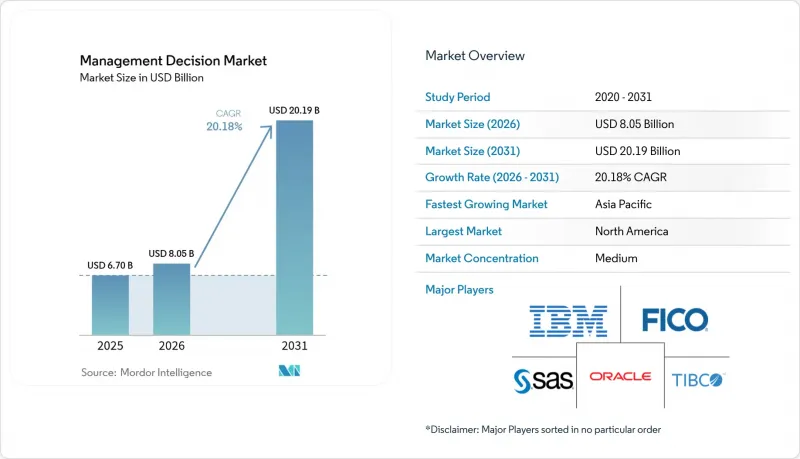
Mordor Intelligence에 의하면, 2026년 경영 의사결정 시장 규모는 80억 5,000만 달러로 추정되며, 2025년 67억 달러에서 성장하여 2031년에는 201억 9,000만 달러에 달할 것으로 예측됩니다.
또한 2026-2031년 연평균 성장률(CAGR) 20.18%를 기록할 전망입니다.
본 보고서는 구성 요소별(소프트웨어 및 서비스), 배포 형태별(On-Premise 및 클라우드),조직 규모별(대기업 및 중소기업(SME)), 기능별(리스크 및 규정 준수 관리 등), 최종 사용자 산업별(은행 및 금융 서비스·보험(BFSI) 등), 그리고 지역별로 분류되어 있습니다. 시장 전망은 금액(달러) 기준으로 제시되어 있습니다.
세계 경영 의사결정 시장 동향 및 인사이트
비즈니스 민첩성과 실시간 인사이트에 대한 수요 증가
시장의 변동성으로 인해 실시간 의사 결정은 생존을 위한 필수 요건이 되었습니다. 최신 플랫폼에서는 예측 분석과 규칙 엔진이 융합되어 있어, 조직은 성과에 차질이 생기기 전에 신호에 기반하여 행동할 수 있게 되었습니다. 기업들은 인간의 지연 없이 워크플로를 조정하는 다중 에이전트 시스템을 통해 가격 책정이나 라우팅과 같은 대량의 업무상 의사결정을 자동화하고 있습니다. 의사결정 흐름은 부서를 넘나들며, 일관된 정책 적용을 유지하면서도 변화하는 시장 상황에 맞추어 실행을 조정하고 있습니다.
은행 및 금융 서비스·보험(BFSI) 업계에서 의사결정 분석 도입 급증
은행과 보험사는 신용 심사, 보험금 청구 처리, 고객 대응 프로세스에 의사결정 엔진을 통합하고 있습니다. 자동화된 신용 결정 프로세스는 대출 신청을 몇 초 만에 처리하고, 통일된 규정 준수 점검을 수행합니다. 각 기업은 내부 기록과 디지털 행동 데이터를 결합하여 맞춤형 금융 상품을 구축하고, 그동안 충분한 서비스를 받지 못했던 차주들에게도 서비스를 확대되고 있습니다. 엔드투엔드 오케스트레이션 도구는 고객의 위험 요인이나 시장 데이터가 변화할 때 상품 조건을 실시간으로 조정하여 포트폴리오의 질과 사용자 경험 모두를 향상시킵니다.
높은 도입 및 통합 비용
종합적인 의사결정 프로그램을 도입하려면 플랫폼 라이선스 비용, 프로세스 재설계 및 변경 관리에 막대한 비용이 소요됩니다. 레거시 시스템에 표준 애플리케이션 프로그래밍 인터페이스(API)가 구비되어 있지 않은 경우, 통합이 복잡해져 미들웨어 개발이나 장기간에 걸친 테스트가 불가피할 수 있습니다. 중소기업의 경우, 예산에서 차지하는 비용 부담이 크기 때문에 도입 속도가 둔화되고 있습니다. 우선, 가치가 높은 이용 사례 몇 가지를 대상으로 단계적인 접근 방식을 채택함으로써 조기 성과를 거두고, 사업 확장을 위한 자금을 확보하는 동시에 사내 전문 지식을 구축할 수 있습니다.
부문 분석
2025년, 소프트웨어는 관리 의사결정 시장에서 67.20%라는 압도적인 점유율을 차지했습니다. 이는 규칙 관리와 분석, 자연어 인터페이스를 융합한 엔진에 힘입은 결과입니다. 각 벤더사는 규칙 최적화를 제안하고 규정 준수상의 미비점을 지적하는 생성형 AI를 점점 더 많이 통합하고 있습니다. 서비스 부문은 규모는 작지만, 조직이 자문, 도입, 지속적인 최적화에 관한 전문 지식을 요구함에 따라 연평균 성장률(CAGR) 21.95%의 궤도에 올라섰습니다. 각 제공업체는 검증된 의사결정 템플릿을 패키지화하여 도입 기간을 단축하는 업계 맞춤형 액셀러레이터를 발전시키고 있습니다.
도입 파트너들은 프로세스 재설계, 거버넌스 플레이북 작성, 그리고 변화하는 규제 및 비즈니스 목표에 맞추어 의사결정 성과를 유지하기 위한 관리형 최적화 프로그램을 운영하고 있습니다. 사내에 데이터 사이언스 전문 지식이 없는 기업들은 의사 결정의 품질을 유지하기 위해 이러한 서비스를 활용하고 있습니다. AI 확장이 경영진의 최우선 과제가 되는 가운데, 모델의 지속적인 모니터링 및 재조정 서비스에 대한 수요가 높아지고 있으며, 이는 서비스 전문 기업의 지속적인 성장을 뒷받침하고 있습니다.
2025년에는 클라우드가 경영 의사결정 시장의 79.30%를 차지할 것이며, 조직들이 탄력적인 용량과 종량제 요금제를 선호함에 따라 2031년까지 연평균 성장률(CAGR) 21.56%로 성장하고 있습니다. 클라우드 플랫폼은 변동이 심한 의사 결정 워크로드를 처리하기 위한 즉각적인 확장을 가능하게 하며, 계절적 트랜잭션 급증 시에 중요합니다. 규제가 엄격한 산업 분야에서도 주권 요건을 충족하기 위해 가상 사설 클라우드를 도입하고 있습니다. 그러나 일부 기업은 기밀성이 높은 워크로드를 사설 환경으로 되돌려, 클라우드의 유연성과 On-Premise 환경의 제어력을 융합한 하이브리드 환경을 구축하고 있습니다.
현재 의사결정 아키텍트는 단일 호스팅 모델을 선택하기보다는 지연 시간, 데이터 지역성, 라이선스 계약 등의 기준에 따라 각 워크로드를 평가했습니다. 락인을 피하고 다양한 공급자가 제공하는 전문적인 기능을 활용하기 위해 멀티클라우드 도입이 진행되고 있습니다. 벤더들은 이에 대응하여 컨테이너 기술을 기반으로 한 이식성이 높은 서비스를 제공하고 있으며, 이를 통해 고객은 의사결정 로직을 재작성하지 않고도 배포 환경을 마이그레이션할 수 있게 되었습니다.
지역별 분석
2025년, 북미는 관리 의사결정 시장에서 매출의 36.50%를 차지하며 시장을 주도했습니다. AI의 조기 도입, 충실한 클라우드 인프라, 그리고 주요 벤더의 집중이 이 지역의 주도적 지위를 뒷받침하고 있습니다. 금융 기관은 의사결정 엔진을 활용하여 신용 평가 및 부정 방지 대책을 정교화하고 있으며, 병원에서는 임상 경로 및 청구 업무에 활용하고 있습니다. 알고리즘의 공정성에 대한 규제 당국의 관심이 높아지는 가운데, 투명성이 높고 거버넌스가 잘 작동하는 의사결정 플랫폼에 대한 수요가 더욱 강해지고 있습니다. 비즈니스 전문가들은 로우코드 도구를 점점 더 많이 도입하고 있으며, 사용자층이 IT 부서 외에도 확대되면서 지역별 성장세가 더욱 강화되고 있습니다.
아시아태평양은 가장 두드러진 성장을 보이고 있으며, 2026-2031년 연평균 성장률(CAGR) 23.95%로 성장할 전망입니다. 중국, 일본, 인도의 각국 정부는 AI 인프라와 인재 양성에 막대한 투자를 하고 있어, 대규모 의사결정 시스템 도입에 적합한 환경을 조성하고 있습니다. 은행은 금융 포용성을 확대하기 위해 실시간 신용 평가 및 부정 감지 엔진을 도입하고, 제조업체는 디지털 생산 라인에 의사결정 로직을 통합하며, 공공기관은 자동화된 의사결정을 기반으로 한 시민 대상 서비스를 전개하고 있습니다. 다양한 규제 체제로 인해 기업의 기준을 분할하지 않으면서도 현지 규정 준수 요건에 적응할 수 있는 설정 가능한 거버넌스 모듈의 채택이 촉진되고 있습니다.
유럽은 설명 가능성을 우선시하는 엄격한 규제 체계를 배경으로 여전히 큰 시장 점유율을 유지하고 있습니다. EU AI법은 고위험 시스템에 대해 엄격한 의무를 부과하고 있으며, 이로 인해 금융 및 의료 기관은 상세한 감사 추적 기록과 자연어로 된 판단 근거를 제공할 수 있는 플랫폼의 도입을 요구받고 있습니다. 다국적 기업은 국경을 초월한 의사결정의 일관성을 필요로 하며, 이는 통합된 규칙 저장소 및 언어에 구애받지 않는 거버넌스에 대한 수요를 견인하고 있습니다. 도메인 지식과 규정 준수 전문성을 갖춘 강력한 도입 파트너 생태계가 이 지역 전반에 걸친 꾸준한 성장을 뒷받침하고 있습니다.
기타 혜택:
- 엑셀 형식 시장 예측(ME) 시트
- 3개월간의 애널리스트 지원
자주 묻는 질문
목차
제1장 서론
제2장 조사 방법
제3장 주요 요약
제4장 시장 구도
제5장 시장 규모와 성장 예측
제6장 경쟁 구도
제7장 시장 기회와 향후 전망
LSH 26.09.14According to Mordor Intelligence, the management decision market size in 2026 is estimated at USD 8.05 billion, growing from 2025 value of USD 6.70 billion with 2031 projections showing USD 20.19 billion, growing at 20.18% CAGR over 2026-2031.
This report is Segmented by Component (Software and Services), by Deployment Type (On-Premises and Cloud), by Organization Size (Large Enterprises and Small and Medium-Size Enterprises (SMEs)), by Function (Risk and Compliance Management, and More), by End-User Industry (Banking, Financial Services, and Insurance (BFSI), and More), and Geography. The Market Forecasts are Provided in Terms of Value (USD).
Global Management Decision Market Trends and Insights
Increasing Need for Business Agility and Real-Time Insights
Market turbulence has turned real-time decisioning into a survival requirement. Modern platforms now fuse predictive analytics with rule engines, enabling organizations to act on signals before they disrupt performance. Enterprises are automating high-volume operational decisions such as pricing and routing through multi-agent systems that coordinate workflows without human delay. Decision flows span departments to keep execution aligned with evolving market conditions while preserving consistent policy enforcement.
Surge in Decision Analytics Adoption in Banking, Financial Services, and Insurance (BFSI)
Banks and insurers are embedding decision engines in credit approval, claims processing and customer interaction journeys. Automated credit decisioning processes loan applications within seconds and enforces uniform compliance checks. Firms are combining internal records with digital behavior to craft individualized financial offerings, extending services to previously underserved borrowers. End-to-end orchestration tools adjust product terms in real time when customer risk factors or market data shift, improving both portfolio quality and user experience.
High Implementation and Integration Cost
Comprehensive decision programs demand sizable outlays for platform licenses, process redesign and change management. Integration can be complex where legacy systems lack standard Application Programming Interfaces (APIs), forcing middleware development and prolonged testing. Smaller firms bear a higher cost burden relative to their budgets, which slows adoption. A phased approach that first targets a few high-value use cases helps generate quick wins and funds expansion while building internal expertise.
Other drivers and restraints analyzed in the detailed report include:
- Compliance-Driven Demand for Explainable Artificial Intelligence (AI)
- Low-Code/No-Code Platforms Widening User Base
- Shortage of Domain-Specific Data for Model Training
For complete list of drivers and restraints, kindly check the Table Of Contents.
Segment Analysis
Software accounted for a commanding 67.20% management decision market share in 2025, underpinned by engines that merge rule management with analytics and natural-language interfaces. Vendors increasingly embed generative AI that suggests rule optimizations and flags compliance gaps. Services, though smaller, are on a 21.95% CAGR path as organizations seek advisory, deployment, and continuous optimization expertise. Providers are evolving industry accelerators that compress rollout timelines by packaging proven decision templates.
Implementation partners redesign processes, create governance playbooks, and run managed optimization programs that keep decision performance aligned with changing regulations and business goals. Firms lacking in-house data science tap these offerings to maintain decision quality. As AI scaling tops executive agendas, demand for continuous model monitoring and recalibration services is rising, supporting sustained expansion for service specialists.
Cloud captured 79.30% of the management decision market in 2025 and is growing at 21.56% CAGR through 2031 as organizations favor elastic capacity and consumption-based pricing. Cloud platforms allow instant scaling to meet volatile decision workloads, important for seasonal transaction spikes. Even regulated sectors adopt virtual private clouds to meet sovereignty requirements. Some enterprises, however, repatriate sensitive workloads to private environments, creating hybrid estates that blend cloud flexibility with on-premise control.
Decision architects now evaluate each workload along criteria such as latency, data locality, and licensing commitments rather than choosing a single hosting model. Multi-cloud adoption is rising to avoid lock-in and to exploit specialized capabilities from different providers. Vendors respond with portable services built on container technology so clients can shift deployments without rewriting decision logic.
Complete Report Scope:
- By Component
- Software
- Services
- By Deployment Type
- On-premises
- Cloud
- By Organization Size
- Large Enterprises
- Small and Medium-size Enterprises (SMEs)
- By Function
- Risk and Compliance Management
- Customer Experience and Personalization
- Fraud Detection and Prevention
- Pricing and Revenue Optimization
- Other Function
- By End-User Industry
- Banking, Financial Services, and Insurance (BFSI)
- Information Technology (IT) and Telecom
- Healthcare
- Retail and E-commerce
- Manufacturing
- Government and Public Sector
- Other End-User Industry
- By Geography
- North America
- United States
- Canada
- South America
- Brazil
- Argentina
- Rest of South America
- Europe
- Germany
- United Kingdom
- France
- Spain
- Russia
- Rest of Europe
- Asia-Pacific
- China
- Japan
- India
- South Korea
- Australia and New Zealand
- Rest of Asia-Pacific
- Middle East and Africa
- Middle East
- Saudi Arabia
- United Arab Emirates
- Rest of Middle East
- Africa
- South Africa
- Egypt
- Rest of Africa
- Middle East
- North America
Geography Analysis
North America dominated the management decision market with 36.50% revenue in 2025. Early adoption of AI, deep cloud infrastructure, and a concentration of leading vendors underpin leadership. Financial institutions use decision engines to refine credit scoring and fraud controls, while hospitals apply them to clinical pathways and billing. Regulatory focus on algorithmic fairness reinforces demand for transparent, governable decision platforms. Business specialists increasingly adopt low-code tools, broadening the user community beyond IT and amplifying regional growth momentum.
Asia-Pacific is the fastest-growing region, set to advance at a 23.95% CAGR from 2026 to 2031. Governments across China, Japan, and India invest heavily in AI infrastructure and skills, fostering an environment conducive to large-scale decision deployments. Banks deploy real-time credit and fraud engines to expand financial inclusion, manufacturers embed decision logic in digital production lines, and public agencies roll out citizen-facing services powered by automated decisions. Diverse regulatory regimes spur the adoption of configurable governance modules that adapt to local compliance mandates without fragmenting enterprise standards.
Europe retains a significant share on the back of stringent regulatory frameworks that prioritize explainability. The EU AI Act imposes rigorous obligations for high-risk systems, prompting financial and healthcare organizations to adopt platforms capable of detailed audit trails and natural-language rationale. Multinational firms require cross-border decision consistency, driving demand for centralized rule repositories and language-agnostic governance. Strong implementation partner ecosystems with domain and compliance expertise support steady growth across the region.
- IBM Corporation
- Oracle Corporation
- SAS Institute Inc.
- SAP SE
- FICO (Fair Isaac Corporation)
- Pegasystems Inc.
- TIBCO Software Inc.
- Actico GmbH
- Sapiens International Corp.
- Equifax Inc.
- Experian plc
- Scorto Inc.
- Sparkling Logic Inc.
- InRule Technology Inc.
- RapidMiner Inc.
- Teradata Corp.
- Alteryx Inc.
- DataRobot Inc.
- Decision Management Solutions
Additional Benefits:
- The market estimate (ME) sheet in Excel format
- 3 months of analyst support
TABLE OF CONTENTS
1 INTRODUCTION
- 1.1 Study Assumptions and Market Definition
- 1.2 Scope of the Study
2 RESEARCH METHODOLOGY
3 EXECUTIVE SUMMARY
4 MARKET LANDSCAPE
- 4.1 Market Overview
- 4.2 Market Drivers
- 4.2.1 Increasing Need for Business Agility and Real-Time Insights
- 4.2.2 Surge In Decision Analytics Adoption in Banking, Financial Services, And Insurance (BFSI)
- 4.2.3 Compliance-Driven Demand for Explainable Artificial Intelligence (AI)
- 4.2.4 Low-Code/No-Code Platforms Widening User Base
- 4.2.5 Embedded Decisioning in Edge and Internet of Things (IoT) Devices
- 4.3 Market Restraints
- 4.3.1 High Implementation and Integration Cost
- 4.3.2 Shortage Of Domain-Specific Data for Model Training
- 4.3.3 Vendor Lock-In Concerns with Cloud-Native Stacks
- 4.3.4 Regulatory Uncertainty Around Automated Decisions
- 4.4 Industry Supply Chain Analysis
- 4.5 Regulatory Landscape
- 4.6 Technological Outlook
- 4.7 Porter's Five Forces Analysis
- 4.7.1 Threat of New Entrants
- 4.7.2 Bargaining Power of Suppliers
- 4.7.3 Bargaining Power of Buyers
- 4.7.4 Threat of Substitutes
- 4.7.5 Competitive Rivalry
- 4.8 Assessment of the Impact of Macroeconomic Trends on the Market
5 MARKET SIZE AND GROWTH FORECASTS (VALUE)
- 5.1 By Component
- 5.1.1 Software
- 5.1.2 Services
- 5.2 By Deployment Type
- 5.2.1 On-premises
- 5.2.2 Cloud
- 5.3 By Organization Size
- 5.3.1 Large Enterprises
- 5.3.2 Small and Medium-size Enterprises (SMEs)
- 5.4 By Function
- 5.4.1 Risk and Compliance Management
- 5.4.2 Customer Experience and Personalization
- 5.4.3 Fraud Detection and Prevention
- 5.4.4 Pricing and Revenue Optimization
- 5.4.5 Other Function
- 5.5 By End-User Industry
- 5.5.1 Banking, Financial Services, and Insurance (BFSI)
- 5.5.2 Information Technology (IT) and Telecom
- 5.5.3 Healthcare
- 5.5.4 Retail and E-commerce
- 5.5.5 Manufacturing
- 5.5.6 Government and Public Sector
- 5.5.7 Other End-User Industry
- 5.6 By Geography
- 5.6.1 North America
- 5.6.1.1 United States
- 5.6.1.2 Canada
- 5.6.2 South America
- 5.6.2.1 Brazil
- 5.6.2.2 Argentina
- 5.6.2.3 Rest of South America
- 5.6.3 Europe
- 5.6.3.1 Germany
- 5.6.3.2 United Kingdom
- 5.6.3.3 France
- 5.6.3.4 Spain
- 5.6.3.5 Russia
- 5.6.3.6 Rest of Europe
- 5.6.4 Asia-Pacific
- 5.6.4.1 China
- 5.6.4.2 Japan
- 5.6.4.3 India
- 5.6.4.4 South Korea
- 5.6.4.5 Australia and New Zealand
- 5.6.4.6 Rest of Asia-Pacific
- 5.6.5 Middle East and Africa
- 5.6.5.1 Middle East
- 5.6.5.1.1 Saudi Arabia
- 5.6.5.1.2 United Arab Emirates
- 5.6.5.1.3 Rest of Middle East
- 5.6.5.2 Africa
- 5.6.5.2.1 South Africa
- 5.6.5.2.2 Egypt
- 5.6.5.2.3 Rest of Africa
- 5.6.5.1 Middle East
- 5.6.1 North America
6 COMPETITIVE LANDSCAPE
- 6.1 Market Concentration
- 6.2 Strategic Moves
- 6.3 Market Share Analysis
- 6.4 Company Profiles (includes Global level Overview, Market level overview, Core Segments, Financials as available, Strategic Information, Market Rank/Share for key companies, Products and Services, and Recent Developments)
- 6.4.1 IBM Corporation
- 6.4.2 Oracle Corporation
- 6.4.3 SAS Institute Inc.
- 6.4.4 SAP SE
- 6.4.5 FICO (Fair Isaac Corporation)
- 6.4.6 Pegasystems Inc.
- 6.4.7 TIBCO Software Inc.
- 6.4.8 Actico GmbH
- 6.4.9 Sapiens International Corp.
- 6.4.10 Equifax Inc.
- 6.4.11 Experian plc
- 6.4.12 Scorto Inc.
- 6.4.13 Sparkling Logic Inc.
- 6.4.14 InRule Technology Inc.
- 6.4.15 RapidMiner Inc.
- 6.4.16 Teradata Corp.
- 6.4.17 Alteryx Inc.
- 6.4.18 DataRobot Inc.
- 6.4.19 Decision Management Solutions
7 MARKET OPPORTUNITIES AND FUTURE OUTLOOK
- 7.1 White-Space and Unmet-Need Assessment