|
시장보고서
상품코드
2124561
바이오의약품 CDMO : 시장 점유율 분석, 업계 동향 및 통계, 성장 예측(2026-2031년)Biologics CDMO - Market Share Analysis, Industry Trends & Statistics, Growth Forecasts (2026 - 2031) |
||||||
 Mordor Intelligence
Mordor Intelligence에 의하면, 바이오의약품 CDMO 시장 규모는 2025년에 253억 2,000만 달러로 평가되었습니다. 2026년 271억 3,000만 달러에서 2031년까지 382억 9,000만 달러에 이를 것으로 예상되며, 예측 기간(2026-2031년) CAGR은 7.14%를 나타낼 전망입니다.
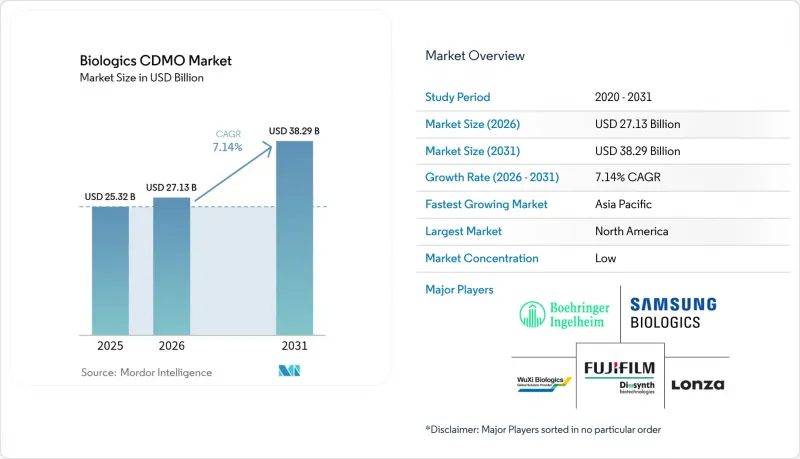
본 보고서는 서비스 유형(공정 개발, GMP 제조 등), 유형(포유류 유래, 미생물 유래), 제품 유형(바이오의약품(단일클론 항체, 재조합 단백질 등), 바이오시밀러), 규모(전임상·임상, 상업적 생산),최종 사용자(중소규모 바이오기술 기업, 대형 제약사), 지역별로 분류되어 있습니다. 시장 예측은 금액(달러) 기준으로 제시되어 있습니다.
세계의 바이오의약품 CDMO 시장 동향 및 인사이트
고령화 및 만성 질환 파이프라인 확대
평균 수명의 연장에 따라 암, 자가면역 질환, 대사성 질환의 유병률이 급격히 증가하고 있으며, 이는 첨단 바이오의약품에 대한 장기적인 수요를 견인하고 있습니다. 60세 이상 세계 인구는 2050년까지 21억 명으로 두 배 증가할 것으로 예측되며, 이는 의료 시스템에 지속적인 압박을 가하는 한편, 치료법 혁신을 가속화하는 요인이 되고 있습니다. 노보노르디스크의 41억 달러 규모의 미국 충전·마감 프로젝트는 고령층을 대상으로 하는 대량 생산형 주사제의 안정적인 공급을 확보하려는 스폰서의 움직임을 여실히 보여주고 있습니다. CDMO와의 제휴를 통해 혁신 기업은 시장 출시 기간을 단축하고 자본 위험을 경감할 수 있으므로, 바이오의약품 CDMO 시장의 꾸준한 성장이 뒷받침되고 있습니다.
자본 집약적인 바이오의약품 혁신이 아웃소싱을 촉진
최첨단 항체-약물 복합체(ADC) 및 다중 특이성 항체 제조 플랜트의 건설 비용은 10억 달러를 초과하는 경우도 있습니다. 이러한 막대한 지출은 스폰서의 재무 상황을 압박하기 때문에 GMP를 준수하는 대규모 생산 능력을 제공하는 파트너에게 제조 리스크를 이전하려는 움직임이 가속화되고 있습니다. 삼성바이오로직스는 고객의 설비 투자가 필요 없는 턴키 방식을 제공함으로써, 상위 20개 제약사 중 16곳과 총액 130억 달러 규모의 장기 생산 계약을 체결했습니다. 특히 일회용 장비 분야의 원자재 가격 급등이 지속되고 있는 점도 아웃소싱의 경제적 타당성을 더욱 높여주고 있습니다.
전 세계 GMP 및 동등성 요건의 진화
배치의 균일성에 관한 FDA의 새로운 지침과 EU 법규 개정으로 인해 검증 및 문서화 업무 부담이 증가하고 있으며, CDMO 각사는 매출의 12-15%를 품질 보증에 할당해야 하는 상황에 직면해 있는데, 이는 기존 제약 업계의 기준을 크게 상회하는 수치입니다. 바이오시밀러의 동등성에 대한 심사가 엄격해짐에 따라 프로젝트 기간이 장기화될 가능성이 있으며, 이는 바이오의약품 CDMO 시장의 단기적인 성장세를 둔화시키는 요인이 될 것입니다.
부문별 분석
2025년에는 충전·마무리 및 포장 서비스가 바이오의약품 CDMO 시장의 34.96% 점유율을 차지하며, 최종 의약품 제제의 무균성 및 규제상의 중요성이 부각되었습니다. 론자(Lonza)사의 5억 스위스 프랑 규모 스위스 시설 건설 등 막대한 투자가 성장을 뒷받침하고 있습니다. 또한, 엄격한 출하 검사에 대한 수요가 증가함에 따라 분석 및 품질 관리(QC) 도입이 가속화되고 있으며, 2031년까지 연평균 성장률(CAGR)은 12.24%를 나타낼 것으로 예측됩니다.
통합형 개발 기업은 공정 개발, GMP 제조, 분석 및 규제 대응 지원을 점점 더 일원화하여 업무 인계 시간을 최소화하고 있습니다. 유로핀 바이오파마가 보유한 45곳의 GMP 실험실 네트워크는 지리적으로 분산된 종합적인 테스트를 통해 출시 주기를 단축하는 추세를 상징합니다. 이러한 통합 모델은 보다 견고한 관계를 구축하고, 공급업체가 바이오의약품 CDMO 시장에서 점유율을 점진적으로 확대할 수 있는 기반이 됩니다.
2025년에는 포유류 유래 플랫폼이 바이오의약품 CDMO 시장 규모의 61.68%를 차지했으며, 이는 단일클론 항체 및 기타 당사슬 의존성 의약품에 대한 수요를 반영합니다. 삼성의 78만 4,000 L로의 규모 확대는 고역가 CHO 생산에 대한 지속적인 투자를 뒷받침합니다.
미생물 시스템은 공정 라인의 단순화와 비용 면에서의 우위를 바탕으로 연평균 성장률(CAGR) 8.22%라는 호재를 타고 성장하고 있습니다. 써모피셔(Thermo Fisher)의 일회용 발효조는 오염 위험을 줄이고 처리 시간을 단축함으로써 펩타이드 및 올리고뉴클레오티드 치료제에 대한 미생물 기술의 적용 범위를 넓히고 있습니다. 그 결과로 얻게 되는 유연성은 경제적인 초기 단계 생산을 원하는 신흥 스폰서들을 끌어들이고 있습니다.
지역별 분석
북미는 밀집된 혁신 생태계와 첨단 제조에 대한 규제 당국의 지원에 힘입어 2025년 매출의 34.12%를 차지하며 계속해서 주도적인 위치를 유지했습니다. 연속 공정 및 신속 심사 경로에 관한 FDA의 지침은 조기 도입을 촉진하고 현지 CDMO에 이익을 가져다주고 있습니다. 노보노르디스크의 41억 달러 규모 노스캐롤라이나 공장 같은 대규모 투자는 이 지역의 설비 기반을 강화하고 있습니다.
유럽은 독일, 영국, 스위스가 주도하는 정교한 체계를 갖추고 있습니다. 슈타인에 위치한 론자(Lonza)사의 5억 스위스 프랑 규모의 충전·마무리 거점(fill-finish hub)은 이 대륙이 높은 전문성과 높은 수익성에 중점을 두고 있음을 상징합니다. 개정된 EMA의 바이오의약품 지침은 기술 이전을 간소화하여 국내 및 대서양을 가로지르는 사업 모두에서 안정적인 수주 유입을 유지하고 있습니다. 바이오신스(BioSynth)사의 독일 내 바이오접합 사업 확대와 같은 신흥 프로젝트는 틈새 전문 지식에 대한 지속적인 수요를 부각시키고 있습니다.
아시아태평양은 성장의 원동력이며, 적극적인 생산 능력 확충과 공공 부문의 인센티브를 배경으로 2031년까지 연평균 성장률(CAGR) 10.48%를 기록할 전망입니다. 삼성바이오로직스의 생산 능력 78만 4,000리터 확대와 SK팜테크의 2억 6,000만 달러 규모 세종 프로젝트는 한국이 세계적인 바이오의약품 강국이 되기 위한 전략을 상징합니다. 중국 국가약품감독관리국(NMPA)의 승인 절차 효율화와 인도의 인프라 보조금도 스폰서 기업의 프로젝트를 해당 지역으로 유치하는 데 있어 마찬가지로 중요한 역할을 하고 있습니다.
기타 혜택 :
- 엑셀 형식 시장 예측(ME) 시트
- 3개월간의 애널리스트 지원
자주 묻는 질문
목차
제1장 서론
제2장 조사 방법
제3장 주요 요약
제4장 시장 구도
제5장 시장 규모 및 성장 예측
제6장 경쟁 구도
제7장 시장 기회 및 향후 전망
KTHAccording to Mordor Intelligence, the biologics CDMO market size was valued at USD 25.32 billion in 2025 and estimated to grow from USD 27.13 billion in 2026 to reach USD 38.29 billion by 2031, at a CAGR of 7.14% during the forecast period (2026-2031).
This report is Segmented by Service Type (Process Development, GMP Manufacturing, and More), Type (Mammalian, Microbial), Product Type (Biologics [Monoclonal Antibodies, Recombinant Proteins, and More], Biosimilars), Scale (Pre-Clinical and Clinical, Commercial), End-User (Small/Mid-size Biotech, Large Pharma), and Geography. The Market Forecasts are Provided in Terms of Value (USD).
Global Biologics CDMO Market Trends and Insights
Aging population and chronic-disease pipeline expansion
Rising life expectancy is sharply increasing the prevalence of oncology, autoimmune, and metabolic disorders, driving long-run demand for advanced biologics. The global population aged 60+ will double to 2.1 billion by 2050, putting consistent pressure on healthcare systems and triggering accelerated therapeutic innovation. Novo Nordisk's USD 4.1 billion US fill-finish project highlights sponsor moves to ensure secure supply for high-volume injectables that serve older cohorts. CDMO alliances allow innovators to compress launch timelines and mitigate capital exposure, reinforcing steady growth of the biologics CDMO market.
Capital-intensive biologics innovation driving outsourcing
State-of-the-art antibody-drug conjugate or multispecific antibody plants can cost in excess of USD 1 billion. Such outlays strain sponsor balance sheets, encouraging transfer of manufacturing risk to partners offering GMP-compliant capacity at scale. Samsung Biologics secured USD 13 billion in long-term production contracts with 16 of the top 20 pharma firms by providing turnkey capability without client capex. Ongoing material cost inflation, especially for single-use equipment, further tilts economic logic toward outsourcing.
Evolving global GMP and comparability requirements
New FDA guidance on batch uniformity and updated EU legislation are escalating validation and documentation workloads, requiring CDMOs to devote 12-15% of revenue to quality assurance, well above traditional pharma norms. Heightened scrutiny around biosimilar comparability can prolong project timelines, tempering near-term momentum of the biologics CDMO market.
Other drivers and restraints analyzed in the detailed report include:
- SME biotech preference for asset-light CDMO partnerships
- Continuous bioprocessing accelerates flexible capacity
- Persistent capacity bottlenecks lengthen lead-times
For complete list of drivers and restraints, kindly check the Table Of Contents.
Segment Analysis
Fill-finish and packaging services captured 34.96% biologics CDMO market share in 2025, underlining the sterility and regulatory stakes of final drug-product preparation. Growth is reinforced by big-ticket investments such as Lonza's CHF 500 million Swiss facility. Parallel demand for robust release testing is accelerating analytical and QC uptake, which is projected to post a 12.24% CAGR through 2031.
Integrated developers increasingly bundle process development, GMP production, analytical, and regulatory support to minimize hand-offs. Eurofins BioPharma's network of 45 GMP labs exemplifies the trend toward geographically diversified, full-scope testing that shortens release cycles. This integrative model embeds stickier relationships and positions suppliers to harvest incremental share of the biologics CDMO market.
Mammalian platforms generated 61.68% of biologics CDMO market size in 2025, reflecting their necessity for monoclonal antibodies and other glycosylation-dependent drugs. Samsung's scale-up to 784,000 L underscores continued investment in high-titer CHO production.
Microbial systems are advancing on an 8.22% CAGR tailwind owing to simplified process trains and cost advantages. Thermo Fisher's single-use fermentors reduce contamination risk and shorten turnovers, broadening microbial applicability to peptide and oligonucleotide therapeutics. The resulting flexibility attracts emerging sponsors seeking economical early-stage production.
Complete Report Scope:
- By Service Type
- Process Development
- GMP Manufacturing
- Fill-Finish and Packaging
- Analytical and QC Services
- Other Service Type
- By Type
- Mammalian
- Microbial
- By Product Type
- Biologics
- Monoclonal Antibodies
- Recombinant Proteins
- Vaccines
- Antisense / Molecular Therapy
- Other Biologics
- Biosimilars
- Biologics
- By Scale
- Pre-clinical and Clinical
- Commercial
- By End-user
- Small / Mid-size Biotech
- Large Pharma
- By Geography
- North America
- United States
- Canada
- Mexico
- Europe
- Germany
- United Kingdom
- France
- Italy
- Spain
- Russia
- Rest of Europe
- Asia-Pacific
- China
- India
- Japan
- South Korea
- Australia and New Zealand
- Rest of Asia-Pacific
- Middle East and Africa
- Middle East
- United Arab Emirates
- Saudi Arabia
- Turkey
- Rest of Middle East
- Africa
- South Africa
- Nigeria
- Egypt
- Rest of Africa
- Middle East
- South America
- Brazil
- Argentina
- Rest of South America
- North America
Geography Analysis
North America retained leadership with 34.12% of 2025 revenue, propelled by dense innovation ecosystems and regulatory support for advanced manufacturing. FDA guidance on continuous processing and expedited review pathways fosters early adoption curves that benefit local CDMOs. Large-scale investments such as Novo Nordisk's USD 4.1 billion North Carolina plant reinforce the region's installed base.
Europe offers a sophisticated framework dominated by Germany, the United Kingdom, and Switzerland. Lonza's CHF 500 million fill-finish hub in Stein exemplifies the continent's specialized, high-margin focus. Updated EMA biologics guidelines simplify technology transfers and sustain steady inflows of both domestic and trans-Atlantic work. Emerging projects such as Biosynth's German bioconjugation expansion underscore persistent demand for niche expertise.
Asia-Pacific is the growth engine, set to post a 10.48% CAGR through 2031 on the back of aggressive capacity builds and public-sector incentives. Samsung Biologics' expansion to 784,000 L and SK pharmteco's USD 260 million Sejong project typify South Korea's strategy to become a global biologics powerhouse. China's streamlined NMPA approval procedures and India's infrastructure grants are equally pivotal in channeling sponsor projects into the region.
- Lonza Group
- Samsung Biologics
- WuXi Biologics
- Boehringer Ingelheim BioXcellence
- Catalent
- Fujifilm Diosynth Biotechnologies
- AGC Biologics
- Thermo Fisher Scientific (Patheon)
- AbbVie Contract Manufacturing
- Rentschler Biopharma
- Celonic
- Binex
- Sandoz
- Parexel
- ICON plc
- Recipharm - Arranta Bio
- Toyobo
- Emergent BioSolutions CDMO
- Porton Biologics
- Just-Evotec Biologics
- Grifols Contract Manufacturing
Additional Benefits:
- The market estimate (ME) sheet in Excel format
- 3 months of analyst support
TABLE OF CONTENTS
1 INTRODUCTION
- 1.1 Study Assumptions and Market Definition
- 1.2 Scope of the Study
2 RESEARCH METHODOLOGY
3 EXECUTIVE SUMMARY
4 MARKET LANDSCAPE
- 4.1 Market Overview
- 4.2 Market Drivers
- 4.2.1 Aging population and chronic-disease pipeline expansion
- 4.2.2 Capital-intensive biologics innovation driving outsourcing
- 4.2.3 SME biotech preference for asset-light CDMO partnerships
- 4.2.4 Continuous bioprocessing accelerates flexible capacity
- 4.2.5 Single-use technologies compress CAPEX and timelines
- 4.2.6 Cell and gene therapy manufacturing spill-over to biologics CDMOs
- 4.3 Market Restraints
- 4.3.1 Evolving global GMP and comparability requirements
- 4.3.2 Persistent capacity bottlenecks lengthen lead-times
- 4.3.3 Captive facility expansion by big pharma reduces outsourcing
- 4.3.4 Resin and single-use component supply fragility
- 4.4 Supply-Chain Analysis
- 4.5 Regulatory Landscape
- 4.6 Technological Outlook
- 4.7 Porter's Five Forces Analysis
- 4.7.1 Bargaining Power of Suppliers
- 4.7.2 Bargaining Power of Buyers
- 4.7.3 Threat of New Entrants
- 4.7.4 Threat of Substitutes
- 4.7.5 Intensity of Competitive Rivalry
5 MARKET SIZE AND GROWTH FORECASTS (VALUE)
- 5.1 By Service Type
- 5.1.1 Process Development
- 5.1.2 GMP Manufacturing
- 5.1.3 Fill-Finish and Packaging
- 5.1.4 Analytical and QC Services
- 5.1.5 Other Service Type
- 5.2 By Type
- 5.2.1 Mammalian
- 5.2.2 Microbial
- 5.3 By Product Type
- 5.3.1 Biologics
- 5.3.1.1 Monoclonal Antibodies
- 5.3.1.2 Recombinant Proteins
- 5.3.1.3 Vaccines
- 5.3.1.4 Antisense / Molecular Therapy
- 5.3.1.5 Other Biologics
- 5.3.2 Biosimilars
- 5.3.1 Biologics
- 5.4 By Scale
- 5.4.1 Pre-clinical and Clinical
- 5.4.2 Commercial
- 5.5 By End-user
- 5.5.1 Small / Mid-size Biotech
- 5.5.2 Large Pharma
- 5.6 By Geography
- 5.6.1 North America
- 5.6.1.1 United States
- 5.6.1.2 Canada
- 5.6.1.3 Mexico
- 5.6.2 Europe
- 5.6.2.1 Germany
- 5.6.2.2 United Kingdom
- 5.6.2.3 France
- 5.6.2.4 Italy
- 5.6.2.5 Spain
- 5.6.2.6 Russia
- 5.6.2.7 Rest of Europe
- 5.6.3 Asia-Pacific
- 5.6.3.1 China
- 5.6.3.2 India
- 5.6.3.3 Japan
- 5.6.3.4 South Korea
- 5.6.3.5 Australia and New Zealand
- 5.6.3.6 Rest of Asia-Pacific
- 5.6.4 Middle East and Africa
- 5.6.4.1 Middle East
- 5.6.4.1.1 United Arab Emirates
- 5.6.4.1.2 Saudi Arabia
- 5.6.4.1.3 Turkey
- 5.6.4.1.4 Rest of Middle East
- 5.6.4.2 Africa
- 5.6.4.2.1 South Africa
- 5.6.4.2.2 Nigeria
- 5.6.4.2.3 Egypt
- 5.6.4.2.4 Rest of Africa
- 5.6.4.1 Middle East
- 5.6.5 South America
- 5.6.5.1 Brazil
- 5.6.5.2 Argentina
- 5.6.5.3 Rest of South America
- 5.6.1 North America
6 COMPETITIVE LANDSCAPE
- 6.1 Market Concentration
- 6.2 Strategic Moves
- 6.3 Market Share Analysis
- 6.4 Company Profiles (includes Global level Overview, Market level overview, Core Segments, Financials as available, Strategic Information, Market Rank/Share, Products and Services, Recent Developments)
- 6.4.1 Lonza Group
- 6.4.2 Samsung Biologics
- 6.4.3 WuXi Biologics
- 6.4.4 Boehringer Ingelheim BioXcellence
- 6.4.5 Catalent
- 6.4.6 Fujifilm Diosynth Biotechnologies
- 6.4.7 AGC Biologics
- 6.4.8 Thermo Fisher Scientific (Patheon)
- 6.4.9 AbbVie Contract Manufacturing
- 6.4.10 Rentschler Biopharma
- 6.4.11 Celonic
- 6.4.12 Binex
- 6.4.13 Sandoz
- 6.4.14 Parexel
- 6.4.15 ICON plc
- 6.4.16 Recipharm - Arranta Bio
- 6.4.17 Toyobo
- 6.4.18 Emergent BioSolutions CDMO
- 6.4.19 Porton Biologics
- 6.4.20 Just-Evotec Biologics
- 6.4.21 Grifols Contract Manufacturing