

|
시장보고서
상품코드
2124562
통신비 관리 : 시장 점유율 분석, 업계 동향과 통계, 성장 예측(2026-2031년)Telecom Expense Management - Market Share Analysis, Industry Trends & Statistics, Growth Forecasts (2026 - 2031) |
||||||
 Mordor Intelligence
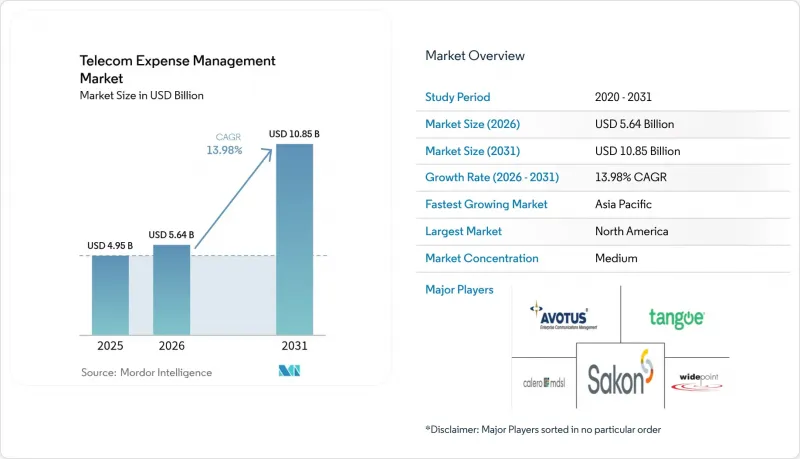
Mordor Intelligence에 의하면, 통신비 관리 시장 규모는 2025년에 49억 5,000만 달러로 평가되었고, 2026년 56억 4,000만 달러에서 2031년까지 108억 5,000만 달러에 이를 것으로 예측되며, 예측 기간(2026-2031년) CAGR은 13.98%를 기록할 전망입니다.
본 보고서는 솔루션별(청구서 관리, 기기 관리, 조달, 감사, 사용 현황 보고서, 분쟁 관리 등), 서비스별(매니지드, 클라우드, 전문 서비스), 도입 형태별(On-Premise, 클라우드, 하이브리드), 조직 규모별(대기업, 중소기업), 최종 사용자별(은행, 금융서비스 및 보험(BFSI), 제조, IT, 의료, 정부), 지역별로 분류되어 있습니다. 시장 예측은 금액(달러) 기준으로 제시되어 있습니다.
세계 통신비 관리 시장 동향 및 인사이트
통신비 가시화 및 복잡한 요금 체계에 대한 대응의 필요성
프라이빗 네트워크, 엣지 워크로드, IoT 링크로 구성된 하이브리드 생태계는 수동 프로세스로는 대규모로 대조할 수 없는 과금 계층을 만들어내고 있습니다. Valicom의 감사에 따르면, 통신 청구서의 35% 이상에서 오류가 확인되었으며, 이는 요금 정확성, 미사용 회선 및 서비스 종료 시 처리에 영향을 미치고 있습니다. 사용량 기반의 5G 및 클라우드 번들 보급으로 과다 청구 위험이 높아짐에 따라, 재무 부서와 네트워크 팀은 사용 현황 텔레메트리 및 예측 벤치마크를 결합한 실시간 대시보드로의 전환을 강요받고 있습니다. 통신 사업자가 API 기반 네트워크 슬라이싱으로 전환함에 따라 추가적인 변수가 더해지면서, 기업들은 복잡하게 연쇄되는 요금 체계에 선제적으로 대응해야 할 필요가 있습니다. 또한, 재무 관리 책임자는 사업 부문 및 관할 구역별 비용 배분을 요구하는 규정 준수 의무에 직면하고 있으며, 이로 인해 스프레드시트를 통한 추적에서 전문 통신비 관리 플랫폼으로의 전환이 가속화되고 있습니다.
AI/애널리틱스를 활용한 청구서 감사 자동화
인공지능(AI)은 경비 관리를 정기적인 검토에서 지속적인 최적화로 변화시킵니다. Tangoe사의 보고에 따르면, 머신러닝 모델은 파일 가져오기 후 몇 분 이내에 이상 징후, 계약 위반 및 최적화 기회를 감지합니다. KPMG는 청구서 자동 워크플로우를 통해 수작업 부담을 60-80% 줄이면서 정확도를 높여, 분석가가 대조 작업이 아닌 협상에 집중할 수 있게 된다고 지적합니다. 고급 플랫폼은 이용 패턴을 생산성 지표와 대조하여, 비용과 비즈니스 가치를 조화시키는 적절한 규모 설정에 대한 의사결정을 이끌어냅니다. 지속적인 학습 루프를 통해 정책 제안이 정교해지고, 공급업체의 규정 준수가 강화됨과 동시에 통신 비용 관리(TEM) 시장이 가져다주는 비용 절감 효과가 더욱 높아집니다.
데이터 보안 우려로 인한 TEM 아웃소싱 제한
규제가 엄격한 업계에서는 기밀성이 높은 운영 데이터를 포함한 통신 이용 파일을 외부에 공개하는 것을 주저하고 있습니다. 랜섬웨어 피해 증가와 국경을 초월한 개인정보 보호 규제로 인해 실사(due diligence) 과정이 장기화되고 있으며, 이는 공급업체에게 비용 증가와 판매 주기 장기화로 이어지고 있습니다. 원시 데이터를 On-Premise에 보관하면서 분석을 클라우드에서 수행하는 하이브리드 도입 모델은 일부 위험을 완화하는 한편, 최적화의 깊이를 떨어뜨리게 됩니다. 서비스 제공업체는 우려를 해소하고 통신비 관리 시장에서 보다 광범위한 보급을 실현하기 위해 SOC 2형 인증, 제로 트러스트 아키텍처, 그리고 지역별 데이터 주권 관리에 투자해야 합니다.
부문 분석
2025년, 청구서 관리는 통신비 관리 시장 점유율의 35.57%를 차지할 것으로 예상되며, 이는 기업들이 계속해서 청구 정확성과 배분 관리에 중점을 두고 있음을 뒷받침합니다. 이 솔루션에 통합된 워크플로는 수천 건에 달하는 청구서 데이터에서 요금, 내역 항목, 세액을 검증하여 복잡한 멀티 벤더 환경에서 예산의 일관성을 유지합니다. Valicom의 감사에 따르면, 정기적으로 15-20%의 회수 가능한 지출이 드러나고 있으며, 이는 청구서 관리가 여전히 핵심인 이유를 여실히 보여줍니다. 그러나 현재 전략적 전환이 진행되고 있습니다. 사용 현황 관리 및 보고 기능은 연평균 성장률(CAGR) 14.04%로 확대되고 있으며, 사후 정산이 아닌 예상치 못한 초과 요금 발생을 미연에 방지하는 실시간 대시보드에 대한 수요가 증가하고 있음을 보여줍니다.
통신비 관리 시장에서는 현재 기존의 청구서 처리 엔진에 AI 기반 분석 기능을 결합하여 정책상의 기준치에 대한 소비량을 예측하고, 청구 마감일 전에 자동으로 권장 사항을 생성하고 있습니다. 5G 슬라이싱, 엣지 워크로드, UCaaS가 확대되는 가운데, 기업들은 서비스 계층을 동적으로 조합하기 위한 예측적 인사이트를 요구하고 있습니다. 벤더들은 이에 대응하여 머신러닝 모델과 직관적인 시각화 레이어를 통합하고 있으며, 이러한 변화로 인해 이 분야는 ‘지불 후 관리’에서 ‘예방적 최적화’로 전환되고 있습니다.
2025년에는 이사회가 고정 기술 비용을 성과 연동형 변동 서비스 요금으로 전환하도록 추진한 결과, 매니지드 서비스가 통신비 관리 시장 규모의 41.82%를 차지하며 1위를 차지했습니다. 프로바이더는 요금 벤치마크 라이브러리, 통신 사업자와의 협상력, 그리고 대부분의 기업이 사내에서 구축할 수 없는 지속적인 프로세스 거버넌스를 제공합니다. 호스팅형 클라우드 서비스 분야는 구독의 유연성과 번거로움 없는 업그레이드에 힘입어 연평균 성장률(CAGR) 14.15%로 가장 빠르게 확장되고 있습니다.
플랫폼의 융합으로 인해 매니지드형과 호스팅형의 경계가 모호해지고 있습니다. 현재 많은 벤더가 SaaS 콘솔에 자문 기능을 결합하고 있어, 고객은 플랫폼을 변경하지 않고도 서비스 수준을 유연하게 조정할 수 있게 되었습니다. 또한, 이러한 이용 모델은 인수를 확대하면서도 IT 인력을 최소화하고 있는 사모펀드 투자 기업에게도 매력적입니다. 이러한 상호작용으로 인해 통신비 관리 시장의 로드맵에서 두 제공 모델이 밀접하게 연계된 상태가 유지되고 있습니다.
지역별 분석
북미는 2025년 매출의 35.42%를 차지했습니다. 이는 성숙한 조달 프레임워크, 엄격한 SOX 및 FCC 보고 규정, 그리고 통신 사업자와 견고한 관계를 구축하고 있는 서비스 제공업체에 의해 형성된 확립된 생태계에 힘입은 결과입니다. 미국의 다국적 기업들은 방대한 국경 간 음성·데이터·IoT 자산을 관리하고 있으며, 계약 협상을 유리하게 진행하고 사업 부문별로 지출을 배분하기 위해 세밀한 분석에 대한 의존도를 높이고 있습니다. e-rate, C-밴드 클리어링, 그린 스펙트럼 경매와 관련된 규제 인센티브는 계속해서 과금 구조를 재편하고 있으며, 통신 비용 관리 시장에 안정적인 수요를 촉진하고 있습니다.
아시아태평양은 2026-2031년 연평균 성장률(CAGR) 14.18%를 기록하며 시장을 주도하고 있습니다. GSMA의 예측에 따르면, 2030년까지 21억 명의 모바일 가입자가 해당 지역의 GDP에 8,800억 달러를 기여할 것으로 전망됩니다. 이러한 가입자 수의 급증으로 인해 일본, 한국, 인도의 각 제조 거점에서 프라이빗 네트워크의 시범 도입이 가속화되고 있습니다. Expereo의 조사에 따르면, 이 지역은 전 세계 데이터센터용량 증가의 약 60%를 주도하고 있으며, 기업의 연결 인프라에 새로운 벤더 구성이 추가되고 있습니다. 환율 변동과 규제 체제의 다양화가 진행되는 가운데, CFO들은 정교한 통신비 관리 도구를 도입하여 통신 사업자의 청구서 통합, 세무 처리의 표준화, 그리고 변동하는 할인 일정에 대응하고 있습니다.
유럽에서는 GDPR(EU 개인정보보호규정), 에코디자인 지침, 그리고 기업에 통신 관련 스코프 3 배출량 정량화를 의무화하는 탄소 보고 요건의 강화가 원동력이 되어 꾸준한 성장을 유지하고 있습니다. 다국적으로 사업을 전개하는 통신 사업자들은 다양한 템플릿과 세금 코드를 사용하여 청구서를 발행하고 있으며, 이는 AI 기반 표준화 엔진의 도입을 촉진하고 있습니다. 중동 및 아프리카에서는 5G 확산, 스마트 시티 구상, 공공 부문의 현대화가 청구 생태계에 복잡성을 더하는 가운데 회복의 조짐이 보입니다. 남미에서는 브라질과 아르헨티나를 필두로, 통화 변동과 통신비 급등에 대처하기 위해 SaaS 기반 솔루션으로의 전환이 진행되고 있습니다. 이러한 지역별 미묘한 차이들이 맞물리면서, 통신비 관리 시장은 다양한 성장 궤도를 유지하고 있으며, 국지적인 거시경제적 충격으로부터 시장을 보호하고 있습니다.
기타 혜택:
- 엑셀 형식 시장 전망(ME) 시트
- 3개월간의 애널리스트 지원
자주 묻는 질문
목차
제1장 서론
제2장 조사 방법
제3장 주요 요약
제4장 시장 구도
제5장 시장 규모와 성장 예측
제6장 경쟁 구도
제7장 시장 기회와 향후 전망
LSH 26.09.14According to Mordor Intelligence, the telecom expense management market size was valued at USD 4.95 billion in 2025 and estimated to grow from USD 5.64 billion in 2026 to reach USD 10.85 billion by 2031, at a CAGR of 13.98% during the forecast period (2026-2031).
This report is Segmented by Solution (Invoice Management, Device Management, Sourcing, Auditing, Usage Reporting, Dispute Management, and More), Service (Managed, Cloud, Professional), Deployment (On-Premise, Cloud, Hybrid), Organization Size (Large, SME), End-User (BFSI, Manufacturing, IT, Healthcare, Government), and Geography. The Market Forecasts are Provided in Terms of Value (USD).
Global Telecom Expense Management Market Trends and Insights
Need for Visibility into Telecom Spend and Tariff Complexity
Hybrid ecosystems of private networks, edge workloads, and IoT links create billing layers that manual processes cannot reconcile at scale. Valicom audits show error rates in more than 35% of telecom invoices, affecting rate accuracy, zero-use lines, and end-of-life services. Consumption-based 5G and cloud bundles intensify the risk of bill shock, forcing finance and network teams to migrate toward real-time dashboards that pair usage telemetry with predictive benchmarks. Operator migration to API-based network slicing adds another variable set, challenging enterprises to stay ahead of cascading tariff structures. Finance controllers also face compliance duties that require cost allocation by business unit and jurisdiction, accelerating the shift from spreadsheet tracking to specialized telecom expense management market platforms.
Integration of AI/Analytics for Automated Invoice Auditing
Artificial intelligence recasts expense oversight from periodic review to perpetual optimization. Tangoe reports that machine-learning models flag anomalies, contract breaches, and optimization opportunities within minutes of file ingestion. KPMG notes that automated invoice workflows reduce manual effort by 60-80% while lifting accuracy rates, freeing analysts to negotiate instead of reconcile. Advanced platforms map usage patterns against productivity metrics, guiding right-sizing decisions that align cost with business value. Continuous learning loops refine policy recommendations, tightening vendor compliance and elevating savings delivered by the telecom expense management market.
Data-Security Concerns Limiting TEM Outsourcing
Highly regulated sectors hesitate to expose telecom usage files containing sensitive operational data. Rising ransomware incidents and cross-border privacy regimes deepen due-diligence cycles, adding cost and elongating sales cycles for providers. Hybrid deployment models that keep raw data on-premise but run analytics in the cloud mitigate some risk yet decrease optimization depth. Providers must invest in SOC2-type attestations, zero-trust architectures, and region-specific data-sovereignty controls to ease concerns and unlock broader uptake within the telecom expense management market.
Other drivers and restraints analyzed in the detailed report include:
- Proliferation of BYOD and Mobile Workforce Adoption
- Shift from CapEx to OpEx via Managed Services
- Shadow-IT Obscuring Usage Data Accuracy
For complete list of drivers and restraints, kindly check the Table Of Contents.
Segment Analysis
Invoice management retained 35.57% of the telecom expense management market share in 2025, underscoring enterprises' persistent focus on billing accuracy and allocation discipline. The solution's embedded workflows validate rates, line items, and taxes across thousands of invoice feeds, defending budget integrity in complex multi-vendor estates. Valicom audits routinely uncover 15-20% recoverable spend, highlighting why invoice control remains foundational. Yet a strategic pivot is underway: usage management and reporting is scaling at a 14.04% CAGR, signaling hunger for real-time dashboards that avoid surprise overages instead of reconciling them after the fact.
The telecom expense management market now pairs traditional invoice engines with AI-driven analytics that forecast consumption against policy thresholds, automatically generating recommendations before the billing cut-off. As 5G slicing, edge workloads, and UCaaS grow, enterprises demand predictive insights to mix and match service tiers dynamically. Vendors respond by embedding machine-learning models and intuitive visualization layers, a shift that moves the category from post-pay hygiene to proactive optimization.
Managed services led with 41.82% of the telecom expense management market size in 2025 as boards pushed to convert fixed technology costs into variable service fees linked to outcomes. Providers furnish rate-benchmark libraries, carrier negotiation muscle, and continuous process governance that most enterprises cannot develop internally. The hosted-cloud services slice expands fastest at 14.15% CAGR, propelled by subscription flexibility and hassle-free upgrades.
Platform convergence is blurring lines between managed and hosted modes. Many vendors now bundle advisory muscle with SaaS consoles, letting clients dial service levels up or down without re-platforming. The consumption model also appeals to private-equity-backed enterprises that maintain lean IT headcount while scaling acquisitions. This interplay keeps both delivery models intertwined within the telecom expense management market roadmap.
Complete Report Scope:
- By Solution
- Invoice Management
- Mobility and Device Management
- Sourcing and Procurement
- Expense Auditing and Optimization
- Usage Management and Reporting
- Dispute Management
- Inventory Management
- UCC Cost Management
- Other Solutions
- By Service
- Managed Service
- Hosted / Cloud Service
- Professional Services
- By Deployment Mode
- On-premise
- Cloud / SaaS
- Hybrid
- By Organization Size
- Large Enterprises
- Small and Medium Enterprises
- By End-user Industry
- BFSI
- Retail and Consumer Goods
- Manufacturing
- IT and Telecom
- Healthcare and Life Sciences
- Energy and Utilities
- Government and Public Sector
- Other End-user Industries
- By Geography
- North America
- United States
- Canada
- Mexico
- Europe
- United Kingdom
- Germany
- France
- Italy
- Spain
- Russia
- Rest of Europe
- Asia-Pacific
- China
- India
- Japan
- South Korea
- Australia and New Zealand
- ASEAN (Singapore, Indonesia, Thailand)
- Rest of Asia-Pacific
- South America
- Brazil
- Argentina
- Colombia
- Rest of South America
- Middle East
- Saudi Arabia
- United Arab Emirates
- Turkey
- Israel
- Rest of Middle East
- Africa
- South Africa
- Nigeria
- Kenya
- Rest of Africa
- North America
Geography Analysis
North America commanded 35.42% revenue in 2025, driven by mature procurement frameworks, strict SOX and FCC reporting rules, and an entrenched ecosystem of service providers offering deep carrier relationships. U.S. multinationals juggle vast cross-border voice, data, and IoT estates, heightening reliance on granular analytics to sharpen contract negotiations and allocate spend by business unit. Regulatory incentives around e-rate, C-band clearing, and green-spectrum auctions continue to reshape billing constructs, offering the telecom expense management market steady demand stimuli.
Asia-Pacific is the sprint leader with a 14.18% CAGR between 2026 and 2031. GSMA projects 2.1 billion mobile subscribers feeding USD 880 billion into regional GDP by 2030. This subscriber swell accelerates private-network pilots across manufacturing hubs in Japan, South Korea, and India. Expereo observes that the region drives roughly 60% of global data-center capacity growth, layering new vendor mixes onto enterprise connectivity stacks. As currencies fluctuate and regulatory regimes diversify, CFOs adopt sophisticated telecom expense management market tools to consolidate carrier bills, normalize tax treatments, and keep pace with dynamic discount schedules.
Europe maintains a steady climb powered by GDPR, eco-design directives, and rising carbon-reporting obligations that force enterprises to quantify telecom-linked Scope-3 footprint. Multi-country operators issue invoices in varied templates and tax codes, fuelling uptake of AI-driven normalization engines. Middle East and Africa show green-shoot potential as 5G rollouts, smart-city ambitions, and public-sector modernization inject complexity into billing ecosystems. South America, led by Brazil and Argentina, turns to SaaS-based solutions to battle currency volatility and telecom inflation. Collectively, geographic nuance sustains a diversified growth trajectory for the telecom expense management market, shielding it from isolated macro shocks.
- Tangoe Inc.
- Calero-MDSL
- Cass Information Systems Inc.
- Sakon Inc.
- Tellennium Inc.
- WidePoint Corporation
- Avotus Corporation
- Valicom Corporation
- Upland Software Inc. (Cimpl)
- CGI Inc.
- Accenture PLC (Network Services)
- TeleManagement Technologies Inc.
- Auditmacs
- Dimension Data (NTT Ltd.)
- Mitel Networks Corp.
- Intrado Corporation (West)
- Advantix Solutions Group
- Comview Corporation (Calero)
- Subex Ltd.
- Xigo (Verizon)
- Basware Corp.
Additional Benefits:
- The market estimate (ME) sheet in Excel format
- 3 months of analyst support
TABLE OF CONTENTS
1 INTRODUCTION
- 1.1 Study Assumptions and Market Definition
- 1.2 Scope of the Study
2 RESEARCH METHODOLOGY
3 EXECUTIVE SUMMARY
4 MARKET LANDSCAPE
- 4.1 Market Overview
- 4.2 Market Drivers
- 4.2.1 Proliferation of BYOD and mobile workforce adoption
- 4.2.2 Need for visibility into telecom spend and tariff complexity
- 4.2.3 Shift from CapEx to OpEx via managed services
- 4.2.4 Integration of AI/analytics for automated invoice auditing
- 4.2.5 Private-5G networks creating new expense categories
- 4.2.6 Sustainability pressure for Scope-3 telecom usage reporting
- 4.3 Market Restraints
- 4.3.1 Data-security concerns limiting TEM outsourcing
- 4.3.2 Fragmented invoice formats and lack of standards
- 4.3.3 Shadow-IT obscuring usage data accuracy
- 4.3.4 Talent shortage in TEM analytics specialists
- 4.4 Value / Supply-Chain Analysis
- 4.5 Regulatory Landscape
- 4.6 Technological Outlook
- 4.7 Porter's Five Forces Analysis
- 4.7.1 Bargaining Power of Suppliers
- 4.7.2 Bargaining Power of Buyers/Consumers
- 4.7.3 Threat of New Entrants
- 4.7.4 Threat of Substitute Products
- 4.7.5 Intensity of Competitive Rivalry
- 4.8 Macroeconomic Impact Analysis (incl. COVID-19 and Inflation)
5 MARKET SIZE AND GROWTH FORECASTS (VALUE)
- 5.1 By Solution
- 5.1.1 Invoice Management
- 5.1.2 Mobility and Device Management
- 5.1.3 Sourcing and Procurement
- 5.1.4 Expense Auditing and Optimization
- 5.1.5 Usage Management and Reporting
- 5.1.6 Dispute Management
- 5.1.7 Inventory Management
- 5.1.8 UCC Cost Management
- 5.1.9 Other Solutions
- 5.2 By Service
- 5.2.1 Managed Service
- 5.2.2 Hosted / Cloud Service
- 5.2.3 Professional Services
- 5.3 By Deployment Mode
- 5.3.1 On-premise
- 5.3.2 Cloud / SaaS
- 5.3.3 Hybrid
- 5.4 By Organization Size
- 5.4.1 Large Enterprises
- 5.4.2 Small and Medium Enterprises
- 5.5 By End-user Industry
- 5.5.1 BFSI
- 5.5.2 Retail and Consumer Goods
- 5.5.3 Manufacturing
- 5.5.4 IT and Telecom
- 5.5.5 Healthcare and Life Sciences
- 5.5.6 Energy and Utilities
- 5.5.7 Government and Public Sector
- 5.5.8 Other End-user Industries
- 5.6 By Geography
- 5.6.1 North America
- 5.6.1.1 United States
- 5.6.1.2 Canada
- 5.6.1.3 Mexico
- 5.6.2 Europe
- 5.6.2.1 United Kingdom
- 5.6.2.2 Germany
- 5.6.2.3 France
- 5.6.2.4 Italy
- 5.6.2.5 Spain
- 5.6.2.6 Russia
- 5.6.2.7 Rest of Europe
- 5.6.3 Asia-Pacific
- 5.6.3.1 China
- 5.6.3.2 India
- 5.6.3.3 Japan
- 5.6.3.4 South Korea
- 5.6.3.5 Australia and New Zealand
- 5.6.3.6 ASEAN (Singapore, Indonesia, Thailand)
- 5.6.3.7 Rest of Asia-Pacific
- 5.6.4 South America
- 5.6.4.1 Brazil
- 5.6.4.2 Argentina
- 5.6.4.3 Colombia
- 5.6.4.4 Rest of South America
- 5.6.5 Middle East
- 5.6.5.1 Saudi Arabia
- 5.6.5.2 United Arab Emirates
- 5.6.5.3 Turkey
- 5.6.5.4 Israel
- 5.6.5.5 Rest of Middle East
- 5.6.6 Africa
- 5.6.6.1 South Africa
- 5.6.6.2 Nigeria
- 5.6.6.3 Kenya
- 5.6.6.4 Rest of Africa
- 5.6.1 North America
6 COMPETITIVE LANDSCAPE
- 6.1 Market Concentration
- 6.2 Strategic Moves
- 6.3 Market Share Analysis
- 6.4 Company Profiles (includes Global level Overview, Market level overview, Core Segments, Financials as available, Strategic Information, Market Rank/Share for key companies, Products and Services, and Recent Developments)
- 6.4.1 Tangoe Inc.
- 6.4.2 Calero-MDSL
- 6.4.3 Cass Information Systems Inc.
- 6.4.4 Sakon Inc.
- 6.4.5 Tellennium Inc.
- 6.4.6 WidePoint Corporation
- 6.4.7 Avotus Corporation
- 6.4.8 Valicom Corporation
- 6.4.9 Upland Software Inc. (Cimpl)
- 6.4.10 CGI Inc.
- 6.4.11 Accenture PLC (Network Services)
- 6.4.12 TeleManagement Technologies Inc.
- 6.4.13 Auditmacs
- 6.4.14 Dimension Data (NTT Ltd.)
- 6.4.15 Mitel Networks Corp.
- 6.4.16 Intrado Corporation (West)
- 6.4.17 Advantix Solutions Group
- 6.4.18 Comview Corporation (Calero)
- 6.4.19 Subex Ltd.
- 6.4.20 Xigo (Verizon)
- 6.4.21 Basware Corp.
7 MARKET OPPORTUNITIES AND FUTURE OUTLOOK
- 7.1 White-space and Unmet-Need Assessment


