|
시장보고서
상품코드
2124576
광트랜시버 : 시장 점유율 분석, 업계 동향과 통계, 성장 예측(2026-2031년)Optical Transceiver - Market Share Analysis, Industry Trends & Statistics, Growth Forecasts (2026 - 2031) |
||||||
 Mordor Intelligence
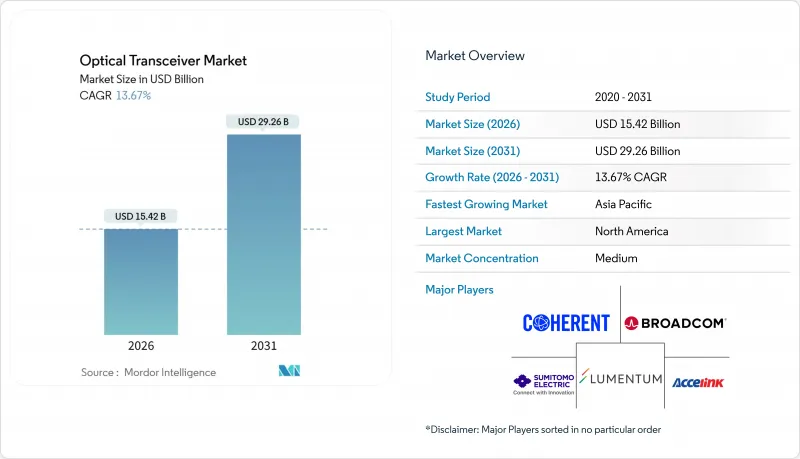
Mordor Intelligence에 의하면, 광트랜시버 시장 규모는 2026년에 154억 2,000만 달러에 이르고, 2031년까지 292억 6,000만 달러에 달할 전망이며, CAGR은 13.67%를 기록할 전망입니다.
본 보고서는 프로토콜(이더넷, 인피니밴드, 기타), 데이터 전송 속도(10 Gbps 미만, 10-40Gbps, 기타), 폼 팩터(SFP/SFP+, OSFP, 기타),광섬유 유형(싱글모드, 멀티모드), 전송 거리(숏리치, 미디엄리치, 롱리치), 용도(통신, 엔터프라이즈/캠퍼스 등), 지역별로 분류되어 있습니다. 시장 예측은 금액(달러) 기준으로 제시되어 있습니다.
세계 광트랜시버 시장 동향 및 인사이트
하이퍼스케일 데이터센터의 확대
Meta, Google, Microsoft 및 Amazon Web Services의 사상 최대 규모의 설비 투자로 인해 400G 및 800G 모듈의 출하량이 증가하고 있습니다. 이는 트레이닝 클러스터 내의 각 그래픽 처리 장치(GPU)가 여러 개의 고속 링크를 필요로 하기 때문입니다. 통신 사업자들은 추가적인 열적 여유를 확보하기 위해 OSFP 패키지의 표준화를 추진하고 있습니다. 급속한 규모 확대로 인해 공급업체들은 비트당 전력 소비를 줄여야 하는 압박을 받고 있으며, 이는 실리콘 포토닉스 집적 기술의 혁신을 가속화하고 있습니다. 400ZR 및 800ZR 코히런트 인터페이스에 의존하는 가용성 구역 간 패브릭은 메트로 리치 지원 플러그인형 모듈에 대한 수요를 더욱 부추기고 있습니다. 하이퍼스케일러가 추론 워크로드를 최종 사용자에게 더 가까이 가져감에 따라, 랙 내 전력 소비를 최소화하기 위해 쇼트리치 선형 광학 장치도 지지를 얻고 있습니다.
400G 및 800G 이더넷으로의 전환
IEEE 802.3df 표준에 따라 800Gbps 물리 계층이 확정되면서, 주류 도입을 위한 기반이 마련되었습니다. 브로드컴은 2024년에 50만 개 이상의 800G 지원 스위치 ASIC을 출하했으며, 가격 수준이 도입의 중요한 문턱을 밑돌았음이 확인되었습니다. Optical Internetworking Forum(OIF)의 800ZR 사양에 따라 통신 사업자는 외부 트랜스폰더를 사용하지 않고도 120km의 메트로 구간을 전송할 수 있게 되어, 총 소유 비용(TCO)을 약 4분의 1로 절감할 수 있습니다. 초기 현장 테스트에서 상용 수준의 성능이 확인됨에 따라 통신 사업자들은 업그레이드 로드맵을 앞당기고 있습니다. 8개의 100Gbps 전기 레인과 고급 전방 오류 정정 기능을 공랭식 섀시에 패키징할 수 있는 벤더가 설계 채택을 확보하는 데 가장 유리한 입장에 있습니다.
800G 초고성능 모듈의 높은 전력 소비
800Gbps OSFP는 50W의 열을 방출하며, 이러한 모듈 8개를 탑재한 랙 상단 스위치의 전력 소비량은 800W에 육박하여 공랭 방식의 한계에 다다르고 있습니다. 액체 냉각을 도입하면 랙당 500-1,000달러의 추가 비용이 발생하며, 예산이 제한된 통신 사업자의 경우 투자 회수 기간이 길어지게 됩니다. Open Compute Project는 100Gbps당 15 W라는 상한선을 설정하고 있지만, 현재 설계에서는 이 목표치를 최대 40% 초과하고 있습니다. 선형 플러그형 광학 장치는 전력 소비를 약 12 W까지 줄여주지만, 전송 거리가 2 km로 제한되어 있어 캠퍼스 내나 단일 사이트 내 패브릭에서의 사용으로 한정됩니다. 또한, 현재 9개월 정도가 소요되는 장기화된 인증 주기로 인해 중소 벤더들의 수익 계상이 지연되고 있습니다.
부문 분석
2025년, 이더넷은 광트랜시버 시장 점유율의 45.79%를 차지하며, 리프-스파인 패브릭 및 애그리게이션 계층에서의 보급 현황을 반영하고 있습니다. 코히런트 DWDM 솔루션은 현재 규모는 작지만, 메트로 및 장거리 통신 사업자들이 400ZR 및 800ZR 플러그인형 모듈의 양산화를 추진함에 힘입어 2031년까지 연평균 성장률(CAGR) 14.88%를 나타낼 것으로 예측됩니다. InfiniBand는 RDMA 지연 시간이 매우 중요한 고성능 컴퓨팅(HPC) 분야에서 틈새 시장 지위를 유지하고 있는 반면, 파이버 채널은 스토리지 영역 네트워크(SAN)에서 Gen 7 속도로 진화하고 있습니다. 패시브 광 네트워크 모듈은 광대역 구축, 특히 규제 당국이 FTTH(Fiber-to-the-Home) 보급을 의무화하고 있는 지역에서 여전히 필수적인 존재입니다.
이더넷의 적용 범위는 25G 캠퍼스 업링크에서 800G 하이퍼스케일 백본에 이르기까지 다양하며, 규모의 경제를 창출하여 포트당 가격을 낮추고 있습니다. 코히런트 DWDM의 성장이 더 빠른 이유는 통신 사업자들이 디스크리트 트랜스폰더에 비해 25-40%의 스펙트럼 효율 향상을 확인하고 있기 때문입니다. 1.6 Tbps EDR을 향한 InfiniBand의 로드맵은 프리미엄 가격 책정을 정당화하는 성능상의 우위를 유지하고 있습니다. 파이버 채널은 신중하고 단계적으로 진행되는 대역폭 확장을 통해 미션 크리티컬 SAN에 대한 하위 호환성을 유지하고 있습니다. PON용 광 모듈은 라스트 마일 광섬유에 이미 투입된 토목 공사 비용을 수익화하기 때문에 데이터센터 지출이 변동하더라도 공급업체에 안정적인 수익원을 제공합니다.
100Gbps에서 400Gbps 트랜시버는 QSFP28 및 QSFP-DD 출하량에 힘입어 2025년에 39.16%의 점유율을 차지했습니다. 400Gbps를 초과하는 모듈용 광트랜시버 시장은 IEEE 802.3df 및 향후 도입될 802.3dj 규격의 지원에 힘입어 연평균 성장률(CAGR) 14.69%를 기록할 전망입니다. 40Gbps 미만 분야에서는 기업들이 전면적인 업그레이드를 진행하기보다는 기존 자산을 최대한 활용하는 경향이 있어 출하 대수는 안정적인 양상을 보이고 있습니다.
400Gbps의 비용 곡선이 충분히 낮아짐에 따라, 일부 하이퍼스케일러는 새로운 데이터센터에서 100Gbps 단계를 완전히 건너뛰고 있습니다. 200Gbps 전기 레인을 활용한 1.6 Tbps 플러그인형 모듈의 초기 엔지니어링 샘플이 2026년 실험실 테스트에 등장할 예정입니다. 한편, SFP 기반 1Gbps 및 10Gbps 모듈은 산업용 및 광대역 CPE 시장을 위해 여전히 수백만 개 단위로 출하되고 있습니다. 전반적으로 광트랜시버 시장은 5-6년마다 대역폭이 4배로 증가하는 기존 추세를 유지하고 있으며, 실리콘 포토닉스와 첨단 DSP가 이러한 추세를 더욱 가속화하고 있습니다.
지역별 분석
북미는 2025년 매출의 33.91%를 차지하고 있으며, 2025년부터 2026년에 걸쳐 2,000억 달러를 넘는 하이퍼스케일 분야의 설비 투자가 이를 뒷받침하고 있습니다. Meta만 해도 100만 대 이상의 GPU를 구축할 계획이며, 각 GPU는 여러 개의 400G 또는 800G 링크에 연결됩니다. Amazon Web Services는 전력 소비를 약 30% 줄이기 위해 코패키지드 옵틱스의 인증을 추진하고 있으며, 이로 인해 벤더들은 더욱 긴밀한 통합을 요구받고 있습니다. AT&T나 Verizon과 같은 Tier 1 통신사는 메트로 링에 400ZR을 도입하고 있으며, 이를 통해 외부 트랜스폰더의 필요성이 사라지고 프로비저닝 비용이 절감되고 있습니다. 캐나다와 멕시코에서는 지방 지역의 광대역 구축 의무와 5G 스탠드얼론의 조기 구축으로 인해 수요가 더욱 확대되고 있습니다.
아시아태평양은 가장 빠르게 성장하는 지역으로, 2031년까지 연평균 성장률(CAGR)이 14.66%를 나타낼 것으로 예측됩니다. 이노라이트(Inolight)는 2024년 상반기에 50만 개 이상의 400G 모듈을 출하하며, 국내 하이퍼스케일 수요가 높음을 입증하고 있습니다. 중국의 각 OEM 업체들은 전 세계 동종 업계 경쟁사들보다 앞서 800G QSFP-DD의 양산을 확대하고 있는 반면, 인도의 통신 사업자들은 전국적인 5G 확산에 따라 수만 개의 25G 프론트홀 모듈을 도입하고 있습니다. 일본, 한국, 호주에서는 코어 네트워크의 코히런트 기술로의 업그레이드가 추진되고 있으며, 대부분의 경우 100Gbps 단계를 완전히 건너뛰고 있습니다.
유럽은 도매 접속 가격 상한 규제로 인해 성장세가 완만하지만, 800Gbps 코히런트 광 모듈을 사양으로 하는 해저 케이블 프로젝트에 힘입고 있습니다. 도이치 텔레콤은 2024년 말까지 1,000만 가구를 FTTH에 연결하여 XGS-PON 트랜시버 수요를 견인하고 있습니다. 중동에서는 각국별 독자적인 클라우드 구축이 진행되고 있으며, UAE와 사우디아라비아의 통신 사업자가 400G 메트로 링을 가동하고 있습니다. 남미는 통화 약세 압박에 직면해 있지만, 상파울루와 부에노스아이레스에서의 FTTH 구축을 통해 PON 수요를 유지하고 있습니다. 아프리카는 여전히 발전 단계에 있으며, 남아프리카공화국과 나이지리아의 통신 사업자들은 오픈 RAN 프론트홀용 광통신 장비를 우선적으로 도입하고 있습니다.
기타 혜택:
- 엑셀 형식 시장 전망(ME) 시트
- 3개월간의 애널리스트 지원
자주 묻는 질문
목차
제1장 서론
제2장 조사 방법
제3장 주요 요약
제4장 시장 구도
제5장 시장 규모와 성장 예측
제6장 경쟁 구도
제7장 시장 기회와 향후 전망
LSH 26.09.14According to Mordor Intelligence, the optical transceiver market size reached USD 15.42 billion in 2026 and is projected to climb to USD 29.26 billion by 2031, reflecting a brisk 13.67% CAGR.

This report is Segmented by Protocol (Ethernet, Infiniband, and More), Data Rate (Less Than 10 Gbps, 10-40 Gbps, and More), Form Factor (SFP/SFP+, OSFP, and More), Fiber Type (Single-Mode, and Multi-Mode), Reach Distance (Short-Reach, Medium-Reach, Long-Reach), Application (Telecommunications, Enterprise/Campus, and More), and Geography. The Market Forecasts are Provided in Terms of Value (USD).
Global Optical Transceiver Market Trends and Insights
Hyperscale Data-Center Expansion
Record capital expenditures by Meta, Google, Microsoft, and Amazon Web Services are lifting unit volumes for 400G and 800G modules, as each graphics processing unit in training clusters demands multiple high-speed links. Operators are standardizing on OSFP packages to unlock additional thermal headroom. Rapid scaling places pressure on suppliers to deliver lower power per bit, which, in turn, accelerates innovation in silicon photonics integration. Inter-availability-zone fabrics that rely on 400ZR and 800ZR coherent interfaces further boost demand for metro-reach pluggables. As hyperscalers move inference workloads closer to end users, short-reach linear optics are also gaining favor to minimize energy draw inside racks.
Migration to 400G and 800G Ethernet
The IEEE 802.3df standard finalized 800 Gbps physical layers, setting the stage for mainstream deployments. Broadcom shipped more than 500,000 800G-capable switch ASICs in 2024, confirming that price points have fallen below key adoption thresholds. The Optical Internetworking Forum's 800ZR specification allows operators to light 120 km metro spans without external transponders, cutting the total cost of ownership by roughly one-quarter. Early field trials show revenue-grade performance, prompting carriers to pull forward upgrade roadmaps. Module vendors able to package 8 X 100 Gbps electrical lanes and advanced forward-error correction inside an air-cooled envelope are best positioned to win design slots.
High Power Consumption of greater than 800G Modules
An 800 Gbps OSFP can dissipate 50 W, and a fully populated top-of-rack switch with eight such modules approaches 800 W, pushing the limits of air cooling. Liquid cooling adds USD 500-1,000 per rack, stretching payback periods for operators on tight budgets. The Open Compute Project set a 15 W per 100 Gbps ceiling, a target that current designs exceed by up to 40%. While linear pluggable optics cut draw to roughly 12 W, their 2 km reach confines them to campus or single-site fabrics. Prolonged qualification cycles, now trending at nine months, slow revenue recognition for smaller vendors.
Other drivers and restraints analyzed in the detailed report include:
- 5G Fronthaul and Backhaul Fiber Build-Out
- Growing Cloud AI/ML Clusters Adopting CPO
- CAPEX Burden to Upgrade Legacy Fiber Plants
For complete list of drivers and restraints, kindly check the Table Of Contents.
Segment Analysis
Ethernet accounted for 45.79% of the optical transceiver market share in 2025, reflecting its ubiquity across leaf-spine fabrics and aggregation layers. Coherent DWDM solutions, though smaller today, are forecast to register a 14.88% CAGR through 2031, propelled by metro and long-haul operators extending 400ZR and 800ZR pluggables into production. InfiniBand retains a niche in high-performance computing where RDMA latency is critical, while Fibre Channel evolves to Gen 7 speeds in storage-area networks. Passive optical network modules remain essential in broadband rollouts, particularly where regulators mandate fiber-to-the-home coverage.
Ethernet's breadth spans 25G campus uplinks to 800G hyperscale backbones, creating economies of scale that depress per-port pricing. Coherent DWDM climbs faster because carriers see spectral efficiency gains of 25-40% compared with discrete transponders. InfiniBand's roadmap toward 1.6 Tbps EDR maintains a performance moat that justifies premium pricing. Fibre Channel's carefully staged bandwidth jumps keep backward compatibility for mission-critical SANs. PON optics monetize civil works already sunk into last-mile fiber, giving suppliers a stable revenue stream even as data center spending fluctuates.
Transceivers between 100 Gbps and 400 Gbps held a 39.16% share in 2025, underpinned by QSFP28 and QSFP-DD volumes. The optical transceiver market for modules above 400 Gbps is on track for a 14.69% CAGR, aided by IEEE 802.3df and the forthcoming 802.3dj frameworks. Below 40 Gbps, shipments stabilize as enterprises sweat legacy assets rather than undertake wholesale upgrades.
Cost curves for 400 Gbps have fallen sufficiently that some hyperscalers skip 100 Gbps altogether in new halls. Early engineering samples of 1.6 Tbps pluggables appear in 2026 lab trials, leveraging 200 Gbps electrical lanes. At the opposite end, SFP-based 1 Gbps and 10 Gbps modules still ship in millions to industrial and broadband CPE markets. Overall, the optical transceiver market continues its historical cadence of quadrupling bandwidth every five to six years, with silicon photonics and advanced DSPs extending that trendline.
Complete Report Scope:
- By Protocol
- Ethernet
- InfiniBand
- Fibre Channel
- CWDM / DWDM
- FTTx / PON
- Other Protocols
- By Data Rate
- Less than 10 Gbps
- 10 - 40 Gbps
- 40 - 100 Gbps
- 100 - 400 Gbps
- Greater than 400 Gbps
- By Form Factor
- SFP / SFP+
- QSFP / QSFP+
- QSFP28 / QSFP-DD
- CFP / CFP2 / CFP4
- OSFP
- Other Form Factors
- By Fiber Type
- Single-Mode
- Multi-Mode
- By Reach Distance
- Short-Reach (Less than 10 km)
- Medium-Reach (10 - 40 km)
- Long-Reach (Greater than 40 km)
- By Application
- Data Centers
- Telecommunications
- Enterprise / Campus
- Industrial and Other Applications
- By Geography
- North America
- United States
- Canada
- Mexico
- Europe
- Germany
- United Kingdom
- France
- Russia
- Rest of Europe
- Asia-Pacific
- China
- Japan
- India
- South Korea
- Australia
- Rest of Asia-Pacific
- Middle East and Africa
- Middle East
- Saudi Arabia
- United Arab Emirates
- Rest of Middle East
- Africa
- South Africa
- Egypt
- Rest of Africa
- Middle East
- South America
- Brazil
- Argentina
- Rest of South America
- North America
Geography Analysis
North America accounted for 33.91% of 2025 revenue, anchored by hyperscale capital outlays exceeding USD 200 billion across 2025-2026. Meta alone plans to deploy over 1 million GPUs, each tied to multiple 400G or 800G links. Amazon Web Services is qualifying co-packaged optics to trim power by roughly 30%, pushing component vendors toward tighter integration. Tier-1 carriers such as AT&T and Verizon have deployed 400ZR in metro rings, eliminating the need for external transponders and reducing provisioning costs. Canada and Mexico contribute incremental volume through rural broadband mandates and early 5G standalone builds.
Asia-Pacific is the fastest-growing region, with a 14.66% CAGR projection through 2031. Innolight shipped more than 500,000 400G modules in the first half of 2024, underscoring domestic hyperscale demand. Chinese OEMs ramp 800G QSFP-DD ahead of global peers, while Indian operators deploy tens of thousands of 25G fronthaul modules during nationwide 5G rollouts. Japan, South Korea, and Australia press forward with coherent upgrades in core networks, often leapfrogging 100 Gbps stages entirely.
Europe grows at a moderate pace, constrained by wholesale access price caps but bolstered by submarine cable projects that specify 800 Gbps coherent optics. Deutsche Telekom connected 10 million premises to FTTH by year-end 2024, driving demand for XGS-PON transceivers. The Middle East pursues sovereign cloud builds, with UAE and Saudi operators lighting 400G metro rings. South America faces currency pressure yet relies on FTTH deployments in Sao Paulo and Buenos Aires to sustain PON volumes. Africa remains nascent, with South African and Nigerian carriers prioritizing open-RAN fronthaul optics.
- Coherent Corp.
- Lumentum Holdings
- Broadcom Inc.
- Accelink Technologies
- Sumitomo Electric Industries
- Fujitsu Optical Components
- Source Photonics
- Huawei Technologies
- Cisco Systems (Acacia)
- Innolight Technology
- Hisense Broadband
- Eoptolink Technology
- Applied Optoelectronics
- Marvell Technology
- Credo Technology
- Ciena Corp.
- HUBER+SUHNER Cube Optics
- POET Technologies
- Molex LLC
- Lumentum Holdings Inc.
Additional Benefits:
- The market estimate (ME) sheet in Excel format
- 3 months of analyst support
TABLE OF CONTENTS
1 INTRODUCTION
- 1.1 Study Assumptions and Market Definition
- 1.2 Scope of the Study
2 RESEARCH METHODOLOGY
3 EXECUTIVE SUMMARY
4 MARKET LANDSCAPE
- 4.1 Market Overview
- 4.2 Market Drivers
- 4.2.1 Hyperscale Data-Center Expansion
- 4.2.2 5G Fronthaul and Backhaul Fiber Build-Out
- 4.2.3 Migration to 400G and 800G Ethernet
- 4.2.4 Growing Cloud AI / ML Clusters Adopting CPO
- 4.2.5 Temperature-Hardened Modules for LEO Satellites
- 4.2.6 Rise of Linear Pluggable Optics Reducing Power and Cost
- 4.3 Market Restraints
- 4.3.1 CAPEX Burden to Upgrade Legacy Fiber Plants
- 4.3.2 Laser-Diode and DSP Supply Constraints
- 4.3.3 High Power Consumption of greater than 800 G Modules
- 4.3.4 IP Licensing Barriers for Second-Source Vendors
- 4.4 Industry Value Chain Analysis
- 4.5 Regulatory Landscape
- 4.6 Technological Outlook
- 4.7 Porter's Five Forces Analysis
- 4.7.1 Bargaining Power of Suppliers
- 4.7.2 Bargaining Power of Buyers
- 4.7.3 Threat of New Entrants
- 4.7.4 Threat of Substitutes
- 4.7.5 Intensity of Competitive Rivalry
- 4.8 Impact of Macroeconomic Factors on the Market
- 4.9 Investment Analysis
5 MARKET SIZE AND GROWTH FORECASTS (VALUE)
- 5.1 By Protocol
- 5.1.1 Ethernet
- 5.1.2 InfiniBand
- 5.1.3 Fibre Channel
- 5.1.4 CWDM / DWDM
- 5.1.5 FTTx / PON
- 5.1.6 Other Protocols
- 5.2 By Data Rate
- 5.2.1 Less than 10 Gbps
- 5.2.2 10 - 40 Gbps
- 5.2.3 40 - 100 Gbps
- 5.2.4 100 - 400 Gbps
- 5.2.5 Greater than 400 Gbps
- 5.3 By Form Factor
- 5.3.1 SFP / SFP+
- 5.3.2 QSFP / QSFP+
- 5.3.3 QSFP28 / QSFP-DD
- 5.3.4 CFP / CFP2 / CFP4
- 5.3.5 OSFP
- 5.3.6 Other Form Factors
- 5.4 By Fiber Type
- 5.4.1 Single-Mode
- 5.4.2 Multi-Mode
- 5.5 By Reach Distance
- 5.5.1 Short-Reach (Less than 10 km)
- 5.5.2 Medium-Reach (10 - 40 km)
- 5.5.3 Long-Reach (Greater than 40 km)
- 5.6 By Application
- 5.6.1 Data Centers
- 5.6.2 Telecommunications
- 5.6.3 Enterprise / Campus
- 5.6.4 Industrial and Other Applications
- 5.7 By Geography
- 5.7.1 North America
- 5.7.1.1 United States
- 5.7.1.2 Canada
- 5.7.1.3 Mexico
- 5.7.2 Europe
- 5.7.2.1 Germany
- 5.7.2.2 United Kingdom
- 5.7.2.3 France
- 5.7.2.4 Russia
- 5.7.2.5 Rest of Europe
- 5.7.3 Asia-Pacific
- 5.7.3.1 China
- 5.7.3.2 Japan
- 5.7.3.3 India
- 5.7.3.4 South Korea
- 5.7.3.5 Australia
- 5.7.3.6 Rest of Asia-Pacific
- 5.7.4 Middle East and Africa
- 5.7.4.1 Middle East
- 5.7.4.1.1 Saudi Arabia
- 5.7.4.1.2 United Arab Emirates
- 5.7.4.1.3 Rest of Middle East
- 5.7.4.2 Africa
- 5.7.4.2.1 South Africa
- 5.7.4.2.2 Egypt
- 5.7.4.2.3 Rest of Africa
- 5.7.4.1 Middle East
- 5.7.5 South America
- 5.7.5.1 Brazil
- 5.7.5.2 Argentina
- 5.7.5.3 Rest of South America
- 5.7.1 North America
6 COMPETITIVE LANDSCAPE
- 6.1 Market Concentration
- 6.2 Strategic Moves
- 6.3 Market Share Analysis
- 6.4 Company Profiles (includes Global-level Overview, Market-level Overview, Core Segments, Financials as available, Strategic Information, Market Rank / Share for key companies, Products and Services, Recent Developments)
- 6.4.1 Coherent Corp.
- 6.4.2 Lumentum Holdings
- 6.4.3 Broadcom Inc.
- 6.4.4 Accelink Technologies
- 6.4.5 Sumitomo Electric Industries
- 6.4.6 Fujitsu Optical Components
- 6.4.7 Source Photonics
- 6.4.8 Huawei Technologies
- 6.4.9 Cisco Systems (Acacia)
- 6.4.10 Innolight Technology
- 6.4.11 Hisense Broadband
- 6.4.12 Eoptolink Technology
- 6.4.13 Applied Optoelectronics
- 6.4.14 Marvell Technology
- 6.4.15 Credo Technology
- 6.4.16 Ciena Corp.
- 6.4.17 HUBER+SUHNER Cube Optics
- 6.4.18 POET Technologies
- 6.4.19 Molex LLC
- 6.4.20 Lumentum Holdings Inc.
7 MARKET OPPORTUNITIES AND FUTURE OUTLOOK
- 7.1 White-Space and Unmet-Need Assessment