
|
시장보고서
상품코드
2124606
로봇 지원 수술 시스템 : 시장 점유율 분석, 업계 동향 및 통계, 성장 예측(2026-2031년)Robotic Assisted Surgery Systems - Market Share Analysis, Industry Trends & Statistics, Growth Forecasts (2026 - 2031) |
||||||
 Mordor Intelligence
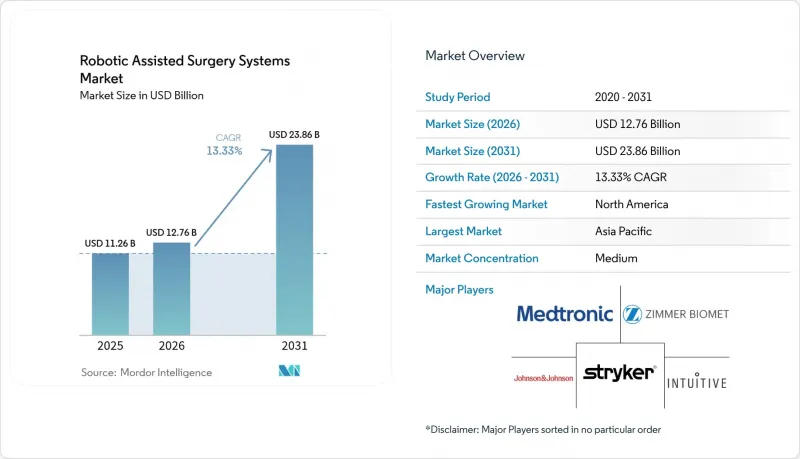
Mordor Intelligence에 의하면, 로봇 지원 수술 시스템 시장 규모는 2025년 112억 6,000만 달러로 평가되었습니다. 2026년에는 127억 6,000만 달러로 확대되어 2031년까지 238억 6,000만 달러에 이를 것으로 예상되고 2026년부터 2031년에 걸쳐 CAGR 13.33%로 성장할 전망입니다.
본 보고서는 제품 유형(시스템(수술용 로봇, 내비게이션 시스템), 소모품·부속품, 소프트웨어 및 서비스), 용도(산부인과, 기타),최종 사용자(병원, 외래수술센터(ASC), 전문 클리닉, 학술 기관), 지역(북미, 유럽, 아시아태평양, 중동 및 아프리카, 남미)별로 분류되어 있습니다. 시장 전망은 금액(달러) 기준으로 제시되어 있습니다.
세계의 로봇 지원 수술 시스템 시장 동향 및 인사이트
외과용 로봇 기술의 발전
하드웨어 및 소프트웨어의 지속적인 개선을 통해 개복 수술과의 성능 격차는 점차 줄어들고 있습니다. 2024년 3월, 미국 식품의약국(FDA)은 인튜이티브 서지컬(Intuitive Surgical)사의 ‘da Vinci 5’를 승인하여, 외과의사가 조직의 층을 구별하는 데 도움이 되는 실시간 햅틱 피드백이 가능해졌습니다. 『The Lancet Digital Health』에 게재된 2025년 다기관 공동 연구에 따르면, 머신러닝을 활용한 내비게이션 모듈 덕분에 로봇 보조 전립선 전적출술에서 양성 절제 가장자리 비율이 18% 감소했습니다. 현재 레벨 3 자율 기능이 승인된 기기의 6%를 차지하고 있어, 조건부 자율성에 대한 규제 당국의 수용이 나타나고 있습니다. CMR Surgical사의 ‘Versius’와 같은 모듈식 설계 덕분에 기존 멀티포트 플랫폼보다 30% 더 좁은 수술실에서도 도입이 가능해져, 적용 가능한 의료기관의 범위가 확대되고 있습니다. 이러한 특징들이 결합되어 로봇 지원 수술 시스템 시장의 성장 전망을 뒷받침하고 있습니다.
최소 침습 수술에 대한 선호도 증가
보험사와 환자들은 입원 기간 단축과 조기 직장 복귀를 점점 더 중요하게 여기고 있습니다. 미국 부인과 복강경 외과 의사 협회(AAGL)의 보고에 따르면, 2025년 미국 대학병원에서 시행된 양성 사례의 자궁 적출술 중 로봇 지원 수술이 57%를 차지했으며, 이는 2년 동안 9포인트 증가한 수치입니다. 이 협회는 출혈량 감소와 조기 퇴원을 그 이유로 꼽고 있습니다. 스트라이커사의 전체 무릎 관절 치환술 8,400건을 대상으로 한 레지스트리에 따르면, Mako 로봇을 사용한 경우 수술 후 12개월 시점의 환자 만족도는 92%였던 반면, 수동 기구를 사용한 경우에는 84%에 그쳤습니다. 외래수술센터(ASC)는 복강경 수술에 비해 15%-20% 높은 진료 보수를 받고 있지만, 설비 투자 장벽으로 인해 2025년 중반 시점에서 로봇을 도입한 곳은 고작 8%에 그쳤습니다. 각 벤더사는 이러한 격차를 해소하기 위해 리스 플랜이나 싱글포트 설계를 도입하고 있으며, 이러한 움직임으로 인해 로봇 지원 수술 시스템의 보급이 가속화될 것으로 예측됩니다.
고액의 설비 투자와 운영 비용
다빈치 Xi의 가격은 약 200만 달러이며, 연간 유지보수 계약비는 15만-20만 달러, 여기에 1건당 2,000-3,500달러의 일회용 기구 비용이 추가됩니다. 『Health Affairs』지의 추산에 따르면, 메디케어 요금 체계를 기준으로 연간 300건의 수술을 시행하는 400병상 규모의 병원의 경우, 투자 회수 기간은 7.2년으로, 일반적인 5년이라는 기준 수익률을 상회합니다. 미국의 지방 병원들은 도입의 가장 큰 장벽으로 자금 면의 제약을 꼽고 있으며, 기구의 독점적 묶음 판매에 대해서는 2024년 연방거래위원회(FTC)의 조사가 진행 중이며, 30%-40%의 가격 인상이 이루어지고 있다고 지적되고 있습니다. 수입 관세와 환율 변동도 신흥 시장에서의 보급을 더욱 제약하고 있어, 이들 지역의 로봇 지원 수술 시스템 시장 규모는 당분간 정체될 전망입니다.
부문별 분석
2025년, 로봇 지원 수술 시스템 시장에서 ‘시스템’이 57.84%의 점유율을 차지하며, 플랫폼 도입이 자본 집약적이라는 점을 여실히 보여주었습니다. 그럼에도 불구하고, ‘소프트웨어 및 서비스’ 분야는 병원들이 훈련용 시뮬레이터, AI 내비게이션, 그리고 지속적인 수익을 확대하는 분석 대시보드를 우선시함에 따라 2031년까지 연평균 성장률(CAGR) 15.65%로 급성장할 것으로 예측됩니다. 소프트웨어 및 서비스 분야의 로봇 지원 수술 시스템 시장 규모는 시스템 분야보다 더 빠르게 확대될 것으로 예측됩니다. 이는 2025년에 420개 병원에서 1억 8,000만 달러의 지속적인 매출을 기록한 메드트로닉(Medtronic)사의 ‘Touch Surgery Enterprise’에 힘입은 것입니다.
기구 및 소모품 매출은 수술 건수에 비례하여 확대됩니다. 인튜이티브(Intuitive)사의 도입 실적을 기준으로 2025년에 190만 건의 수술이 수행되었으며, 이는 약 57억 달러의 기구 매출에 해당합니다. Hugo RAS와 같은 개방형 아키텍처 플랫폼은 타사 장비와의 통합을 촉진하는 한편, CMR Surgical사의 ‘Versius’는 도입 가격을 40% 인하하여 중규모 의료기관에서의 도입을 가속화하고 있습니다. Globus Medical사의 ‘ExcelsiusGPS’와 같은 내비게이션 로봇은 척추 나사의 정확도 향상에 기여하여, 2025년에는 시술 건수가 두 자릿수 성장을 기록했습니다.
지역별 분석
북미는 2025년 43.54%의 점유율을 차지했으며, 도입 대수가 많고 병원의 이익률을 보장하는 전용 CPT 코드의 지원에 힘입었습니다. 미국에서만 2026년 1월까지 누적 약 1,200만 건의 다빈치 수술이 시행되어, 그 이용이 정착되었음을 보여주고 있습니다. 캐나다는 2025년에 1억 5,000만 캐나다 달러(1억 1,000만 달러)를 투자하여 18개 지역 병원에 로봇을 도입하고, 암 치료 대기 시간 단축을 목표로 했습니다. 멕시코의 사회보장 제도는 당뇨병 환자의 개복 수술로 인한 합병증을 억제하기 위해 2024년에 14대의 플랫폼을 도입했습니다.
아시아태평양은 비용 경쟁력이 있는 국내 제조업체들의 주도하에 2031년까지 연평균 성장률(CAGR) 14.65%를 나타낼 것으로 예측됩니다. 마이크로포트(MicroPort)사의 ‘투마이(Tumai)’는 800만 위안(110만 달러)이라는 가격 책정을 통해 중국 2·3선 도시로의 보급을 가능하게 했습니다. 일본의 메디카로이드(Medicaroid)는 국민건강보험이 로봇 보조 위절제술의 적용 범위를 확대함에 따라 2025년 말까지 ‘히노토리’ 85대를 도입했으며, 판매 대수는 전년 대비 34% 증가했습니다. 인도는 여전히 매력적인 시장이며, CMR 서지컬사는 2025년 말까지 12개 병원에 ‘베르시우스’를 도입해 초기 비용에 민감한 본인 부담 시장을 개척했습니다. 한국과 호주는 각각 보조금 및 소프트웨어 승인 절차를 신속화하여 도입을 지원하고 있습니다.
유럽에서는 의료기기 규정(MDR)의 적용과 보험 환급 제도의 불균형으로 인해 도입 속도가 둔화되고 있습니다. 독일의 공적 의료보험에서는 로봇 전립선 전적출술이 보험 적용 대상에 포함되어 있으나, 영국의 국민보건서비스(NHS)에서는 NICE(국립의료기술평가기구)의 2024년 비용 대비 효과 결정에 따라 이용 사례가 복잡한 증례로 제한되고 있습니다. 메드트로닉(Medtronic)사의 ‘Hugo RAS’는 2025년 말까지 유럽에서 42대의 도입 실적을 확보했습니다. 이 회사는 진료비 지급 제도(fee-for-service)를 통해 혁신 자금이 조달되는 프랑스와 이탈리아의 사립 병원을 타겟으로 삼고 있습니다. 중동에서는 아랍에미리트(UAE)가 2024년부터 2025년에 걸쳐 8개 공립 병원에 로봇을 도입했습니다. 한편, 브라질 상파울루주에서 실시된 보험 급여 시범 사업에서는 첫해에 1,200건의 수술이 이루어졌습니다.
기타 혜택 :
- 엑셀 형식 시장 예측(ME) 시트
- 3개월간의 애널리스트 지원
자주 묻는 질문
목차
제1장 서론
제2장 조사 방법
제3장 주요 요약
제4장 시장 구도
제5장 시장 규모 및 성장 예측
제6장 경쟁 구도
제7장 시장 기회 및 향후 전망
KTH 26.09.14According to Mordor Intelligence, the robotic assisted surgery systems market size is expected to increase from USD 11.26 billion in 2025 to USD 12.76 billion in 2026 and reach USD 23.86 billion by 2031, growing at a CAGR of 13.33% over 2026-2031.
This report is Segmented by Product Type (System [Surgical Robot, Navigation System], Consumables & Accessories, and Software & Services), Application (Gynecological, and More), End User (Hospitals, Ascs, Specialty Clinics, and Academic Institutes), and Geography (North America, Europe, Asia-Pacific, MEA, and South America). Market Forecasts are Provided in Terms of Value (USD).
Global Robotic Assisted Surgery Systems Market Trends and Insights
Technological Advancements in Surgical Robotics
Continuous hardware and software iterations are shrinking performance gaps with open surgery. The FDA cleared Intuitive Surgical's da Vinci 5 in March 2024, enabling real-time haptic feedback that helps surgeons differentiate tissue planes. Machine-learning navigation modules lowered positive margin rates in robotic prostatectomy by 18% in a 2025 multi-center study published in The Lancet Digital Health. Level-3 autonomous functions now account for 6% of cleared devices, indicating regulatory acceptance of conditional autonomy. Modular designs, such as CMR Surgical's Versius, allow deployment in operating rooms 30% smaller than those of legacy multi-port platforms, widening the addressable facilities. These features collectively reinforce the robotic-assisted surgery systems market growth outlook.
Growing Preference for Minimally Invasive Procedures
Payers and patients increasingly favor shorter stays and faster returns to work. The American Association of Gynecologic Laparoscopists reported that robotic hysterectomy accounted for 57% of benign cases at U.S. academic centers in 2025, up 9 percentage points in 2 years, citing lower blood loss and faster discharge. Stryker's registry of 8,400 total knee arthroplasties found 92% patient satisfaction at 12 months when the Mako robot was used, versus 84% with manual tools. Ambulatory surgery centers secure 15%-20% higher reimbursement than laparoscopy, yet only 8% had installed a robot by mid-2025 due to capital hurdles. Vendors are introducing leasing plans and single-port designs to close this gap, a move expected to accelerate the penetration of robotic-assisted surgery systems.
High Capital and Operational Expenditure
A da Vinci Xi costs roughly USD 2 million, with annual service contracts of USD 150,000-200,000 and disposable instruments adding USD 2,000-3,500 per case. Health Affairs calculated a 7.2-year payback for a 400-bed hospital performing 300 cases annually under Medicare tariffs, exceeding the typical 5-year hurdle rate. Rural U.S. hospitals cite capital limits as the top adoption barrier, and exclusive instrument tie-ins prompted an ongoing Federal Trade Commission probe in 2024 that alleges 30%-40% price inflation. Import duties and currency swings further constrain emerging-market uptake, capping near-term robotic assisted surgery systems market size in those regions.
Other drivers and restraints analyzed in the detailed report include:
- Increasing Geriatric Patient Base and Disease Incidence
- Expanding Clinical Evidence Supporting Robotic Outcomes
- Stringent and Fragmented Regulatory Requirements
For complete list of drivers and restraints, kindly check the Table Of Contents.
Segment Analysis
Systems captured 57.84% of robotic assisted surgery systems market share in 2025, underscoring the capital-intensive nature of platform rollout. Nevertheless, Software & Services is projected to surge at a 15.65% CAGR through 2031 as hospitals prioritize training simulators, AI navigation, and analytics dashboards that deepen recurring revenue. The robotic assisted surgery systems market size for Software & Services is expected to expand faster than Systems, supported by Medtronic's Touch Surgery Enterprise, which booked USD 180 million in 2025 recurring sales across 420 hospitals.
Instrument consumables scale directly with volume. Intuitive's installed base delivered 1.9 million procedures in 2025, translating into roughly USD 5.7 billion instrument revenue. Open-architecture platforms such as Hugo RAS promote third-party integration, while CMR Surgical's Versius lowers the entry price by 40%, accelerating adoption in mid-tier facilities. Navigation robots like Globus Medical's ExcelsiusGPS addressed spinal screw accuracy, fueling double-digit procedure growth in 2025.
Complete Report Scope:
- By Product Type
- System
- Surgical Robot
- Navigation System
- Consumables & Accessories
- Software & Services
- System
- By Application
- Gynecological Surgery
- Cardiovascular Surgery
- Neurosurgery
- Orthopedic Surgery
- Laparoscopy / General Surgery
- Urology
- Thoracic Surgery
- Otolaryngology (ENT)
- Other Applications
- By End User
- Hospitals
- Ambulatory Surgery Centers
- Specialty Clinics
- Academic & Research Institutes
- Geography
- North America
- United States
- Canada
- Mexico
- Europe
- Germany
- United Kingdom
- France
- Italy
- Spain
- Rest of Europe
- Asia-Pacific
- China
- Japan
- India
- Australia
- South Korea
- Rest of Asia-Pacific
- Middle East & Africa
- GCC
- South Africa
- Rest of Middle East & Africa
- South America
- Brazil
- Argentina
- Rest of South America
- North America
Geography Analysis
North America commanded 43.54% share in 2025, sustained by dense installed bases and dedicated CPT codes that shield hospital margins. The United States alone had performed roughly 12 million cumulative da Vinci procedures by January 2026, demonstrating entrenched use. Canada diverted CAD 150 million (USD 110 million) in 2025 to deploy robots in 18 community hospitals, targeting reductions in oncology wait times. Mexico's social security system installed 14 platforms in 2024 to curb complications from open surgery among diabetic patients.
Asia-Pacific is forecast to grow at a 14.65% CAGR through 2031, driven by cost-competitive domestic makers. MicroPort's Toumai, priced at CNY 8 million (USD 1.1 million), enabled penetration into Tier 2-3 Chinese cities. Japan's Medicaroid logged 85 hinotori installations by end-2025 after national insurance extended coverage to robotic gastric resection, pushing volumes up 34% year-on-year. India remains attractive, as CMR Surgical plans to place Versius in 12 hospitals by late 2025, tapping a self-pay market sensitive to upfront pricing. South Korea and Australia support adoption through subsidies and fast-track software approvals, respectively.
Europe faces slower uptake under the Medical Device Regulation and mixed reimbursement. Germany's statutory insurance covers robotic prostatectomy, but the U.K.'s National Health Service restricts use to complex cases after NICE's 2024 cost-effectiveness ruling. Medtronic's Hugo RAS secured 42 European installations by late 2025, targeting private hospitals in France and Italy where fee-for-service models finance innovation. In the Middle East, the United Arab Emirates equipped eight public hospitals with robots between 2024-2025, while Brazil's pilot reimbursement in Sao Paulo performed 1,200 procedures in its first year.
- Asensus Surgical
- Brain Lab
- CMR Surgical
- Globus Medical
- Intuitive Surgical
- Johnson & Johnson (Ethicon/Auris)
- Medical Microinstruments (MMI)
- Medicaroid
- Medtronic
- Meere Company
- MicroPort MedBot
- Renishaw
- Siemens Healthineers (Corindus Vascular)
- Smiths Group
- Stryker
- Think Surgical
- Titan Medical
- Zimmer Biomet
Additional Benefits:
- The market estimate (ME) sheet in Excel format
- 3 months of analyst support
TABLE OF CONTENTS
1 Introduction
- 1.1 Study Assumptions & Market Definition
- 1.2 Scope of the Study
2 Research Methodology
3 Executive Summary
4 Market Landscape
- 4.1 Market Overview
- 4.2 Market Drivers
- 4.2.1 Technological Advancements in Surgical Robotics
- 4.2.2 Growing Preference for Minimally Invasive Procedures
- 4.2.3 Increasing Geriatric Patient Base and Disease Incidence
- 4.2.4 Expanding Clinical Evidence Supporting Robotic Outcomes
- 4.2.5 Rising Investments and Funding in Digital Surgery Platforms
- 4.2.6 Surgeons Demand For Precision, Consistency, and Efficiency
- 4.3 Market Restraints
- 4.3.1 High Capital and Operational Expenditure
- 4.3.2 Stringent and Fragmented Regulatory Requirements
- 4.3.3 Data Security and Patient Privacy Concerns
- 4.3.4 Technical Limitations and Steep Learning Curve
- 4.4 Value / Supply-Chain Analysis
- 4.5 Regulatory Landscape
- 4.6 Technological Outlook
- 4.7 Porter's Five Forces Analysis
- 4.7.1 Bargaining Power Of Buyers
- 4.7.2 Bargaining Power Of Suppliers
- 4.7.3 Threat Of New Entrants
- 4.7.4 Threat Of Substitutes
- 4.7.5 Intensity Of Competitive Rivalry
5 Market Size & Growth Forecasts (Value, USD)
- 5.1 By Product Type
- 5.1.1 System
- 5.1.1.1 Surgical Robot
- 5.1.1.2 Navigation System
- 5.1.2 Consumables & Accessories
- 5.1.3 Software & Services
- 5.1.1 System
- 5.2 By Application
- 5.2.1 Gynecological Surgery
- 5.2.2 Cardiovascular Surgery
- 5.2.3 Neurosurgery
- 5.2.4 Orthopedic Surgery
- 5.2.5 Laparoscopy / General Surgery
- 5.2.6 Urology
- 5.2.7 Thoracic Surgery
- 5.2.8 Otolaryngology (ENT)
- 5.2.9 Other Applications
- 5.3 By End User
- 5.3.1 Hospitals
- 5.3.2 Ambulatory Surgery Centers
- 5.3.3 Specialty Clinics
- 5.3.4 Academic & Research Institutes
- 5.4 Geography
- 5.4.1 North America
- 5.4.1.1 United States
- 5.4.1.2 Canada
- 5.4.1.3 Mexico
- 5.4.2 Europe
- 5.4.2.1 Germany
- 5.4.2.2 United Kingdom
- 5.4.2.3 France
- 5.4.2.4 Italy
- 5.4.2.5 Spain
- 5.4.2.6 Rest of Europe
- 5.4.3 Asia-Pacific
- 5.4.3.1 China
- 5.4.3.2 Japan
- 5.4.3.3 India
- 5.4.3.4 Australia
- 5.4.3.5 South Korea
- 5.4.3.6 Rest of Asia-Pacific
- 5.4.4 Middle East & Africa
- 5.4.4.1 GCC
- 5.4.4.2 South Africa
- 5.4.4.3 Rest of Middle East & Africa
- 5.4.5 South America
- 5.4.5.1 Brazil
- 5.4.5.2 Argentina
- 5.4.5.3 Rest of South America
- 5.4.1 North America
6 Competitive Landscape
- 6.1 Market Concentration
- 6.2 Market Share Analysis
- 6.3 Company Profiles {(Includes Global Level Overview, Market Level Overview, Core Segments, Financials As Available, Strategic Information, Market Rank/Share For Key Companies, Products & Services, And Recent Developments)}
- 6.3.1 Asensus Surgical
- 6.3.2 Brainlab
- 6.3.3 CMR Surgical
- 6.3.4 Globus Medical
- 6.3.5 Intuitive Surgical
- 6.3.6 Johnson & Johnson (Ethicon/Auris)
- 6.3.7 Medical Microinstruments (MMI)
- 6.3.8 Medicaroid
- 6.3.9 Medtronic
- 6.3.10 Meere Company
- 6.3.11 MicroPort MedBot
- 6.3.12 Renishaw
- 6.3.13 Siemens Healthineers (Corindus Vascular)
- 6.3.14 Smith & Nephew
- 6.3.15 Stryker Corporation
- 6.3.16 Think Surgical
- 6.3.17 Titan Medical
- 6.3.18 Zimmer Biomet
7 Market Opportunities & Future Outlook
- 7.1 White-Space & Unmet-Need Assessment