

|
시장보고서
상품코드
2124609
신경 혈전 제거 기기 : 시장 점유율 분석, 업계 동향 및 통계, 성장 예측(2026-2031년)Neurothrombectomy Devices - Market Share Analysis, Industry Trends & Statistics, Growth Forecasts (2026 - 2031) |
||||||
 Mordor Intelligence
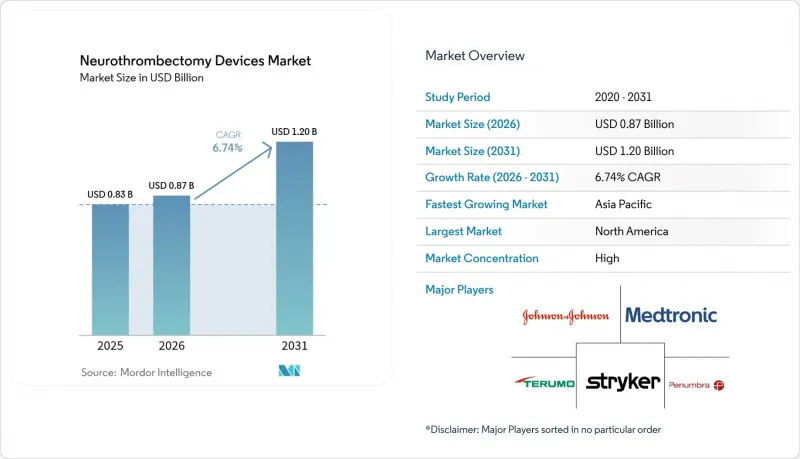
Mordor Intelligence에 의하면, 신경 혈전 제거 기기 시장 규모는 2025년에 8억 3,000만 달러로 평가되었습니다. 2026년에 8억 7,000만 달러에 달하고, 2031년까지 12억 달러에 이를 것으로 예측되며, 2026년부터 2031년에 걸쳐 CAGR 6.74%로 성장할 전망입니다.
본 보고서는 기기 유형(스텐트 리트리버, 흡입 카테터, 복합형 기계적 혈전 제거 시스템, 풍선 가이드 카테터 및 부속 기기), 최종 사용자(병원, 전문 뇌신경외과 센터, 외래수술센터(ASC)), 지역(북미, 유럽,아시아태평양, 남미, 중동 및 아프리카)별로 분류되어 있습니다. 시장 예측은 금액(달러) 기준으로 제시되어 있습니다.
세계의 신경 혈전 제거 기기 시장 동향 및 인사이트
전 세계 급성 허혈성 뇌졸중 발생률 증가
세계보건기구(WHO)의 기록에 따르면, 2021년 뇌졸중 환자 수는 1,195만 명이었으며, 그중 87%가 허혈성 뇌졸중이었습니다. 또한 일본, 독일, 미국에서 고령화가 진행됨에 따라 환자 수는 매년 2-3%씩 계속 증가하고 있습니다. 중국에서만 연간 약 300만 건의 신규 사례가 보고되고 있으며, 인도에서는 도시 지역의 생활 방식이 고혈압과 당뇨병을 조장하고 있어 발병률이 연간 4%의 속도로 상승하고 있습니다. 조직 플라스미노겐 활성화 인자(tPA)로는 대혈관 폐색의 60-70%에서 재관류가 이루어지지 않는다는 점을 감안할 때, 이러한 역학적 압박은 혈전 용해 요법의 대응 능력을 한계에 몰고 있습니다. 따라서 의료 시스템에서는 수요에 대응하기 위해 신경 혈전 제거실의 확충을 우선시하고, 진료를 늦게 받은 환자에 대한 적응증 확대를 도모하며, 전문의 연수 프로그램에 대한 투자를 추진하고 있습니다.
치료 지침 및 보험 적용 범위 확대
2026년에 개정된 AHA/ASA 가이드라인에서는 관류 영상에서 구제 가능한 반음영이 확인되는 경우, 마지막으로 정상 상태가 확인된 시점으로부터 24시간 이내라면 기계적 혈전 제거술이 권장되고 있습니다. 메디케어는 이러한 시술을 MS-DRG 023-027에 근거하여 7,200-8,500달러로 보상하고 있으며, 독일, 프랑스, 일본에서도 유사한 정책 전환이 이루어진 결과, 2차원 혈관조영 장치의 병원 측 투자 회수 기간은 5년 미만으로 단축되었습니다. 급여 범위의 명확화는 설비 투자를 촉진하고, 소규모 지역 병원이 인력을 확충할 정당성을 입증하는 데 도움이 되어, 신경 혈전 제거 기기 시장이 더 광범위한 지역으로 확산되고 있습니다.
자원이 부족한 지역에서의 기기 및 시술 비용 부담
1회의 혈전 제거술 비용은 1만 5,000-4만 달러에 달하며, 이는 남아시아의 1인당 연간 의료비를 최대 200배나 상회합니다. 인도의 ‘아유슈만 바라트’ 제도는 1건당 1,800달러만 보장하기 때문에 병원들은 치료를 보류하거나 손실을 감수해야 하는 선택의 기로에 서 있습니다. 사하라 이남 아프리카와 라틴아메리카의 농촌 지역에서도 유사한 격차가 존재하며, 이 지역에서는 수입 관세와 환율 변동이 가격을 더욱 끌어올리고 있어 신경 혈전 제거술에 대한 접근은 기부금으로 운영되는 시범 사업에 국한되어 있습니다.
부문별 분석
2025년 매출 중 스텐트 리트리버가 41.62%를 차지했지만, 흡입 카테터는 연평균 성장률(CAGR) 10.13%로 확대되고 있으며, 이는 신경 혈전 제거 기기 시장 전체 성장률의 거의 2배에 해당합니다. 교체 횟수의 감소와 투시 시간 단축으로 인해, 직접 흡입법은 1건당 2,000-3,000달러의 비용 절감을 실현하고 있습니다. 흡입·스텐트 복합 시스템이 등장하고 있지만, 장기적인 예후 데이터가 확립되기를 기다리는 상황입니다. 풍선 가이드 카테터는 근위부 혈류 정지를 통해 색전을 최소화할 수 있어 안정적인 수요를 유지하고 있습니다. 한편, 혈관 스네어는 여전히 틈새 시장의 응급 처치 수단에 그치고 있습니다.
메드트로닉사의 ‘React’나 스트라이커사의 ‘Catalyst’와 같은 2세대 흡입 플랫폼은 원위부 선단을 유연하게 유지하면서도 삽입 용이성을 확보하기 위해 샤프트의 강성을 단계적으로 변화시키고 있습니다. 현재 미국 내 혈전 제거술의 초기 시술 중 약 40%에서 ‘ADAPT 프로토콜’이 채택되고 있지만, 가느다란 혈관이 카테터 삽입을 방해하는 원위부 M2/M3 사례에서는 여전히 스텐트 리트리버가 주류를 이루고 있습니다. 510(k) 승인 절차의 신속화로 인해 신규 진출기업이 증가하고 가격 경쟁이 격화됨에 따라, 신경 혈전 제거 기기 시장의 선택지가 확대되고 있습니다.
2025년에는 대퇴동맥 경로가 76.13%의 점유율을 차지했으며, 이는 혈관 직경이 비교적 크고 시술자의 숙련도에 기인한 것입니다. 그러나 요골동맥 및 상완동맥을 통한 접근은 연평균 성장률(CAGR) 9.34%로 증가하고 있습니다. 요골동맥을 통한 접근은 서혜부 합병증을 줄이고 당일 퇴원을 가능하게 하므로, 외래 진료 센터의 주요 판매 포인트가 되고 있습니다. 직접 경동맥 천자는 전체 사례의 3% 미만을 차지할 뿐이지만, 경동맥궁의 굴곡으로 인해 기존 경로가 차단되는 사례에서는 8-9%의 성장률을 보이고 있습니다.
20-30건 정도의 학습 곡선에서는 초기 단계에 투시 시간이 길어지지만, 일본의 레지스트리 데이터에 따르면 기술이 숙달되면 대퇴동맥법과 동등한 성공률을 얻을 수 있는 것으로 나타났습니다. 가느다란 6프렌치 가이드 시스템의 경우, 대형 흡입 카테터가 내강을 통과하기 어려워져 수술 중 접근 경로를 변경해야 할 수도 있지만, 환자가 보고한 편안함 평가에서는 요골동맥을 통한 접근이 선호되고 있습니다.
지역별 분석
2025년 시점에서 북미는 39.13%의 점유율을 차지했으며, 그 배경에는 1,600명의 신경 중재 전문의, 1,500곳 이상의 혈전 제거술 대응 시설, 그리고 충실한 메디케어 환급 제도가 있습니다. 캐나다의 주립 뇌졸중 네트워크는 접근성을 향상시키고 있지만, 영상 진단 대기 시간이 길기 때문에 1인당 시술 건수는 여전히 미국보다 약 30% 적은 상황입니다. 멕시코에서는 양극화된 구조가 나타납니다. 주요 도시의 사립 병원은 미국의 기준을 충족하고 있지만, 공립 시설에서는 전문의가 부족하여 치료 대상자의 최대 80%가 치료를 받지 못한 채로 남아 있습니다.
아시아태평양은 중국의 전국적인 뇌졸중 센터 설치 의무화와 인도의 허브 앤 스포크(hub-and-spoke) 방식을 통한 원격 뇌졸중 의료 서비스 확대에 힘입어 연평균 성장률(CAGR) 8.12%로 가장 빠르게 성장하고 있는 지역입니다. 중국의 의료기기 제조업체들은 수입품보다 40-50% 저렴한 가격 책정을 통해 이미 국내 시장 점유율의 약 25%를 차지하고 있으며, 다국적 기업들에게 현지 생산을 압박하고 있습니다. 일본의 고령화 사회에서는 연간 약 30만 건의 뇌졸중이 발생하고 있으며, 현지 기업인 아사히인텍과 테르모가 해부학적 특성에 맞춘 마이크로카테터를 공급하고 있습니다. 한편, 인도는 14억 인구에 비해 전문의가 고작 200명에 불과해 시장 침투율이 2% 미만에 그치고 있습니다.
유럽에서는 독일, 프랑스, 영국이 주도적인 역할을 하고 있으며, 각국의 대혈관 폐색증 치료 건수는 15-20%를 차지하고 있습니다. 2024년에 개정된 ESO 가이드라인에 따라 국경을 초월한 진료 격차가 축소되었으며, EU 구조 기금의 지원을 받아 폴란드, 체코 공화국, 헝가리에서는 연간 9-10%의 성장률로 새로운 치료 시설이 증설되고 있습니다. 안달루시아나 시칠리아 등 남부 지역에서는 전문의 부족으로 인해 여전히 의료 서비스가 미흡하지만, 중동의 GCC 국가들에서는 서유럽인 직원이 상주하는 종합 의료 센터에 대한 적극적인 투자가 진행되고 있습니다. 사하라 이남 아프리카의 점유율은 1% 미만에 그치고 있는데, 이는 의료기기 비용이 각국의 의료 예산을 훨씬 초과하기 때문입니다.
기타 혜택 :
- 엑셀 형식 시장 예측(ME) 시트
- 3개월간의 애널리스트 지원
자주 묻는 질문
목차
제1장 서론
제2장 조사 방법
제3장 주요 요약
제4장 시장 구도
제5장 시장 규모 및 성장 예측
제6장 경쟁 구도
제7장 시장 기회 및 향후 전망
KTH 26.09.14According to Mordor Intelligence, the neurothrombectomy devices market size is projected to be USD 0.83 billion in 2025, USD 0.87 billion in 2026, and reach USD 1.20 billion by 2031, growing at a CAGR of 6.74% from 2026 to 2031.
This report is Segmented by Device Type (Stent Retrievers, Aspiration Catheters, Combined Mechanical Thrombectomy Systems, Balloon Guide Catheters & Accessory Devices), End User (Hospitals, Specialty Neurosurgery Centers, Ambulatory Surgical Centers), and Geography (North America, Europe, Asia-Pacific, South America, Middle East and Africa). The Market Forecasts are Provided in Terms of Value (USD).
Global Neurothrombectomy Devices Market Trends and Insights
Rising Global Incidence of Acute Ischemic Stroke
The World Health Organization logged 11.95 million strokes in 2021, 87% of which were ischemic, and aging populations in Japan, Germany, and the United States continue to nudge the caseload upward by 2-3% each year. China alone records nearly 3 million new events annually, while India's incidence rises 4% per year as urban lifestyles fuel hypertension and diabetes. These epidemiological pressures stretch thrombolysis capacity, given that tissue plasminogen activator fails to recanalize 60-70% of large-vessel occlusions. Health systems are therefore prioritizing neurothrombectomy suite build-outs, expanding eligibility to late presenters, and investing in specialist training programs to keep pace with demand.
Expansion of Treatment Guidelines and Reimbursement Coverage
Updated 2026 AHA/ASA guidelines endorse mechanical thrombectomy up to 24 hours after the last known well time when perfusion imaging shows salvageable penumbra. Medicare reimburses these procedures under MS-DRG 023-027 at USD 7,200-8,500, and similar policy shifts in Germany, France, and Japan cut hospital payback times on biplane angiography equipment to under five years. Coverage clarity encourages capital spending and helps smaller community hospitals justify staff expansion, moving the neurothrombectomy devices market toward broader geographic penetration.
High Device and Procedure Costs in Low-Resource Settings
A single thrombectomy can cost USD 15,000-40,000, exceeding the annual per-capita health spend in South Asia by up to 200 times. India's Ayushman Bharat covers only USD 1,800 per case, forcing hospitals either to forgo treatment or absorb losses. Similar gaps exist across sub-Saharan Africa and rural Latin America, where import tariffs and currency volatility further inflate prices, limiting neurothrombectomy access to donor-funded pilots.
Other drivers and restraints analyzed in the detailed report include:
- Technological Advances in Stent Retrievers and Aspiration Catheters
- Growing Adoption in Emerging Markets
- Stringent Regulatory and Clinical-Trial Requirements
For complete list of drivers and restraints, kindly check the Table Of Contents.
Segment Analysis
Stent retrievers secured 41.62% of 2025 revenue, yet aspiration catheters are advancing at a 10.13% CAGR, nearly double the overall neurothrombectomy devices market rate. Lower exchange counts and shorter fluoroscopy times make direct aspiration USD 2,000-3,000 cheaper per case. Combined aspiration-stent systems are emerging but await long-term outcome data. Balloon guide catheters maintain steady demand because proximal flow arrest minimizes emboli, whereas vascular snares remain a niche rescue option.
Second-generation aspiration platforms such as Medtronic React and Stryker Catalyst use graduated shaft stiffness for pushability while keeping soft distal tips. The ADAPT protocol now guides about 40% of U.S. thrombectomy first passes, though stent retrievers still dominate distal M2/M3 cases where small vessels hamper catheter delivery. Faster 510(k) cycles encourage more new entrants, intensifying price competition and broadening the neurothrombectomy devices market choice set.
Trans-femoral access held 76.13% share in 2025, sustained by larger vessel caliber and operator familiarity, yet radial and brachial entry sites are climbing at a 9.34% CAGR. Radial access cuts groin complications and supports same-day discharge, a selling point for ambulatory centers. Direct carotid puncture serves <3% of cases but grows 8-9% where arch tortuosity blocks traditional routes.
Learning curves of 20-30 cases elevate fluoroscopy times early on, but Japanese registry data show parity with femoral success once skills mature. Slender 6-French guide systems can limit inner lumen for large aspiration catheters, occasionally forcing access crossover mid-procedure, yet patient-reported comfort scores favor radial entry.
Complete Report Scope:
- By Product Type
- Stent Retrievers
- Aspiration Devices
- Combined Aspiration-Stent Systems
- Balloon Guide Catheters
- Vascular Snares & Retrieval Devices
- By Access Route
- Trans-femoral
- Trans-radial / Brachial
- Direct Carotid / Percutaneous
- By Application
- Acute Ischemic Stroke
- Cerebral Aneurysm Thrombosis
- Arteriovenous Malformations & Fistulas
- By Treatment Window
- <= 6 Hours From Symptom Onset
- > 6 to 24 Hours (Extended Window)
- > 24 Hours (Late-Presenter / Wake-Up Stroke)
- By End User
- Hospitals
- Primary Stroke Centers
- Ambulatory Surgical Centers
- Emergency & Specialty Clinics
- By Geography
- North America
- United States
- Canada
- Mexico
- Europe
- Germany
- France
- United Kingdom
- Italy
- Spain
- Rest of Europe
- Asia-Pacific
- China
- Japan
- India
- South Korea
- Australia
- Rest of Asia-Pacific
- Middle East & Africa
- GCC
- South Africa
- Rest of Middle East & Africa
- South America
- Brazil
- Argentina
- Rest of South America
- North America
Geography Analysis
North America held 39.13% share in 2025, anchored by 1,600 neurointerventionalists, 1,500+ thrombectomy-capable centers, and robust Medicare reimbursement. Canada's provincial stroke networks lift access yet still perform about 30% fewer procedures per capita than the United States because of longer imaging queues. Mexico presents a two-tier structure: private hospitals in major metros match U.S. standards, while public facilities lack specialists, leaving up to 80% of candidates untreated.
Asia-Pacific is the fastest-growing region at an 8.12% CAGR, underpinned by China's nationwide stroke-center mandate and India's hub-and-spoke telestroke rollouts. Chinese device makers already own ~25% domestic share through prices that undercut imports by 40-50%, pressuring multinationals to localize production. Japan's aging society sustains roughly 300,000 strokes yearly, with local firms Asahi Intecc and Terumo supplying anatomy-specific microcatheters, while India's penetration lingers below 2% because only 200 specialists serve 1.4 billion people.
Europe led by Germany, France, and the United Kingdom, each treating 15-20% of large-vessel occlusions. Updated 2024 ESO guidelines narrowed cross-border practice gaps, and EU structural funds help Poland, the Czech Republic, and Hungary add new labs at 9-10% annual growth. Southern regions like Andalusia and Sicily remain underserved due to specialist shortages, although GCC states in the Middle East are investing aggressively in Western-staffed comprehensive centers. Sub-Saharan Africa represents <1% share because device costs far exceed national health budgets.
- Abbott Laboratories
- Acandis GmbH & Co. KG
- AngioDynamics
- Argon Medical Devices
- Asahi Intecc Co., Ltd.
- Boston Scientific
- Imperative Care
- Inari Medical
- Johnson & Johnson
- Medtronic
- MicroPort
- MicroVention
- Penumbra
- Perflow Medical
- Phenox
- Rapid Medical
- Shanghai HeartCare Medical Technology
- Straub Medical
- Stryker
- Terumo
- ZYLOX-Tonbridge Medical Technology
Additional Benefits:
- The market estimate (ME) sheet in Excel format
- 3 months of analyst support
TABLE OF CONTENTS
1 Introduction
- 1.1 Study Assumptions & Market Definition
- 1.2 Scope of the Study
2 Research Methodology
3 Executive Summary
4 Market Landscape
- 4.1 Market Overview
- 4.2 Market Drivers
- 4.2.1 Rising Global Incidence of Acute Ischemic Stroke
- 4.2.2 Expansion of Treatment Guidelines & Reimbursement Coverage
- 4.2.3 Technological Advances in Stent Retrievers & Aspiration Catheters
- 4.2.4 Growing Adoption in Emerging Markets
- 4.2.5 AI-Enabled Stroke Triage Platforms Accelerating Procedure Volumes
- 4.2.6 Telestroke & Remote Proctoring Enabling Community-Hospital Access
- 4.3 Market Restraints
- 4.3.1 High Device & Procedure Costs in Low-Resource Settings
- 4.3.2 Stringent Regulatory & Clinical-Trial Requirements
- 4.3.3 Shortage of Neuro-Interventional Specialists in Rural Areas
- 4.3.4 Supply-Chain Fragility for Nitinol/Polymer Components
- 4.4 Value / Supply-Chain Analysis
- 4.5 Regulatory Landscape
- 4.6 Technological Outlook
- 4.7 Porter's Five Forces Analysis
- 4.7.1 Threat of New Entrants
- 4.7.2 Bargaining Power of Suppliers
- 4.7.3 Bargaining Power of Buyers
- 4.7.4 Threat of Substitutes
- 4.7.5 Intensity of Competitive Rivalry
5 Market Size & Growth Forecasts (Value in USD)
- 5.1 By Product Type
- 5.1.1 Stent Retrievers
- 5.1.2 Aspiration Devices
- 5.1.3 Combined Aspiration-Stent Systems
- 5.1.4 Balloon Guide Catheters
- 5.1.5 Vascular Snares & Retrieval Devices
- 5.2 By Access Route
- 5.2.1 Trans-femoral
- 5.2.2 Trans-radial / Brachial
- 5.2.3 Direct Carotid / Percutaneous
- 5.3 By Application
- 5.3.1 Acute Ischemic Stroke
- 5.3.2 Cerebral Aneurysm Thrombosis
- 5.3.3 Arteriovenous Malformations & Fistulas
- 5.4 By Treatment Window
- 5.4.1 <= 6 Hours From Symptom Onset
- 5.4.2 > 6 to 24 Hours (Extended Window)
- 5.4.3 > 24 Hours (Late-Presenter / Wake-Up Stroke)
- 5.5 By End User
- 5.5.1 Hospitals
- 5.5.2 Primary Stroke Centers
- 5.5.3 Ambulatory Surgical Centers
- 5.5.4 Emergency & Specialty Clinics
- 5.6 By Geography
- 5.6.1 North America
- 5.6.1.1 United States
- 5.6.1.2 Canada
- 5.6.1.3 Mexico
- 5.6.2 Europe
- 5.6.2.1 Germany
- 5.6.2.2 France
- 5.6.2.3 United Kingdom
- 5.6.2.4 Italy
- 5.6.2.5 Spain
- 5.6.2.6 Rest of Europe
- 5.6.3 Asia-Pacific
- 5.6.3.1 China
- 5.6.3.2 Japan
- 5.6.3.3 India
- 5.6.3.4 South Korea
- 5.6.3.5 Australia
- 5.6.3.6 Rest of Asia-Pacific
- 5.6.4 Middle East & Africa
- 5.6.4.1 GCC
- 5.6.4.2 South Africa
- 5.6.4.3 Rest of Middle East & Africa
- 5.6.5 South America
- 5.6.5.1 Brazil
- 5.6.5.2 Argentina
- 5.6.5.3 Rest of South America
- 5.6.1 North America
6 Competitive Landscape
- 6.1 Market Concentration
- 6.2 Market Share Analysis
- 6.3 Company Profiles (includes Global level Overview, Market level overview, Core Segments, Financials as available, Strategic Information, Market Rank/Share, Products & Services, Recent Developments)
- 6.3.1 Abbott Laboratories
- 6.3.2 Acandis GmbH & Co. KG
- 6.3.3 AngioDynamics, Inc.
- 6.3.4 Argon Medical Devices, Inc.
- 6.3.5 Asahi Intecc Co., Ltd.
- 6.3.6 Boston Scientific Corporation
- 6.3.7 Imperative Care, Inc.
- 6.3.8 Inari Medical, Inc.
- 6.3.9 Johnson & Johnson
- 6.3.10 Medtronic plc
- 6.3.11 MicroPort Scientific Corporation
- 6.3.12 MicroVention, Inc.
- 6.3.13 Penumbra, Inc.
- 6.3.14 Perflow Medical
- 6.3.15 Phenox GmbH
- 6.3.16 Rapid Medical
- 6.3.17 Shanghai HeartCare Medical Technology
- 6.3.18 Straub Medical AG
- 6.3.19 Stryker Corporation
- 6.3.20 Terumo Corporation
- 6.3.21 ZYLOX-Tonbridge Medical Technology
7 Market Opportunities & Future Outlook
- 7.1 White-space & Unmet-Need Assessment


