|
시장보고서
상품코드
2124614
중추신경계 치료제 : 시장 점유율 분석, 업계 동향과 통계, 성장 예측(2026-2031년)Central Nervous System Therapeutics - Market Share Analysis, Industry Trends & Statistics, Growth Forecasts (2026 - 2031) |
||||||
 Mordor Intelligence
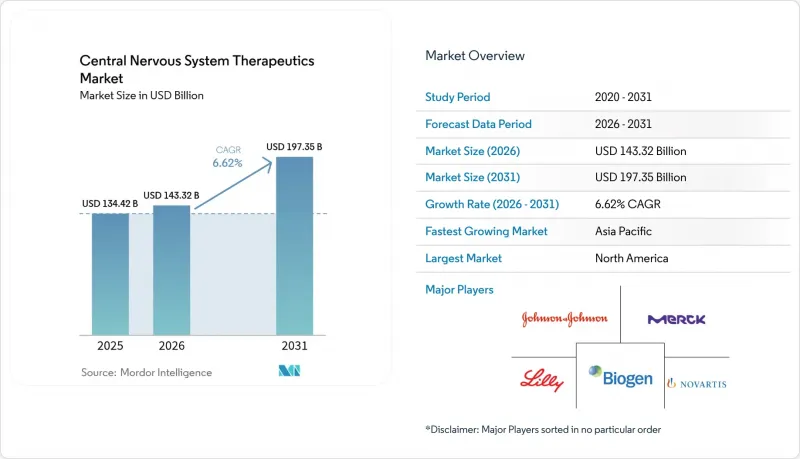
Mordor Intelligence에 의하면, 2026년 중추신경계 치료제 시장 규모는 1,433억 2,000만 달러로 추정되며, 2025년 1,344억 2,000만 달러에서 2031년 예측은 1,973억 5,000만 달러에 달하고, 2026-2031년 CAGR 6.62%를 기록할 전망입니다.
본 보고서는 치료 분야(항우울제, 항정신병제 등), 질환(신경혈관 질환, 외상 등), 제형(저분자 화합물, 생물학적 제제/고분자 화합물), 투여 경로(경구, 비경구, 기타), 지역(북미, 유럽 등)별로 분류되어 있습니다. 시장 전망은 금액(달러) 기준으로 제시되어 있습니다.
전 세계 중추신경계 치료제 시장 동향 및 인사이트
고령화와 중추신경계 질환 유병률의 상승
2024년에는 신경 질환을 앓는 사람이 34억 명에 달할 것으로 예상되며, 이는 장애 조정 생명 연수(DALY)의 주요 원인이 되고 있습니다. 65세를 넘기면 발병률이 급증하여 중추신경계 치료제 시장의 지속적인 수요를 견인하고 있습니다. 선진국에서 인지 기능 저하에 따른 연간 간병 비용은 1조 1,000억 달러에 달하며, 이로 인해 지불 주체들은 시설 입소를 지연시키는 치료법을 지지하게 되었습니다. 따라서 조기 진단과 질병 수정 약물의 병용은 보험사에게 재정적으로 현명한 조치로 간주됩니다. 예측 기간 동안 인구 고령화는 되돌릴 수 없는 현상이므로, 이러한 수요 요인은 중추신경계 치료제 시장에 있어 가장 지속적인 성장 동력으로 남아 있을 것입니다.
독점권 만료 후 제네릭 의약품 시장 침투 확대
미국에서 독점권이 만료된 지 18개월 이내에 ‘릴리카’의 제네릭 의약품이 처방량의 85%를 차지하게 되었습니다. 이는 블록버스터급 중추신경계 브랜드 의약품이 얼마나 급속도로 가격 하락을 겪는지 보여줍니다. 저비용 대안의 등장으로 신흥국 환자들의 접근성이 확대되고 치료 대상 인구가 증가함에 따라, 중추신경계 치료제 시장은 공적 보험자에게 핵심 지출 항목으로 자리 잡아가고 있습니다. 동시에, 오리지널 제약사들은 프리미엄 가격을 책정하여 대체를 막을 수 있는 차세대 의약품이나 새로운 투여 형태의 개발을 가속화하며, 혁신 주기를 활발하게 유지하고 있습니다.
신경학 분야의 높은 임상시험 실패율
신경학 분야의 파이프라인은 92%라는 높은 탈락률로 어려움을 겪고 있으며, 이는 치료 분야 중 최악의 수준입니다. 복잡한 병태생리, 혈액-뇌 장벽의 투과성과 관련된 장벽, 그리고 환자의 증상 다양성이 전임상 단계에서 유망한 결과를 임상적으로 적용하는 데 걸림돌이 되고 있습니다. 엠라크리진이나 달자네무돌과 같은 주목할 만한 실패 사례는 뿌리 깊은 위험성을 여실히 드러내고 있습니다. 자본 집약적인 임상시험은 중소기업의 진입을 가로막고 있으며, 자금력이 있는 제약 기업이 경영난에 빠진 자산을 인수함으로써 업계 재편이 진행되고 있지만, 전반적인 혁신 속도는 둔화되어 중추신경계 치료제 시장의 성장 전망을 어둡게 하고 있습니다.
부문 분석
질환 수정 치료제 부문은 연평균 성장률(CAGR) 6.83%로 확대될 전망이며, 이는 중추신경계 치료제 시장 내의 다른 모든 부문을 능가하는 속도입니다. 항우울제는 1차 진료에서의 광범위한 처방에 힘입어 2025년 25.12%의 점유율로 여전히 판매량 1위를 유지하고 있습니다. 그러나 브리스톨-마이어스 스퀴브가 KarXT에 140억 달러를 투자한 사례에서 볼 수 있듯이, 투자자들의 관심은 질병의 경과를 바꾸는 약물로 이동하고 있습니다. 이러한 거래를 통해 재생 의학, 면역 조절, 시냅스 복구 플랫폼으로 자본이 유입되고 있습니다.
KarXT 인수를 계기로 항정신병 약물은 다시 탄력을 얻고 있는 반면, 항경련제는 제네릭 의약품의 급격한 시장 침투에 직면해 있습니다. 진통제는 이익률 압박으로 어려움을 겪고 있지만, 편두통 치료용 전문 바이오의약품은 가격 경쟁력을 유지하고 있습니다. 신경퇴행성 질환 치료제는 효능이 다소 제한적임에도 불구하고 높은 평가를 받고 있습니다. 이는 질병의 진행을 늦추는 것만으로도 사회 전체에 막대한 비용 절감 효과를 가져오기 때문입니다. 각사가 증상 완화와 질환 수정을 결합한 병용 요법을 시험하고 있어, 중추신경계 치료제 시장에서 기존 치료 분야의 경계가 모호해지고 있으며, 치료법의 융합이 진행되고 있습니다.
우울증은 2025년 매출의 27.55%를 차지했으나, 알츠하이머병은 연평균 성장률(CAGR) 7.05%로 추이할 것으로 예측되며, 이는 적응증 중 가장 높은 성장률입니다. 레카네맙이나 도나네맙과 같은 파이프라인 의약품의 보험 적용으로 인해, 지금까지 개척되지 않았던 수십억 달러 규모의 잠재 시장이 창출되고 있습니다. 정신 질환 적응증은 기존의 임상 현장을 넘어선 접근을 가능하게 하는 디지털 치료법으로부터도 혜택을 받고 있습니다.
신경혈관 장애와 희귀 뇌전증은 여전히 의료 수요가 충분히 충족되지 않은 틈새 영역이며, 희귀질환 치료제로서 가격 결정력을 가지고 있습니다. 중추신경계(CNS)에 대한 바이러스의 잠재적 영향에 관한 연구가 활발해지고 있는 것을 배경으로, 감염증과 관련된 신경학적 후유증 및 종양학과의 교차 치료 시장도 서서히 확대되고 있습니다. 이러한 다양한 질환 수준의 동향은 중추신경계 치료제 시장에서 다중 모드 포트폴리오 전략을 뒷받침하고 있습니다.
지역별 분석
북미는 메디케어 적용 범위 확대와 탄탄한 임상시험 인프라에 힘입어 2025년 매출의 45.01%를 차지했습니다. 미국은 가치 기반 계약을 채택한 정교한 지불자 체계를 통해 시장을 주도하고 있는 반면, 캐나다는 국민건강보험 제도를 통해 안정적인 시장 침투를 실현하고 있습니다. 멕시코는 중산층의 보험 가입률 향상을 배경으로 부상하고 있습니다. 제네릭 의약품의 보급과 구매자 통합에 따른 가격 압박으로 환자 1인당 매출액은 억제되고 있지만, 혁신적인 신제품 출시를 통해 얻는 프리미엄 가격이 이를 상쇄하고 있어 중추신경계 치료제 시장의 리더십을 유지하고 있습니다.
아시아태평양은 성장의 원동력이며, 중국의 규제 완화, 일본의 신속 승인, 인도의 접근성 확대 프로그램에 힘입어 연평균 성장률(CAGR) 7.78%가 예상됩니다. 급속한 도시화는 기분 장애 및 불안 장애의 유병률 상승과 상관관계가 있어 판매량 확대로 이어지고 있습니다. 일본과 한국이 이 지역 임상시험의 핵심을 담당하는 한편, 동남아시아 국가들은 저렴한 제네릭 의약품을 수입하여 의료 보장 범위를 확대되고 있습니다. 신경 질환의 질병 부담에 대한 정부의 인식이 높아짐에 따라, 보험 급여 제도 개혁이 진행되고 시장 가치가 향상되어, 이 지역은 중추신경계 치료제 시장에 있어 매우 중요한 성장 거점이 되고 있습니다.
유럽에서는 EMA(유럽의약품청)가 조정하는 승인 절차와 의료 보장 제도 덕분에 꾸준한 성장이 예상됩니다. 독일과 영국은 탄탄한 심사 기관을 바탕으로 신약 출시를 주도하고 있는 반면, 남유럽 시장은 시장 규모 확대에 기여하고 있습니다. 새로운 임상시험 정보 시스템을 통해 신청 절차가 효율화되어 소요 기간이 다소 단축되었습니다. 비용 대비 효과에 대한 심사는 여전히 엄격하여 경우에 따라 고가 제품의 출시가 지연되기도 하지만, 예측 가능한 환급 결정 덕분에 장기적인 수익 안정성이 확보되고 있습니다. 전반적으로, 유럽 대륙 전체의 이러한 추세는 중추신경계 치료제 시장의 이해관계자들에게 성장 동력과 위험 프로파일을 다각화시키고 있습니다.
기타 혜택:
- 엑셀 형식 시장 예측(ME) 시트
- 3개월간의 애널리스트 지원
자주 묻는 질문
목차
제1장 서론
제2장 조사 방법
제3장 주요 요약
제4장 시장 구도
제5장 시장 규모와 성장 예측
제6장 경쟁 구도
제7장 시장 기회와 향후 전망
LSH 26.09.14According to Mordor Intelligence, central nervous system therapeutics market size in 2026 is estimated at USD 143.32 billion, growing from 2025 value of USD 134.42 billion with 2031 projections showing USD 197.35 billion, growing at 6.62% CAGR over 2026-2031.
This report is Segmented by Therapeutic Class (Antidepressants, Antipsychotics, and More), Diseases (Neurovascular, Trauma, and More), Drug Type (Small Molecule, Biologic/Large Molecule), Route of Administration (Oral, Parenteral, Others), and Geography (North America, Europe, and More). The Market Forecasts are Provided in Terms of Value (USD).
Global Central Nervous System Therapeutics Market Trends and Insights
Aging Population & Rising CNS Disorder Prevalence
Neurological disorders affected 3.4 billion people in 2024, making them the leading global source of disability-adjusted life years. Incidence accelerates beyond age 65, driving sustained demand for the central nervous system therapeutics market. Annual caregiving costs for cognitive decline reached USD 1.1 trillion in developed economies, motivating payers to endorse interventions that delay institutionalization. Early diagnosis paired with disease-modifying drugs is therefore viewed as fiscally prudent by insurers. As demographic aging is irreversible over the forecast horizon, this demand vector remains the single most durable growth catalyst for the central nervous system therapeutics market.
Growing Generic Penetration Post-LOE
Lyrica generics captured 85% of prescription volume within 18 months of US exclusivity loss, illustrating how quickly price erosion strikes blockbuster CNS brands. Lower cost options widen patient access in emerging economies, swelling treated populations and cementing the central nervous system therapeutics market as a core expenditure line for public payers. Simultaneously, originators accelerate next-generation assets and novel delivery modes that command premium pricing and resist substitution, keeping innovation cycles active.
High Clinical Trial Failure Rates in Neurology
A 92% attrition rate afflicts neurological pipelines, the worst among therapeutic areas. Complex pathophysiology, blood-brain-barrier permeability hurdles, and heterogeneous patient presentations thwart translation of preclinical signals. High-profile setbacks such as emraclidine and dalzanemdor underscore persistent risk. Capital-intensive trials deter smaller firms, fostering consolidation as deep-pocketed pharmas acquire distressed assets, yet overall innovation velocity suffers, tempering the growth outlook for the central nervous system therapeutics market.
Other drivers and restraints analyzed in the detailed report include:
- Favorable Reimbursement for Breakthrough CNS Drugs
- Improved Neuroimaging & Biomarker-Based Diagnosis
- Stringent CNS Safety Labeling Requirements
For complete list of drivers and restraints, kindly check the Table Of Contents.
Segment Analysis
The disease-modifying cohort is on track to expand at a 6.83% CAGR, outpacing all other categories inside the central nervous system therapeutics market. Antidepressants remain the volume leader at 25.12% 2025 share, sustained by widespread prescribing in primary care. Investor interest has pivoted, however, toward agents that alter disease course, exemplified by Bristol Myers Squibb's USD 14 billion outlay for KarXT. These transactions channel capital into regenerative pathways, immunomodulation, and synaptic repair platforms.
Antipsychotics receive renewed momentum following KarXT, while antiepileptics confront steep generic penetration. Analgesics suffer margin squeeze, yet specialty migraine biologics retain pricing strength. Neurodegeneration assets attract premium valuations despite modest efficacy because any delay in progression yields sizeable societal savings. Convergence is emerging as firms test combo regimens pairing symptomatic relief with disease modification, blurring historic therapeutic silos within the central nervous system therapeutics market.
Depression kept 27.55% of 2025 revenues, but Alzheimer's disease is forecast to post a 7.05% CAGR, the fastest among indications. Reimbursement of lecanemab and pipeline agents such as donanemab creates a multibillion-dollar addressable segment that was previously untapped. Mental-health indications also benefit from digital therapeutics that extend reach beyond traditional clinical settings.
Neurovascular disorders and rare epilepsies remain underserved niches offering orphan-drug pricing power. Infection-linked neurological sequelae and oncology crossover therapies are slowly enlarging, aided by heightened research into latent viral impacts on the CNS. These diverse disease-level dynamics reinforce multi-modal portfolio strategies inside the central nervous system therapeutics market.
Complete Report Scope:
- By Therapeutic Class (Value)
- Antidepressants
- Antipsychotics
- Antiepileptics
- Analgesics (Neuropathic & Migraine)
- Disease-Modifying (MS, ALS, etc.)
- Neurodegeneration (AD, PD)
- Others
- By Diseses
- Neurovascular Diseases
- Trauma
- Mental Health
- Anxiety Disorders
- Epilepsy
- Psychotic Disorders
- Other Mental Health Disorders
- Degenerative Diseases
- Alzheimer's Disease
- Parkinson's Disease
- Multiple Sclerosis
- Amyotrophic Lateral Sclerosis
- Other Degenerative Diseases
- Infectious Diseases
- Cancer
- Other Diseases
- By Drug Type (Value)
- Small Molecule
- Biologic /Large Molecule
- By Route of Administration (Value)
- Oral
- Parenteral
- Others
- By Geography (Value)
- North America
- United States
- Canada
- Mexico
- Europe
- Germany
- United Kingdom
- France
- Italy
- Spain
- Rest of Europe
- Asia-Pacific
- China
- India
- Japan
- South Korea
- Australia
- Rest of Asia-Pacific
- South America
- Brazil
- Argentina
- Rest of South America
- Middle East and Africa
- GCC
- South Africa
- Rest of Middle East and Africa
- North America
Geography Analysis
North America accounted for 45.01% of 2025 revenue, underpinned by Medicare coverage expansions and dense clinical-trial infrastructure. The United States leads with sophisticated payer frameworks that adopt value-based contracts, whereas Canada provides stable uptake through universal coverage. Mexico is emerging on the back of growing middle-class insurance penetration. Pricing pressures from generic proliferation and buyer consolidation temper revenue per patient but are offset by the premium commanded by innovative launches, sustaining leadership for the central nervous system therapeutics market.
Asia-Pacific is the growth heartbeat, projected at 7.78% CAGR, driven by China's regulatory liberalization, Japan's fast-track approvals, and India's expanding access programs. Rapid urbanization correlates with higher incidence of mood and anxiety disorders, unlocking volume. Japan and South Korea anchor regional clinical trials, while Southeast Asian nations import affordable generics to widen coverage. Government recognition of neurological disease burden is translating into reimbursement reforms that uplift market value, positioning the region as a pivotal expansion arena for the central nervous system therapeutics market.
Europe delivers steady gains through EMA-coordinated pathways and universal healthcare. Germany and the United Kingdom dominate launches due to robust assessment agencies, whereas southern European markets contribute scale. The new Clinical Trials Information System streamlines submissions, slightly trimming timelines. Cost-effectiveness scrutiny remains stringent, sometimes delaying premium products, yet predictable reimbursement decisions create long-tail revenue stability. Collectively, these continental patterns diversify growth drivers and risk profiles for stakeholders in the central nervous system therapeutics market.
- Biogen
- Pfizer
- Eli Lilly and Company
- Johnson & Johnson
- Novartis
- Otsuka
- Lundbeck A/S
- Teva Pharmaceutical Industries
- UCB
- GlaxoSmithKline
- Merck
- Roche
- Amgen
- AstraZeneca
- Takeda Pharmaceuticals
- Sunovion Pharmaceuticals
- Jazz Pharmaceuticals plc
- ACADIA Pharmaceuticals Inc.
- Sage Therapeutics
- Marinus Pharmaceuticals, Inc.
- GW Pharmaceuticals
Additional Benefits:
- The market estimate (ME) sheet in Excel format
- 3 months of analyst support
TABLE OF CONTENTS
1 Introduction
- 1.1 Study Assumptions & Market Definition
- 1.2 Scope of the Study
2 Research Methodology
3 Executive Summary
4 Market Landscape
- 4.1 Market Overview
- 4.2 Market Drivers
- 4.2.1 Aging population & rising CNS disorder prevalence
- 4.2.2 Growing generic penetration post-LOE
- 4.2.3 Favorable reimbursement for breakthrough CNS drugs
- 4.2.4 Improved neuroimaging & biomarker-based diagnosis
- 4.2.5 Psychedelic-assisted therapy clinical wins
- 4.2.6 Venture funding into CNS-focused digital twins
- 4.3 Market Restraints
- 4.3.1 High clinical trial failure rates in neurology
- 4.3.2 Generic erosion of blockbusters (e.g., Lyrica)
- 4.3.3 Stringent CNS safety labeling requirements
- 4.3.4 Supply-chain scarcity of specialized excipients
- 4.4 Value / Supply-Chain Analysis
- 4.5 Regulatory Landscape
- 4.6 Technological Outlook
- 4.7 Porter's Five Forces
- 4.7.1 Threat of New Entrants
- 4.7.2 Bargaining Power of Buyers
- 4.7.3 Bargaining Power of Suppliers
- 4.7.4 Threat of Substitutes
- 4.7.5 Competitive Rivalry
5 Market Size & Growth Forecasts
- 5.1 By Therapeutic Class (Value)
- 5.1.1 Antidepressants
- 5.1.2 Antipsychotics
- 5.1.3 Antiepileptics
- 5.1.4 Analgesics (Neuropathic & Migraine)
- 5.1.5 Disease-Modifying (MS, ALS, etc.)
- 5.1.6 Neurodegeneration (AD, PD)
- 5.1.7 Others
- 5.2 By Diseses
- 5.2.1 Neurovascular Diseases
- 5.2.2 Trauma
- 5.2.3 Mental Health
- 5.2.3.1 Anxiety Disorders
- 5.2.3.2 Epilepsy
- 5.2.3.3 Psychotic Disorders
- 5.2.3.4 Other Mental Health Disorders
- 5.2.4 Degenerative Diseases
- 5.2.4.1 Alzheimer's Disease
- 5.2.4.2 Parkinson's Disease
- 5.2.4.3 Multiple Sclerosis
- 5.2.4.4 Amyotrophic Lateral Sclerosis
- 5.2.4.5 Other Degenerative Diseases
- 5.2.5 Infectious Diseases
- 5.2.6 Cancer
- 5.2.7 Other Diseases
- 5.3 By Drug Type (Value)
- 5.3.1 Small Molecule
- 5.3.2 Biologic /Large Molecule
- 5.4 By Route of Administration (Value)
- 5.4.1 Oral
- 5.4.2 Parenteral
- 5.4.3 Others
- 5.5 By Geography (Value)
- 5.5.1 North America
- 5.5.1.1 United States
- 5.5.1.2 Canada
- 5.5.1.3 Mexico
- 5.5.2 Europe
- 5.5.2.1 Germany
- 5.5.2.2 United Kingdom
- 5.5.2.3 France
- 5.5.2.4 Italy
- 5.5.2.5 Spain
- 5.5.2.6 Rest of Europe
- 5.5.3 Asia-Pacific
- 5.5.3.1 China
- 5.5.3.2 India
- 5.5.3.3 Japan
- 5.5.3.4 South Korea
- 5.5.3.5 Australia
- 5.5.3.6 Rest of Asia-Pacific
- 5.5.4 South America
- 5.5.4.1 Brazil
- 5.5.4.2 Argentina
- 5.5.4.3 Rest of South America
- 5.5.5 Middle East and Africa
- 5.5.5.1 GCC
- 5.5.5.2 South Africa
- 5.5.5.3 Rest of Middle East and Africa
- 5.5.1 North America
6 Competitive Landscape
- 6.1 Market Concentration
- 6.2 Market Share Analysis
- 6.3 Company Profiles (includes Global level Overview, Market level overview, Core Segments, Financials as available, Strategic Information, Market Rank/Share for key companies, Products & Services, and Recent Developments)
- 6.3.1 Biogen Inc.
- 6.3.2 Pfizer Inc.
- 6.3.3 Eli Lilly and Company
- 6.3.4 Johnson & Johnson (Janssen)
- 6.3.5 Novartis AG
- 6.3.6 Otsuka Holdings Co., Ltd.
- 6.3.7 Lundbeck A/S
- 6.3.8 Teva Pharmaceutical Industries Ltd.
- 6.3.9 UCB S.A.
- 6.3.10 GlaxoSmithKline plc
- 6.3.11 Merck & Co., Inc.
- 6.3.12 Roche Holding AG
- 6.3.13 Amgen Inc.
- 6.3.14 AstraZeneca plc
- 6.3.15 Takeda Pharmaceutical Company Limited
- 6.3.16 Sunovion Pharmaceuticals Inc.
- 6.3.17 Jazz Pharmaceuticals plc
- 6.3.18 ACADIA Pharmaceuticals Inc.
- 6.3.19 Sage Therapeutics, Inc.
- 6.3.20 Marinus Pharmaceuticals, Inc.
- 6.3.21 GW Pharmaceuticals plc
7 Market Opportunities & Future Outlook
- 7.1 White-space & Unmet-Need Assessment