
|
시장보고서
상품코드
2124629
스마트 개인보호장비 : 시장 점유율 분석, 업계 동향과 통계, 성장 예측(2026-2031년)Smart Personal Protective Equipment - Market Share Analysis, Industry Trends & Statistics, Growth Forecasts (2026 - 2031) |
||||||
 Mordor Intelligence
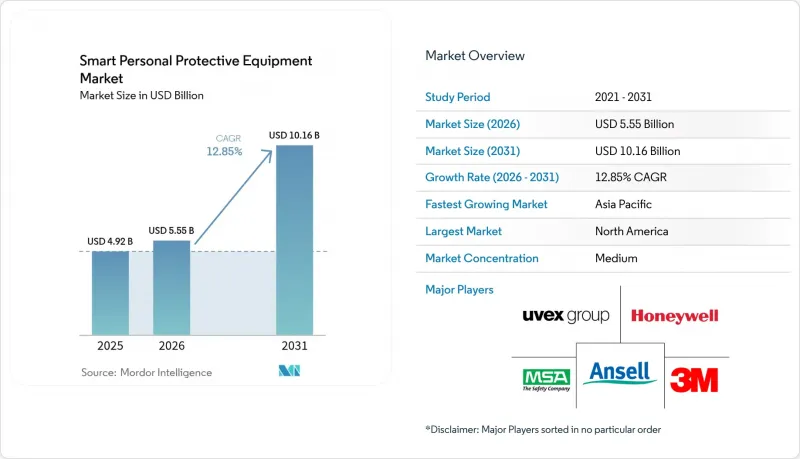
Mordor Intelligence에 의하면, 스마트 개인보호장비(PPE) 시장 규모는 2025년에 49억 2,000만 달러로 평가되었고, 2026년 55억 5,000만 달러에서 2031년까지 101억 6,000만 달러에 이를 것으로 예측되며, 예측 기간(2026-2031년) CAGR은 12.85%를 기록할 전망입니다.
본 보고서는 유형별(눈·안면 보호, 청각 보호 등), 기술별(IoT 지원 PPE, AR/VR 지원 스마트 글래스 등), 연결 방식별(Bluetooth Low Energy, Wi-Fi 등), 센서 유형별(환경 센서 등), 최종 사용자 산업별(건설, 석유 및 가스 등),및 지역별로 분류되어 있습니다. 시장 예측은 금액(달러) 기준으로 제시되어 있습니다.
전 세계 스마트 개인보호구(PPE)(PPE) 시장 동향 및 인사이트
유럽 및 북미의 엄격한 안전 규제
OSHA의 2025년 발열 안전 규정은 실시간 생리적 모니터링을 의무화하고 있으며, 개정된 착용 지침을 통해 여성 및 체구가 작은 근로자에 대한 보호상의 공백이 해소되었습니다. 유럽의 GDPR(EU 개인정보보호규정)에 따른 제약은 지속적인 생체 인식이 사생활 침해 우려를 야기하기 때문에 역설을 낳고 있습니다. 각 제조업체는 데이터를 익명화하면서도 즉시 경보를 발령할 수 있는 엣지 컴퓨팅 지원 스마트 글라스로 이에 대응하고 있습니다. 기업의 구매 담당자들은 이러한 하이브리드 솔루션을 규정 준수 및 개인정보 보호 요건을 모두 충족하기 위한 최적의 수단으로 간주하고 있습니다.
지하 광산에서의 실시간 생체 정보 및 위치 정보 모니터링
가스 센서가 내장된 스마트 헬멧은 유독 가스 감지 정확도 97%를 실현하여, 깊은 광산에서의 대응 시간을 절반으로 단축합니다. BLE 비콘과 6G 백홀을 결합함으로써, 지금까지 도달하지 못했던 갱도까지 커버 범위를 확대합니다. 운영자는 가스, 온도, 위치 정보를 종합하여 환기 시스템을 미세 조정하고, 예측 유지보수 일정을 수립함으로써 스마트 PPE를 단순한 안전 장비에 그치지 않고 운영 인텔리전스의 한 축으로 자리매김하고 있습니다.
중소기업의 고액 초기 투자와 불투명한 ROI
스마트 PPE는 기존 장비에 비해 300%에서 500% 더 높은 비용이 드는 경우가 많아, 많은 중소기업이 도입을 미루고 있습니다. 모듈식 사후 장착 키트나 ‘PPE-as-a-Service’ 리스를 통해 자본 집약도는 낮아졌으며, 센서 가격 하락으로 인해 라틴아메리카의 제조업체들도 단계적으로 도입할 수 있게 되었습니다.
부문 분석
2025년, 개인보호장비는 매출 점유율의 29.76%를 차지하며 멀티 센서 어레이의 핵심 계층으로서의 입지를 공고히 했습니다. 스마트 조끼는 착용감을 해치지 않으면서 온도, 가스, 자세 추적 기능을 융합하고 있습니다. 이 카테고리는 전도성 섬유의 대규모 통합을 가능하게 하는 확립된 섬유 공급망의 혜택을 받고 있습니다. 또한 표면적이 넓기 때문에 섬유 배터리를 내장할 수 있어 장시간 근무 중 가동 시간 문제를 해결하고 있습니다.
스마트 장갑은 연평균 성장률(CAGR) 14.11%를 기록하며, 이 부문 내에서 가장 높은 성장률을 보이고 있습니다. 음성 조작이 필요 없는 제스처 인식과 햅틱 피드백을 통해 기술자는 내화학성 보호 장비를 착용한 상태에서도 자동화 시스템과 상호작용할 수 있습니다. 제조업체들은 악력 데이터를 측정하는 마이크로 전기기계 센서를 추가하고 있으며, 감독자는 이 데이터를 분석하여 근골격계의 부하 패턴을 파악합니다. 이러한 분석을 통해 가동 중단 시간을 최소화하고 생산성을 향상시킬 수 있습니다.
2025년, IoT 지원 PPE는 스마트 개인보호구(PPE) 시장의 60.85%를 차지하며 클라우드 분석 및 차량 관리의 기반을 형성했습니다. 표준화된 API를 통해 기업은 여러 유형의 PPE를 단일 대시보드에 통합하고, 사고 정보를 기업 자원 계획(ERP) 모듈에 직접 연동할 수 있습니다. 이러한 통합성은 개념 증명(PoC) 주기를 단축시키고, 수년에 걸친 교체 계약의 기반이 됩니다.
연평균 성장률(CAGR) 13.04%로 성장하고 있는 AR/VR 스마트 글래스는 핸즈프리 지침 및 원격 전문가 지원을 제공합니다. 배터리 기술의 발전으로 1교대 근무 시간 동안의 연속 작동이 가능해져, 기존 도입 장벽이 해소되었습니다. 이 하드웨어에는 열화상 기능이 통합되어 있어, 사용자의 시야에 히트맵을 중첩시켜 접촉 전에 고온 표면을 경고합니다. AI 기반 예측 안전 소프트웨어는 센서 동향을 분석하여 아차 사고 시나리오를 예측하고, 예방적 경고를 발령합니다.
지역별 분석
2025년, 북미는 전 세계 매출의 39.98%를 차지했습니다. OSHA(미국 직업안전보건청)의 열사병 대책 의무화뿐만 아니라 보험료 우대 조치에 힘입어 커넥티드 워커 프로그램은 표준 관행으로 자리 잡았습니다. 셰브론(Chevron)사의 수분 보충 패치 도입은 열사병 관련 사고 및 산재 보상 비용의 측정 가능한 감소를 입증하는 벤치마크 사례가 되었습니다. 성숙한 4G/5G 통신망과 견고한 데이터 보호 프레임워크가 대규모 도입을 뒷받침하고 있습니다.
아시아태평양은 2031년까지 연평균 성장률(CAGR) 12.96%로 성장하고 있습니다. 중국에서는 PPE(개인보호구(PPE))에 관한 권장 지침이 법적 요건으로 전환되면서 해당 시장 규모가 즉시 확대되었습니다. 일본의 오사카·간사이 엑스포에서는 300명의 청소 직원을 대상으로 열 스트레스 대응 웨어러블 기기의 실증 실험이 진행되었으며, 감독자를 위한 실시간 대시보드가 공개되었습니다. 인도의 ‘SAMARTH Udyog Bharat 4.0’ 정책은 스마트 PPE를 국가적 제조업 현대화에 통합하여 안전성과 생산성을 동시에 도모하고 있습니다.
유럽에서는 꾸준한 보급세가 나타나고 있습니다. GDPR(EU 개인정보보호규정)(일반 데이터 보호 규정)이 엣지 처리 도입을 촉진하는 한편, 지속가능성 목표에 따라 구매자들은 폐기물을 줄여주는 내구성이 높고 센서가 풍부하게 탑재된 작업복으로 전환하고 있습니다. 중동 및 아프리카에서는 의료 인프라가 부족한 외딴 지역의 고온 유전이나 심부 광산에서 스마트 PPE가 활용되고 있습니다. 라틴아메리카에서는 센서 비용의 하락과 중소기업의 진입 장벽을 낮추는 ‘PPE-as-a-Service(서비스형 PPE)’ 모델의 부상으로 혜택을 보고 있습니다.
기타 혜택:
- 엑셀 형식 시장 예측(ME) 시트
- 3개월간의 애널리스트 지원
자주 묻는 질문
목차
제1장 서론
제2장 조사 방법
제3장 주요 요약
제4장 시장 구도
제5장 시장 규모와 성장 예측
제6장 경쟁 구도
제7장 시장 기회와 향후 전망
LSH 26.09.14According to Mordor Intelligence, the smart personal protective equipment market size was valued at USD 4.92 billion in 2025 and estimated to grow from USD 5.55 billion in 2026 to reach USD 10.16 billion by 2031, at a CAGR of 12.85% during the forecast period (2026-2031).
This report is Segmented by Type (Eye and Face Protection, Hearing Protection, and More), Technology (IoT-Enabled PPE, AR/VR-Enabled Smart Glasses, and More), Connectivity (Bluetooth Low Energy, Wi-Fi, and More), Sensor Type (Environmental Sensors, and More), End-User Industry (Construction, Oil and Gas, and More), and by Geography. The Market Forecasts are Provided in Terms of Value (USD).
Global Smart Personal Protective Equipment Market Trends and Insights
Stringent Safety Regulations in Europe and North America
OSHA's 2025 heat-safety rule compels real-time physiological monitoring, and updated fitting guidelines close protection gaps for female and smaller-statured workers. European GDPR constraints create a paradox because continuous biometrics raise privacy concerns. Manufacturers respond with edge-computing smart glasses that anonymize data yet still trigger instant alerts. Enterprise buyers see these hybrid solutions as the optimal route to meet dual compliance and privacy requirements.
Real-time Biometric and Location Monitoring in Underground Mining
Smart helmets with integrated gas sensors deliver 97% toxic-gas detection accuracy and cut response times by half in deep mines. BLE beacons combined with 6G backhaul extend coverage to previously unreachable shafts. Operators aggregate gas, temperature, and location data to fine-tune ventilation systems and schedule predictive maintenance, framing smart PPE as an operational intelligence layer rather than a simple safety accessory.
High Up-front Investment and Uncertain ROI for SMEs
Smart PPE often costs 300 % to 500 % more than conventional gear, so many small enterprises delay adoption. Modular retrofit kits and PPE-as-a-Service leasing reduce capital intensity, while falling sensor prices make phased rollouts viable for Latin American manufacturers.
Other drivers and restraints analyzed in the detailed report include:
- Connected-Worker Programs Lowering Insurance Costs in Oil and Gas
- Construction-4.0 Megaprojects in Asia Pacific
- GDPR and CCPA Restricting Continuous Biometric Capture
For complete list of drivers and restraints, kindly check the Table Of Contents.
Segment Analysis
Body protection held a 29.76% revenue share in 2025, cementing its status as the anchor layer for multi-sensor arrays. Smart vests fuse temperature, gas, and posture tracking without compromising comfort. This category benefits from established textile supply chains that enable conductive fiber integration at scale. The large surface area also supports embedded fiber batteries, solving run-time challenges during extended shifts.
Smart gloves are tracking a 14.11% CAGR, the fastest within the segment. Voice-free gesture recognition and haptic feedback allow technicians to interact with automation systems while wearing chemical-resistant protection. Manufacturers add micro-electromechanical sensors that tally grip-force data, which supervisors mine to identify musculoskeletal strain patterns. These analytics minimize downtime and elevate productivity.
IoT-enabled PPE retained 60.85% of the smart personal protective equipment market in 2025, forming the backbone for cloud analytics and fleet management. Standardized APIs let enterprises plug multiple PPE types into a single dashboard and feed incidents directly into enterprise resource planning modules. This uniformity shortens proof-of-concept cycles and underpins multiyear replacement contracts.
AR/VR smart glasses, growing at 13.04% CAGR, provide hands-free instructions and remote expert support. Battery advances now allow a full shift of operation, removing a historical adoption barrier. The hardware integrates thermal imaging, which overlays heat maps onto the user's view to flag hot surfaces before contact. AI-driven predictive safety software mines sensor trends to forecast near-miss scenarios, pushing preemptive warnings.
Complete Report Scope:
- By Type
- Eye and Face Protection
- Hearing Protection
- Head Protection
- Respiratory Protection
- Hand Protection (Smart Gloves)
- Body Protection (Smart Clothing and Vests)
- Fall Protection Devices
- Foot Protection (Smart Footwear)
- Integrated Multi-Sensor PPE
- By Technology
- IoT-Enabled PPE
- AR/VR-Enabled Smart Glasses
- AI-Based Predictive Safety Analytics
- Cloud-Connected PPE Platforms
- By Connectivity
- Bluetooth Low Energy
- Wi-Fi
- Cellular (4G/LTE/5G)
- Zigbee / LPWAN
- Wired
- By Sensor Type
- Environmental Sensors (Gas/Temperature/Humidity)
- Motion and Proximity Sensors
- Biometric and Vital-Sign Sensors
- By End-user Industry
- Construction
- Oil and Gas
- Mining
- Manufacturing
- Automotive
- Chemicals and Pharmaceuticals
- Utilities (Energy and Power)
- Healthcare and Life Sciences
- Firefighting and Law Enforcement
- Transportation and Logistics
- By Geography
- North America
- United States
- Canada
- Mexico
- South America
- Brazil
- Argentina
- Chile
- Rest of South America
- Europe
- Germany
- France
- United Kingdom
- Italy
- Spain
- Rest of Europe
- Asia Pacific
- China
- Japan
- India
- South Korea
- ASEAN
- Australia
- New Zealand
- Rest of Asia Pacific
- Middle East and Africa
- Middle East
- GCC
- Turkey
- Israel
- Rest of Middle East
- Africa
- South Africa
- Nigeria
- Egypt
- Rest of Africa
- Middle East
- North America
Geography Analysis
North America generated 39.98% of global revenue in 2025. OSHA's heat-safety mandate plus insurance premium incentives have cemented connected-worker programs as standard practice. Chevron's hydration-patch deployment provides benchmark evidence, demonstrating measurable reductions in heat events and workers-comp costs. Mature 4G/5G coverage and robust data-protection frameworks underpin large-scale rollouts.
Asia Pacific is advancing at a 12.96% CAGR through 2031. China converted advisory PPE guidelines into binding requirements, immediately enlarging the addressable base. Japan's Osaka-Kansai Expo acted as a live laboratory for heat-stress wearables on 300 cleaning staff, showcasing real-time dashboards for supervisors. India's SAMARTH Udyog Bharat 4.0 policy weaves smart PPE into national manufacturing modernization, aligning safety with productivity.
Europe records steady uptake. GDPR drives edge-processing adoption, while sustainability goals shift buyers toward durable, sensor-rich garments that reduce waste. The Middle East and Africa leverage smart PPE in high-temperature oil fields and deep mines where remote medical infrastructure is sparse. Latin America benefits from falling sensor costs and emerging PPE-as-a-Service models that lower entry barriers for SMEs.
- Honeywell International Inc.
- 3M Company
- MSA Safety Inc.
- Ansell Ltd.
- Uvex Group
- DuPont de Nemours Inc.
- Intellinium
- Corvex Connected Worker
- Guardhat Inc.
- Kenzen Inc.
- Tenacious Holdings Inc. (Ergodyne)
- Vuzix Corp.
- Iristick NV
- Draegerwerk AG
- Cybertree Technologies (Modjoul)
- Optrel AG
- Seebo Interactive Ltd. (Augury)
- Climax Technologies
- Forcite
Additional Benefits:
- The market estimate (ME) sheet in Excel format
- 3 months of analyst support
TABLE OF CONTENTS
1 INTRODUCTION
- 1.1 Study Assumptions and Market Definition
- 1.2 Scope of the Study
2 RESEARCH METHODOLOGY
3 EXECUTIVE SUMMARY
4 MARKET LANDSCAPE
- 4.1 Market Overview
- 4.2 Market Drivers
- 4.2.1 Stringent Safety Regulations in Europe and North America
- 4.2.2 Real-time Biometric and Location Monitoring in Underground Mining
- 4.2.3 Connected-Worker Programs Lowering Insurance Costs in Oil and Gas
- 4.2.4 Construction-4.0 Megaprojects in Asia-Pacific
- 4.2.5 Post-COVID Demand for Contact-less Safety Monitoring in Manufacturing
- 4.2.6 Declining IoT Sensor Costs Driving SME Retro-fit Adoption (LatAm)
- 4.3 Market Restraints
- 4.3.1 High Up-front Investment and Uncertain ROI for SMEs
- 4.3.2 GDPR and CCPA Restricting Continuous Biometric Capture
- 4.3.3 Battery-Life Constraints Causing Device Downtime in Remote Sites
- 4.3.4 Lack of Interoperability Across PPE and IoT Platforms
- 4.4 Value / Supply-Chain Analysis
- 4.5 Regulatory Outlook
- 4.6 Porter's Five Forces
- 4.6.1 Bargaining Power of Suppliers
- 4.6.2 Bargaining Power of Buyers
- 4.6.3 Threat of New Entrants
- 4.6.4 Threat of Substitutes
- 4.6.5 Competitive Rivalry
- 4.7 Investment Analysis
5 MARKET SIZE AND GROWTH FORECASTS (VALUE)
- 5.1 By Type
- 5.1.1 Eye and Face Protection
- 5.1.2 Hearing Protection
- 5.1.3 Head Protection
- 5.1.4 Respiratory Protection
- 5.1.5 Hand Protection (Smart Gloves)
- 5.1.6 Body Protection (Smart Clothing and Vests)
- 5.1.7 Fall Protection Devices
- 5.1.8 Foot Protection (Smart Footwear)
- 5.1.9 Integrated Multi-Sensor PPE
- 5.2 By Technology
- 5.2.1 IoT-Enabled PPE
- 5.2.2 AR/VR-Enabled Smart Glasses
- 5.2.3 AI-Based Predictive Safety Analytics
- 5.2.4 Cloud-Connected PPE Platforms
- 5.3 By Connectivity
- 5.3.1 Bluetooth Low Energy
- 5.3.2 Wi-Fi
- 5.3.3 Cellular (4G/LTE/5G)
- 5.3.4 Zigbee / LPWAN
- 5.3.5 Wired
- 5.4 By Sensor Type
- 5.4.1 Environmental Sensors (Gas/Temperature/Humidity)
- 5.4.2 Motion and Proximity Sensors
- 5.4.3 Biometric and Vital-Sign Sensors
- 5.5 By End-user Industry
- 5.5.1 Construction
- 5.5.2 Oil and Gas
- 5.5.3 Mining
- 5.5.4 Manufacturing
- 5.5.5 Automotive
- 5.5.6 Chemicals and Pharmaceuticals
- 5.5.7 Utilities (Energy and Power)
- 5.5.8 Healthcare and Life Sciences
- 5.5.9 Firefighting and Law Enforcement
- 5.5.10 Transportation and Logistics
- 5.6 By Geography
- 5.6.1 North America
- 5.6.1.1 United States
- 5.6.1.2 Canada
- 5.6.1.3 Mexico
- 5.6.2 South America
- 5.6.2.1 Brazil
- 5.6.2.2 Argentina
- 5.6.2.3 Chile
- 5.6.2.4 Rest of South America
- 5.6.3 Europe
- 5.6.3.1 Germany
- 5.6.3.2 France
- 5.6.3.3 United Kingdom
- 5.6.3.4 Italy
- 5.6.3.5 Spain
- 5.6.3.6 Rest of Europe
- 5.6.4 Asia Pacific
- 5.6.4.1 China
- 5.6.4.2 Japan
- 5.6.4.3 India
- 5.6.4.4 South Korea
- 5.6.4.5 ASEAN
- 5.6.4.6 Australia
- 5.6.4.7 New Zealand
- 5.6.4.8 Rest of Asia Pacific
- 5.6.5 Middle East and Africa
- 5.6.5.1 Middle East
- 5.6.5.1.1 GCC
- 5.6.5.1.2 Turkey
- 5.6.5.1.3 Israel
- 5.6.5.1.4 Rest of Middle East
- 5.6.5.2 Africa
- 5.6.5.2.1 South Africa
- 5.6.5.2.2 Nigeria
- 5.6.5.2.3 Egypt
- 5.6.5.2.4 Rest of Africa
- 5.6.5.1 Middle East
- 5.6.1 North America
6 COMPETITIVE LANDSCAPE
- 6.1 Market Concentration
- 6.2 Strategic Moves
- 6.3 Market Share Analysis
- 6.4 Company Profiles {(includes Global level Overview, Market level overview, Core Segments, Financials as available, Strategic Information, Market Rank/Share, Products and Services, Recent Developments)}
- 6.4.1 Honeywell International Inc.
- 6.4.2 3M Company
- 6.4.3 MSA Safety Inc.
- 6.4.4 Ansell Ltd.
- 6.4.5 Uvex Group
- 6.4.6 DuPont de Nemours Inc.
- 6.4.7 Intellinium
- 6.4.8 Corvex Connected Worker
- 6.4.9 Guardhat Inc.
- 6.4.10 Kenzen Inc.
- 6.4.11 Tenacious Holdings Inc. (Ergodyne)
- 6.4.12 Vuzix Corp.
- 6.4.13 Iristick NV
- 6.4.14 Draegerwerk AG
- 6.4.15 Cybertree Technologies (Modjoul)
- 6.4.16 Optrel AG
- 6.4.18 Seebo Interactive Ltd. (Augury)
- 6.4.19 Climax Technologies
- 6.4.20 Forcite
7 MARKET OPPORTUNITIES AND FUTURE OUTLOOK
- 7.1 White-Space and Unmet-Need Assessment