

|
시장보고서
상품코드
2124637
유럽의 생분해성 컵 : 시장 점유율 분석, 업계 동향 및 통계, 성장 예측(2026-2031년)Europe Biodegradable Cups - Market Share Analysis, Industry Trends & Statistics, Growth Forecasts (2026 - 2031) |
||||||
 Mordor Intelligence
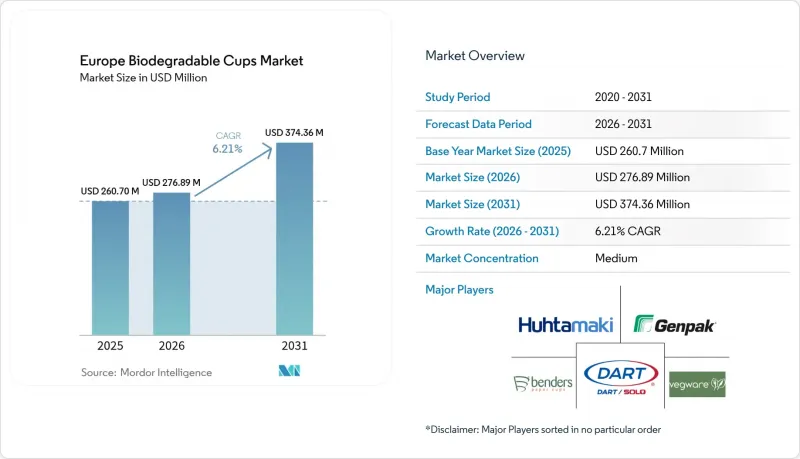
Mordor Intelligence에 의하면, 유럽의 생분해성 컵 시장 규모는 2025년 2억 6,070만 달러로 평가되었습니다. 2026년에는 2억 7,689만 달러로 확대되어 2026년부터 2031년에 걸쳐 CAGR 6.21%로 성장을 지속하여, 2031년에는 3억 7,436만 달러에 이를 것으로 예측됩니다.
본 보고서는 소재 유형(바이오플라스틱, 종이, 사탕수수 찌꺼기, 식물 섬유), 용도(음료, 식품), 최종 사용자(외식 산업, 공공기관, 일반 가정), 유통 채널(오프라인, 온라인) 및 지역(영국, 독일, 프랑스, 이탈리아, 스페인, 베네룩스, 기타 유럽)별로 분류되어 있습니다. 시장 전망은 금액(달러) 기준으로 제시되어 있습니다.
유럽의 생분해성 컵 시장 동향 및 인사이트
지속 가능한 외식 산업용 포장재에 대한 수요 증가
유럽 소비자들은 일회용 플라스틱에 대한 거부감을 점점 더 강하게 나타내고 있습니다. 2024년 유로바로미터 조사에 따르면, 현재 78%의 소비자가 이용처를 선택할 때 지속가능성을 고려하고 있는 것으로 보고되었습니다. 계약 급식 업체와 퀵서비스 체인은 이러한 소비자 의식을 조달 정책에 반영하고 있으며, 그 예로 컴퍼스 그룹이 2,000개 지점에서 컵 구매의 62%를 퇴비화 가능한 소재로 전환한 것을 들 수 있습니다. 맥도날드는 2025년 2월, 영국 및 아일랜드의 모든 매장에서 폴리에틸렌 라이너를 제거하고 수성 코팅이 된 섬유 컵을 도입하겠다고 약속했습니다. EU의 규제 또한 이러한 추세를 뒷받침하고 있으며, 2030년까지 모든 포장재를 재활용 가능하거나 퇴비화 가능하도록할 것을 의무화하고 있습니다. 가격에 대한 수용도는 제각각으로, 스웨덴 고객은 최대 12%의 가격 인상을 수용하는 반면, 가격에 민감한 이탈리아나 스페인의 사업자들은 전환 시 비용의 동등성을 요구하고 있습니다.
엄격한 EU 일회용 플라스틱 규제
회원국들은 2024년까지 ‘일회용 플라스틱 지침’의 완전한 이행을 달성하고, 규제의 허점을 메우며, 금지 범위를 확대했습니다. 스페인에서는 2024년 1월부터 음식점에서 퇴비화 불가능한 컵의 사용이 금지되었으며, 위반 시 최대 60만 유로의 벌금이 부과됩니다. 프랑스의 AGEC 법에서는 2025년까지 재사용 가능한 포장재 비율을 20%로 한 반면, 옥소분해성 플라스틱이 금지됨에 따라 인증된 퇴비화 가능 컵에 대한 단기적인 수요가 증가했습니다. 이탈리아에서는 현재 일회용 컵에 최소 40%의 바이오 소재를 포함하도록 의무화하고 있어, 실질적으로 PLA 코팅이나 섬유 소재 대체품에 대한 진열 공간이 확보되고 있습니다. 독일과 네덜란드에서는 재활용이 불가능한 컵에 대해 확대 생산자 책임(EPR) 수수료가 부과되고 있으며, 기존 플라스틱의 상대적 비용이 상승함에 따라 유럽에서 생분해성 컵의 도입이 가속화되고 있습니다.
기존 종이 및 플라스틱 컵과의 비용 차이
2025년 1분기, 12온스 PLA 라이닝 컵의 판매 가격은 0.09-0.12유로였던 반면, 폴리에틸렌 코팅 제품은 0.07-0.09유로로 15-25%의 가격 프리미엄이 발생해 이익률이 제한적인 카페 입장에서는 이를 감당하기 어려운 상황이 되었습니다. 특히 남유럽의 독립 운영업체들은 높은 가격 탄력성을 보이며, 54%가 단가가 0.03유로 이상 상승할 경우 전환을 연기하겠다고 응답했습니다. 독일과 프랑스에서는 EPR(확대 생산자 책임) 수수료로 인해 인증된 컵으로의 전환에 따른 비용 부담이 경감되고 있지만, 이탈리아와 중부 유럽에서는 이와 같은 상쇄 효과가 여전히 미미한 수준에 그치고 있어, 유럽의 생분해성 컵 시장에서 판매량의 전환을 억제하는 요인이 되고 있습니다.
부문별 분석
바이오플라스틱은 가장 빠르게 성장하는 소재 카테고리이며, 공급 과잉으로 인해 PLA 수지 가격이 하락하고 폴리에틸렌 라이너에서 대체가 진행됨에 따라 연평균 성장률(CAGR) 8.02%로 확대될 것으로 예측됩니다. PBAT 블렌드는 따뜻한 음료에 대한 내열성이 향상된 덕분에 시장 점유율을 18% 더 확대했습니다. 신흥 소재인 폴리하이드록시아르카노에이트는 해양 환경에서 분해되기 때문에 쓰레기 문제와 관련된 법적 책임이 경감된다는 점에서 연안 지역 사업자들의 주목을 받고 있습니다. 종이는 37.92%로 최대 시장 점유율을 유지하고 있지만, 고온 환경에서의 내열성 측면에서 섬유 컵이 여전히 PLA에 미치지 못하는 점도 한 요인이 되어 성장세가 완만합니다. 또한, 2025년 1분기 유럽 크라프트 펄프의 평균 가격이 톤당 1,420유로(1,562달러)로 높은 수준을 유지한 것도 가공업체의 이익률을 압박했습니다. 사탕수수 찌꺼기나 밀짚을 원료로 하는 기판은 EU의 농업 폐기물 유효 이용 제도 하에서 정책적 지원을 받고 있지만, 성형 능력이 제한적이어서 여전히 틈새 시장으로 머물러 있습니다. 바이오플라스틱의 부상은 보다 광범위한 전환을 부각시키고 있습니다. 즉, 소재 간의 성능 격차가 좁혀짐에 따라 유럽의 생분해성 컵 시장 성장은 퇴비화 특성을 해치지 않으면서도 높은 차단 성능을 발휘하는 수지로 점점 더 이동하고 있습니다.
종이 컵은 고온 액체에 대한 내구성 문제와 수성 코팅에 대한 의존도가 장기적인 전망을 제약하고 있습니다. 그럼에도 불구하고, 가공 제조업체의 생산 라인에서 높은 보급률과 소비자의 친숙함 덕분에 가격에 민감한 구매자에게는 여전히 입문 수준의 지속 가능한 선택지로 남아 있습니다. 대조적으로, 기관 투자자들의 견적 요청에서는 바이오플라스틱이 더 큰 주목을 받고 있으며, 이는 조달 팀이 기존공급 관계보다 인증 및 내열 성능을 더 중요시하고 있음을 시사합니다. 이러한 구성의 변화로 인해, 설령 종이컵이 차가운 음료 제공 분야에서 기존의 입지를 유지한다 하더라도, 향후 10년이 끝날 무렵에는 바이오플라스틱의 판매량이 종이컵에 근접할 것으로 전망됩니다. 유럽의 생분해성 컵 시장에서 섬유 코팅 컵과 수지 코팅 컵을 유연하게 구분하여 사용할 수 있는 기업은 가장 폭넓은 고객 기반을 확보할 수 있을 것입니다.
2025년, 음료 부문은 유럽의 생분해성 컵 시장에서 70.12%라는 압도적인 점유율을 차지했으며, 2031년까지 연평균 성장률(CAGR) 7.05%라는 견조한 성장이 예상됩니다. 수요의 대부분은 따뜻한 음료가 주도하고 있지만, 차가운 음료는 여름철에 수요가 급증하기 때문에 유연한 생산 일정을 수립할 수 있는 가공업체에게는 좋은 기회가 될 것입니다. 음료 사업자들은 자동 뚜껑 부착을 위한 엄격한 치수 공차를 중시하고 있으며, 이에 따라 더 높은 사양의 PLA 컵이나 이중층 구조의 섬유 컵으로의 전환이 진행되고 있습니다.
수프, 면류, 디저트 등을 포함하는 식품 부문은 퀵서비스 체인의 따뜻한 테이크아웃 메뉴 확대를 호재로 삼아 연평균 성장률(CAGR) 약 6.55%를 나타낼 것으로 예측됩니다. 컵 크기가 커짐에 따라 평균 판매 가격은 음료용보다 높아지며, 이는 제조업체의 이익률을 뒷받침하고 있습니다. 그러나 충전 온도나 유분 함량이 일정하지 않아 다층 구조가 필요하고, 이로 인해 비용이 상승하여 소규모 카페에서의 도입이 제한되고 있습니다. 유럽에서 식품용 생분해성 컵 시장 점유율은 기관 구매자들이 음식물 쓰레기와 컵의 퇴비화를 포함하는 폐쇄형 폐기물 처리 계약을 중시하고 있기 때문에 완만하지만 꾸준히 확대되고 있습니다. 이러한 계약이 보급됨에 따라 음료 분야와 더불어 식품용 컵 시장에서의 입지도 더욱 공고해지고 있습니다.
기타 혜택 :
- 엑셀 형식 시장 예측(ME) 시트
- 3개월간의 애널리스트 지원
자주 묻는 질문
목차
제1장 서론
제2장 조사 방법
제3장 주요 요약
제4장 시장 구도
제5장 시장 규모 및 성장 예측
제6장 경쟁 구도
제7장 시장 기회 및 향후 전망
KTH 26.09.14According to Mordor Intelligence, the Europe biodegradable cups market size is expected to grow from USD 260.7 million in 2025 to USD 276.89 million in 2026 and is forecast to reach USD 374.36 million by 2031 at 6.21% CAGR over 2026-2031.
This report is Segmented by Material Type (Bio-Plastics, Paper, Bagasse and Plant Fibre), Application (Beverages, Food), End User (Food Service Outlets, Institutional, Household), Distribution Channel (Offline, and Online), and Geography (United Kingdom, Germany, France, Italy, Spain, Benelux, Rest of Europe). Market Forecasts are Provided in Terms of Value (USD).
Europe Biodegradable Cups Market Trends and Insights
Growing Demand for Sustainable Foodservice Packaging
European consumers are showing a growing intolerance for single-use plastics. A 2024 Eurobarometer survey reported that 78% now factor sustainability into venue choice. Contract caterers and quick-service chains translate sentiment into procurement policies, as evidenced by Compass Group shifting 62% of cup purchases to compostable materials across 2,000 sites. McDonald's committed in February 2025 to fiber cups with water-based coatings for every UK and Ireland outlet, eliminating polyethylene liners. EU regulations reinforce preference, mandating that all packaging be recyclable or compostable by 2030. Willingness to pay varies-Swedish patrons accept price increases of up to 12%, while operators in price-sensitive Italy and Spain demand cost parity before switching.
Stringent EU Single-Use Plastics Regulations
Member states are expected to reach full enforcement of the Single-Use Plastics Directive in 2024, closing loopholes and expanding bans. Spain prohibited the use of non-compostable cups in hospitality venues as of January 2024, with fines of up to EUR 600,000. France's AGEC law set a 2025 target for 20% reusable packaging but simultaneously banned Oxo-degradable plastics, boosting short-run demand for certified compostable cups. Italy now requires single-use cups to contain at least 40% bio-based content, essentially reserving shelf space for PLA-lined or fiber alternatives. Extended producer responsibility fees on non-recyclable cups in Germany and the Netherlands raise the relative cost of traditional plastics, accelerating the adoption of biodegradable cups in Europe.
Cost Premium Versus Conventional Paper and Plastic Cups
In Q1 2025, a 12-ounce PLA-lined cup sold for EUR 0.09-0.12, compared to EUR 0.07-0.09 for polyethylene-coated units, resulting in a 15-25% premium that margin-constrained cafes struggle to absorb. Independent operators, especially in Southern Europe, exhibit high price elasticity: 54% would postpone switching if unit costs rise more than EUR 0.03. While EPR fees reduce the penalty on certified cups in Germany and France, similar offsets remain minimal in Italy or Central Europe, tempering volume conversion in the Europe biodegradable cups market.
Other drivers and restraints analyzed in the detailed report include:
- Excess PLA Production Capacity Drives Price Cuts
- Coffee Chain Commitments to 100% Compostable Cups
- Patchy Industrial Composting Infrastructure
For complete list of drivers and restraints, kindly check the Table Of Contents.
Segment Analysis
Bio-plastics represent the fastest-growing material class, forecast to rise at 8.02% CAGR as oversupply trims PLA resin prices and spurs substitution away from polyethylene liners. PBAT blends captured an additional 18% share, thanks to their improved heat resistance for hot drinks. Emerging polyhydroxyalkanoates attract coastal operators because marine degradability eases litter liability. Paper retains the largest slice at 37.92% but expands more slowly, partly because fiber cups still underperform PLA in high-temperature service. Elevated pulp costs, with European kraft pulp averaging EUR 1,420 per ton (USD 1,562) in Q1 2025, also weigh on converter margins. Bagasse and wheat-straw substrates draw policy support under EU agricultural-waste valorization schemes, yet remain niche due to limited forming capacity. The traction of bioplastics underlines a broader pivot: as material parity improves, the Europe biodegradable cups market growth increasingly flows to resins that deliver high barrier performance without compromising compostability.
The paper's durability issues with steaming liquids and its reliance on water-based coatings constrain its long-term outlook. Nonetheless, its ubiquity in converter lines and consumer familiarity keep it the entry-level sustainable option for price-sensitive buyers. In contrast, bio-plastics now command greater attention in requests for quotation issued by institutional buyers, signaling that procurement teams value certifications and heat performance over legacy supply relationships. This mix shift ensures that bio-plastics' unit volumes will close in on paper by the end of the decade, even if the latter maintains a legacy footprint in the cold-drink service. Europe biodegradable cups market players, able to flex between fiber- and resin-lined cups, stand to secure the widest customer base.
In 2025, beverages held a dominant 70.12% share of the Europe biodegradable cups market, with projections indicating a robust 7.05% CAGR growth rate extending through 2031. Hot drinks drive most demand, yet iced beverages deliver incremental summer spikes that reward converters with agile scheduling. Beverage operators prize tight dimensional tolerances for automated lid fit, nudging them toward higher-spec PLA or dual-layer fiber cups.
The food segment, encompassing soups, noodles, and desserts, is projected to grow at a rate of approximately 6.55% CAGR, driven by the expansion of quick-service chains into hot-food-to-go menus. Larger cup formats push average selling prices higher than those of drinks, thereby cushioning converter margins. However, variable fill temperatures and oil content necessitate multilayer construction, which raises costs and limits uptake in smaller cafes. Europe biodegradable cups market share in food applications grows slowly but steadily because institutional buyers value closed-loop waste contracts that include food residues plus cup composting. As these contracts proliferate, food cups gain a firmer beachhead alongside beverages.
Complete Report Scope:
- By Material Type
- Bio-Plastics
- Polylactic Acid (PLA)
- Poly(Butylene Adipate-co-Terephthalate) (PBAT)
- Polybutylene Succinate (PBS)
- Polyhydroxyalkanoates (PHA)
- Other Bio-Plastics
- Paper
- Bagasse and Plant Fibre
- Bio-Plastics
- By Application
- Beverages
- Food
- By End User
- Food Service Outlets (Cafes and Hotels)
- Institutional (Malls and Commercial Establishments)
- Household
- By Distribution Channel
- Offline
- Online
- By Country
- United Kingdom
- Germany
- France
- Italy
- Spain
- Benelux
- Rest of Europe
List of Companies Covered in this Report:
- Huhtamaki Oyj
- Vegware Ltd.
- Dart Container Corporation
- Benders Paper Cups Ltd.
- Genpak LLC
- Pactiv LLC
- Seda International Packaging Group S.p.A.
- Stora Enso Oyj
- Eco-Products LLC
- International Paper Company
- Graphic Packaging Holding Company
- Fabri-Kal LLC
- Go-Pak Holdings Ltd.
- Bio Futura B.V.
- B-V-O International GmbH
- Scyphus Ltd.
- Colpac Ltd.
- Seda Group UK Ltd.
- World Centric Inc.
- NatureWorks LLC
Additional Benefits:
- The market estimate (ME) sheet in Excel format
- 3 months of analyst support
TABLE OF CONTENTS
1 INTRODUCTION
- 1.1 Study Assumptions and Market Definition
- 1.2 Scope of the Study
2 RESEARCH METHODOLOGY
3 EXECUTIVE SUMMARY
4 MARKET LANDSCAPE
- 4.1 Market Overview
- 4.2 Market Drivers
- 4.2.1 Growing Demand for Sustainable Foodservice Packaging
- 4.2.2 Stringent EU Single-Use Plastics Regulations
- 4.2.3 Coffee Chain Commitments to 100 % Compostable Cups
- 4.2.4 Excess PLA Production Capacity Drives Price Cuts
- 4.2.5 Retailer-Led Private-Label Eco-Packaging Race
- 4.2.6 AI-Optimised Coating Lines Reduce Scrap Rates
- 4.3 Market Restraints
- 4.3.1 Cost Premium Versus Conventional Paper and Plastic Cups
- 4.3.2 Patchy Industrial Composting Infrastructure
- 4.3.3 Rising Pulp Prices and Supply Volatility
- 4.3.4 Reusable Cup Deposit Systems Cannibalise Demand
- 4.4 Industry Value Chain Analysis
- 4.5 Regulatory Landscape
- 4.6 Technological Outlook
- 4.7 Porter's Five Forces Analysis
- 4.7.1 Bargaining Power of Suppliers
- 4.7.2 Bargaining Power of Buyers
- 4.7.3 Threat of New Entrants
- 4.7.4 Threat of Substitutes
- 4.7.5 Competitive Rivalry
- 4.8 Impact of Macroeconomic Factors on the Market
5 MARKET SIZE AND GROWTH FORECASTS (VALUE)
- 5.1 By Material Type
- 5.1.1 Bio-Plastics
- 5.1.1.1 Polylactic Acid (PLA)
- 5.1.1.2 Poly(Butylene Adipate-co-Terephthalate) (PBAT)
- 5.1.1.3 Polybutylene Succinate (PBS)
- 5.1.1.4 Polyhydroxyalkanoates (PHA)
- 5.1.1.5 Other Bio-Plastics
- 5.1.2 Paper
- 5.1.3 Bagasse and Plant Fibre
- 5.1.1 Bio-Plastics
- 5.2 By Application
- 5.2.1 Beverages
- 5.2.2 Food
- 5.3 By End User
- 5.3.1 Food Service Outlets (Cafes and Hotels)
- 5.3.2 Institutional (Malls and Commercial Establishments)
- 5.3.3 Household
- 5.4 By Distribution Channel
- 5.4.1 Offline
- 5.4.2 Online
- 5.5 By Country
- 5.5.1 United Kingdom
- 5.5.2 Germany
- 5.5.3 France
- 5.5.4 Italy
- 5.5.5 Spain
- 5.5.6 Benelux
- 5.5.7 Rest of Europe
6 COMPETITIVE LANDSCAPE
- 6.1 Market Concentration
- 6.2 Strategic Moves
- 6.3 Market Share Analysis
- 6.4 Company Profiles (includes Global Level Overview, Market Level Overview, Core Segments, Financials as available, Strategic Information, Market Rank/Share for Key Companies, Products and Services, and Recent Developments)
- 6.4.1 Huhtamaki Oyj
- 6.4.2 Vegware Ltd.
- 6.4.3 Dart Container Corporation
- 6.4.4 Benders Paper Cups Ltd.
- 6.4.5 Genpak LLC
- 6.4.6 Pactiv LLC
- 6.4.7 Seda International Packaging Group S.p.A.
- 6.4.8 Stora Enso Oyj
- 6.4.9 Eco-Products LLC
- 6.4.10 International Paper Company
- 6.4.11 Graphic Packaging Holding Company
- 6.4.12 Fabri-Kal LLC
- 6.4.13 Go-Pak Holdings Ltd.
- 6.4.14 Bio Futura B.V.
- 6.4.15 B-V-O International GmbH
- 6.4.16 Scyphus Ltd.
- 6.4.17 Colpac Ltd.
- 6.4.18 Seda Group UK Ltd.
- 6.4.19 World Centric Inc.
- 6.4.20 NatureWorks LLC
7 MARKET OPPORTUNITIES AND FUTURE OUTLOOK
- 7.1 White-Space and Unmet-Need Assessment


