

|
시장보고서
상품코드
2124639
항체약물접합체(ADC) : 시장 점유율 분석, 업계 동향 및 통계, 성장 예측(2026-2031년)Antibody Drug Conjugates - Market Share Analysis, Industry Trends & Statistics, Growth Forecasts (2026 - 2031) |
||||||
 Mordor Intelligence
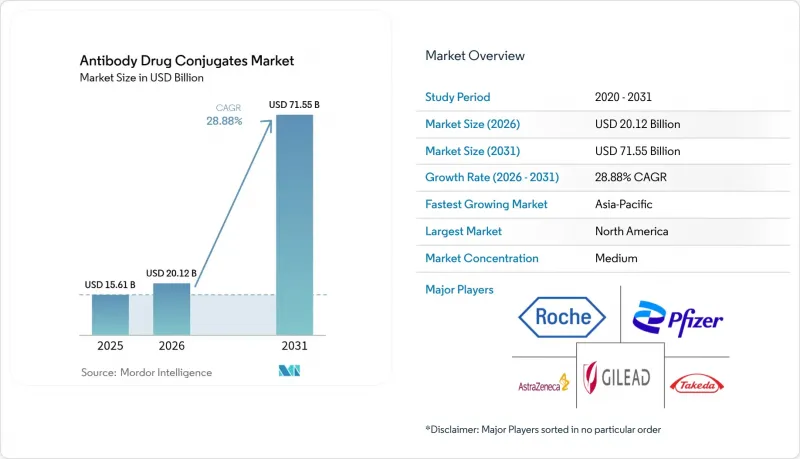
Mordor Intelligence에 의하면, 항체약물접합체(ADC) 시장 규모는 2025년 156억 1,000만 달러로 평가되었습니다. 2026년에는 201억 2,000만 달러로 확대되어 2026년부터 2031년에 걸쳐 CAGR 28.88%로 성장하여 2031년에는 715억 5,000만 달러에 이를 것으로 예측됩니다.
본 보고서는 제품별(아드세트리스, 카도실라, 파도세브 등), 페이로드 분류별(미세관 억제제, DNA 손상제 등), 링커의 화학 구조별(절단형, 비절단형, 부위 특이형), 적응증(유방암, 혈액암, 요로상피암, 폐암 등), 최종 사용자(병원, 전문 암 센터 등) 및 지역별로 분류되어 있습니다. 시장 전망은 금액(달러) 기준으로 제시되어 있습니다.
세계의 항체약물접합체(ADC) 시장 동향 및 인사이트
고형암 발병률 증가
2022년 전 세계 암 진단 건수는 1,996만 건에 달했으며, 모델 예측에 따르면 2050년까지 연간 3,500만 건에 이를 것으로 전망됩니다. 유방암, 폐암, 대장암은 이미 ADC 승인의 주류를 이루고 있지만, 2025년에는 적격 환자의 불과 8%만이 ADC 치료를 받고 있어 항체약물접합체(ADC) 시장에 큰 성장 여지가 있음을 보여줍니다. 중국의 폐암 신규 발병 건수는 2024년에 80만 건을 넘어설 것으로 예상되며, 이는 TROP2 및 HER2를 표적으로 하는 복합체에 대한 수요를 끌어올리고 있습니다. 고형암의 이질성은 다항원 ADC 칵테일의 개발을 촉진하고 있으며, 이 전략은 규제 당국의 승인을 받을 경우 치료 대상 환자 수를 30% 확대할 것으로 기대됩니다. 이러한 요인들이 결합되어 정밀 치료제의 대상 환자층이 확대되며, 2031년까지 두 자릿수의 출하량 성장을 뒷받침할 것입니다.
65세 이상 인구의 급속한 증가
세계 65세 이상 인구는 2024년에 7억 6,100만 명에 달했으며, 2050년까지 15억 명을 넘어설 전망입니다. 고령자의 암 발병률은 젊은 성인에 비해 10배 높으며, 표적 전달을 통해 전신 독성이 감소하기 때문에 고령자용 지침에서는 ADC가 권장되고 있습니다. 2025년 국민 중 29%가 65세 이상이었던 일본에서는 화학요법에 비해 입원률을 40% 감소시킨 ‘엔하르투’를 포함하여, 고령자를 대상으로 한 4가지 ADC의 적응증이 승인되었습니다. 2025년, 메디케어는 재택 ADC 정맥 주사 요법에 대한 보험 적용을 시작했으며, 이로 인해 연간 1만 5,000건의 신규 치료가 추가되었습니다. 이러한 인구 통계학적 및 정책적 변화는 성숙한 의료 시스템 전반에서의 활용을 촉진하고, 항체약물접합체(ADC) 시장의 장기적인 수요를 뒷받침하고 있습니다.
고액의 치료비
미국 내 연간 치료비는 ‘엔헤르투’의 16만 8,000달러에서 ‘트로델비’의 17만 4,000달러에 달하며, 47개 주에서 가구 소득 중앙값을 초과하고 있습니다. 유럽의 의료기술평가(HTA) 기관은 2025년, 3가지 ADC에 대해 품질조정생존년(QALY)당 증분 비용 대비 효과 비율이 10만 유로를 초과했다는 이유로 보험 적용을 기각했습니다. 제조 과정의 복잡성으로 인해 바이오시밀러 시장 진입이 저해되고 있으며, 2035년까지의 특허 기간 동안 오리지널 의약품의 가격 결정력이 유지되고 있습니다. 환자 지원 프로그램이 본인 부담 비용을 보전하는 비율은 체크포인트 억제제의 40%에 비해 불과 18%에 그치고 있습니다. 높은 비용은 특히 신흥 시장에서 보급 속도를 둔화시켜, 예상 연평균 성장률(CAGR)을 4.7포인트 하락시키고 있습니다.
부문별 분석
Kadcyla는 2025년 제품 매출의 23.55%를 차지했으나, Enhertu는 2031년까지 연평균 성장률(CAGR) 29.25%를 달성할 것으로 예상되며, 이는 시판 브랜드 중 가장 높은 성장률입니다. 이러한 급속한 성장은 HER2 저발현 유방암 및 비소세포폐암 2차 치료에 대한 승인으로 인한 것이며, 이로 인해 2025년에 북미와 유럽에서 18만 명의 대상 환자가 추가되었습니다. 파드세브의 1차 선택 요로상피암 적응증 승인으로 인해 백금 제제 요법에서 치료 순서가 변경된 비율이 73%에 달했으며, 이는 고형암에서 MMAE 페이로드의 효능을 입증했습니다. 트로델비는 호르몬 수용체 양성 유방암으로 적응증을 확대했으나, 환자의 32%에서 주입 반응이 관찰되면서 보급 속도는 둔화되었습니다. 폴리비와 아드세트리스는 무재발 생존 기간이 우수한 것으로 입증된 이중 특이성 T세포 엔게이저에 의한 대체 위협에 직면해 있습니다. 엘라헬레는 FRa 양성 난소암의 치료 성과를 향상시켰으나, 지역 진료소의 검사 체계 미비로 인해 보급이 제한되고 있습니다. 전반적으로 제품 교체가 토포이소머라제 표적 치료제로 편중되어 있으며, 항체약물접합체(ADC) 시장은 고형암 적응증으로 재편되고 있습니다.
2차 코호트인 Zynlonta, Blenrep, Mylotarg, Tivdak은 점진적인 수익원을 창출하고 있지만, 바이오마커의 적용 범위가 좁고 보험사의 엄격한 심사에 직면해 있습니다. Blenrep은 생존율에 대한 확인 데이터가 확보된 후 2024년에 미국 시장에 재진입하며 규제 환경의 변동성을 여실히 드러냈습니다. Dato-DXd 및 DusiTag-001과 같은 파이프라인의 신규 진입 제품들은 더 광범위한 항원 표적화를 약속하고 있으며, 2031년까지 경쟁이 심화될 것으로 예측됩니다. 이러한 동향은 브랜드 주도권의 지속적인 교체를 보여주며, 항체약물접합체(ADC) 시장에서 차별화된 페이로드-링커 플랫폼의 필요성을 뒷받침하고 있습니다.
토포이소메라제 I 억제제는 항원 저발현 종양에 대응하는 델크스테칸의 방관자 살상 작용에 힘입어 2025년 매출의 53.53%를 차지했습니다. 마이크로튜브 억제제 프로그램 분야의 항체약물접합체(ADC) 시장 규모는 화이자가 현재 6개의 승인된 베드틴(Bedotin) ADC와 14개의 파이프라인 자산을 보유하고 있는 점을 고려할 때, 연평균 성장률(CAGR) 30.75%로 확대될 것으로 예측됩니다. PBD 이량체와 같은 DNA 손상성 페이로드는 틈새 시장 점유율을 유지하고 있으나, 수율 및 안전성 문제에 직면해 있습니다. 신흥 면역 조절성 페이로드는 2024년부터 2025년에 걸쳐 12억 달러의 벤처 자금을 조달하며, 향후 치료 양식의 전환을 시사했습니다. 현재 페이로드 선택은 종양 미세환경에 맞추어 이루어지고 있습니다. 저산소성 종양에서는 DNA 절단제가 효과적인 반면, 혈관이 풍부한 병변에서는 미세관 파괴제가 효과적입니다. 파이프라인의 다양성이 탄탄하기 때문에 항체약물접합체(ADC) 시장에서는 단일 분류가 지배적이기보다는 페이로드의 다양성이 확보될 전망입니다.
이와 동시에, 절단 가능한 링커는 이질적인 고형암에 있어 매우 중요한 방관자 효과를 가능하게 합니다. 부위 특이적 결합은 유효 성분의 유연성을 더욱 높여, 개발자가 전신 독성을 높이지 않으면서도 세포 독성 물질을 항원에 맞출 수 있게 해줍니다. 그 결과, 활성 성분의 화학적 특성을 전략적으로 제어하는 것은 다이이치 산쿄가 확보한 32억 달러 규모의 마일스톤 수익이 보여주듯이, 라이선싱을 통한 수익원이 되고 있습니다. 이러한 경제적 우위 덕분에 항체약물접합체(ADC) 시장 전반에서 독자적인 활성 성분 플랫폼에 대한 수요가 더욱 높아질 것입니다.
지역별 분석
북미는 메디케어가 외래 환자에 대한 ADC 정맥 주사 투여에 대해 평균 판매 가격의 106%로 보험 적용을 시작함에 따라, 병원들의 종양학과 전용 시설 확충이 진행된 결과, 2025년 매출의 41.55%를 차지했습니다. FDA가 2024년부터 2025년에 걸쳐 4개의 신규 ADC를 승인하고, 캐나다 보건부도 심사 일정을 조율함에 따라 지역 간 출시 시기 차이는 8개월로 단축되었습니다. 페이로드 제조 거점은 미국에 집중되어 있으며, 화이자,론자, 카탈렌트 등 3개사가 전 세계 12곳의 접합 공장 중 7곳을 운영하며, 3상 임상시험용 시료의 제조 리드타임을 단축하고 있습니다. 약물과 항체의 비율을 재현하는 것은 기술적으로 여전히 복잡하기 때문에 바이오시밀러에 의한 경쟁은 최소한으로 제한되고 있습니다.
아시아태평양은 2031년까지 연평균 성장률(CAGR)이 29.22%로 가장 빠르게 성장하는 지역이며, 중국 규제 당국이 6개의 국산 ADC를 승인한 결과, 18개월 만에 중국 바이오의약품 지출의 23%를 차지하게 되었습니다. 일본에서는 ‘엔헤르투’가 5가지 적응증으로 승인되었으며, 다이이치산쿄는 국내 ADC 매출의 34%를 차지하고 있습니다. 인도에서는 2025년에 2개의 바이오시밀러 ADC에 대해 신속 승인이 내려졌으며, 본인부담금이 주류를 이루는 시장에서 향후 가격 경쟁이 예상됩니다. 호주에서는 2024년 FDA와의 협력 협정에 따라 심사 기간이 11개월로 단축되어 ‘파드세브’와 ‘트로델비’의 동시 출시가 가능해졌습니다.
유럽, 중동, 남미는 뒤처져 있습니다. 이는 독일, 프랑스, 영국의 HTA(의료기술평가) 기관이 3개 ADC의 보험 적용에 앞서 실제 세계 데이터(RWE) 제출을 요구했기 때문입니다. EMA(유럽의약품청)의 조건부 승인은 초기 접근을 가속화하지만, 적응증별로 800만-1,200만 달러의 시판 후 비용을 부과하게 됩니다. 브라질은 2025년에 Kadcyla와 Enhertu를 승인했으나, 민간 보험의 급여 대상은 HER2 과발현 종양으로 한정되어 있어, 환자의 55%를 차지하는 HER2 저발현 사례는 대상에서 제외되었습니다. 사우디아라비아와 UAE는 FDA 승인을 근거로 하는 승인 절차를 채택하여 2025년에 4개의 ADC를 승인함으로써, 걸프 지역을 신속 승인 시장으로 자리매김했습니다. 전반적으로, 환급 제도 및 제조 거점에서의 지역 간 격차가 항체약물접합체(ADC) 시장 전체의 보급 곡선에 영향을 미치고 있습니다.
기타 혜택 :
- 엑셀 형식 시장 예측(ME) 시트
- 3개월간의 애널리스트 지원
자주 묻는 질문
목차
제1장 서론
제2장 조사 방법
제3장 주요 요약
제4장 시장 구도
제5장 시장 규모 및 성장 예측
제6장 경쟁 구도
제7장 시장 기회 및 향후 전망
KTH 26.09.14According to Mordor Intelligence, the antibody drug conjugates market size is expected to grow from USD 15.61 billion in 2025 to USD 20.12 billion in 2026 and is forecast to reach USD 71.55 billion by 2031 at 28.88% CAGR over 2026-2031.
This report is Segmented by Product (Adcetris, Kadcyla, Padcev, and More), Payload Class (Microtubule Inhibitors, DNA-Damaging Agents, and More), Linker Chemistry (Cleavable, Non-Cleavable, Site-Specific), Application (Breast, Hematologic, Urothelial, Lung, and More), End User (Hospitals, Specialty Cancer Centres, and More), and Geography. Market Forecasts are Provided in Terms of Value (USD).
Global Antibody Drug Conjugates Market Trends and Insights
Rising Incidences of Solid Tumors
Worldwide cancer diagnoses reached 19.96 million in 2022, and models project 35 million annual cases by 2050. Breast, lung, and colorectal cancers already anchor ADC approvals yet only 8% of eligible patients received an ADC in 2025, signaling significant headroom for the Antibody-Drug Conjugates market. Lung cancer incidence in China surpassed 800,000 cases in 2024, boosting demand for TROP2- and HER2-targeting conjugates. Solid-tumor heterogeneity spurs development of multi-antigen ADC cocktails, a strategy expected to expand the treatable population by 30% pending regulatory acceptance. Together these forces enlarge the addressable pool for precision payloads and underpin double-digit volume growth through 2031.
Rapid Expansion of >=65-yr Demographic
The global population aged 65 years and older reached 761 million in 2024 and will exceed 1.5 billion by 2050. Cancer incidence in seniors is ten-fold higher than in younger adults, and geriatric guidelines prefer ADCs because targeted delivery lowers systemic toxicity. Japan, where 29% of citizens were over 65 in 2025, cleared four elderly-focused ADC labels, including Enhertu, which cut hospitalizations by 40% versus chemotherapy. In 2025, Medicare began reimbursing home-based ADC infusions, adding 15,000 new treatment starts annually. These demographic and policy shifts lift utilization across mature health systems and reinforce long-run demand in the Antibody-Drug Conjugates market.
High Treatment Costs
Annual U.S. therapy costs range from USD 168,000 for Enhertu to USD 174,000 for Trodelvy, exceeding median household income in 47 states. European HTA bodies rejected reimbursement for three ADCs in 2025 because incremental cost-effectiveness ratios topped EUR 100,000 per quality-adjusted life year. Manufacturing complexity deters biosimilar entrants, preserving originator pricing power through patent lifespans to 2035. Patient-assistance programs defray only 18% of out-of-pocket charges versus 40% for checkpoint inhibitors. High costs temper uptake, particularly in emerging markets, and shave 4.7 percentage points off the projected CAGR.
Other drivers and restraints analyzed in the detailed report include:
- Accelerated R&D Funding and Clinical Trial Initiations
- Growing Pharmaceutical Investments
- Payload Supply Constraints
For complete list of drivers and restraints, kindly check the Table Of Contents.
Segment Analysis
Kadcyla held 23.55% of 2025 product revenue, but Enhertu is on track for a 29.25% CAGR through 2031, the fastest among marketed brands. This surge follows HER2-low breast and second-line non-small-cell lung approvals that added 180,000 addressable patients in North America and Europe during 2025. Padcev's first-line urothelial label prompted 73% sequencing shifts away from platinum regimens, validating MMAE payloads in solid tumors. Trodelvy broadened into hormone-receptor-positive breast disease, but infusion reactions in 32% of patients slowed uptake. Polivy and Adcetris face substitution from bispecific T-cell engagers showing superior progression-free survival. Elahere lifted FRa-positive ovarian cancer outcomes, yet testing gaps in community clinics cap penetration. Overall, product churn skews toward topoisomerase payloads, realigning the Antibody-Drug Conjugates market toward solid-tumor indications.
A second-tier cohort-Zynlonta, Blenrep, Mylotarg, Tivdak-contributes incremental revenue streams but battles narrow biomarker windows and payer scrutiny. Blenrep returned to U.S. shelves in 2024 after confirmatory survival data, underscoring regulatory volatility. Pipeline entrants such as Dato-DXd and DusiTag-001 promise broader antigen targeting, suggesting competitive intensity will rise through 2031. These trends indicate ongoing rotation in brand leadership and reinforce the need for differentiated payload-linker platforms inside the Antibody-Drug Conjugates market.
Topoisomerase I inhibitors delivered 53.53% of 2025 revenue, powered by deruxtecan's bystander-killing that addresses antigen-low tumors. The Antibody-Drug Conjugates market size for microtubule inhibitor programs is projected to expand 30.75% CAGR because Pfizer now controls six approved vedotin ADCs and 14 pipeline assets. DNA-damaging payloads such as PBD dimers retain niche share but face yield and safety hurdles. Emerging immunomodulatory payloads attracted USD 1.2 billion in venture backing across 2024-2025, signaling future modality shifts. Payload selection now aligns with tumor microenvironment: hypoxic tumors favor DNA-cleavers, while well-vascularized lesions respond to microtubule disruptors. Robust pipeline diversity ensures that the Antibody-Drug Conjugates market will see payload pluralism rather than single-class dominance.
In parallel, cleavable linkers enable bystander effects crucial for heterogeneous solid cancers. Site-specific conjugation further magnifies payload flexibility, allowing developers to match cytotoxins to antigens without raising systemic toxicity. Consequently, strategic control of payload chemistry has become a revenue stream via out-licensing, as evidenced by Daiichi Sankyo's USD 3.2 billion milestone haul. This economic leverage will intensify demand for proprietary payload platforms across the Antibody-Drug Conjugates market.
Complete Report Scope:
- By Product
- Adcetris (brentuximab vedotin)
- Kadcyla (trastuzumab emtansine)
- Padcev (enfortumab vedotin)
- Polivy (polatuzumab vedotin)
- Enhertu (trastuzumab deruxtecan)
- Trodelvy (sacituzumab govitecan)
- Elahere (mirvetuximab soravtansine)
- Other Approved ADCs
- By Payload Class
- Microtubule Inhibitors (MMAE, DM1, DM4)
- DNA-Damaging Agents (PBD, Calicheamicin, Duocarmycin)
- Topoisomerase I Inhibitors (DXd, SN-38)
- Emerging Payloads (Auristatin variants, novel alkylators)
- By Linker Chemistry
- Cleavable Linkers
- Non-cleavable Linkers
- Site-specific / Next-Gen Conjugation Technologies
- By Application (Indication)
- Breast Cancer
- Hematologic Cancers (Lymphoma, Leukemia, Myeloma)
- Urothelial / Bladder Cancer
- Lung Cancer
- Gynaecologic Cancers (Ovary, Endometrium, Cervix)
- Other Solid Tumors
- By End User
- Hospitals
- Specialty Cancer Centres
- Biopharma & Contract Research Organisations
- Others
- By Geography
- North America
- United States
- Canada
- Mexico
- Europe
- Germany
- United Kingdom
- France
- Italy
- Spain
- Rest of Europe
- Asia-Pacific
- China
- India
- Japan
- Australia
- South Korea
- Rest of Asia-Pacific
- Middle East and Africa
- GCC
- South Africa
- Rest of Middle East and Africa
- South America
- Brazil
- Argentina
- Rest of South America
- North America
Geography Analysis
North America generated 41.55% of 2025 revenue after Medicare began reimbursing outpatient ADC infusions at 106% of average sales price, prompting hospital build-outs of oncology suites. The FDA cleared four new ADC labels between 2024-2025, and Health Canada aligned review timelines, cutting regional launch gaps to eight months. Payload manufacturing clusters in the United States, where Pfizer, Lonza, and Catalent run seven of 12 global conjugation plants, reducing cycle times for Phase 3 material. Biosimilar competition is minimal because reproducing drug-antibody ratios remains technically complex.
Asia-Pacific is the fastest-growing region at 29.22% CAGR through 2031 as China's regulator authorized six domestic ADCs, capturing 23% of the country's biologics spend in 18 months. Japan approved Enhertu for five indications, giving Daiichi Sankyo a 34% share of national ADC revenue. India issued accelerated nods for two biosimilar ADCs in 2025, signaling future price competition where out-of-pocket spending dominates. Australia shortened reviews to 11 months under a 2024 FDA cooperation pact, enabling simultaneous Padcev and Trodelvy launches.
Europe, the Middle East, and South America trail because HTA agencies in Germany, France, and the U.K. demanded real-world evidence before reimbursing three ADCs. EMA's conditional approvals speed initial access yet impose post-marketing costs of USD 8-12 million per indication. Brazil approved Kadcyla and Enhertu in 2025, but private insurance limits coverage to HER2-overexpressing tumors, excluding HER2-low cases in 55% of patients. Saudi Arabia and the UAE embraced FDA reliance pathways, approving four ADCs in 2025 and positioning the Gulf as a fast-track market. Overall, regional disparities in reimbursement and manufacturing footprint influence adoption curves across the Antibody-Drug Conjugates market.
- Abbvie
- ADC Therapeutics
- Amgen
- Astellas Pharma
- AstraZeneca
- BeiGene Ltd.
- BioNTech
- Bristol-Myers Squibb
- Catalent
- Daiichi Sankyo Co. Ltd
- Roche
- Genmab
- Gilead Sciences
- GlaxoSmithKline
- ImmunoGen
- Lonza Group
- MacroGenics Inc.
- Mersana Therapeutics
- Pfizer Inc. (Seagen Inc.)
- RemeGen Co., Ltd
- Synaffix BV
- Takeda Pharmaceuticals
- WuXi XDC
- Zai Lab Ltd.
Additional Benefits:
- The market estimate (ME) sheet in Excel format
- 3 months of analyst support
TABLE OF CONTENTS
1 Introduction
- 1.1 Study Assumptions & Market Definition
- 1.2 Scope of the Study
2 Research Methodology
3 Executive Summary
4 Market Landscape
- 4.1 Market Overview
- 4.2 Market Drivers
- 4.2.1 Rising incidences of solid tumors
- 4.2.2 Rapid expansion of Above 65-yr demographic
- 4.2.3 Accelerated R&D funding and clinical trial initiations
- 4.2.4 Growing pharmaceutical investments
- 4.2.5 Increasing demand for low-toxicity and effective drugs
- 4.2.6 Reimbursement expansion for outpatient ADC administration
- 4.3 Market Restraints
- 4.3.1 High treatment costs
- 4.3.2 Payload supply constraints (auristatin/PBD) causing production bottlenecks
- 4.3.3 Competition from emerging T-cell engagers & bispecific antibodies
- 4.3.4 High manufacturing complexity
- 4.4 Supply-Chain Analysis
- 4.5 Regulatory Landscape
- 4.6 Technological Outlook
- 4.7 Porter's Five Forces
- 4.7.1 Bargaining Power of Buyers
- 4.7.2 Bargaining Power of Suppliers
- 4.7.3 Threat of New Entrants
- 4.7.4 Threat of Substitutes
- 4.7.5 Intensity of Competitive Rivalry
5 Market Size & Growth Forecasts (Value, USD)
- 5.1 By Product
- 5.1.1 Adcetris (brentuximab vedotin)
- 5.1.2 Kadcyla (trastuzumab emtansine)
- 5.1.3 Padcev (enfortumab vedotin)
- 5.1.4 Polivy (polatuzumab vedotin)
- 5.1.5 Enhertu (trastuzumab deruxtecan)
- 5.1.6 Trodelvy (sacituzumab govitecan)
- 5.1.7 Elahere (mirvetuximab soravtansine)
- 5.1.8 Other Approved ADCs
- 5.2 By Payload Class
- 5.2.1 Microtubule Inhibitors (MMAE, DM1, DM4)
- 5.2.2 DNA-Damaging Agents (PBD, Calicheamicin, Duocarmycin)
- 5.2.3 Topoisomerase I Inhibitors (DXd, SN-38)
- 5.2.4 Emerging Payloads (Auristatin variants, novel alkylators)
- 5.3 By Linker Chemistry
- 5.3.1 Cleavable Linkers
- 5.3.2 Non-cleavable Linkers
- 5.3.3 Site-specific / Next-Gen Conjugation Technologies
- 5.4 By Application (Indication)
- 5.4.1 Breast Cancer
- 5.4.2 Hematologic Cancers (Lymphoma, Leukemia, Myeloma)
- 5.4.3 Urothelial / Bladder Cancer
- 5.4.4 Lung Cancer
- 5.4.5 Gynaecologic Cancers (Ovary, Endometrium, Cervix)
- 5.4.6 Other Solid Tumors
- 5.5 By End User
- 5.5.1 Hospitals
- 5.5.2 Specialty Cancer Centres
- 5.5.3 Biopharma & Contract Research Organisations
- 5.5.4 Others
- 5.6 By Geography
- 5.6.1 North America
- 5.6.1.1 United States
- 5.6.1.2 Canada
- 5.6.1.3 Mexico
- 5.6.2 Europe
- 5.6.2.1 Germany
- 5.6.2.2 United Kingdom
- 5.6.2.3 France
- 5.6.2.4 Italy
- 5.6.2.5 Spain
- 5.6.2.6 Rest of Europe
- 5.6.3 Asia-Pacific
- 5.6.3.1 China
- 5.6.3.2 India
- 5.6.3.3 Japan
- 5.6.3.4 Australia
- 5.6.3.5 South Korea
- 5.6.3.6 Rest of Asia-Pacific
- 5.6.4 Middle East and Africa
- 5.6.4.1 GCC
- 5.6.4.2 South Africa
- 5.6.4.3 Rest of Middle East and Africa
- 5.6.5 South America
- 5.6.5.1 Brazil
- 5.6.5.2 Argentina
- 5.6.5.3 Rest of South America
- 5.6.1 North America
6 Competitive Landscape
- 6.1 Market Concentration
- 6.2 Market Share Analysis
- 6.3 Company Profiles (includes Global-level Overview, Market-level Overview, Core Segments, Financials as available, Strategic Information, Market Rank/Share for key companies, Products & Services, and Recent Developments)
- 6.3.1 AbbVie Inc.
- 6.3.2 ADC Therapeutics SA
- 6.3.3 Amgen Inc.
- 6.3.4 Astellas Pharma Inc.
- 6.3.5 AstraZeneca plc
- 6.3.6 BeiGene Ltd.
- 6.3.7 BioNTech SE
- 6.3.8 Bristol-Myers Squibb Co.
- 6.3.9 Catalent Inc.
- 6.3.10 Daiichi Sankyo Co. Ltd
- 6.3.11 F. Hoffmann-La Roche Ltd
- 6.3.12 Genmab A/S
- 6.3.13 Gilead Sciences Inc.
- 6.3.14 GSK plc
- 6.3.15 ImmunoGen Inc.
- 6.3.16 Lonza Group AG
- 6.3.17 MacroGenics Inc.
- 6.3.18 Mersana Therapeutics Inc.
- 6.3.19 Pfizer Inc. (Seagen Inc.)
- 6.3.20 RemeGen Co., Ltd
- 6.3.21 Synaffix BV
- 6.3.22 Takeda Pharmaceutical Co. Ltd
- 6.3.23 WuXi XDC
- 6.3.24 Zai Lab Ltd.
7 Market Opportunities & Future Outlook
- 7.1 White-space & Unmet-Need Assessment


