

|
시장보고서
상품코드
2124642
치과용 인상 시스템 : 시장 점유율 분석, 업계 동향 및 통계, 성장 예측(2026-2031년)Dental Impression Systems - Market Share Analysis, Industry Trends & Statistics, Growth Forecasts (2026 - 2031) |
||||||
 Mordor Intelligence
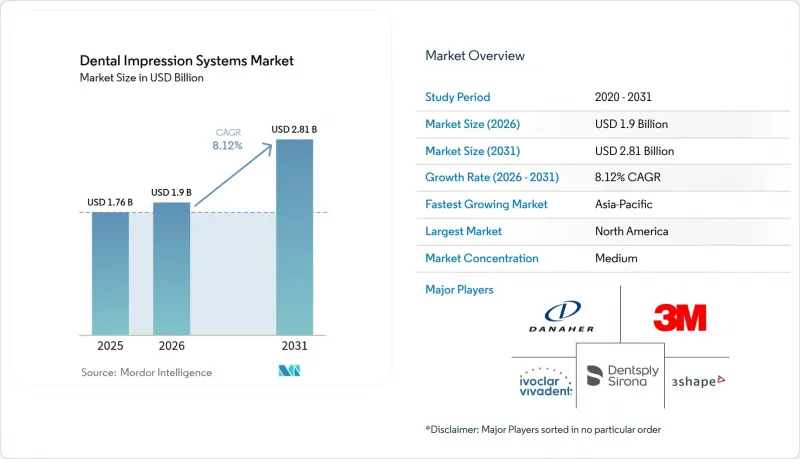
Mordor Intelligence에 의하면, 치과용 인상 시스템 시장 규모는 2025년 17억 6,000만 달러로 평가되었습니다. 2026년에는 19억 달러로 확대되어 2026년부터 2031년에 걸쳐 CAGR 8.12%로 성장을 지속하여, 2031년에는 28억 1,000만 달러에 이를 것으로 예측됩니다.
본 보고서는 제품별(인상재, 디지털 인상 시스템, 부속품·소모품), 용도별(수복·보철, 교정치과, 임플란트), 최종 사용자별(치과, 병원 등), 지역별(북미, 유럽, 아시아태평양, 중동 및 아프리카, 남미)로 분류되어 있습니다. 시장 예측은 금액(달러) 기준으로 제시되어 있습니다.
세계의 치과용 인상 시스템 시장 동향 및 인사이트
디지털 치과 솔루션의 보급 확대
현재, 구강 내 스캐너가 치료 시간을 단축하면서도 더 높은 품질의 수복물을 가능하게 한다는 증거가 널리 제시되고 있습니다. 2025년 미국치과의사협회(ADA)의 조사에 따르면, 미국 치과의사의 53%가 스캐너를 사용하고 있으며, 70%가 효율성을 주요 도입 요인으로 꼽고 있습니다. 보급률은 지역에 따라 현저한 차이가 있으며, 3Shape사의 보고에 따르면 미국에서는 57%의 보급률을 보이는 반면, 많은 신흥국에서는 훨씬 낮은 수준에 머물러 있습니다. 현재 북미 치과 대학의 93%가 CAD/CAM 모듈을 교육 과정에 포함하고 있지만, 교원 연수에는 여전히 병목 현상이 남아 있습니다. 조기 도입자들은 치료 승인이 빨라지고 재제작 비율이 낮아짐으로써 경쟁 우위를 확보하고 있으며, 이는 네트워크 효과를 창출하여 스캐너 구매를 더욱 가속화하고 있습니다.
심미 치과 치료에 대한 수요 증가
자연스러운 외관의 당일 수복에 대한 소비자의 선호도는 점점 더 강해지고 있습니다. 조사 데이터에 따르면, 환자의 85%가 1회 내원만으로 완료되는 치료를 선호하며, 50%는 속도를 중시하여 추가 비용을 지불할 의향이 있는 것으로 나타났습니다. 디지털 인상 시스템은 엘라스토머로 인한 왜곡을 제거하고, 특히 전치부 세라믹 치료에서 매우 중요한 정확한 색조 매칭을 가능하게 함으로써 이러한 기대에 부응하고 있습니다. 가처분 소득이 높은 고령 인구 증가도 심미 치과 분야를 더욱 확대시키고 있습니다. 또한, 저침습적 치아 성형은 기술적 장벽을 높이고 있어, 기존 방법보다 디지털 기법이 유리해지고 있습니다.
고급 치과 장비 및 시술의 높은 비용
Medit i700과 같은 보급형 스캐너의 가격은 1만 3,000달러에서 2만 1,900달러이지만, 체어사이드용 풀 CAD/CAM 시스템은 10만 달러를 초과하기도 합니다. 이러한 막대한 설비 투자는 특히 1인당 소득이 여전히 낮은 지역에서 소규모 치과 병원에 있어 장벽이 되고 있습니다. 지속적인 소프트웨어 라이선스 비용, 유지보수 비용, 직원 교육비 등이 더해지면서 비용 격차는 더욱 벌어집니다. 2025년에 실시된 치과의사 대상 설문조사에서 응답자의 85%가 스캐너 도입의 가장 큰 장벽으로 가격을 꼽았습니다. 대규모 치과 서비스 조직(DSO)은 여러 지점에서 비용을 분산할 수 있기 때문에 통합된 네트워크를 갖춘 업체로 시장 점유율이 이동하는 추세가 나타나고 있습니다.
부문별 분석
2025년, 인상재는 매출 점유율 53.72%를 유지했으며, 이는 치료 건수가 많고 가격에 민감한 수복 시술에서 그 사용이 정착되었음을 보여줍니다. 신흥국에서는 단가가 저렴하고 모든 치과 기공소와 호환성이 있어 엘라스토머 제품이 여전히 표준으로 자리 잡고 있습니다. 그러나 진료소가 정확도와 환자의 편안함을 우선시함에 따라 디지털 시스템이 가장 빠르게 확대되고 있으며, 연간 10.12%의 성장률을 보이고 있습니다. 스캐너 관련 소모품(일회용 팁, 보정 팩, 연간 소프트웨어 구독)은 기존 재료로는 재현할 수 없는 지속적인 수익원을 창출하고 있습니다. 임상 연구에 따르면, 디지털 인상법을 사용하면 재제작률이 최대 40% 감소하는 것으로 보고되어, 중-고난이도 사례에서 경제적 타당성이 더욱 강화되고 있습니다.
2세대 스캐너는 현재 개방형 아키텍처의 STL 파일을 제공하여, 실험실이 모든 CAD 플랫폼과 통합할 수 있게 되었습니다. 이러한 상호 운용성으로 인해 벤더 종속성에 대한 우려가 해소되었으며, 재료의 독점적 지위는 더욱 약화되고 있습니다. 한편, 기존 소재 제조업체들은 임플란트의 스프린트 고정 등 특수한 시나리오를 위한 생체적합성 배합을 개발하는 등의 방식으로 대응하며, 디지털화의 물결 속에서도 입지를 유지하기 위해 노력하고 있습니다.
지역별 분석
북미는 견고한 보험 적용 범위, 높은 가처분 소득, 그리고 기술의 조기 도입에 힘입어 2025년 매출의 34.02%를 차지했습니다. FDA 510(k) 승인을 통한 명확한 규제 절차가 예측 가능한 시장 진입을 촉진하고 있습니다. 그러나 DSO(치과 서비스 조직)로부터의 경쟁 압력으로 인해 장비 공급업체들은 이익률을 유지하기 위해 가격 정책을 엄격히 하고, 스캐너를 진료 관리 소프트웨어와 세트로 판매하고 있습니다.
아시아태평양은 연평균 성장률(CAGR) 9.31%로 확장되고 있으며, 가장 눈에 띄는 성장을 보이는 지역입니다. 도시 지역의 중산층은 더 높은 품질의 수복 치료를 원하고 있으며, 태국과 인도에는 최신 장비를 기대하는 해외 치과 관광객들이 방문하고 있습니다. 중국은 국내 제조업체들이 현지 가격대에 맞추어 맞춤형으로 제작된 비용 최적화 스캐너를 출시하고 있어, 절대적인 성장률 측면에서 선두를 달리고 있습니다.
유럽에서는 종합적인 공적 치과 보험 제도와 표준화된 의료기기 규제를 배경으로 꾸준한 성장이 나타나고 있습니다. 독일과 북유럽 국가에서는 치과의사 1인당 스캐너 보유율이 세계 최고 수준을 보이고 있습니다. 조화로운 MDR(의료기기 규정) 덕분에 국경을 초월한 기기 유통이 원활해져, 유럽 전역에 퍼진 치과 기공소 네트워크에 혜택을 주고 있습니다.
중동, 아프리카 및 남미는 아직 발전 단계에 있지만, 미래가 기대되고 있습니다. 사우디아라비아와 브라질의 정부 자금 지원 구강 보건 프로그램에서는 현재 디지털 기술 교육이 중시되고 있어, 향후 스캐너 조달의 기반이 마련되고 있습니다. 비용은 여전히 장벽으로 작용하고 있지만, 현지 유통업체들은 사례 수에 따른 지불 체계를 채택한 리스 모델을 점점 더 많이 제공합니다.
기타 혜택 :
- 엑셀 형식 시장 예측(ME) 시트
- 3개월간의 애널리스트 지원
자주 묻는 질문
목차
제1장 서론
제2장 조사 방법
제3장 주요 요약
제4장 시장 구도
제5장 시장 규모 및 성장 예측
제6장 경쟁 구도
제7장 시장 기회 및 향후 전망
KTH 26.09.14According to Mordor Intelligence, the dental impression systems market size is expected to grow from USD 1.76 billion in 2025 to USD 1.9 billion in 2026 and is forecast to reach USD 2.81 billion by 2031 at 8.12% CAGR over 2026-2031.

This report is Segmented by Product (Impression Materials, Digital Impression Systems, and Accessories & Consumables), Application (Restorative & Prosthodontics, Orthodontics, and Implantology), End User (Dental Clinics, Hospitals, and More), and Geography (North America, Europe, Asia-Pacific, Middle East & Africa, South America). The Market Forecasts are Provided in Terms of Value (USD).
Global Dental Impression Systems Market Trends and Insights
Growing Adoption of Digital Dentistry Solutions
Widespread evidence now demonstrates that intraoral scanners foster higher-quality restorations while compressing chair time. A 2025 American Dental Association survey shows 53% of U.S. dentists using scanners, and 70% cite efficiency as the main driver. Penetration varies markedly; 3Shape reports a 57% rate in the United States versus far lower uptake in many emerging economies. Ninety-three percent of North American dental schools now embed CAD/CAM modules, but faculty-training bottlenecks remain. Early adopters gain competitive advantages through faster treatment acceptance and lower remake rates, creating network effects that accelerate further scanner purchases.
Rising Demand for Aesthetic Dental Procedures
Consumer preference for natural-looking, same-day restorations has intensified. Survey data reveal that 85% of patients prefer single-visit treatment and 50% will pay a premium for speed. Digital impression systems satisfy these expectations by eliminating elastomeric distortions and enabling precise shade matching, especially critical for anterior ceramics. Aging populations with higher discretionary income further enlarge the aesthetic segment. Minimally invasive preparations also raise technical bars that favor digital over traditional methods.
High Cost of Advanced Dental Equipment and Procedures
Entry-level scanners such as Medit i700 list between USD 13,000 and USD 21,900, while full chair-side CAD/CAM suites can exceed USD 100,000. These capital commitments deter smaller clinics, especially where per-capita incomes remain low. Ongoing software licenses, maintenance, and staff training widen the cost gap. A 2025 practitioner survey recorded 85% of respondents citing price as the chief obstacle to scanner adoption. Larger dental service organizations (DSOs) can amortize costs across multiple sites, contributing to market-share shifts favoring consolidated networks.
Other drivers and restraints analyzed in the detailed report include:
- Increasing Global Burden of Oral Diseases
- Expansion of Dental Tourism in Emerging Markets
- Limited Insurance Coverage and Reimbursement Challenges
For complete list of drivers and restraints, kindly check the Table Of Contents.
Segment Analysis
Impression materials retained 53.72 % revenue share in 2025, underscoring their entrenched use in high-volume, price-sensitive restorative procedures. In emerging economies, elastomeric products remain the default due to low unit costs and universal lab compatibility. Yet digital systems propel the fastest expansion, growing 10.12 % annually as clinics prioritize precision and patient comfort. Consumables linked to scanners-single-use tips, calibration pucks, and annual software subscriptions-create recurring revenue streams that traditional materials cannot replicate. Clinical studies report up to 40 % fewer remakes with digital impressions, strengthening economic rationales for mid- and high-complexity cases.
Second-generation scanners now offer open-architecture STL files, allowing labs to integrate with any CAD platform. This interoperability further erodes material dominance by removing vendor lock-in concerns. Meanwhile, manufacturers of traditional materials respond with biocompatible formulations for specialized scenarios such as implant splinting, seeking to preserve relevance amid the digital shift.
Complete Report Scope:
- By Product
- Impression Materials
- Digital Impression Systems (Intra-/Extra-Oral Scanners)
- Accessories & Consumables
- By Application
- Restorative & Prosthodontics
- Orthodontics
- Implantology
- By End User
- Dental Clinics
- Hospitals
- Dental Laboratories
- Academic & Research Institutes
- Geography
- North America
- United States
- Canada
- Mexico
- Europe
- Germany
- United Kingdom
- France
- Italy
- Spain
- Rest of Europe
- Asia-Pacific
- China
- Japan
- India
- Australia
- South Korea
- Rest of Asia-Pacific
- Middle East & Africa
- GCC
- South Africa
- Rest of Middle East & Africa
- South America
- Brazil
- Argentina
- Rest of South America
- North America
Geography Analysis
North America commands 34.02 % of 2025 revenue, underpinned by robust insurance coverage, high disposable incomes, and early technological adoption. Clear regulatory pathways via FDA 510(k) clearances foster predictable market entry. However, competitive pressure from DSOs drives equipment suppliers to sharpen pricing and bundle scanners with practice-management software to preserve margins.
Asia-Pacific is the fastest-growing region, expanding at 9.31 % CAGR. Urban middle-class populations seek higher-quality restorations, while Thailand and India attract international dental tourists who expect modern equipment. China leads absolute growth as domestic manufacturers introduce cost-optimized scanners customized for local price points.
Europe shows steady expansion on the back of comprehensive public dental coverage and standardized device regulations. Germany and the Nordic countries exhibit some of the world's highest per-dentist scanner ratios. Harmonized MDR rules streamline cross-border equipment flows, benefiting pan-European lab networks.
Middle East-Africa and South America remain nascent yet promising. Government-funded oral-health programs in Saudi Arabia and Brazil now emphasize digital training, laying groundwork for future scanner procurement. Cost remains a barrier, yet local distributors increasingly offer leasing models that align payments with case volumes.
- Dentsply Sirona
- 3M
- Danaher (Kerr)
- 3 Shape
- Ivoclar Vivadent
- Align Technology
- Planmeca
- Carestream Dental
- DETAX GmbH
- Ultradent Products
- Zhermack SpA
- Kuraray Co., Ltd.
- DMG Chemisch-Pharmazeutische
- Medit Corp.
- Straumann Group
- Vatech Co., Ltd.
- VOCO
- GC Corporation
- Kulzer
Additional Benefits:
- The market estimate (ME) sheet in Excel format
- 3 months of analyst support
TABLE OF CONTENTS
1 Introduction
- 1.1 Study Assumptions & Market Definition
- 1.2 Scope of the Study
2 Research Methodology
3 Executive Summary
4 Market Landscape
- 4.1 Market Overview
- 4.2 Market Drivers
- 4.2.1 Growing Adoption of Digital Dentistry Solutions
- 4.2.2 Rising Demand for Aesthetic Dental Procedures
- 4.2.3 Increasing Global Burden of Oral Diseases
- 4.2.4 Expansion of Dental Tourism in Emerging Markets
- 4.2.5 Technological Advancements in Intraoral Scanning and 3D Printing
- 4.2.6 Shift Toward Chair-Side Workflow and Same-Day Restorations
- 4.3 Market Restraints
- 4.3.1 High Cost of Advanced Dental Equipment and Procedures
- 4.3.2 Limited Insurance Coverage and Reimbursement Challenges
- 4.3.3 Data Security and Interoperability Concerns in Digital Workflows
- 4.3.4 Shortage of Skilled Professionals for Digital Impression Systems
- 4.4 Regulatory Landscape
- 4.5 Technological Outlook
- 4.6 Porter's Five Forces Analysis
- 4.6.1 Bargaining Power Of Buyers
- 4.6.2 Bargaining Power Of Suppliers
- 4.6.3 Threat Of New Entrants
- 4.6.4 Threat Of Substitutes
- 4.6.5 Competitive Rivalry
5 Market Size & Growth Forecasts (Value, USD)
- 5.1 By Product
- 5.1.1 Impression Materials
- 5.1.2 Digital Impression Systems (Intra-/Extra-Oral Scanners)
- 5.1.3 Accessories & Consumables
- 5.2 By Application
- 5.2.1 Restorative & Prosthodontics
- 5.2.2 Orthodontics
- 5.2.3 Implantology
- 5.3 By End User
- 5.3.1 Dental Clinics
- 5.3.2 Hospitals
- 5.3.3 Dental Laboratories
- 5.3.4 Academic & Research Institutes
- 5.4 Geography
- 5.4.1 North America
- 5.4.1.1 United States
- 5.4.1.2 Canada
- 5.4.1.3 Mexico
- 5.4.2 Europe
- 5.4.2.1 Germany
- 5.4.2.2 United Kingdom
- 5.4.2.3 France
- 5.4.2.4 Italy
- 5.4.2.5 Spain
- 5.4.2.6 Rest of Europe
- 5.4.3 Asia-Pacific
- 5.4.3.1 China
- 5.4.3.2 Japan
- 5.4.3.3 India
- 5.4.3.4 Australia
- 5.4.3.5 South Korea
- 5.4.3.6 Rest of Asia-Pacific
- 5.4.4 Middle East & Africa
- 5.4.4.1 GCC
- 5.4.4.2 South Africa
- 5.4.4.3 Rest of Middle East & Africa
- 5.4.5 South America
- 5.4.5.1 Brazil
- 5.4.5.2 Argentina
- 5.4.5.3 Rest of South America
- 5.4.1 North America
6 Competitive Landscape
- 6.1 Market Concentration
- 6.2 Market Share Analysis
- 6.3 Company Profiles (includes Global level Overview, Market level overview, Core Business Segments, Financials, Headcount, Key Information, Market Rank, Market Share, Products and Services, and analysis of Recent Developments)
- 6.3.1 Dentsply Sirona
- 6.3.2 3M
- 6.3.3 Danaher (Kerr)
- 6.3.4 3Shape A/S
- 6.3.5 Ivoclar Vivadent
- 6.3.6 Align Technology
- 6.3.7 Planmeca Oy
- 6.3.8 Carestream Dental
- 6.3.9 DETAX GmbH
- 6.3.10 Ultradent Products
- 6.3.11 Zhermack SpA
- 6.3.12 Kuraray Co., Ltd.
- 6.3.13 DMG Chemisch-Pharmazeutische
- 6.3.14 Medit Corp.
- 6.3.15 Straumann Group
- 6.3.16 Vatech Co., Ltd.
- 6.3.17 VOCO GmbH
- 6.3.18 GC Corporation
- 6.3.19 Kulzer GmbH
7 Market Opportunities & Future Outlook
- 7.1 White-space & Unmet-Need Assessment


