

|
시장보고서
상품코드
2124648
중간 벌크 컨테이너 : 시장 점유율 분석, 업계 동향과 통계, 성장 예측(2026-2031년)Intermediate Bulk Container - Market Share Analysis, Industry Trends & Statistics, Growth Forecasts (2026 - 2031) |
||||||
 Mordor Intelligence
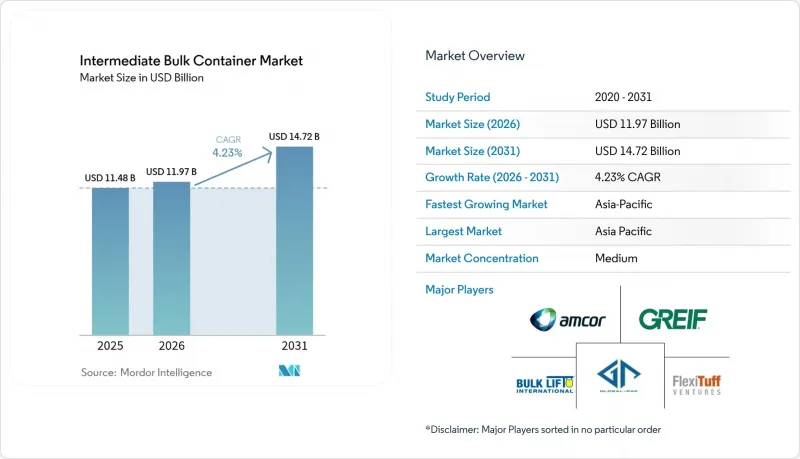
Mordor Intelligence에 의하면, iBC 시장 규모는 2025년에 114억 8,000만 달러로 평가되었고, 2026년 119억 7,000만 달러에서 2031년까지 147억 2,000만 달러에 이를 것으로 예측되며, 예측 기간(2026-2031년) CAGR은 4.23%를 기록할 전망입니다.
본 보고서는 유형별(경질 IBC, 연질 IBC), 재질별(플라스틱 IBC, 금속 IBC, 복합재 IBC, 섬유판 IBC), 최종 사용자별(화학 산업, 제약 산업, 식품 및 음료 산업, 농업, 운송 및 물류 등),설계(표준 IBC, 접이식 IBC, 가열식 IBC, 스마트/IoT 대응 IBC), 지역별로 분류되어 있습니다. 시장 예측은 금액(달러) 기준으로 제시되어 있습니다.
세계 중간 벌크 컨테이너 시장 동향 및 인사이트
화학·의약품 생산량 확대
아시아태평양에서는 2024년에 지역 화학제품 생산 능력이 12% 증가함에 따라 원자재 및 완제품에 대한 컨테이너 수요가 지속적으로 증가하고 있습니다. 인도의 바이오시밀러 제조 시설 급증과 베트남의 새로운 특수 화학제품 복합 시설 건설로 인해 부식 방지 기준을 충족하는 표준화된 복합 소재 IBC에 대한 수요가 증가하고 있습니다. 연속 생산 라인에는 폐쇄형 이송 시스템이 필요하며, 무균성 검증을 위한 스마트 센서 도입이 촉진되고 있습니다. 컨테이너 벽면에 디지털 모니터링 기능을 직접 내장한 공급업체들은 제약 업계 바이어들에게 가격 면에서 우위를 점하고 있습니다. 장기적으로는 이러한 생산 거점들이 IBC 시장 증가분의 약 3분의 1을 차지할 것으로 예측됩니다.
IBC에 충전된 제품의 수출 확대
2024년, 액체 화학물질의 국경을 넘는 유통 규모는 2조 1,000억 달러에 달할 전망이며, 수출업체들은 운임 비용을 절감하기 위해 중량을 최적화한 플렉서블 IBC를 우선적으로 채택하고 있습니다. 원료의약품의 온도 관리 운송 경로에서는 현재 보관 이력을 검증하는 데이터 로깅 패치가 장착된 단열 복합 드럼이 채택되고 있습니다. 아시아와 유럽 간 항해 시간이 길어짐에 따라, 접이식 빈 용기를 반송함으로써 얻는 비용상의 이점이 더욱 두드러지고 있습니다. 해운의 탈탄소화로 인해 운송업체가 적재 밀도를 엄격히 검토하는 가운데, 경량이며 RFID 태그가 부착된 라이너를 채택하는 수출업체는 유리한 운임을 협상할 수 있는 입장에 있어, 이는 IBC 시장에 대한 수요를 더욱 부추기고 있습니다.
재활용 및 재충전된 IBC의 이용 확대
전문 재생 업체가 재생한 IBC는 현재 신제품과 동등한 성능을 95% 달성하고 있어, 비용을 중시하는 구매자들을 저가 대체품으로 끌어들이고 있습니다. 2024년의 인플레이션 압력으로 인해 화학제품 운송 업체들이 설비 투자 주기를 연기함에 따라 이러한 추세는 더욱 강화되었습니다. 규제 당국은 의약품 이외의 자재에 대한 재생 컨테이너 인증을 점차 허용하고 있으며, 과거에는 일시적인 조치에 불과했던 것이 이제 주류 조달 옵션으로 변화하고 있습니다. 따라서 특히 IBC 시장의 상품화가 진행된 부문에서 신품 IBC 판매는 구조적인 역풍에 직면해 있습니다.
부문 분석
경질 컨테이너는 화학 및 의약품 충전 라인에서 높은 기계적 안정성을 바탕으로 2025년 IBC 시장 점유율 58.02%를 유지했습니다. 표준화된 팔레트의 실적 덕분에 고속 로봇을 통한 취급이 가능하며, 이는 연중무휴 24시간 생산 환경에서 큰 강점이 됩니다. 플렉서블형 IBC 시장 규모는 빈 용기 반송 공간을 40% 절감할 수 있다는 점(이를 통해 화물 운송 시 배출량이 감소함)을 배경으로 연평균 성장률(CAGR) 5.55%로 확대될 것으로 예측됩니다. 식품 원료 운송업체들은 비위험물 액체 운송에 있어 이러한 라이너를 점점 더 선호하는 경향을 보이고 있지만, IoT 도입에 있어서는 리지드형 쉘에 비해 여전히 쉽지 않은 실정입니다. 주요 제조업체들이 동남아시아에서 플렉서블형의 생산 능력을 확대하고 있으며, 이는 IBC 시장의 장기적인 재균형을 시사합니다.
산이나 농약 등 유엔 분류 그룹 II 및 III에 해당하는 분야에서는 여전히 경질 컨테이너가 계속 채택되고 있습니다. 일체형 딥 튜브식 주출구는 라인의 처리 능력을 12% 향상시켜 적시(JIT) 배송 모델을 뒷받침하고 있습니다. 한편, 플렉서블 설계는 오염 위험이 낮고 폐기가 간편한 점이 중시되는 향료 농축액 및 식물성 유지 분야 등에서 틈새 시장을 개척하고 있습니다. 센서의 소형화와 접착식 전원 기술의 성숙에 따라 기술 격차는 줄어들 것으로 예상되며, 플렉서블 IBC 시장에서 스마트 기능의 도입이 가속화될 것입니다.
2025년 현재, 플라스틱은 IBC 시장 점유율의 39.10%를 차지하고 있으며, 비용 효율이 뛰어난 블로우 성형 라인과 폭넓은 화학적 호환성을 활용하고 있습니다. 그러나 운송업체들이 고순도 용제에 대한 내식성을 우선시함에 따라, 복합재 쉘은 2031년까지 연평균 성장률(CAGR) 6.55%로 확대되고 있습니다. 재활용 가능한 다층 구조 덕분에 외부 금속 케이지와는 독립적으로 내부 HDPE 병을 교체할 수 있어 수명이 25% 연장됩니다. 재활용 HDPE 가격의 변동으로 인해 유리섬유 강화 폴리프로필렌의 상대적 매력이 높아지고 있으며, 복합 소재는 이미 확립된 플라스틱 IBC 시장에서 점차 점유율을 빼앗기 시작하고 있습니다.
극한 온도나 고압 용도에서는 여전히 금속 드럼이 주류를 이루고 있지만, 생분해성 용기가 필요한 유기농 식품 수출업체들 사이에서는 섬유판이 주목을 받고 있습니다. 제약 업계의 구매자들은 여전히 신중한 태도를 유지하고 있으며, 플라스틱이 더 쉽게 충족시킬 수 있는 USP 규격의 배합을 요구하고 있지만, 탄소 배출량 공개에 대한 규제의 중요성이 커짐에 따라 예측 기간 동안에는 더 가벼운 복합 소재를 선호하는 경향이 나타날 가능성이 있습니다. ‘크래들 투 크래들(C2C)’ 인증을 제공하는 소재 혁신 기업들은 지속적으로 진화하는 IBC 시장에서 고부가가치 계약을 확보할 가능성이 높을 것입니다.
지역별 분석
아시아태평양은 2025년에 40.10%의 점유율로 IBC 시장을 선도할 것이며, 2031년까지 연평균 성장률(CAGR) 6.55%로 확대될 것으로 예측됩니다. 중국의 1조 7,000억 달러 규모의 화학제품 생산량과 인도의 의약품 수출이 15% 급증하고 있는 것이 원자재 및 완제품 의약품 물류 분야에서 지속적인 컨테이너 수요를 뒷받침하고 있습니다. 지방 자치 단체는 재사용 가능한 포장 자산에 대해 세제 혜택을 제공하고 있으며, 이로 인해 스마트 복합 단지의 투자 회수 기간이 단축되고 있습니다. 베트남과 태국을 비롯한 신흥 아세안(ASEAN) 클러스터에서는 다회 사용 체계를 유지하기 위해 전용 IBC 세척 베이를 갖춘 새로운 폴리머 및 방향족 화합물 복합 시설이 건설되고 있습니다.
유럽에서는 규제 주도형으로 미묘한 뉘앙스를 띤 수요가 나타나고 있으며, 고급형 순환 경제 준수 솔루션으로의 편중이 두드러집니다. 독일과 프랑스의 제약 기업들은 센서가 탑재된 차량 보유 대수에서 세계 최고 수준을 자랑하며, 인더스트리 4.0 프레임워크를 활용하여 예측 유지보수를 실시했습니다. EU의 ‘포장 및 포장 폐기물 규정’은 2030년까지 65%의 재활용 목표를 설정하고 있으며, 이로 인해 분리 가능한 라이너 시스템의 도입이 가속화되고 있습니다. 규제를 최우선으로 하는 환경 덕분에 공급업체는 인증된 저탄소 IBC 시장용 제품에 대해 10-15%의 가격 프리미엄을 책정할 수 있게 되었습니다.
북미에서는 품질이 극히 중요한 의약품 및 특수 화학제품 부문이 중심을 이루고 있습니다. 2024년 미국의 화학제품 생산액은 5,530억 달러에 달하며, 특히 철도 및 드레지 운송을 통해 수송되는 유엔 제8류 부식성 물질의 경우 견조한 기준 운송량으로 이어지고 있습니다. 멕시코의 니어쇼어링 열풍은 새로운 수지 공장의 가동에 따라 경질 복합 용기에 대한 새로운 수요를 창출하고 있습니다. 성숙한 도로 및 철도망은 차량 순환을 최적화하는 자산 추적 플랫폼의 운영을 용이하게 하여, 지역 내 IBC 시장의 디지털 서비스 수익을 강화하고 있습니다.
기타 혜택:
- 엑셀 형식 시장 예측(ME) 시트
- 3개월간의 애널리스트 지원
자주 묻는 질문
목차
제1장 서론
제2장 조사 방법
제3장 주요 요약
제4장 시장 구도
제5장 시장 규모와 성장 예측
제6장 경쟁 구도
제7장 시장 기회와 향후 전망
LSH 26.09.14According to Mordor Intelligence, the iBC market size was valued at USD 11.48 billion in 2025 and estimated to grow from USD 11.97 billion in 2026 to reach USD 14.72 billion by 2031, at a CAGR of 4.23% during the forecast period (2026-2031).
This report is Segmented by Type (Rigid IBC, Flexible IBC), Material (Plastic IBC, Metal IBC, Composite IBC, and Fiberboard IBC), End User (Chemical Industry, Pharmaceutical Industry, Food and Beverage Industry, Agriculture, Transport and Logistics, and More), Design (Standard IBC, Collapsible/Foldable IBC, Heated IBC, and Smart/IoT-Enabled IBC), and Geography. The Market Forecasts are Provided in Terms of Value (USD).
Global Intermediate Bulk Container Market Trends and Insights
Expansion of Chemical and Pharmaceutical Output
Asia-Pacific lifted regional chemical capacity by 12% in 2024, sparking sustained container demand for raw materials and finished products. India's surging biosimilar facilities and Vietnam's new specialty complexes favor standardized composite IBCs that meet corrosive-resistance benchmarks. Continuous-manufacturing lines require closed-loop transfer systems, pushing adoption of smart sensors for sterility verification. Suppliers that integrate digital monitoring directly into container walls gain a pricing edge with pharmaceutical buyers. Over the long term, these production hubs are expected to underpin roughly one-third of incremental IBC market growth.
Growing Export of IBC-Packed Products
Cross-border flows of liquid chemicals reached USD 2.1 trillion in 2024, with exporters prioritizing weight-optimized flexible IBCs to curb freight costs. Temperature-controlled routes for active pharmaceutical ingredients now rely on insulated composite drums outfitted with data-logging patches that validate chain-of-custody. Extended voyage times between Asia and Europe further highlight the cost advantage of foldable empty returns. As maritime decarbonization drives carriers to scrutinize payload density, exporters adopting lighter, RFID-tagged liners are positioned to negotiate favorable rates, reinforcing the pull on the IBC market.
Rising Use of Reconditioned and Rebottled IBCs
Specialized refurbishers now attain 95% performance parity with newly manufactured units, drawing cost-focused buyers toward lower-priced alternatives. Inflationary pressures during 2024 amplified this shift as chemical shippers deferred capex cycles. Regulatory bodies increasingly certify reconditioned containers for non-pharma materials, converting what once was a stopgap into a mainstream procurement option. New IBC sales therefore confront a structural headwind, particularly in commoditized segments of the IBC market.
Other drivers and restraints analyzed in the detailed report include:
- Deployment of IoT-Enabled "Smart" IBCs
- Shift Toward Reusable Industrial Packaging
- Environmental Scrutiny of Plastic Containers
For complete list of drivers and restraints, kindly check the Table Of Contents.
Segment Analysis
Rigid containers retained 58.02% of the 2025 IBC market share, owing to high mechanical stability in chemical and pharmaceutical filling lines. Standardized pallet footprints allow high-speed robotic handling, an asset in 24/7 production environments. The IBC market size for flexible variants is projected to rise at a 5.55% CAGR, underpinned by 40% empty-return space savings that translate into lower freight emissions. Food ingredient shippers increasingly favor these liners for non-hazardous fluids, though IoT retrofits remain less straightforward than with rigid shells. Major producers are adding flexible capacity in Southeast Asia, signalling a long-term rebalancing of the IBC market.
Rigid adoption persists where UN Group II and III classifications prevail, such as acids and agrochemicals. Integrated dip-tube outlets boost line throughput by 12%, supporting just-in-time delivery models. Flexible designs, conversely, are carving niches in flavor concentrates and plant-based oils where contamination risk is lower and disposal simplicity ranks high. As sensors shrink and adhesive power supplies mature, the technology gap will likely narrow, triggering faster smart-feature infusion into flexible IBC market offerings.
Plastic held 39.10% of the IBC market share in 2025, leveraging cost-efficient blow-molding lines and broad chemical compatibility. Composite shells, however, are advancing at a 6.55% CAGR through 2031 as shippers prioritize corrosion resistance against high-purity solvents. Recyclable, layered structures allow inner HDPE bottles to be replaced independently of outer metal cages, extending service life by 25%. Volatility in recycled HDPE prices widens the relative attractiveness of glass-fiber reinforced polypropylene, positioning composites to chip away at the established plastic IBC market.
Metal drums still dominate extreme-temperature and high-pressure applications, while fiberboard attracts organic food exporters requiring biodegradable containers. Pharmaceutical buyers remain cautious, demanding USP-class formulations that plastics meet more readily, yet increasing regulatory emphasis on carbon disclosures could tilt preferences toward lighter composites over the forecast window. Material innovators that provide cradle-to-cradle certification are likely to secure premium contracts in the evolving IBC market.
Complete Report Scope:
- By Type
- Rigid IBC
- Flexible IBC
- By Material
- Plastic IBC
- Metal IBC
- Composite IBC
- Fiberboard IBC
- By End User
- Chemical Industry
- Pharmaceutical Industry
- Food and Beverage Industry
- Agriculture
- Transport and Logistics
- Other End Users
- By Design
- Standard IBC
- Collapsible / Foldable IBC
- Heated IBC
- Smart / IoT-Enabled IBC
- By Geography
- North America
- United States
- Canada
- Mexico
- South America
- Brazil
- Argentina
- Rest of South America
- Europe
- United Kingdom
- Germany
- France
- Spain
- Italy
- Rest of Europe
- Asia-Pacific
- China
- India
- Japan
- Australia
- South Korea
- Rest of Asia-Pacific
- Middle East and Africa
- Middle East
- Saudi Arabia
- United Arab Emirates
- Turkey
- Rest of Middle East
- Africa
- South Africa
- Kenya
- Rest of Africa
- Middle East
- North America
Geography Analysis
Asia-Pacific dominated the IBC market with 40.10% share in 2025 and is projected to expand at 6.55% CAGR through 2031. China's USD 1.7 trillion chemical output and India's 15% export surge in pharmaceuticals underpin continuous container demand across raw-material and finished-drug logistics. Local governments offer tax incentives for reusable packaging assets, lowering payback periods for smart composite units. Emerging ASEAN clusters, notably Vietnam and Thailand, are installing new polymer and aromatic complexes, each including dedicated IBC cleaning bays to sustain multi-trip schemes.
Europe showcases nuanced, regulation-driven demand that skews toward high-end, circular-compliant solutions. German and French pharma firms top global rankings in sensor-equipped fleets, leveraging Industry 4.0 frameworks for predictive maintenance. EU Packaging and Packaging Waste rules drive 65% recycling targets by 2030, accelerating adoption of detachable liner systems. The regulatory-first environment enables suppliers to command 10-15% price premiums for certified low-carbon IBC market offerings.
North America centers on quality-critical pharmaceutical and specialty chemical sectors. The United States chemical output of USD 553 billion in 2024 translates into robust baseline volumes, especially for UN Class 8 corrosives moved via rail and drayage. Mexico's near-shoring wave is spurring fresh demand for rigid composite containers as new resin plants come online. Mature road and rail networks facilitate asset-tracking platforms that optimize fleet rotation, reinforcing digital-service revenue within the regional IBC market.
- Greif Inc.
- Bulk Lift International LLC
- International Paper Company (DS Smith)
- Global-Pak LLC
- FlexiTuff Ventures International Ltd.
- LC Packaging International BV
- Plymouth Industries LLC
- Mauser Packaging Solutions Holding Company
- Schoeller Allibert Group BV
- Schuetz GmbH and Co. KGaA
- Amcor plc
- Mondi plc
- Time Technoplast Ltd.
- Snyder Industries LLC
- Hoover Circular Solutions Inc.
- Schfer Werke GmbH
- Thielmann Portinox Spain S.A.
- Goodpack Pte. Ltd.
- Horen Group Co. Ltd.
- Myers Industries Inc.
Additional Benefits:
- The market estimate (ME) sheet in Excel format
- 3 months of analyst support
TABLE OF CONTENTS
1 INTRODUCTION
- 1.1 Study Assumptions and Market Definition
- 1.2 Scope of the Study
2 RESEARCH METHODOLOGY
3 EXECUTIVE SUMMARY
4 MARKET LANDSCAPE
- 4.1 Market Overview
- 4.2 Market Drivers
- 4.2.1 Growing export of IBC-packed products
- 4.2.2 Expansion of chemical and pharmaceutical output
- 4.2.3 Shift toward reusable industrial packaging
- 4.2.4 Growth in food and beverage bulk logistics
- 4.2.5 Deployment of IoT-enabled "smart IBCs"
- 4.2.6 Carbon-border taxes boosting circular packaging
- 4.3 Market Restraints
- 4.3.1 Rising use of reconditioned and rebottled IBCs
- 4.3.2 Environmental scrutiny of plastic containers
- 4.3.3 EPA SCCAP rule raises stationary-source risk
- 4.3.4 Recycled HDPE supply-chain volatility
- 4.4 Industry Value Chain Analysis
- 4.5 Porter's Five Forces Analysis
- 4.5.1 Threat of New Entrants
- 4.5.2 Bargaining Power of Buyers
- 4.5.3 Bargaining Power of Suppliers
- 4.5.4 Threat of Substitutes
- 4.5.5 Intensity of Competitive Rivalry
- 4.6 Impact of Macroeconomic Factors Analysis
- 4.7 Regulatory Landscape
- 4.8 Technological Outlook
5 MARKET SIZE AND GROWTH FORECASTS (VALUE)
- 5.1 By Type
- 5.1.1 Rigid IBC
- 5.1.2 Flexible IBC
- 5.2 By Material
- 5.2.1 Plastic IBC
- 5.2.2 Metal IBC
- 5.2.3 Composite IBC
- 5.2.4 Fiberboard IBC
- 5.3 By End User
- 5.3.1 Chemical Industry
- 5.3.2 Pharmaceutical Industry
- 5.3.3 Food and Beverage Industry
- 5.3.4 Agriculture
- 5.3.5 Transport and Logistics
- 5.3.6 Other End Users
- 5.4 By Design
- 5.4.1 Standard IBC
- 5.4.2 Collapsible / Foldable IBC
- 5.4.3 Heated IBC
- 5.4.4 Smart / IoT-Enabled IBC
- 5.5 By Geography
- 5.5.1 North America
- 5.5.1.1 United States
- 5.5.1.2 Canada
- 5.5.1.3 Mexico
- 5.5.2 South America
- 5.5.2.1 Brazil
- 5.5.2.2 Argentina
- 5.5.2.3 Rest of South America
- 5.5.3 Europe
- 5.5.3.1 United Kingdom
- 5.5.3.2 Germany
- 5.5.3.3 France
- 5.5.3.4 Spain
- 5.5.3.5 Italy
- 5.5.3.6 Rest of Europe
- 5.5.4 Asia-Pacific
- 5.5.4.1 China
- 5.5.4.2 India
- 5.5.4.3 Japan
- 5.5.4.4 Australia
- 5.5.4.5 South Korea
- 5.5.4.6 Rest of Asia-Pacific
- 5.5.5 Middle East and Africa
- 5.5.5.1 Middle East
- 5.5.5.1.1 Saudi Arabia
- 5.5.5.1.2 United Arab Emirates
- 5.5.5.1.3 Turkey
- 5.5.5.1.4 Rest of Middle East
- 5.5.5.2 Africa
- 5.5.5.2.1 South Africa
- 5.5.5.2.2 Kenya
- 5.5.5.2.3 Rest of Africa
- 5.5.5.1 Middle East
- 5.5.1 North America
6 COMPETITIVE LANDSCAPE
- 6.1 Market Concentration Analysis
- 6.2 Strategic Moves
- 6.3 Market Share Analysis
- 6.4 Company Profiles (includes Global level Overview, Market level overview, Core Segments, Financials as available, Strategic Information, Market Rank/Share, Products and Services, and Recent Developments)
- 6.4.1 Greif Inc.
- 6.4.2 Bulk Lift International LLC
- 6.4.3 International Paper Company (DS Smith)
- 6.4.4 Global-Pak LLC
- 6.4.5 FlexiTuff Ventures International Ltd.
- 6.4.6 LC Packaging International BV
- 6.4.7 Plymouth Industries LLC
- 6.4.8 Mauser Packaging Solutions Holding Company
- 6.4.9 Schoeller Allibert Group BV
- 6.4.10 Schuetz GmbH and Co. KGaA
- 6.4.11 Amcor plc
- 6.4.12 Mondi plc
- 6.4.13 Time Technoplast Ltd.
- 6.4.14 Snyder Industries LLC
- 6.4.15 Hoover Circular Solutions Inc.
- 6.4.16 Schfer Werke GmbH
- 6.4.17 Thielmann Portinox Spain S.A.
- 6.4.18 Goodpack Pte. Ltd.
- 6.4.19 Horen Group Co. Ltd.
- 6.4.20 Myers Industries Inc.
7 MARKET OPPORTUNITIES AND FUTURE OUTLOOK
- 7.1 White-Space and Unmet-Need Assessment


