|
시장보고서
상품코드
2124653
중동 및 아프리카의 스마트폰 : 시장 점유율 분석, 업계 동향 및 통계, 성장 예측(2026-2031년)Middle East And Africa Smartphones - Market Share Analysis, Industry Trends & Statistics, Growth Forecasts (2026 - 2031) |
||||||
 Mordor Intelligence
Mordor Intelligence에 의하면, 중동 및 아프리카의 스마트폰 시장 규모는 2025년 314억 달러로 평가되었습니다. 2026년에는 339억 5,000만 달러로 확대되어 2026년부터 2031년에 걸쳐 CAGR 8.12%로 성장을 지속하여, 2031년에는 501억 4,000만 달러에 이를 것으로 예측됩니다.

본 보고서는 운영 체제(안드로이드, iOS, 기타), 가격대(800달러 이상의 울트라 프리미엄, 600-799달러의 프리미엄, 300-599달러의 중가대, 기타), 판매 채널(온라인 소매, 통신사/운영사 직영점, 기타),기술(5G, 4G/LTE, 기타), 지역별로 분류되어 있습니다. 시장 전망은 금액(달러) 기준으로 제시되어 있습니다.
중동 및 아프리카의 스마트폰 시장 동향 및 인사이트
GCC 지역 통신 사업자의 5G 급속한 확산
GCC 통신 사업자들은 5G를 단순한 정기적인 네트워크 업데이트가 아닌 경제 활성화를 이끄는 촉매제로 간주하고 있으며, 스마트폰을 스마트 시티 서비스, 고정 무선 액세스 및 기업용 IoT(사물 인터넷) 용도과 연동하고 있습니다. 사우디아라비아만 해도 2030년까지 5G가 해당국 경제에 180억 달러를 기여할 것으로 예측됩니다. stc,Zain,e& 등의 통신사들이 투자한 결과 이미 인구의 54.70%를 커버하고 있으며, 이로 인해 고성능 단말기에 대한 수요가 증가하여 평균 판매 가격 상승을 견인하고 있습니다.
사하라 이남 아프리카에서 젊은 층을 주축으로 한 최초의 스마트폰 보급
아프리카의 연령 중앙값은 19.7세이며, 이는 피처폰 단계를 건너뛰고 합리적인 가격의 단말기를 통해 직접 모바일 인터넷 서비스를 이용하는 첫 소유자의 급증에 박차를 가하고 있습니다. TRANSSION이 47%의 시장 점유율로 시장을 선도하고 있는 이유는 다국어 지원과 피부색이 어두운 사람들을 위한 사진 촬영에 최적화된 단말기를 제공하고 있기 때문입니다. 케냐의 자산 금융 모델은 보급률을 68.3%까지 끌어올렸으며, 이는 수요의 구조적 특성을 여실히 보여주고 있습니다.
환율 변동과 수입 관세가 평균 판매 가격(ASP)을 끌어올리고 있습니다.
통화 약세와 수입 관세로 인해 단말기 가격이 상승하면서 재량 지출이 억제되고 있습니다. 이집트에서는 스마트폰에 대한 38.5%의 수입 관세가 당초 출하 대수를 감소시켰으나, OEM 업체들은 관세를 회피하기 위해 현지 조립으로 전환했습니다. 현지에서 부품을 이중 조달하고 있는 제조업체는 가격 충격을 흡수하는 데 있어 가장 유리한 입장에 있습니다.
부문별 분석
안드로이드는 2025년에 87.78%의 점유율로 시장을 주도했으며 연평균 성장률(CAGR) 11.06%를 나타낼 것으로 예측됩니다. 이는 해당 플랫폼이 현지 가격 민감도와 서비스 생태계에 부합하고 있음을 반영합니다. 이러한 주도적 지위 덕분에 중동 및 아프리카의 스마트폰 시장은 안드로이드 중심의 환경으로 강화되고 있으며, 오픈소스의 유연성 덕분에 모바일 뱅킹, 차량 호출 서비스, 원격 의료 분야의 앱 개발 비용이 절감되고 있습니다. 중국의 각 OEM 업체들은 안드로이드 커스터마이징 계층을 활용하여 지역 고유의 언어 팩과 피부색이 어두운 사람들을 위한 카메라 알고리즘을 통합하고 있으며, 이를 통해 소비자 경험과 충성도가 향상되고 있습니다. 또한, 이 플랫폼과 근거리 무선 통신(NFC) 표준의 시너지 효과로 사우디아라비아에서는 디지털 지갑의 보급이 가속화되고 있으며, Nafath의 1,720만 명의 사용자가 생체 인증을 통해 매일 거래를 하고 있습니다.
이러한 전략적 우위는 하드웨어의 범위를 넘어, 서비스 번들링을 통해 사용자를 클라우드 스토리지, 결제 및 ID 생태계에 더욱 깊이 연결하고 있습니다. 개발자들은 신속하게 규모를 확장하기 위해 Android의 광범위한 설치 기반을 선호하는 반면, 각국 정부는 국민 신분증, 세무, 의료 기록 앱에서 ‘Android 우선’ 접근 방식을 채택하고 있습니다. iOS는 초고급 부문에서 여전히 높은 평가를 유지하고 있지만, 그 틈새 시장에서의 존재감만으로는 안드로이드의 네트워크 효과를 훼손하기에는 미치지 못합니다. 예측 기간 동안, 걸프 지역의 5G 커버리지가 거의 전역으로 확대되고 사하라 이남 아프리카의 통신 사업자들이 2G 네트워크를 단계적으로 폐지함에 따라, 안드로이드 단말기와 관련된 중동 및 아프리카의 스마트폰 시장 규모는 더욱 확대될 것으로 예측됩니다.
2025년에는 151달러에서 299달러 사이의 저가형 단말기가 37.02%의 점유율을 차지하며 대중 시장 구매자의 소득 실태를 여실히 드러낸 반면, 600달러에서 799달러 사이의 프리미엄 스마트폰은 연평균 성장률(CAGR) 9.58%의 성장이 예상됩니다. 이러한 양극화는 농촌 지역의 첫 스마트폰 구매자와 도시 지역의 디지털 서비스를 적극적으로 이용하는 헤비 유저라는 병행하는 소비자층의 존재에서 기인합니다. 저가형 단말기는 보조금 프로그램이나 상환액을 극소액의 할부로 분산시키는 BNPL(후불) 방식을 활용하고 있습니다. 대조적으로, 걸프 지역 부유층 소비자들은 5G, 증강현실(AR) 기능, 내장형 AI 가속기를 활용하기 위해 프리미엄 SKU로 기기를 교체하고 있습니다.
케냐와 나이지리아의 통신 사업자가 종량제 계약을 통해 프리미엄 단말기를 판매하는 등, 자금 조달의 혁신으로 인해 이러한 범주의 경계가 모호해지고 있습니다. 투명성이 높은 할부 모델을 통해 중산층은 초기 비용을 지불하지 않고도 상위 기종을 소유할 수 있게 되었으며, 그 결과 중동 및 아프리카의 프리미엄 단말기 스마트폰 시장 규모가 확대되고 있습니다. OEM 제조업체에게 주어진 과제는 기능 확충과 비용 관리의 균형을 맞추어, 미드레인지 모델 간의 매출 잠식을 방지하는 데 있습니다.
기타 혜택 :
- 엑셀 형식 시장 예측(ME) 시트
- 3개월간 애널리스트 지원
자주 묻는 질문
목차
제1장 서론
제2장 조사 방법
제3장 주요 요약
제4장 시장 구도
제5장 시장 규모 및 성장 예측
제6장 경쟁 구도
제7장 시장 기회 및 향후 전망
KTH 26.09.14According to Mordor Intelligence, the Middle East and Africa smartphones market size is expected to grow from USD 31.40 billion in 2025 to USD 33.95 billion in 2026 and is forecast to reach USD 50.14 billion by 2031 at 8.12% CAGR over 2026-2031.
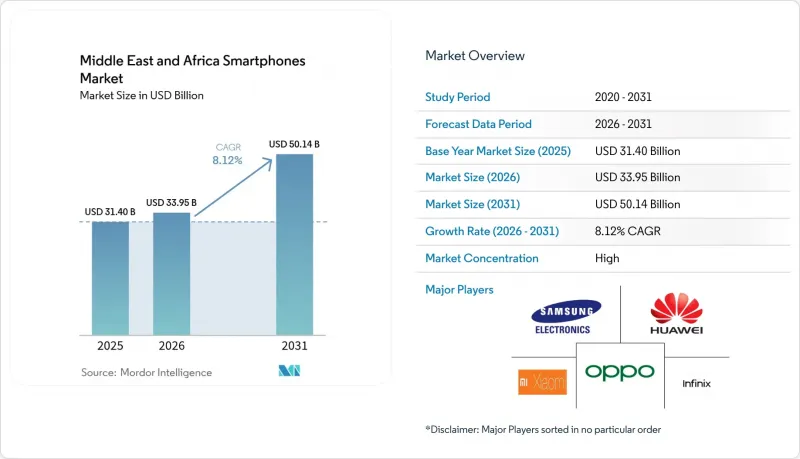
This report is Segmented by Operating System (Android, IOS, and More), Price Range (Ultra-Premium Above USD 800, Premium USD 600-799, Mid-Range USD 300-599, and More), Distribution Channel (Online Retail, Carrier/Operator Stores, and More), Technology (5G, 4G/LTE, and More), and Geography. The Market Forecasts are Provided in Terms of Value (USD).
Middle East And Africa Smartphones Market Trends and Insights
Rapid 5G roll-outs across GCC operators
GCC carriers view 5G as an economic catalyst rather than a routine network refresh, linking smartphones to smart-city services, fixed-wireless access, and enterprise Internet of Things (IoT) applications. Saudi Arabia alone expects 5G to inject USD 18 billion into its economy by 2030. Operator investments by stc, Zain, and e& already support 54.70% population coverage, prompting demand for premium-capable devices and driving higher average selling prices.
Youth-driven first-time smartphone adoption in Sub-Saharan Africa
Africa's median age of 19.7 fuels a surge of first-time owners who leapfrog feature phones and access mobile internet services straight through affordable handsets. TRANSSION's market-leading 47% share results from devices optimized for multi-language support and darker skin-tone photography. Asset-financing models in Kenya lifted penetration to 68.3%, illustrating the structural nature of this demand.
FX volatility and import tariffs inflating ASPs
Currency depreciation and import duties raise device prices, constraining discretionary spending. Egypt's 38.5% smartphone import tax initially lowered shipments, pushing OEMs toward local assembly to sidestep tariffs. Manufacturers that dual-source components locally are best positioned to absorb price shocks.
Other drivers and restraints analyzed in the detailed report include:
- E-commerce and social-commerce channels accelerating device sales
- National e-ID / super-app programs (e.g., Saudi Vision 2030)
- Grey-market and counterfeit handset inflows
For complete list of drivers and restraints, kindly check the Table Of Contents.
Segment Analysis
Android led the market with an 87.78% share in 2025 and is projected to register an 11.06% CAGR, reflecting the platform's alignment with local price sensitivities and service ecosystems. This leadership reinforces the Middle East and Africa smartphones market as an Android-centric environment where open-source flexibility lowers development cost for apps in mobile banking, ride-hailing, and telemedicine. Chinese OEMs leverage Android's customization layers to embed regional language packs and camera algorithms tailored to darker skin tones, which enhance consumer experience and loyalty. The platform's synergy with near-field communication (NFC) standards propels digital-wallet adoption in Saudi Arabia, where Nafath's 17.2 million users log daily transactions via biometric authentication.
The strategic edge expands beyond hardware as service bundling locks users deeper into cloud storage, payment, and identity ecosystems. Developers favor Android's broader install base to reach scale quickly, while governments adopt Android-first approaches for national ID, tax, and health-record apps. Although iOS retains cachet in ultra-premium brackets, its niche presence does little to erode Android's network effects. Over the forecast horizon, the Middle East and Africa smartphones market size tied to Android devices is expected to widen further as 5G coverage becomes near-ubiquitous in the Gulf and as Sub-Saharan operators sunset 2G networks.
Budget devices between USD 151 and USD 299 held 37.02% share in 2025, underscoring the income realities of mass-market buyers, yet premium smartphones priced USD 600-799 are on track for 9.58% CAGR growth. The bifurcation arises from parallel consumer bases: first-time rural owners and urban digital-service power users. Budget units capitalize on subsidy programs and BNPL schemes that spread repayments across micro-instalments. In contrast, affluent Gulf consumers upgrade to premium SKUs to harness 5G, augmented-reality (AR) features, and onboard AI accelerators.
Financing innovations blur these categories as operators in Kenya and Nigeria market premium devices through pay-as-you-go contracts. Transparent installment models enable mid-income earners to aspire to higher tiers without upfront cash, thereby enlarging the Middle East and Africa smartphones market size for premium devices. The challenge for OEMs lies in balancing feature proliferation with cost control to prevent cannibalization of mid-range models.
Complete Report Scope:
- By Operating System
- Android
- iOS
- Other Operating Systems
- By Price Range
- Ultra-Premium (Above USD 800)
- Premium (USD 600-799)
- Mid-range (USD 300-599)
- Budget (USD 151-299)
- Ultra-Budget (Less Than or Equal USD 150)
- By Distribution Channel
- Online Retail
- Carrier / Operator Stores
- Offline Retail
- By Technology (Connectivity)
- 5G
- 4G / LTE
- 3G and Below
- By Country
- Saudi Arabia
- United Arab Emirates
- South Africa
- Egypt
- Nigeria
- Turkey
- Rest of Middle East and Africa
List of Companies Covered in this Report:
- Samsung Electronics Co., Ltd.
- Transsion Holdings Limited
- Xiaomi Corporation
- Oppo Guangdong Mobile Communications Co., Ltd.
- Apple Inc.
- Vivo Communication Technology Co., Ltd.
- Huawei Technologies Co., Ltd.
- HMD Global Oy (Nokia)
- Google LLC
- ZTE Corporation
- Lenovo Group Limited
- Realme Chongqing Mobile Telecommunications Corp., Ltd.
- OnePlus Technology (Shenzhen) Co., Ltd.
- Honor Device Co., Ltd.
- Tecno Mobile Limited
- itel Mobile Limited
- Infinix Mobility Limited
- Motorola Mobility LLC
- TCL Technology Group Corporation (Alcatel brand)
- Sony Corporation
- Asustek Computer Inc.
- Lava International Limited
- Gionee Communication Equipment Co., Ltd.
Additional Benefits:
- The market estimate (ME) sheet in Excel format
- 3 months of analyst support
TABLE OF CONTENTS
1 INTRODUCTION
- 1.1 Study Assumptions and Market Definition
- 1.2 Scope of the Study
2 RESEARCH METHODOLOGY
3 EXECUTIVE SUMMARY
4 MARKET LANDSCAPE
- 4.1 Market Overview
- 4.2 Market Drivers
- 4.2.1 Rapid 5G roll-outs across GCC telecom operators
- 4.2.2 Youth-driven first-time smartphone adoption in Sub-Saharan Africa
- 4.2.3 Proliferation of ultra-low-cost Chinese OEM devices
- 4.2.4 E-commerce and social-commerce channels accelerating device sales
- 4.2.5 National e-ID / super-app programs (e.g., Saudi Vision 2030)
- 4.2.6 Buy-Now-Pay-Later (BNPL) financing apps widening affordability
- 4.3 Market Restraints
- 4.3.1 FX volatility and import tariffs inflating ASPs
- 4.3.2 Grey-market and counterfeit handset inflows
- 4.3.3 Emerging data-localization and OTT regulations raising compliance cost
- 4.3.4 Power-supply unreliability limiting rural usage
- 4.4 Industry Value Chain Analysis
- 4.5 Regulatory Landscape
- 4.6 Technological Outlook
- 4.7 Porter's Five Forces Analysis
- 4.7.1 Bargaining Power of Suppliers
- 4.7.2 Bargaining Power of Consumers
- 4.7.3 Threat of New Entrants
- 4.7.4 Intensity of Competitive Rivalry
- 4.7.5 Threat of Substitute Products
- 4.8 Pricing Analysis
- 4.9 Impact of Macroeconomics Factors on the Market
5 MARKET SIZE AND GROWTH FORECASTS (VALUE)
- 5.1 By Operating System
- 5.1.1 Android
- 5.1.2 iOS
- 5.1.3 Other Operating Systems
- 5.2 By Price Range
- 5.2.1 Ultra-Premium (Above USD 800)
- 5.2.2 Premium (USD 600-799)
- 5.2.3 Mid-range (USD 300-599)
- 5.2.4 Budget (USD 151-299)
- 5.2.5 Ultra-Budget (Less Than or Equal USD 150)
- 5.3 By Distribution Channel
- 5.3.1 Online Retail
- 5.3.2 Carrier / Operator Stores
- 5.3.3 Offline Retail
- 5.4 By Technology (Connectivity)
- 5.4.1 5G
- 5.4.2 4G / LTE
- 5.4.3 3G and Below
- 5.5 By Country
- 5.5.1 Saudi Arabia
- 5.5.2 United Arab Emirates
- 5.5.3 South Africa
- 5.5.4 Egypt
- 5.5.5 Nigeria
- 5.5.6 Turkey
- 5.5.7 Rest of Middle East and Africa
6 COMPETITIVE LANDSCAPE
- 6.1 Market Concentration
- 6.2 Strategic Moves
- 6.3 Market Share Analysis
- 6.4 Company Profiles (includes global overview, market overview, core segments, financials as available, strategic information, market rank/share, products and services, recent developments)
- 6.4.1 Samsung Electronics Co., Ltd.
- 6.4.2 Transsion Holdings Limited
- 6.4.3 Xiaomi Corporation
- 6.4.4 Oppo Guangdong Mobile Communications Co., Ltd.
- 6.4.5 Apple Inc.
- 6.4.6 Vivo Communication Technology Co., Ltd.
- 6.4.7 Huawei Technologies Co., Ltd.
- 6.4.8 HMD Global Oy (Nokia)
- 6.4.9 Google LLC
- 6.4.10 ZTE Corporation
- 6.4.11 Lenovo Group Limited
- 6.4.12 Realme Chongqing Mobile Telecommunications Corp., Ltd.
- 6.4.13 OnePlus Technology (Shenzhen) Co., Ltd.
- 6.4.14 Honor Device Co., Ltd.
- 6.4.15 Tecno Mobile Limited
- 6.4.16 itel Mobile Limited
- 6.4.17 Infinix Mobility Limited
- 6.4.18 Motorola Mobility LLC
- 6.4.19 TCL Technology Group Corporation (Alcatel brand)
- 6.4.20 Sony Corporation
- 6.4.21 Asustek Computer Inc.
- 6.4.22 Lava International Limited
- 6.4.23 Gionee Communication Equipment Co., Ltd.
7 MARKET OPPORTUNITIES AND FUTURE OUTLOOK
- 7.1 White-space and Unmet-need Assessment