
|
시장보고서
상품코드
2124661
인도의 플릿 관리 소프트웨어 시장 : 시장 점유율 분석, 업계 동향 및 통계, 성장 예측(2026-2031년)India Fleet Management Software - Market Share Analysis, Industry Trends & Statistics, Growth Forecasts (2026 - 2031) |
||||||
 Mordor Intelligence
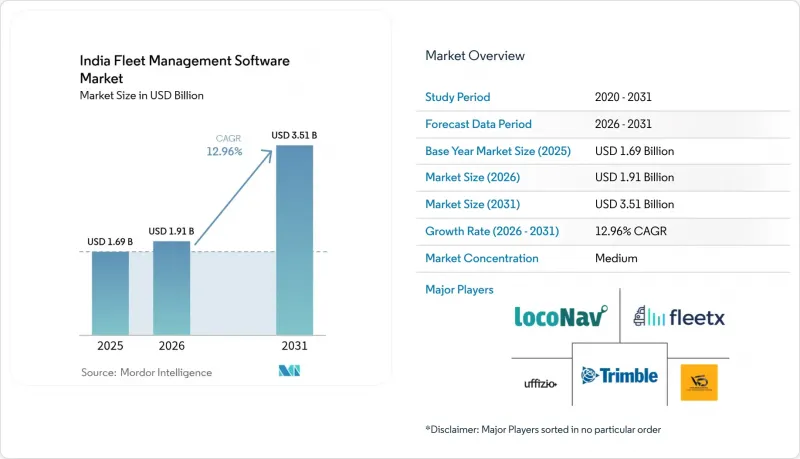
Mordor Intelligence에 의하면, 2026년 인도 플릿 관리 소프트웨어 시장 규모는 19억 1,000만 달러로 추정되고, 2025년 16억 9,000만 달러에서 성장하여 2031년에는 35억 1,000만 달러에 이를 것으로 예측됩니다.
2026-2031년 연평균 성장률(CAGR)은 12.96%를 나타낼 전망입니다.
본 보고서는 도입 형태별(온프레미스 및 클라우드/SaaS), 차량 보유 대수별(소규모, 중규모, 대규모), 차종별(소형 상용차, 대형 상용차, 승용차, 이륜차), 최종 사용자 산업별(물류 및 운송, 제조·산업, 기타), 기능·모듈별(추적·텔레매틱스, 경로 최적화·내비게이션, 기타), 지역별로 분류되어 있습니다.
인도의 플릿 관리 소프트웨어 시장 동향 및 인사이트
AIS-140 및 IS-16833 준수 의무가 시장 확대 견인
정부의 지침에 따라 모든 상용차에는 실시간 데이터를 주 교통 서버로 전송하는 GPS 지원 추적 장치를 장착해야 합니다. 이 의무화는 비상 버튼 및 운전자 행동 모니터링까지 확대되어, 플릿 관리 소프트웨어는 단순한 선택적 최적화 도구에서 필수적인 안전 인프라로 변모하고 있습니다. 기존에 기술 투자를 미뤄왔던 중소규모 사업자들은 기한이 정해진 규정 준수 조치를 서둘러야 하는 상황에 놓여 있으며, 이는 인도 플릿 관리 소프트웨어 시장 전반에 걸쳐 급속한 도입을 촉진하고 있습니다. 규제 사양이 급속히 변화함에 따라, 무선(OTA)을 통한 규칙 업데이트 기능을 탑재한 벤더가 우위를 점하고 있습니다. 또한, 규정 준수 수요의 급증은 중고 트럭 판매업체에서의 사후 장착 수요도 창출하고 있어, 대상 시장을 신차 판매의 범위를 넘어 확대시키고 있습니다.
연료 가격 변동이 총소유비용(TCO) 중심의 디지털화를 가속화
연료비는 트럭 운송 운영 비용의 40%-50%를 차지하고 있으며, 최근의 가격 변동으로 인해 본래 극히 낮은 이익률이 더욱 압박받게 된 결과, 공회전, 과속, 경로 이탈을 억제하기 위한 기술 도입이 가속화되고 있습니다. 현재 플릿 관리 소프트웨어는 연료 센서와 예측 분석을 결합하여 유사한 운행 주기의 소비량을 벤치마킹함으로써, 사업자가 객관적인 데이터를 바탕으로 운전기사나 화주와 협상할 수 있도록 지원합니다. 디젤 연료 청구서, 운전자의 스코어카드, 경로 히트맵을 통합한 클라우드 대시보드는 신속한 투자 회수(ROI)를 실현하며, 구독 비용 평가 시 비용을 중시하는 차량 운영 사업자에게 설득력 있는 근거가 됩니다.
기존 운송 사업자와 노동조합의 반발이 조기 도입을 가로막고 있습니다.
장거리 운전기사들은 텔레매틱스를 감시와 동일시하는 경우가 많으며, 소규모 차량 소유주들은 앱 기반 화물 플랫폼을 수십 년에 걸친 중개업자와의 관계를 위협하는 요소로 간주합니다. 이러한 회의적인 시각은 심각한 운전기사 부족으로 인해 더욱 강화되고 있으며, 고용주는 엄격한 감시보다 인재 유지를 우선시할 수밖에 없는 상황에 처해 있습니다. 성공적인 공급업체들은 SOS 알림, 급여 선지급, 차량 내 인포테인먼트 등을 제공하는 ‘복지 증진 수단’으로 소프트웨어를 재정의하며, 이야기의 초점을 ‘관리’에서 ‘역량 강화’로 전환하고 있습니다. 교통부의 주 차원 인식 제고 캠페인으로 인해 거부감은 서서히 누그러지고 있지만, 문화적 변화에는 여전히 수년이 걸릴 전망입니다.
부문 분석
클라우드 솔루션은 2025년 매출의 69.10%를 차지했으며, 도입 형태별로는 인도 플릿 관리 소프트웨어 시장에서 가장 큰 점유율을 기록하고 있습니다. 클라우드 플랫폼은 초기 투자를 최소화할 수 있어, 인도 사업자 전체의 80%를 차지하는 소규모 사업자에게 결정적인 요인이 되고 있습니다. 차량 단위 구독, 자동 OTA(Over-the-Air) 업데이트, API 기반 통합을 통해 차량 운영 사업자는 새로운 서버를 도입하지 않고도 기능을 확장할 수 있습니다. 향후 5년간 이러한 유연성이 원동력이 되어, 모든 도입 형태 중 가장 높은 연평균 성장률(CAGR)인 13.55%를 나타낼 것으로 전망됩니다.
온프레미스 도입은 데이터의 국내 보관이나 독자적인 워크플로우 로직이 필요한 대기업 및 공공기관에게 여전히 중요한 선택지입니다. 그러나 규제나 기능 업데이트 때마다 현지에서 패치를 적용해야 하기 때문에 혁신 속도 면에서는 뒤처지고 있습니다. 전기차 급증과 운전자 평가 분석이 활발해지는 가운데, 클라우드 벤더들은 매주 새로운 버전을 출시하고 있어 기능 면에서의 격차는 더욱 벌어지고 있습니다. 인도의 4G 및 5G 통신 영역 확대와 맞물려, 클라우드 구독 모델은 인도 플릿 관리 소프트웨어 시장 규모에서 압도적인 선두 자리를 유지할 것으로 예측됩니다.
2025년 지출 중 중규모 차량 플릿이 51.10%를 차지했는데, 이는 20-100대의 차량을 소유한 운송업체가 다수 존재함을 반영합니다. 이러한 사업자들은 디지털화가 필요할 정도로 업무의 복잡성이 높은 반면, 새로운 벤더를 시도해 볼 수 있을 만큼의 기동성도 갖추고 있습니다. 이러한 사업자들은 일반적으로 추적 기능부터 도입을 시작하여 12개월 이내에 경로 최적화나 유지보수 모듈로 업그레이드하기 때문에 안정적인 월간 정기 수익을 창출하고 있습니다.
100대를 초과하는 대규모 차량은 13.78%라는 가장 높은 연평균 성장률(CAGR)을 기록하고 있으며, 인도 플릿 관리 소프트웨어 시장 전망에서 매우 중요한 역할을 하고 있습니다. 전자상거래 물류 및 조직화된 제3자 물류(3PL) 사업자의 통합으로 인해, 실시간 대시보드, 운전자 참여 앱, 그리고 전사적 자원 관리(ERP)와의 통합이 필요한 거대 차량 함대가 생겨나고 있습니다. 20대 미만의 소규모 차량fleet의 경우, 소유주가 투자 회수 기간을 ‘몇 달’이 아닌 ‘몇 주’ 단위로 계산하는 경향이 있어 도입이 더딘 임베디드니다. 이 부문에서는 프리미엄형 모바일 우선 서비스가 여전히 시장 진입의 관문 역할을 하고 있습니다.
기타 혜택 :
- 엑셀 형식 시장 예측(ME) 시트
- 3개월간의 애널리스트 지원
자주 묻는 질문
목차
제1장 서론
제2장 조사 방법
제3장 주요 요약
제4장 시장 구도
제5장 시장 규모 및 성장 예측
제6장 경쟁 구도
제7장 시장 기회 및 향후 전망
AJY 26.09.15According to Mordor Intelligence, the India fleet management software market size in 2026 is estimated at USD 1.91 billion, growing from 2025 value of USD 1.69 billion with 2031 projections showing USD 3.51 billion, growing at 12.96% CAGR over 2026-2031.
This report is Segmented by Deployment (On-Premise and Cloud/SaaS), Fleet Size (Small, Medium, and Large), Vehicle Type (Light Commercial Vehicles, Heavy Commercial Vehicles, Passenger Cars, and Two-Wheelers), End-User Industry (Logistics and Transportation, Manufacturing and Industrial, and More), Functionality/Module (Tracking and Telematics, Route Optimisation and Navigation, and More), and Region.
India Fleet Management Software Market Trends and Insights
AIS-140 and IS-16833 Compliance Mandates Drive Market Acceleration
Government directives compel every commercial vehicle to install GPS-enabled tracking devices that transmit real-time data to state transport servers. The mandates extend to panic buttons and driver-behavior monitoring, transforming fleet software from optional optimization to compulsory safety infrastructure. Small and medium operators that historically deferred tech spending now face time-bound compliance, triggering rapid adoption across the India fleet management software market. Vendors that embed over-the-air rule updates gain an edge because regulatory specifications evolve quickly. The compliance surge is also generating retrofit demand among used-truck dealers, broadening the addressable base beyond new-vehicle sales.
Volatile Fuel Prices Catalyze TCO-Focused Digitization
Fuel accounts for 40%-50% of trucking operating costs; recent price swings have eroded razor-thin margins and hastened technology uptake to rein in idling, speeding, and route detours. Fleet software now couples fuel sensors with predictive analytics that benchmark consumption across similar duty cycles, empowering operators to negotiate with drivers and shippers using objective data. Cloud dashboards that aggregate diesel invoices, driver scorecards, and route heatmaps deliver quick ROI, a persuasive narrative for cost-sensitive fleets evaluating subscription outlays.
Traditional Operator and Union Resistance Limits Early Uptake
Long-haul drivers often equate telematics with surveillance, and small-fleet owners view app-based freight platforms as threats to decades-old broker ties. The skepticism is amplified by an acute driver shortage that pushes employers to prioritize retention over strict monitoring. Successful vendors reframe software as a welfare enabler offering SOS alerts, salary advances, and in-cab infotainment to shift the narrative from control to empowerment. State-level awareness campaigns by transport departments are gradually softening resistance, but cultural change remains a multi-year journey.
Other drivers and restraints analyzed in the detailed report include:
- E-Commerce and On-Demand Logistics Boom Reshapes Fleet Requirements
- Declining IoT Hardware Costs Democratize Advanced Telematics
- High Capex for Multi-Sensor Telematics Constrains SMEs
For complete list of drivers and restraints, kindly check the Table Of Contents.
Segment Analysis
Cloud solutions claimed 69.10% of 2025 revenue, translating to the largest India fleet management software market share within the deployment spectrum. Cloud platforms minimize upfront investment, a decisive factor for India's 80% small-operator landscape. Pay-per-vehicle subscriptions, automatic over-the-air updates, and API-based integrations allow fleets to scale features without new servers. Over the next five years, this flexibility fuels a 13.55% CAGR, the fastest of any deployment mode.
On-premise installations remain relevant for large enterprises and public agencies requiring data residency or custom workflow logic. However, they lag in innovation velocity because each regulatory or feature update demands on-site patches. Amid the surge in electric vehicles and driver-scorecard analytics, cloud vendors push weekly releases, widening the functionality gap. Combined with India's improving 4G and 5G coverage, cloud subscription is expected to maintain its commanding India fleet management software market size leadership.
Medium fleets accounted for 51.10% of 2025 spending, reflecting the abundance of carriers that own 20-100 vehicles. Their operational complexity is high enough to warrant digitization but still agile enough to experiment with new vendors. These operators typically begin with tracking and upgrade to route optimization and maintenance modules within twelve months, driving sticky monthly recurring revenue.
Large fleets above 100 vehicles posted the highest 13.78% CAGR and are pivotal to forecasts of the India fleet management software market. Consolidation in e-commerce logistics and organized 3PLs produces mega-fleets that require real-time dashboards, driver engagement apps, and enterprise resource planning integration. Small fleets under twenty vehicles trail in adoption because owners tend to calculate payback in weeks, not months. Freemium mobile-first offerings remain the entry gateway for this cohort.
Complete Report Scope:
- By Deployment
- On-Premise
- Cloud/SaaS
- By Fleet Size
- Small (<20 vehicles)
- Medium (20-100)
- Large (>100)
- By Vehicle Type
- Light Commercial Vehicles (LCV)
- Heavy Commercial Vehicles (HCV)
- Passenger Cars
- Two-Wheelers
- By End-User Industry
- Logistics and Transportation
- Manufacturing and Industrial
- Passenger Transport (Bus, Taxi, School)
- Other End-User Industries (Corporate, Utilities, Waste Management)
- By Functionality / Module
- Tracking and Telematics
- Route Optimisation and Navigation
- Maintenance and Diagnostics
- Compliance and Safety
- Fuel and Energy Management
- Analytics and Reporting
- By Region
- North India
- West India
- South India
- East and North-East India
- Central India
List of Companies Covered in this Report:
- Trimble Mobility Solutions India Private Limited
- BT TechLabs Private Limited (LocoNav)
- fleetx Technologies Private Limited
- Uffizio India Software Consultants Private Limited
- Web World Digital Solutions Private Limited (TrackoBit)
- iTriangle Infotech Private Limited
- Azuga Telematics Private Limited
- Samsara Networks India Private Limited
- Geotab Inc. (India)
- Intellicar Telematics Private Limited
- Enmovil Solutions Private Limited
- Vamo Systems Private Limited (Vamosys)
- Binary Semantics Limited (FleetRobo)
- Taabi Mobility (Astra Mobility India Private Limited)
- Mind Your Fleet Tech Private Limited
- GeoSafe Technologies Private Limited
- Affable Web Solutions Private Limited (Fleetable)
- Llama Logisol Private Limited (FleetEnable)
- Pulse Energy India Private Limited
- NextBillion.ai India Private Limited
- Trackster Technologies Private Limited
- Cygnux Softtech Private Limited
Additional Benefits:
- The market estimate (ME) sheet in Excel format
- 3 months of analyst support
TABLE OF CONTENTS
1 INTRODUCTION
- 1.1 Market Definition and Scope of the Study
- 1.2 Study Assumptions
2 RESEARCH METHODOLOGY
3 EXECUTIVE SUMMARY
4 MARKET LANDSCAPE
- 4.1 India Fleet Management Software Market Overview
- 4.2 Stakeholder Analysis
- 4.3 Market Drivers
- 4.3.1 AIS-140 and IS-16833 compliance mandates
- 4.3.2 Volatile fuel prices driving Total-Cost-of-Ownership (TCO) reduction
- 4.3.3 E-commerce and on-demand logistics boom
- 4.3.4 Declining IoT hardware costs and GNSS accuracy gains
- 4.3.5 OEM data-monetization partnerships with FMS vendors
- 4.3.6 EV fleet electrification and energy-aware routing demand
- 4.4 Market Restraints
- 4.4.1 Traditional fleet-operator and driver-union technology resistance
- 4.4.2 High capex for multi-sensor telematics in SME fleets
- 4.4.3 Rural data-connectivity gaps hindering always-on tracking
- 4.4.4 2G/3G sunset forcing legacy-device retrofit costs
- 4.5 Industry Value Chain Analysis
- 4.6 Regulatory Landscape
- 4.7 Technological Outlook (IoT, AI-enabled Telematics)
- 4.8 Porter's Five Forces Analysis
- 4.8.1 Bargaining Power of Suppliers
- 4.8.2 Bargaining Power of Buyers
- 4.8.3 Threat of New Entrants
- 4.8.4 Threat of Substitutes
- 4.8.5 Intensity of Competitive Rivalry
- 4.9 Impact of Key Macroeconomic Trends on Market
5 MARKET SIZE AND GROWTH FORECASTS (VALUES)
- 5.1 By Deployment
- 5.1.1 On-Premise
- 5.1.2 Cloud/SaaS
- 5.2 By Fleet Size
- 5.2.1 Small (<20 vehicles)
- 5.2.2 Medium (20-100)
- 5.2.3 Large (>100)
- 5.3 By Vehicle Type
- 5.3.1 Light Commercial Vehicles (LCV)
- 5.3.2 Heavy Commercial Vehicles (HCV)
- 5.3.3 Passenger Cars
- 5.3.4 Two-Wheelers
- 5.4 By End-User Industry
- 5.4.1 Logistics and Transportation
- 5.4.2 Manufacturing and Industrial
- 5.4.3 Passenger Transport (Bus, Taxi, School)
- 5.4.4 Other End-User Industries (Corporate, Utilities, Waste Management)
- 5.5 By Functionality / Module
- 5.5.1 Tracking and Telematics
- 5.5.2 Route Optimisation and Navigation
- 5.5.3 Maintenance and Diagnostics
- 5.5.4 Compliance and Safety
- 5.5.5 Fuel and Energy Management
- 5.5.6 Analytics and Reporting
- 5.6 By Region
- 5.6.1 North India
- 5.6.2 West India
- 5.6.3 South India
- 5.6.4 East and North-East India
- 5.6.5 Central India
6 COMPETITIVE LANDSCAPE
- 6.1 Market Concentration
- 6.2 Strategic Moves
- 6.3 Market Share Analysis
- 6.4 Company Profiles (includes Global level Overview, Market level overview, Core Segments, Financials as available, Strategic Information, Market Rank/Share for key companies, Products and Services, and Recent Developments)
- 6.4.1 Trimble Mobility Solutions India Private Limited
- 6.4.2 BT TechLabs Private Limited (LocoNav)
- 6.4.3 fleetx Technologies Private Limited
- 6.4.4 Uffizio India Software Consultants Private Limited
- 6.4.5 Web World Digital Solutions Private Limited (TrackoBit)
- 6.4.6 iTriangle Infotech Private Limited
- 6.4.7 Azuga Telematics Private Limited
- 6.4.8 Samsara Networks India Private Limited
- 6.4.9 Geotab Inc. (India)
- 6.4.10 Intellicar Telematics Private Limited
- 6.4.11 Enmovil Solutions Private Limited
- 6.4.12 Vamo Systems Private Limited (Vamosys)
- 6.4.13 Binary Semantics Limited (FleetRobo)
- 6.4.14 Taabi Mobility (Astra Mobility India Private Limited)
- 6.4.15 Mind Your Fleet Tech Private Limited
- 6.4.16 GeoSafe Technologies Private Limited
- 6.4.17 Affable Web Solutions Private Limited (Fleetable)
- 6.4.18 Llama Logisol Private Limited (FleetEnable)
- 6.4.19 Pulse Energy India Private Limited
- 6.4.20 NextBillion.ai India Private Limited
- 6.4.21 Trackster Technologies Private Limited
- 6.4.22 Cygnux Softtech Private Limited
7 MARKET OPPORTUNITIES AND FUTURE OUTLOOK
- 7.1 White-Space and Unmet-Need Assessment