|
시장보고서
상품코드
2124706
소수력 발전 : 시장 점유율 분석, 업계 동향과 통계, 성장 예측(2026-2031년)Small Hydropower - Market Share Analysis, Industry Trends & Statistics, Growth Forecasts (2026 - 2031) |
||||||
 Mordor Intelligence
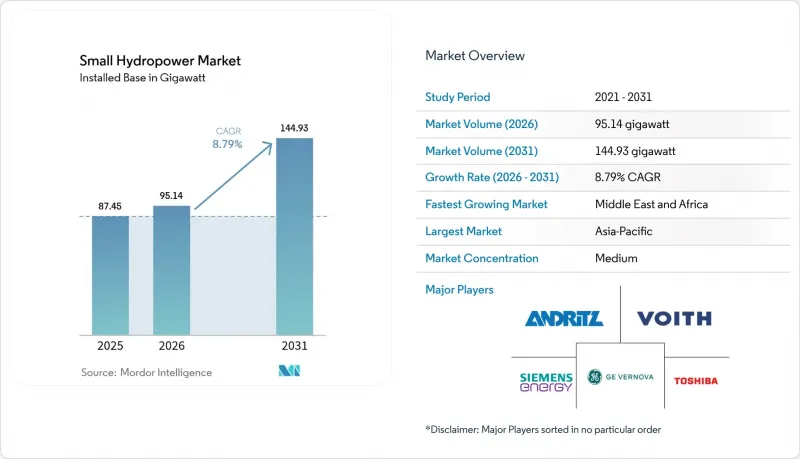
Mordor Intelligence에 의하면, 소수력 발전 시장 규모는 2025년에 87.45기가와트로 평가되었고, 2026년 95.14기가와트에서 2031년까지 144.93기가와트에 이를 것으로 예측되며, 예측 기간(2026-2031년) CAGR은 8.79%를 기록할 전망입니다.

본 보고서는 용량(1MW 이하 및 1-10MW), 기술(저수지식, 하천 유수식, 양수식, 하천 내식 및 마이크로 컨듀잇식), 최종 사용자(전력 회사, 독립 발전 사업자, 산업용 및 자가 소비용),지역(북미, 유럽, 아시아태평양, 남미, 중동 및 아프리카)별로 분류되어 있습니다. 시장 규모 및 전망은 설치 용량(GW)으로 표시되어 있습니다.
전 세계 소규모 수력 발전 시장 동향 및 인사이트
청정하고 지속 가능한 전력에 대한 수요 급증
기업의 지속가능성 정책에서는 24시간 체제의 재생에너지 조달이 중요시되고 있으며, 소규모 수력 발전의 베이스로드 특성은 고가의 축전지와 결합된 풍력이나 태양광 발전보다 이 목표에 더 부합합니다. 국제재생에너지기구(IRENA)는 2030년까지 기업 주도형 청정 전력 계약이 연간 100GW를 넘어설 것으로 예측하고 있으며, 베이스로드 전원은 프리미엄 계약 가격을 확보할 것으로 전망됩니다. 데이터센터 운영자를 포함한 대규모 전력 구매자들은 사내 탄소 회계 체계를 충족하기 위해 소수력 발전을 간헐적인 재생에너지와 결합하는 사례가 늘고 있습니다. 이러한 추세에 따라 인증 시장에서 차별화된 가격 책정이 가능한 유럽 및 북미의 신규 프로젝트에 투자가 집중되고 있습니다. 그 결과, 장기적인 전력 구매의 확실성이 높아지고 자금 조달 위험이 완화되어 건설 착공이 가속화되고 있습니다.
Off-grid 지역을 위한 농촌 전기화 프로그램
정부가 지원하는 농촌 에너지 프로그램에서는 험준한 지형으로 인해 장거리 송전선 건설이 비용 면에서 현실적이지 않기 때문에 분산형 수력발전을 이용한 미니 그리드에 막대한 자금이 배정되고 있습니다. 인도의 ‘딘 다야르 우파디야야 그람 조티 요자나’에서는 2024년 전기화 사업에 25억 달러를 배정하고 있으며, 신규 발전 용량의 15%를 소규모 수력 발전으로 충당할 계획입니다. 지역 사회가 소유하는 모델을 통해 요금이 합리적인 수준으로 유지되고 이익이 지역 사회에 환원되므로 사회적 수용성이 강화됩니다. 세계은행의 이니셔티브는 현재 양허성 대출과 기술 지원을 결합하여 사하라 이남 아프리카 전역에 이러한 접근 방식을 확산시키고 있습니다. 농산물 가공 및 냉장 보관을 중심으로 지역 산업이 성장함에 따라, 수요 곡선은 안정적인 하천 발전과 일치하게 되어 사업자의 수익 안정성이 더욱 높아집니다.
기후 변화로 인한 유량 변동과 불안정한 발전량
가뭄이 심화되면서 하천 유량이 감소하고 설비 가동률이 낮아지고 있어, 당초 많은 프로젝트를 정당화했던 ‘신뢰성 높은 전력’이라는 주장의 근거가 약화되고 있습니다. IPCC는 2030년까지 유량 변동성이 20-30% 증가할 것으로 예측했습니다. 2024년, 남유럽의 평균 설비 이용률은 8% 하락하여 발전 사업자들은 현물 시장에서 조정 전력을 구매할 수밖에 없게 되었습니다. 태양광 발전과의 하이브리드화는 부분적인 리스크 헤지 수단이 되지만, 자본 예산을 10-15% 증가시킵니다. 기후 변화에 대한 회복력을 높이기 위한 전용 자금이 없다면, 소규모 개발 사업자는 보험료 급등이나 대출 기관이 요구하는 부채 상환 여유분을 충당하는 데 어려움을 겪을 가능성이 있습니다.
부문 분석
1-10 MW 등급(1-10 MW tier)은 소규모 수력 발전 시장의 기반을 계속 형성하고 있으며,검증된 유틸리티 비즈니스 모델과 1kWh당 0.05-0.08달러의 대출 가능한 균등화 발전 비용(LCOE) 덕분에 2025년에는 매출의 66.85%를 차지할 전망입니다. 벤더가 표준화된 패키지를 제공하고, 대출 기관도 실행 위험이 낮다고 인식하고 있기 때문에 자산 개발업체들은 이 등급을 선호하고 있습니다. 많은 하천이 이미 이러한 프로젝트의 대상으로 평가되고 있기 때문에 기존 시설의 개보수(브라운필드 업그레이드)를 통한 리파워링이 이 부문의 매출 기준을 더욱 공고히 하고 있습니다.
한편, 1MW 미만의 마이크로 발전 설비는 2031년까지 연평균 성장률(CAGR) 10.26%라는 견실한 속도로 확대되고 있습니다. 이는 허가 취득 절차의 효율화와 지역 협동조합 등 혁신적인 자금 조달 방식이 반영된 결과입니다. 어류 사망률이 2% 미만인 터빈의 인증 획득으로, 과거 소규모 개울에서의 개발을 가로막았던 생물 다양성에 대한 우려가 완화되고 있습니다. 인도의 외딴 마을이나 페루의 산악 지역에서는 지분을 보유함으로써 현금 흐름이 지역 내에 머물게 되어, 요금 회수율 향상과 사회적 수용성 제도로 이어지고 있습니다. 이러한 특징 덕분에 마이크로 규모 부문은 소규모 수력 발전 시장에서 주요 성장 동력으로 계속 자리매김할 것이 보장됩니다.
지역별 분석
2025년에는 아시아태평양이 매출의 63.55%를 차지하며 시장을 주도했습니다. 이는 2030년까지 15GW를 증설하겠다는 중국의 85억 달러 투자 계획과, 5MW 미만 프로젝트에 대한 인도의 신속한 허가·인가 절차가 배경에 있습니다. 일본에서는 도쿄전력이 15곳에서 개보수 공사를 실시하는 등, 성숙기에 접어들었음에도 불구하고 계속 진화하는 모습을 보이고 있습니다. 이곳에서는 디지털화를 통해 새로운 환경 부하를 발생시키지 않으면서 발전량이 증가하고 있습니다. 인도네시아와 필리핀은 섬의 미니 그리드에 전력을 공급하기 위해 소규모 수력 발전의 주력 발전소에 의존하고 있으며, 자원의 혜택을 포용적 성장으로 연결하고 있습니다.
중동 및 아프리카은 2031년까지 연평균 성장률(CAGR) 14.31%로 가장 빠르게 성장하고 있는 지역이며, 모로코의 총 45MW 규모 8개 발전소 가동과 2024년에 5만 명의 주민에게 전력을 공급한 케냐의 농촌 전기화 파트너십에 힘입고 있습니다. 우간다에서는 5MW 미만 프로젝트에 대한 승인 절차를 간소화하여 규제 소요 기간을 40% 단축했습니다. 콩고 민주 공화국에서는 중국의 자금 지원을 통해 광물 가공에 전력을 공급하는 동시에, 전력망이 연결되지 않은 마을들의 전력 접근성을 확대하는 사업이 시행되고 있습니다. 이러한 노력은 관개, 전력, 지역 내 부가가치 창출을 통합하는 ‘물·에너지·식량 넥서스’ 모델의 유효성을 입증하고 있습니다.
유럽과 북미에서는 발전 설비 현대화와 환경 규제 준수에 주력하고 있습니다. EU의 12억 유로 규모의 ‘REPowerEU’ 기금은 효율 향상과 어도 개량을 목표로 하고 있는 반면, 노르웨이의 스타트크라프트(Statkraft)사는 머신러닝을 통한 최적화를 통해 12곳의 발전소에서 발전 용량을 20% 증가시켰습니다. 미국에서는 FERC가 2024년에 3유형의 어류 친화적 터빈을 인증함으로써, 과거 연어 보호 규정에 의해 금지되었던 프로젝트가 가능해졌습니다. 남미에서는 브라질과 칠리가 중심이 되어 풍부한 수자원을 활용해 외딴 농업 지역까지 송전망을 확장하고 있으며, 현대화와 신규 건설이 공존할 수 있음이 입증되었습니다.
기타 혜택:
- 엑셀 형식 시장 예측(ME) 시트
- 3개월간의 애널리스트 지원
목차
제1장 서론
제2장 조사 방법
제3장 주요 요약
제4장 시장 구도
제5장 시장 규모와 성장 예측
제6장 경쟁 구도
제7장 시장 기회와 향후 전망
LSHAccording to Mordor Intelligence, the small hydropower market size was valued at 87.45 gigawatt in 2025 and estimated to grow from 95.14 gigawatt in 2026 to reach 144.93 gigawatt by 2031, at a CAGR of 8.79% during the forecast period (2026-2031).
This report is Segmented by Capacity (Up To 1 MW and 1 To 10 MW), Technology (Reservoir-Based, Run-Of-River, Pumped-Storage, and In-Stream and Micro-Conduit), End-User (Utilities, Independent Power Producers, and Industrial and Captive), and Geography (North America, Europe, Asia-Pacific, South America, and Middle East and Africa). The Market Size and Forecasts are Provided in Terms of Installed Capacity (GW)
Global Small Hydropower Market Trends and Insights
Surge in Demand for Clean & Sustainable Power
Corporate sustainability mandates now prize around-the-clock renewable procurement, and small hydropower's baseload profile matches that goal better than wind or solar paired with costly batteries. The International Renewable Energy Agency anticipates corporate-led clean-power contracting to exceed 100 GW annually by 2030, with baseload sources commanding premium contract prices. Utility-scale buyers, including data-center operators, increasingly bundle small hydropower with intermittent renewables to meet internal carbon accounting frameworks. These trends channel investment toward new projects in Europe and North America, where certificate markets allow differentiated pricing. The result reinforces long-term offtake certainty that de-risks financing and accelerates construction starts.
Rural Electrification Programmes for Off-Grid Communities
Government-backed rural-energy programs allocate sizable funding to distributed hydropower mini-grids because steep terrain makes long transmission lines cost-prohibitive. India's Deen Dayal Upadhyaya Gram Jyoti Yojana earmarked USD 2.5 billion for electrification in 2024, with 15% of new megawatts sourced from small hydropower. Community ownership models ensure tariffs remain affordable and profits stay local, strengthening social acceptance. World Bank initiatives now blend concessional finance with technical assistance to replicate similar approaches across sub-Saharan Africa. As local industry grows around agro-processing and cold storage, demand curves align with steady river-based generation, reinforcing revenue stability for operators.
Climate-Driven Flow Variability & Unstable Output
Intensifying droughts reduce river discharge and erode capacity factors, undercutting the dependable-power narrative that originally justified many projects. The IPCC expects flow variability to rise 20-30% by 2030. In 2024, average capacity factors in southern Europe fell 8%, forcing generators to buy balancing power on spot markets. Hybridization with solar offers a partial hedge but inflates capital budgets by 10-15%. Without dedicated climate-resilience finance, smaller developers could struggle to absorb higher insurance premiums and debt-service cushions required by lenders.
Other drivers and restraints analyzed in the detailed report include:
- Modernisation & Repowering of Ageing Small-Hydro Assets
- Fish-Friendly Micro-Turbine Innovations Unlocking New Sites
- Lengthy, Uncertain Environmental-Permitting Cycles
For complete list of drivers and restraints, kindly check the Table Of Contents.
Segment Analysis
The 1-10 MW tier continues to anchor the small hydropower market, holding 66.85% revenue in 2025 thanks to proven utility business models and bankable levelized costs of USD 0.05-0.08 per kWh. Asset developers favor this bracket because equipment vendors offer standardized packages and lenders perceive lower execution risk. With many rivers already assessed for such projects, brownfield upgrades further solidify the segment's revenue base through repowering.
Micro units under 1 MW, however, expand at a brisk 10.26% CAGR through 2031, reflecting streamlined permitting pathways and innovative funding such as community cooperatives. Certification of sub-2% fish-mortality turbines mitigates biodiversity objections that once sidelined small creeks. For remote villages in India or mountainous areas in Peru, ownership stakes keep cash flows local, improving tariff recovery and social license. These attributes ensure the micro tier remains the principal growth engine within the small hydropower market.
Complete Report Scope:
- By Capacity
- Up to 1 MW
- 1 to 10 MW
- By Technology
- Reservoir-Based
- Run-of-River
- Pumped-Storage
- In-Stream and Micro-conduit
- By Component (Qualitative Analysis only)
- Turbines
- Generators
- Control and Automation
- Balance-of-Plant
- By End-User
- Utilities (State & Public)
- Independent Power Producers
- Industrial and Captive
- By Geography
- North America
- United States
- Canada
- Mexico
- Europe
- France
- Italy
- Spain
- Norway
- Turkey
- Russia
- Rest of Europe
- Asia-Pacific
- China
- India
- Japan
- South Korea
- Indonesia
- Philippines
- Tajikistan
- Australia and New Zealand
- Rest of Asia-Pacific
- South America
- Brazil
- Chile
- Colombia
- Honduras
- Rest of South America
- Middle East and Africa
- South Africa
- Uganda
- Morocco
- Kenya
- Democratic Republic of the Congo
- Rest of Middle East and Africa
- North America
Geography Analysis
Asia-Pacific dominated with 63.55% revenue in 2025, led by China's USD 8.5 billion commitment to add 15 GW by 2030 and India's expedited permitting for sub-5 MW projects. Upgrades in Japan, 15 sites retrofitted by Tokyo Electric Power, demonstrate a mature yet evolving landscape, where digitalization raises output without fresh ecological footprints. Indonesia and the Philippines rely on small hydropower anchor plants to energize island mini-grids, translating resource endowment into inclusive growth.
The Middle East & Africa is the fastest-growing region at 14.31% CAGR toward 2031, buoyed by Morocco's eight-plant rollout totaling 45 MW and Kenya's rural-electrification partnerships that served 50,000 residents in 2024. Uganda streamlines approvals for under-5 MW projects, slashing regulatory timelines 40%. In the Democratic Republic of Congo, Chinese finance underwrites schemes that power mineral processing while expanding access for off-grid villages. These initiatives validate the water-energy-food nexus model that integrates irrigation, electricity, and local value addition.
Europe and North America concentrate on repowering and environmental compliance. The EU's EUR 1.2 billion REPowerEU fund targets efficiency gains and fish-passage retrofits, while Norway's Statkraft achieves 20% capacity boosts on 12 plants through machine-learning optimization. In the United States, FERC certified three fish-friendly turbines in 2024, enabling projects once barred by salmon-protection rules. South America centers on Brazil and Chile, leveraging robust hydrology to extend grids into remote agrarian zones, proving that modernization and greenfield builds can coexist.
List of Companies Covered in this Report:
- Voith GmbH & Co. KGaA
- Andritz AG
- GE Vernova, Inc.
- Siemens Energy AG
- Toshiba Energy Systems & Solutions Corp.
- PJSC RusHydro
- Statkraft AS
- Gilbert Gilkes & Gordon Ltd.
- FLOVEL Energy Pvt Ltd.
- Natel Energy Inc.
- Mavel a.s.
- Bharat Heavy Electricals Ltd. (BHEL)
- SNC-Lavalin Group Inc. (AtkinsRealis)
- CKD Blansko Holding
- Canyon Hydro
- American Hydro Corp.
- Litostroj Power
- Turbulent NV
- Blueline Manufacturing
- Voith Hydro Italy
Additional Benefits:
- The market estimate (ME) sheet in Excel format
- 3 months of analyst support
TABLE OF CONTENTS
1 Introduction
- 1.1 Study Assumptions & Market Definition
- 1.2 Scope of the Study
2 Research Methodology
3 Executive Summary
4 Market Landscape
- 4.1 Market Overview
- 4.2 Market Drivers
- 4.2.1 Surge in demand for clean & sustainable power
- 4.2.2 Rural electrification programmes for off-grid communities
- 4.2.3 Modernisation & repowering of ageing small-hydro assets
- 4.2.4 Fish-friendly micro-turbine innovations unlocking new sites
- 4.2.5 Water-energy-food nexus projects attracting blended finance
- 4.2.6 Corporate renewable PPAs seeking baseload renewables
- 4.3 Market Restraints
- 4.3.1 Climate-driven flow variability & unstable output
- 4.3.2 Lengthy, uncertain environmental-permitting cycles
- 4.3.3 Falling solar-plus-storage LCOE compressing hydro IRRs
- 4.3.4 Siltation & sedimentation raising O&M costs
- 4.4 Supply-Chain Analysis
- 4.5 Regulatory Landscape
- 4.6 Technological Outlook
- 4.7 Regional Installed Capacity Share
- 4.8 Projects Pipeline & Upcoming Developments
- 4.9 Porter's Five Forces
- 4.9.1 Bargaining Power of Suppliers
- 4.9.2 Bargaining Power of Buyers
- 4.9.3 Threat of New Entrants
- 4.9.4 Threat of Substitutes
- 4.9.5 Competitive Rivalry
5 Market Size & Growth Forecasts
- 5.1 By Capacity
- 5.1.1 Up to 1 MW
- 5.1.2 1 to 10 MW
- 5.2 By Technology
- 5.2.1 Reservoir-Based
- 5.2.2 Run-of-River
- 5.2.3 Pumped-Storage
- 5.2.4 In-Stream and Micro-conduit
- 5.3 By Component (Qualitative Analysis only)
- 5.3.1 Turbines
- 5.3.2 Generators
- 5.3.3 Control and Automation
- 5.3.4 Balance-of-Plant
- 5.4 By End-User
- 5.4.1 Utilities (State & Public)
- 5.4.2 Independent Power Producers
- 5.4.3 Industrial and Captive
- 5.5 By Geography
- 5.5.1 North America
- 5.5.1.1 United States
- 5.5.1.2 Canada
- 5.5.1.3 Mexico
- 5.5.2 Europe
- 5.5.2.1 France
- 5.5.2.2 Italy
- 5.5.2.3 Spain
- 5.5.2.4 Norway
- 5.5.2.5 Turkey
- 5.5.2.6 Russia
- 5.5.2.7 Rest of Europe
- 5.5.3 Asia-Pacific
- 5.5.3.1 China
- 5.5.3.2 India
- 5.5.3.3 Japan
- 5.5.3.4 South Korea
- 5.5.3.5 Indonesia
- 5.5.3.6 Philippines
- 5.5.3.7 Tajikistan
- 5.5.3.8 Australia and New Zealand
- 5.5.3.9 Rest of Asia-Pacific
- 5.5.4 South America
- 5.5.4.1 Brazil
- 5.5.4.2 Chile
- 5.5.4.3 Colombia
- 5.5.4.4 Honduras
- 5.5.4.5 Rest of South America
- 5.5.5 Middle East and Africa
- 5.5.5.1 South Africa
- 5.5.5.2 Uganda
- 5.5.5.3 Morocco
- 5.5.5.4 Kenya
- 5.5.5.5 Democratic Republic of the Congo
- 5.5.5.6 Rest of Middle East and Africa
- 5.5.1 North America
6 Competitive Landscape
- 6.1 Market Concentration
- 6.2 Strategic Moves (M&A, Partnerships, PPAs)
- 6.3 Market Share Analysis (Market Rank/Share for key companies)
- 6.4 Company Profiles (includes Global level Overview, Market level overview, Core Segments, Financials as available, Strategic Information, Products & Services, and Recent Developments)
- 6.4.1 Voith GmbH & Co. KGaA
- 6.4.2 Andritz AG
- 6.4.3 GE Vernova, Inc.
- 6.4.4 Siemens Energy AG
- 6.4.5 Toshiba Energy Systems & Solutions Corp.
- 6.4.6 PJSC RusHydro
- 6.4.7 Statkraft AS
- 6.4.8 Gilbert Gilkes & Gordon Ltd.
- 6.4.9 FLOVEL Energy Pvt Ltd.
- 6.4.10 Natel Energy Inc.
- 6.4.11 Mavel a.s.
- 6.4.12 Bharat Heavy Electricals Ltd. (BHEL)
- 6.4.13 SNC-Lavalin Group Inc. (AtkinsRealis)
- 6.4.14 CKD Blansko Holding
- 6.4.15 Canyon Hydro
- 6.4.16 American Hydro Corp.
- 6.4.17 Litostroj Power
- 6.4.18 Turbulent NV
- 6.4.19 Blueline Manufacturing
- 6.4.20 Voith Hydro Italy
7 Market Opportunities & Future Outlook
- 7.1 White-space & Unmet-need Assessment
- 7.2 Integrating IoT with Small Hydropower Assets
- 7.3 Hybrid Micro-Hydro + Solar Mini-Grid Models
- 7.4 Innovative Community-ownership Financing